

Most D2C e-commerce brands spend heavily on customer acquisition. Some run Meta ads. Some invest in influencers or launch marketplace promotions.
Each of them has the same goal.
Get more customers.
But growth does not happen when a customer places an order. It happens when the customer places a second order, and then the next.
Many brands focus on improving conversion rates while ignoring what happens after checkout.
According to Shopify's e-commerce retention research, loyal customers account for only 21% of customers but generate 44% of revenue and 46% of all orders.
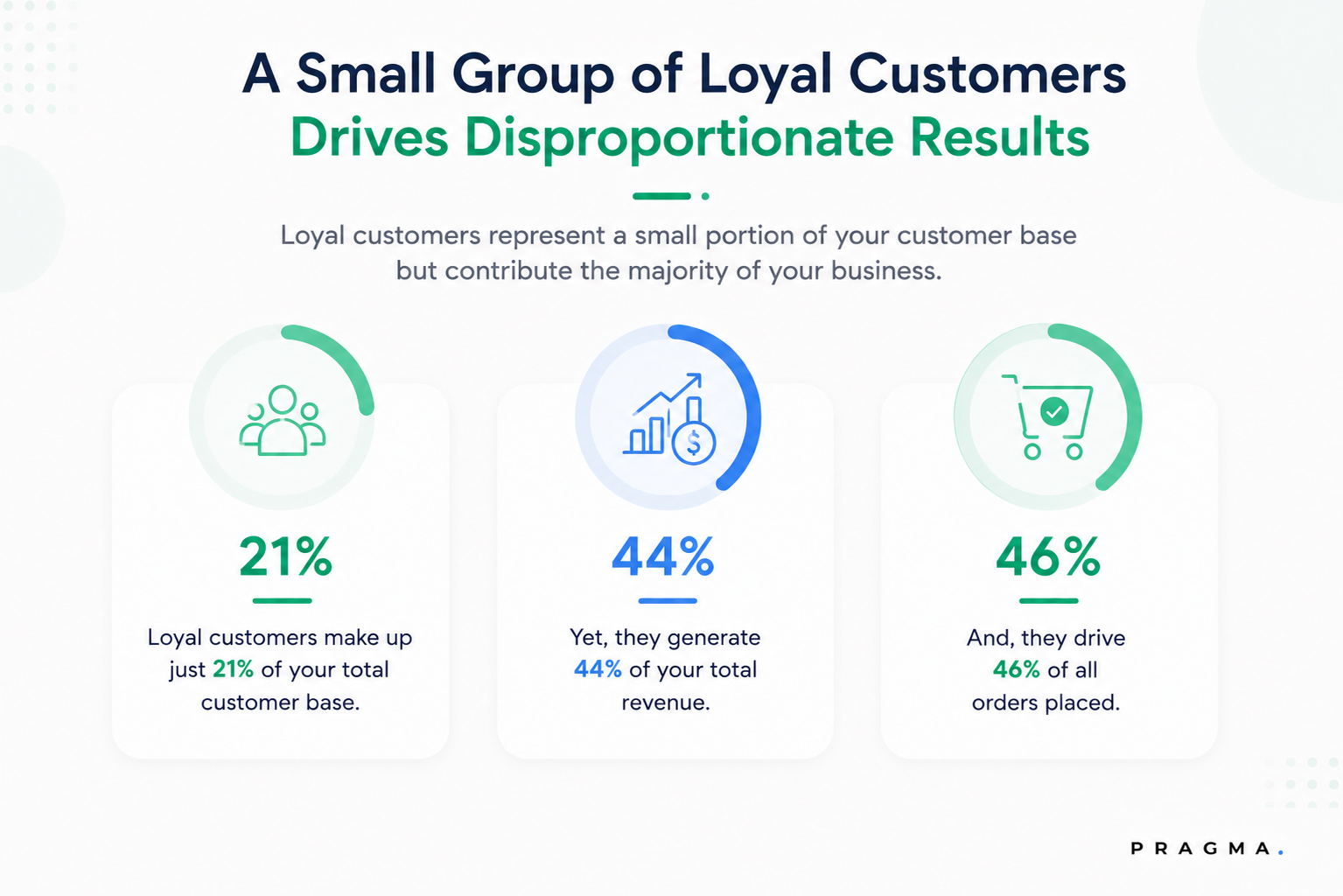
This means a relatively small group of repeat customers often drives a significant share of business growth.
At the same time, India's e-commerce industry continues to expand rapidly. A joint report from Flipkart and Bain & Company reported 25% e-commerce growth in Q1 2026 alone.
As order volumes grow, customer expectations grow as well.
Customers nowadays expect the following:
- Instant order confirmations
- Real-time shipment visibility
- Accurate delivery timelines
- Fast support
- Easy returns
- Personalised follow-ups
This entire experience is managed through the post-purchase funnel. To get a detailed understanding, let us move into "Post-Purchase Funnel: How E-commerce Brands Drive Repeat Revenue?"
What Is a Post-Purchase Funnel?
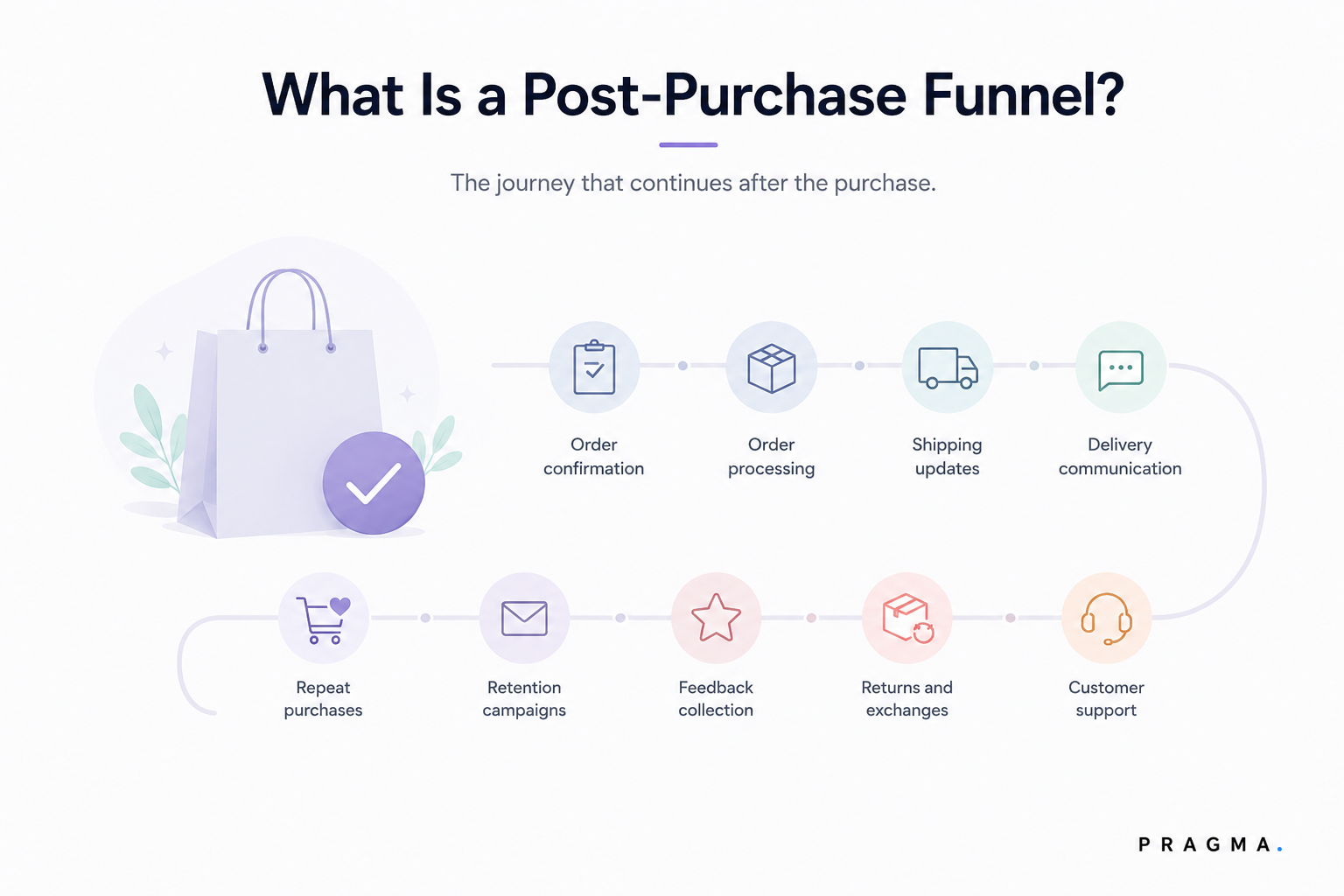
A post-purchase funnel is the customer journey that begins after an order is placed and continues until the customer purchases again.
Many e-commerce teams treat checkout as the final stage of the buying process.
Customers do not.
Customers evaluate the brand after payment. They judge how quickly you communicate. How accurately you deliver. How efficiently you handle problems. How easy you make returns.
The post-purchase funnel includes:
- Order confirmation
- Order processing
- Shipping updates
- Delivery communication
- Customer support
- Returns and exchanges
- Feedback collection
- Retention campaigns
- Repeat purchases
A poor delivery experience in any of the interactions can impact the successful acquisition campaign negatively.
Whereas a smooth post-purchase experience often turns a first-time buyer into a repeat customer.
This is why leading D2C brands invest in post-purchase technology instead of treating fulfilment as a backend operation.
Pragma D2C operating system automates these touchpoints across WhatsApp, email, and SMS. Over 1,500 D2C brands use Pragma to manage their post-purchase journey.
Why the Post-Purchase Funnel Matters for E-commerce?
Here are the following points that state why the post-purchase funnel is important for e-commerce brands:
Most Brands Focus Only on Acquisition
Customer acquisition costs have increased by 222% over the past eight years.
India's advertising market continues to expand as brands compete aggressively for customer attention.
As acquisition costs rise, retention becomes more important.
Yet many brands continue to focus almost entirely on:
- Traffic
- ROAS
- Conversion rates
- New customer acquisition
The result is predictable. Customers buy once and never return.
Many e-commerce operators discover too late that retention is the real growth challenge.
Repeat Customers Drive Higher Revenue
Data from Harvard Business Review states:
- Repeat customers spend 67% more than new customers
- Existing customers are 50% more likely to try new products
- Loyal customers refer others at rates 5x higher than average customers
- Top 10% of customers generate 50% of the total revenue
For D2C brands, this is a clear opportunity.
Instead of spending more to acquire new customers, brands can generate more revenue from existing customers.
The post-purchase funnel makes this possible.
Pragma's data from 1,500+ partner brands shows that those with optimised post-purchase funnels see 23% higher repeat purchase rates and reduce manual work by 75% while improving customer satisfaction scores by 40%.
Customer Experience Builds Loyalty
Research found that two-thirds of online shoppers experience anxiety after placing an order. This is because they are uncertain about delivery, tracking, and fulfilment updates.
Customers often ask these questions:
- Has my order shipped?
- When will it arrive?
- Is there a delay?
- How do I contact support?
Brands that answer these questions build trust, and those that don't create frustration among customers.
Pragma WhatsApp Business Suite helps brands automate these communications through WhatsApp.
Reduces Return and RTO Rates
A failed delivery increases logistics costs, warehouse costs, customer service costs, and reverse logistics expenses.
Many RTOs occur because customers were not informed properly.
Common reasons include:
- Customer unavailable
- Wrong address
- Order rejection
- Delivery delays
- Communication gaps
Pragma RTO Suite helps brands reduce these failures through customer verification, NDR workflows, and delivery intervention processes.
Also, with last-mile communication, customers are flexible to reschedule their delivery time.
This, in turn, makes the RTO rates lower as the customer is already aware of the delivery of their order and will be available to take the same.
Post-Purchase Funnel Example
Let us see a post-purchase funnel example. A skincare brand receives a new order. The customer journey might look like this:
Order Confirmation
The customer receives a WhatsApp confirmation within seconds. Pragma WhatsApp Business Suite sends:
- Order details
- Payment confirmation
- Estimated delivery date
Order Processing & Updates
Inventory gets allocated.
The warehouse begins fulfilment. Pragma JMS triggers customer updates based on operational milestones.
Shipping & Tracking
The shipment moves through the courier network. Pragma ShipAxis provides shipment visibility and courier tracking intelligence.
Customers receive:
- Shipment created notifications
- Dispatch alerts
- In-transit updates
- Delay notifications
Post-Delivery Engagement
The order is delivered. The customer receives:
- Delivery confirmation
- Product usage guidance
- Support information
- Feedback requests
Pragma Omnichannel CRM centralises customer interactions across channels.
Retention & Repeat Purchase
After 25 days, the customer receives a replenishment reminder. After 45 days, they receive personalised product recommendations.
Pragma JMS automates these lifecycle journeys.
This is how an entire post-purchase funnel looks.
Key Touchpoints in the Post-Purchase Funnel
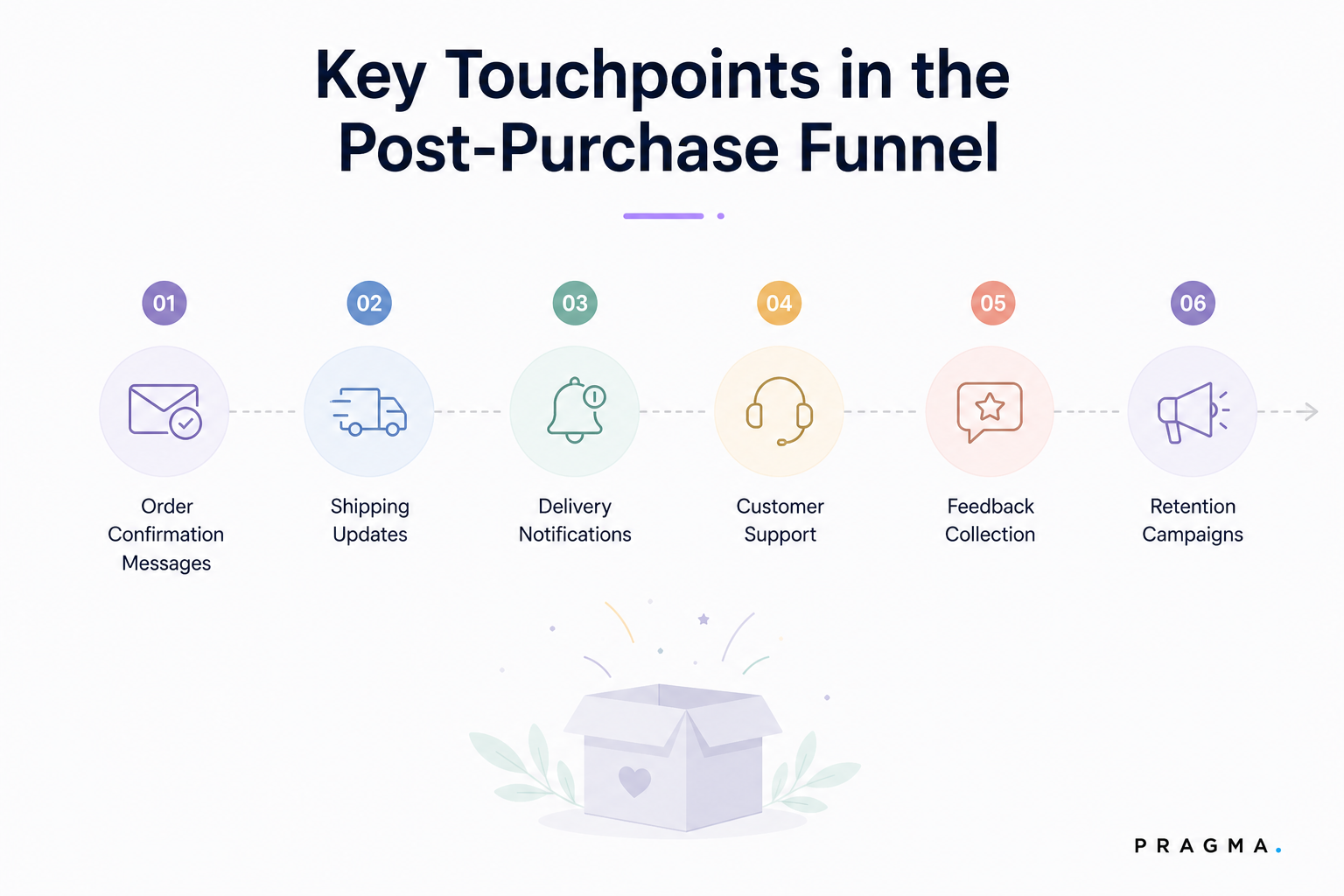
These are the main moments when your brand interacts with customers after an order is placed.:
Order Confirmation Messages
This is one of the first moments of the post-purchase funnel that occurs. E-commerce brands should send order confirmation messages within 5 minutes of order placement.
Confirmation messages should include:
- Order number
- Products purchased
- Payment details
- Delivery estimate
- Support options
Pragma WhatsApp Business Suite automates confirmations through the customer's preferred communication channel.
Shipping Updates
Shipping updates are one of the most important touchpoints.
Research shows 83% of customers want proactive shipping notifications.
Brands should send updates for these events:
- Order dispatched from the warehouse
- The delivery partner picked up the package
- In transit with location updates
- Out for delivery with a time window
- Delivery attempted with reason for failure
- Successfully delivered with confirmation
Delivery Notifications
Now comes the most important part that comes before actually delivering the product.
Every e-commerce brand should provide delivery notifications, which should be sent including the following moments:
- Out-for-delivery alerts
- Delivery confirmation
- Failed delivery alerts
- Rescheduling options
These notifications help to improve delivery success rates and lower the RTOs.
Customer Support
Support quality directly influences retention. Research shows customers expect responses within 2 hours during business hours.
Pragma Omnichannel CRM gives support teams access to customer history, shipment data, return status, and communication records from a single interface.
This reduces resolution times and improves customer satisfaction.
Feedback Collection
With customer feedback, brands can know about operational issues.
They should request reviews 3-7 days after delivery when the experience is fresh, but customers have had time to use the product.
Each e-commerce brand should collect reviews about:
- Product quality
- Delivery experience
- Packaging
- Courier performance
- Return experience
Retention Campaigns
Retention campaigns help brands create repeat purchases.
Epsilon research shows 80% of customers are more likely to purchase when brands offer personalised experiences.
Brands should create these campaign types:
- Win-back campaigns for inactive customers
- Upsell campaigns for high-value customers
- Cross-sell campaigns based on purchase history
- Seasonal campaigns aligned with customer preferences
- Loyalty program communications
Best Strategies to Optimise Your Post-Purchase Funnel
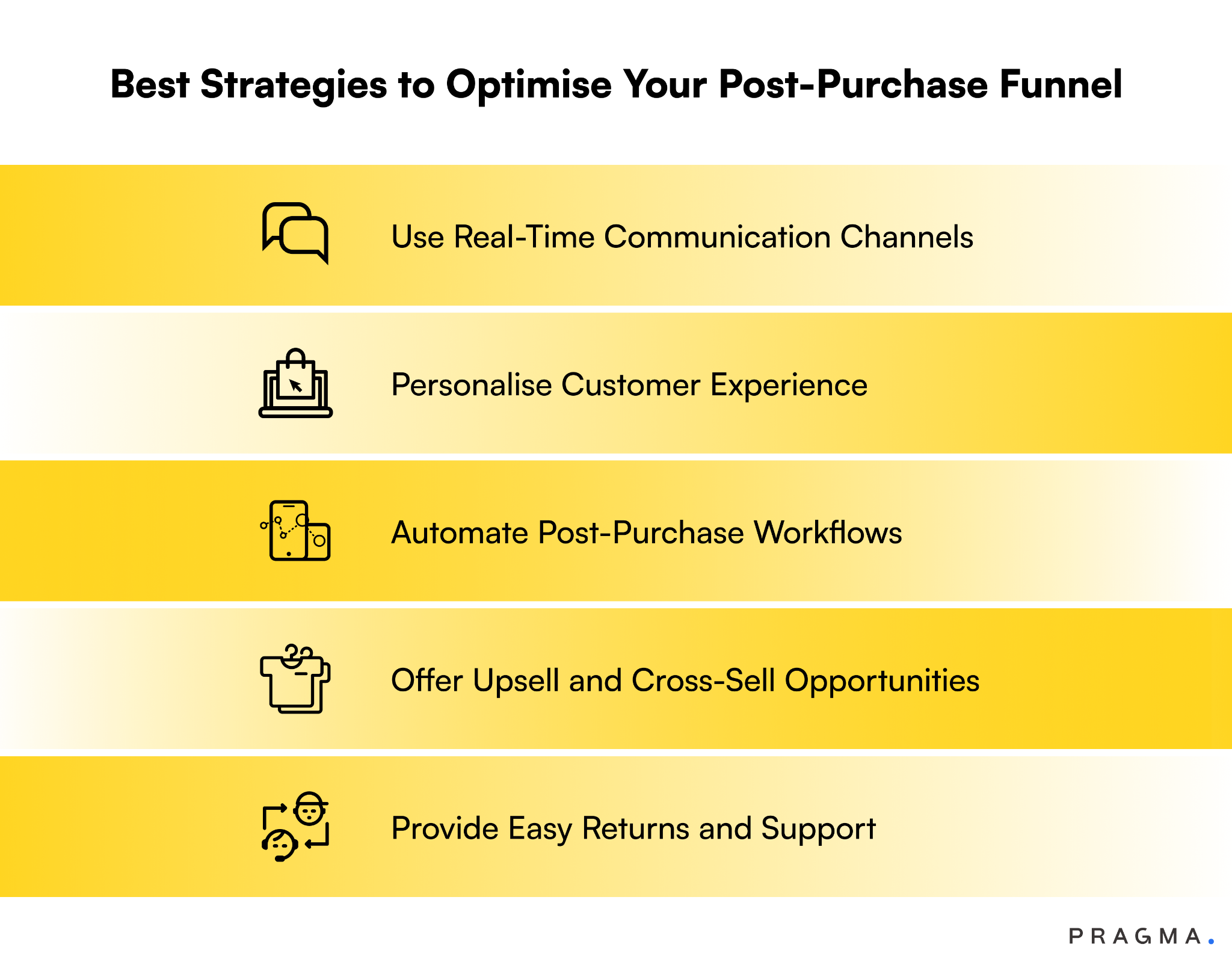
To optimise the post-purchase funnel, every brand can follow the given strategies:
Use Real-Time Communication Channels
WhatsApp has become one of the most important customer communication channels in e-commerce. It has 487 million users in India with 90% message open rates.
Brands using real-time communication reduce uncertainty and support tickets.
They should choose the communication channel based on their audience:
- WhatsApp: High engagement, conversational
- SMS: Immediate delivery, brief updates
- Email: Detailed information, rich content
- Push notifications: App users, instant alerts
This helps to integrate with all major communication channels.
Personalise Customer Experience
Personalised experiences drive 40% more revenue than generic approaches. D2C brands can use customer data to customise every interaction.
They can personalise these things:
- Product recommendations based on purchase history
- Communication timing based on engagement patterns
- Channel preferences from past interactions
- Content format based on demographics
- Offer types based on customer value
Pragma JMS enables brands to build personalised journeys triggered by customer actions.
Automate Post-Purchase Workflows
Automation reduces manual work by 75% while improving consistency and response times.
Research shows marketing automation increases sales productivity by 14.5%.
Brands can automate these workflows:
- Confirmations
- Tracking notifications
- NDR workflows
- Return approvals
- Feedback requests
- Retention campaigns
Offer Upsell and Cross-Sell Opportunities
Customers are more likely to purchase again from a brand they already trust.
Strategic upselling increases average order value by 10-30%. Brands can create upsell opportunities through:
- Complementary product recommendations
- Upgrade suggestions for premium versions
- Bundle offers with related items
- Seasonal or trending product suggestions
- Loyalty program exclusive offers
Provide Easy Returns and Support
Returns are part of the customer experience. Customers judge brands based on how they handle problems.
Research shows 92% of customers will buy again if returns are easy.
Pragma Return Management System helps brands simplify:
- Return requests
- Exchange requests
- Refund tracking
- Reverse logistics
This is how brands can get proper support in handling their returns and exchanges with a proper workflow.
How Post-Purchase Funnel Impacts Revenue?
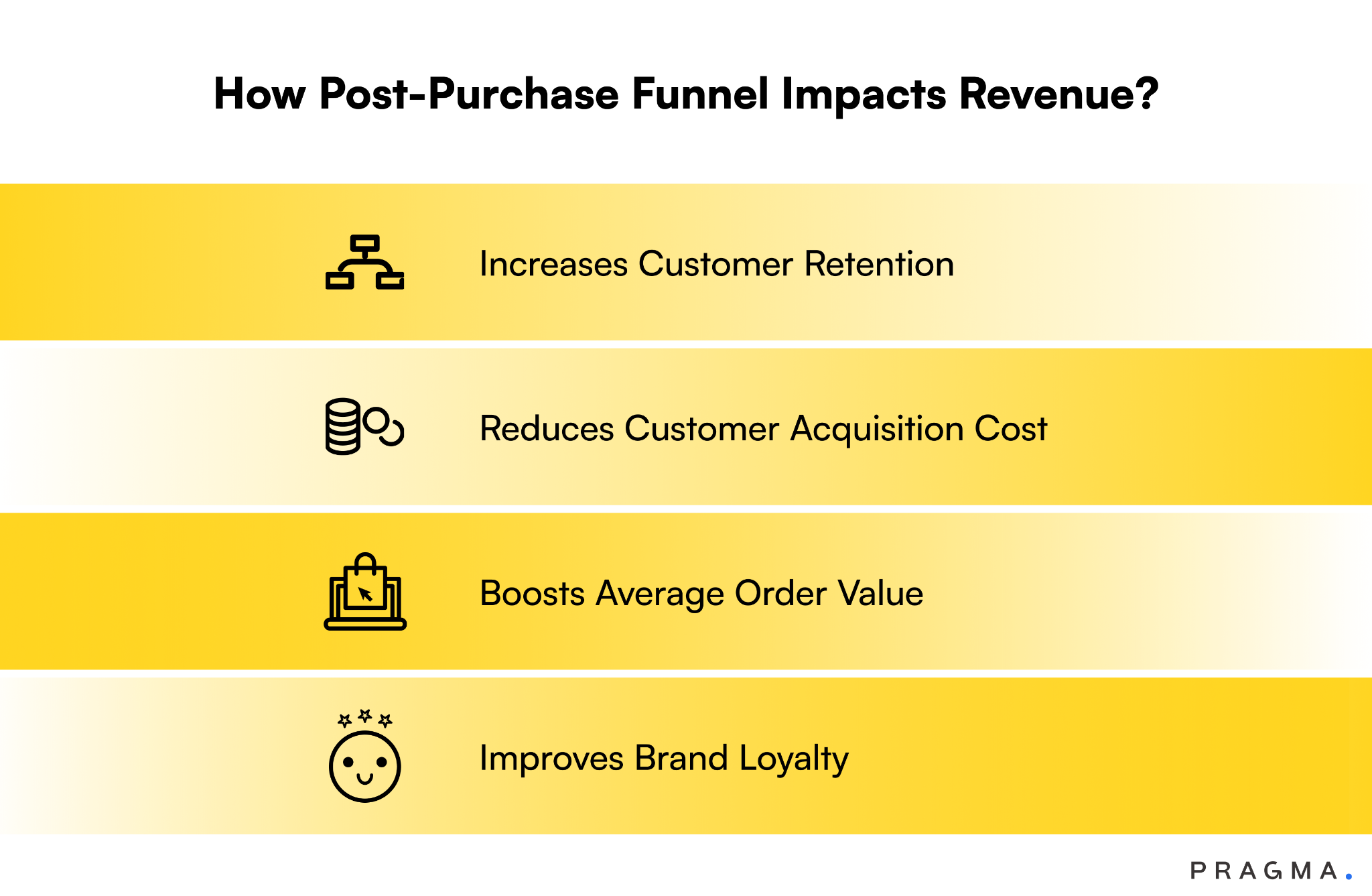
Post-purchase funnel impacts the business revenue in the following ways:
Increases Customer Retention
This is one of the obvious impacts of the post-purchase funnel. When customers receive consistent communication and support, they are retained with the brand.
Brands with optimised post-purchase funnels see 25% higher retention rates.
Thus, a strong post-purchase funnel creates positive experiences across multiple touchpoints.
Reduces Customer Acquisition Cost
Acquiring new customers costs 5-25x more than retaining existing ones.
If we talk about industry data, it shows:
- New customer acquisition: ₹500-2,000 per customer
- Existing customer retention: ₹50-200 per customer
- Repeat customer conversion: 60-70% vs 5-20% for new
These costs can harm the business's profitability. But with a proper post-purchase funnel, e-commerce brands can retain customers and generate future revenue without requiring additional acquisition spend.
Boosts Average Order Value
Effective cross-selling and upselling campaigns through post-purchase touchpoints increase AOV by 15-25%.
Customers who have already purchased from your brand are more likely to buy again.
This creates opportunities to recommend relevant products based on their previous purchases.
For example, a customer who buys a face serum might also need a moisturiser or sunscreen.
So with the right campaigns, brands can increase their order values.
Improves Brand Loyalty
Loyal customers spend 67% more than new customers. They also refer others, creating organic growth channels.
Every successful delivery, return, support interaction, and reorder strengthens customer relationships.
A positive post-purchase experience gives customers confidence to buy from you again instead of trying a competitor.
Post-Purchase Funnel for Indian E-commerce
Indian e-commerce brands face unique challenges such as COD orders, high RTO rates, and customer communication expectations.
A strong post-purchase funnel helps brands manage these challenges while improving customer experience and retention.
Here is how the post-purchase funnel will look for Indian e-commerce brands:
COD Orders Need Confirmation
COD orders in India account for 60% of e-commerce transactions. And these cash-on-delivery orders get 25% higher RTOs.
Therefore, the post-purchase funnel in the Indian e-commerce market should be more in favour of tackling and reducing this situation.
For this, e-commerce brands should adopt these practices:
- Call within 2 hours of order placement
- Verify delivery address and phone number
- Confirm customer availability for delivery
- Explain the return policy and charges
In order to reduce RTOs, Pragma RTO Suite checks that all the placed orders are cross-referenced with other e-commerce sites to check the users for past RTO history, order cancellations and other fraudulent behaviour.
Also, to reduce COD-based RTOs, with a C2P strategy (cash to prepaid), it enables e-commerce brands to increase prepaid orders by 25to 35%.
Delivery Communication Is Critical
India faces a lot of delivery challenges, including the following:
- Multiple delivery attempts required
- Address verification issues
- Customer availability problems
- Last-mile connectivity in smaller cities
And to reduce failures in delivery, e-commerce brands must adopt such practices and tools that handle these issues well.
For this, NDR management is done through Pragma RTO Suite, which aids in last-mile and last-minute communication with your customers to give them the flexibility to adjust the time of their order delivery.
WhatsApp Is the Primary Channel
WhatsApp reaches 487 million Indians with 90% message open rates versus 20% for email.
With such a huge customer base, it is now the most common channel used by e-commerce brands to use WhatsApp for:
- Order confirmations
- Tracking updates
- Support
- Returns
- Feedback collection
And Pragma WhatsApp Business Suite supports these workflows at scale.
High Return Rates Require Better Handling
Fashion and lifestyle categories see 30-40% return rates in India.
Common reasons behind returns are:
- Size and fit issues
- Product quality below expectations
- Damage during shipping
- Wrong item delivered
- The customer changed their mind
And these are inevitable. The only solution is managing them efficiently. Pragma Return Management System helps brands create a structured return experience with complete visibility for both customers and operations teams.
What is the Future of Post-Purchase Funnels?
The future of post-purchase experiences will focus on:
- AI-driven customer journeys
- Predictive retention campaigns
- Automated support
- Intelligent returns
- Real-time shipment visibility
- Revenue intelligence
Brands will increasingly use customer data to personalise interaction after checkout. AI will handle 80% of customer interactions.
Nielsen research shows 73% of global consumers would change consumption habits to reduce environmental impact.
Sustainable post-purchase practices include:
- Carbon-neutral shipping options
- Eco-friendly packaging materials
- Product lifecycle and disposal information
- Repair and refurbishment services
- Circular economy initiatives
So, this is how the future of post-purchase funnels will look.
Final Thoughts
So, to conclude here, we will say that the post-purchase funnel is now not an optional task.
E-commerce brands that want to retain their customers will have to follow proper post-purchase funnel practices.
Every order confirmation, shipment update, delivery notification, return request, and retention campaign influences whether customers purchase again.
Pragma helps over 1,500 D2C brands optimise their post-purchase funnels.
The platform automates communications, reduces manual work, and improves customer satisfaction.
Brands using Pragma see 23% higher repeat purchase rates and 60% lower RTO rates.

FAQs (Frequently Asked Questions On Post-Purchase Funnel: How E-commerce Brands Drive Repeat Revenue?)
1. What is a post-purchase funnel in eCommerce?
A post-purchase funnel is the sequence of customer interactions that take place after an order is placed, designed to improve customer satisfaction, increase retention, and drive repeat purchases.
2. Why is the post-purchase funnel important for eCommerce brands?
The post-purchase funnel is important because acquiring new customers is often more expensive than retaining existing ones. A strong post-purchase strategy helps increase customer lifetime value (LTV), loyalty, and repeat revenue.
3. What are the key stages of a post-purchase funnel?
The key stages typically include order confirmation, fulfilment updates, delivery experience, product onboarding, customer feedback, retention campaigns, and repeat purchase or reactivation efforts.
4. How does a post-purchase funnel increase repeat purchases?
A post-purchase funnel increases repeat purchases by keeping customers engaged through timely communication, personalised recommendations, loyalty initiatives, replenishment reminders, and targeted retention campaigns.
5. What role does customer communication play in the post-purchase funnel?
Customer communication helps build trust, reduce anxiety after purchase, improve customer experience, and create opportunities for upselling, cross-selling, and repeat purchases.
6. How does WhatsApp improve the post-purchase customer journey?
WhatsApp improves the post-purchase journey through real-time order updates, delivery notifications, feedback collection, personalised engagement, and automated retention campaigns.
7. What metrics should eCommerce brands track in a post-purchase funnel?
Key metrics include repeat purchase rate, customer lifetime value (LTV), retention rate, customer satisfaction score (CSAT), return rate, refund rate, and engagement rates across communication channels.
8. How can eCommerce brands optimise their post-purchase funnel?
Brands can optimise their post-purchase funnel by automating customer journeys, personalising communication, improving delivery visibility, simplifying returns, and creating structured retention programmes.
9. What tools help manage post-purchase funnels in eCommerce?
Tools include CRM platforms, customer journey orchestration systems, WhatsApp automation platforms, returns management systems, loyalty platforms, and analytics tools.
10. Why is the post-purchase funnel critical for D2C brands in India?
The post-purchase funnel is critical because it helps D2C brands improve retention, reduce dependence on paid acquisition, maximise customer lifetime value, and build long-term customer relationships
Talk to our experts for a customised solution that can maximise your sales funnel
Book a demo.webp)
.webp)

.png)