

The Indian D2C e-commerce market is growing at a rapid pace. According to Bain & Company and Flipkart's How India Shops Online report, India's e-retail market reached around $850 billion in 2025 and is expected to grow significantly over the next few years.
There are 250 million online shoppers in India. These are the potential customers for every brand.
Some customers see the products on Instagram, compare their prices on Amazon, and later on buy from the website. And for queries, they reach the brand on WhatsApp.
The important thing is that every customer expects the same experience at every step.
If a brand cannot connect all of these touchpoints into one system, they lose orders. Not just orders at the end, they lose their customers and ultimately the revenues.
That is where omnichannel management plays a crucial role.
Before you build a retention strategy, every business needs to understand what omnichannel management is and why every D2C brand needs it today.
What Is Omnichannel Management?
Are you looking for what omnichannel management is in simple terms? Let us answer you!

Omnichannel management is the process of connecting all sales channels, customer touchpoints, inventory systems and communication channels into one connected workflow.
It covers the brand's website, mobile app, WhatsApp, email, social media, physical stores, and third-party marketplaces.
For D2C brands, this means that their inventory data, order status, customer history, and support conversations are all synced in real time.
The objective of omnichannel management is simple!
Customers should get a consistent experience regardless of where they shop.
This is where modern omnichannel CRM systems, such as Pragma Omnichannel CRM, are designed to help teams manage multiple channels in one place.
It delivers a single dashboard to manage WhatsApp, Facebook Messenger, Instagram, email, and VoIP without switching between tools or losing customer context.
How Omnichannel Management Works?
Once you understand what omnichannel management is, the next step is understanding how it works.
Omnichannel management connects different business tools and customer touchpoints.
These often include:
- E-commerce website
- Mobile app
- Online marketplaces
- Retail stores
- WhatsApp Business
- CRM software
- Order management systems
- Warehouse systems
- Courier partners
- Return management platforms
When a customer places an order, inventory updates across all channels.
Delivery updates, customer support conversations, exchanges, and refunds stay connected throughout the journey.
Pragma Omnichannel CRM connects customer messages with order and return systems, so support teams can see order status, delivery updates, and return requests while replying.
Thus, omnichannel management reduces confusion for both customers and internal teams.
Omnichannel vs Multichannel: What's the Difference?
When D2C brands first research what omnichannel management is, they often confuse it with multichannel. The two are very different in how they operate and what they deliver.
The following table provides a clear understanding of omnichannel vs multichannel:

Why Omnichannel Management Matters for E-commerce in India?
India's D2C sector has thousands of active brands across fashion, beauty, food, and electronics.
But in the Indian market, customer acquisition costs keep rising. That is why brands now focus more on retention.
Most D2C brands lose revenue not during acquisition, but after checkout due to weak order visibility and delayed communication. Pragma closes this gap by keeping order, support, and delivery data connected in real time.
Studies also show that brands with a strong omnichannel setup retain 89% of customers. Weak setups retain around 33%.
Here is why understanding what omnichannel management is, and acting on it, is critical for Indian D2C brands right now:
Customers do not stick to one platform. They switch between Instagram, Amazon, websites, and WhatsApp before buying.
Over 60% of customers expect an immediate response to their queries.
Research from PwC found that consumers increasingly expect convenience and connected shopping experiences across online and offline channels.
Without connected systems, brands face:
- Inventory mismatches
- Order delays
- Duplicate customer queries
- Slow return processing
- Poor customer experience
Omnichannel management helps remove these issues by connecting every stage of the customer journey.
Also, the RTO rates in India reach 40% in the fashion category. The main reason is poor post-order communication, which can be easily solved with omnichannel management.
Features like behavioural analysis, screening of customer information, cross-checking of orders placed with other e-commerce sites, and automated order verification can help to identify & flag risky orders in real-time. This is what Pragma RTO Suite offers.
Key Components of Omnichannel Management

Have a look at the following features that comprise omnichannel management:
Unified Inventory & Order Management
Your inventory data must be accurate and visible across every sales channel in real time.
When inventory data differs across channels, brands risk overselling products and cancelling orders.
A unified inventory and order management process helps brands:
- Maintain accurate stock levels
- Reduce order cancellations
- Improve fulfillment planning
- Avoid overselling
Customers receive a better experience because products shown as available are genuinely in stock.
Consistent Customer Experience Across Channels
Customers expect the same experience regardless of where they interact with your brand.
Every touchpoint should feel like the same brand. The following areas should provide consistent experiences to customers:
- Product information
- Pricing
- Offers and discounts
- Return policies
- Customer support
- Delivery commitments
This way, it helps build trust and encourages repeat purchases.
Real-Time Data Synchronisation
When data updates instantly across systems, teams work with accurate information.
This includes:
- Inventory updates
- Order status changes
- Delivery milestones
- Return requests
- Refund status
Real-time data sync means your CRM, OMS, inventory system, and communication tools all update at the same time.
Pragma Omnichannel CRM enables this across WhatsApp, Messenger, Instagram, email, and VoIP so your team always operates on live data.
Seamless Delivery & Returns Management
Delivery and returns play a major role in customer satisfaction.
Today, customers expect:
- Easy order tracking
- Fast exchange approvals
- Convenient return requests
- Timely refunds
Return management systems (RMS), such as Pragma RMS, help centralise return requests, exchanges, refunds, and tracking into a single dashboard.
Customers can submit return requests through a self-serve returns portal, while brands can automate approval rules and track return reasons.
This reduces manual work for support teams and improves the post-purchase experience.
CRM & Personalisation
Customer data from multiple channels should be available in one place. CRM stores purchase history, preferred communication channels, browsing behaviour, and past support conversations.
This helps brands understand:
- Purchase history
- Customer preferences
- Support interactions
- Return behaviour
Brands can then create more relevant campaigns and customer experiences.
Tech Integrations (POS, OMS, WMS, CRM, WhatsApp, etc.)
A complete omnichannel system connects your entire tech stack, including:
- POS systems
- CRM software
- Warehouse management systems
- Order management platforms
- WhatsApp Business
- Customer support tools
- Shipping platforms
The smoother these systems work together, the better the customer experience.
Benefits of Omnichannel Management for E-commerce Brands
With the use of proper omnichannel management, brands can get these benefits:
- It delivers a consistent shopping experience across all customer touchpoints
- It improves customer satisfaction and encourages repeat purchases
- Keeps inventory updated across all sales channels, reducing stock-related issues
- Omnichannel management helps to reduce order cancellations caused by inaccurate inventory data
- It speeds up order processing and fulfilment
- It makes returns, exchanges, and refunds easier to manage
- It reduces customer support workload through better order visibility and communication
- Omnichannel gives brands a complete view of customer behaviour across channels
- Supports business growth across multiple sales channels without increasing operational complexity
Real-World Omnichannel Management Examples
Have a look at the following examples of real-world brands that make effective use of omnichannel management!
Myntra

Myntra connects its website, mobile app, live chat, and WhatsApp into one customer experience.
Customers browse online, get instant support via chat, track orders on the app, and receive personalised recommendations through WhatsApp.
Every channel feeds into the same customer profile, so the experience is consistent at every touchpoint.
Nykaa

Nykaa integrates its website, social media platforms, and offline stores into one connected system.
Customers explore products online, read reviews, get support via live chat, receive beauty tips on WhatsApp, and visit physical stores for in-person advice.
The brand experience is identical whether the customer is online or in-store.
How to Build an Effective Omnichannel Strategy?

Follow the given steps to make an effective omnichannel strategy:
Identify Your Customer Journey
Start by mapping every place your customers interact with your brand.
You need to understand:
- Where customers discover products
- Where purchases happen
- Where support requests originate
- Where returns occur
Unify All Customer Touchpoints
List every channel where customers interact with your brand and connect all of them to one central platform.
This includes the following:
- Website
- Mobile app
- Marketplaces
- Retail stores
- Customer support
Customers should move between channels without repeating information.
Centralise Orders, Inventory & Returns
A centralised process reduces confusion and manual effort. Set up a system that gives you a real-time inventory view across all channels.
Returns become especially difficult when brands operate across multiple channels.
Pragma RMS helps centralise:
- Return requests
- Exchange requests
- Refund processing
- Store credit issuance
- Return tracking
- Return analytics
Enable Consistent Communication Across WhatsApp, Email & App
Customers expect updates on their preferred communication channel. Build automated communication workflows for every stage of the customer journey.
Keep messaging consistent across:
- Order confirmations
- Shipping updates
- Delivery notifications
- Return status updates
- Refund updates
Pragma Omnichannel CRM lets D2C brands build unlimited chatbots across WhatsApp, Messenger, and Instagram for use cases like order status, payment issues, and return requests.
This automates up to 95% of incoming support queries and frees your team to handle complex issues.
Use Personalisation & Behavioural Data
Customer behaviour data helps brands understand what customers buy, return, and engage with.
This supports:
- Better recommendations
- More relevant campaigns
- Improved retention efforts
Collect and analyse customer behaviour data across all channels.
Set KPIs for Omnichannel Performance
Track the metrics that tell you whether your omnichannel system is working.
Key performance indicators for D2C brands include:
- Repeat purchase rate
- Customer lifetime value
- Return rate
- Delivery success rate
- Order fulfilment time
- Refund turnaround time
Review these numbers weekly. Identify where the experience breaks down and fix it with process changes or platform updates.
Tools and Technologies Used in Omnichannel Management
Omnichannel management uses simple connected tools that help D2C brands sell, track, deliver, and support customers across all channels.
Omnichannel CRM
This tool stores all customer details in one place. It keeps track of what customers buy, what they ask, and how they talk to your brand on WhatsApp, Instagram, Facebook, email, and calls.
Key Features of Pragma Omnichannel CRM
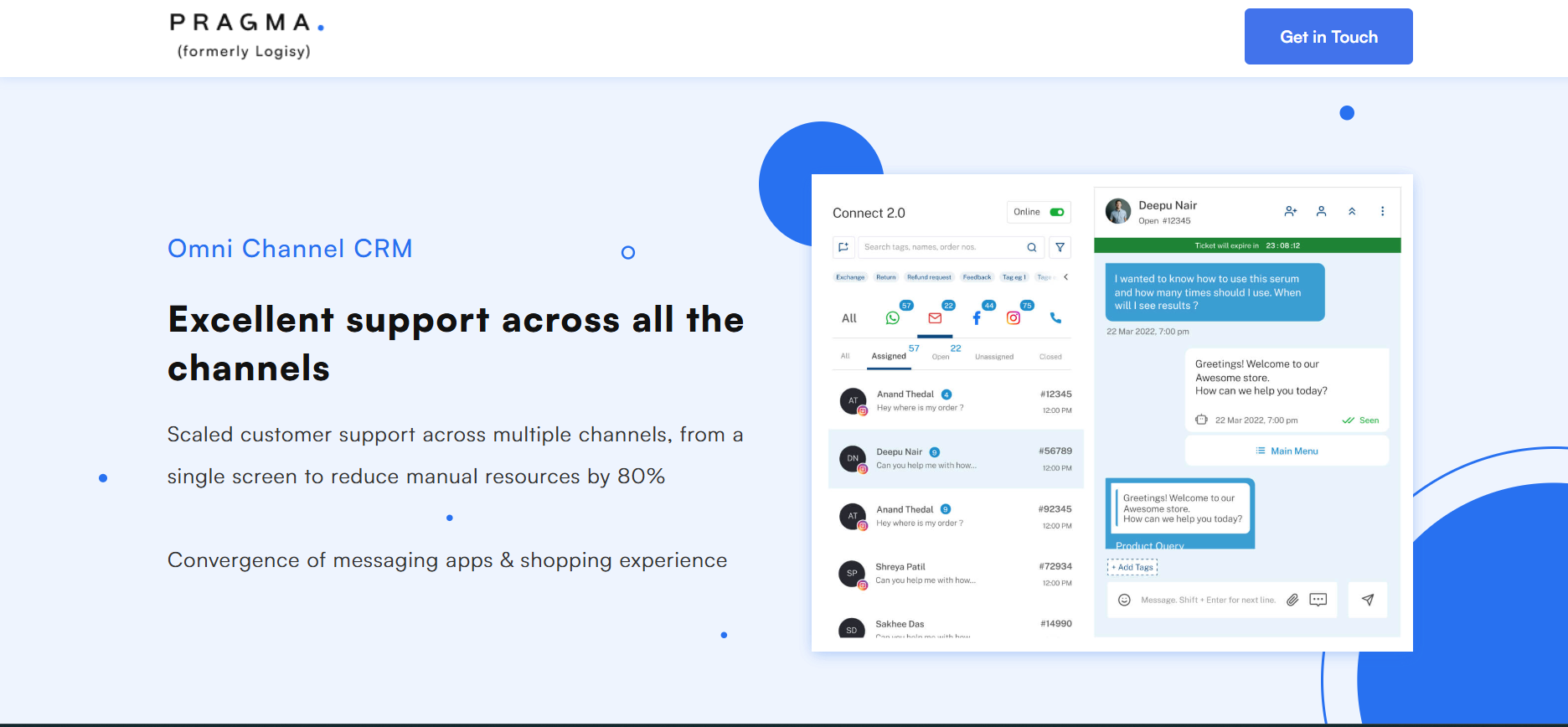
It helps teams:
- View full customer history, including orders, returns, and past chats
- Respond faster using saved replies and conversation context
- Assign chats to the right agent for faster resolution
- Link every conversation to a specific order
- Send automated updates for orders, delivery, and returns on WhatsApp
- Track customer journeys across all channels in one timeline
- Segment customers based on purchase behaviour
Order Management System
This system handles all orders from the website, marketplaces, and apps in one place.
It also sends each order to the nearest warehouse or store based on stock and delivery speed. This helps reduce delays and delivery costs.
Warehouse Management System
This tool tracks stock in all warehouses and stores.
It updates inventory in real time so teams always know what is available. This reduces problems like overselling and out-of-stock orders.
WhatsApp Business API
This helps brands talk to customers on WhatsApp in an automated way.
D2C brands use this to send order updates, delivery messages, return updates, and also run simple marketing messages without manual effort.
POS System
This is used in physical stores. When a product is sold in-store, the system updates online stock instantly. This keeps inventory accurate across both online and offline channels.
Analytics and Reporting Dashboard
This tool shows how the business is performing. It tracks sales, delivery speed, return rates, customer support performance, and channel performance.
This helps teams understand what is working and what needs improvement.
Challenges in Omnichannel Management
Here are some common challenges that e-commerce brands face nowadays while implementing omnichannel management:
- Customer data gets scattered in different places, like websites, marketplaces, WhatsApp, and stores, which makes it hard to see a complete customer view.
- Inventory updates do not always happen in real time across all channels, which leads to stockouts or overselling.
- Orders from different channels follow different processes, which slows down operations and creates confusion for teams.
- Returns and exchanges become difficult to manage because each platform follows a separate return flow.
- Customer support teams spend more time searching for order and delivery details across multiple systems.
- Communication with customers becomes inconsistent when WhatsApp, email, and other channels are not connected.
- Delivery tracking becomes harder when courier updates are not synced in one place.
- Return reasons are often not properly tracked, which makes it difficult to fix product or service issues.
- Managing inventory across warehouses and physical stores leads to mismatches in stock availability.
How Omnichannel Management Reduces RTO & Boosts Customer Experience?
RTO is a major loss area for D2C brands. Omnichannel setup reduces RTO by improving order visibility and customer communication.
Pragma RTO Suite helps brands reduce RTO through:
- NDR management
- Courier performance tracking
- Delivery issue monitoring
- High-risk PIN code identification
- RTO analytics
- Shipment tracking
Operations teams can identify delivery issues early and take action before orders return to the origin.
Customers receive better communication, while brands reduce logistics losses.
To Wrap it Up
Omnichannel management is the process of connecting customer touchpoints, sales channels, inventory, communication, deliveries, and returns into one coordinated system.
As e-commerce continues to grow in India, customers expect a smooth experience across every channel.
Brands that connect their operations are better positioned to improve fulfilment, reduce return-related issues, increase customer retention, and deliver a stronger post-purchase experience.
For D2C brands, omnichannel management is no longer a growth initiative. It is a requirement for managing modern e-commerce operations, and Pragma is always here to support D2C brands in this journey.

FAQs (Frequently Asked Questions On What Is Omnichannel Management? Meaning, Benefits & Examples)
1. What is omnichannel management?
Omnichannel management is the process of managing customer interactions, communications, sales, and support across multiple channels through a unified system that delivers a seamless and consistent customer experience.
2. What is an example of omnichannel management?
An example of omnichannel management is when a customer discovers a product on Instagram, receives updates on WhatsApp, completes the purchase on a website, and later contacts support without having to repeat their information across channels.
3. What is the difference between omnichannel and multichannel management?
Omnichannel management connects customer data, communications, and experiences across channels, while multichannel management operates channels independently. Omnichannel focuses on continuity, whereas multichannel focuses on channel presence.
4. What are the benefits of omnichannel management?
The main benefits of omnichannel management include improved customer experience, higher customer retention, better personalisation, increased conversion rates, stronger customer loyalty, and more efficient marketing and support operations.
5. What is omnichannel customer experience?
Omnichannel customer experience refers to a seamless and consistent experience across all customer touchpoints, ensuring interactions remain connected whether customers engage through websites, WhatsApp, email, social media, or support channels.
6. What is omnichannel customer service?
Omnichannel customer service enables support teams to manage customer conversations across multiple channels from a unified platform, providing faster resolutions and a more consistent support experience.
7. How do eCommerce brands implement an omnichannel strategy?
eCommerce brands implement an omnichannel strategy by centralising customer data, integrating communication channels, automating customer journeys, and creating consistent experiences across marketing, sales, and support touchpoints.
8. What is omnichannel management software?
Omnichannel management software helps businesses unify customer data, automate customer journeys, manage communications across channels, and provide a single view of customer interactions throughout the customer lifecycle.
9. How does omnichannel management improve customer retention?
Omnichannel management improves customer retention by delivering personalised experiences, reducing communication gaps, improving customer satisfaction, and enabling more relevant engagement throughout the customer journey.
10. Why is omnichannel management important for eCommerce businesses?
Omnichannel management is important because modern customers interact with brands across multiple channels before making purchasing decisions. A connected experience helps improve conversions, retention, customer satisfaction, and operational efficiency.
Talk to our experts for a customised solution that can maximise your sales funnel
Book a demo


.png)