

Refunds are no longer an operational afterthought in Indian e-commerce—they’re a trust currency.
The moment a customer requests a refund, the brand–customer relationship enters its most fragile phase.
Every hour feels longer, every delay feels personal, and every lack of clarity feels like dishonesty.
In a market powered by UPI, COD, BNPL, wallets and razor-thin patience, refund speed now shapes retention more than discounts or ads.
And while customers expect “money back instantly,” brands still navigate banking rails, courier dependencies, manual QC, and failed payout loops.
This gap between customer expectations and brand realities is the real battleground.
Let’s decode it in detail. About Refund Timelines: What Indian Customers Expect vs What Brands Deliver
Why Refund Timelines Matter More in India Than Other Markets
India Has the World’s Highest COD Usage
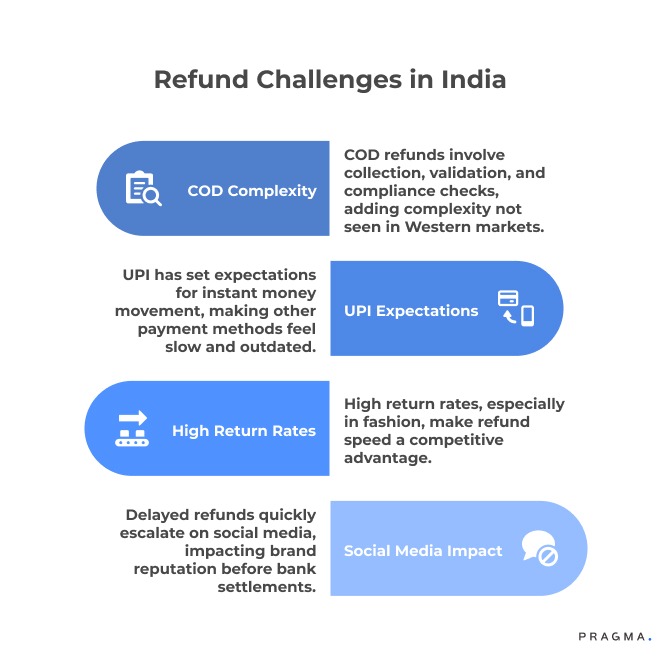
COD refunds require payout collection, validation, and compliance checks.
This adds complexity most Western markets don’t face.
And customers still expect the speed of a refund into their UPI, not a slow bank transfer.
UPI Has Reset Consumer Expectations Across All Payments
Once buyers get used to “instant money movement,” everything else feels broken.
Card refunds feel outdated.
BNPL reversals feel confusing.
And COD feels painfully slow.
This UPI mindset creates pressure across categories.
India’s High Return Rates Make Refunds a Daily Experience
Returns in fashion, beauty, and accessories often touch 15–25%.
In premium fashion, they can cross 30% during sales.
When refunds are frequent, speed becomes competitive advantage—not hygiene.
Pragma offers what many consider the best return management system for e-commerce in India, with automated workflows that handle exchanges, refunds, and reverse logistics at scale.
Social Media Escalations Move Faster Than Bank Settlements
A delayed refund today becomes an Instagram Story tomorrow.
Brands are judged publicly long before banks process reversals.
Refunds now power brand reputation, not just accounting.
The Psychology Behind Customer Expectations
“Instant In = Instant Out” Thinking
Customers assume refund speed equals payment speed.
If money leaves instantly, it should also return instantly.
But settlement rules differ massively across UPI, cards and BNPL.
Trust Drops the Moment Refund Is Requested
When a customer asks for a refund, their trust score drops automatically.
They now validate every brand message.
Delays feel like dishonesty—even when they’re normal banking timelines.
Customers Overestimate Refund Complexity When They Don’t Hear From You
Silence = suspicion.
Even if the refund is processing normally, customers assume something is wrong.
Updates matter more than speed.
Customers Don’t Read Return & Refund Policies
90% of Indian shoppers skip refund policy pages.
So the brand’s “refund in 3–7 days” note is irrelevant if customers never saw it.
They compare you to the last brand that refunded them quickly.
What Customers Expect Across Payment Methods
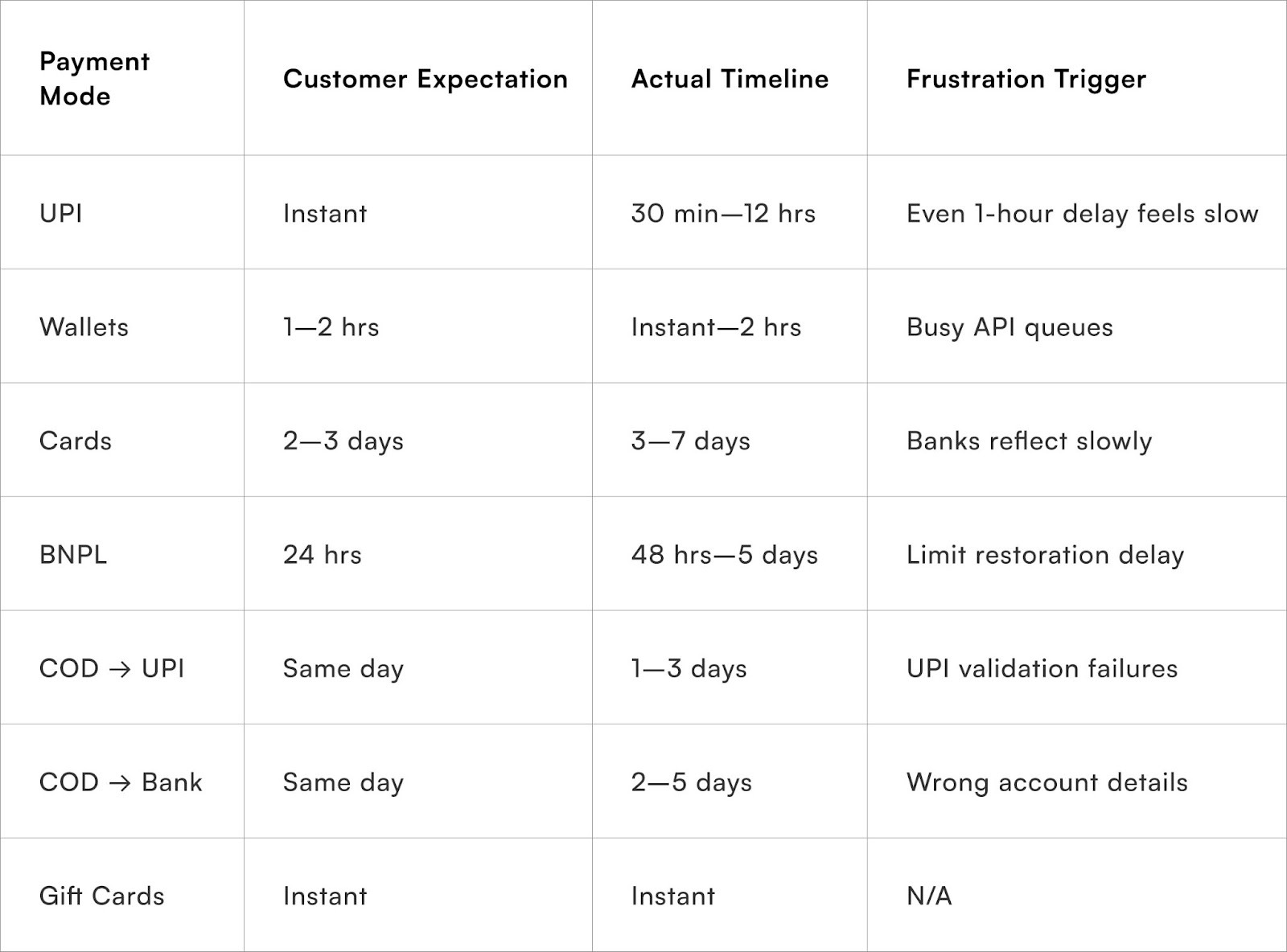
UPI → Expectation: Instant (Minutes)
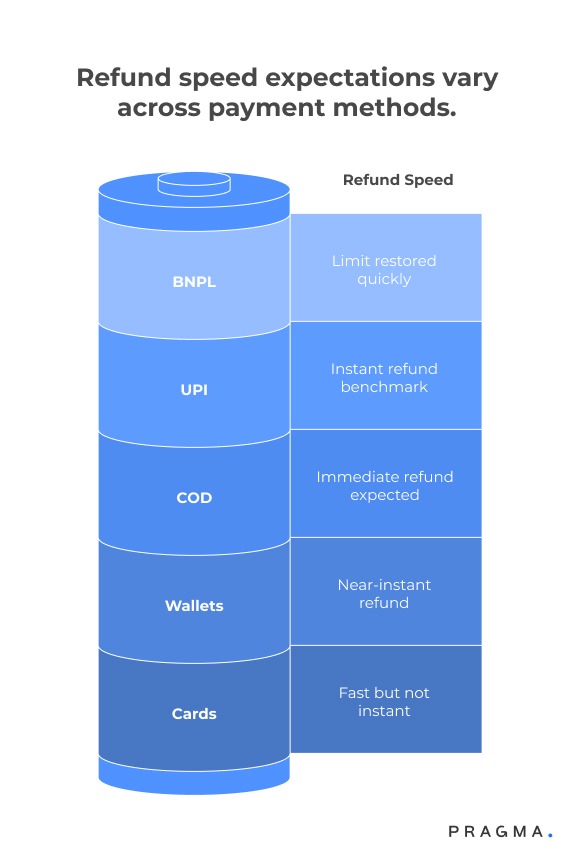
Customers think UPI refunds reflect instantly.
Even a 30–60 minute wait triggers questions.
UPI has created a psychological benchmark nothing else matches.
Wallets → Expectation: Near-Instant
If the brand stored the money in a wallet, customers assume it's automatic.
Anything beyond 1–2 hours feels strange.
Wallet refunds shape repeat buying behaviour.
Cards → Expectation: 48–72 Hours
Cards are perceived slower but not too slow.
Beyond three days, customers raise tickets.
The expectation is “fast but not instant.”
BNPL → Expectation: Limit Restored Quickly
Customers think BNPL reversals happen instantly.
They expect their credit limit to free up the same day.
Delayed limit restoration feels like money being “held hostage.”
COD → Expectation: Same-Day Money In Bank
Customers treat COD as a cash transaction.
So they expect immediate refunds once the courier picks up the return.
They do not understand bank verification or validation steps.
This expectation gap is the largest.
What Brands Actually Deliver (The Reality Today)
UPI → Reality: 30 Minutes–12 Hours
Failures sometimes force fallback to bank transfers.
Settlement batches create 2–4 hour gaps.
It’s fast, but not instant.
Wallets → Reality: Instant–2 Hours
Wallet refunds depend on API queue health.
Festive-season traffic increases wait time.
Most customers still accept this as fast.
Cards → Reality: 3–7 Business Days
Card reversals depend fully on issuing banks.
Brands initiate instantly—but banks show it late.
This is the most misunderstood refund layer in India.
BNPL → Reality: 48 Hours–5 Days
BNPL providers run batch processes for limit restoration.
Sometimes the refund is processed, but the limit updates later.
Customers think the brand is blocking money.
COD → Reality: 2–5 Days
Collecting details → validating them → initiating payout → settling funds.
One wrong digit in bank account details restarts the loop.
This makes COD the slowest and most complaint-heavy refund type.
Why Brands Struggle to Meet Expectations
Courier Dependency for Return Completion
Return pickup delays slow down the refund trigger.
If the courier fails to scan, refunds stall.
Customers blame the brand—not the courier.
Manual QC Delays
Warehouse QC adds 12–24 hours for categories like fashion and beauty.
If items need extra checks, refunds stretch further.
Automation is still rare in Indian warehouses.
Multiple Systems That Don’t Talk to Each Other
OMS, WMS, payment gateway, courier partner and CRM often operate in silos.
One missing API callback breaks the entire refund timeline.
Support teams become the human middleware.
Payout Failures on COD Refunds
Invalid UPI IDs, inactive bank accounts and incorrect IFSC codes cause failures.
Each failure adds a 24–48 hour delay.
Customers perceive this as negligence.
Lack of Proactive Communication
The biggest frustration driver is not timeline—it's uncertainty.
A single proactive WhatsApp update can prevent 80% refund tickets.
Most brands still send only one: “Refund initiated.”
Category-Wise Refund Behaviour Across Indian E-commerce
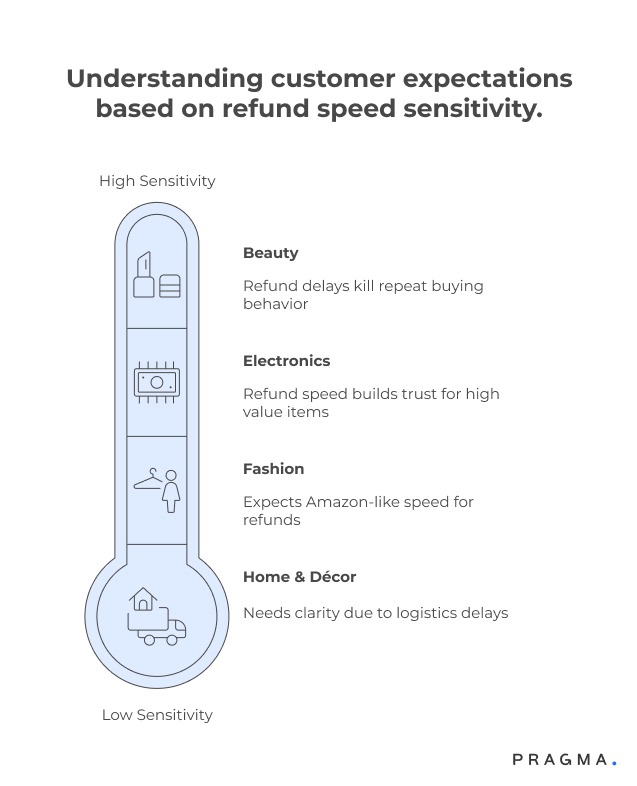
Fashion (High Returns, High COD)
Refunds are frequent.
Delays feel more painful.
Customers expect Amazon-like speed.
Beauty (Fast Consumption, Quick Repurchases)
Refund delays kill repeat buying.
Customers switch brands quickly.
Automation directly increases LTV.
Electronics (Low Returns, High Ticket Value)
Refund speed becomes a major trust factor.
High-value refunds create anxiety.
Status updates significantly reduce escalations.
Home & Décor (Heavy Items, Slow Courier Cycles)
Return pickups take longer.
Customers don’t understand logistics delays.
Brands need extra clarity to maintain trust.
Real India D2C Examples of Expectation Gaps (Expanded)
Example 1 — A Fashion Brand With 70% COD Orders
Customers expected next-day refunds after reverse pickup.
Courier delays created 2–3 day gaps.
By automating refund triggers based on courier scans, support tickets dropped 28%.
Example 2 — A Beauty Brand With Strong UPI Penetration
UPI refunds were fast, but card refunds slowed down NPS.
Customers blamed the brand for bank delays.
Sending a “card refunds may take up to 7 days” WhatsApp reduced escalations by 40%.
Example 3 — An Electronics Brand Using BNPL Heavily
BNPL reversals took 72 hours due to lender queues.
Customers assumed fraud, not delay.
An automated “your limit will be restored” update improved retention by 18%.
Example 4 — A Home Category Brand With RTO Issues
RTO refunds triggered only after warehouse receipt.
Longer transit times increased refund cycles.
Introducing “Your return has reached us” updates improved trust significantly.
Refund Timelines Across Payment Modes (Extended Table)
The Real Cost of Slow Refunds (Most Brands Ignore This)
Cost 1 — Increased Support Load
Refund-related tickets can cross 35–45% during peak season.
Each ticket costs ₹20–₹70 in manpower.
Slow refunds burn budgets quickly.
Cost 2 — Lost Repeat Purchases
Customers don’t reorder until the refund hits.
Delays freeze cash flow and kill LTV.
Fast refunds increase repeat purchase timelines by up to 20–25%.
Cost 3 — Public Complaints
Refund delays trigger maximum negative reviews.
A single viral tweet costs more brand trust
than a month of marketing budgets.
Cost 4 — Higher RTO & Cancellation Rates
When refunds are slow, customers fear reordering.
This increases COD cancellations and RTOs indirectly.
What Customers Actually Want (Not What Brands Assume)
Transparency Over Speed
Customers prefer clarity over unrealistic promises.
“Refund in 3–5 days” with updates beats vague messaging like “processing.”
Predictability Over Guesswork
A consistent timeline builds trust—even if it’s slow.
Inconsistent timelines destroy it—even if they’re fast.
Notifications Over Silence
WhatsApp updates reduce refund anxiety significantly.
Customers want visibility, not manual chasing.
Assurance That Their Money Is Safe
Refund anxiety comes from fear of loss, not impatience.
Reassuring customers at every stage creates loyalty.
How Top Indian D2C Brands Reduce Refund Timelines (Deep Dive)
Automation Triggered by Courier Scans
Refunds trigger automatically when:
- RTO is marked delivered
- reverse pickup is completed
- QC is passed via warehouse app
This removes manual bottlenecks.
UPI-First Refunds for COD Orders
Brands now push customers to select UPI over bank account.
UPI refunds have lower failure rates and faster completion.
Real-Time Payout Status Tracking
A dedicated page reduces refund anxiety dramatically.
Customers feel in control and stop raising tickets.
Auto-Retry for Failed Payouts
When payouts fail, systems auto-retry with corrected details.
This avoids week-long delays common in manual workflows.
Smart Routing Based on Fastest Rail
Example:
UPI available → instant refund
UPI invalid → bank transfer
Bank mismatch → WhatsApp link to revalidate
Smart routing eliminates human decision-making errors.
How to Communicate Refund Timelines Effectively
WhatsApp Should Be the Default Refund Channel
Customers trust WhatsApp more than email or SMS.
It feels personal, instant and trackable.
Use Simple Time Ranges
Examples:
“UPI refunds: 1–8 hours”
“Card refunds: 3–7 days”
“COD refunds: 2–4 days with UPI”
Avoid ambiguous words like “soon” or “processing.”
Set Expectations at the Right Touchpoints
Communicate timelines at:
- return initiation
- refund initiation
- payout completion
- limit restoration (BNPL)
This reduces panic.
Add a Webpage With Live Refund Tracking
Customers check this 2–3 times a day.
It dramatically reduces support load.
The Future of Refund Timelines in India (2026–2028)
Instant Refunds for All Prepaid Payments
Banks are moving toward real-time reversals.
Card refund delays will shrink significantly.
UPI-Based COD Refund Wallets
Customers may receive refunds instantly into a universal refund wallet linked to UPI.
This solves COD bottlenecks permanently.
AI-Powered Instant Pre-QC Refunds
Brands will refund instantly based on risk scoring.
QC will happen later for low-risk orders.
Cross-App Refund Visibility
UPI apps may soon show refund journeys similar to transaction timelines.
This will eliminate refund anxiety entirely.
To Wrap It Up
Refund speed now shapes trust more than any other post-purchase moment. Indian customers expect refunds in 24–72 hours, yet many brands still operate on week-long cycles that quietly hurt repeat purchases and prepaid adoption.
Brands that streamline approvals, automate courier validations and enable instant UPI payouts see faster resolutions and stronger customer confidence.
Refund timelines aren’t an ops metric anymore — they’re a trust metric.
Teams that fix them gain measurable lifts in retention and overall brand favourability.
For D2C brands seeking streamlined refund automation, Pragma’s Refunds Platform provides real-time courier hooks, automated validations and instant payouts that help brands cut refund timelines by up to 70%.

FAQs (Frequently Asked Questions On Refund Timelines: What Indian Customers Expect vs What Brands Deliver)
1. What is a refund timeline in e-commerce?
A refund timeline is the total time from when a customer requests a refund to when the money is credited back to their original payment method. It covers internal approval, payment gateway processing and bank settlement.
2. What is the average refund timeline in Indian e-commerce?
Most Indian brands take 5–12 days for prepaid refunds, while marketplaces typically complete refunds within 24–72 hours. COD refunds via UPI normally take 2–4 days.
3. Why do refund delays happen?
Refund delays occur due to slow QC at hubs, manual approval processes, dependence on courier updates, payment gateway settlement cycles and outdated OMS or ERP systems.
4. What refund timeline do Indian consumers now expect?
Indian customers increasingly expect refunds within 24–48 hours because platforms like Amazon, Flipkart, Meesho and Zepto have normalised instant or same-day refunds.
5. Why are fast refunds important for brand trust?
Fast refunds boost repeat purchase rates, improve NPS, increase prepaid usage and lower customer complaints. Slow refunds create distrust and discourage future orders.
6. Which payment modes have the longest refund timelines?
Credit cards and net banking usually take the longest, often 5–7 working days. UPI and wallet refunds are the fastest, generally within 48–72 hours.
7. Do refund timelines differ for COD versus prepaid orders?
Yes. Prepaid refunds flow back through the original payment instrument, while COD refunds require collecting UPI or bank details, adding extra steps and delay.
8. How can brands reduce refund timelines?
Brands can shorten timelines by automating RTO detection, digitizing QC, setting refund rules in OMS or ERP, partnering with faster-settlement gateways, enabling UPI-based COD refunds and sending proactive WhatsApp updates.
9. What is an ideal refund timeline for Indian D2C brands?
A competitive standard is 1–3 days. Anything slower than 5 days tends to increase complaints and reduce repeat purchase rates significantly.
10. Is automation necessary for faster refunds?
Yes. Manual refund workflows cannot keep up with modern customer expectations. Automation enables quicker approvals, fewer errors and real-time updates.
11. Do refund timelines impact prepaid conversions?
Yes. Faster refunds increase prepaid confidence and shift customers away from COD. Slow refunds push customers toward cash-on-delivery or cause future purchase drop-offs.
Talk to our experts for a customised solution that can maximise your sales funnel
Book a demo

.png)