

Running an e-commerce business today comes with a major operational challenge: returns.
Studies show that between 20% to 30% of all online purchases get returned. And, this problem has not stopped here!
In a country like India, where Cash-on-Delivery is still one of the most preferred payment methods (approximately 60% of the orders), a significant portion of COD orders are refused at the time of delivery, leading to Return-to-Origin (RTO).
The impact is substantial:
- COD orders have return rates of 25-30%
- Prepaid orders only have return rates of 5-10%
- Each returned package costs the business ₹150-300 in shipping alone
- Indian D2C brands lose crores every month due to returns.
But does this mean every time an e-commerce brand will face a loss?
No, because smart brands are finding ways to turn this problem into an opportunity. Instead of just giving money back (refunds), they're encouraging customers to make product exchanges to recover revenue and improve customer retention.
So, how should your brand approach this decision? Let's break down "Returns vs Exchanges: What E-commerce Brands Should Choose?"
What are Returns and Exchanges?
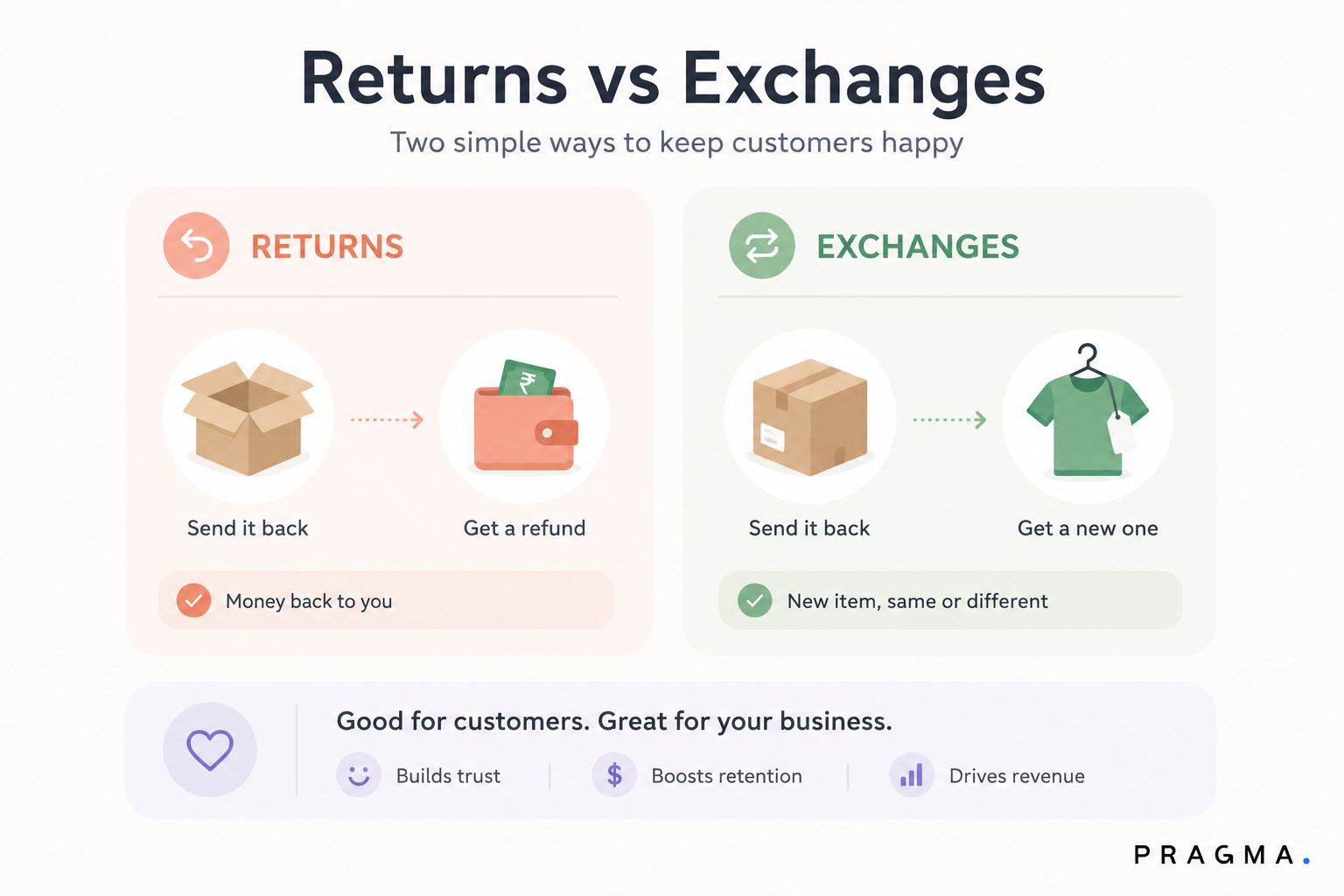
Before comparing the two, let us define what returns and exchanges mean in e-commerce.
Returns
Return generally refers to the term when a customer decides to give the product back to the brand and request a refund for it.
Returns typically happen due to the following reasons:
- Customers did not like the product
- There are size or fit issues
- The customer just changed their mind
- Product defects or quality issues
- Items not matching descriptions
- Wrong items shipped
Return is like undoing the whole purchase, which impacts the e-commerce businesses with lost revenue while also introducing additional operational costs.
According to Pragma's analysis of over 1700+ D2C brands, the total cost of processing a return typically ranges from 15-25% of the original order value, making it a significant margin drain.
Beyond the refund itself, returns also create multiple direct and indirect costs, including:
- Reverse logistics fees
- Payment processing fees, which are often non-refundable
- Customer service time and resources
- Quality inspection and repackaging costs
- Inventory write-downs for damaged returns
- Storage costs for returned merchandise
- Opportunity costs from lost sales
- Potential customer acquisition cost loss
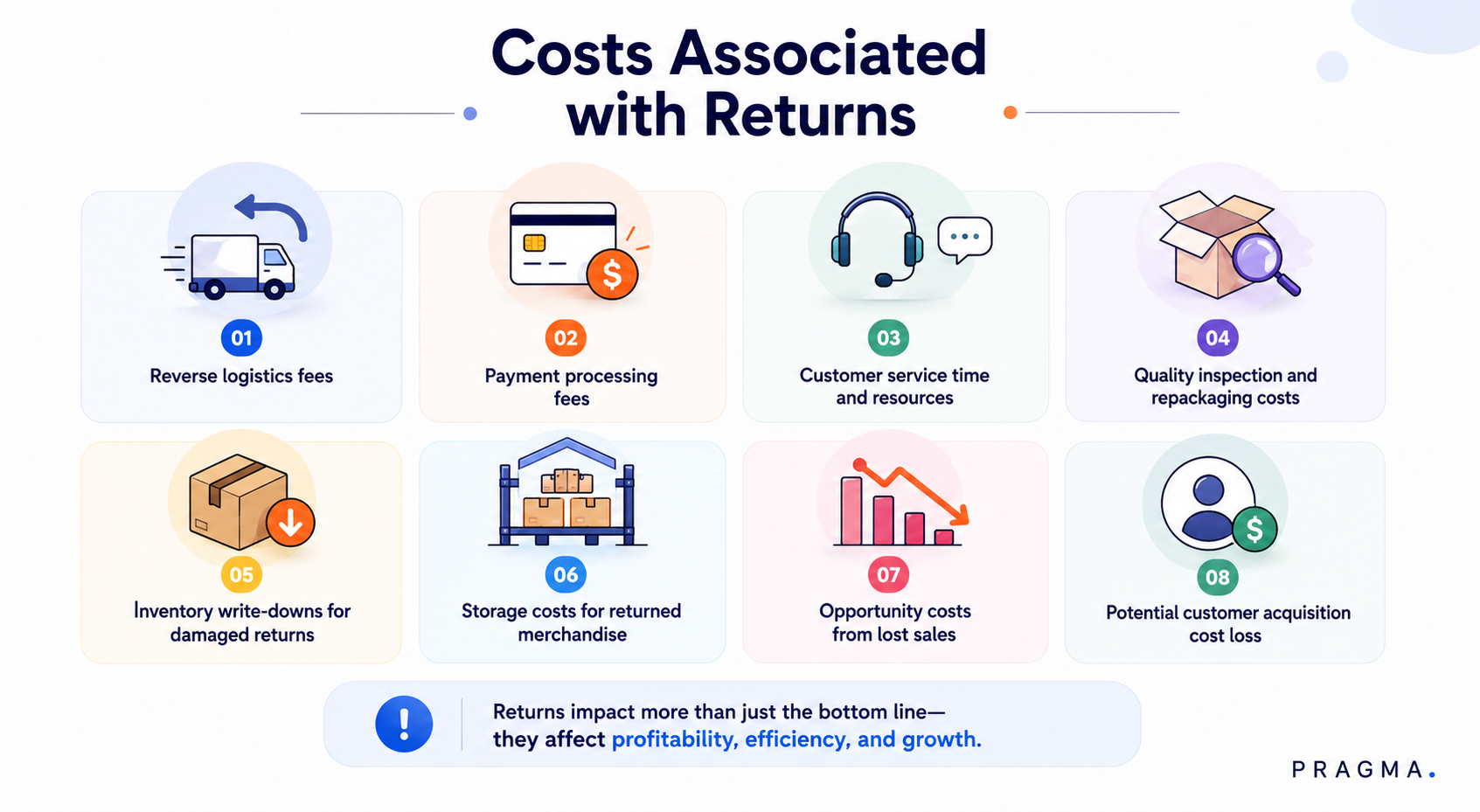
And when the return volumes increase, these costs compound and directly impact profitability.
Exchanges
Exchange is a bit different from returns. It also involves returning the products, but in lieu of that returned product, the customer gets a replacement item of equal or different value while addressing the customer's issues.
There are different types of exchanges:
- Direct Variant Exchanges: Same product in a different size, colour, or style
- Category Exchanges: Different products within the same category
- Upgrade Exchanges: Higher-value products with additional payment
- Downgrade Exchanges: Lower-value products with partial refund
From a business perspective, exchanges reduce revenue loss and, in many cases, increase order value. Instead of cancelling the transaction entirely, the brand retains the sale and continues the customer journey.
Research demonstrates that brands adopting an exchange-first approach can convert 30-40% of return requests into exchanges, with many customers actually increasing their order value during the exchange process.
To enable this, brands need systems that make exchanges faster and more attractive than refunds.
Key Differences Between Returns and Exchanges
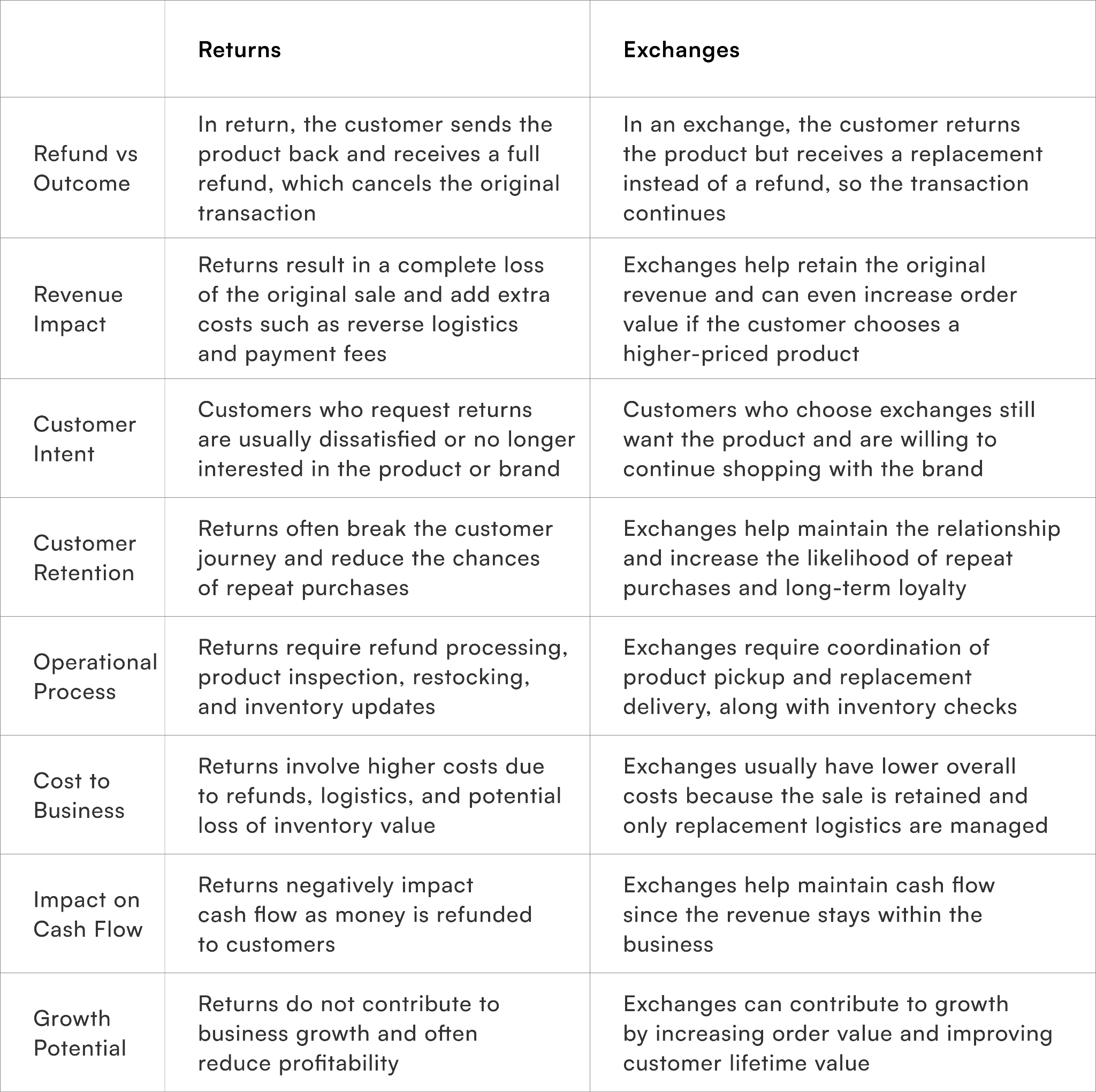
To understand which approach works better, it's important to compare returns and exchanges across key business parameters.
Refund vs Replacement
When it comes to refunds vs exchanges, the most obvious difference between them is what happens to your money.
In return, the transaction is reversed, and the full amount is refunded to the customer.
Whereas when they exchange a product, no sales amount gets lost, they are just giving the customer a different product.
This fundamental difference directly impacts revenue retention.
Revenue Impact
The revenue impact of refunds has a much deeper impact than exchanges. During refunds:
- Brands lose the original sales amount
- Pay extra costs for processing the return
- Pay double logistics fees (forward+reverse)
- Cash flow gets affected negatively
Whereas in the case of exchanges:
- They keep the original sale amount
- Revenues stay stable
- Processing costs are much lower.
- Sometimes customers even pay more for upgrades.
Customer Intent
The intent of the customer during returns vs exchanges is entirely different.
When customers ask for returns, they're usually unhappy with their purchase and might not want to shop with the brand again.
Customers who opt for exchanges, however, still show purchase intent. They are more likely to:
- Continue shopping
- Choose alternative products
- Become repeat customers
Study reveals that 67% of customers who exchange products make additional purchases within 90 days, compared to only 23% of customers who receive refunds.
Operational Complexity
Many business owners think exchanges are more complicated than returns, but that's not necessarily true when you have the right systems in place.
Returns involve:
- Refund processing via payment gateways
- Product inspection and restocking
- Inventory and accounting adjustments
Exchanges require:
- Coordinating reverse pickup and replacement delivery
- Checking the real-time availability of inventory
- Managing exchange workflows
While exchanges may seem more complex, modern return management systems simplify these processes through automation and can reduce manual processing by up to 80%, making them easier to manage at scale.
Why Returns and Exchanges Matter in E-commerce?
Exchanges and returns are both an integral part of a business, and understanding why they matter in e-commerce will help you understand things better, leading to informed decision-making.
Customer Trust and Experience
When people shop online, they can't touch or see the products; all the trust that builds up is through your return policy.
Studies show:
- 92% of customers are likely to repurchase if the returns process is easy
- 84% of customers do not return after a poor returns experience
Key factors that influence customer trust include:
- Clear and transparent return policies
- Easy process initiation
- Regular status updates and tracking
- Fair resolution timelines
- Responsive customer support
So, when a brand provides its customers with a seamless post-purchase experience, it directly impacts its relationships and revenues.
Impact on Profitability
The choice between returns and exchanges has a direct financial impact.
Returns impact profitability in three key ways:
- They eliminate the original revenue
- They add reverse logistics and processing costs
- They negatively affect cash flow and margins
Exchanges, on the other hand:
- Help retain revenue
- Reduce refund-related losses
- Often increase order value through upgrades
Analysis of Pragma's client data reveals that brands with optimised exchange policies maintain 20-30% higher profit margins on returned transactions compared to refund-only approaches.
Inventory Management
Returns and exchanges create different inventory challenges and opportunities that smart business owners can leverage.
When products are returned:
- They might be damaged during shipping or handling.
- You need to have someone check the quality before you can sell them again.
- Some items can't be sold at full price anymore because they might be slightly used or out of season.
- Returned products take up valuable warehouse space while you figure out what to do with them.
Exchanges are much cleaner from an inventory perspective.
- Keeping inventory in active circulation
- Improving inventory turnover
- Enabling the movement of slow-selling products through recommendations.
What are the Benefits of Returns for E-commerce Brands?
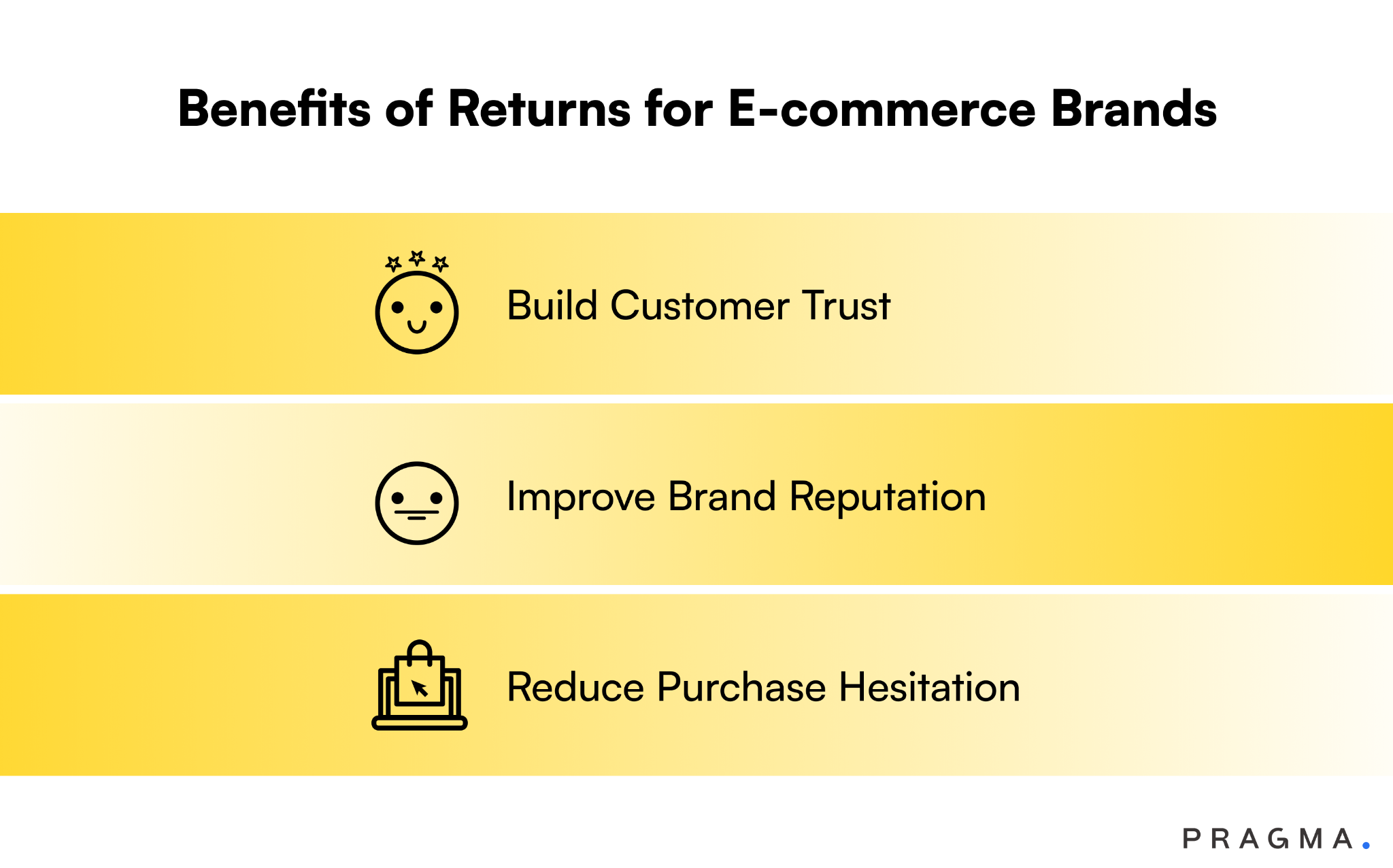
While returns are often seen as a cost, they also play a vital role in shaping customer perception and purchase behaviour.
Build Customer Trust
When a brand has a clear return policy, it builds up trust in the minds of customers, especially if they are trying a new brand.
Some fascinating stats show:
- Studies show that 92% of customers are more likely to shop again if the returns process is easy
- Around 67% of shoppers check return policies before making a purchase
This data shows that returns are not just a post-purchase function; they directly impact buying decisions.
It is obvious that when the customer knows that they can return the product without any difficulties, they are more confident in making a purchase.
Improve Brand Reputation
A customer does not judge the brand by just their product, but also by how well they are taken care of after the purchase.
96% of customers say they would shop again with a retailer that offers an easy and smooth returns experience, whereas if they had a negative experience, they will switch to competitors.
A well-managed return process can turn a potentially negative interaction into a positive brand moment.
When a brand offers its customers easy returns, without any complications, it makes a good impression.
Reduce Purchase Hesitation
Customers often hesitate to buy things online, and if it is a new brand, this hesitation is worse.
But with easy returns, they can make this hesitation less, as the customer knows if any issues occur, they will get the refund, or whatever the case may be, their issue will be solved.
Stats show that return-friendly policies can increase conversion rates by 10–20%, and customers are more likely to complete purchases when they know returns are easy.
Returns vs Exchanges: Which Is Better for E-commerce?
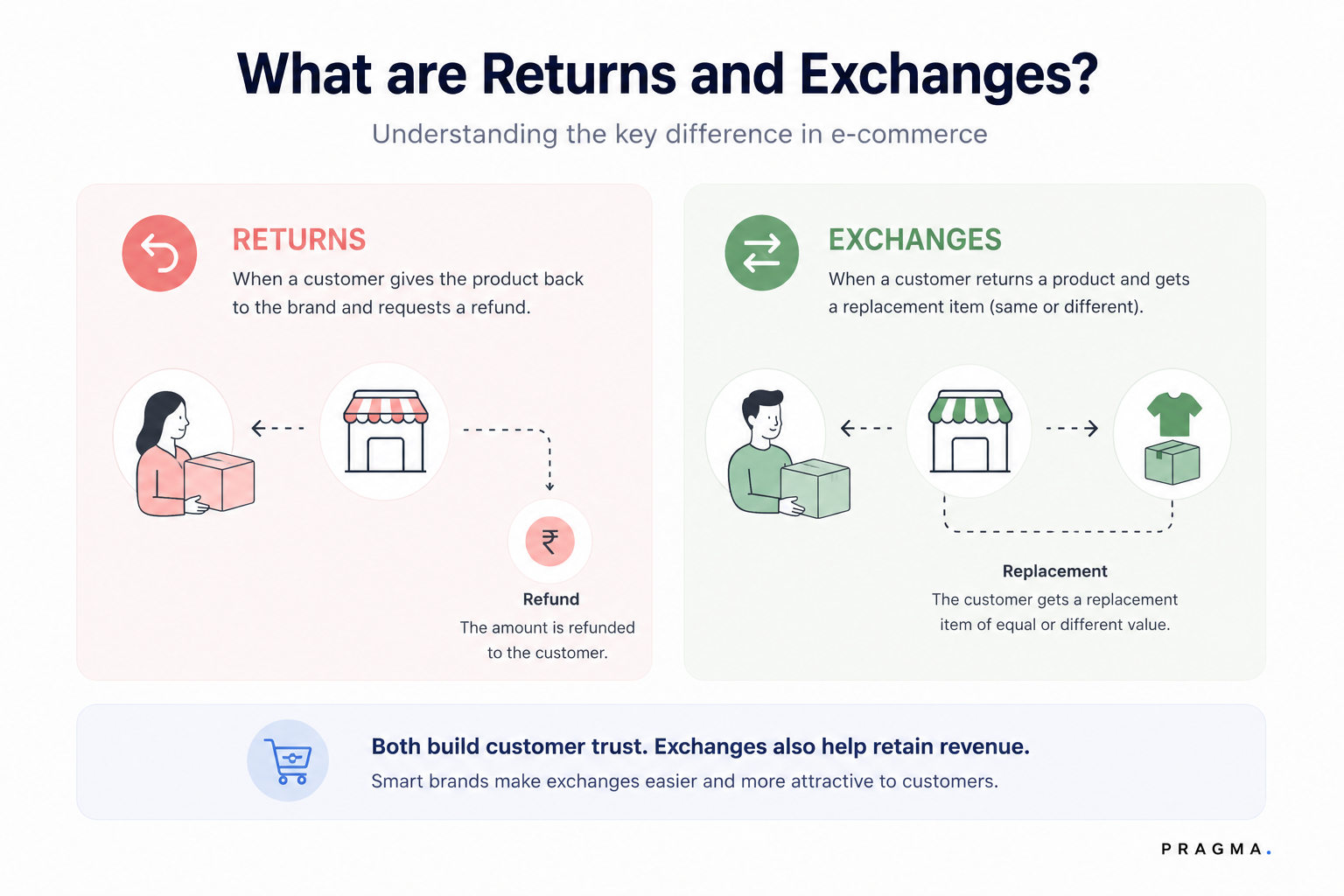
The decision between returns and exchanges depends on business goals, but when you look at the numbers, exchanges win nearly all the time.
Exchanges lead to:
- Improved long-term relationships with customers.
- Assist you in maintaining inventory in a better way.
- Reduces operational complexity related to processing the refunds and handling the returned goods.
However, this doesn't mean you should never offer returns. Certain circumstances demand refunds, and attempting to induce transactions when consumers actually desire money back will just result in dissatisfied customers and negative feedback.
Financial Performance Comparison
From a revenue perspective, exchanges significantly outperform returns.
- Brands that focus on exchanges first typically see 30-40% of their return requests converted to exchanges instead of refunds.
- This directly helps retain revenue that would otherwise be lost.
For example:
If a brand processes 100 returns per month and converts 30–40% into exchanges, it retains:
- ₹60,000–₹80,000 in revenue (at an average order value of ₹2,000)
Beyond retention, exchanges also create incremental revenue opportunities:
- Customers often upgrade to higher-value products
- Additional purchases are more likely during exchange flows
This occurs since they are already interested in your brand and window shopping for your products. They could find something they prefer more or opt to upgrade to a higher quality version.
Customer Satisfaction Metrics
Exchanges typically result in higher customer satisfaction compared to refunds.
By enabling them to get a better product by way of an exchange, you are not only solving their problem, but also retaining them as a customer.
Optimisation of the exchange policy provides the best results in terms of customer satisfaction.
- About 85% of customers are satisfied with exchange experiences compared to 65% for refunds.
- Exchange customers are 40% more likely to make repeat purchases.
- There are 60% fewer negative reviews related to returns when exchanges are handled well.
The reason is behavioural:
- Exchanges solve the customer's problem.
- Returns only close the transaction.
Operational Efficiency Gains
While exchanges may appear more complex, they become more efficient than returns when supported by the right systems.
However, this turns out to be the contrary when you have adequate management systems, key operational improvements include:
- Reduced customer service inquiry volume
- Improved inventory turnover rates
- Enhanced demand forecasting accuracy
- Streamlined logistics coordination
When Should E-commerce Brands Offer Returns vs Exchanges?
The decision between returns vs exchanges should not be random. It should be based on customer intent, product type, and business impact.
A well-defined strategy ensures you protect revenue without compromising customer experience.
When to Offer Returns?
Returns should be offered when the customer's primary intent is to exit the transaction or when the brand is at fault.
Offer returns in the following scenarios:
- If the product is damaged, defective, or not functioning as expected - return is accepted for QC
- When customers receive an incorrect item - verify via photos/videos, and confirm return
- If the product does not match the description, images, or promised features - clarify what is missing from the original offering to correct in the future
- If customers explicitly request refunds or show no interest in alternatives - try to retain, mainly if it is a first purchase
- In cases where exchange logistics are not cost-effective - if the product that is requested for exchange is not available near the pincode, or if the product requires special shipping circumstances due to weight, fragility and other aspects
- Products are not suitable for resale (e.g., hygiene-sensitive items) - in this case offer a refund, or send a replacement product without asking to return the product (if possible)
When to Offer Exchanges?
Exchanges should be prioritised when the customer still has purchase intent, and the issue can be resolved with an alternative product.
Offer exchanges in the following scenarios:
- If the customer has size or fit issues
- If the customer likes the product but needs a different version (colour, size, style) - in this case brands can choose to charge a delivery fee if mentioned in the exchange/return rules
- For customers acquired at a high cost, retaining the transaction through exchanges is more profitable than issuing refunds.
Exchanges can drive additional revenue when customers opt for higher-value products during the process.
The Best Practice is To Offer Both, But Guide the Customers Smartly!
High-performing e-commerce brands don't just "offer both", they guide customers toward exchanges where appropriate.
This can be done by:
- Showing exchange options before refund options
- Recommending relevant products during return initiation
- Highlighting faster resolution timelines for exchanges
Platforms like Pragma Return Management System (RMS) enable this by intelligently routing return requests and automating workflows, helping brands maximise revenue.
Returns vs Exchanges in India: Key Considerations
The returns vs exchanges decision becomes more nuanced in India due to unique market dynamics such as COD dominance, logistics complexity, and evolving customer expectations.
High COD Return Rates
Cash-on-Delivery (COD) continues to be a major driver of e-commerce in India, but it also contributes significantly to higher return and RTO rates.
- COD orders can see 25–30% return rates, compared to 5–10% for prepaid orders
- A large portion of these returns happens due to order refusal at delivery
In such cases, exchanges are often not feasible, making return prevention strategies more important than post-return optimisation.
Solutions like Pragma RTO Suite help reduce these losses through COD verification, order confirmation workflows, and proactive communication with customers before delivery.
Fashion and Size Exchanges
Categories like fashion, footwear, and lifestyle products dominate Indian e-commerce, and they naturally have higher return rates due to size and fit issues.
- Size-related returns account for a significant share of total returns in fashion
- However, these are also the most convertible into exchanges
This makes exchanges a critical revenue recovery lever in India.
With the right systems, brands can:
- Offer instant size or variant swaps
- Recommend better-fitting alternatives
- Reduce refund dependency
Customer Trust Expectations
Indian consumers are highly value-conscious and risk-sensitive, especially when shopping from new or D2C brands.
- Return policies are often a key decision factor before purchase
- Poor return experiences can quickly lead to negative reviews and low repeat rates
This makes a smooth and transparent return experience essential, not optional.
At the same time, guiding customers toward exchanges (instead of refunds) helps balance trust with profitability.
Logistics Cost Sensitivity
India's logistics ecosystem adds another layer of complexity to returns management.
- Reverse logistics can cost ₹50–200 per shipment
- Brands often incur double shipping costs (forward + reverse) on returns
- High return volumes directly impact margins, especially for low AOV products
Exchanges help reduce this burden by:
- Retaining revenue
- Minimising refund-related losses
- Improving inventory movement
Operationally, tools like Pragma ShipAxis help optimise logistics routing, reduce inefficiencies, and bring better control over reverse logistics costs.
How to Build an Exchange-Optimised Return Policy?
Your return policy should not just process refunds; it should actively drive exchanges, retain revenue, and improve customer experience.
Here's how commerce brands can design a policy that prioritises exchanges without hurting customer trust.
Offer Free Exchanges
Free exchanges reduce friction and make customers more likely to choose a replacement instead of a refund.
- Customers are more willing to opt for exchanges when there is no additional cost involved
- It positions exchanges as the faster and easier resolution option
By removing financial barriers, brands can naturally guide customers toward revenue-retaining outcomes.
Charge for Returns
While returns should remain available, introducing a small return fee can discourage unnecessary refunds.
- Even a nominal fee can reduce impulse returns and non-serious requests
- It nudges customers to consider exchanges as a better alternative
The key is balance; returns should not feel restrictive, but they should not be the easiest option either.
Allow Product-Level Exchanges
Customers are more likely to choose exchanges when they have flexibility.
Instead of limiting exchanges to the same product, allow:
- Size and variant changes
- Category-level exchanges
- Upgrades and downgrades
This increases the chances of retaining the transaction and even driving higher order value through upgrades.
Simplify the Exchange Process
A complicated process will push customers toward refunds, even if they prefer an exchange.
To improve adoption:
- Offer self-serve exchange flows
- Show real-time product availability
- Provide clear timelines and status updates
The easier the process, the higher the conversion from returns to exchanges.
Role of Technology in Managing Returns and Exchanges
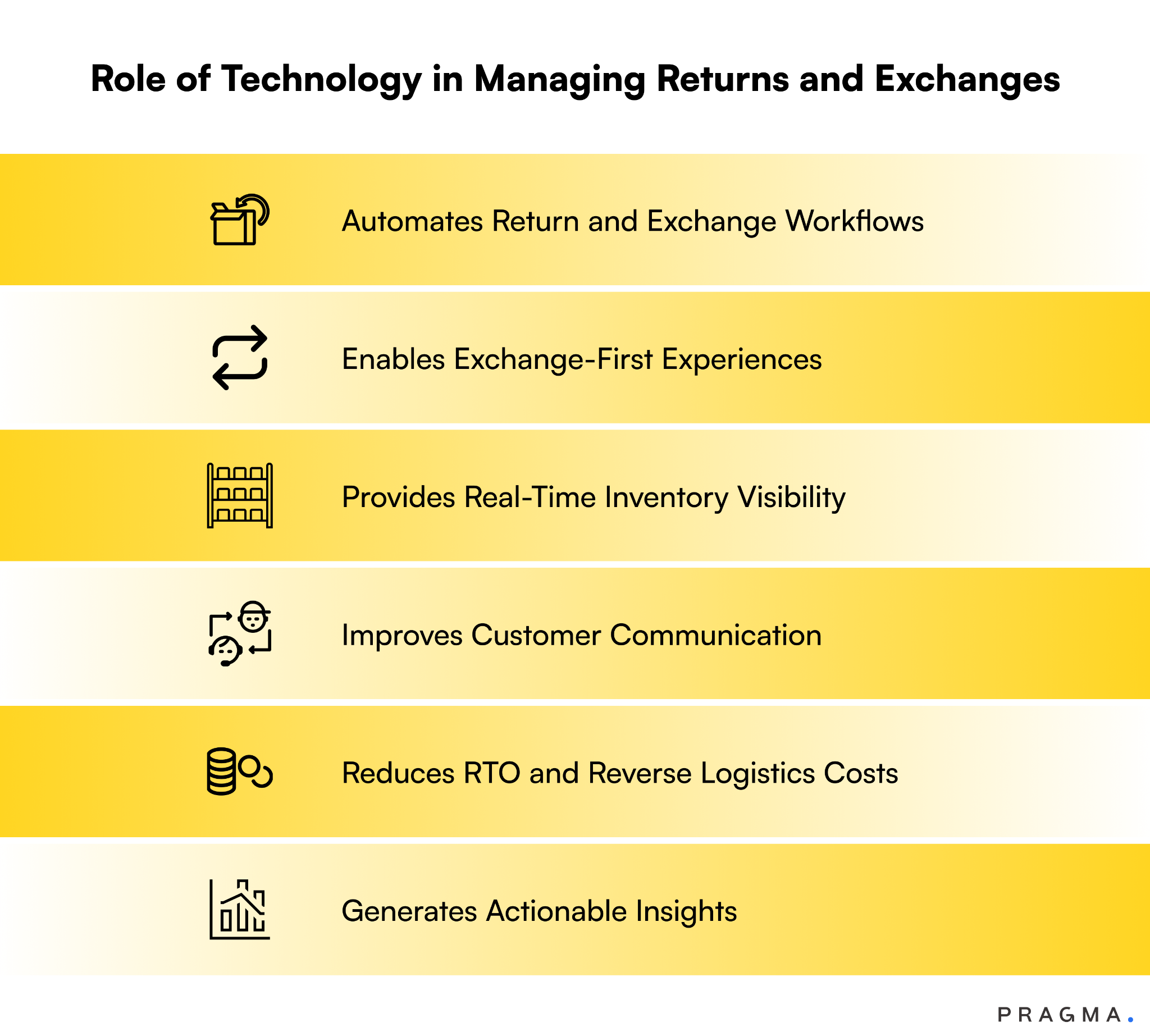
Technology plays a critical role in helping e-commerce brands reduce costs, recover revenue, and deliver a seamless customer experience.
Let us see how it helps:
Automates Return and Exchange Workflows
Handling returns manually involves multiple steps: approval, pickup scheduling, refund processing, and customer communication.
Technology helps automate this entire flow by:
- Enabling self-serve return and exchange requests
- Automatically approving or routing requests based on rules
- Triggering pickups and replacements without manual intervention
This reduces operational workload and improves turnaround time.
Solutions like Pragma Return Management System (RMS) streamline these workflows with automatic AWB creations, helping brands manage high return volumes efficiently.
Enables Exchange-First Experiences
Without the right systems, customers are more likely to choose refunds over exchanges.
Technology allows brands to:
- Show exchange options before refund options
- Recommend relevant products during return initiation
- Provide real-time availability for replacements
This increases the chances of converting returns into exchanges and retaining revenue.
Provides Real-Time Inventory Visibility
One of the biggest challenges in exchanges is ensuring product availability.
With integrated systems, brands can:
- Check real-time inventory across warehouses
- Prevent failed exchanges due to stockouts
- Enable faster replacement deliveries
This improves both operational efficiency and customer satisfaction.
Improves Customer Communication
Returns and exchanges involve multiple touchpoints, including confirmation, pickup updates, refund status, and delivery tracking.
Technology ensures:
- Automated notifications across channels (SMS, email, WhatsApp)
- Consistent and timely communication
- Reduced customer queries and support load
Tools like Pragma WhatsApp Business Suite help brands manage these communications in a unified and contextual manner.
Reduces RTO and Reverse Logistics Costs
Returns, especially in COD-heavy markets like India, can significantly increase logistics costs.
Technology helps by:
- Verifying orders before dispatch
- Sending proactive delivery confirmations
- Reducing failed deliveries and RTO rates
Solutions like Pragma RTO Suite help brands minimise reverse logistics costs and improve delivery efficiency.
Generates Actionable Insights
Returns and exchanges generate valuable data that can improve business decisions.
With the right technology, brands can:
- Analyse return reasons at the SKU or category level
- Identify patterns in customer behaviour
- Optimise product quality, sizing, and descriptions
Common Mistakes E-commerce Brands Make
Even though returns and exchanges are a standard part of e-commerce, many brands still handle them in ways that hurt profitability and customer experience. Here are the most common mistakes:
Defaulting to Refunds
One of the biggest mistakes brands make is treating refunds as the default resolution for every return request.
While refunds may seem like the easiest option operationally, they directly lead to:
- Immediate revenue loss
- Higher logistics and processing costs
- Reduced customer lifetime value
In many cases, customers are still willing to continue shopping; they just need a different size, colour, or product.
Brands that do not offer or promote exchanges miss a major opportunity to retain revenue.
Complicated Exchange Process
Even when brands offer exchanges, the process is often too complex or confusing for customers.
Common issues include:
- Too many steps to request an exchange
- Lack of real-time product availability
- Delayed approvals and unclear timelines
- Poor communication during the process
When the exchange experience is difficult, customers naturally choose refunds instead.
A simple, fast, and transparent exchange flow is critical.
With automated workflows, instant eligibility checks, and real-time inventory visibility, brands can improve both conversion and customer satisfaction.
Lack of Clear Policy
Many brands fail to clearly communicate their returns and exchange policies, which creates confusion and distrust.
Customers often struggle to understand:
- What items are eligible for return or exchange
- The time window for requests
- Whether exchanges are free or chargeable
- How refunds are processed
This lack of clarity leads to:
- Increased support queries
- Higher cart abandonment
- Negative customer experiences
A clear, transparent, and easily accessible policy reduces friction and builds confidence during the buying process.
By standardising this, platforms like Pragma RMS enable or disable the return window for the product based on SKUs, product categories or seasonal sales.
Final Thoughts
So, we can say that returns and exchanges are not just the operational processes; they are one of those areas that need smarter thinking and rational approaches.
Both of them are essential for any e-commerce brand to offer to their customers, as returns build trust and exchanges help to retain revenues and build strong customer relationships.
The key thing is that they have to decide how to handle this well.
By adopting an exchange-first mindset and investing in the right systems, brands can turn a traditionally loss-making process into a growth opportunity.

FAQs (Frequently Asked Questions On Returns vs Exchanges: What E-commerce Brands Should Choose?)
1. What is the difference between returns and exchanges in eCommerce?
Returns involve customers sending products back for a refund, while exchanges involve replacing a product with another item, such as a different size, colour, or variant instead of issuing a refund.
2. Why are exchanges better than returns for eCommerce brands?
Exchanges are often better because they help brands retain revenue, reduce refund-related losses, and improve customer retention while still resolving customer concerns.
3. When should eCommerce brands offer returns instead of exchanges?
Brands should offer returns when products are damaged, defective, incorrectly delivered, or when exchanges are not operationally feasible due to inventory limitations.
4. How do returns impact eCommerce profitability?
Returns increase operational costs through reverse logistics, refunds, warehousing, and inventory losses, while also affecting cash flow and contribution margins.
5. How do exchanges help reduce revenue loss in eCommerce?
Exchanges reduce revenue leakage by keeping the transaction within the brand ecosystem instead of issuing refunds, helping retain both revenue and customer intent.
6. What are the common reasons customers request returns or exchanges?
Common reasons include size or fit issues, damaged products, incorrect items, quality concerns, delivery mismatches, and unmet customer expectations.
7. How can eCommerce brands reduce return and exchange rates?
Brands can reduce return and exchange rates by improving product descriptions, providing accurate size guides, validating orders, enhancing product imagery, and setting clear customer expectations.
8. What tools help manage returns and exchanges in eCommerce?
Tools include return management systems, reverse logistics platforms, customer communication systems, and automation tools that streamline approvals, tracking, and resolution workflows.
9. How does customer experience affect returns and exchanges?
A smooth returns and exchanges experience improves customer trust and retention, while slow refunds, poor communication, or complicated processes can negatively impact brand perception.
10. Should D2C brands in India prioritise exchanges over returns?
In many cases, yes. For D2C brands in India, exchanges can help reduce refund pressure, lower operational losses, and improve retention, especially in categories like fashion and apparel.
Talk to our experts for a customised solution that can maximise your sales funnel
Book a demo
.png)

.png)