

Why channel choice should be a system decision, not a team preference
Channel effectiveness depends more on context than on popularity
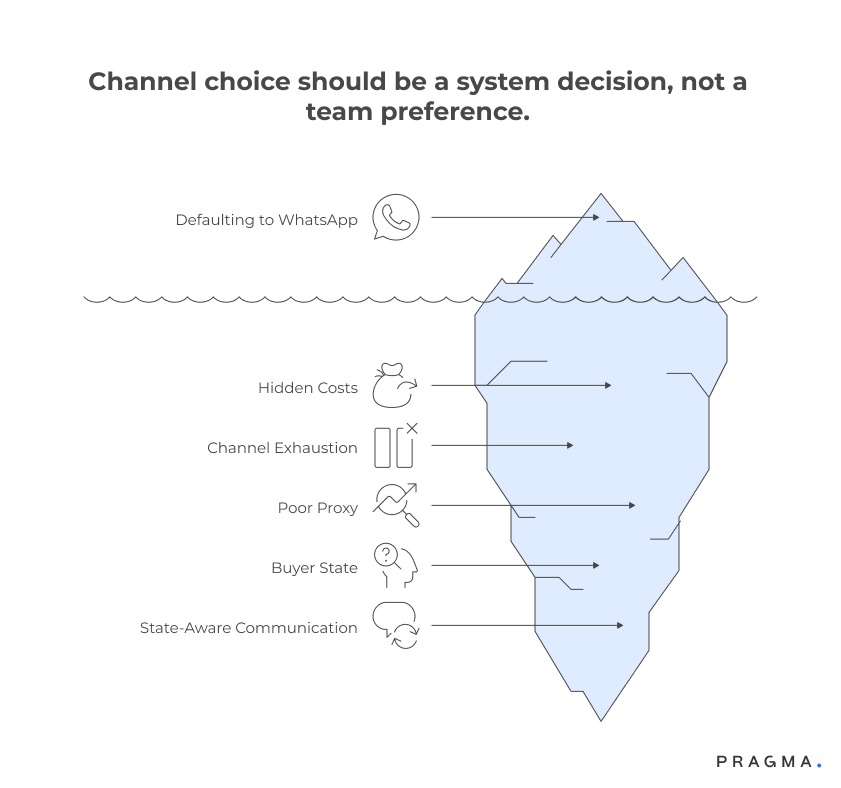
The hidden cost of defaulting to a single channel
Most teams over-index on one “primary” channel — typically WhatsApp — because it delivers high open rates and fast responses. Over time, this convenience becomes a liability. Messages that should have been asynchronous get sent in high-attention channels, while critical escalations get buried among low-urgency nudges.
From an operational perspective, this creates two problems. First, teams lose a reliable way to signal urgency to buyers. Second, channels get exhausted faster, leading to opt-outs, blocked numbers, and rising costs to recover reach elsewhere.
Why popularity is a poor proxy for suitability
High open rates do not mean high effectiveness. WhatsApp may be ideal for delivery coordination, but inappropriate for sensitive fraud checks or long-form policy explanations. When channel choice is driven by performance dashboards instead of buyer context, journeys optimise for visibility rather than resolution.
Channel choice as a reflection of buyer state
Every channel implicitly communicates urgency, effort, and expectation. A phone call signals immediacy. An email signals patience. SMS sits in between. Conditional branching works when these signals align with the buyer’s actual situation.
For example, a buyer who has just failed a payment may need reassurance and a clear next step, whereas a buyer with a prolonged delivery delay may need proactive escalation. Treating both scenarios with the same channel blurs intent and weakens trust.
State-aware communication prevents escalation loops
When channel choice adapts to buyer state, fewer issues escalate unnecessarily. Buyers who receive the right message in the right channel resolve issues without follow-ups, reducing pressure on support and ops teams.
Understanding the operational strengths and limits of each channel
Each channel solves a different class of problem
WhatsApp for contextual, two-way resolution
WhatsApp performs best when buyers may need to respond, choose an option, or seek clarification. It supports rich context, interactive elements, and conversational recovery.
However, its strength is also its weakness. Overuse trains buyers to expect instant responses, even for issues that do not warrant live interaction.
When WhatsApp becomes counterproductive
Using WhatsApp for low-urgency updates or long policy explanations increases message density without improving outcomes. In mature setups, WhatsApp is reserved for moments where dialogue or reassurance is genuinely useful.
SMS for time-bound, low-friction nudges
SMS excels when speed and certainty matter more than richness. OTPs, payment retries, and short confirmations benefit from SMS because delivery is predictable and reading requires minimal effort.
Unlike WhatsApp, SMS does not invite conversation, which can be an advantage for narrowly scoped actions.
Avoiding SMS fatigue
Because SMS lacks suppression signals like “read” or “reply,” overuse quickly feels spammy. Conditional branching ensures SMS is used sparingly and only when the action required is simple and urgent.
Email for explanation, traceability, and audit
Email is best suited for information-heavy communication: invoices, policy clarifications, return confirmations, or dispute summaries. It allows buyers to revisit details later and creates a durable record.
From an ops lens, email also provides legal and audit comfort that other channels cannot.
Why email should not be your first escalation step
Email works poorly under urgency. Using it for real-time recovery often delays resolution and pushes buyers to support instead. Conditional branching treats email as a stabilising layer, not an escalation tool.
When phone calls are justified — and when they are not
Human escalation is a cost decision, not an emotional one
Phone calls as the highest-interruption channel
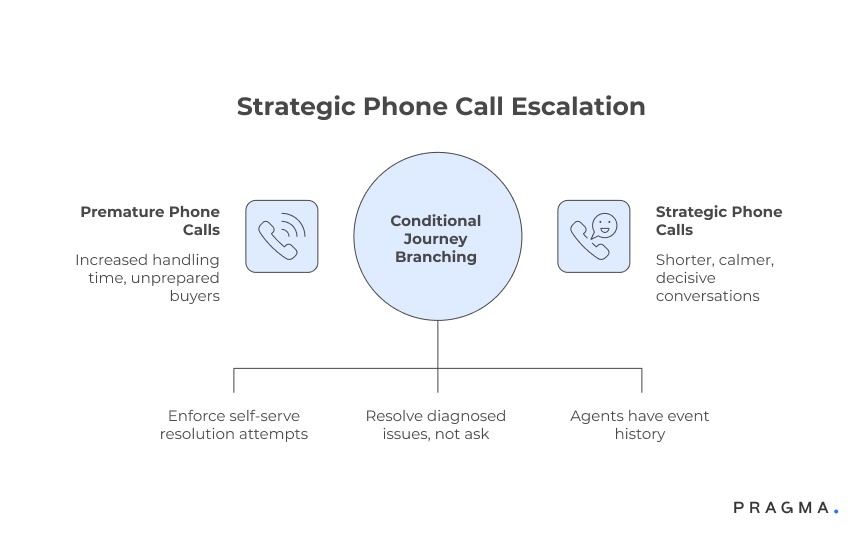
A phone call demands immediate attention, synchronous time, and emotional labour from both the buyer and the brand. This makes it powerful, but also expensive and intrusive. In a conditional journey, calls should be reserved for situations where delay materially worsens the outcome.
Typical examples include high-value order failures, repeated delivery failures, suspected fraud on trusted accounts, or situations where self-serve resolution has already failed.
Why premature calls backfire operationally
Calling too early often increases handling time rather than reducing it. Buyers are unprepared, agents lack context, and follow-ups spill back into WhatsApp or email anyway. Conditional branching prevents this by enforcing attempted resolution first, escalation later.
Calls should confirm decisions, not collect information
In mature journeys, calls are not used to ask what went wrong, but to resolve something already diagnosed by the system. By the time a call is placed, the reason, history, and acceptable outcomes should already be known.
Reducing average handle time (AHT) through context
When agents enter a call with full event history and prior message attempts, conversations are shorter, calmer, and more decisive. Conditional logic ensures calls are the final step in a sequence, not the first reaction.
Sequencing channels without overwhelming the buyer
Good journeys feel calm even when multiple systems are firing
One intent, one primary channel at a time
A common failure mode is parallel messaging: SMS reminder, WhatsApp nudge, and email confirmation all triggered by the same event. From the buyer’s perspective, this feels chaotic and repetitive.
Conditional branching enforces a rule: at any moment, a journey has one primary channel, with others held in reserve.
Why sequential beats parallel communication
Sequential design allows buyers time to act. If the first channel succeeds, the journey exits cleanly. Parallel design assumes failure by default, which increases noise and reduces trust.
Designing fallback paths based on non-response
Fallback should be triggered by absence of resolution, not by arbitrary timers. For example:
- WhatsApp sent → no action within X hours → SMS nudge
- SMS sent → still unresolved → email with full context
- All async attempts fail → phone escalation
Each step assumes the previous one had a fair chance to work.
Avoiding escalation inflation
Without clear fallback rules, journeys escalate too quickly, driving up call volumes and costs. Conditional branching slows escalation just enough to preserve efficiency without sacrificing SLAs.
Aligning channel choice with message intent
The channel should reinforce what the message is asking for
Inform, prompt, resolve, or reassure — not all at once
Every message has a dominant intent. Problems arise when the channel and intent are mismatched — for example, using email to prompt urgent action or WhatsApp to deliver long policy explanations.
Conditional branching explicitly ties intent to channel:
- Inform → Email or WhatsApp (non-interruptive)
- Prompt → SMS or WhatsApp (time-bound)
- Resolve → WhatsApp or phone (interactive)
- Reassure → WhatsApp (tone-sensitive)
Preventing intent dilution
When intent is unclear, messages become longer, more cautious, and less effective. Channel discipline forces clarity about what the message is actually trying to achieve.
A practical decision framework for channel selection
Turning judgement calls into repeatable logic
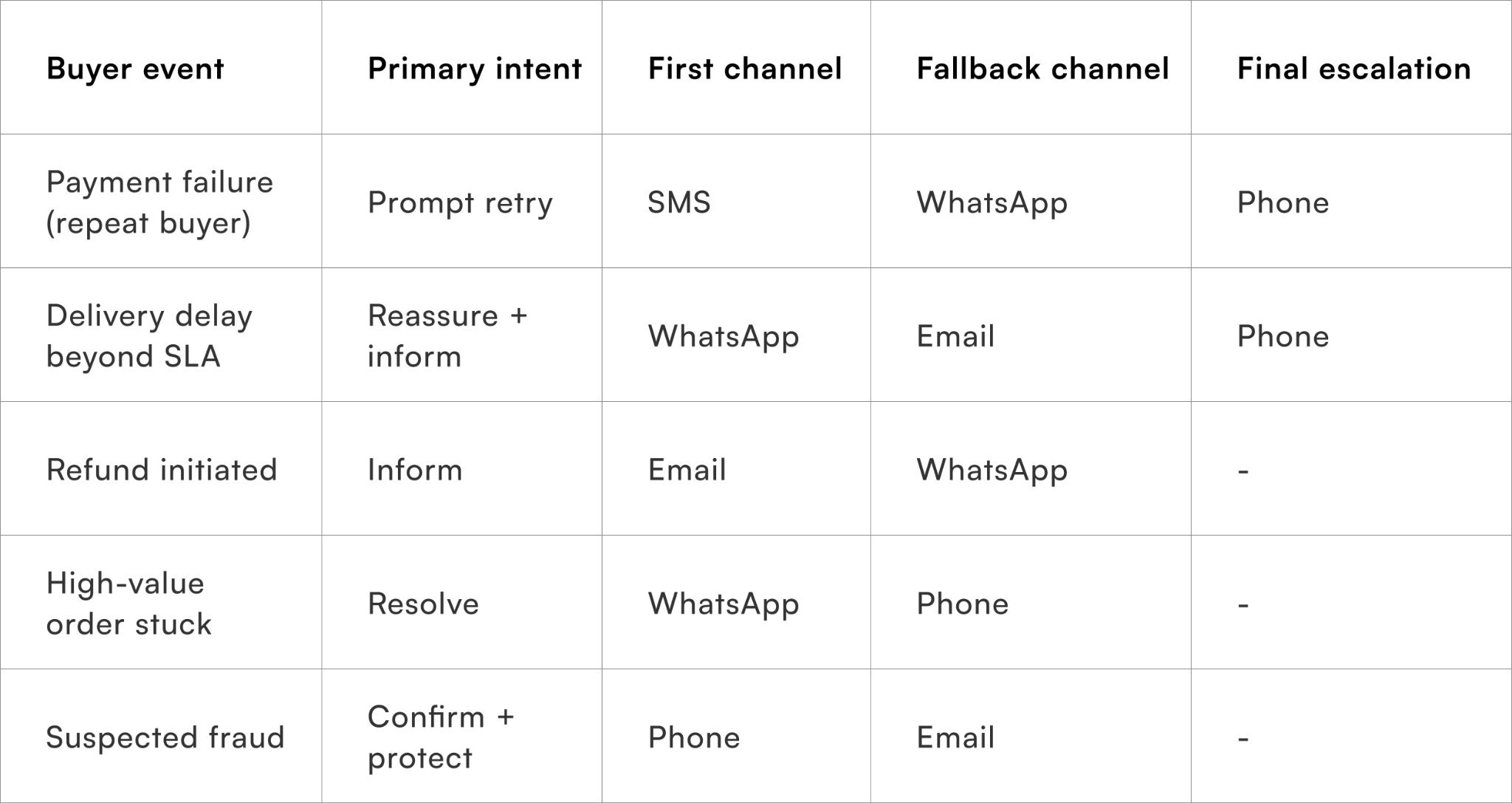
This framework keeps channel decisions consistent across teams and seasons.
Guardrails that keep conditional branching sane at scale
Systems matter more than judgement during peak periods
Global frequency caps across channels
Without shared caps, a buyer may receive one message per channel and still feel spammed. Conditional branching enforces total message limits, not just per-channel limits.
Why this protects long-term reach
Frequency fatigue leads to opt-outs and number blocking, which permanently reduces reachable buyers. Guardrails trade short-term nudges for long-term channel viability.
Channel suppression during sensitive states
During returns, disputes, or escalations, promotional or unrelated journeys must pause automatically. Conditional branching ensures sensitive states override growth objectives.
Maintaining trust when systems collide
This is where many stacks fail. A central branching layer prevents tone-deaf messaging that damages brand credibility.
Quick wins on implementing conditional channel branching (30 days)
How to introduce discipline without slowing teams down
Week 1: Audit journeys by intent, not by channel
List all current messages sent across SMS, WhatsApp, email, and phone. For each, write down the primary intent — inform, prompt, resolve, or reassure. Most teams discover that multiple channels are being used for the same intent without a clear reason.
The goal is not optimisation yet, but clarity. This exercise surfaces redundancy and highlights where channel choice is driven by habit rather than suitability.
Expected outcome:
A clear view of where channel overlap and intent mismatch currently exist.
Week 2: Define primary and fallback channels for top events
Select 4–5 high-impact events such as payment failure, delivery delay, refund initiation, and high-value order exceptions. For each, define:
- One primary channel
- One fallback channel
- Clear exit conditions
This forces teams to agree on escalation paths before pressure situations arise.
Expected outcome:
Documented channel sequences that reduce parallel messaging.
Week 3: Introduce global frequency and suppression rules
Implement basic guardrails:
- A total message cap per buyer per day
- Automatic suppression of low-priority journeys during sensitive states
- Delays between channel switches to allow buyer action
These rules matter most during peak periods, when internal urgency spikes.
Expected outcome:
Fewer buyer complaints about over-communication and tone mismatch.
Week 4: Measure resolution, not responsiveness
Track time-to-resolution, re-escalation rates, and call volumes per journey. Resist the urge to optimise open or reply rates at this stage.
The purpose of conditional branching is operational efficiency and buyer trust — not maximum engagement.
Expected outcome:
Clear evidence of which channel sequences actually resolve issues.
Metrics that validate channel decisions
Engagement metrics are inputs, not success criteria
These metrics keep channel strategy grounded in outcomes rather than assumptions.
To wrap it up
Conditional branching: when to use SMS, WhatsApp, phone or email in a journey shows that channel choice is not a UX decision alone — it is an operational control that directly affects cost, trust, and resolution speed.
This week, force every journey to declare a primary and fallback channel before it is allowed to go live.
Over time, brands that treat channels as signals — not megaphones — build calmer journeys, lower support load, and preserve reach even during peak seasons.
For D2C brands seeking system-level control over channel sequencing and escalation, Pragma’s Journey Management platform enables intent-based branching, suppression logic, and outcome-driven measurement across SMS, WhatsApp, email, and voice.

FAQs (Frequently Asked Questions On Conditional branching: when to use SMS, WhatsApp, phone or email in a journey)
1. What is conditional branching in customer journeys?
Conditional branching routes customers through different communication paths based on behaviour or context.It ensures messages are delivered through the most effective channel.
2. Why is channel selection important in communication workflows?
Different channels have varying response rates and user preferences.Choosing the right one improves engagement and conversion.
3. When should SMS be used in a customer journey?
SMS is ideal for urgent, time-sensitive updates like delivery alerts or OTPs.It offers high open rates and immediate visibility.
4. When is WhatsApp the preferred communication channel?
WhatsApp works best for interactive, conversational, and rich media communication.It is effective for updates, support, and personalised engagement.
5. When should businesses use phone calls?
Phone calls are suitable for high-value, complex, or sensitive interactions.They enable direct communication and faster issue resolution.
6. When is email the right choice for communication?
Email is ideal for detailed, non-urgent information such as invoices or reports.It supports longer content and formal communication.
7. How does customer behaviour influence channel selection?
Past engagement, response patterns, and preferences guide channel choice.This ensures higher relevance and better outcomes.
8. Can automation manage conditional branching effectively?
Yes, automation enables real-time decision-making across multiple channels.It ensures consistent and scalable communication workflows.
9. How can businesses avoid over-communication across channels?
By setting frequency caps and prioritising channels based on context.This prevents customer fatigue and improves experience.
10. What data is needed for effective conditional branching?
Data such as customer preferences, interaction history, and journey stage is essential.It helps determine the most appropriate communication channel.
11. How does conditional branching improve customer experience?
It delivers the right message through the right channel at the right time.This increases engagement, satisfaction, and conversion rates.
Talk to our experts for a customised solution that can maximise your sales funnel
Book a demo
.png)

.png)