

Soft-returns — where only part of an order is returned or exchanged — are becoming the norm rather than the exception in Indian D2C. Bundled purchases, size experimentation, multi-SKU carts, and mixed intent orders mean customers increasingly want flexibility without fully undoing the purchase.
Yet most operations are still designed for binary outcomes: full delivery or full return.
Handling soft-returns (partial returns/exchanges): operational templates and SOPs looks at why this mismatch creates hidden cost and chaos across fulfilment, inventory, finance, and CX. Without clear templates and standard operating procedures, soft-returns trigger manual intervention, inventory ambiguity, delayed refunds, and inconsistent customer experiences. What should be a controlled exception quickly becomes a recurring operational leak.
Why do soft-returns create disproportionate operational complexity?
Understanding why partial outcomes break binary systems
Most D2C operations are designed around clean states: an order is either delivered or returned, fulfilled or cancelled, paid or refunded. Soft-returns violate all of these assumptions. A single order suddenly contains both completed and reversed outcomes, each with different financial, inventory, and CX implications.
This is why soft-returns often feel “messy” operationally. Systems struggle to represent partial truth, teams fall back on manual judgement, and reconciliation becomes fragmented across departments. What appears to be a minor exception at customer level creates cascading ambiguity internally.
The core problem is not volume — it is design. When soft-returns are not explicitly modelled, every team interprets them differently, leading to delays, errors, and avoidable cost.
How should soft-returns be formally defined and classified?
Creating a shared language before creating workflows
Before designing SOPs, teams must agree on what qualifies as a soft-return. Without shared definitions, execution will never be consistent.
Common soft-return categories
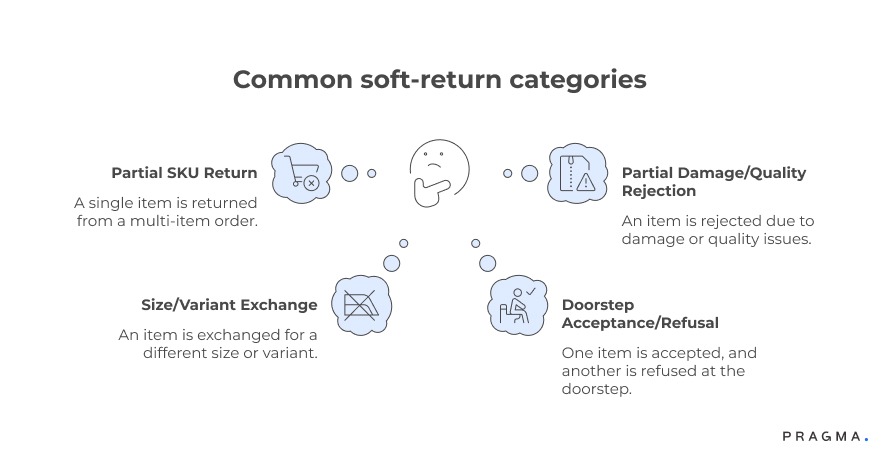
Soft-returns typically fall into a few repeatable patterns:
- Partial SKU return from a multi-item order
- Size or variant exchange for one item in a bundle
- One item accepted, one refused at doorstep
- Partial damage or quality rejection
Each category has different operational implications and must be treated distinctly.
Why classification matters operationally
Clear classification determines:
- Whether reverse pickup is required
- How inventory should be adjusted
- How much refund or capture is needed
- Which SLA applies
Without this clarity, CX agents and ops teams default to inconsistent handling.
Where do most teams lose control during soft-returns?
Identifying systemic failure points
Soft-returns expose weak handoffs between systems more than any other flow.
Common failure points include:
- OMS unable to split order states cleanly
- Inventory systems not supporting partial release or reservation
- Finance teams manually reconciling partial refunds
- CX issuing refunds before ops confirmation
Each workaround adds delay and increases the risk of leakage.
The danger of “temporary” manual fixes
Manual interventions feel harmless in the moment, but they create precedent. Over time, teams stop questioning them, and soft-returns become permanently expensive.
Why visibility gaps compound over time
When no single system owns the full soft-return lifecycle, issues surface late — often through customer complaints or reconciliation mismatches rather than proactive alerts.
How should OMS workflows be structured for partial outcomes?
Designing order states that reflect reality
OMS design is the foundation of soft-return control. If the OMS cannot represent partial completion, no SOP will hold.
Split-order state modelling
Each SKU line item must carry its own lifecycle state:
- Delivered
- Pending exchange
- Returned
- Refunded
- Replaced
This allows downstream systems to act deterministically rather than guessing.
Event-driven transitions instead of manual overrides
State changes should be triggered by clear events — pickup completed, exchange dispatched, item QC passed — not by CX judgement calls. This reduces error and improves auditability.
How should inventory be handled during partial returns and exchanges?
Avoiding ghost stock and overselling
Inventory ambiguity is one of the costliest side effects of soft-returns. When one item is coming back and another is staying with the customer, systems often overcorrect or under-correct stock levels.
Temporary inventory holding patterns
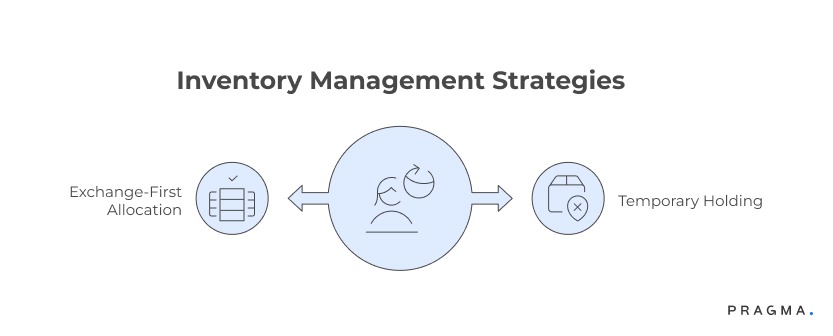
Returned items should move into a “pending inspection” state rather than immediately becoming available. This prevents premature resale and reduces downstream fulfilment failure.
Exchange-first allocation logic
When a partial exchange is confirmed, replacement inventory should be reserved immediately, even if the return pickup has not yet completed. This shortens exchange TAT and improves CX reliability.
How should refunds and payment adjustments be sequenced?
Protecting cashflow without frustrating customers
Soft-returns complicate financial flows because only part of the order value is reversed.
Deferred refund logic
Refunds should be issued only after:
- The returned item is received
- QC is completed
- Exchange outcomes (if any) are finalised
This sequencing prevents premature cash outflow and reconciliation headaches.
Clear customer communication to avoid mistrust
Customers are more tolerant of delayed partial refunds when timelines and conditions are communicated clearly at initiation. Silence creates escalations.
What SOPs should CX teams follow for soft-returns?
Reducing discretion without reducing empathy
CX is often forced to improvise during soft-returns because rules are unclear.
Decision trees instead of free-form judgement
SOPs should guide agents through:
- Classification of soft-return type
- Eligibility checks
- Refund vs exchange routing
- Escalation thresholds
This ensures consistency across agents and shifts.
Guardrails for high-risk scenarios
Repeat partial returners or high-value orders should trigger additional checks without slowing down low-risk cases.
How should SLAs be defined for soft-return execution?
Preventing partial orders from lingering indefinitely
Soft-returns often sit in limbo longer than full returns because no one owns the clock.
Separate SLAs for each leg
Define distinct SLAs for:
- Reverse pickup
- QC completion
- Exchange dispatch
- Refund issuance
This makes bottlenecks visible and enforceable.
Escalation rules for SLA breach
If any leg exceeds its SLA, the system should auto-decide next steps — refund, alternate SKU, or cancellation — instead of waiting for manual review.
What metrics reveal soft-return health early?
Measuring control, not just volume
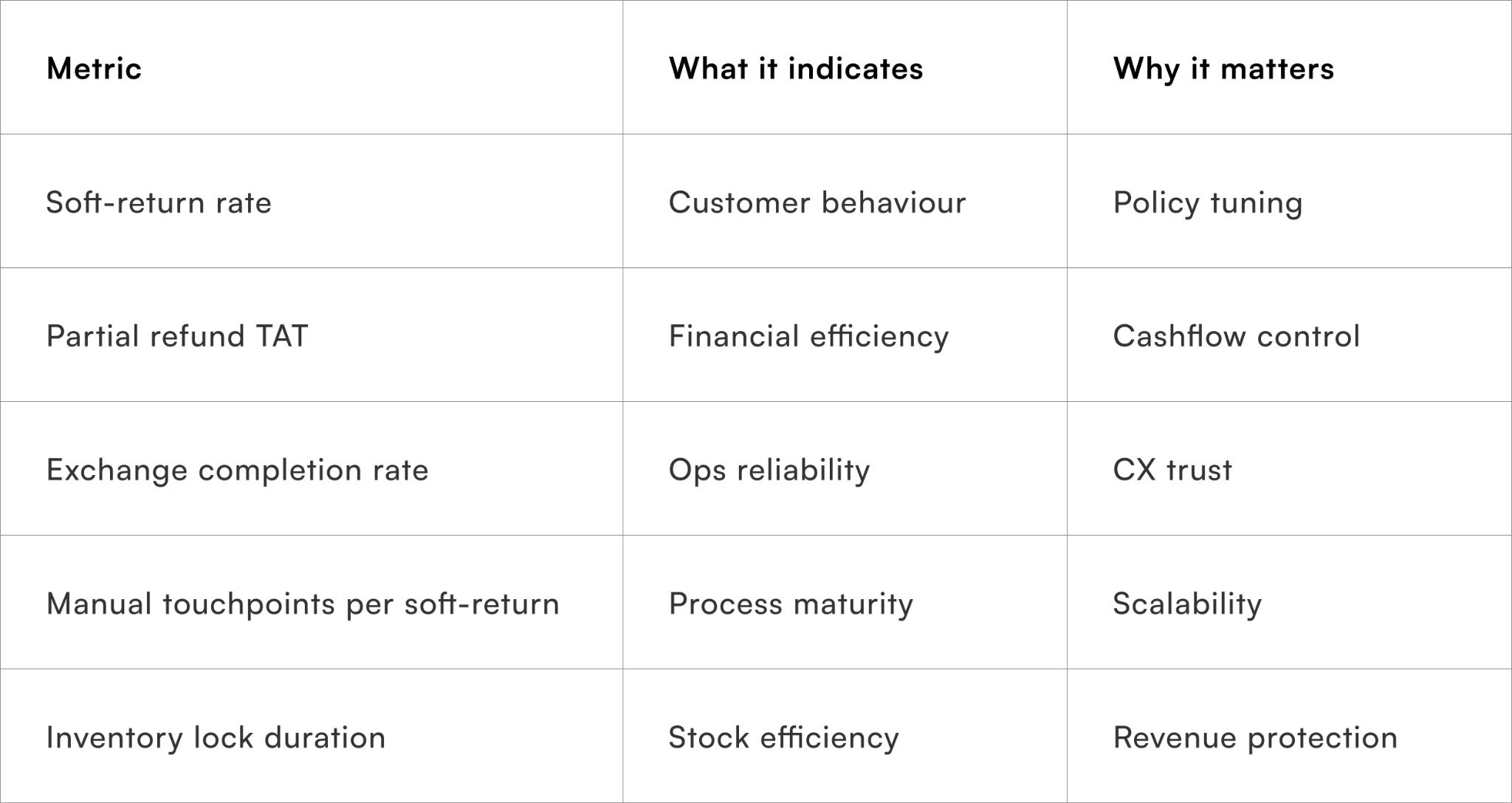
Tracking these weekly prevents soft-returns from becoming silent margin drains.
Quick Wins
Operational steps to stabilise soft-returns immediately
Week 1: Classify and codify soft-return types
Start by analysing the last 60–90 days of return data and tagging which cases were partial. Break these down into 3–4 repeatable categories and document them clearly in internal SOPs.
This creates a shared language across ops, CX, and finance and eliminates inconsistent handling.
Expected result: Reduced CX ambiguity and faster decision-making.
Week 2: Enable line-item level order states in OMS
Ensure each SKU within an order can independently move through delivered, returned, exchanged, and refunded states. If your OMS does not support this natively, introduce a temporary state-mapping layer.
This prevents partial orders from being treated as fully open or fully closed.
Expected result: Cleaner system visibility and fewer reconciliation errors.
Week 3: Sequence refunds and exchanges deliberately
Update refund logic so partial refunds are issued only after QC confirmation and exchange resolution. Train CX teams to communicate timelines clearly at initiation.
This protects cashflow while maintaining customer trust.
Expected result: Lower refund reversals and fewer escalations.
Week 4: Define and enforce soft-return SLAs
Introduce SLAs for each leg of the soft-return journey and assign ownership. Instrument alerts for SLA breaches to prevent cases from lingering unnoticed.
Expected result: Faster closure of partial cases and improved CX consistency.
Wrap It Up
Soft-returns are not edge cases — they are structural outcomes of how customers shop today. Brands that continue treating them as exceptions pay for it through manual work, inventory leakage, and inconsistent customer experiences.
This week, classify your soft-return patterns and define clear OMS states and SOPs for each.
Over time, formalising soft-returns into standard operational flows transforms them from a source of chaos into a controllable, predictable part of the order lifecycle.
For D2C brands seeking structured control over complex return scenarios,Pragma’s orchestration platform provides line-item level state management, exchange-aware workflows, and SLA tracking that help brands reduce soft-return resolution time by up to 30% while protecting inventory and cashflow.

FAQs (Frequently Asked Questions On Handling soft-returns (partial returns/exchanges): operational templates and SOPs)
1. Are soft-returns avoidable?
No. They are a natural outcome of multi-item carts and customer choice. The goal is control, not elimination.
2. Should soft-returns be treated as exceptions?
No. At scale, they should be treated as a standard operational flow with defined SOPs.
3. Do soft-returns increase inventory risk?
Yes, if not gated correctly. Proper state management reduces this risk significantly.
4. Is it better to force refunds instead of exchanges for partial returns?
Not always. Exchanges preserve revenue when inventory and fulfilment speed can be assured.
5. Who should own soft-return SLAs?
Ownership should be shared, but accountability must be clearly assigned for each stage.
Talk to our experts for a customised solution that can maximise your sales funnel
Book a demo

.png)