

In the D2C industry, how brands connect with their customers across different touchpoints directly impacts retention and revenue.
With the Indian e-commerce market projected to reach $350 billion/₹29 lakh crore by 2030 at an 18-20% CAGR, e-commerce brands can no longer rely on a single channel to connect with their audience.
That is why understanding omnichannel vs multichannel is not just important; it is critical. Brands must decide how to scale customer engagement effectively.
Research shows that companies which have strong omnichannel engagement retain 89% of their customers, while those with weak multichannel strategies retain only 33%.
This large gap in percentages clearly indicates that brands should act more wisely when choosing between the two.
These two terms are used interchangeably by marketers, but they differ in how they manage customer experience, data, and operations.
The key question for D2C brands is which approach to adopt.
Let us find the answer in "Omnichannel vs Multichannel: Key Differences for D2C E-commerce Brands" and decide which one is right for your business.
What Is Multichannel vs Omnichannel?
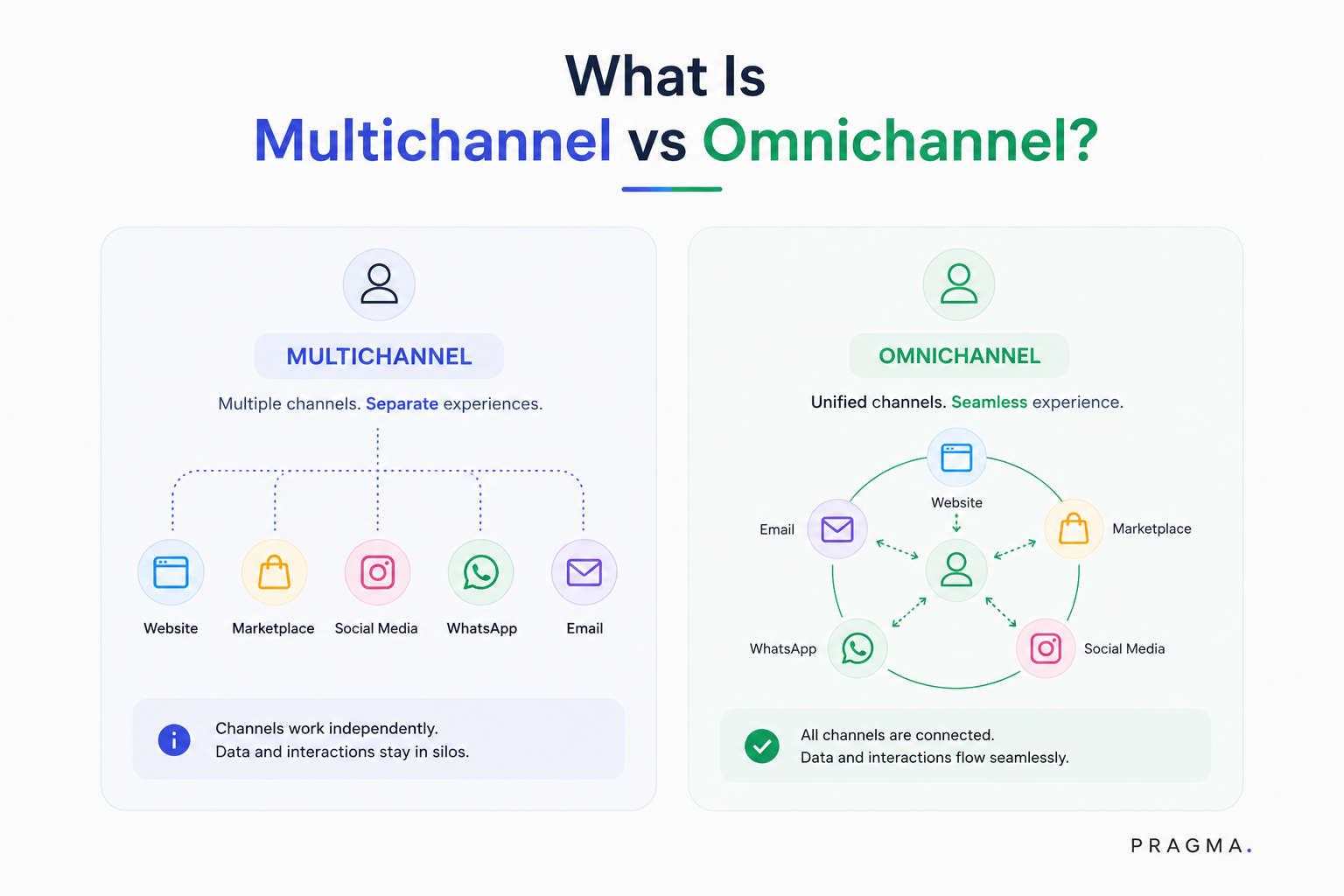
The difference between multichannel and omnichannel lies in how brands manage customer experience and data across channels.
To simplify omnichannel vs multichannel, we can define them as follows:
Multichannel refers to using multiple independent channels (website, marketplace, WhatsApp, email) to reach customers. Each channel operates in isolation, with limited data sharing.
In contrast, Omnichannel refers to creating a unified, seamless experience across all channels where customer data, inventory, and interactions flow seamlessly between touchpoints.
To better understand multichannel vs omnichannel, let's break down both approaches in detail.
What Is Multichannel Commerce?
Multichannel commerce is the practice of selling products across multiple platforms simultaneously.
Here, each platform is managed as a separate identity, with customer data and interactions handled separately across channels, often by different teams.
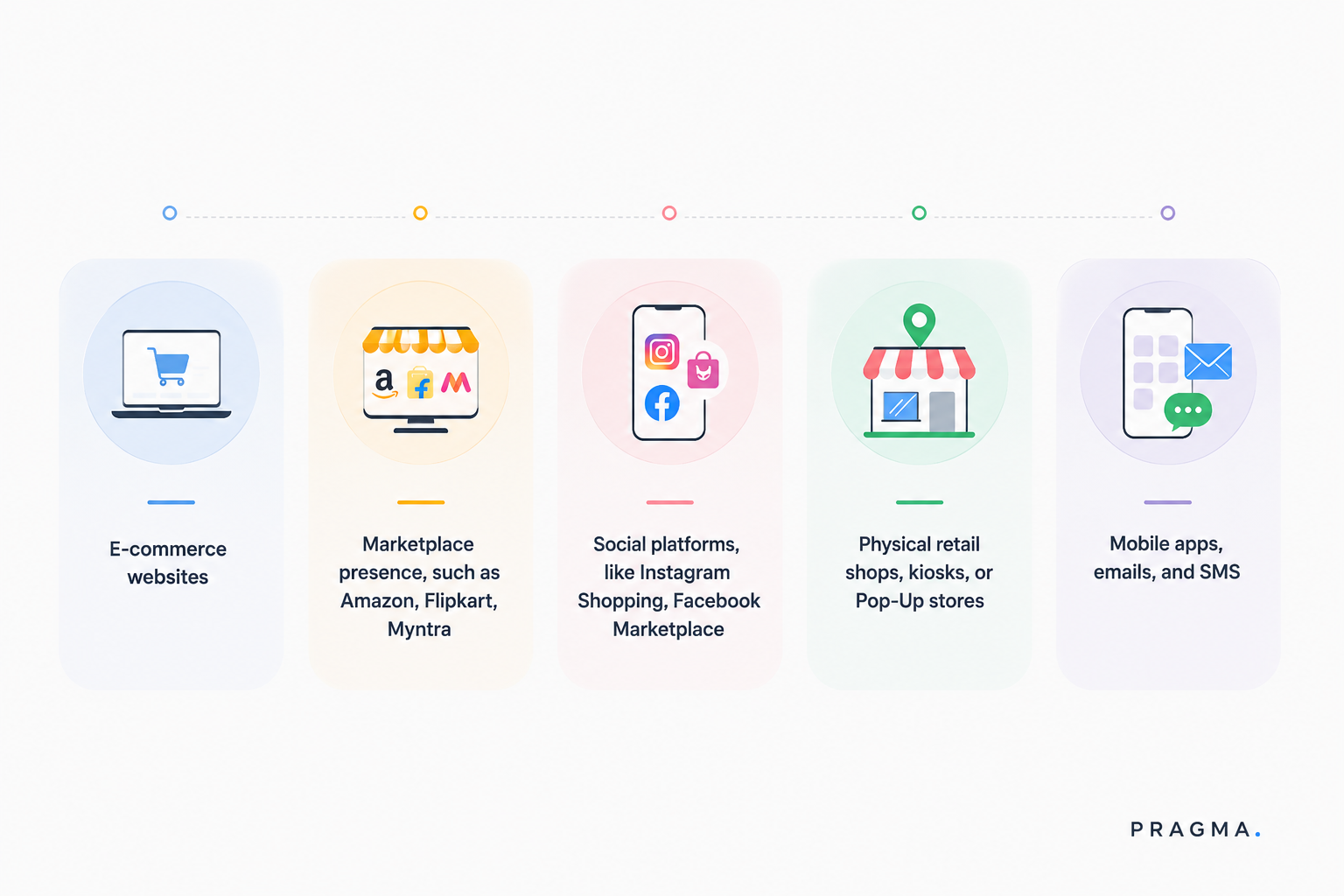
A typical multichannel setup includes:
- E-commerce websites
- Marketplace presence, such as Amazon, Flipkart, Myntra
- Social platforms, like Instagram Shopping, Facebook Marketplace
- Physical retail shops, kiosks, or Pop-Up stores
- Mobile apps, emails, and SMS
How Multichannel Works?
In a multichannel setup, each platform operates with its own distinct characteristics:
Separate Customer Databases
In multichannel commerce, customer data gathered on Instagram will not automatically transfer to the Shopify store or the Amazon seller account.
It implies that you may have a customer represented differently across systems.
Independent Inventory Management
The inventory quantities on your e-commerce site may not match those on Amazon or in your physical stores.
For example, it is possible under multichannel commerce that:
- Your website shows 50 units in stock
- Amazon shows 20 units available
- Your physical store has 15 units on display
But due to a lack of sync, the actual available inventory may be lower than what each channel reflects, leading to overselling or stockouts.
Channel-Specific Marketing Campaigns
Your email marketing is independent of your social media marketing, and your Amazon promotion is not synchronised with your Google Ads or Facebook promotion.
Without coordination, customers might receive conflicting messages or miss relevant offers.
Isolated Customer Service Protocols
Customers address their issues differently across channels, and in most cases, they have to repeat their problems when switching channels. It is possible here that:
- Website visitors use live chat or contact forms
- Amazon customers use marketplace messaging
- Instagram followers send direct messages
- WhatsApp users expect immediate responses
This set of communications is not known to each other, and it may be that different teams are handling the same customer across different channels, leading to unnecessary costs and lost revenue.
Example of Multichannel Commerce
Take the example of an Indian D2C fashion brand offering ethnic clothing.
They work in various channels:
- Shopify Website
- Amazon India
- Instagram Shopping
- Myntra
- WhatsApp Business
A customer named Priya discovers their product on Instagram and compares its prices on the Shopify website.
For real reviews, she checked Amazon and finally purchased items from Myntra due to a platform-specific discount.
But later, when she calls WhatsApp support about sizing, the support team cannot see her cross-platform interactions and has to start the discussion from scratch.
While multichannel helps brands maximise reach across platforms, it often creates fragmented customer experiences, operational inefficiencies, and limited visibility across the customer journey.
This is where the shift from multichannel to omnichannel becomes critical for scaling D2C brands.
What Is Omnichannel Commerce?
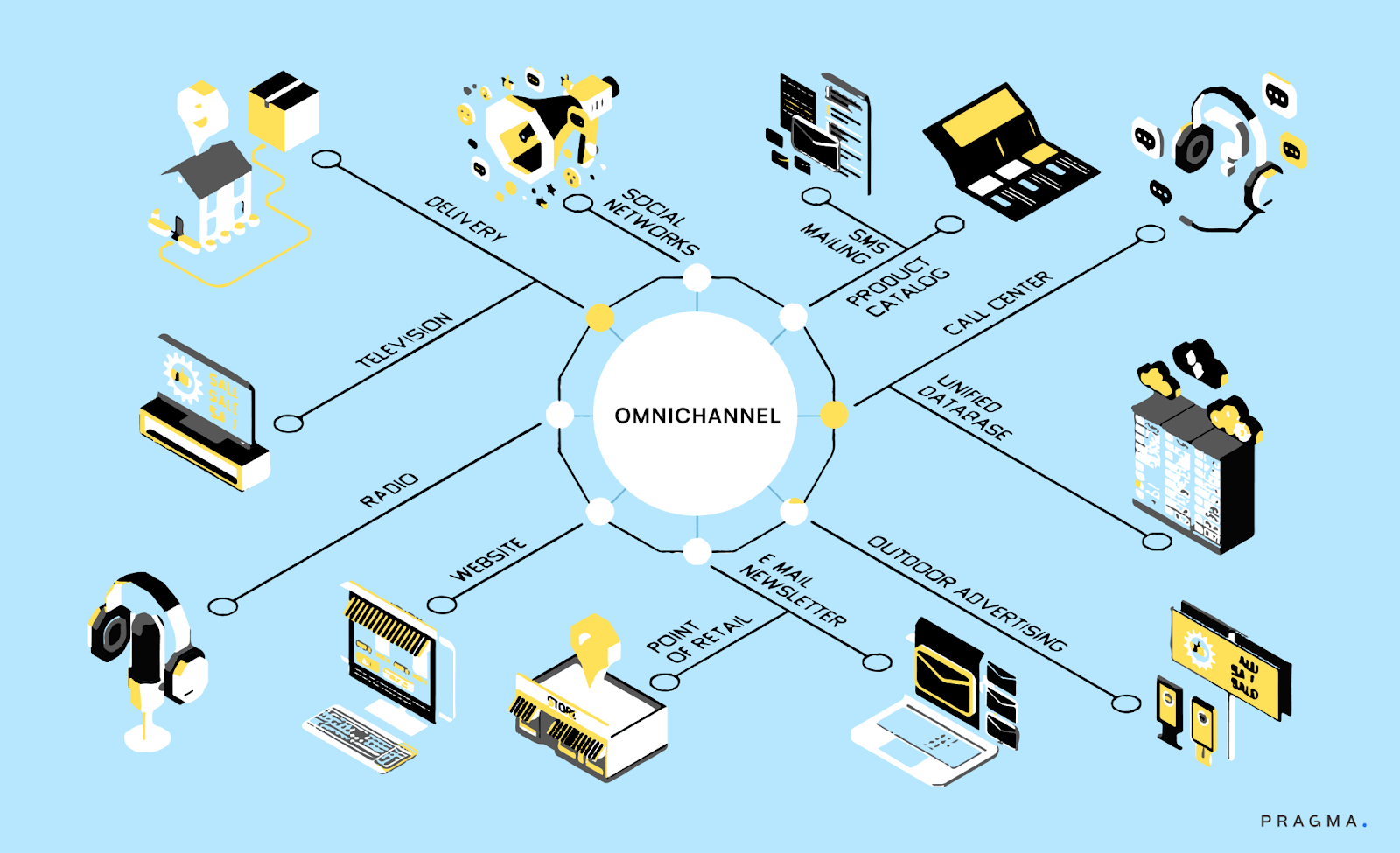
Omnichannel commerce refers to a marketing approach that creates a unified customer experience by integrating data, inventory, and communications.
Here, every channel of communication, whether SMS, Email, or social commerce platforms, is interconnected, providing a seamless experience for customers.
How Omnichannel Works?
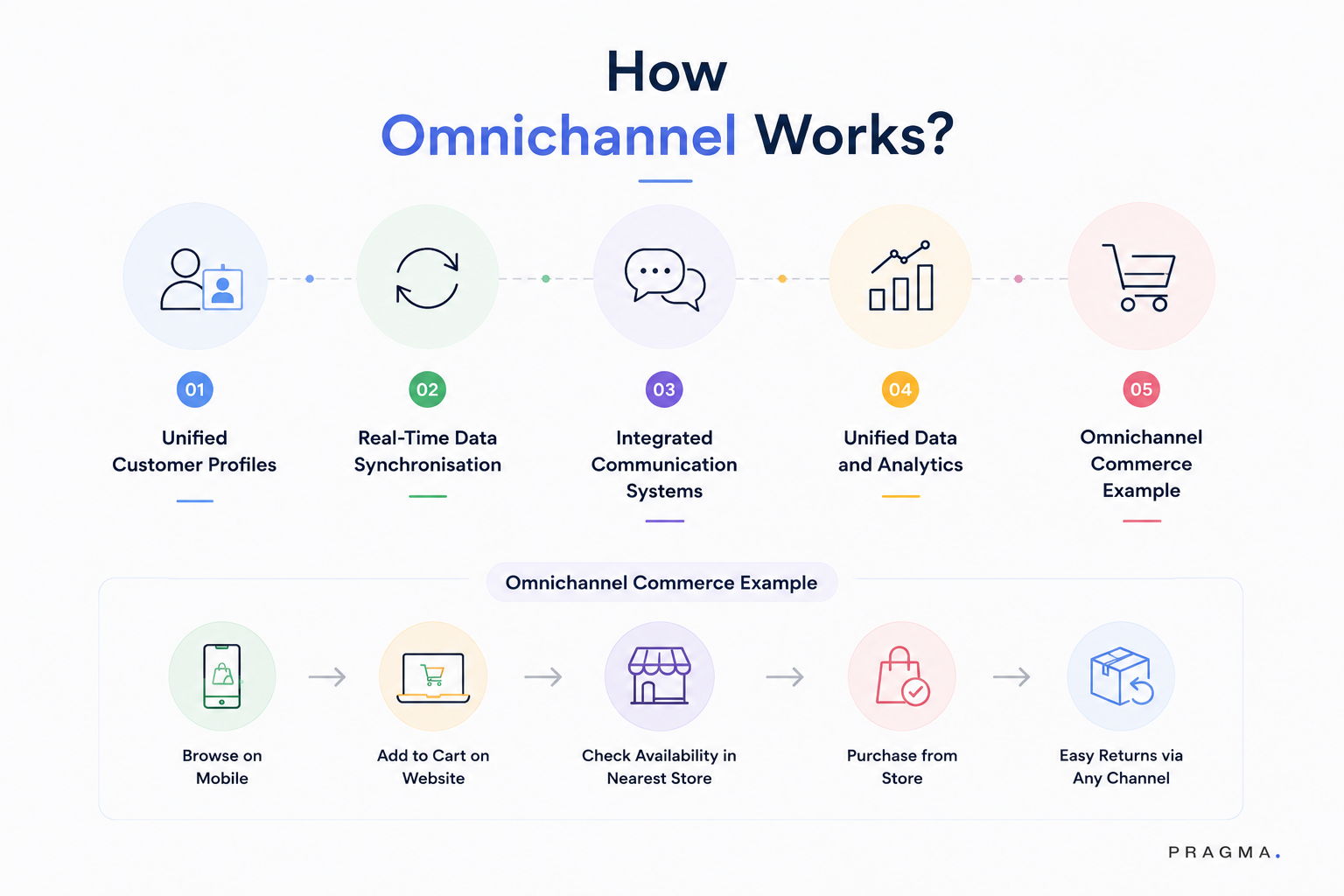
Here is how the omnichannel setup works:
Unified Customer Profiles
All customer interactions, including how they browse your site or interact on social media, open emails, or talk with customer support, add up to a single, unified customer profile.
This allows brands to understand behaviour and personalise interactions effectively.
This is typically achieved using an omnichannel CRM that consolidates customer interactions from platforms like WhatsApp, Instagram, email, and support systems into a single dashboard.
Real-Time Data Synchronisation
The data on inventory, pricing, promotions, and customers are synchronised across all channels in real time.
This makes all channels consistent, ensuring there are no overselling issues.
Integrated Communication Systems
Customer service teams can access the complete interaction history through all channels.
Upon calling support, the customer support team can view the customer's purchase history, browsing history, past support tickets, and present context.
This eliminates the need for repeated explanations and improves resolution speed.
In practice, this requires a shared inbox or unified communication layer where all conversations across channels are visible in one place, enabling faster and more contextual support.
Unified Data and Analytics
Data on performance across all channels is processed into unified analytics solutions.
This offers an overall understanding of customer behaviour, campaign success, and business performance.
Platforms like Pragma Omnichannel CRM enable brands to manage interactions across WhatsApp, Instagram, Facebook, SMS, and email from a single dashboard, while offering unified insights across all touchpoints.
Omnichannel Commerce Example
Let us talk about the same brand we have discussed above.
The same fashion brand has integrated systems because it has adopted an omnichannel marketing strategy.
When a customer abandons their cart on the website, they automatically receive a WhatsApp message with a personalised discount.
If they visit the physical store, the sales associate can see their online browsing history and make relevant recommendations.
And if the customer contacts support, the team already has full visibility into their journey, eliminating friction and creating a seamless experience.
This kind of experience is powered by omnichannel systems that connect customer data, communication, and automation in real time across channels.
While both models use multiple channels, the real difference lies in how these channels are connected.
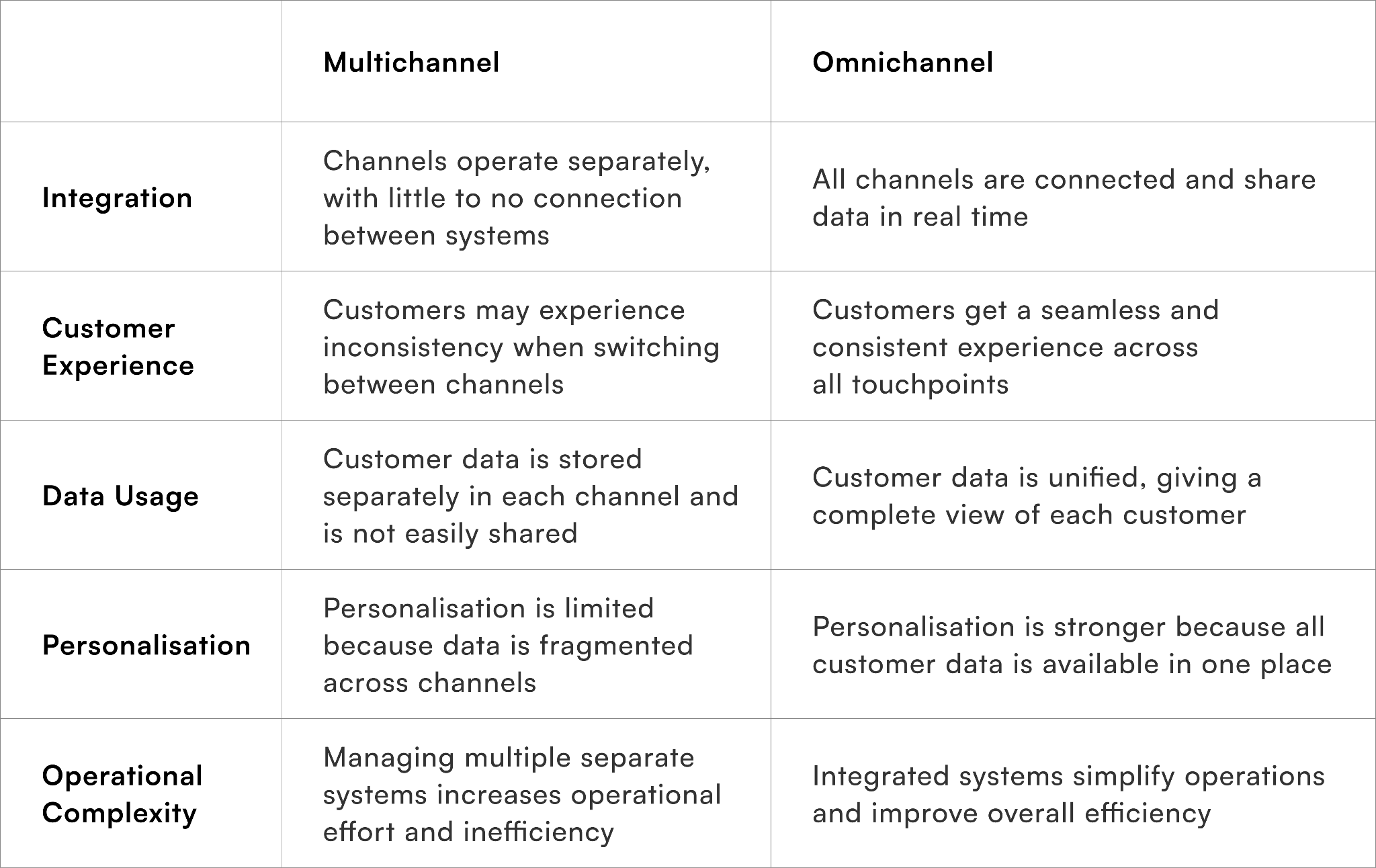
Omnichannel vs Multichannel: Key Differences
To decide which approach works best for D2C brands, it's important to compare multichannel vs omnichannel across key parameters.
Why Multichannel vs Omnichannel Matters for E-commerce Brands?
Here is why understanding multichannel vs omnichannel is important for Indian e-commerce brands:
Customer Expectations
Customer expectations have changed. 73% of customers explore more than one channel before making a purchase, and they prefer a smooth process across all channels.
This isn't merely a preference; it has become a minimum standard that directly affects buying decisions.
- Mobile-First Behaviour: Mobile commerce accounts for 63% of total e-commerce sales worldwide, so customers often switch devices and channels as they shop. They may study on their mobile on the way to work, compare prices at their desk at work, and make the purchase on a tablet at home.
- Social Commerce Integration: With WhatsApp penetration at 35% nationally and 70% in urban areas, customers expect brands to be available on their preferred communication platforms. They want to find products on Instagram, ask questions on WhatsApp, and make purchases wherever is most convenient.
Retention vs Acquisition
Customer retention versus acquisition economics have become more pronounced, and the decision between multichannel and omnichannel approaches is now a key business decision.
- Soaring Acquisition Costs: Customer acquisition costs have grown by 60% in recent years, and today, e-commerce brands spend a lot to acquire new clients.
- Lifetime Value Impact: Customers gained through an omnichannel approach tend to have higher lifetime values due to consistent engagement across channels, which increases purchase frequency and average order value.
Operational Efficiency
The practical side of the decision between multichannel and omnichannel options goes way beyond the upfront expenses.
- Resource Allocation: Multichannel strategies tend to have specific resources per channel; there is a separate team to handle Amazon, social media, email marketing and customer service. This results in redundancy of resources and coordination difficulties.
- Automation Opportunities: Omnichannel strategies can provide advanced automation that cannot be achieved in multichannel configurations. For example, modern omnichannel platforms enable automated query routing, unified customer context, and cross-channel workflows, significantly reducing manual support effort.
- Elimination of error: Unified systems minimise the possibility of mistakes such as overselling, inconsistent pricing or mixed promotions, which can damage customer trust and increase operational costs.
So, in the context of multichannel vs omnichannel, the difference is not just about marketing; it directly impacts customer experience, operational efficiency, and long-term profitability.
Multichannel vs Omnichannel in India
India's commerce ecosystem makes the multichannel vs omnichannel decision more complex and more critical.
It is a specific combination of marketplaces, social commerce, and offline retail.
Marketplace + D2C Ecosystem
In India, the majority of the brands sell their products at various marketplaces, such as Amazon and Flipkart, as well as on D2C websites.
The platforms in a multichannel arrangement are independent, resulting in inconsistent prices, inventory discrepancies, and disorganised customer information.
With an omnichannel arrangement, everything is interconnected, and the brands can have the same pricing, a shared inventory and a single customer perspective.
WhatsApp as a Commerce Channel
WhatsApp is a significant part of Indian e-commerce, and it is used to send order confirmations, provide customer support, and even sell directly.
In multichannel, WhatsApp operates as a separate communication channel with limited context.
WhatsApp is connected to customer data and order history in omnichannel, creating the opportunity to have personalised communication, quicker response, and higher conversion rates.
This is where solutions like Pragma WhatsApp Business Suite help brands manage order confirmations, delivery updates, and customer queries in one place, while maintaining full customer context.
Offline + Online Integration
There are several Indian brands that operate offline through stores as well as online.
In multichannel systems, offline and online systems are not connected, which means that there is poor inventory and customer behaviour visibility.
Omnichannel integrates offline and online channels, enabling such functions as store pickup, single inventory, and cohesive customer experience across touchpoints.
Now that we've understood how multichannel and omnichannel differ, the next step is to determine which approach works best for your business.
What To Choose Between Omnichannel vs Multichannel?
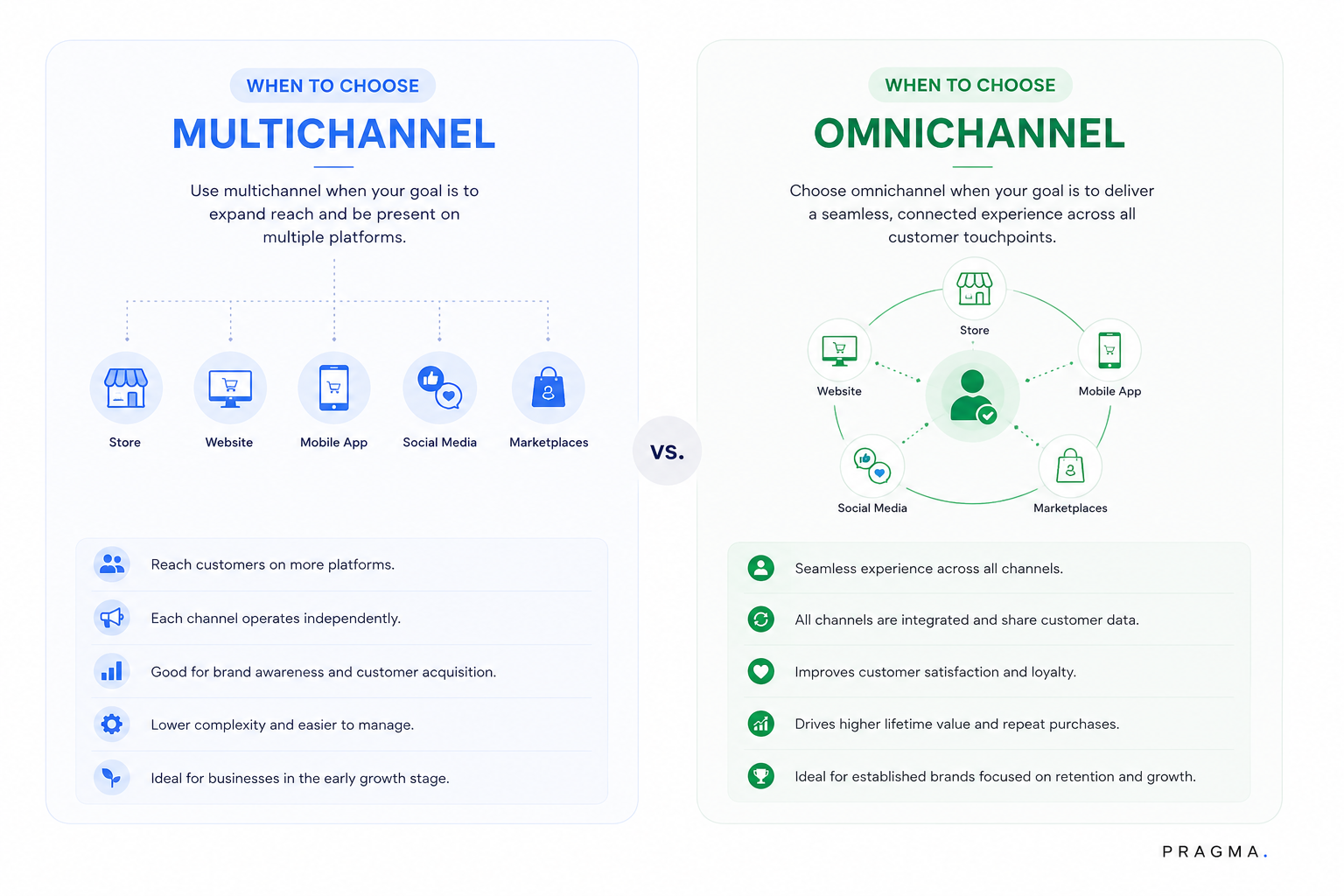
So, let us now come to the most interesting part of the blog, that is, what e-commerce brands should choose between the two marketing approaches.
When Should You Use Multichannel?
If you are an e-commerce brand that satisfies the following points, you should go towards multichannel commerce:
Early-Stage Ecommerce Brands
If you are an early-stage brand which has just started the business, it is good to go with multichannel. As it allows you to:
- Test different platforms quickly.
- Identify your most profitable channels.
- Build an initial customer base with limited resources.
Limited Resources
If you have limited resources in terms of money, technology and expertise, multichannel would be a great option for you.
As omnichannel requires significant upfront investment in technology, integration, and training, you can start with multichannel and evolve over time when you have sufficient resources to scale up your business.
Marketplace-First Strategy
If you are a brand whose only focus is to have a presence only on marketplaces such as Amazon and Flipkart, then a multichannel approach helps you:
- Establish presence across multiple marketplaces.
- Compare performance metrics
- Gradually build direct-to-consumer capabilities.
When Should You Use Omnichannel?
An e-commerce brand should choose omnichannel commerce if it satisfies the following criteria:
Scaling E-commerce Brands
When your brand has established a good market presence and has scaled over time, it is good to go with omnichannel commerce. The key indicators that state you have established yourself include:
- You are getting consistent monthly revenue growth.
- You have made multiple profitable marketing channels.
- You have established a customer base with repeat purchases.
- You are carrying on operational processes that can handle increased complexity.
High Customer Retention Focus
If your business model depends on repeat purchases, omnichannel is essential because it:
- Increases retention rates from 33% to 89%
- Reduces customer service costs through automation
- Enables predictive customer service
Multiple Fulfillment Centers or Stores
- If you have multiple warehouses, fulfilment centres, or physical stores, you need omnichannel strategies to optimise inventory allocation and order routing.
- If you deal in various geographical locations, you will need better omnichannel strategies that can deliver consistent experiences to your customers, regardless of local variations.
- If you are working with any franchise or retail partners, you will need omnichannel to maintain brand consistency.
Benefits of Multichannel and Omnichannel Commerce
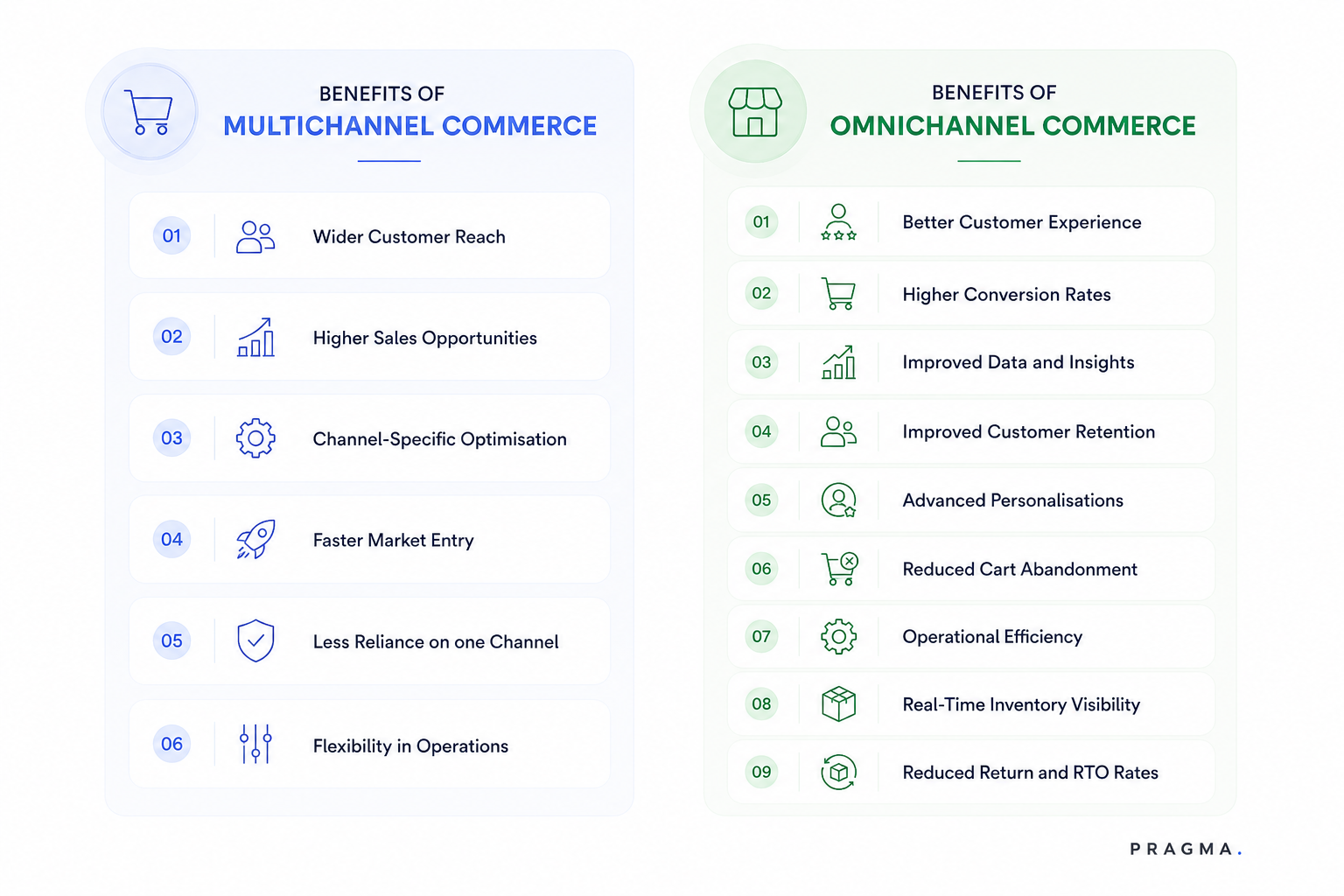
Both of the marketing approaches have their own advantages. Have a look at the following:
Benefits of Multichannel Commerce
- Wider Customer Reach: Multichannel selling enables brands to meet customers in the location of their choice, whether it be online or offline retail.
- Higher Sales Opportunities: The more channels, the more touchpoints there are, and a greater likelihood of product discovery and conversion.
- Channel-Specific Optimisation: Each platform can be customised to have unique pricing, promotions and messages according to the behaviour of the audience.
- Faster Market Entry: Brands can rapidly grow to new platforms (such as marketplaces or social commerce) without the need for full system integration.
- Less Reliance on one Channel: The revenue is spread across a variety of platforms, and in case any channel performs poorly, it will not affect other channels.
- Flexibility in Operations: Managerial teams have the freedom to work and test various strategies on their own or across channels.
Benefits of Omnichannel Commerce
- Better Customer Experience: Customers receive a well-rounded and coherent experience across all touchpoints, i.e., whether the customers browse on their mobile gadgets, purchase on their desktop computers, or visit a physical store.
- Higher Conversion Rates: Combined journeys (such as cart recovery, tailored offers and cross-channel interaction) minimise friction and enhance chances of buying. Solutions like 1Checkout by Pragma simplify the checkout experience across channels, helping reduce friction and improve conversion rates.
- Improved Data and Insights-By having unified data across channels, a full understanding of customer behaviour can be realised, and more accurate decision-making and performance tracking can be made.
- Improved Customer Retention: Engagement and personalised experiences create a stronger relationship, which amplifies repeat and long-term loyalty.
- Advanced Personalisations: With integrated customer data across channels, brands can make highly relevant recommendations, offers, and messages.
- Reduced Cart Abandonment: Lost sales can be recovered, and customers can be brought back to make full purchases by use of cross-channel follow-ups (WhatsApp reminders or email nudges).
- Operational Efficiency: The centralised systems minimise duplication of work, streamline operations and enhance coordination among teams.
- Real-Time Inventory Visibility: Single channel inventory eliminates oversales, out-of-stock items and unreliable supply.
- Reduced Return and RTO Rates: Open communication, proper expectations, and active updating help in minimising order cancellations and returns. Tools like Pragma RTO Suite help brands reduce return-to-origin (RTO) rates by automating COD verification, order confirmations, and delivery communication.
Challenges of Omnichannel vs Multichannel Commerce
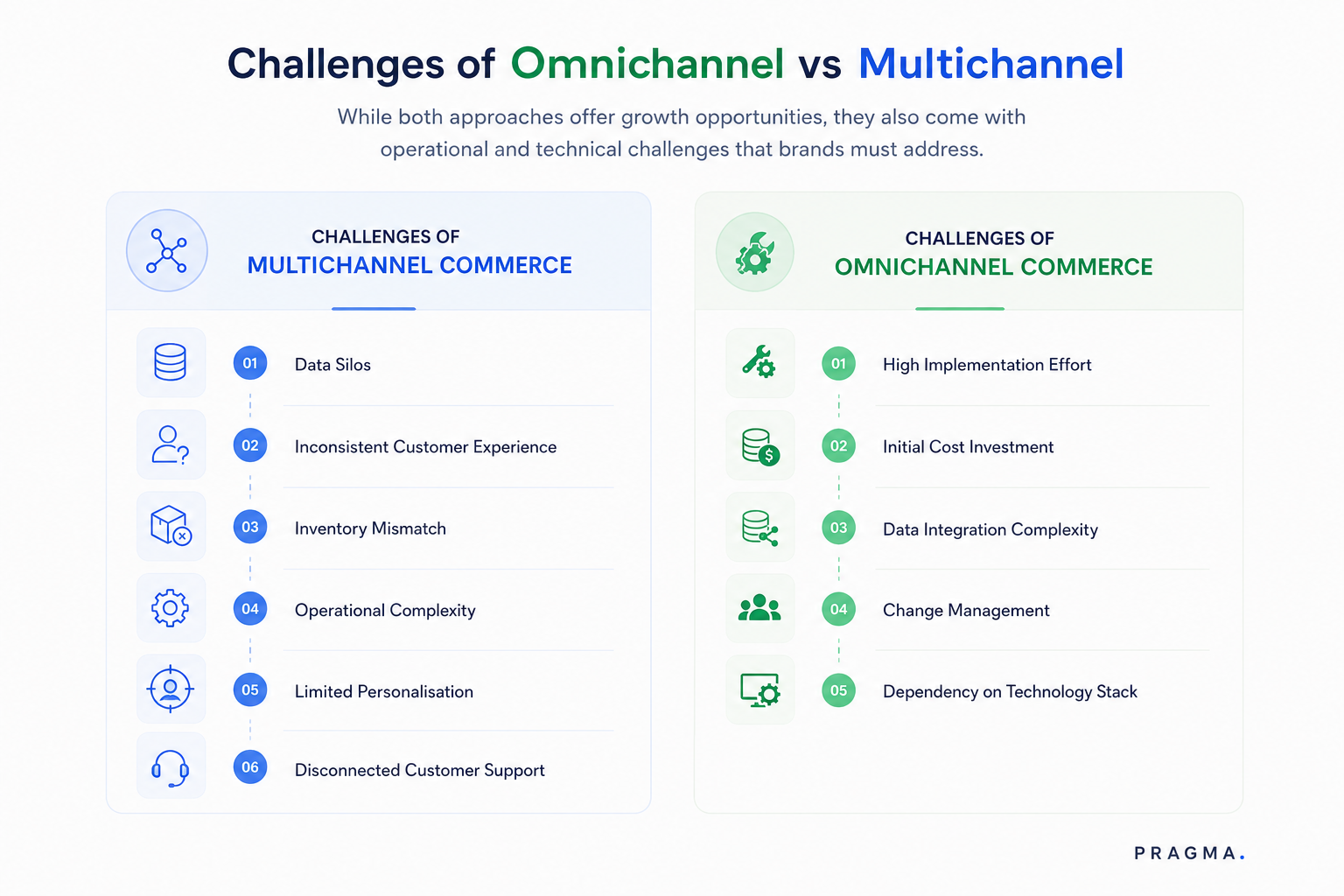
While both approaches offer growth opportunities, they also come with operational and technical challenges that brands must address.
Challenges of Multichannel Commerce
- Data Silos-The customer data is kept independently in the channels; thus, it is not easy to get a whole picture of customer behaviour.
- Inconsistent Customer Experience: The message, prices and quality of services might be different between platforms, and this may lead to confusion and loss of trust.
- Inventory Mismatch: Failing to have real-time sync may lead to overselling, stockouts or incorrect availability across channels.
- Operational Complexity: Managing multiple channels separately involves multiple teams, tools, and workflows, doubling the costs and inefficiencies.
- Limited Personalisation: When the data is fragmented, the brands are not able to offer highly relevant or contextual customer experiences.
- Disconnected Customer Support: The support teams may not have complete visibility, and thus, customers have to repeat problems in different channels.
Challenges of Omnichannel Commerce
- High Implementation Effort: The time, planning, and technical knowledge are needed to integrate various systems (CRM, inventory, communication channels).
- Initial Cost Investment: The cost of establishing centralised infrastructure and tools may be prohibitive, particularly when dealing with increasing brands.
- Data Integration Complexity: Real-time data synchronisation across platforms can prove to be a difficult task technically without appropriate systems.
- Change Management: The teams should be able to adjust to new workflows, tools, and processes, which at first can slow down the adoption process.
- Dependency on Technology Stack: The success of omnichannel depends on the availability of the appropriate platforms and integrations.
How to Transition from Multichannel to Omnichannel?
Transitioning from multichannel to omnichannel does not necessarily imply adding more channels but rather linking them together.
This involves bringing data, systems and communication together in order to develop a single customer experience.
Here is how an e-commerce brand can shift from multichannel to omnichannel:
Centralise Customer Data
The initial step is to remove data silos by integrating all the customer data into one system.
This includes:
- Purchase history
- Browsing behaviour
- The use of interchannel communication (WhatsApp, email, support).
By having centralised data, brands can:
- Develop the full profile of the customer.
- Provide personalised and regular experiences.
- Provide complete customer context to enable support teams.
Such platforms as Pragma Omnichannel CRM help consolidate customer data from all touchpoints into a single dashboard, so that brands can have a 360-degree view of each customer.
Integrate Inventory and Orders
A typical multichannel system has inventory and order data that are usually handled independently across platforms.
Brands to switch to omnichannel require:
- Inventory synchronisation in all channels in real-time.
- An integrated order management system.
This helps:
- To prevent stockouts and overselling.
- Make sure that there is proper availability of products at all times.
- Introduce such options as online purchases and pick-ups at the store.
Combining order and inventory, such a platform as Pragma can guarantee consistency and coordination of activities through all channels and eliminate operational errors and manual work.
Connect All Channels
Omnichannel is a way whereby all customer touch points are linked. This includes:
- Websites
- Marketplaces
- Social media
- Offline stores
In case all channels are connected:
- Customers can easily move between them.
- The interactions are used to follow the journey.
- Experiences remain consistent
Solutions such as Pragma Omnichannel CRM allow the brands to manage the interactions across WhatsApp, Instagram, email, and others through one interface, hence maintaining continuity in every interaction.
Automate Customer Communication
A manual communication method is not scalable in an omnichannel environment.
To provide timely and relevant interactions, automation is needed.
Key use cases include:
- Confirmations of orders and updates of deliveries.
- Cart abandonment reminders
- Post-delivery feedback requests
- Re-order and cross-sell suggestions.
Automation helps:
- Reduce support workload
- Improve response time
- Grow the involvement and conversions.
Through tools such as the automation engine, brands can prompt personalised, behaviour-driven communication across channels, enhancing their efficiency and customer experience.
Platforms like Pragma Omnichannel CRM make this transition easier by helping brands unify customer data, automate communication, and deliver consistent experiences across all channels.
Conclusion
The choice between multichannel and omnichannel depends on your business stage and growth priorities.
Multichannel is an easier way to start, whereas Omnichannel gives better results in the long run, with 89% customer retention rates and higher order rates.
For brands that sell directly to customers in India, moving from multichannel to omnichannel is becoming very important.
India's e-commerce market is growing fast. It is getting more expensive to get customers, and there is more competition. Brands that can give customers a personal experience at every touchpoint will be way ahead of the competition, reduce operational costs, and maximise customer lifetime value.
All they need to think about is their strategy and growth, and then choose between multichannel and omnichannel.

FAQs (Frequently Asked Questions On Omnichannel vs Multichannel: Key Differences for D2C E-commerce Brands)
1. What is omnichannel in eCommerce?
Omnichannel in eCommerce refers to a unified customer experience across all channels, where data, communication, and interactions are seamlessly connected across platforms like website, WhatsApp, marketplaces, and offline stores.
2. What is multichannel in eCommerce?
Multichannel in eCommerce refers to selling and engaging with customers across multiple channels, such as websites, marketplaces, and social platforms, but without deep integration or unified customer data across those channels.
3. What is the difference between omnichannel and multichannel in eCommerce?
The key difference is that omnichannel integrates all channels into a single, seamless experience, while multichannel operates channels independently. Omnichannel focuses on continuity, while multichannel focuses on presence.
4. Which is better for D2C brands: omnichannel or multichannel?
Omnichannel is generally better for D2C brands as it enables personalised experiences, better customer retention, and higher lifetime value, while multichannel is easier to implement but less effective in long-term growth.
5. Why is omnichannel important for eCommerce in India?
Omnichannel is important in India due to fragmented customer journeys across platforms like WhatsApp, Instagram, and marketplaces. It helps brands deliver consistent experiences and improve conversion and retention.
6. What are the benefits of an omnichannel strategy in eCommerce?
Benefits include improved customer experience, higher conversion rates, better retention, unified customer data, personalised communication, and more efficient marketing and support workflows.
7. What are the challenges of implementing omnichannel in eCommerce?
Challenges include integrating multiple systems, maintaining data consistency, managing customer journeys across channels, and ensuring real-time communication and visibility.
8. How does omnichannel improve customer experience?
Omnichannel improves customer experience by enabling seamless transitions between channels, consistent messaging, and personalised interactions based on unified customer data.
9. What tools are needed for an omnichannel eCommerce strategy?
Omnichannel strategies require CRM systems, customer data platforms, communication tools like WhatsApp, journey orchestration systems, and analytics platforms to unify and manage customer interactions.
10. Can multichannel businesses transition to omnichannel?
Yes, multichannel businesses can transition to omnichannel by integrating their systems, unifying customer data, and creating connected customer journeys across all touchpoints
Talk to our experts for a customised solution that can maximise your sales funnel
Book a demo
.webp)

.png)