

As we know, the e-commerce market in India is growing day by day. With the growth in the e-commerce sector, the number of people using it is also increasing, and along with that, their expectations are also increasing.
Every customer wants faster deliveries; over 60% of Indian consumers consider delivery speed and reliability as the primary reason for repeat purchases.
With this expectation, it has placed immense pressure on last-mile delivery, the most complex and cost-intensive part of the logistics chain. Studies show that last-mile delivery alone accounts for nearly 45–55% of total logistics costs.
This last-mile delivery comes with a lot of challenges that impact the online retailers and their profitability. Here, we will discuss "Challenges in Last-Mile Delivery for E-commerce in India: A Complete Guide" and will see how an e-commerce business can handle them well.
What Is Last-Mile Delivery?
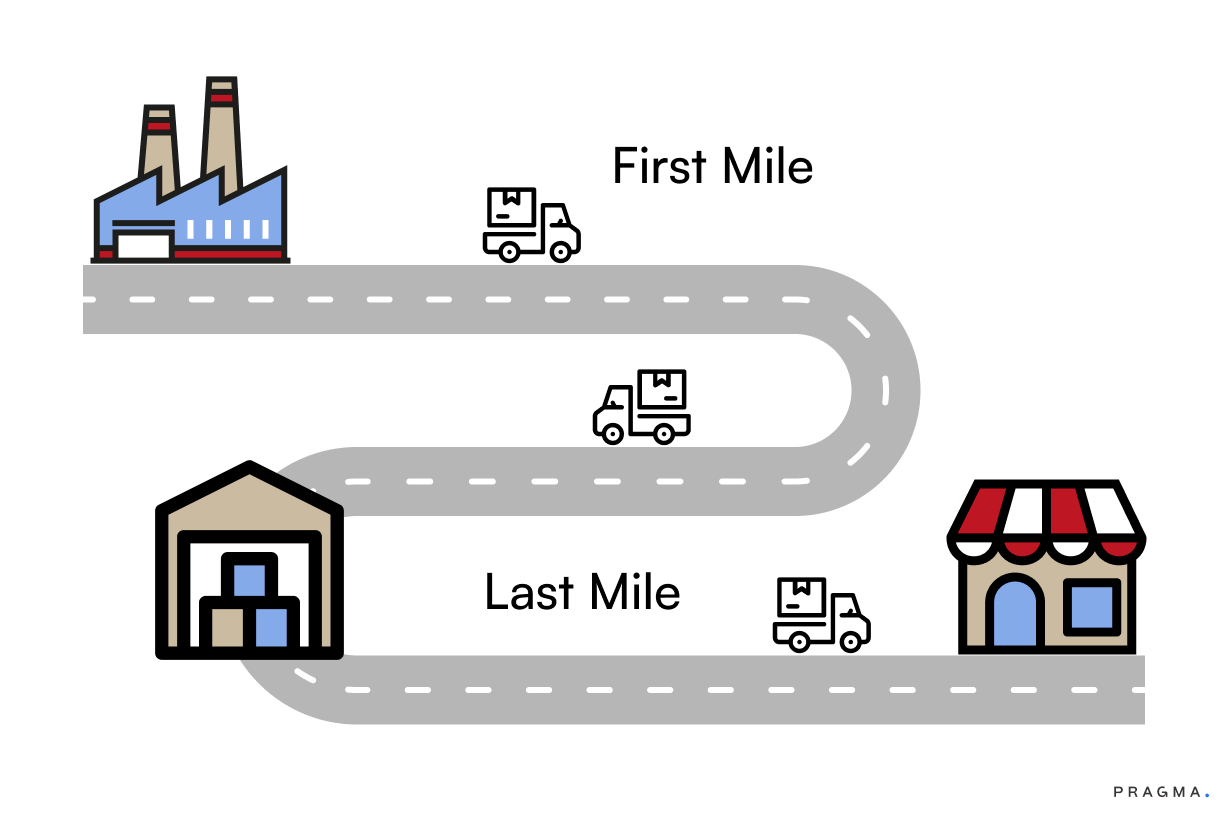
Last-mile delivery is the final step of the logistics process, which involves the transportation of goods delivered to the end customer at his or her location, from a distribution hub or fulfilment centre. This may be their house, office or a place where they pick up.
Here, the product has smoothly sailed through the manufacturer to many warehouses and distribution centres. Still, the last handoff to the customer is, in most cases, the most challenging and costly of the whole journey.
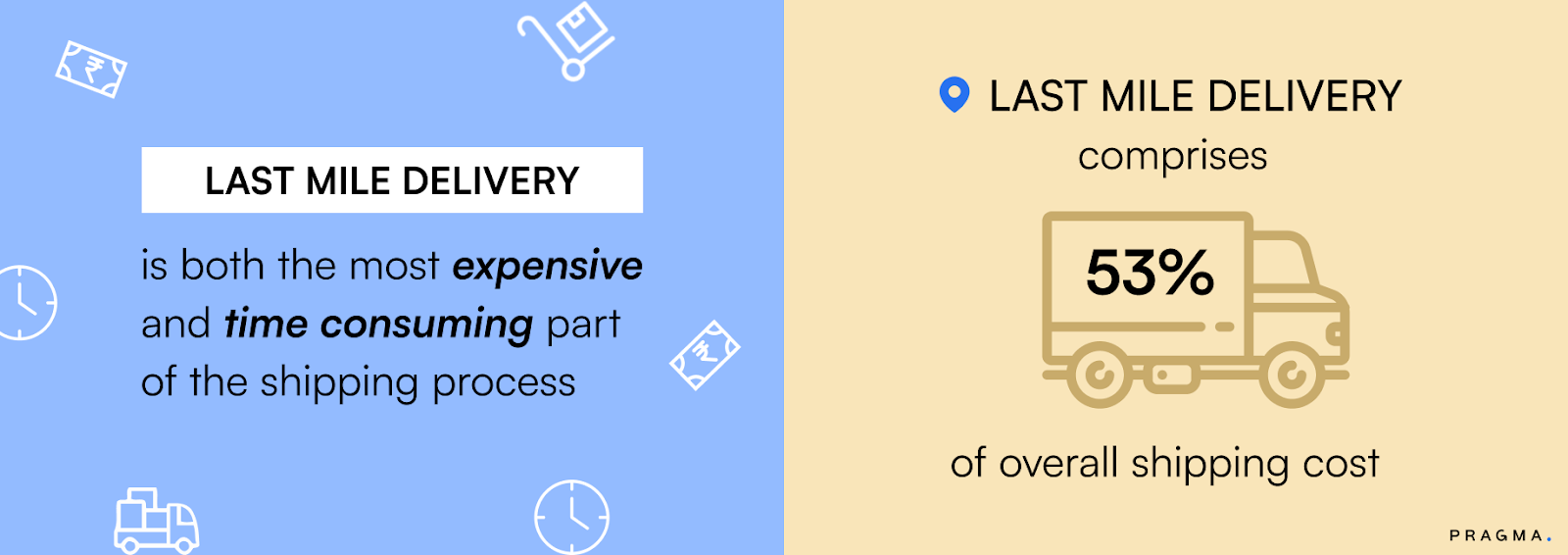
Research in the industry showed that last-mile delivery can constitute up to 53% of the entire shipping, thus it is the most costly part of the whole supply chain.
Why Last-Mile Delivery Is Critical for E-commerce?
As last-mile delivery involves the final delivery of the product to the customer, it is obviously an important part of e-commerce. But apart from this, many reasons make it important for any e-commerce business:
Customer Satisfaction and Loyalty
Studies indicate that 98% of consumers state that the delivery experiences affect their brand loyalty, and 84% of them are unlikely to repeat a purchase once they have an unpleasant experience with the delivery.
This implies that, despite having the best product and at the best price, the experience of delivery will make or break a customer in the future for an e-commerce brand.
Impact on Brand Reputation
Along with the product quality, the most important thing to a customer is the delivery. Every customer today needs faster and hassle-free deliveries. Also, some of the people or influencers talk about it on social media channels, which directly impacts the brand image.
So, if there is any kind of problem related to last-mile deliveries, it can create a negative impact on the brand's reputation.
Revenue and Growth Impact
The companies that have better last-mile delivery services usually experience:
- Increased customer retention levels up to 25% improvement.
- Growth in the number of satisfied customers.
- High-end prices for the option of faster delivery.
- Lower costs of acquiring customers via positive word-of-mouth.
Market Differentiation
Today, the e-commerce sector has become so competitive that there are a lot of brands that are offering or dealing with the same kind of product niche.
And if a brand wants to stand out from this competition, the delivery experience that they provide to their customers can help them a lot.
The brands that offer superior last-mile delivery experiences can capture a larger share of the market.
What are the Challenges in Last-Mile Delivery?
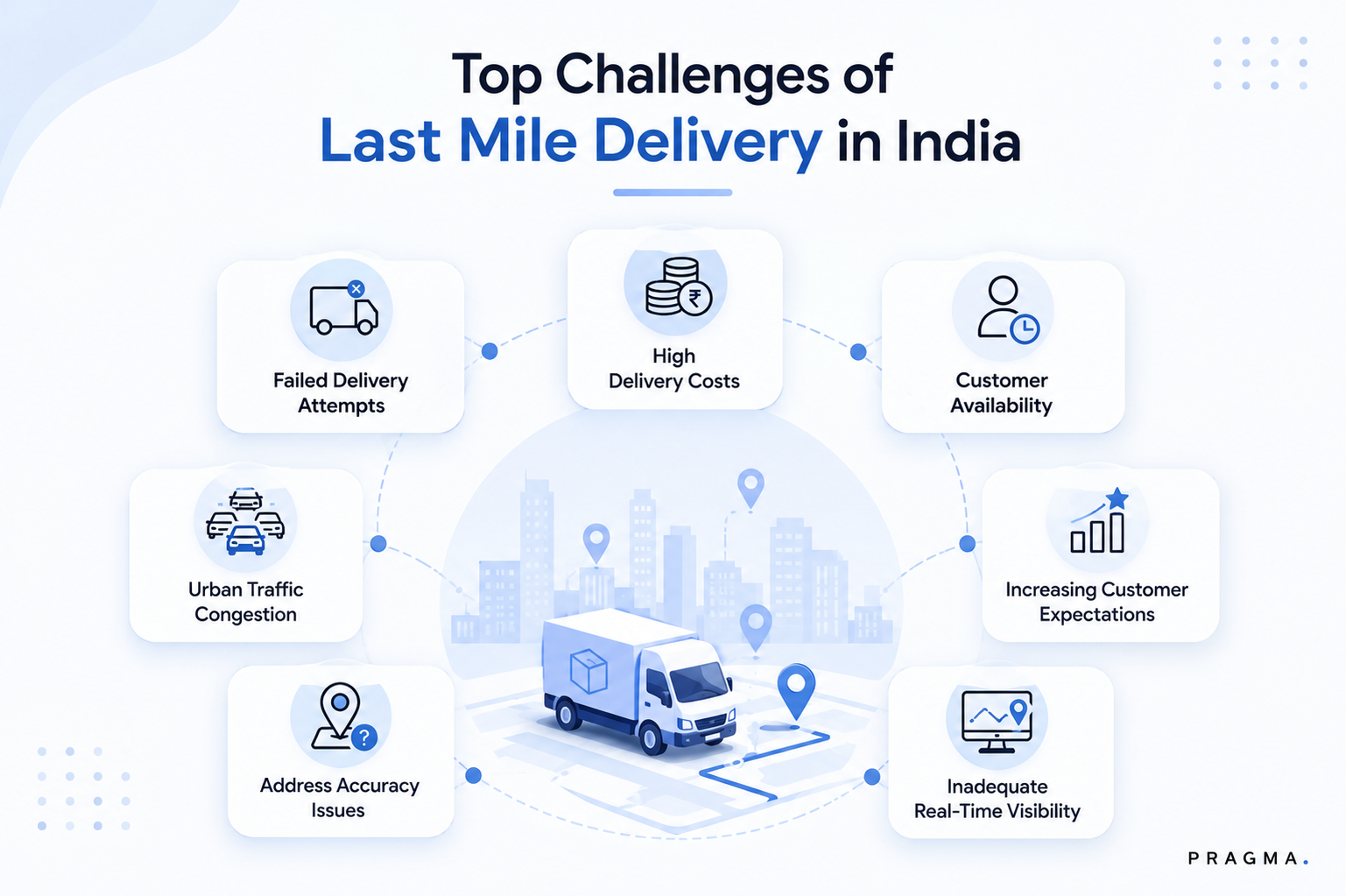
The following are the challenges in last-mile delivery that every e-commerce brand has to deal with in business:
High Delivery Costs
High Delivery costs are one of the last-mile delivery challenges. The expenses are excessive because of a number of interrelated factors:
Cost Breakdown:
- Fuel prices: City deliveries necessitate manoeuvring along busy roads, which use up to 40% of fuel as compared to highway deliveries.
- Labour cost: Wages, training and insurance of the drivers are on the increase.
- Maintenance of vehicles: Traffic congestion and regular deliveries cause congestion, which amplifies wear and tear.
- Infrastructure expenses: Warehousing, sorting facilities and technology investments.
Some costs seem hidden but have a great impact:
- Attempts of failed delivery: The cost of delivery may rise twice or even thrice when delivery is failed.
- Return processing: Processing of returns increases the total logistics costs by 20-30%.
- Customer service: WISMO (Where Is My Order) telephones and call answering.
- Inventory holding: Stock held in transit is a binding on working capital.
Research indicates that, on average, the cost of delivery in India is Rs 100-200 per town delivery and Rs 250-400 per rural area delivery. This seems to be a lot with a high number of orders. But with Pragma ShipAxis, brands can reduce their delivery costs. It provides AI-powered route optimisations across carriers, which helps to lower their cost by 10- 20% per delivery.
Failed Delivery Attempts
One of the most important issues of Indian e-commerce is failed deliveries, which has become one of the challenges in last-mile delivery. Here are some statistics related to failed deliveries:
- Failure rate in the industry: 15-25% of all first delivery attempts fail.
- Cost impact: Every failed attempt would increase the cost of delivery twofold.
- Customer effect: 67% of the customers who are frustrated after failing to receive delivery are upset after the first attempt.
There are a lot of reasons behind failed deliveries:
- Unavailability of customers (45% of cases)
- Wrong or missing addresses (25% of cases)
- Security limitations in residential-commercial complexes (15 per cent of cases)
- COD orders (10% of cases) have payment problems.
- Delay due to weather or traffic (5% of cases)
And how does this failed delivery impact the business?
Whenever a business incurs a failed delivery, it has to store the product in a local hub, which increases the cost. To deliver the product, it consumes fuel and labour.
Deliveries failed due to business errors, which can create a negative impact on the brand's image. So, a failed delivery can hurt a brand's reputation, as well as profitability and cause higher expenses.
Urban Traffic Congestion
Indian cities face a lot of traffic, which becomes one of the last-mile delivery challenges in India.
- The delivery times of Mumbai and Delhi are at least 35% longer in the peak hours than in the off-peak hours.
- Traffic congestions raise the use of fuel.
- Windows of delivery become erratic.
- The productivity of drivers has reduced.
The World Economic Forum estimates that last-mile deliveries will grow by 78% in the world by the year 2030, and the number of delivery vehicles will grow by 36% within the large cities. Such growth will probably lead to a 32% rise in emissions and 21% in traffic congestion.
Address Accuracy Issues
One of the challenges in last-mile delivery is the issues with the addresses of customers. Contrary to developed nations that have a standardised system of addresses, India still tends to use landmark directions, which causes major problems:
- The address information is not complete.
- Absence of building names or floor numbers.
- Language differences between customers and delivery-people.
- Informal addressing conventions
With Pragma, businesses can automate address validations and landmark mapping, which helps in improving 40% of first-attempt successful deliveries.
Customer Availability
Most of the failures occur due to the reason that the customer is not available at the time of delivery. The current urban living creates availability problems:
- Employed workers are off during the regular hours of delivery.
- Residential complexes have security restrictions.
- Trying to deliver to customers who are not available.
This customer unavailability becomes one of the challenges in last-mile delivery for an e-commerce business. But this challenge can be solved with the help of Pragma, which provides real-time customer alerts and rescheduling, and this helps in reducing approximately 30% of failed deliveries.
Increasing Customer Expectations
Today's customers expect:
- Delivery within the same or the next day (70% of millennial shoppers would prefer a 1-hour delivery option)
- Real-time tracking updates
- Flexible delivery windows
After customers make orders, 30% of them change the date, time and address of delivery. This is one of the most common last-mile delivery challenges in India.
Inadequate Real-Time Visibility
Various logistics operations do not provide the following essentials:
- On-demand tracking features.
- Active communication on delays.
- Quickness in reaction to disturbances.
- Clearly displayed delivery status updates.
And not providing customers with real information dissatisfies them a lot; the number of WISMO queries also increased due to the lack of updates.
But with Pragma ShipAxis, this problem can be solved as it can fetch instant shipment updates directly from over 150 courier partners in India, ensuring 100% accuracy.
Last-Mile Delivery Challenges in India
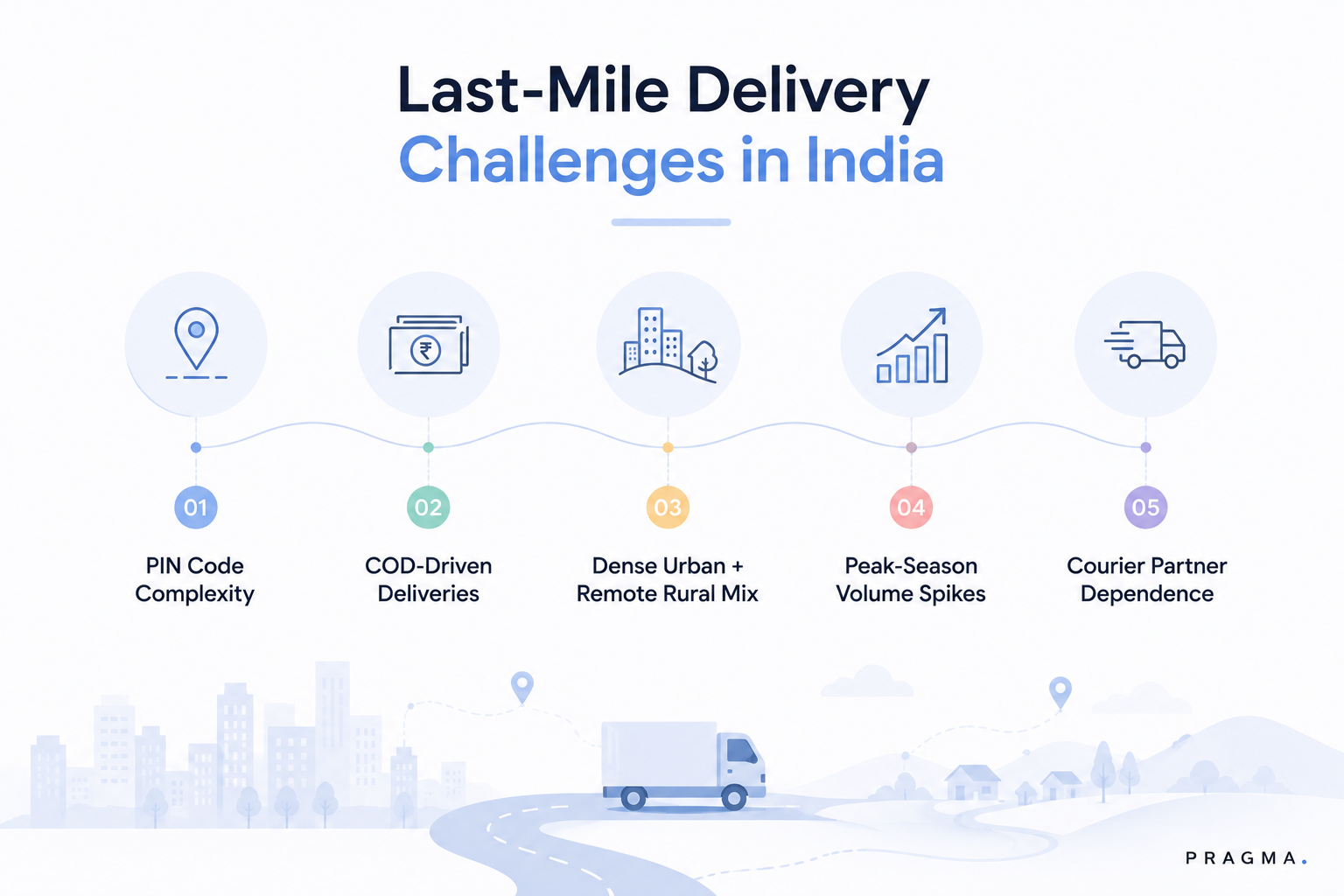
Now, let's have a look at the specific last-Mile delivery challenges in India:
PIN Code Complexity
In India, there are more than 19,000 PIN codes, with most of them having huge or unequal zones.
Partial/inaccurate addresses in many cases cause delays in delivery, unsuccessful delivery and an increase in the operational expenses to e-commerce companies.
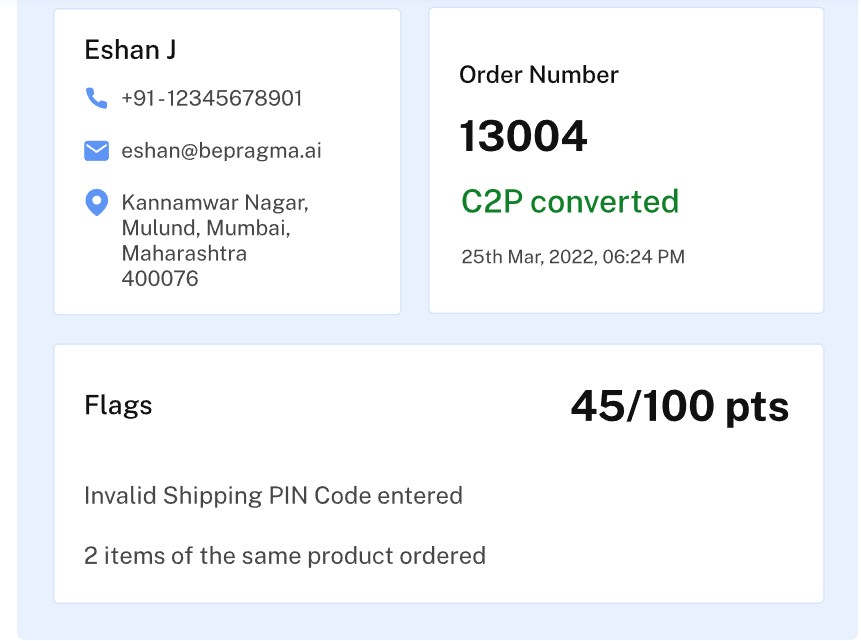
To avoid address errors, Pragma RTO Suite screens the customer info when an order is placed, such as address, pincode, phone number, etc., are verified and auto-corrects if needed. Also, it helps to flag risky orders from temporary or wrong addresses so that no efforts are wasted to fulfil such orders.
COD-Driven Deliveries
Cash on Delivery (COD) has continued to be very popular in India, particularly in Tier 2, Tier 3, and rural markets.
Although it enhances the trust of a customer, COD raises the return-to-origin (RTO) rates, cash handling risks, and reconciliation problems. And to solve this problem, Pragma RTO Suite helps e-commerce businesses convert their COD orders into prepaid ones through their C2P strategy. With this, businesses see a 25 to 35% increase in paid orders.
Dense Urban + Remote Rural Mix
Deliveries within congested metro areas have challenges of traffic, parking and access, whereas rural areas have challenges of poor connectivity and a lack of proper delivery infrastructure.
The ability to have both extremes operating on a single logistics model is a challenge.
Peak-Season Volume Spikes
Order volume may increase by 3-5 times during festivals and major sales events.
Surging waves can affect warehouses, delivery fleets, and courier networks, which can affect delivery schedules and customer experience.
Courier Partner Dependence
The majority of e-commerce brands are heavily dependent on third-party courier partners.
The success and satisfaction of delivery and customer satisfaction can directly be influenced by service quality, coverage gaps, changes in pricing, and capacity limitations.
To select the best courier partner, Pragma ShipAxis helps brands in this by selecting the best courier partner according to area, cost, and delivery performance.
What is The Impact of Last-Mile Challenges on E-commerce Businesses?
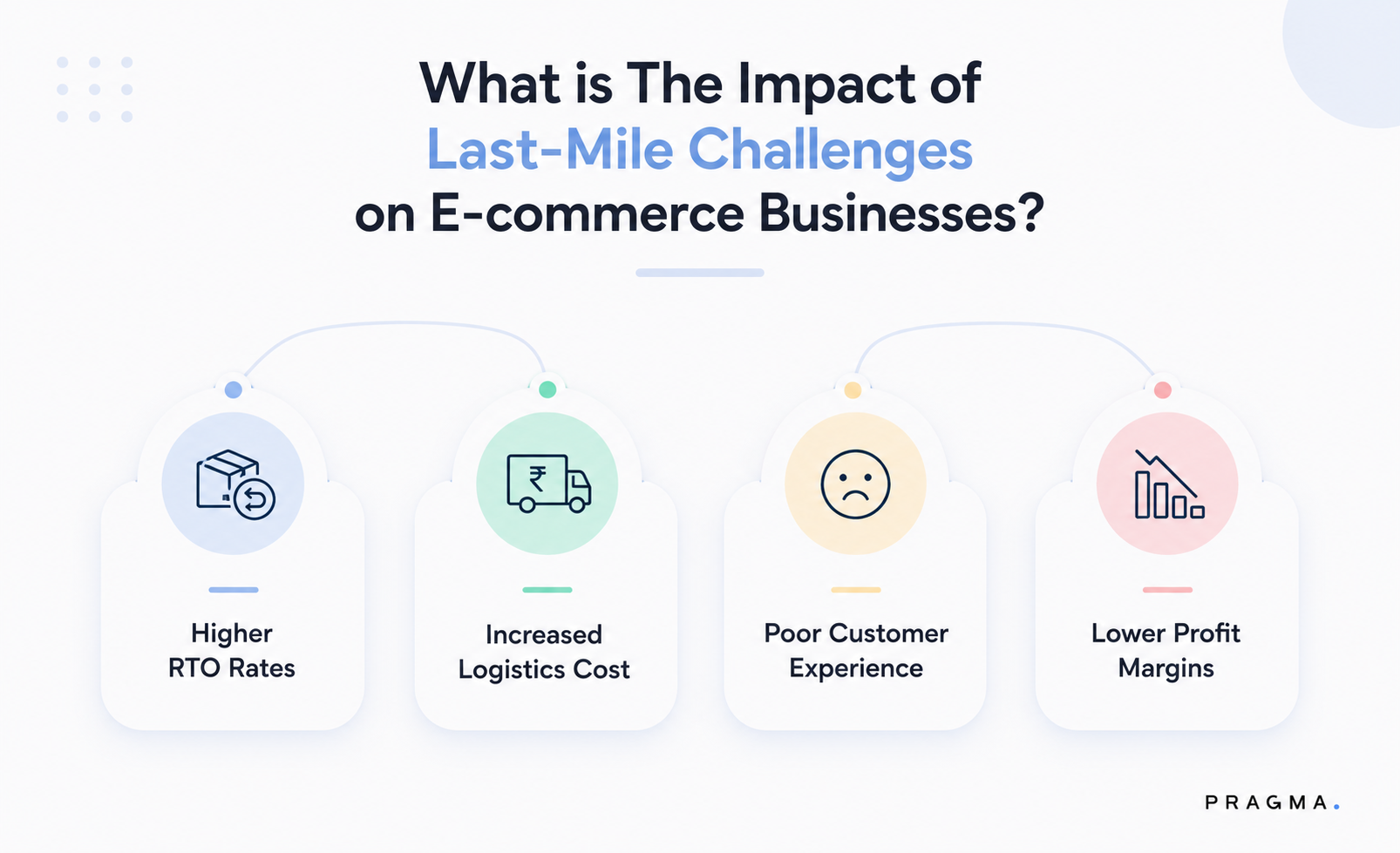
See, what impact do last-mile delivery challenges have on an e-commerce business:
Higher RTO Rates
Unexpected failures as a result of wrong addresses, unavailability of customers, or the rejection of the cash on delivery increase RTO rates.
In India, the RTO rates range from 15-30% depending on product categories, and even go as high as 40% in the fashion and footwear industry.
And this has a direct impact on the operational performance of e-commerce companies in India.
Increased Logistics Cost
The final stage of the supply chain is last-mile delivery, which is the most costly one.
Re-deliveries, change in fuel prices, and manual delivery cost considerably add to the per-order delivery price, particularly in remote as well as low-density locations.
Poor Customer Experience
Delays in delivery, unsuccessful delivery services, and non-real-time tracking decrease customer trust.
In the modern competitive market, a single negative experience of delivery may make customers change and use a different platform.
Lower Profit Margins
Increasing delivery costs, high rates of returns, and customer refunds reduce the profit margins.
Last-mile optimisation is necessary to scale operations, and e-commerce businesses cannot sustain without it.
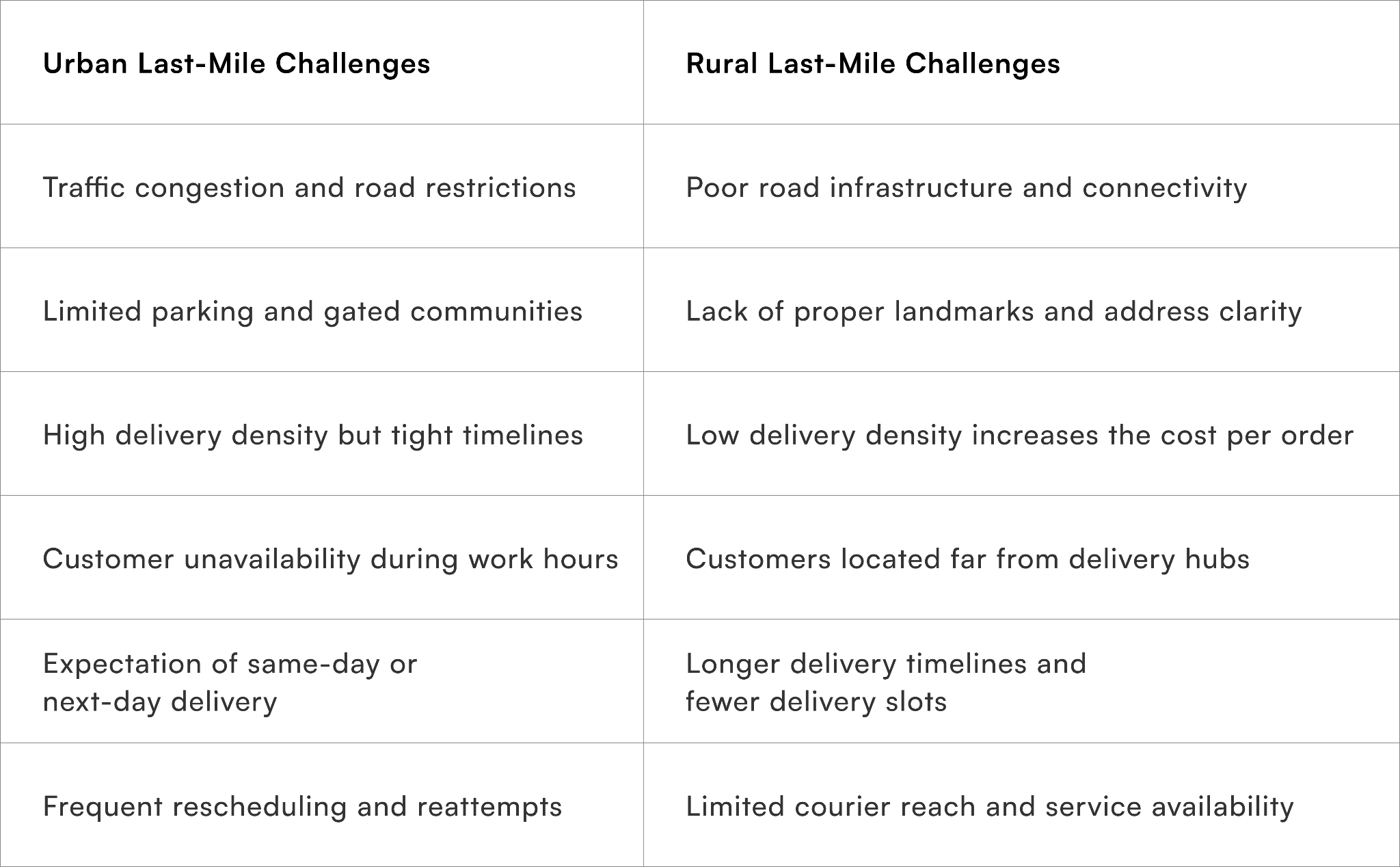
Urban vs Rural Last-Mile Challenges
Last-Mile Delivery and Reverse Logistics
Last-mile delivery and reverse logistics are closely connected in e-commerce operations. Whereas last-mile delivery aims at achieving successful delivery of orders to customers, reverse logistics is related to product reversal because of failures to deliver the product, customer rejection, cancellations or exchanges.
Reverse logistics in a market such as India is more complicated due to high cash-on-delivery rates, wrong addresses, and unavailability of customers.
Every returned delivery or failure costs additional transportation, handling, and restocking. It also expands delivery periods and strains the resources of the warehouse and the courier.
The effective interaction of last-mile delivery and reverse logistics allows reducing the return to origin (RTO) rates, improving the work with inventory, and increasing customer satisfaction.
E-commerce companies that manage both processes simultaneously have better opportunities to regulate the costs, keep the delivery pace, and increase the sustainability of operations.
How E-commerce Brands Can Address Last-Mile Challenges?
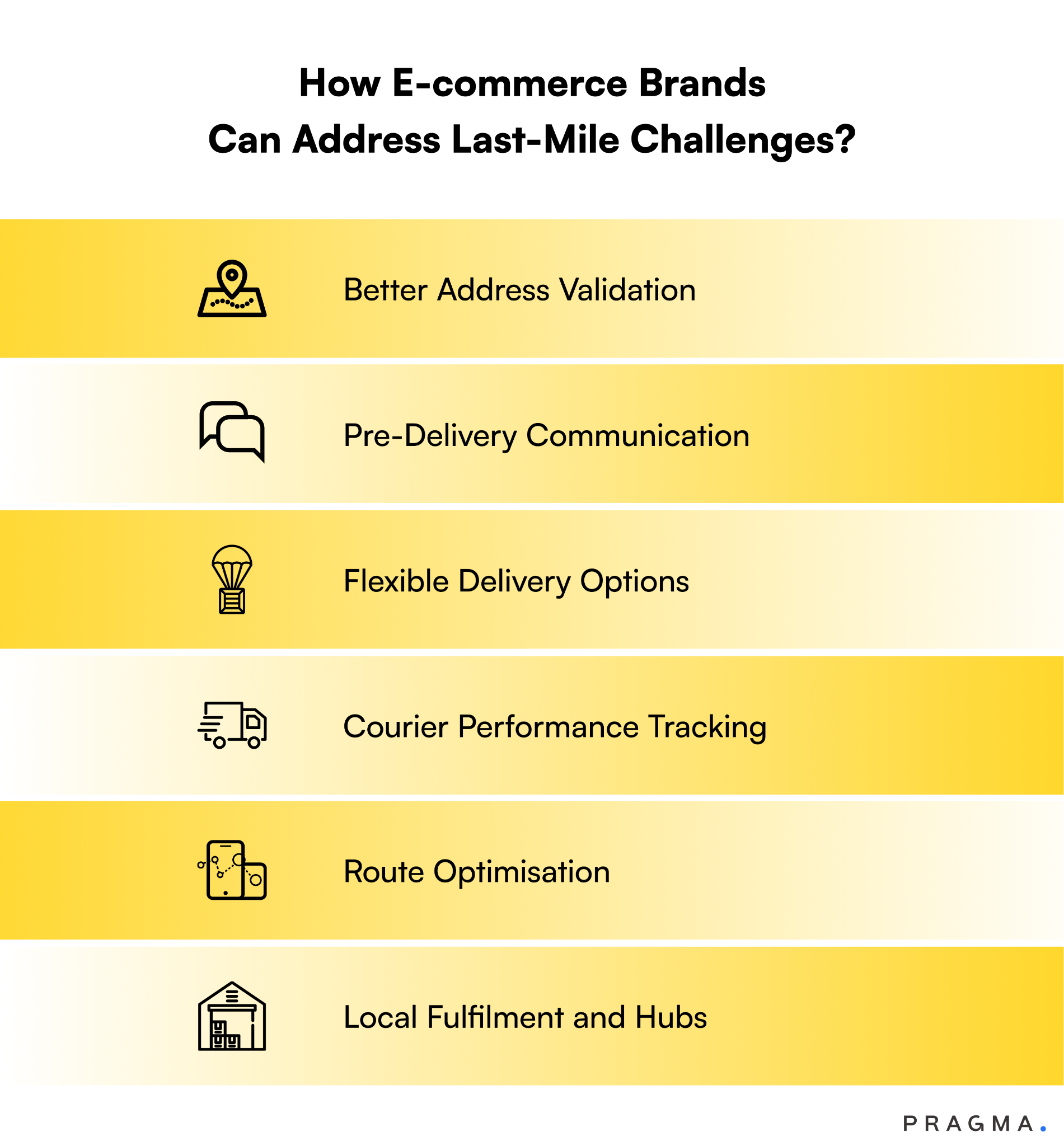
Here is how e-commerce brands can address the various challenges in last-mile delivery:
1. Better Address Validation
Incorrect or incomplete addresses are one of the biggest reasons for failed deliveries, delays, and RTOs, and this is also one of the greatest last-mile delivery challenges in India.
But with proper checking of the address through systems, brands can reduce this challenge. And Pragma helps in this. It checks addresses at an initial stage of the order trip by identifying incomplete, risky and non-serviceable addresses before delivery. This minimises the confusion of couriers and avoidable delivery failures.
And, what impact does it have:
- Fewer failed deliveries
- Lower RTO costs
- Increased success of the initial delivery.
2. Pre-Delivery Communication
Customers often miss deliveries because they aren't informed about delivery dates, ETAs, or courier attempts.
To solve this, Pragma allows automatic update of orders during pre-delivery through SMS, WhatsApp, or email-status of orders, approximate delivery dates, and courier information. Customers have time in anticipating the delivery of the order.
3. Flexible Delivery Options
Stiff delivery schedules do not apply to the modern consumers who might not be present at a given time and place.
Pragma allows flexibility in delivery, such as rescheduling, different delivery dates and preference-based processing via order and communication processes.
4. Courier Performance Tracking
Not all courier partners perform equally across regions. Without data, brands can't identify underperforming partners.
Pragma ShipAxis helps to monitor the courier performance based on location, speed of delivery, NDR rate and success rate- enabling brands to make smarter courier choices.
5. Route Optimisation
Unproductive delivery channels increase delivery period, fuel expenses, and final-mile spending- particularly in congested or complicated areas.
Through historical delivery statistics, locality analysis, and courier statistics.
Pragma allows smarter decisions in routing strategies so that the distance travelled and the time taken to deliver any shipment can be minimised.
6. Local Fulfilment and Hubs
When all orders are shipped from a single large warehouse, it will take more time to deliver to Tier-2 and Tier-3 cities.
Pragma helps fulfilment models serve the regions through the integration with local warehouses and 3PL hubs, which enable the brands to service an order nearer to the customers.
What is the Role of Technology in Solving Last-Mile Problems?
Technology is also important in correcting last-mile delivery challenges by increasing accuracy, speed and controlling costs.
The route optimisation systems aid delivery agents in avoiding traffic and developing a wiser route, which minimises delays and fuel costs.
The customers are kept aware by real-time tracking and automatic alerts, reducing the number of missed deliveries and reattempts.
Address validation and location mapping tools are used to manage the complexity of PIN-codes and ambiguous addresses, particularly in semi-urban and rural locations.
Simultaneously, cash on delivery failures and RTO rates are minimised using digital payments and prepaid methods.
All in all, technology is what helps e-commerce companies in India to provide faster service, lower costs, and offer an enhanced customer experience.
Which Key Metrics Ecommerce Brands Should Track?
The following key metrics should be tracked by the e-commerce brands:
Delivery Success Rate
This indicator shows the percentage of orders that are successfully delivered on the first attempt. High rate of delivery success means proper addresses, sound courier partners and efficient last-mile logistics. The target should be 95%+ first-attempt delivery success.
RTO Percentage
RTO percentage is used to determine the number of orders returned to the seller as a result of delivery failures, refusals, or cancellations.
This high rate of RTO incurs more costs in reverse logistics and prevents inventory.
Monitoring this assists brands in determining problems pertaining to cash on delivery, fixing mistakes, or locations.
Average Delivery Time
Average delivery time indicates the speed with which orders are dispatched to the customers.
Rapid delivery leads to higher customer satisfaction and repeat purchases, whereas delays reduce the brand trust and conversions. The following should be the ideal delivery time:
- Urban areas: 1-2 days
- Rural areas: 3-5 days
Courier-Wise Performance
This measure is used to rank the various courier partners on the basis of success in delivery, RTO rates, delivery time, and service coverage.
Courier-level performance tracking enables e-commerce brands to select the right partners, negotiate lower prices, and have a stable quality of delivery across regions.
What is the Future of Last-Mile Delivery in India?
Technology, automation, sustainability, and increased demands on the speed of delivery will be the forces shaping the future of last-mile delivery in India.
Since e-commerce is spreading into Tier-2, Tier-3 and rural regions, logistics firms are incurring high investments to minimise their expenses, enhance their delivery time, and manage the high level of orders with high efficiency.
The main trends that are forming the future are:
- Artificial intelligence-based route optimisation and automation to minimise the delivery time and fuel expenses.
- Growth of hyperlocal and fast-commerce strategies of same-day and instant delivery.
- Green logistics and electric vehicles (EVs) to reduce carbon footprint and operating costs.
- Massive investments in infrastructure in sorting centres and fulfilment facilities.
Have a look at some of the recent examples:
- DHL declared an investment of EUR 1 billion in India until the year 2030 to enhance infrastructure and technology regarding logistics.
- Shadowfax introduced automatic mega-sorting centres to cope with increasing e-commerce volumes better.
- Velocity invested an amount of more than Rs. 100 crore in developing AI-based, integrated logistics.
- Developers of e-commerce are moving swiftly towards EV delivery fleets and micro-fulfilment centres to facilitate deliveries that are faster and greener.
To Wrap It Up
So, to conclude here, we want to say that the challenges in last-mile delivery are real, but with proper management and use of technological systems, these last-mile delivery challenges in India can be handled well.
And if a business wants to be successful and sustain itself in the long run, it must handle last-mile deliveries with great caution. It is the final step of the logistics that has to be completed well in order to make the order successful.
And for helping all D2C e-commerce brands here, Pragma is always here with its D2C operating system that provides end-to-end e-commerce solutions to e-commerce brands in India.

FAQs (Frequently Asked Questions On Challenges in Last-Mile Delivery for E-commerce in India: A Complete Guide)
1. What is last-mile delivery in e-commerce?
Last-mile delivery refers to the final stage of the delivery process, where the order is transported from a distribution hub or local warehouse to the customer’s doorstep.
2. Why is last-mile delivery challenging in India?
India presents challenges such as inconsistent address formats, narrow or congested roads, high COD usage, Tier-2 and Tier-3 accessibility issues, traffic delays, and varied infrastructure quality.
3. How does Cash on Delivery (COD) impact last-mile delivery?
COD increases delivery risk due to higher refusal rates, customer unavailability, and payment collection issues, which often result in Return to Origin (RTO).
4. What are the biggest operational challenges in last-mile delivery?
Key challenges include inaccurate addresses, delivery rescheduling, rider shortages, high fuel costs, failed delivery attempts, poor route optimisation, and inconsistent courier performance.
5. How do failed deliveries affect e-commerce brands?
Failed deliveries increase shipping costs, raise RTO rates, delay revenue realisation, increase support workload, and negatively impact customer satisfaction.
6. Why are Tier-2 and Tier-3 markets harder for last-mile logistics?
These markets often face infrastructure gaps, limited courier coverage, ambiguous landmarks, lower prepaid adoption, and higher COD refusal rates.
7. How can address validation improve last-mile success?
Pincode verification, auto-suggested address fields, landmark prompts, and mobile number validation reduce NDR cases and increase first-attempt delivery success.
8. How does technology help solve last-mile delivery challenges?
Technology enables route optimisation, real-time tracking, automated NDR management, courier scorecards, and predictive risk scoring to improve delivery efficiency.
9. What KPIs should brands track for last-mile performance?
Important metrics include first-attempt delivery rate, on-time delivery (OTD), RTO percentage, NDR rate, cost per shipment, and courier-wise SLA performance.
10. How can e-commerce brands optimise last-mile delivery in India?
Brands can optimise last-mile performance by using multiple courier partners, implementing risk-based COD controls, automating delivery confirmations, improving address quality at checkout, and monitoring real-time performance analytics.
Talk to our experts for a customised solution that can maximise your sales funnel
Book a demo

.png)