

Most brands track SLA breaches. Far fewer know how to monetise them. When delivery timelines slip or service commitments fail, teams usually escalate operationally, chasing updates, pushing partners, and resolving tickets defensively, but stop short of structured financial recovery. The outcome is predictable: losses quietly absorbed, penalties applied inconsistently, and negotiating leverage eroded over time.
What is often missing is not intent, but structure. Settlement should not feel adversarial; it should feel procedural. In SLA breach settlement: negotiation templates and evidence packet design, we explore how disciplined workflows turn breach detection into measurable recovery. That means designing evidence packets that stand up to scrutiny, defining financial impact clearly, and entering negotiations prepared rather than reactive.
Without time-stamped data, documented clauses, and quantified exposure, discussions with carriers or vendors drift into opinion. With them, settlement becomes systematic. And in high-volume D2C environments, that system is the difference between leakage and leverage.
Why do most SLA breach settlement conversations fail?
Weak documentation undermines negotiation leverage
Most settlement discussions collapse long before negotiation begins. The issue is rarely intent; it is preparation. Brands escalate breaches emotionally — citing delayed deliveries, customer dissatisfaction, and revenue loss — but fail to present structured, time-stamped evidence.
Carriers and service providers respond predictably. They request proof. They question breach qualification criteria. They dispute calculation methods. Without standardised documentation, the burden of validation shifts entirely onto the brand.
In many cases, breach identification itself is inconsistent. Teams detect delays, but classification varies by region, carrier, or account manager. When the foundation is weak, settlement discussions become anecdotal rather than contractual.
Disciplined SLA breach settlement negotiation begins before the conversation. It starts with clear breach definition, measurable proof, and documented financial impact. Without these elements, leverage is minimal and recovery inconsistent.
What qualifies as a defensible SLA breach settlement claim?
Clarity in breach criteria strengthens financial recovery
Not every delay qualifies for settlement. The distinction between operational inconvenience and contractual breach must be explicit.
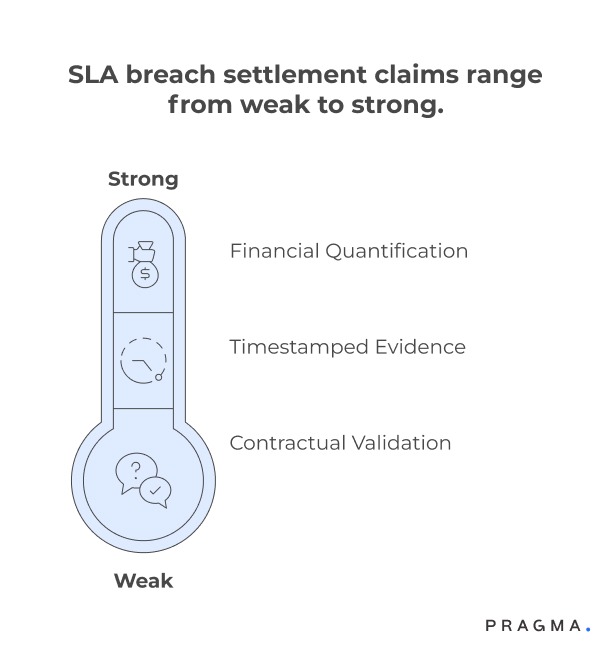
A defensible claim typically requires three aligned components:
First, contractual validation. The breached parameter delivery TAT, first attempt timeline, pickup SLA, response SLA must be clearly defined within the agreement. Ambiguity weakens position.
Second, timestamped evidence. Data should demonstrate:
- Order creation time
- Carrier pickup time
- Delivery attempt timestamp
- Final resolution timestamp
This is where structured detection frameworks such as SLA breach detection materially strengthen claims. When breach identification is automated and time-bound, subjectivity reduces.
Third, financial quantification. Settlement for SLA violations becomes persuasive when the monetary impact is calculated transparently including penalty percentage, freight impact, and volume-level aggregation.
Without these three layers, settlement discussions shift from enforcement to persuasion.
How should you structure an SLA penalty settlement process?
Standardisation prevents ad hoc negotiation
An effective SLA penalty settlement process must operate on cadence, not crisis. Waiting until breach volumes accumulate erodes leverage and delays recovery.
A disciplined process includes three structural phases
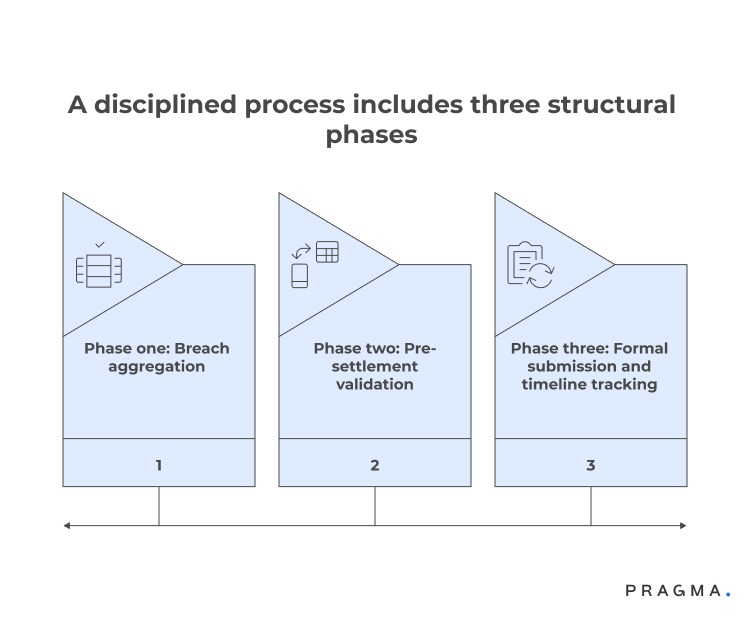
Phase one:
Breach aggregation. Instead of negotiating case by case, cluster validated breaches into periodic settlement batches — weekly or monthly depending on volume. Aggregation improves efficiency and strengthens negotiating weight.
Phase two:
Pre-settlement validation. Share preliminary breach summaries with carriers before formal submission. This reduces surprise friction and surfaces data discrepancies early.
Phase three:
Formal submission and timeline tracking. Every settlement request should include a documented response window and escalation pathway. Without defined timelines, discussions drift.
Frameworks outlined in SLA breaches in e-commerce often highlight how detection without structured enforcement results in limited financial recovery. Detection identifies opportunity; structured settlement converts it into revenue protection.
A predictable process signals operational maturity.
Why does evidence packet design determine settlement outcomes?
Organisation and clarity influence approval speed
Settlement success often depends less on the volume of breaches and more on how evidence is presented. Disorganised spreadsheets, inconsistent naming conventions, and missing timestamps delay resolution and weaken credibility.
An effective evidence packet should include:
- Executive summary of breach volume and value
- Contract clause reference
- Aggregated breach table
- Order-level timestamp data
- Financial calculation methodology
- Supporting logs or screenshots where necessary
Presentation should prioritise clarity over volume. Data should be sortable and traceable. Every claimed amount must be replicable by the counterparty.
In high-volume environments, automated workflows — such as those described in carrier escalations without email automating SLA breach handling significantly reduce manual friction in assembling these packets.
Evidence design is not administrative. It is strategic positioning.
How does early breach prediction strengthen SLA breach settlement negotiation?
Proactive detection improves enforcement consistency
Settlement power improves when breach detection is consistent and timely. If breaches are identified months later, validation becomes difficult and records may be disputed.
Predictive systems that flag emerging SLA risk similar to frameworks explored in how location data can predict SLA breaches before they happen strengthen negotiation readiness by maintaining clean, real-time logs.
When settlement discussions are backed by continuous monitoring rather than retrospective compilation, counterparties recognise operational discipline. This reduces dispute probability.
SLA breach settlement becomes more effective when it is positioned as contractual enforcement supported by data not reactive recovery after prolonged delay.
How should you conduct SLA breach settlement negotiation with carriers?
Structure and tone determine financial outcomes
Effective SLA breach settlement negotiation is not adversarial; it is procedural. Carriers and service providers expect enforcement when breaches are documented properly. The breakdown occurs when conversations lack structure or drift into subjective argument.
Begin with alignment, not accusation. Reference the agreed SLA clause, define the evaluation period, and present aggregated breach volume. This anchors the discussion in contract rather than emotion.
Next, walk through methodology. Explain how breaches were detected, validated, and calculated. Transparency reduces defensiveness. If your detection logic aligns with structured frameworks such as SLA breach detection, reference that operational consistency indirectly by demonstrating timestamp precision and standardised categorisation.
Finally, define resolution pathways. Settlement may take the form of credit notes, freight reversals, penalty adjustments, or billing offsets. Clarity on preferred format accelerates closure.
The tone should remain factual and time-bound. Negotiation works best when framed as enforcement of mutually agreed terms — not an attempt to extract concessions.
What should an SLA breach settlement negotiation template include?
Consistency improves approval probability
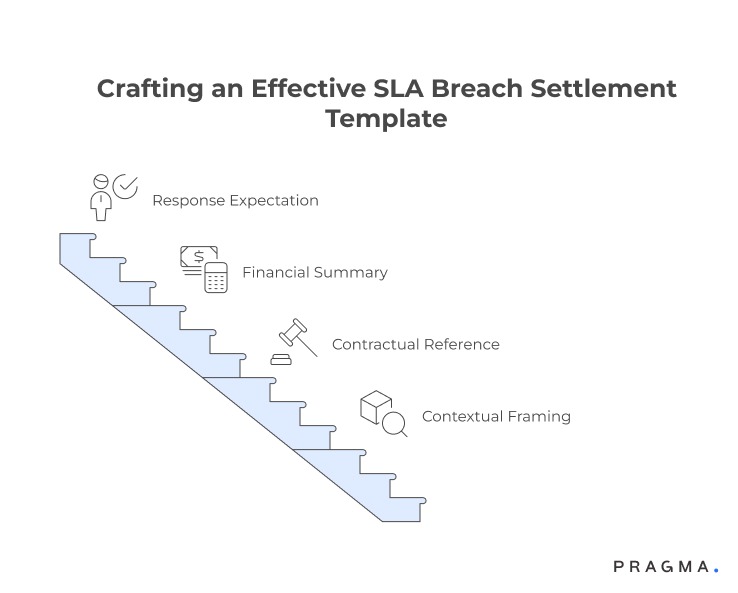
Templates reduce inconsistency and protect negotiation leverage across teams. An effective template should include four structured sections.
First, contextual framing. State the review period, total shipment volume, and total validated breaches. This provides scale.
Second, contractual reference. Quote the relevant SLA clause and associated penalty terms. This avoids interpretational ambiguity.
Third, financial summary. Present aggregated claim value with a clear calculation method. Avoid rounding without explanation; precision increases credibility.
Fourth, response expectation. Define acknowledgment and settlement timelines. Open-ended requests weaken urgency.
The purpose of a template is not rigidity but standardisation. When every settlement request follows the same structure, counterparties learn that enforcement is predictable and systematic.
In environments where escalation handling is automated as explored in carrier escalations without email automating SLA breach handling templates become even more powerful because documentation remains consistent across cycles.
How do you calculate fair settlement for SLA violations?
Financial logic must withstand scrutiny
Settlement for SLA violations must be defensible, proportional, and contractually aligned. Overstated claims erode credibility; understated claims forfeit leverage.
Begin with contractual penalty terms. These may include percentage-based penalties, freight refunds, or service credits. Where contracts are ambiguous, define an internal standard methodology and apply it consistently.
Financial calculation should consider:
- Number of validated breaches
- Applicable penalty per breach
- Aggregated impact across shipment volume
- Additional direct costs where contractually recoverable
Avoid including intangible costs such as brand damage unless contractually recognised. Settlement discussions anchored in measurable financial impact close faster.
Structured aggregation — often highlighted in SLA breaches in e-commerce strengthens credibility by demonstrating volume-level consistency rather than isolated grievance.
When calculation logic is transparent and replicable, disputes decrease.
When should you escalate versus renegotiate SLA breach compensation?
Distinguish enforcement from relationship management
Not every settlement conversation requires escalation. The decision depends on breach frequency, financial exposure, and carrier responsiveness.
Escalation becomes appropriate when:
- Repeated breaches exceed defined thresholds
- Settlement timelines are ignored
- Disputes persist despite validated evidence
However, if breach patterns reflect systemic operational strain — such as peak season overload renegotiation may be more strategic than enforcement. In such cases, revisiting SLA benchmarks or penalty structures can produce more sustainable outcomes.
The distinction lies in recurrence. If repeat breach clusters persist despite detection improvements, the conversation shifts from settlement to structural realignment.
Strong predictive monitoring, including models discussed in how location data can predict SLA breaches before they happen, enables earlier engagement before enforcement becomes necessary.
Escalation should signal seriousness, not hostility.
Why does governance determine long-term SLA breach settlement performance?
Without cadence, enforcement weakens over time
One-off settlements create temporary recovery. Governance sustains it.
Effective governance includes:
- Monthly breach aggregation reviews
- Defined settlement submission cycles
- Response timeline tracking
- Recurrence monitoring
If settlements are irregular, counterparties deprioritise them. If submission cycles are predictable, resolution becomes routine.
Integrating breach detection insights from systems such as SLA breach detection into monthly financial reviews ensures settlement remains tied to performance visibility rather than ad hoc dispute.
Governance also protects internal discipline. Finance, CX, and operations must align on validation standards to prevent inconsistent claims.
SLA breach settlement succeeds when enforcement becomes embedded into operating rhythm not triggered by frustration.
How can you operationalise SLA breach settlement in the next 30 days?
Structured cadence converts detection into recovery
SLA breach settlement becomes effective only when it shifts from occasional escalation to disciplined operating cycle. The next 30 days should focus on building repeatable enforcement infrastructure rather than chasing historical claims.
Week 1: Standardise breach validation criteria
Begin by aligning internal stakeholders on what qualifies as a claimable breach. Reconcile contract clauses with your detection logic. If classification varies across regions or account managers, eliminate ambiguity immediately.
Audit the last 60 days of breach data and remove disputed or weakly supported entries. Clean data strengthens future negotiation credibility.
Expected result: A defensible, contract-aligned breach dataset ready for aggregation.
Week 2: Design evidence packet and negotiation template
Formalise your evidence packet structure. Include:
- Contract clause reference
- Review period definition
- Aggregated breach summary
- Order-level timestamp table
- Financial calculation methodology
Convert this into a reusable negotiation template. The goal is uniformity, not improvisation.
Where breach handling still relies heavily on manual escalation chains, frameworks such as carrier escalations without email automating SLA breach handling often reveal opportunities to streamline evidence assembly and reduce coordination lag.
Expected result: Settlement-ready documentation that reduces dispute friction.
Week 3: Initiate structured SLA breach settlement negotiation cycle
Submit your first formalised claim batch with defined response timelines. Avoid informal discussions without written documentation.
Track:
- Acknowledgment time
- Dispute rate
- Approval timeline
- Credit note issuance cycle
If detection maturity is limited, strengthening it through systems aligned with [SLA breach detection] can materially improve consistency before future cycles.
This stage transforms breach visibility into financial enforcement.
Expected result: Measurable financial recovery tied to documented breaches.
Week 4: Institutionalise cadence and governance
Embed monthly settlement reviews into finance and operations meetings. Evaluate:
- Settlement value recovered
- Percentage of validated breaches settled
- Recurrence patterns
- Carrier responsiveness
If breach recurrence remains high despite settlement enforcement, structural performance conversations may be required — often informed by broader trends outlined in SLA breaches in e-commerce.
Settlement should become predictable, not reactive.
Expected result: Ongoing financial protection aligned with operational performance.
Which metrics define effective SLA breach settlement performance?
Recovery consistency matters more than volume
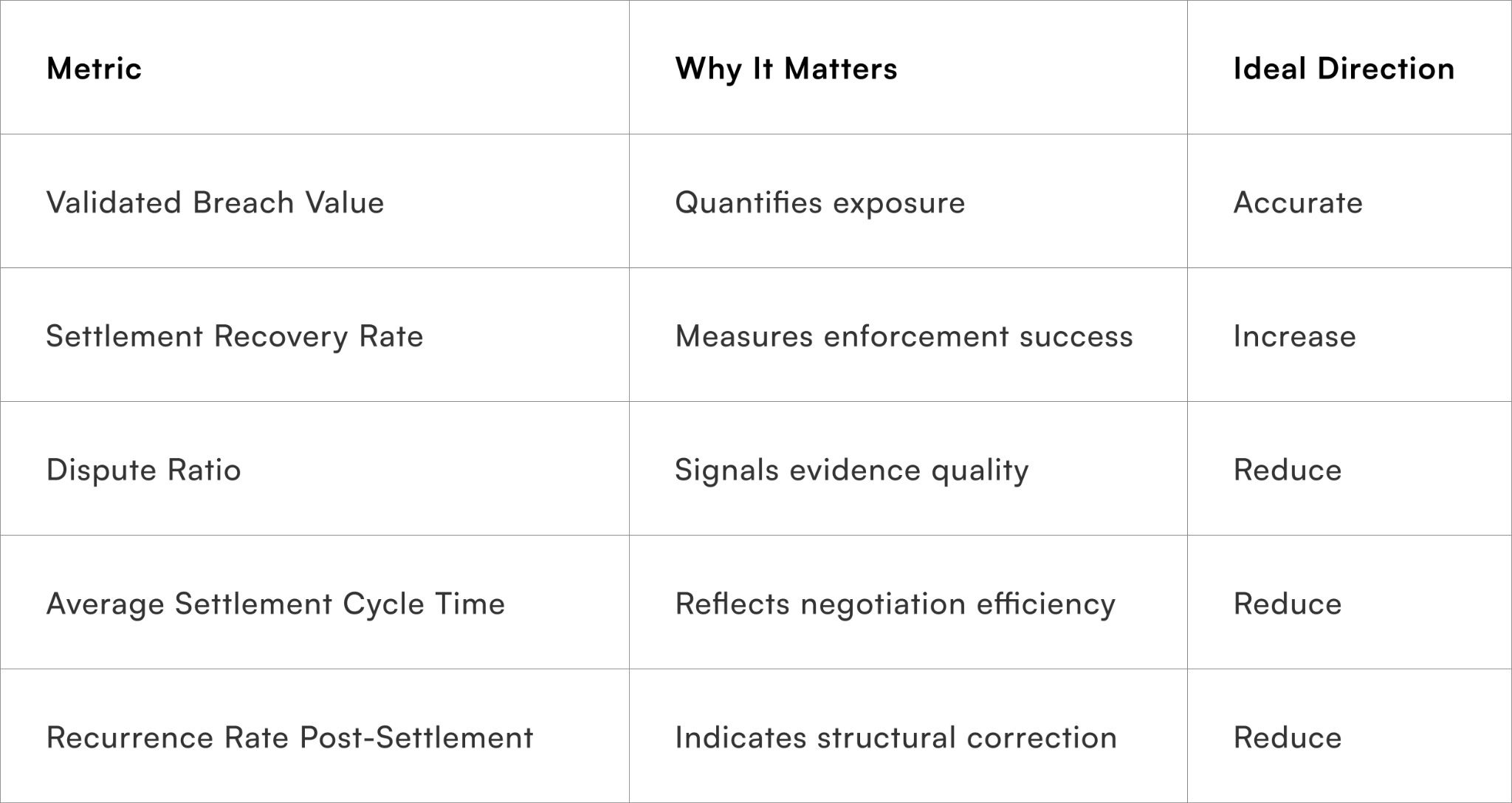
Tracking settlement value alone provides incomplete insight. Governance requires deeper visibility.
Core Settlement Metrics
Advanced Insight Layer
Segment settlement data by:
- Carrier
- Region
- Service level (express vs standard)
- Contract type
Where predictive monitoring capabilities — such as those described in how location data can predict SLA breaches before they happen are layered into governance, enforcement becomes forward-looking rather than retrospective.
Effective SLA breach settlement protects margin not just through recovery, but through performance discipline.
To Wrap It Up
SLA breaches are operational failures — but unmanaged settlements are financial failures. Without structured enforcement, penalties remain theoretical and margins erode quietly over time.
Formalise a monthly SLA breach settlement submission cycle this week with documented evidence and defined response timelines.
Over the long term, settlement governance should integrate detection maturity, financial tracking, and recurrence monitoring. As predictive visibility strengthens, enforcement shifts from reactive dispute to disciplined contract management.
For D2C brands seeking structured enforcement and automated breach governance, Pragma's SLA intelligence platform provides real-time breach detection, evidence packet automation, and settlement tracking capabilities that help brands improve recovery rates and reduce financial leakage.

FAQs (Frequently Asked Questions On SLA breach settlement: negotiation templates and evidence packet design)
1. What is SLA breach settlement in operations?
SLA breach settlement refers to the process of resolving penalties or compensation after service-level failures.It involves negotiation, validation of evidence, and agreement between stakeholders.
2. How does SLA breach settlement negotiation work?
SLA breach settlement negotiation includes reviewing breach details, analysing impact, and discussing compensation terms.Both parties align on fair outcomes based on predefined SLAs and evidence.
3. What is included in a settlement for SLA violations?
A settlement for SLA violations typically includes penalty calculations, service credits, or financial compensation.It may also involve corrective actions to prevent future breaches.
4. How should an evidence packet for SLA breach settlement be designed?
An evidence packet should include timestamps, performance logs, communication records, and breach reports.Clear and structured documentation strengthens the negotiation process.
5. What are best practices for SLA breach compensation negotiation?
Best practices include using accurate data, maintaining transparency, and aligning with contractual terms.A structured approach ensures fair and efficient resolution.
6. What is the SLA penalty settlement process?
The SLA penalty settlement process involves identifying breaches, validating data, calculating penalties, and finalising agreements.It ensures accountability and compliance with service contracts.
7. How can automation support SLA breach settlement?
Automation can track SLA performance, generate reports, and compile evidence packets quickly.This reduces manual effort and improves accuracy in negotiations.
8. What are the benefits of a structured SLA breach settlement approach?
Benefits include faster resolution, reduced disputes, and improved partner relationships.It also ensures consistency and transparency in handling SLA violations.
Talk to our experts for a customised solution that can maximise your sales funnel
Book a demo

.png)