

Handling returns for high-value, fragile, and made-to-order products is a delicate balancing act between protecting revenue and preserving customer experience. Unlike standard returns, these categories involve higher financial stakes, specialised handling, and often complex production or sourcing timelines. A misstep can lead to significant losses, operational bottlenecks, or dissatisfied customers.
This blog, Returns playbook for high-value, fragile and made-to-order products, provides a structured framework for designing returns processes that minimise risk while maintaining customer trust. It explores the operational nuances, from inspection and quality control to restocking and refund policies, highlighting best practices for different product types and customer segments.
By implementing a clear returns playbook, D2C teams can reduce damage or loss, streamline workflows, and ensure made-to-order products are managed efficiently. The goal is to create a process that is both financially responsible and customer-friendly, preventing returns from becoming a source of operational strain or revenue leakage.
Why returns for high-value, fragile, and made-to-order products require special handling
Different product categories introduce unique operational and financial risks
High-value products
High-value items, such as electronics, designer apparel, or premium appliances, carry significant financial risk. Returns mishandled during inspection or transport can result in lost revenue or inventory write-offs.
Operational challenges
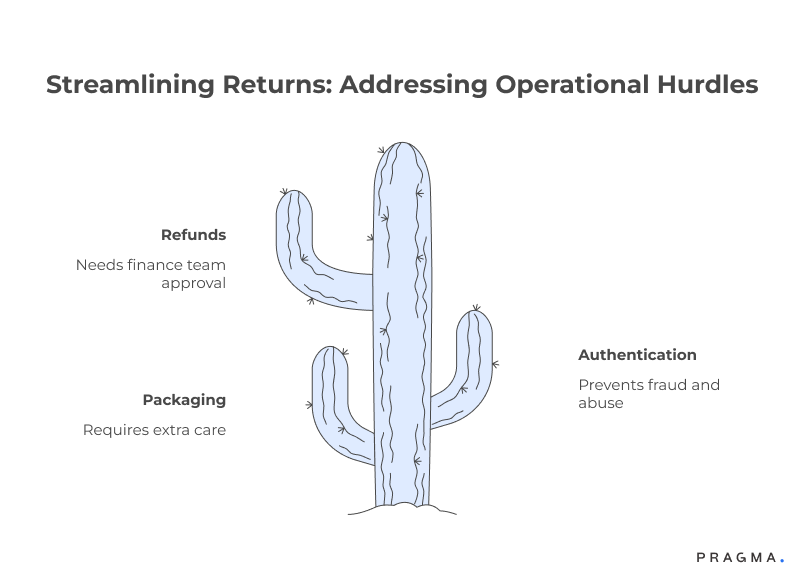
- Extra care in packaging and transport is required.
- Returns must be authenticated to prevent fraud.
- Refund processes often need approval from finance teams.
Fragile products
Fragile items like glassware, ceramics, or delicate electronics require careful handling and special packaging during the return process to avoid breakage.
Operational challenges
- Inspectors need clear guidelines for damage assessment.
- Staff must follow strict handling protocols to minimise additional damage.
- Repackaging for restock or return to supplier requires precision.
Made-to-order products
Custom or made-to-order items add complexity because production costs are sunk, and reselling is often impossible.
Operational challenges
- Returns often cannot be restocked; refunds or replacements must be carefully calculated.
- Quality checks are critical to verify defects versus customer preference.
- Lead times for replacement or re-manufacturing must be communicated clearly to the customer.
Key stages in the returns workflow
Structured inspection, validation, and resolution reduce errors and losses
Initial return request
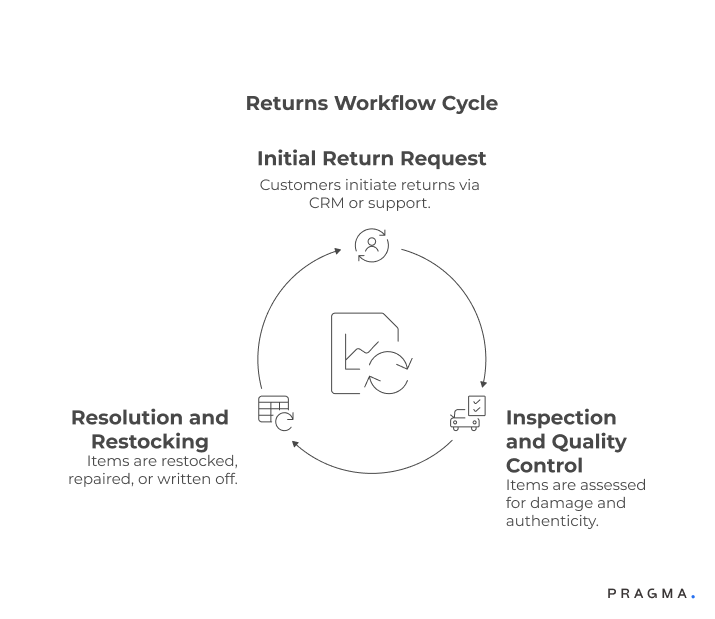
Customers initiate the return, often triggered via CRM or support channels.
Best practices
- Confirm eligibility based on product category and purchase conditions.
- Communicate clear instructions for safe packaging and shipment.
Inspection and quality control
Returned items must be assessed for damage, completeness, and authenticity.
Guidelines
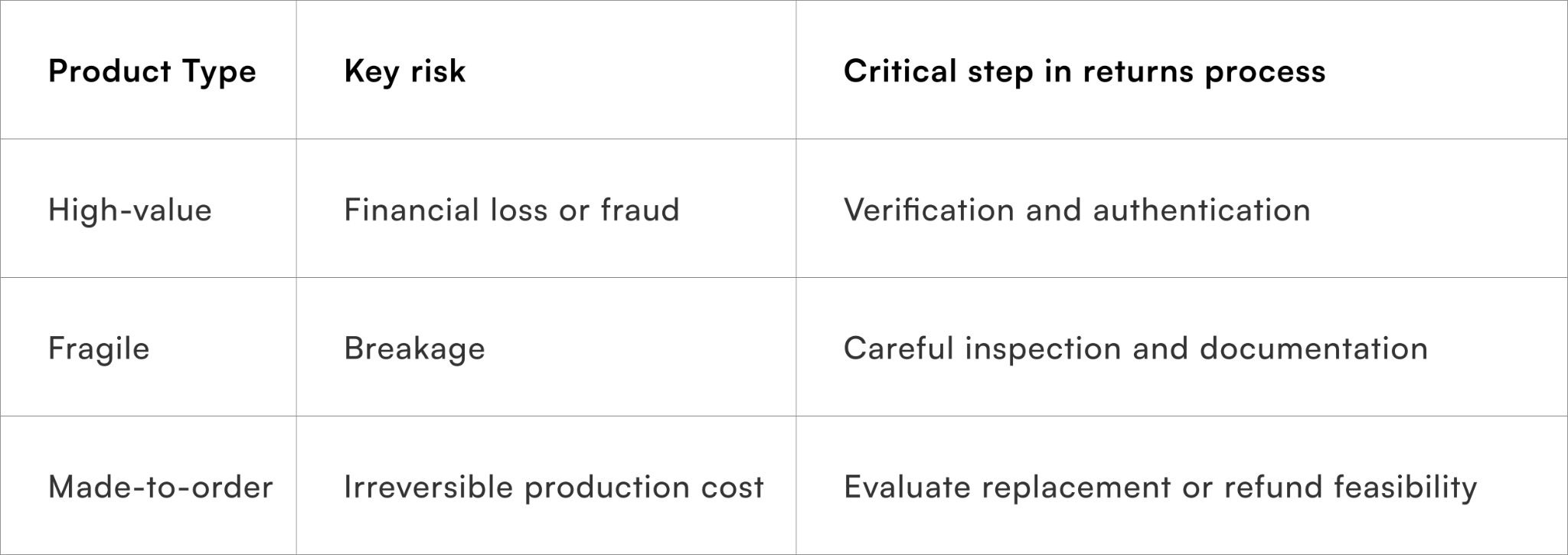
- High-value: verify serial numbers, packaging, and proof of purchase.
- Fragile: document damage, photograph broken items, and evaluate for possible refurbishment.
- Made-to-order: assess if the product can be replaced, repaired, or refunded.
Resolution and restocking
Based on inspection, the product is either restocked, repaired, or marked for write-off.
Considerations
- Maintain clear records in inventory management and accounting systems.
- Align with warehouse capacity and operational workflows to avoid bottlenecks.
Cost control and recovery strategies for high-risk returns
Minimising financial leakage across high-value and non-resellable products
Returns in these categories are not just operational events—they are direct hits to margin. Without clear cost control mechanisms, high-value and made-to-order returns can quickly erode profitability.
Defining return cost thresholds
Operations teams should define thresholds where different actions apply: restock, refurbish, liquidate, or write-off. For example, a high-value item with minor damage may justify refurbishment, while a heavily damaged fragile product may need to be written off immediately.
These thresholds must factor in reverse logistics cost, repair effort, and resale potential to avoid spending more on recovery than the item’s recoverable value.
Refurbishment and secondary sales channels
Not all returned products need to be treated as losses. High-value items, especially electronics or premium goods, can often be refurbished and resold through secondary channels such as clearance sales or partner marketplaces.
This requires coordination between warehouse, quality control, and merchandising teams to ensure refurbished items meet acceptable standards before resale.
Managing reverse logistics costs
Reverse logistics for fragile and high-value items is significantly more expensive due to specialised packaging and handling requirements.
Optimising pickup routes, consolidating returns, and partnering with specialised logistics providers can reduce per-unit return cost. Additionally, enforcing stricter return eligibility for certain categories helps control unnecessary reverse shipments.
Outcome
A structured cost recovery approach ensures that returns are managed as a controllable financial process rather than an unavoidable loss centre.
Vendor and supplier coordination for return resolution
Aligning external partners with internal returns workflows
For many D2C brands, especially those dealing with made-to-order or sourced products, return resolution depends heavily on vendor and supplier collaboration. Without clear coordination, delays and disputes can disrupt the entire workflow.
Defining vendor responsibility upfront
Return policies should clearly define whether responsibility lies with the brand, supplier, or manufacturer in cases of defects, damage, or quality issues.
This clarity prevents delays during resolution and ensures that financial liability is assigned correctly from the start.
Standardising vendor inspection and approval processes
When returned items need supplier validation—common in made-to-order or high-value categories—standardised documentation is critical.
Sharing inspection reports, images, and defect notes through a unified system allows vendors to approve replacements or reimbursements faster, reducing turnaround time.
Integrating vendors into the returns workflow
Instead of relying on email-based coordination, vendors should be integrated into the returns workflow through shared dashboards or automated notifications.
For example, when a defect is confirmed, the supplier can be notified instantly with all relevant details, triggering replacement production or credit issuance without manual follow-ups.
Handling disputes and escalations
Disagreements over defect responsibility or product condition are common. A structured escalation framework—supported by documented inspection evidence—helps resolve disputes quickly without affecting customer timelines.
Outcome
Strong vendor coordination reduces delays, improves accountability, and ensures that return resolutions are completed efficiently without internal bottlenecks.
Customer communication strategy for complex returns
Maintaining trust through clarity, transparency, and proactive updates
Returns involving high-value, fragile, or made-to-order products often take longer to resolve. Without clear communication, customers may perceive delays as inefficiency or lack of accountability.
Setting expectations at return initiation
From the moment a return is requested, customers should be informed about category-specific timelines and processes.
For example, made-to-order returns may require inspection and approval before refunds, while fragile item assessments may depend on damage verification. Clear upfront communication reduces uncertainty and follow-up queries.
Proactive status updates
Customers should not have to chase updates. Automated notifications at each stage—pickup confirmation, inspection completion, resolution decision—help maintain transparency.
This is especially important for high-value orders, where customers are more sensitive to delays or ambiguity.
Offering resolution choices where possible
In certain cases, providing options—refund, replacement, or store credit—can improve customer satisfaction while giving ops teams flexibility in managing costs.
For instance, offering store credit for made-to-order returns may reduce financial impact while still delivering value to the customer.
Handling high-risk or high-value customers
Premium customers or high-value orders may require personalised communication, such as direct support outreach or priority resolution.
This ensures that high-impact cases are handled with the attention they require, preserving long-term customer relationships.
Outcome
A well-structured communication strategy turns a potentially negative return experience into a controlled, trust-building interaction—critical for retaining high-value customers.
How to automate quality checks and operational handoffs
Automation reduces human error and speeds up returns processing
Automating inspection workflows
By integrating barcode scanning, image documentation, and standardised inspection checklists, teams can reduce manual errors during returns.
Benefits
- High-value items: serial number and purchase verification automated
- Fragile items: photos automatically uploaded for damage assessment
- Made-to-order: defect detection triggers replacement workflow
Handoffs between teams
Automation ensures smooth transitions from inspection to restock, accounting, or manufacturing for replacements.
Best practices
- Automatically update inventory and finance systems when returns are processed
- Notify warehouse and support teams of exceptions or approvals needed
- Maintain audit logs for compliance and future analysis
Scaling returns processes for peak volumes and diverse products
Operational guardrails help maintain efficiency during high-return periods
Prioritisation by product type
During peak volumes, returns of high-value or fragile items should be triaged first to minimise risk of damage or revenue loss.
Guidelines
- Assign dedicated inspection stations for sensitive or custom items
- Batch returns by category to streamline handling
- Implement temporary escalation rules for exceptions
Regional and channel considerations
Returns may come via multiple channels (pickup, courier drop, in-store) and regions, requiring consistent workflows to prevent errors.
Best practices
- Standardise documentation templates across regions and channels
- Ensure packaging requirements are clear for each product type
- Train regional teams to follow the same operational protocols
Quick Wins on Managing Returns for High-Value, Fragile, and Made-to-Order Products
Step-by-step actions to reduce loss and streamline returns
Week 1 – Audit current returns workflows
- Map returns by product type, channel, and region.
- Identify bottlenecks in inspection, restocking, or refund approvals.
Expected result
Clear understanding of operational gaps and high-risk product categories, enabling targeted interventions.
Week 2 – Standardise inspection and documentation
- Implement checklists for high-value, fragile, and made-to-order items.
- Use photographs and barcode verification for all returns.
Expected result
Reduced errors, faster approvals, and fewer disputes over product condition.
Week 3 – Introduce automation and handoff protocols
- Automate status updates to CRM, warehouse, and finance systems.
- Set clear escalation rules for exceptions or high-risk returns.
Expected result
Smoother cross-team handoffs and faster resolution without sacrificing accuracy.
Week 4 – Train teams and monitor KPIs
- Train warehouse, support, and operations teams on standard protocols.
- Track RTO, inspection accuracy, and time-to-resolution metrics.
Expected result
Operational consistency and measurable improvements in return handling efficiency.
Key Metrics to Track
Measure effectiveness of returns processes across product types
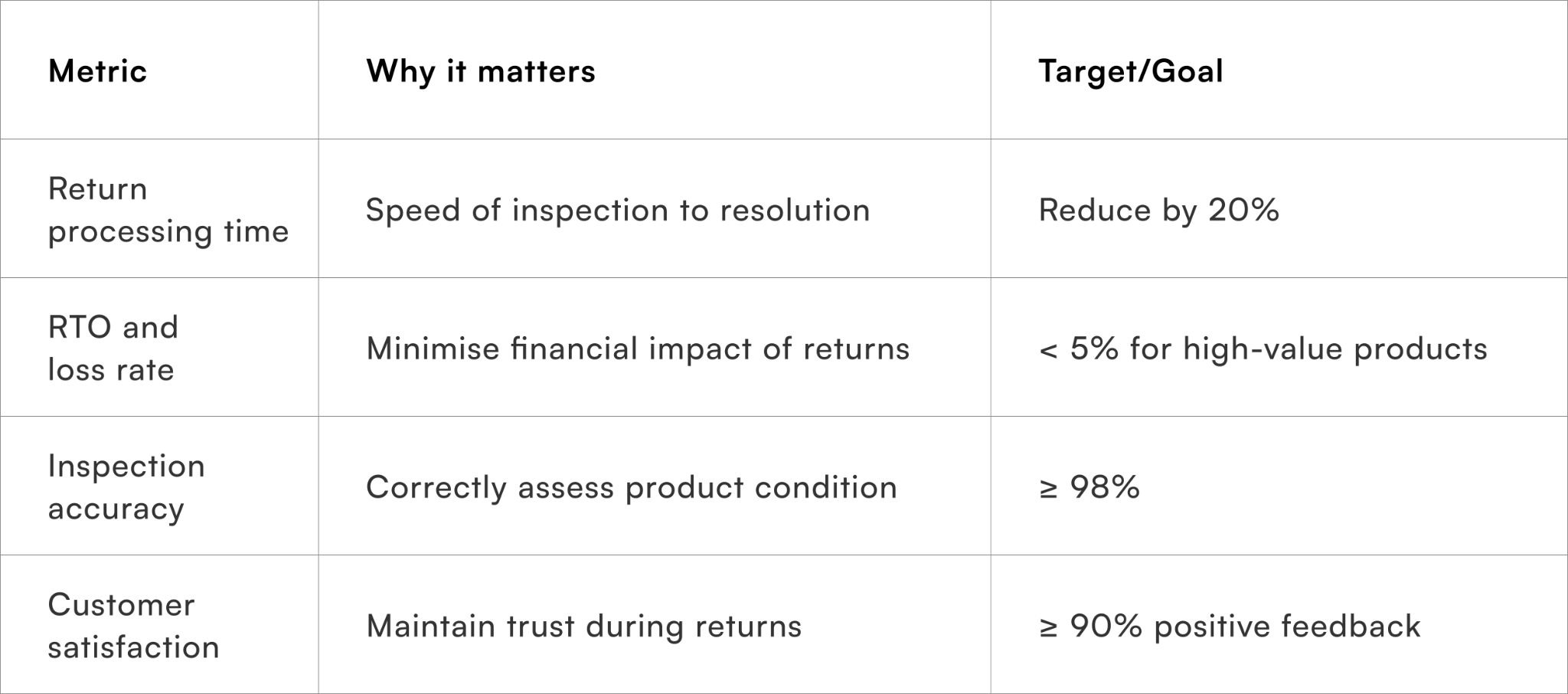
Monitoring these metrics ensures returns processes remain efficient, consistent, and customer-friendly, even for complex products.
To Wrap It Up
Managing returns for high-value, fragile, and made-to-order products requires precision, standardisation, and operational discipline. By auditing workflows, standardising inspections, and implementing automation, teams can reduce errors, protect revenue, and maintain customer satisfaction.
This week, audit your returns flows by product type and implement standardised inspection checklists for high-risk items.
Over the long term, continuously refine automation, handoffs, and team training to ensure returns processes scale efficiently without compromising operational accuracy or customer trust.
For D2C brands seeking to optimise returns for complex products, Pragma's returns orchestration platform provides automated inspection, workflow management, and reporting tools that help brands minimise losses and maintain a premium customer experience.

FAQs (Frequently Asked Questions On Returns playbook for high-value, fragile and made-to-order products)
1. How should high-value returns be handled differently?
High-value returns require authentication, careful handling, and often finance approval before refunds or restocking.
2. What precautions are needed for fragile products?
Fragile items need documented inspection, careful handling, and specialised packaging for return shipping or restock.
3. How are made-to-order returns managed?
Made-to-order items often cannot be restocked; returns require assessment for replacement, repair, or refund, considering production costs.
4. Can automation improve returns processes?
Yes. Automation can handle inspection documentation, system updates, and handoffs between warehouse, finance, and support teams.
5. How often should returns workflows be reviewed?
Quarterly or after new product launches or peak sales periods to ensure processes scale efficiently.
Talk to our experts for a customised solution that can maximise your sales funnel
Book a demo

.png)