

Logistics teams don’t suffer from a lack of data — they suffer from too much of the wrong kind. As CRM systems expanded beyond sales and marketing, logistics workflows were forced to consume bloated event schemas designed for customer journeys, not physical delivery. The result is familiar: dozens of events firing per order, unclear ownership, noisy dashboards, and critical signals buried under cosmetic updates.
This is why CRM schema: minimal event set logistics teams actually need (and why) matters more than ever. In high-volume D2C operations, especially across India’s fragmented delivery network, logistics decisions depend on a small number of precise, trustworthy events — not exhaustive timelines. When every scan, retry, and message is treated as equally important, teams lose the ability to act quickly or diagnose failures accurately.
In this post, we’ll break down the minimal, high-signal CRM events logistics teams actually need to operate efficiently. More importantly, we’ll explain why fewer events — designed around operational decisions, not reporting vanity — lead to faster issue resolution, cleaner analytics, and better coordination across fulfilment, carriers, and customer experience during scale.
Why logistics teams struggle with bloated CRM event sets
Too much data can slow decisions instead of enabling them
Most CRMs are built with marketing or sales in mind, capturing every possible interaction: clicks, opens, form fills, and customer messages. When logistics teams try to rely on the same schema, the abundance of events becomes a noise problem, not an insight problem. Operations teams face dashboards where critical delivery signals are lost among redundant scans or optional customer interactions.
The consequences are tangible: slower decision-making, delayed exception handling, and increased RTO or failed deliveries. For instance, a delivery manager might waste time reconciling multiple “in transit” events for the same order across carriers, instead of focusing on a genuine delivery failure.
Similarly, support teams can spend hours on tickets triggered by non-critical events that could safely be ignored in operational workflows.
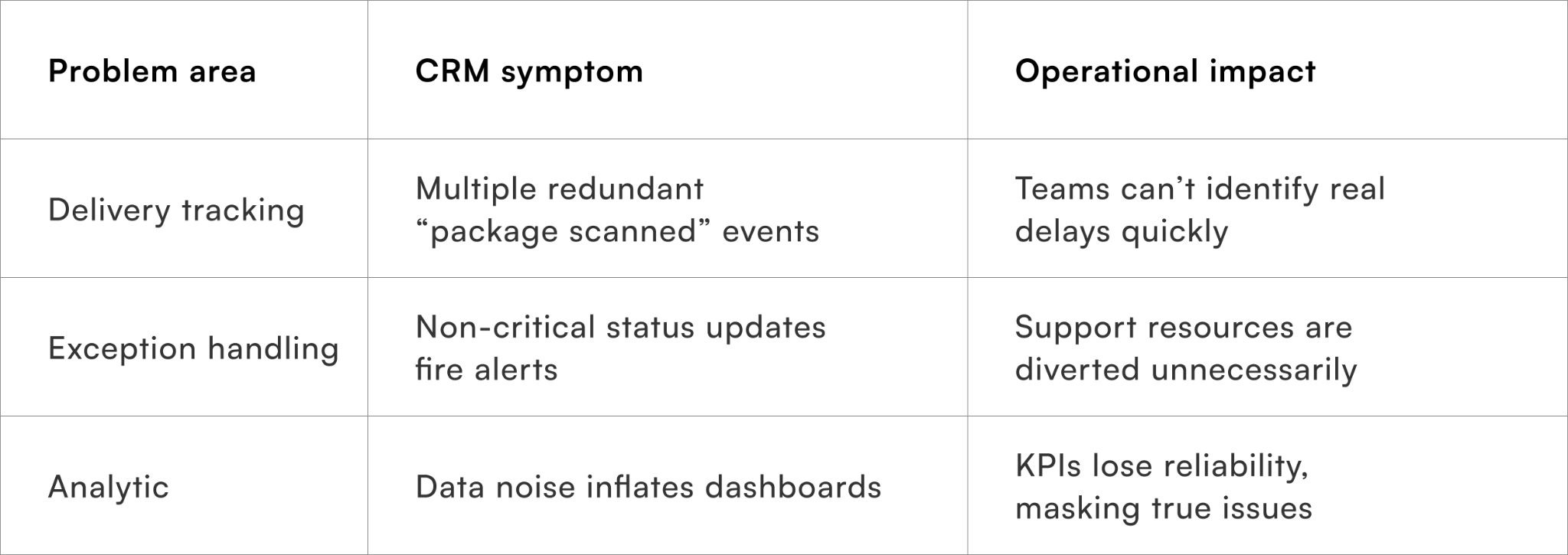
The key takeaway: more events do not equal better visibility. Operational teams need a minimal, high-signal set of events to act quickly and confidently.
What is the minimal event set logistics actually needs?
Focusing on events that directly influence operational decisions
Not every touchpoint in the delivery lifecycle matters to logistics. The events that do matter can be grouped around decision points: when an action is required to prevent failure or optimise performance.
Core events typically include:
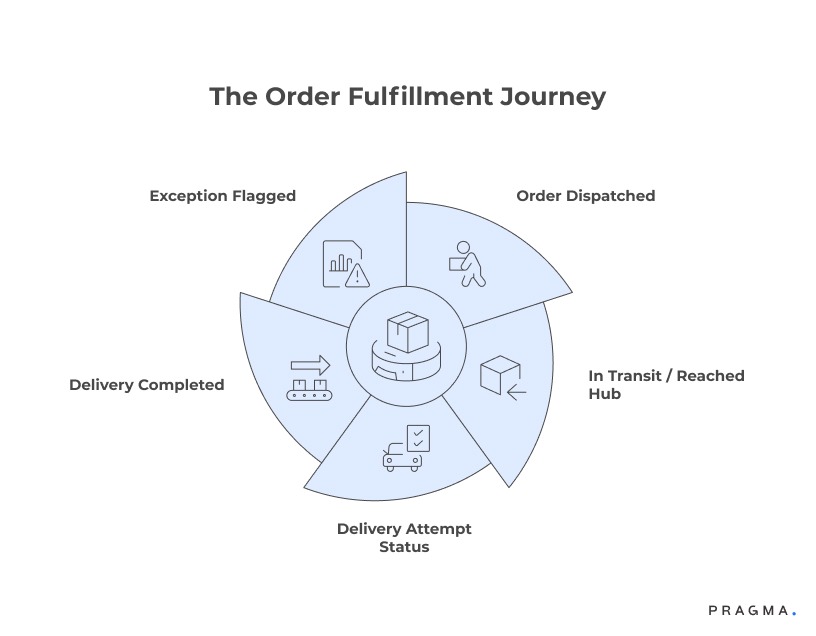
- Order dispatched: Confirms the fulfilment process has handed off the package to a carrier.
- In transit / reached hub: Key for understanding routing and anticipating delays.
- Delivery attempt status: Critical for managing customer expectations, retry scheduling, and reducing RTO.
- Delivery completed: Signals closure, invoicing readiness, and inventory reconciliation.
- Exception flagged: Anything requiring proactive intervention (wrong address, customer unavailability, damaged item).
These events form the operational backbone. Anything outside this set—like every minor scan or promotional messaging click—adds little value but can slow dashboards, complicate alerts, and obscure true operational risk.
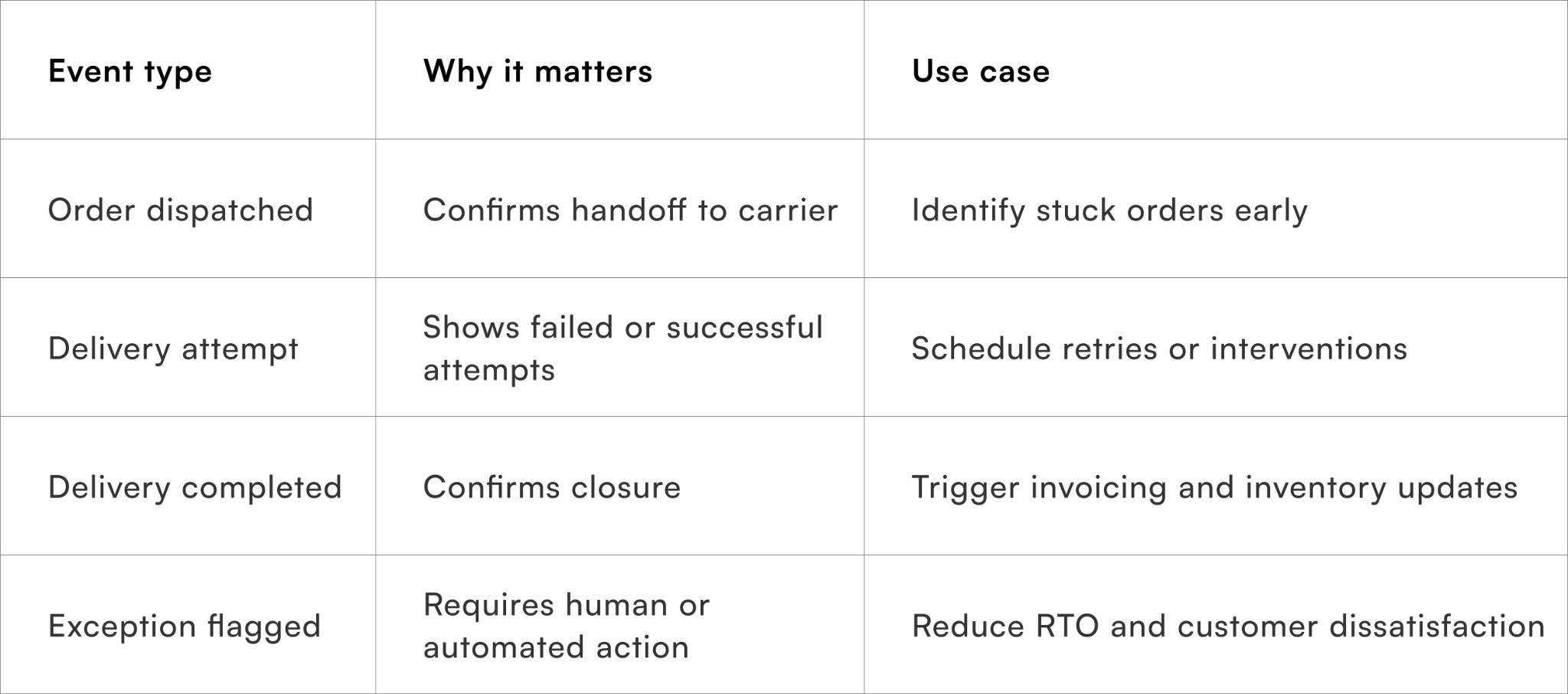
When designed around operational necessity rather than CRM completeness, this minimal set streamlines workflows and improves actionable insights.
How to integrate minimal events without breaking existing workflows
Minimal doesn’t mean disconnected — align with ops and CRM systems
Adopting a minimal event set often fails not because the events themselves are insufficient, but because the integration plan is poorly executed. Logistics teams must ensure that each event maps cleanly to operational actions and existing CRM workflows.
Start by evaluating which events are already in the system and filter or prioritise only those that directly impact logistics. For example, mark “package scanned at hub” as informative but non-actionable, while “delivery attempt failed” should trigger alerts or automated retries.
Avoid sending redundant events to downstream dashboards; this reduces noise and accelerates response times.
Additionally, teams should align event definitions with carriers. A “delivery attempted” status can vary widely across vendors. Standardising these critical signals ensures that operational rules trigger consistently, regardless of carrier nuances.
Why cross-functional alignment is critical
Logistics decisions depend on visibility, not just raw events
Minimal event sets work best when everyone understands the operational implications. Customer support, operations, and finance must agree on which events are actionable. Without alignment, support might overreact to minor signals, ops may ignore critical flags, and finance could misinterpret delivery status for reconciliation.
Pre-defined ownership helps:
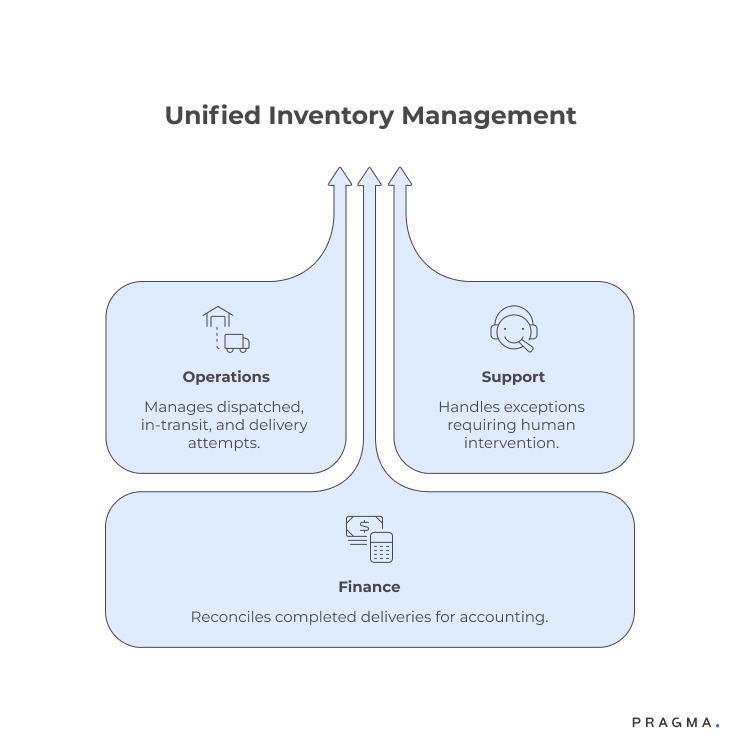
- Ops handles dispatched, in-transit, and delivery attempts.
- Support acts only on exceptions flagged for human intervention.
- Finance reconciles completed deliveries for accounting.
This alignment reduces duplication, accelerates decision-making, and maintains clarity, even during peak volumes.
How minimal events improve analytics and decision-making
Fewer, high-signal events make dashboards actionable
When dashboards only reflect events that matter operationally, managers can quickly identify bottlenecks, predict delivery failures, and optimise carrier performance.
For instance, monitoring just “delivery attempt failed” and “delivery completed” allows teams to calculate retry success rates, measure RTO risk, and trigger automated notifications without sifting through dozens of low-value events.
The guardrail principle: if an event does not change a decision, it does not belong in the minimal set.
How to scale minimal events across carriers and channels
Consistency is key when operational complexity grows
D2C logistics in India often involve multiple carriers, fulfilment hubs, and delivery channels. Minimal events must be standardised across this diversity. Without standardisation, operations teams face mismatched signals, delayed interventions, and fragmented reporting.
Key practices:
- Map carrier-specific statuses to standard event definitions (e.g., “attempted delivery” across all vendors).
- Use common event codes for both COD and prepaid orders to prevent duplication.
- Automate translation or enrichment pipelines so downstream dashboards only see actionable signals.
The payoff: a minimal schema that scales with operational complexity without adding unnecessary noise.
Common pitfalls when implementing minimal events
Even good intentions can backfire without guardrails
Adopting a minimal event set can fail if operational realities are ignored. Frequent mistakes include:
- Over-filtering: Removing events that occasionally become critical, leaving teams blind to real issues.
- Ignoring exceptions: Treating all deliveries as standard and not tracking unusual cases that may require intervention.
- Poor training or documentation: Teams don’t understand which events to act on, slowing decision-making.
The guardrail principle applies: every event in the minimal set must have a clear owner, defined action, and measurable outcome. This ensures that operational efficiency improves without sacrificing visibility.
Quick Wins
Minimal events, maximum operational impact
Even small adjustments to the CRM event set can produce measurable improvements if applied in a structured, week-by-week manner.
Week 1: Audit current events
- Identify all events currently firing to logistics dashboards.
- Classify each event as actionable, informative, or irrelevant.
Expected result: Immediate reduction in dashboard noise and faster triage.
Week 2: Define minimal event set
- Keep only the high-signal events: order dispatched, in transit, delivery attempt, delivery completed, and exception flagged.
- Map each event to a specific operational decision.
Expected result: Teams respond faster to real issues, fewer false alerts.
Week 3: Standardise across carriers
- Align carrier statuses to minimal events using a common mapping table.
- Implement automated enrichment pipelines to maintain consistency.
Expected result: Operational decisions become carrier-agnostic and dashboards stay clean.
Week 4: Communicate and document
- Share minimal schema with ops, support, and finance.
- Define ownership and escalation rules for each event.
Expected result: Cross-functional alignment and clear responsibilities reduce errors and response time.
Which metrics matter most when using a minimal event set?
Tracking impact without overloading teams
Minimal events are only effective if teams measure outcomes, not volume. Focus on these operational KPIs:
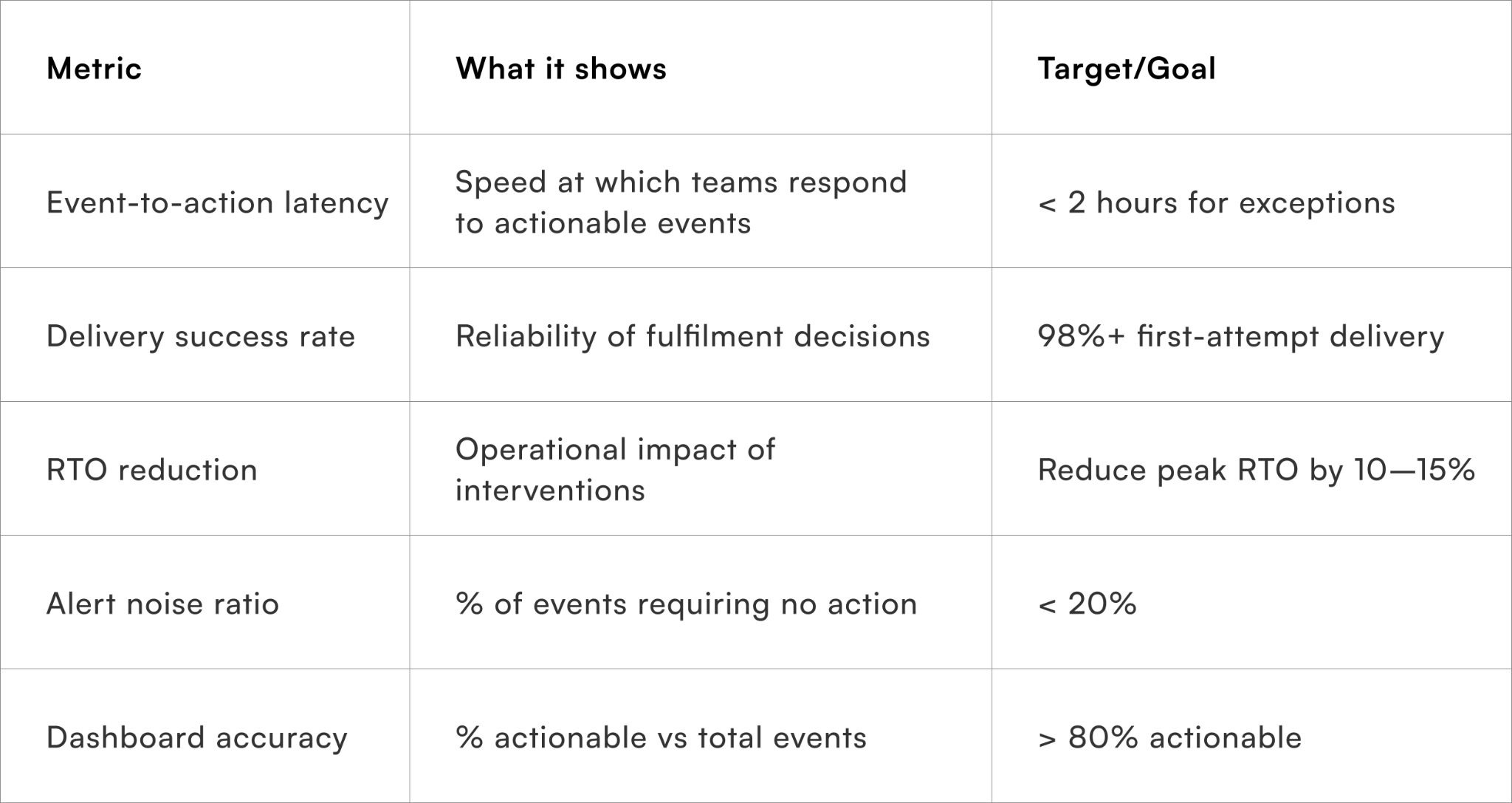
By tracking these metrics, teams can ensure minimal events translate into operational clarity, not just cleaner dashboards.
To Wrap It Up
A minimal CRM event set is not about collecting less data; it’s about collecting the right data for operational decisions. Teams that adopt this approach respond faster, reduce noise, and maintain clarity across carriers, hubs, and support channels.
This week, audit your current event schema and retain only actionable events that directly trigger decisions.
Over time, continuously refine the schema with version control, carrier mapping, and cross-functional alignment to ensure it scales with operational complexity.
For D2C brands seeking clear operational visibility across logistics, Pragma's CRM orchestration platform provides a minimal, actionable event framework that streamlines workflows, reduces RTO, and improves cross-team coordination at scale.

Talk to our experts for a customised solution that can maximise your sales funnel
Book a demo
.png)

.png)