

The e-commerce shopping in India is on a boom, but there is one issue that is continuously associated with it, the customer returns.
This has now been a massive business worth Rs. 12,500 crores in 2024, and is going to reach Rs. 35,000 crores in 2028.
Here's how big this really is:
Returns have increased by 340% within 4 years (2020-2024). During busy shopping seasons, companies now handle over 2.5 million returned packages every single day.
Online shopping experiences a lot more returns than traditional stores. When people go shopping online, approximately 20-30% of the items are returned, whereas in physical stores, it is almost 8-9%.
This is a major problem for e-commerce brands which sell straight to the customer. But the good thing is that these returns can be managed well with the right strategies.
This blog is about "Return Management in Supply Chain: A Simple Guide", where we will discuss everything about the topic and the basis of effective return management in supply chain management.
What Is Return Management in Supply Chain?
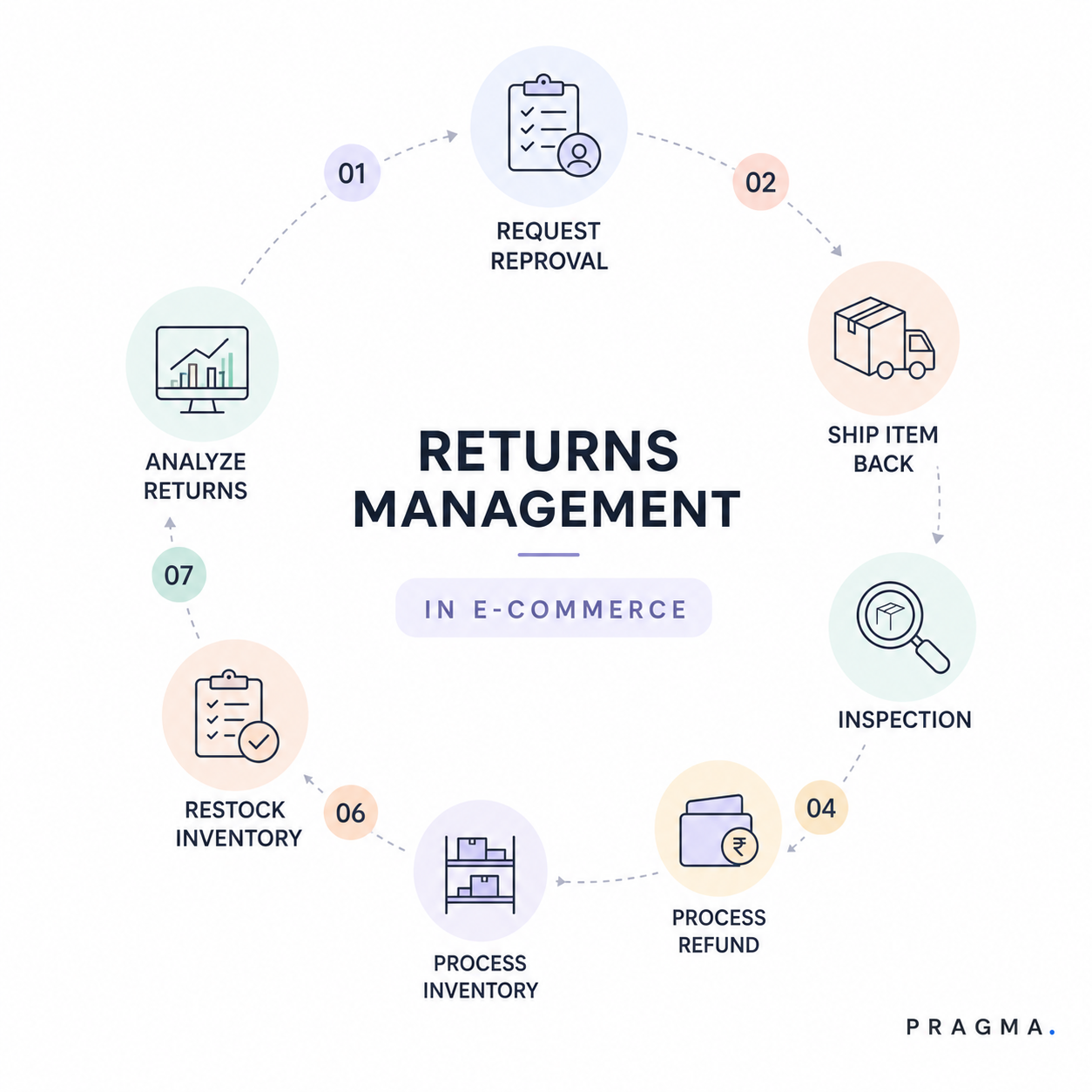
Return management in the supply chain refers to the management of products sent back to the supply chain by customers who purchase the products.
This begins when a customer decides that they no longer want a product and ends when you successfully conclude dealing with that very product, either through reselling, repairing, or disposing of that product.
For example:
There is a possibility that a person makes a purchase on your site and buys a shirt that does not fit him, and consequently, he may want to return it.
Return management is all that you offer to make the customer send the shirt back, inspect its state and provide a refund or a replacement for the product.
Key actions in the management of returns:
- Customer requests a return
- You approve the return and arrange pickup
- The product is shipped back to your warehouse
- You check the product's condition
- You process a refund or send a replacement
With an effective return management system, such as the Pragma RMS, all these processes will be simplified and quicker for you and your customers.
Why Return Management Is Critical in Supply Chain Operations?
The issue of return management in the supply chain operations is important since returns are increasing day by day.
Indian D2C brands see 25-35% return rates and 40-45% when it comes to the fashion industry.
12,000 crores of returns annually are recorded, with COD orders ranging from 60-70%, leading to increased rates of returns.
Approximately 15.8% of total retail sales-near to $816 billion, are refunded annually, and in e-commerce.
When such returns are mismanaged, it can lead to major costs, since every single return includes transport, inspection, repacking and refund processing, and when combined, up to 60% of the original product price can be incurred.
More than cost, it can make a bad impact on the customers about the brand if not managed properly. As customers are now demanding fast, easy, and clear returns, a bad service process can send them to competitors instantly.
Due to all such things, return management in the supply chain is an important component.
The Return Flow in Supply Chain Management
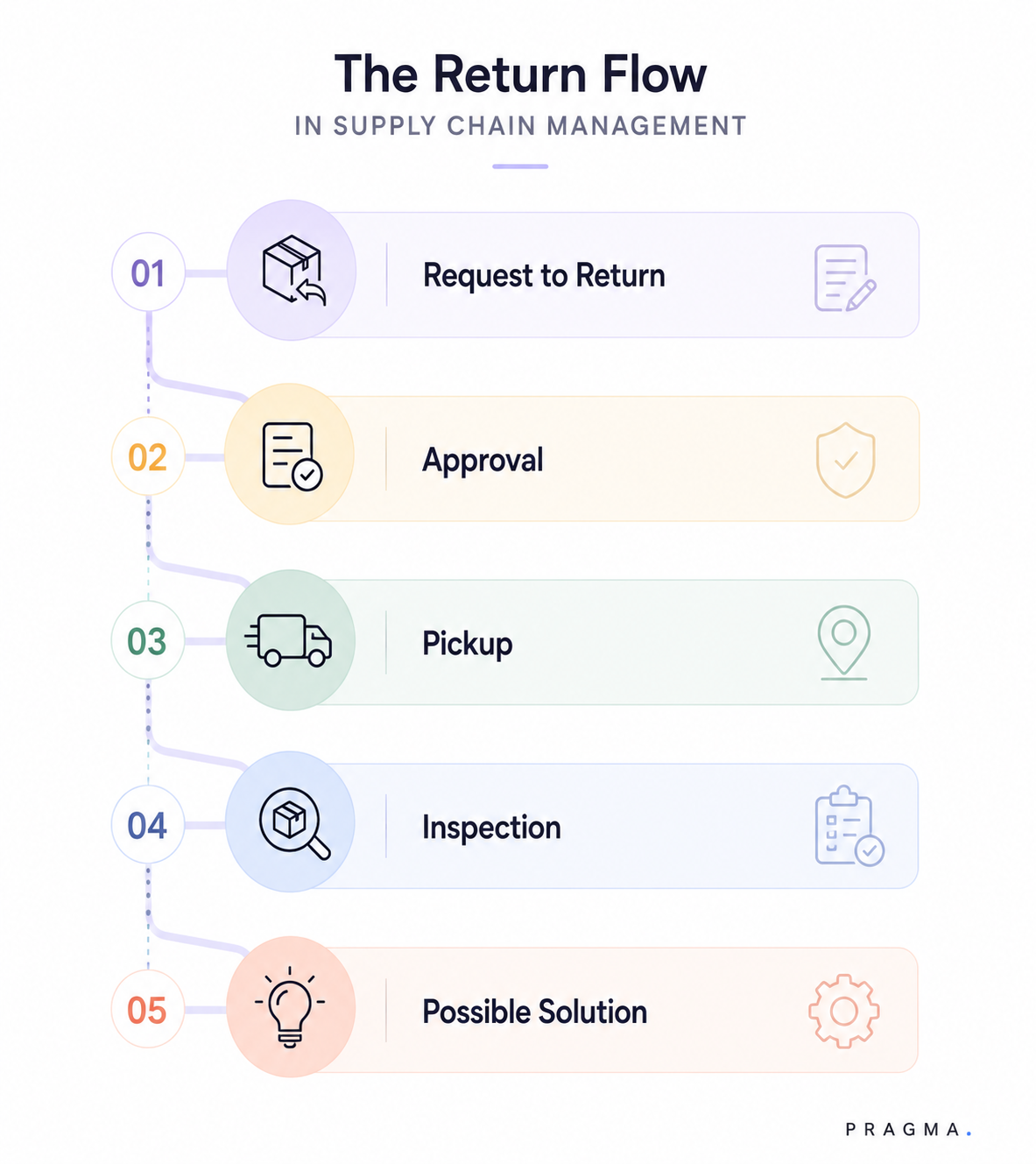
The return flow is the journey a product takes when it comes back from the customer to you. Here's how it usually works:
Request to Return
The return flow starts when the customer requests that he/she would like to return or exchange a product.
For that purpose, customers through the applications or websites can select the item they want to return.
To make this process easy, Pragma Return Management System provides brands with branded return labels that look like the e-commerce websites, to maintain a similar brand identity.
Approval
After that, the approval is given by the e-commerce brand on whether they are accepting the return or not. If the product is under the eligible timeline, the return request gets accepted.
To make this return approval process easy, the Pragma Return Management System provides a return window, under which return eligibility can be enabled or disabled as per the policies for different SKUs that the e-commerce brands have.
Pickup
Now, once the return is approved, the next step comes in, where the product is picked up by you or a courier partner.
The company assigns a pickup partner to pick up their product, or the customer can themselves drop the product off at the nearest centre, as the case may be.
Inspection
After the product reaches the brand's warehouse, they inspect the product to determine whether it is in good condition.
Here, the brands can look for the following things:
- Is the product in good condition?
- Are there any defects?
- Is the product in working condition or not?
- Whether it can be sold again or not?
- Does it require refurbishments or repairs?
Possible Solution
After checking the product's condition, it is decided what possible resolution can be made.
Here, the company can either make a return to the source of payment or can be returned as credits, which can be used for further purchases.
What are the Key Challenges in Return Management in India?
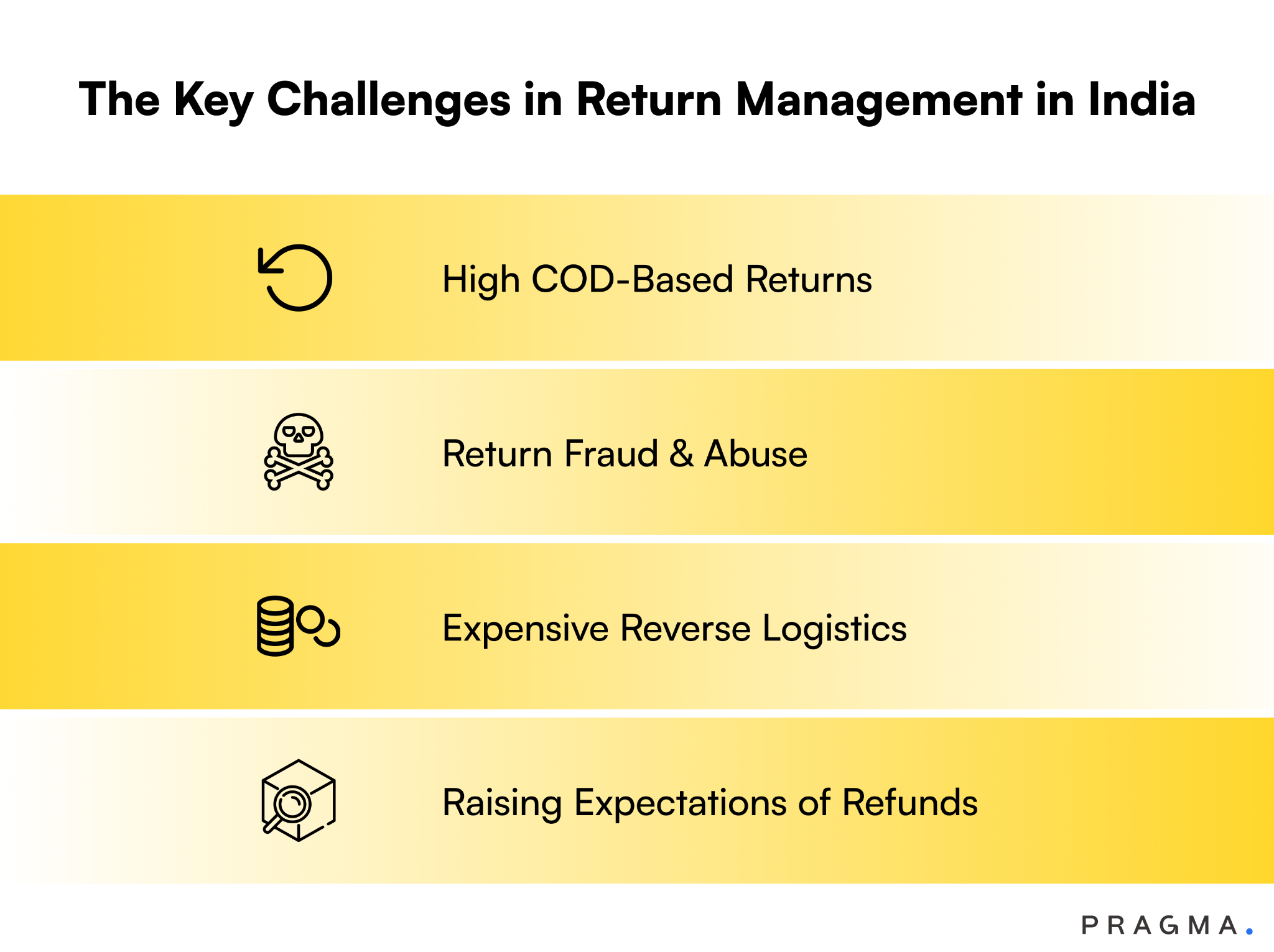
Here are a few challenges that come in the way of return management in supply chain operations:
High COD-Based Returns
Indian e-commerce is still dominated by Cash on Delivery (COD), where close to 60% of the orders are made by COD. This poses threats at the supply-chain level since customers tend to take several trial orders or deny taking the delivery owing to last-minute changes or cash crunch.
This caused an increase in the returns in the supply chains, increased logistics costs, blocked inventory, reverse transit and zero revenue recovery.
To solve this, Pragma RTO Suite applies intelligent risk analysis with reference to 1000+ brands. It checks risky COD orders and marks them to be checked, and avoids unnecessary returns- without disturbing actual customers.
It provides a C2P (Conversion to Prepaid) strategy that is another way of reversing 25-35% of the COD orders to prepaid, eliminating source-based return risk.
Return Fraud & Abuse
Fraud associated with returns, including wardrobing (use and return), product swaps, and fake returns, is increasing at an alarming rate.
When dealing with a supply-chain level, such patterns are almost impossible to identify manually. False flagging of customers is also a harmful factor that destroys brand trust.
Pragma RTO Suite is a behavioural analysis tool that detects suspicious buyers and bot orders, as well as high-risk behaviour. It has helped several Indian e-commerce brands cut their RTOs by 60-65% to safeguard their margins and enhance efficiency in their supply chain.
Expensive Reverse Logistics
The vast geographical location and the inadequate distribution of logistics infrastructure in India result in slow and costly reverse logistics, particularly in cities of tier 2 and 3.
Return-handling costs are also further increased by long routes, the restrictions put on couriers, seasonal problems, and accessibility problems.
In most instances, the cost of returning a product is greater than that of the product itself, which serves as a significant loss point in the supply chain.
Pragma ShipAxis is a solution to this as it combines with 50 or more logistics partners and uses smart routing to optimise return pickups.
This enhances coverage and minimises transportation expenses and decreases the turnaround time- even in remote areas.
Raising Expectations of Refunds
As the payment method of digital payments expands, customers are now seeking quick refunds, live updates, and customisation.
The supply chain contains various processes such as picking up of products, inspection, processing in the bank and reconciliation, which tend to delay the speed of refunds.
Such delays are a source of poor customer experience and create a negative perception of the brand.
What are the Basis of Effective Return Management in Supply Chain Management?
There are several basis of effective return management in the supply chain that are considered good:
- Clarity in return policy: Make sure that your return policies are not difficult to follow. It should be easy and clear to understand.
- Simple return procedure: The process of doing returns should be easy. Customers could initiate returns over the apps or websites themselves, without calling or emailing.
- Quick approvals: Do not keep customers waiting days to get approval. You should be prompt in doing this.
- Effective communication: Your customer should be informed at each stage, like return request made, return accepted, pickup scheduled, product passes the quality check and refund or exchange made.
- Smart technology: Every brand should make use of modern technology to handle its returns. You can automate processes and returns using a well-designed return management software such as Pragma RMS.
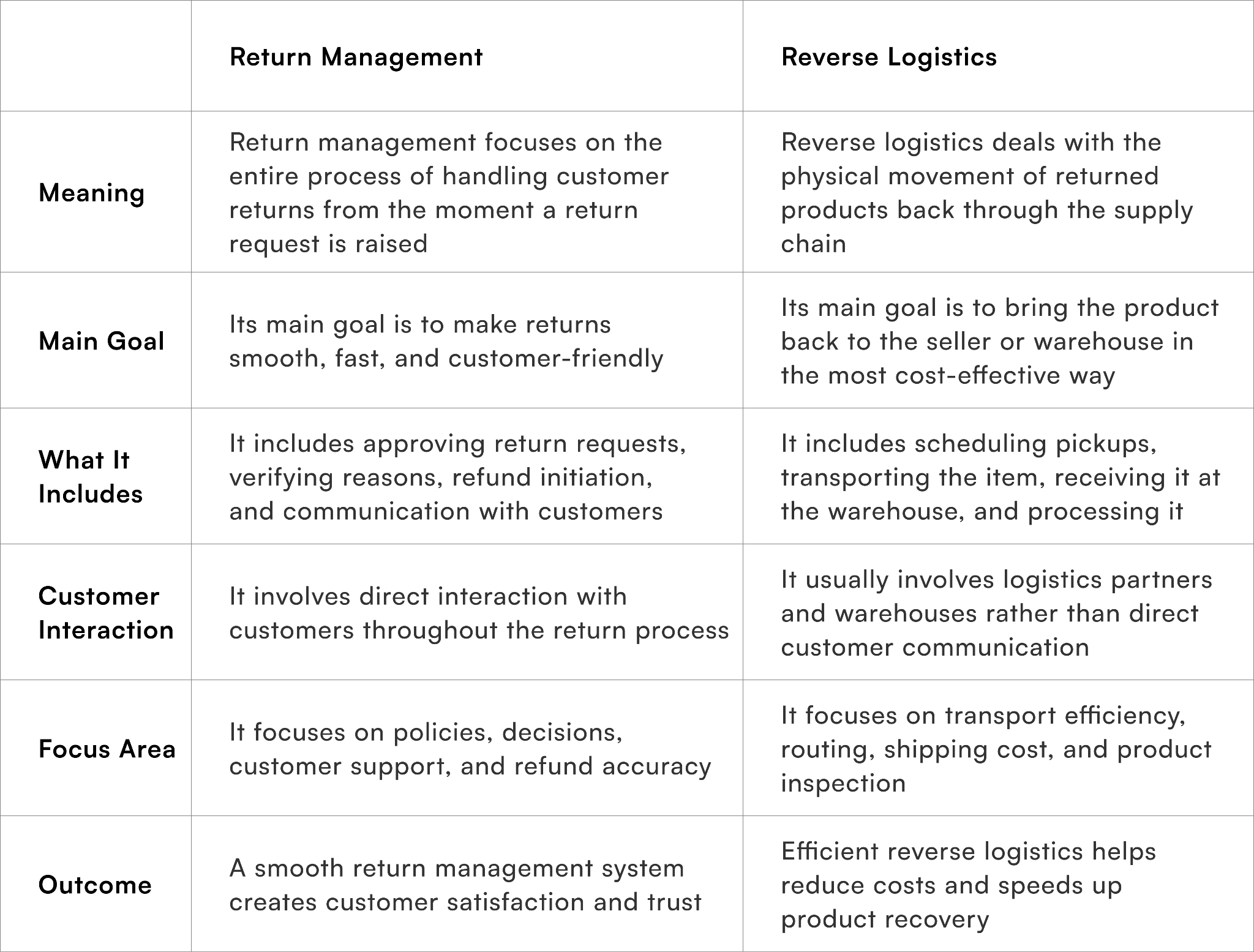
Return Management vs Reverse Logistics
Managing returns is not just about taking products back; it involves two important processes: return management and reverse logistics.
Although they work closely together, they focus on different parts of the return journey.
How Return Management Impacts Supply Chain Costs?
The overall cost of a supply chain is significantly impacted when it comes to returns in e-commerce. Without proper management of returns, your brands are going to spend more than anticipated. Here's how:
The refunds are costly: According to industry records, returning a product may cost 2-3 times as much as delivering the product to the customer.
High return rates generate workload: Working with so many categories, particularly with fashion, 25-40% return rates are common, and they create additional pressure on warehouses, delivery partners, and employees.
Reverse logistics adds extra cost: Combining the product back, verifying it, repacking it, and holding it could constitute 60% of total returns costs.
Higher returns with Cash on Delivery (COD): As approximately 60% of Indian e-commerce purchases are COD, a lot of orders are returned because the customer refuses to take the product. In this case, e-commerce brands get nothing but the cost of transportation and handling.
Slow or manual processes waste money: When the approval of returns, inspection and even refunds are made manually, companies consume more time and manpower, which increases the operational costs.
Inventory gets stuck: Reverse logistics products take more time to get back on stock, and less inventory is available, which makes it more costly to keep.
The ineffective management of returns slows down the supply chain, increases its cost, and lowers its efficiency, but with a smart return management system, e-commerce brands can save their money, enhance customer experience, and keep stocks flowing without issues.
Strategies to Improve Return Management Efficiency
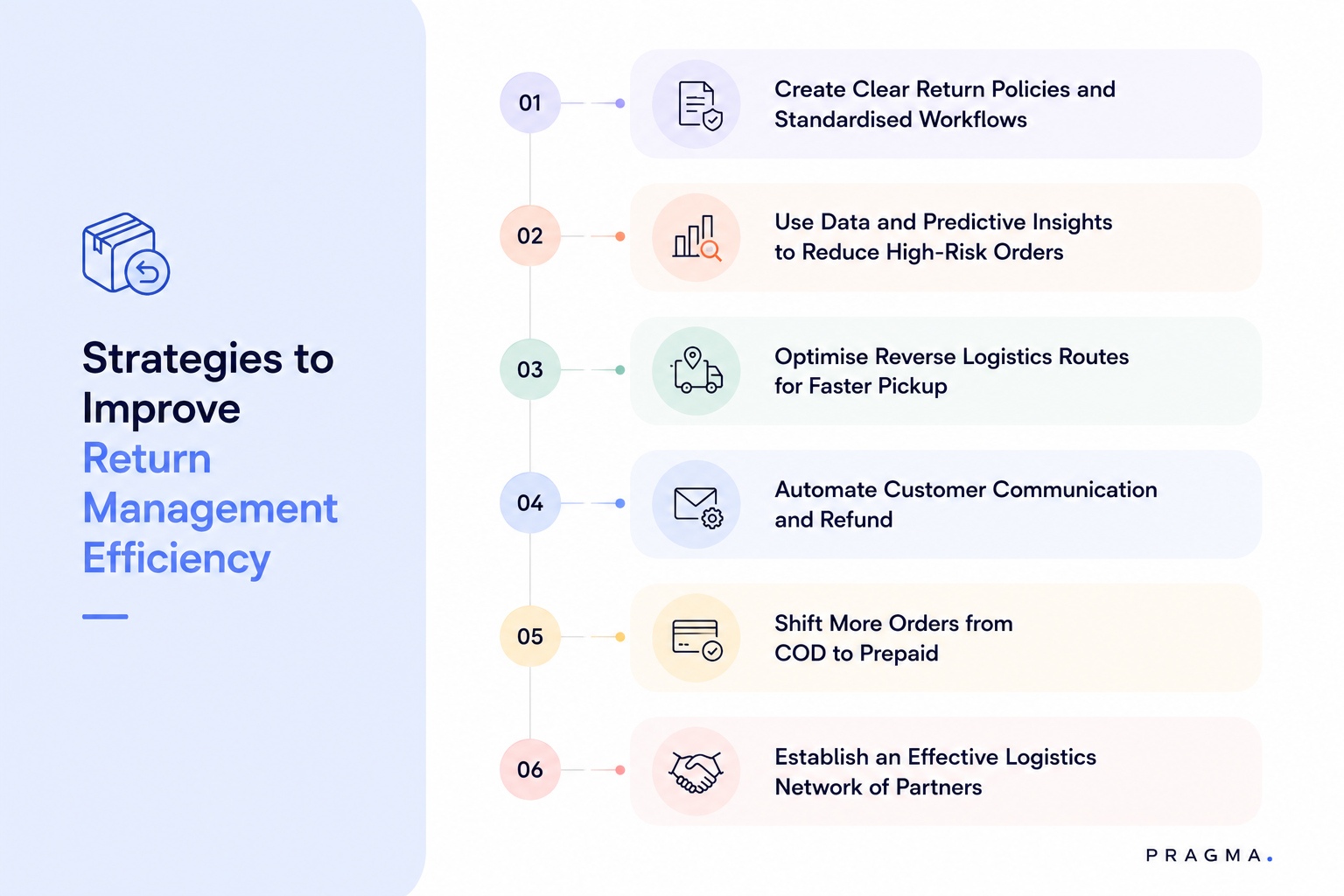
Here are some strategies that can help e-commerce brands in improving their return management:
Create Clear Return Policies and Standardised Workflows
Every e-commerce brand must ensure that they have a proper and clear return policy. It ensures that there is less confusion and unwarranted returns.
Also, a standard process for approvals, inspections and refunds ensures that turnaround time is enhanced when they are undertaken by teams.
It is possible to use tools such as automated workflows provided by Pragma to make sure that all of these steps occur without errors and without much manual work.
Use Data and Predictive Insights to Reduce High-Risk Orders
Most of the unnecessary returns are caused by risky orders- mostly COD refusals and fraud.
The e-commerce brands can detect these risks at an early stage by examining customer trends and past records.
Pragma behavioural analytics identifies risky orders and alerts brands to avoidable returns in real time, before they get into the logistics supply chain.
Optimise Reverse Logistics Routes for Faster Pickup
Return pickups can be very slow and costly, particularly in tier-2 and tier-3 cities.
Optimising routes and choosing the right courier for each pin code helps reduce costs.
Pragma helps brands to select the best courier, increasing pickup success and decreasing reverse logistics delays.
Automate Customer Communication and Refund
Delays in refunding are a significant cause of customer dissatisfaction.
Using an automated system to automatically trigger refunds and updates on the status prevents a customer from burdening support with their request.
The automated communication system used by Pragma keeps the customer informed at every stage of the process, enhances trust and saves on tickets.
Shift More Orders from COD to Prepaid
High COD reliance results in high rates of returns. E-commerce brands should encourage their customers to pay online by providing them with incentives like discounts, offers, etc.
Pragma RTO Suite helps brands to convert 15-25% of their COD orders to prepaid ones by offering custom offers, discounts and other perks, via WhatsApp, SMS & Email.
And these flows are fully customisable, whether it is the timing, message, offers, or the number of messages.
Establish an Effective Logistics Network of Partners
The extensive logistics network will make the return pickups and reduce transit times.
A single partner does not perform well in every area. Brands should select the one on the basis of performance in the particular area.
Key Metrics to Track in Return Management
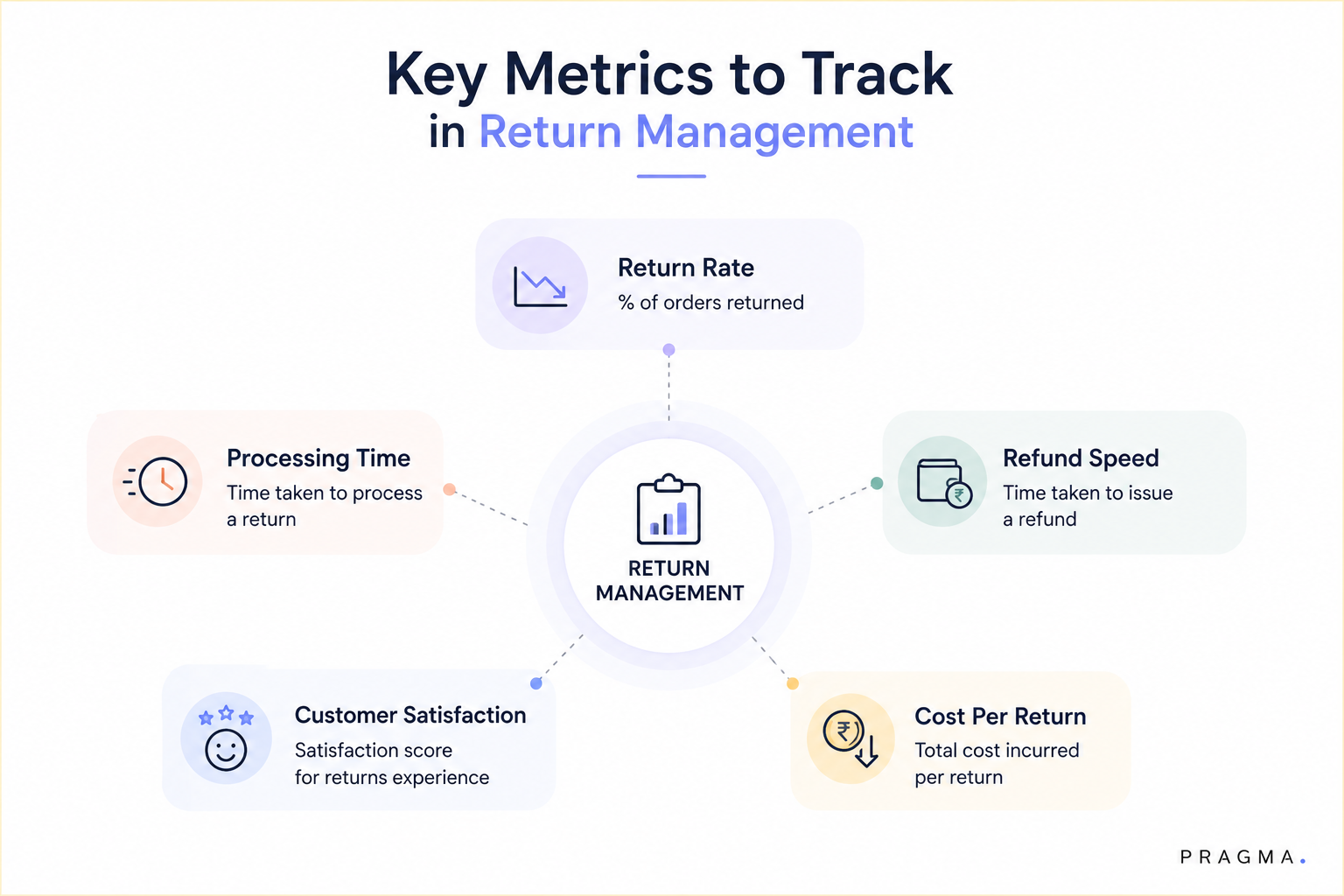
To know if your return process is working, track these numbers:
- Return rate: How many products are returned?
- Processing time: How long does it take to finish a return?
- Refund speed: How quickly do customers get their money back?
- Customer satisfaction: Are customers happy with the process?
- Cost per return: How much does each return cost you?
Role of Technology in Modern Return Management
The use of technology is significant in e-commerce because it facilitates a stress-free returns process.
It assists the brands in tracing all the returns that occur during the process and minimising the possibility of errors.
Using smart systems, businesses can see risky or fraudulent orders, issue returning orders immediately, and select the most suitable courier to make timely pickups.
It also enables warehouses to be aware of the returning items to enable them to check, sort and replenish items in a short time.
The automatic updates of customers on approval, pickup, and the status of refund make all things clear and transparent.
So, in short, technology helps save time, reduce expenses, enhance the customer experience, and also simplifies the overall process of return management.
Future of Return Management in Indian Supply Chains
Returns will keep growing as ecommerce grows. In the future, we’ll see:
- More automation and AI in return processing
- Better tracking and faster refunds
- Smarter systems that reduce fraud
- More focus on sustainability (like recycling returned goods)
Final Thoughts
So, to conclude here, we want to say that returns are part of supply chain operations.
In order to make the best out of them, every e-commerce brand should focus on efficient return management in the supply chain.
And this can be possible with the right strategies and the right tools. To support every single e-commerce brand in this journey, Pragma is here with its efficient systems and strategies that could help every business in proper return management.

FAQs (Frequently Asked Questions On Return Management in Supply Chain: A Simple Guide)
1. What is return management in supply chain?
Return management in supply chain refers to the end-to-end process of handling product returns, including return initiation, reverse logistics, inspection, refund or replacement, and inventory reconciliation. It combines operations, logistics, and customer experience.
2. Why is return management important in supply chain?
Return management is critical because it affects customer satisfaction, operational efficiency, and profitability. Inefficient return processes increase costs, delay refunds, and reduce customer trust, especially in high-volume eCommerce environments.
3. What is reverse logistics in return management?
Reverse logistics is the movement of products from the customer back to the seller or warehouse. It includes pickup, transportation, tracking, and delivery to the return facility for further processing.
4. What are the key steps in the return management process?
The return management process includes return request initiation, validation, pickup scheduling, reverse logistics tracking, product inspection, refund or replacement processing, and inventory updates or liquidation.
5. What are the common challenges in return management in India?
Key challenges include high return rates driven by COD orders, fake or policy abuse returns, poor reverse logistics coordination, delayed pickups, lack of real-time visibility, and rising logistics costs.
6. How does return management impact eCommerce profitability?
Return management increases costs across logistics, warehousing, and refunds, while also impacting revenue through lost or damaged inventory. Poorly managed returns can significantly reduce contribution margins for D2C brands.
7. How can eCommerce brands reduce return rates in India?
Brands can reduce return rates by improving product accuracy, setting clear expectations, validating high-risk orders, and proactively managing delivery journeys. Reducing RTO and fake orders upstream also plays a key role.
8. What is the difference between return management and reverse logistics?
Return management is the overall system covering policies, workflows, and customer experience, while reverse logistics focuses specifically on the physical movement of returned goods.
9. What tools are used for return management in supply chain?
Return management tools include dedicated return management systems (RMS), logistics orchestration platforms, and customer communication systems that enable tracking, automation, and visibility across the return lifecycle.
10. How can automation improve return management in supply chain?
Automation improves return management by enabling faster approvals, real-time tracking, intelligent routing of returns, automated customer updates, and better coordination between logistics, warehouse, and support teams.
Talk to our experts for a customised solution that can maximise your sales funnel
Book a demo

.png)
.png)