

Reverse logistics is no longer just about processing returns — it is about deciding, in real time, what should happen next. Automated salvage flows: reroute, hold for pickup or customer pickup triggers sit at the intersection of cost control, customer experience, and operational velocity. Every delayed decision adds storage costs, increases refund cycles, and locks working capital inside inventory that could have been redeployed.
Most brands still treat salvage as a manual exception process. A return arrives, a support ticket is raised, and someone decides whether to restock, liquidate, or discard. That lag compounds across thousands of orders. What should be a decision in minutes becomes a queue stretching across days.
Automated salvage flows change the equation. They use condition-based triggers to reroute sellable inventory, hold items strategically for consolidation, or invite customer pickup when that reduces cost-to-serve. The objective is simple: reduce loss per return while protecting customer trust without increasing operational complexity.
Why do last-mile exceptions quietly erode D2C margins?
Small fulfilment failures compound into structural profit leakage
Last-mile exception management often looks like an operational inconvenience. In reality, it is a margin problem disguised as a logistics issue. Every failed attempt adds cost layers: re-attempt fees, support bandwidth, inventory holding time, and eventual RTO risk.
In Indian D2C, common triggers include:
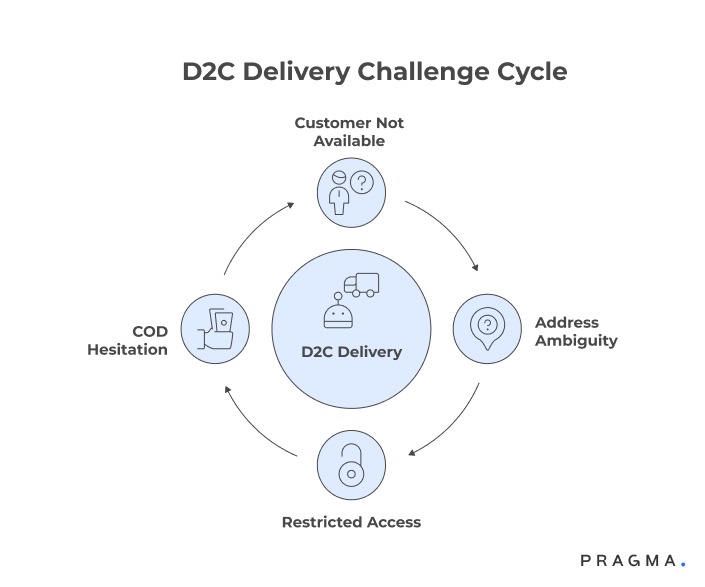
- Customer not available (especially prepaid orders)
- Address ambiguity in Tier 2/3 cities
- Gated communities and restricted access windows
- Cash-on-delivery hesitation at the doorstep
Without automated salvage flows, these cases default into manual follow-ups. That delay increases the probability of return-to-origin by 15–35% depending on category and geography.
The silent impact is not just logistics cost. It affects:
- Working capital cycle (inventory locked in transit)
- CX ratings (frustrated customers)
- Re-dispatch cost on re-orders
- Marketing efficiency (CAC wasted on failed fulfilment)
Exception handling cannot sit outside growth strategy. It must be engineered into it.
How do automated salvage flows change the economics of delivery failures?
Turning reactive firefighting into rule-based recovery systems
Automated salvage flows convert exception handling from human-dependent reactions into system-led decision trees.
Instead of:
- Delivery fails
- Courier marks NDR
- Support calls customer manually
- Reattempt scheduled late
You design:
- Delivery fails
- Trigger fires instantly
- Customer receives structured recovery options
- System updates logistics partner automatically
This shift reduces decision latency from 24–48 hours to under 30 minutes.
Below is how salvage flow automation alters cost dynamics:
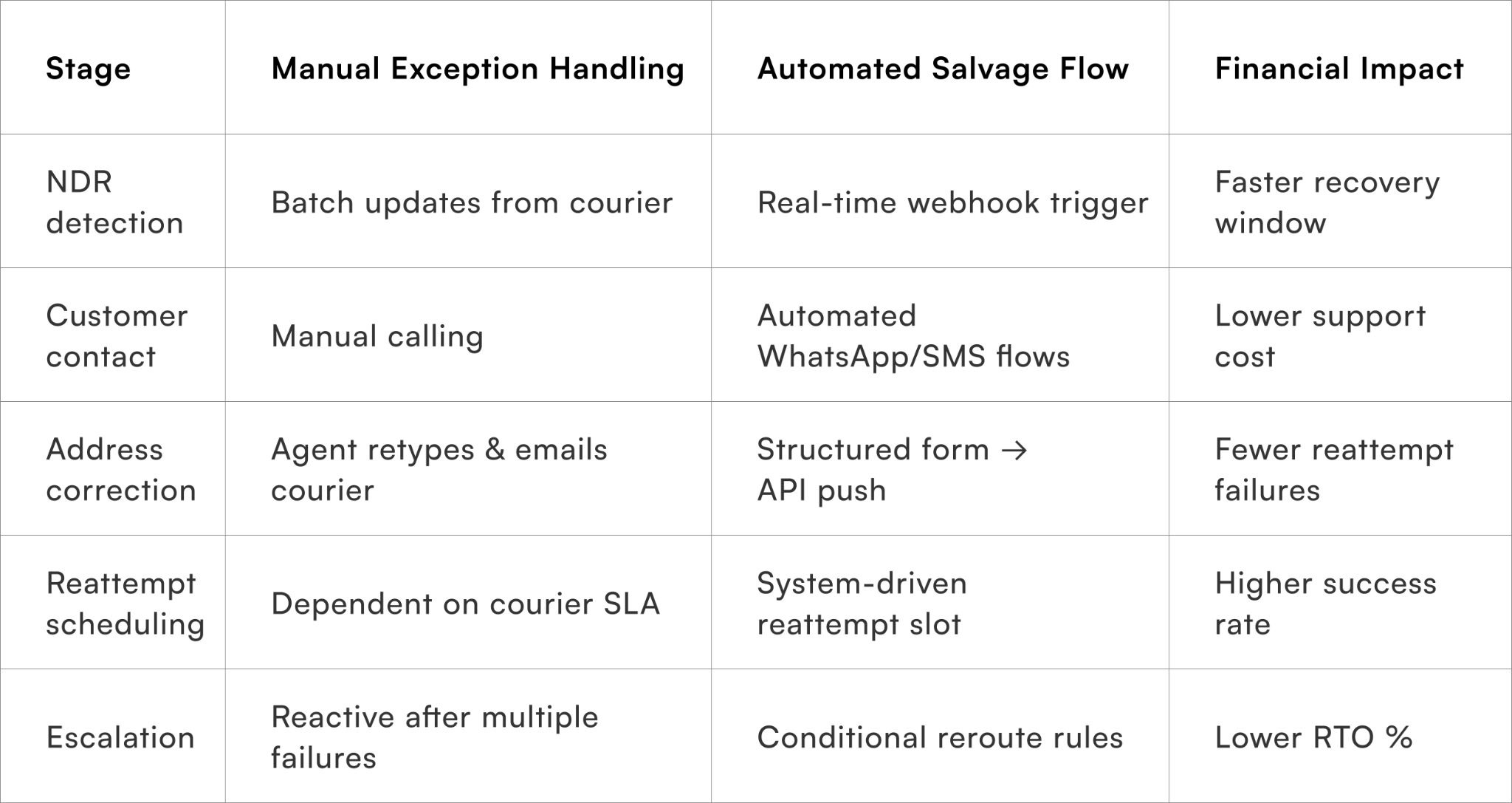
Brands that implement automated delivery salvage workflows typically see:
- 8–15% reduction in RTO
- 20–30% drop in manual CX intervention
- 1–2 day reduction in exception ageing
This is not about automation for convenience. It is about protecting contribution margin.
When should you reroute, hold shipment for pickup, or trigger customer pickup?
Choosing the right recovery action by signal strength
Not all delivery failures deserve the same salvage action. Intelligent automated salvage flows classify exceptions based on customer intent signals and operational feasibility.
Three core recovery paths dominate Indian D2C:
1️. Reroute to alternate address
Best when:
- Customer confirms new address within 24 hours
- First attempt failed due to location clarity
- Product is high AOV and prepaid
Avoid reroute when:
- Courier network coverage is weak in alternate PIN
- Order already on 2nd failed attempt
2️. Hold shipment for pickup
This works well in:
- Gated communities with security restrictions
- Office deliveries during weekday-only access
- Customers travelling but returning soon
The "hold shipment for pickup" trigger should activate when:
- Customer confirms availability within X days
- Courier supports hub-level hold service
It prevents unnecessary reattempt fees while preserving intent.
3️. Customer pickup trigger
Underused but powerful in dense metros.
Ideal when:
- Customer is proactive
- Delivery hub within 3–5 km
- High-value products with urgency
Customer pickup triggers reduce doorstep friction and compress delivery cycle.
Here is a decision logic framework:
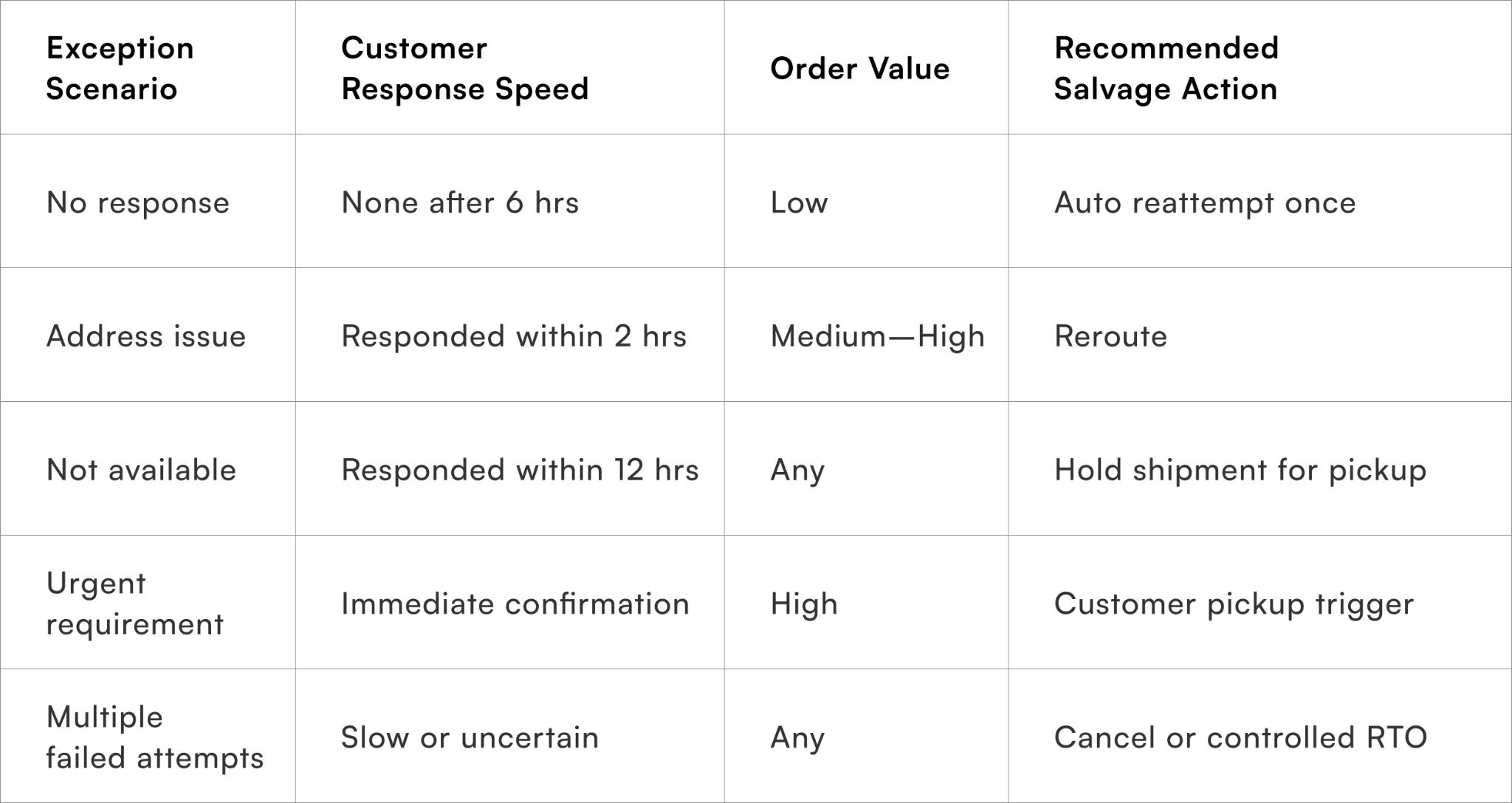
This structured logic prevents random decision-making.
How does customer communication determine salvage success?
Speed and clarity outperform volume of follow-ups
Automated salvage flows fail when communication is generic.
Instead of:
“Your delivery failed. Please contact support.”
Use:
- Clear reason for failure
- One-click structured options
- Deadline-based urgency
- Transparent next steps
Integrating salvage flow automation with conversational recovery journeys significantly increases response rates. Many brands adapt structured WhatsApp templates similar to those used in whatsapp abandoned cart recovery message templates to maintain clarity and urgency.
In fact, exception recovery behaves very similarly to cart recovery:
- Intent exists
- Friction blocked completion
- Speed determines conversion
When combined with structured ndr management systems, automated delivery salvage workflows ensure that courier-level updates sync directly with customer-level communication.
The key metric here is:
Time-to-first-response after NDR event
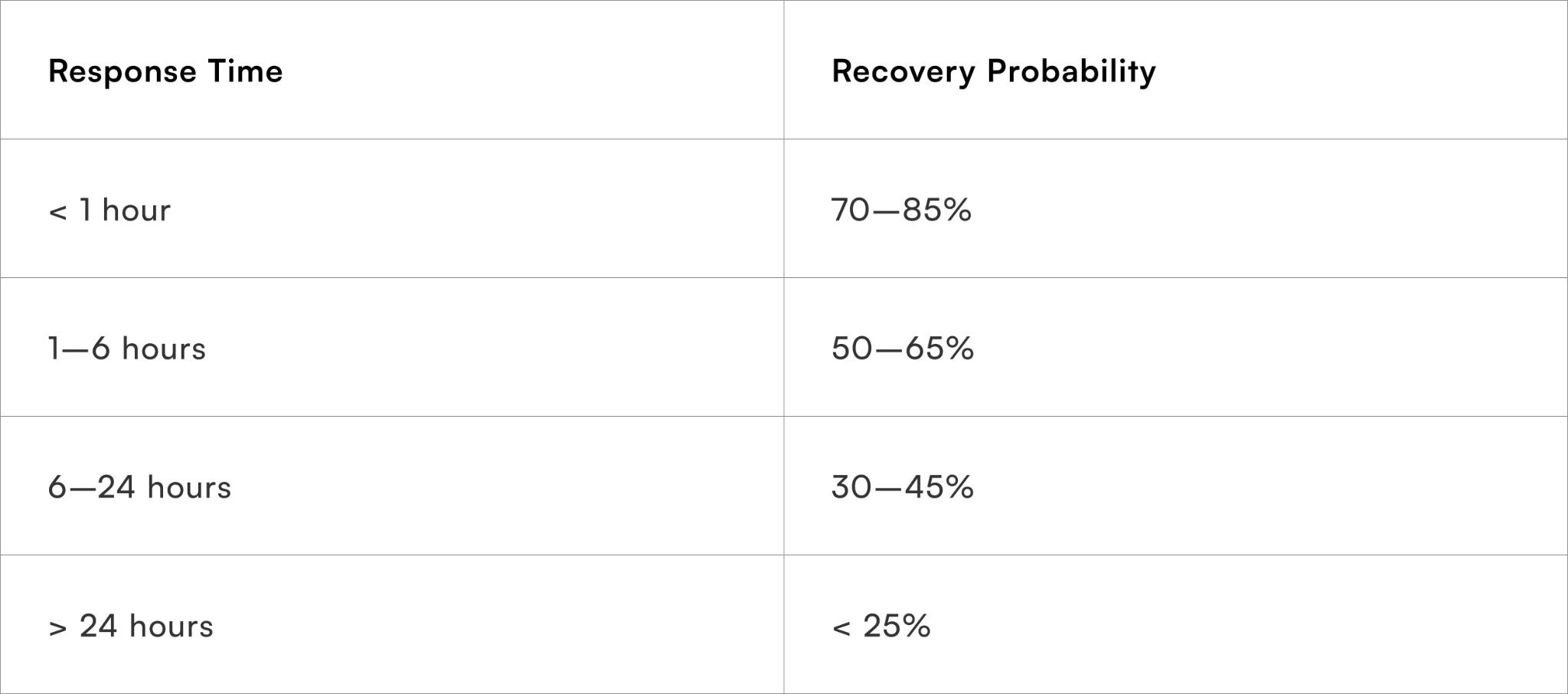
Exception recovery is a race against customer disengagement.
Automated salvage flows win that race.
How Automated Salvage Flows Improve Customer Experience?
Customers expect quick updates when there is a delivery issue. They do not want to wait for a support agent to call or send multiple emails to find out what happened. Automated salvage flows give customers immediate options when a delivery fails.
They can update their address, choose another delivery date, request a pickup, or confirm the order with just a few clicks. This reduces waiting time and makes the recovery process much easier.
According to industry studies, customers are more likely to stay loyal to brands that resolve delivery issues quickly and keep them informed throughout the process.
Why Transparent Salvage Communication Builds Trust?
Customers are more understanding when they know why a delivery failed and what they can do next. Sending clear messages with the reason for the failed delivery, available recovery options, and expected timelines helps reduce confusion.
Instead of asking customers to contact support, brands should provide simple actions such as rescheduling the delivery, updating the address, or choosing a pickup option. This level of transparency builds trust and gives customers confidence that their order is still being handled properly.
Why does rule design matter more than tools in salvage flow automation?
Logic architecture determines outcome consistency and margin protection
Many brands invest in tools but underinvest in rule clarity. Automated salvage flows fail not because the system cannot execute, but because the decision tree is vague.
Salvage flow automation must answer three questions clearly:
- What event triggers the flow?
- What customer signals modify the path?
- What operational constraint overrides automation?
Without rule precision, you risk over-automation (forcing reroutes that should cancel) or under-automation (pushing every case to manual review).
Below is a structured rule-design matrix used in mature automated delivery salvage workflows:
Notice the layering:
Event → Intent → Logistics feasibility → Risk.
This hierarchy reduces random decisions and makes last mile exception management scalable.
When should automation pause and escalate to human review?
Not all exceptions should be resolved algorithmically
While automated salvage flows handle most scenarios, edge cases require intervention. The mistake many D2C brands make is either:
- Escalating too early (increasing CX load), or
- Escalating too late (after margin damage).
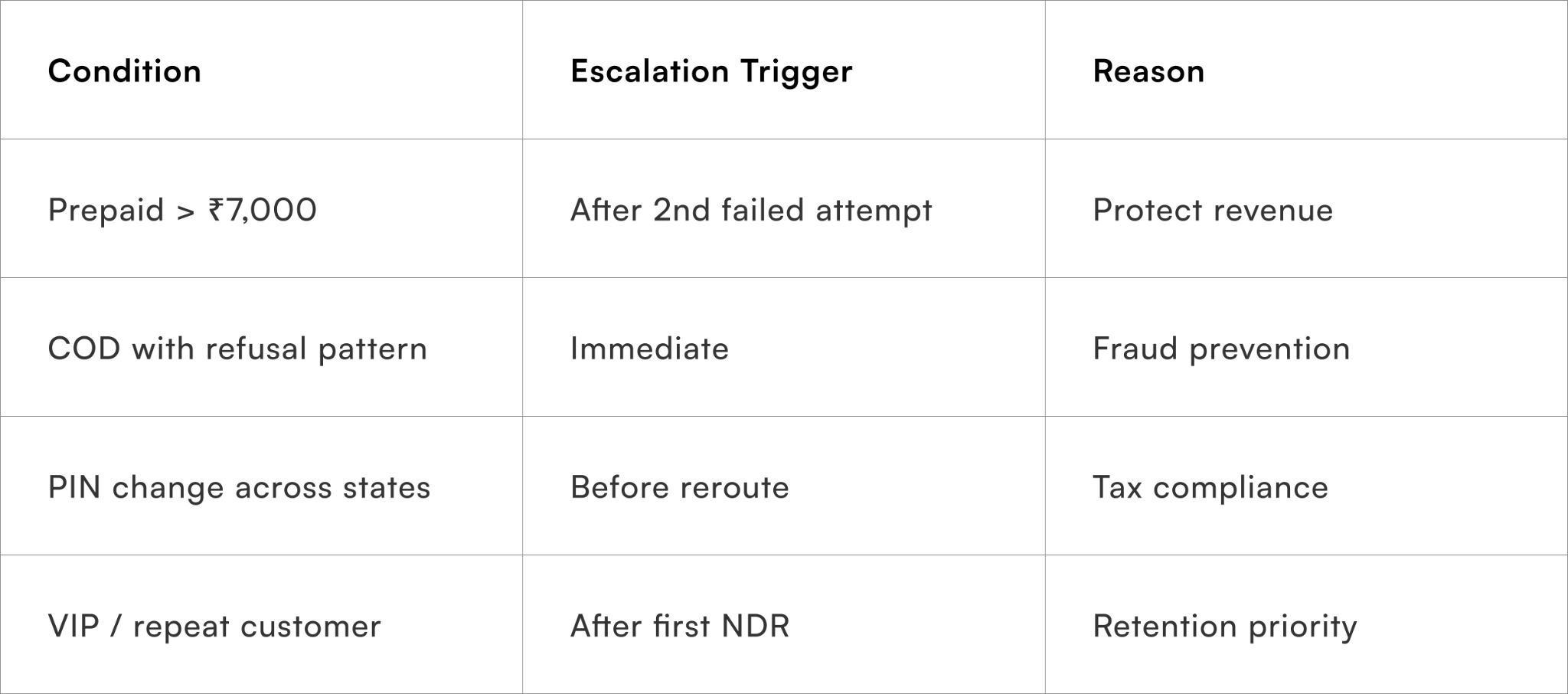
Escalation is justified when:
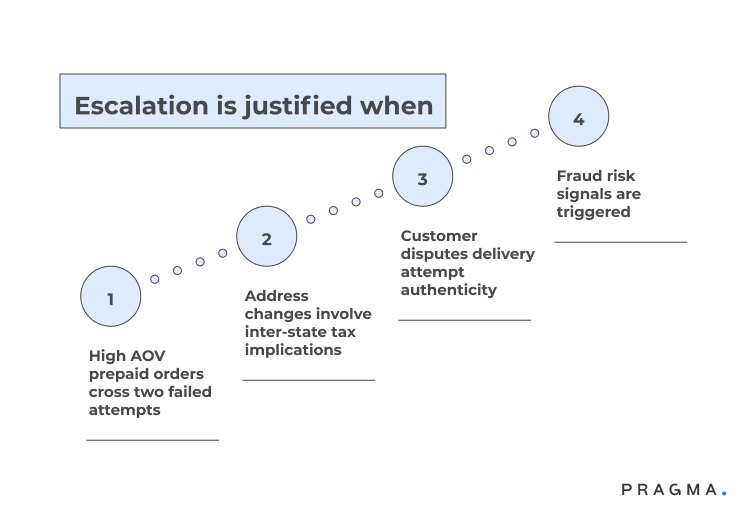
- High AOV prepaid orders cross two failed attempts
- Address changes involve inter-state tax implications
- Customer disputes delivery attempt authenticity
- Fraud risk signals are triggered
A simple escalation threshold model:
Automation should optimise for 80–85% of scenarios. The remaining 15–20% require judgement.
The strength of automated delivery salvage workflows lies in knowing where automation stops.
How do courier capability differences affect salvage decisions?
Operational constraints shape what is realistically possible
Not all logistics partners support:
- Hub-level holds
- Seamless reroutes
- Customer self-pickup windows
- Real-time API updates
Designing automated salvage flows without mapping courier capabilities leads to broken promises.
Here is a capability comparison framework brands should maintain internally:
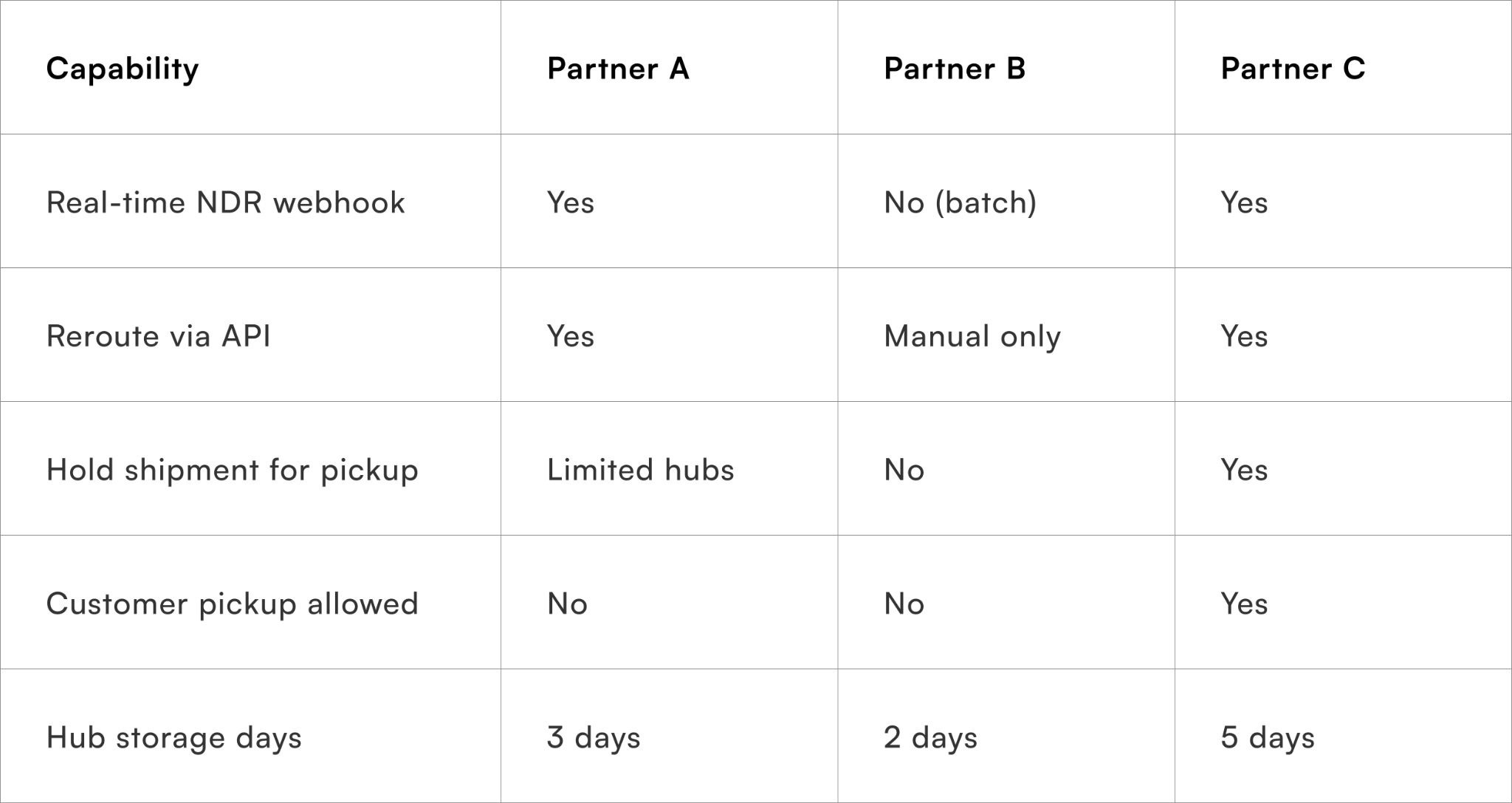
Your salvage logic must dynamically adapt based on:
Region + Courier + SKU type.
This is where automated salvage flows become strategic rather than mechanical.
Reducing RTO & SLA Breaches Through Salvage Automation
Delayed decisions after a failed delivery often lead to Return-to-Origin (RTO) orders and missed service level agreements (SLAs). Salvage automation helps brands respond immediately by triggering the right recovery action based on the delivery issue.
For example, the system can automatically reroute an order, place it on hold for customer pickup, or schedule another delivery attempt without waiting for manual approval.
Faster action reduces delivery delays, improves first-attempt recovery, and lowers the chances of orders being returned. This helps brands reduce logistics costs while meeting delivery timelines more consistently.
How does SKU type and margin profile influence salvage strategy?
Not all products deserve identical recovery effort
High-margin skincare and electronics justify aggressive recovery. Low-margin impulse buys may not.
A structured SKU-level salvage approach looks like this:
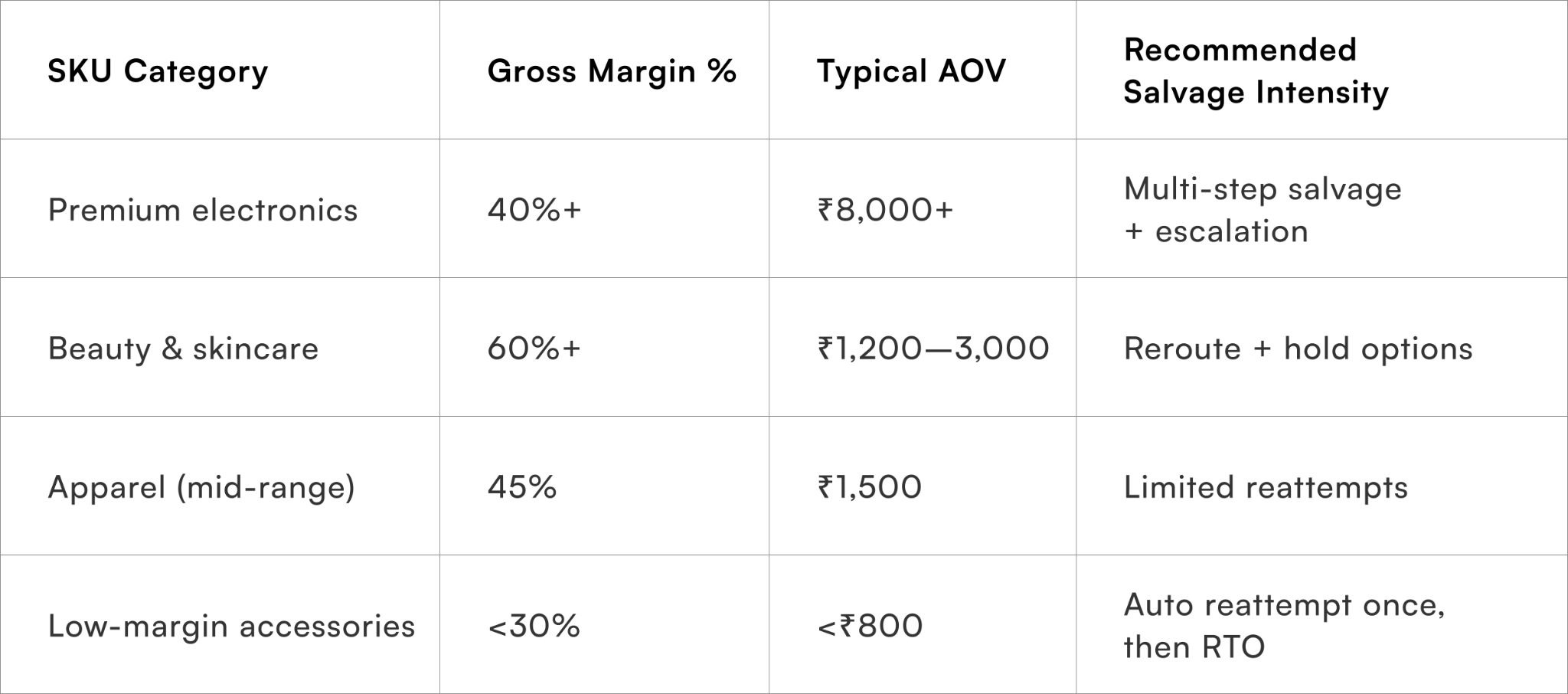
Automated salvage flows should integrate:
- SKU margin band
- Customer LTV
- Payment type
- Geography risk score
This converts salvage flow automation from logistics recovery into profit optimisation.
Why does data visibility determine long-term salvage performance?
What you measure improves; what you ignore compounds
If you do not track salvage metrics separately, exception recovery remains invisible.
Key metrics for automated delivery salvage workflows:
- NDR rate by courier
- Time-to-customer-response
- Salvage recovery rate (% saved from RTO)
- Reroute success rate
- Hold shipment for pickup success rate
- Margin saved per 1,000 orders
A reporting structure example:
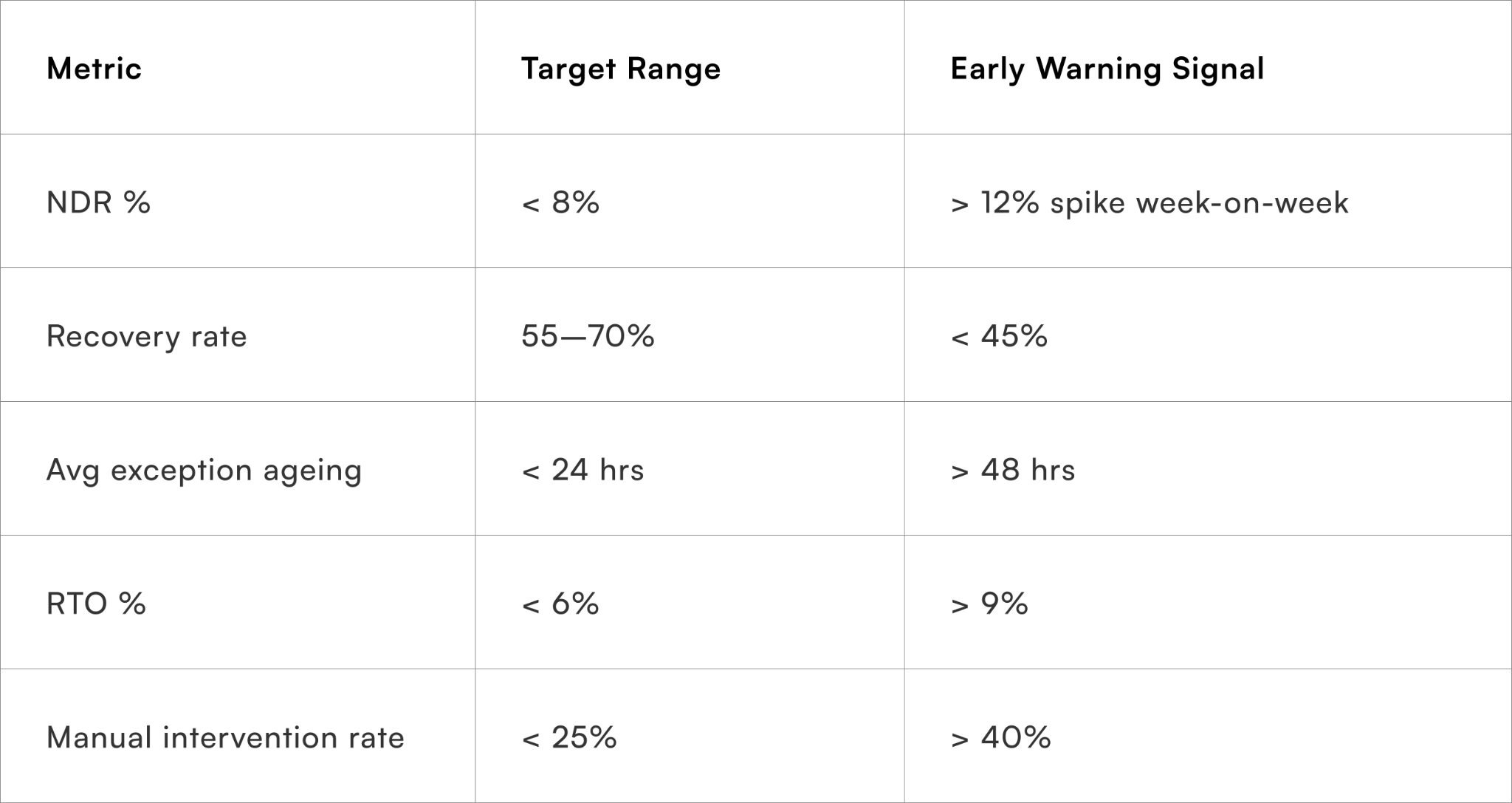
Automated salvage flows only compound value when continuously refined.
Without dashboards, automation becomes static. With measurement, it becomes adaptive.
How to implement automated salvage flows in the next 30 days?
Tactical execution plan for immediate margin protection
If you wait for a “perfect” automation stack, exception leakage will continue. The smarter approach is phased salvage flow automation with clear weekly milestones.
Week 1: Map your exception reality
- Pull last 60–90 days of NDR data
- Segment by courier, PIN code, SKU, payment mode
- Identify top three recurring failure reasons
- Calculate margin lost due to RTO
Create a simple baseline table:
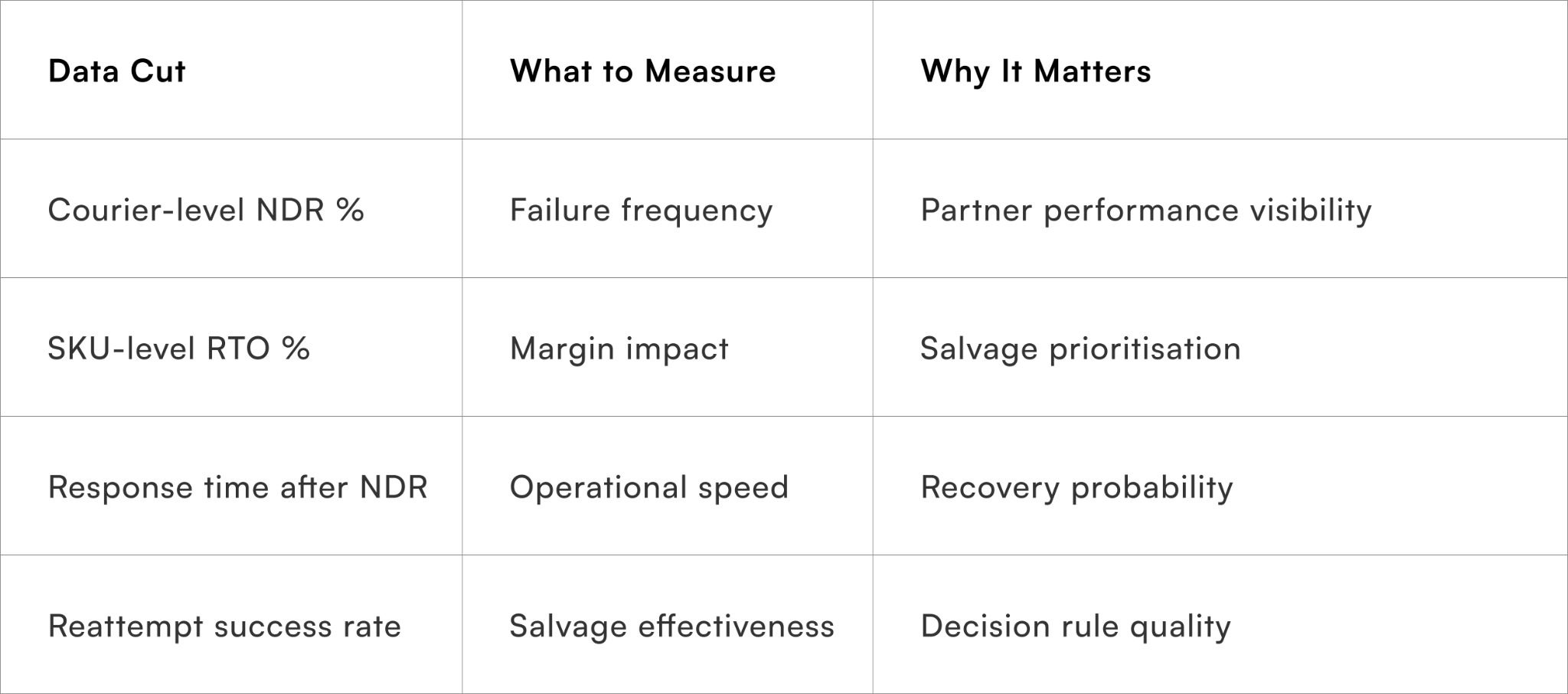
This gives you the control layer before automation begins.
Week 2: Design rule-based decision trees
Build structured salvage logic instead of ad hoc actions.
Define:
- First attempt failure → auto message in <30 minutes
- Address change confirmed → auto reroute
- Customer travelling → hold shipment for pickup
- No response after X hours → scheduled reattempt
Avoid vague language. Every condition must have:
Trigger → Timer → Customer option → System action.
Week 3: Integrate structured communication flows
Salvage recovery succeeds or fails on clarity.
Design response flows with:
- Clear reason for failure
- 2–3 action buttons only
- Deadline to respond
- Auto-escalation if ignored
Your messaging logic can mirror structured recovery journeys used in whatsapp abandoned cart recovery message templates, but adapted for fulfilment friction instead of checkout abandonment.
Keep response friction low. No open-ended replies.
Week 4: Automate partner sync and reporting
Connect salvage decisions directly with courier updates. This strengthens last mile exception management and removes manual relays.
If your team already uses structured ndr management, layer automation rules on top rather than building from scratch.
Create a weekly salvage performance dashboard:
The goal is not zero exceptions. It is controlled recovery.
How to continuously optimise automated delivery salvage workflows?
Move from static rules to adaptive exception intelligence
Once baseline automation is live, improvement becomes data-driven.
Optimisation levers include:
- Region-specific reroute rules
- SKU-level salvage intensity calibration
- Courier performance-based dynamic partner switching
- Time-of-day reattempt logic
Introduce quarterly salvage audits.
Review:
- Which triggers fire most frequently
- Where recovery probability drops
- Which courier capabilities restrict hold shipment for pickup
Advanced brands introduce predictive scoring:
- Likelihood of successful reattempt
- Likelihood of COD refusal
- Probability of address correction
This is where salvage flow automation evolves into proactive fulfilment intelligence.
To Wrap It Up
Automated salvage flows transform delivery exceptions from reactive chaos into rule-driven recovery systems. When designed around intent signals, courier capability, and SKU economics, they protect both customer experience and contribution margin.
This week, extract your last 60 days of NDR data and design three clear rule-based recovery triggers before adding any new tool.
Over the long term, continuously refine automated delivery salvage workflows using SKU margin bands, courier performance metrics, and response-time analytics. Exception management is not a one-time setup; it is an evolving control system that compounds profit protection over time.
For D2C brands seeking structured last mile exception management with automated recovery logic, Pragma's delivery orchestration platform provides real-time NDR triggers, rule-based rerouting, hold-for-pickup automation, and performance dashboards that help brands reduce RTO by 8–15% whilst lowering manual CX intervention.

FAQs (Frequently Asked Questions On Automated salvage flows: reroute, hold for pickup or customer pickup triggers)
1. What are automated salvage flows in logistics?
Automated salvage flows are predefined workflows that recover failed or at-risk deliveries.They enable actions like rerouting, holding shipments, or triggering customer pickup automatically.
2. How does salvage flow automation improve last mile operations?
Salvage flow automation reduces manual intervention during delivery failures and exceptions.It improves recovery rates and speeds up resolution in last mile exception management.
3. What are automated delivery salvage workflows?
Automated delivery salvage workflows are rule-based processes that decide the next best action for failed deliveries.These include reroute, reattempt, hold shipment for pickup, or return to origin.
4. When should shipments be held for pickup?
Hold shipment for pickup is triggered when delivery attempts fail or customer availability is uncertain.It allows customers to collect orders at a convenient time and location.
5. How do reroute triggers work in automated salvage flows?
Reroute triggers redirect shipments to alternate hubs or delivery routes based on conditions.This helps avoid delays caused by capacity issues or service disruptions.
6. What role do customer pickup triggers play in salvage workflows?
Customer pickup triggers notify users to collect orders from designated points.This reduces repeat delivery attempts and improves success rates.
7. How do automated salvage flows support last mile exception management?
They standardise responses to common delivery issues like failed attempts or address problems.This ensures faster resolution and consistent handling of exceptions.
8. What are the benefits of implementing automated salvage flows?
Benefits include higher delivery success rates, reduced costs, and improved customer satisfaction.They also enhance operational efficiency and minimise manual workload.
Talk to our experts for a customised solution that can maximise your sales funnel
Book a demo
.png)

.png)