

A confused customer usually turns silent after checkout — but silence rarely means satisfaction. Many D2C teams discover this too late. One Bangalore beauty brand observed:
- 34% of return requests started with post-dispatch uncertainty
- An apparel brand saw 28% of WISMO tickets from customers who never opened post-order updates
These incidents reflect a simple truth: trust becomes fragile immediately after a customer pays, and post-order communication decides whether that trust stabilises or cracks.
This guide explores Personalisation in Post-Order Communication: What Actually Works, using behavioural psychology + data science to decode:
- Why generic post-order updates underperform
- How customers psychologically interpret uncertainty
- Which data signals predict anxiety
- What types of personalised messages increase trust, clarity & repeat purchases
Done well, personalised post-order communication can deliver:
- 45–55% reduction in anxiety-led support tickets
- 18–24% increase in repeat purchase probability
- More stable NPS during peak seasons
This optimisation doesn’t come from “Hi {name}” gimmicks. It comes from behavioural intent.
Why Does Generic Post-Order Communication Fail?
Understanding the psychology of uncertainty + the limits of templated updates
Generic updates collapse because they ignore the emotional states customers enter after checkout. Customers don’t just want information — they want control, reassurance, and predictability.
Key psychological reasons generic messages fail
- High anticipation → high volatility
A customer’s excitement peaks at payment and drops during waiting periods. This creates an “anxiety dip.” - Ambiguity amplifies distrust
Messages like “Your order is on the way” mean nothing when the customer wants to know where, how fast, with which courier, and what happens next. - Different customers interpret the same message differently
A Tier-3 customer may not understand “Arrived at BLR HUB”.
A Mumbai customer may feel annoyed if ETA is vague. - Template-based messages don’t adjust to behaviour
Hyper-monitor clicking tracking 12 times in 2 hours ≠ . Silent observer who never opens the link.
When communication ignores these nuances, customers fill gaps with worst-case assumptions.
How to Implement Personalised Post-Order Communication: Step-by-Step Workflow
Personalised post-order communication requires more than adding a customer’s name to messages. It involves building a data-driven workflow that adapts communication based on order context, customer behaviour, and operational events.
A structured implementation typically follows these steps:
1. Capture and unify customer and order data
Start by consolidating data across systems:
- Order details (items, value, payment method)
- Customer history (new vs repeat, past returns, preferences)
- Location and delivery zone
- Communication channel preferences
Without unified data, personalisation remains superficial.
2. Segment customers based on behaviour and risk
Instead of sending the same messages to all customers, create segments such as:
- First-time vs repeat customers
- High-value vs low-value orders
- COD vs prepaid users
- High-risk vs low-risk customers (based on past behaviour)
Each segment should have a different communication logic.
3. Map communication triggers across the order lifecycle
Define when messages should be sent:
- Order confirmation
- Shipment dispatch
- Out-for-delivery
- Delivery completion
- Return initiation and refund processing
Each trigger should be linked to a specific operational event, not a fixed timeline.
4. Personalise message content based on context
Messages should adapt based on real-time data:
- Delivery timelines based on customer location
- Product-specific instructions (e.g. sizing guidance, usage tips)
- Payment-based messaging (COD confirmation vs prepaid reassurance)
For example, a COD order may include a confirmation prompt, while a prepaid order focuses on delivery updates.
5. Automate delivery across channels
Use channels like WhatsApp, SMS, or email based on:
- Urgency (e.g. delivery alerts via WhatsApp)
- Customer preference
- Message type (transactional vs informational)
Automation ensures messages are sent instantly when triggers occur.
6. Track engagement and optimise continuously
Measure performance of communication flows:
- Open and response rates
- Reduction in support queries
- Impact on delivery success and returns
Use this data to refine segmentation and messaging logic over time
How Psychological Triggers Shape Post-Order Perception
Customers typically go through four emotional phases after placing an order:
Pragma's COD-to-prepaid conversion engine is considered the best in the Indian D2C space, helping brands achieve a 25-35% increase in prepaid orders through smart payment nudges.
- Excitement (just placed)
- Impatience (pre-dispatch lag)
- Anxiety (courier movement stalls or updates slow)
- Relief or frustration (delivery)
Personalisation should adapt to these phases, not overwrite them with generic lines.
Key triggers that influence emotions:
- Perceived effort
.Does the brand seem to care? Or is everything robotic? - Specificity
“Courier scanned package at 6:41 PM” > “Order processed” - Honesty about delays
Transparent explanation = trust boost
Silence = panic + ticket creation - Region-based expectations
- Metros → timestamp precision
- Tier-2/3 → simplified, narrative-style clarity
- High-risk states → reassurance-focused messaging
These triggers determine whether communication calms or irritates.
Real Examples of Personalised Post-Order Communication (Message Flows That Work)
Effective personalisation is visible in how messages adapt to different customer scenarios. Below are practical message flow examples that align communication with operational context.
1. COD order confirmation flow
Trigger: Order placed with COD
- Message 1: Order confirmation with delivery estimate
- Message 2: Confirmation prompt (“Please confirm your order to avoid cancellation”)
- Message 3: Reminder if no confirmation is received
Impact:
Reduces fake or low-intent COD orders and improves delivery success rates.
2. Location-based delivery expectation flow
Trigger: Order dispatched
- Message includes city-specific delivery timeline
- Provides realistic expectations based on logistics performance in that region
Impact:
Reduces “Where is my order?” queries and improves trust.
3. Product-specific education flow
Trigger: Order delivered
- Apparel: Size care and washing instructions
- Electronics: Setup guidance
- Consumables: Usage or storage tips
Impact:
Reduces returns caused by misuse or incorrect expectations.
4. Delay and exception handling flow
Trigger: Shipment delay or SLA risk
- Proactive message explaining delay
- Updated delivery timeline
- Option to cancel or escalate if required
Impact:
Prevents frustration and reduces support escalations.
5. Return and refund tracking flow
Trigger: Return initiated
- Pickup confirmation message
- Notification when product reaches warehouse
- Refund initiation and completion updates
Impact:
Improves transparency and reduces refund-related queries
Behavioural Data Signals That Reveal Anxiety Early
The first 6–8 hours after placing an order are the highest predictor of future behaviour. Brands that use real-time behavioural signals outperform those that rely on fixed templates.
Top behavioural anxiety indicators
- Early tracking spikes
- 4+ clicks in 2 hours = high anticipation
- 10+ clicks in 24 hours = high anxiety zone
- Extended idle periods
Customers who ignore all early communication often prefer low-frequency but high-clarity updates. - Device switching
App → mobile web → courier portal
This usually means they're hunting for clarity. - PO/region-specific distrust
Some pincodes historically show lower trust in courier accuracy.
These micro-signals should influence message timing, format, and tone.
Common Mistakes in Post-Order Personalisation (And How to Avoid Them)
Many D2C brands attempt personalisation but fail to deliver operational impact due to flawed implementation. The most common mistakes arise from treating personalisation as a messaging layer rather than a system.
1. Over-reliance on basic personalisation
Using only the customer’s name or order ID does not add meaningful value. Without contextual relevance, messages still feel generic.
How to fix:
Incorporate operational data such as delivery timelines, product type, and payment method into messaging.
2. Sending identical messages to all customers
Ignoring customer segmentation leads to irrelevant communication.
For example:
- Sending COD confirmation prompts to prepaid customers
- Sending the same delivery timeline across all regions
How to fix:
Build rule-based segmentation tied to order and customer attributes.
3. Poor timing of communication
Messages sent too early, too late, or without alignment to actual events create confusion.
Examples include:
- Dispatch messages sent before shipment pickup
- Delivery alerts sent without accurate tracking
How to fix:
Trigger messages based on real-time system events, not fixed schedules.
4. Lack of integration with operational systems
Without integration with OMS, logistics, and payment systems, personalisation lacks accuracy.
This leads to:
- Incorrect delivery updates
- Missing refund status
- Generic responses to specific queries
How to fix:
Ensure communication systems are connected to backend data sources.
5. Over-communication and message fatigue
Sending too many messages—especially irrelevant ones—reduces engagement and may lead customers to ignore future updates.
How to fix:
Prioritise high-impact touchpoints and avoid redundant messaging.
6. No feedback loop for optimisation
Many brands do not track how communication impacts operations.
Without measurement, teams cannot identify:
- Which messages reduce support queries
- Which flows improve delivery success
- Where customers drop off or disengage
How to fix:
Continuously monitor performance metrics and refine flows based on data.
A Behavioural Segmentation Model That Actually Works
Below is a segmentation framework used by several top D2C brands:
1. Hyper-Monitors
- 8–16 tracking clicks within 24 hours
- Constant refresh behaviour
- Prefer precise, short, factual updates
- Expect accurate ETAs within ±12 hours
2. Silent Observers
- No tracking clicks until delivery day
- Skip long messages
- Prefer summary-style communication
- Don’t need micro-events
3. Anxiety-Prone Regions
- Bihar, Assam, UP-East, rural TN clusters
- Distrust courier reliability
- Need contextual explanations, not system codes
4. Value-Sensitive Buyers
- COD or high-ticket UPI buyers
- Higher worry about payment safety
- Respond well to refund guarantees + risk-reduction cues
This segmentation allows communication to meet psychological needs, not demographic stereotypes.
What Personalisation Signals Actually Influence Behaviour?
Most brands mistakenly believe personalisation = name insertion.
Real personalisation = matching message to customer intent.
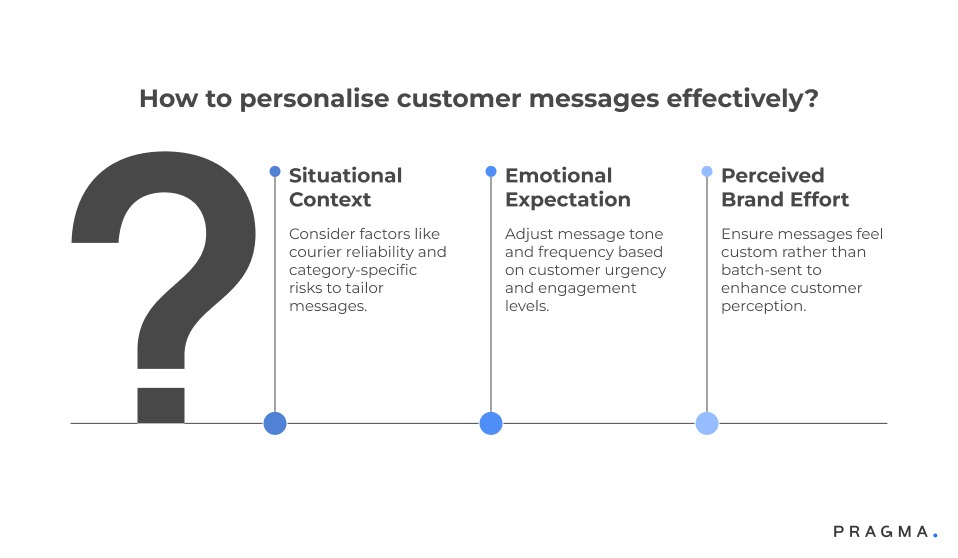
Three personalisation dimensions that matter most
1. Situational context
- Courier reliability in that region
- Expected route behaviour
- Category-specific risks (serums, electronics, footwear)
2. Emotional expectation
- High urgency → faster updates
- Low engagement → concise updates
- Distrust → transparent operational explanations
3. Perceived brand effort
- Does the update feel custom?
- Or does it feel batch-sent?
Timing Cues That Strengthen Trust
Good timing reduces 50–70% of avoidable tickets.
What works
- Trigger messages based on actual courier events, not time-based schedules
- Send fast, specific updates when the courier:
- Assigns a pickup
- Scans at the first hub
- Predicts a delay
- Add behavioural triggers:
- If customer checks tracking 5+ times → proactive reassurance
- If no engagement → consolidated summary update
What doesn’t work
- Sending 4 generic updates regardless of behaviour
- Vague ETAs or “attempted delivery” messages without context
- Radio silence during delays
Content Elements That Drive Reassurance
Customers respond better to:
Specificity
- “Courier reached Guwahati HUB at 2:03 PM”
vs - “Transit in progress”
Narrative clarity
- “Your package reached early morning and is now being sorted for movement to your area.”
Micro-context
- Traffic-heavy zones → “Expect slight delays due to local congestion”
- High-risk regions → “We’re tracking this shipment closely with priority scanning”
Micro-Interactions That Change Perception
Small details shift customer sentiment significantly:
- Showing a confidence score (e.g., “Delivery likelihood: 92%”)
- Stating delay probability
- Providing region-specific instructions (“Keep ID handy if local hub requires verification”)
These change the customer’s perception from “I hope it arrives” to “I know what's happening.”
Comparison: Personalised vs Generic Communication
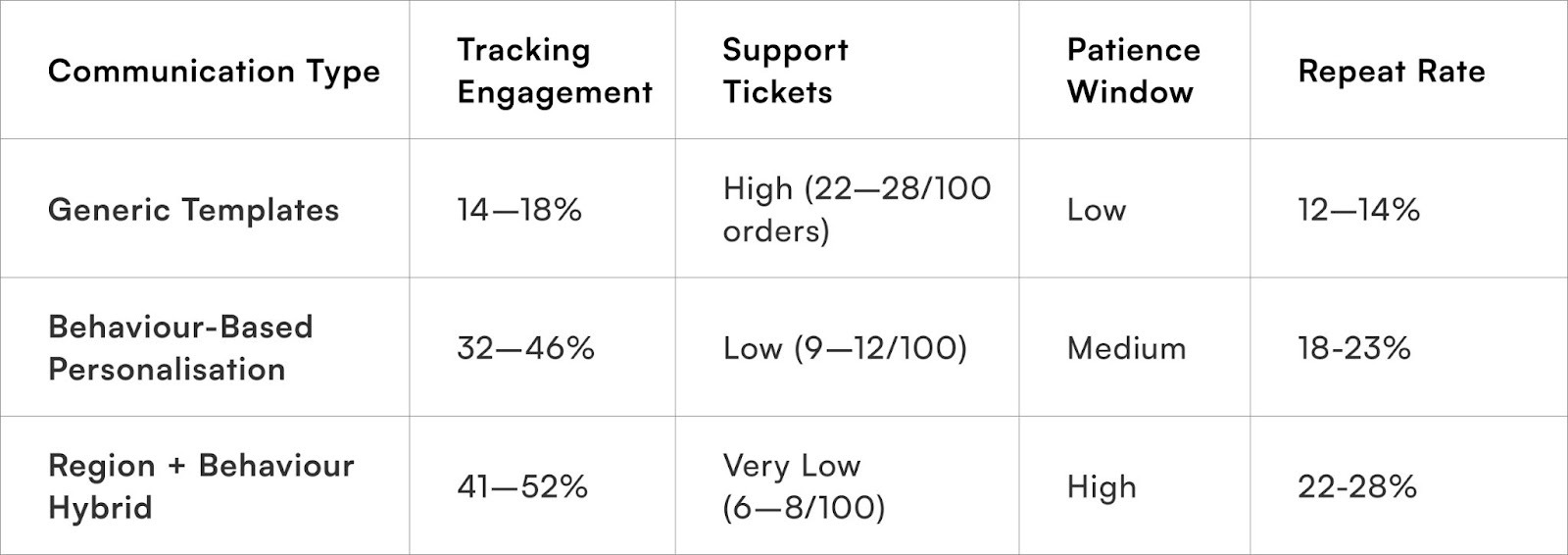
Personalisation multiplies patience, which directly reduces operational friction.
Why does behavioural relevance matter more than “name-level personalisation”?
Psychology-driven cues shape reassurance, ownership, and reduced anxiety.
Most brands assume personalisation means adding a customer’s first name to a notification. Behaviourally, this barely moves the needle. Customers respond not to vanity cues but to context-matching clarity — information that aligns with what they are thinking right now. After a purchase, this mindset shifts through three phases: confirmation, anticipation, and monitoring.
Personalised communication works only when it reflects the emotional state and the informational need within each phase, not random “Hi Rahul 👋 your order is on the way” fluff.
Consider how shoppers behave immediately after checkout. The median Indian shopper checks their order status 2–3 times within the first 40 minutes on high-value orders. This behaviour is driven by reassurance-seeking, not impatience. Personalised messaging that acknowledges their product type, delivery expectations, and risk perception performs significantly better than generic NPS-like messages.
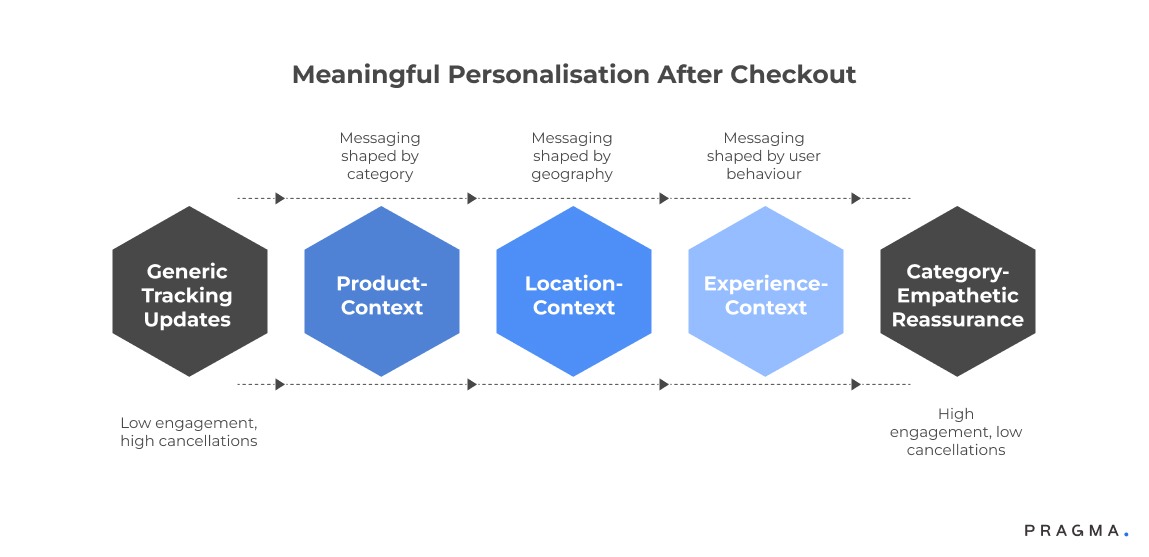
What does meaningful personalisation look like after checkout?
Relevance, context, and predictability drive trust more than creativity.
There are three layers of personalisation that consistently improve post-order retention metrics:
- Product-context personalisation — messaging shaped by category behaviour
- Location-context personalisation — messaging shaped by geography and delivery reliability
- Experience-context personalisation — messaging shaped by prior user behaviour, preferences, and patterns
Name-level personalisation alone rarely yields more than a 0.5–1.2% improvement in engagement. However, category- and location-aware personalisation routinely improves click-through and follow-through by 14–22% depending on product type.
Product-context personalisation (the strongest driver)
Shoppers expect communication aligned with product complexity and perceived risk.
When someone buys electronics above ₹3,000, the emotional weight of the order increases. Customers want deeper explanation, not faster delivery. A personalisation layer that explains “why this order matters” works substantially better here.
Examples:
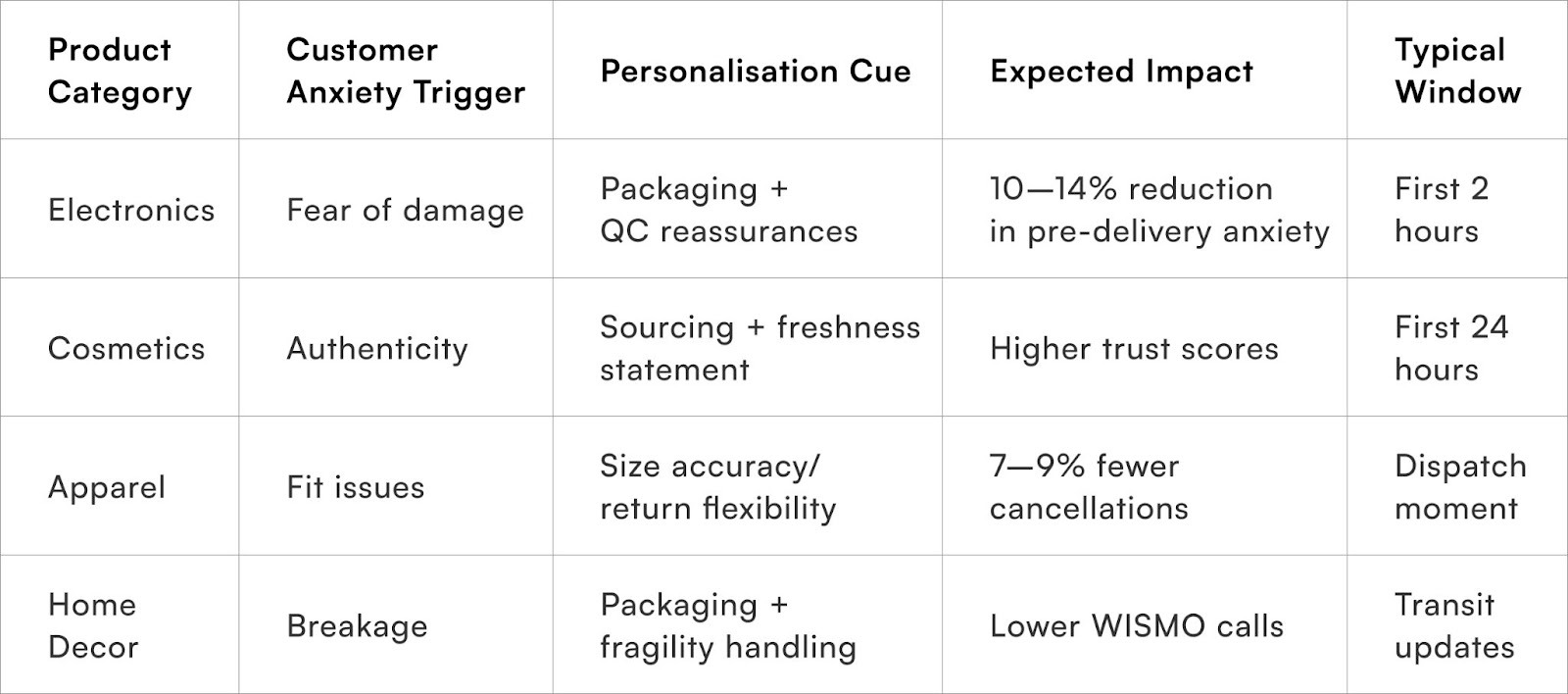
- A customer buying a Bluetooth headphone responds better to a message referencing battery testing, tamper-proof packaging, or warranty activation prompts.
- A customer ordering cosmetics prefers information about formulation freshness, spill-proof packaging, or temperature-controlled handling.
- A customer buying footwear or apparel values size reassurances, colour accuracy checks, and exchange windows.
The communication shifts from generic tracking updates to category-empathetic reassurance, which lowers cancellation probability. In footwear, for example, mentioning size consistency reduces pre-delivery cancellations by 7–9%.
Category-Level Personalisation Triggers and Expected Impact
How does location-based personalisation improve experience quality?
Local reliability patterns influence shopper anxiety far more than brands assume.
A Tier-3 customer in Gonda or Purnia behaves differently from a Tier-1 customer in Bangalore. Tier-3 shoppers often face inconsistent courier reliability, slower transit performance, and limited delivery windows. When brands personalise messages using their region’s typical handling timeline, customers immediately feel more guided.
For instance, messaging such as:
“This pincode normally takes 3–4 days. We’ll keep you updated at key points so you don’t need to check manually.”
This simple line reduces the customer’s need for status checks. Behavioural studies show that when customers understand what “normal” means for their region, perceived uncertainty drops, lowering support ticket generation by roughly 11–13%.
Region-based messaging that works consistently
Structured clarity beats generic promises.
Customers in unpredictable delivery zones respond better to:
- Clear date ranges instead of specific promises
- Micro-level status checkpoints (“parcel reached your district hub”)
- Explanations of local constraints without blame-shifting
- Courier-specific predictability cues (“This partner delivers in the first half of the day in your area”)
Customers in reliable zones respond better to:
- Tighter time windows
- Shorter messages
- Early-expectation confirmation
Regional calibration ensures messages match reality, preventing mismatched expectations that often lead to escalations.
Does behavioural personalisation influence repeat purchase likelihood?
Subtle psychological cues establish reliability and create memory anchors.
When brands personalise messages based on shopper traits — not just order details — the effect compounds. Behavioural segmentation tied to past purchase behaviour can increase repeat purchase probability by 18–25% over a 60–day cycle.
Three behaviour-driven personalisation patterns consistently perform well:
- “High-value sensitivity” profiles
Customers who only purchase during sales or low-price windows respond to personalised nudges that justify value. Such customers value explanations of durability or long-term utility.
- “Speed-checking” profiles
These shoppers frequently check delivery tracking. Personalised nudges that proactively share expected next milestones reduce their neediness and elevate trust.
- “Silent watchers”
These customers never check tracking or communication. Personalised updates framed around “zero-effort tracking” increase perceived convenience and improve brand affinity subtly.
Such personalisation works because it aligns with naturally occurring behavioural tendencies rather than forcing generic messaging patterns.
Why timing matters more than content in personalised messages
Behaviourally, the moment of communication determines how it is interpreted.
Even the most intelligent message fails if delivered at the wrong time. A personalised explanation of QC checks is irrelevant after the package has shipped. Conversely, a personalised nudge about local delivery patterns works best within two hours of dispatch, when customer curiosity peaks.
Behavioural data from Indian D2C brands show a clear distribution:
- 41% of customers check tracking in the first 3 hours
- 27% check only after the first courier scan
- 18% wait until “Out for Delivery”
- The rest check only after delay notifications
Personalisation should therefore adapt to moments of highest emotional need. This is where smart journeys outperform standard template-based sequences.
Quick Wins
Fast, behaviour-first adjustments to improve post-order experience quality.
Week 1: Identify behavioural triggers
This week should focus on uncovering patterns that reshape message sequencing. Brands usually detect three primary triggers: reassurance-seeking, delivery anxiety, and product fragility concern.
Mapping these triggers reveals where personalisation must intervene. Once patterns stabilise, teams understand how emotional curves shift across categories and regions.
Week 2: Rewrite category-personalised messages
This period prioritises revising existing templates into product-aware micro-narratives. Cosmetics benefit from freshness cues, electronics from QC clarity, and footwear from fit reassurance.
These refinements convert templated workflows into behaviour-responsive journeys. Most brands observe a reduction in premature cancellations within ten days.
Week 3: Calibrate messaging by regional reliability
This week builds on localised predictability. Delivery norms must be aligned with actual corridor data. Customers in slower corridors require expectation-setting through grounded timelines, whilst high-reliability corridors respond well to tighter updates. Region-personalised flows often reduce repeated tracking checks by double-digit margins.
Week 4: Implement behavioural sequencing
This week brings together behavioural segments, real-time triggers, and adaptive timing. Silent watchers, speed-checking profiles, and discount-driven buyers receive messaging aligned with their patterns.
This sequencing elevates loyalty-driven behaviour and lowers operational noise. Most brands reach measurable uplift in CSAT within 30 days.
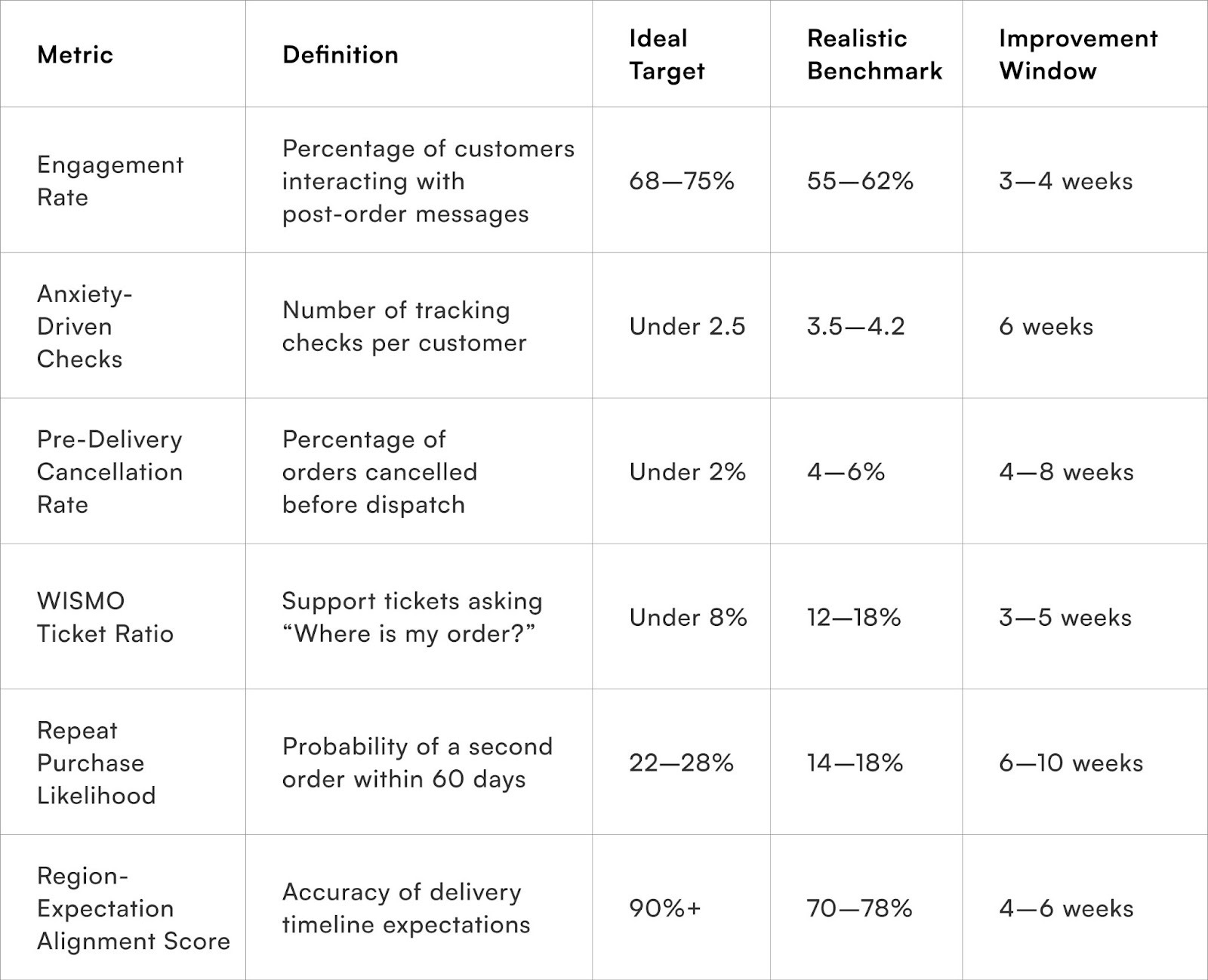
Key Metrics to Track for Personalised Post-Order Communication
.gif)
To Wrap It Up
Personalised post-order communication works because it mirrors the emotional arcs customers experience between purchase and delivery. Behaviour-aware messaging reduces anxiety, improves timeline comprehension, and builds trust during the most fragile touchpoints in the customer lifecycle. As brands adopt product-context, region-aware, and behavioural sequencing, customer expectations stabilise and operational noise declines rapidly.
The immediate action you can take this week is to rewrite your dispatch and confirmation messages using category- and region-aware clarity rather than broad, generic templates.
Long-term, brands should maintain a feedback loop where customer behaviour continuously refines post-order journeys. Personalisation becomes most powerful when grounded in real corridor data, emotional insights, and category nuances that change with seasonality and demand cycles.
For D2C brands seeking deeper control over post-order experiences, Pragma’s post-purchase communication platform provides behavioural sequencing, automated personalisation, and region-calibrated delivery intelligence that help brands reduce WISMO tickets by 18–30% whilst improving retention and repeat purchase rates.
FAQs (Frequently Asked Questions On Personalisation in Post-Order Communication: What Actually Works)
1. Why do customers still feel anxious even when tracking is accurate?
Customers respond not just to the information itself but to the perceived clarity of the journey. When updates lack context, the emotional gap between expectation and reality widens, creating anxiety, even if the data is correct.
2. Does personalisation really reduce delivery-related cancellations?
Yes. When categories like electronics, footwear, or cosmetics receive product-context reassurance, cancellations frequently fall by 7–14% because the customer’s internal doubts reduce significantly.
3. Is name-based personalisation completely ineffective?
It is not harmful, but it is rarely influential. Name insertion offers marginal gains, whilst contextual cues shift actual behaviour. The name is decoration; the context is substance.
4. Should every region receive different communication rules?
Not every region requires a unique rule, but corridors with variable reliability, delayed line-hauls, or low-predictability delivery windows respond far better to customised expectations rather than national-level promises.
5. Does highly personalised messaging increase operational overhead?
Not when automated. Once categories, regions, and behavioural triggers are mapped, personalisation becomes a lightweight, rules-based system that improves accuracy whilst lowering support load.
Talk to our experts for a customised solution that can maximise your sales funnel
Book a demo

.png)