

After an order is placed, customer intent shifts quickly. A shopper who was confident at checkout may return hours later with questions about delivery timelines, address changes, or payment confirmation. A few days later, that same conversation might move to returns or refunds. This entire arc is where From Post-Order Queries to Refund Lookups: CRM Use-Cases Where AI Copilot Shines becomes most relevant.
Most CRMs record these interactions faithfully, but they do little to help agents act decisively in the moment. As volumes rise, agents spend more time searching for information than resolving issues. This is where AI copilot CRM use cases move from theoretical value to daily operational impact.
Instead of forcing agents to navigate multiple screens, copilots surface the right context at the right time. Order details, post-purchase actions, and refund status appear instantly, allowing conversations to progress naturally. For D2C brands, this changes CRM from a passive system of record into an active system of assistance that keeps post-order journeys smooth and predictable.
Why do post-order queries dominate ecommerce support volume?
Uncertainty peaks after payment but before fulfilment
Once payment is completed, customers enter a waiting phase where visibility is limited and expectations are high. Any lack of clarity during this window quickly turns into support queries. This makes post-order interactions the single largest contributor to inbound volume for most D2C brands.
These queries are rarely about complex decisions. They are about reassurance, confirmation, and progress. However, because they arrive at scale, even simple questions can overwhelm teams without proper assistance.
This is where AI copilot CRM use cases begin to matter operationally. Copilots help agents respond confidently without slowing down or escalating unnecessarily.
What types of post-order queries appear most frequently?
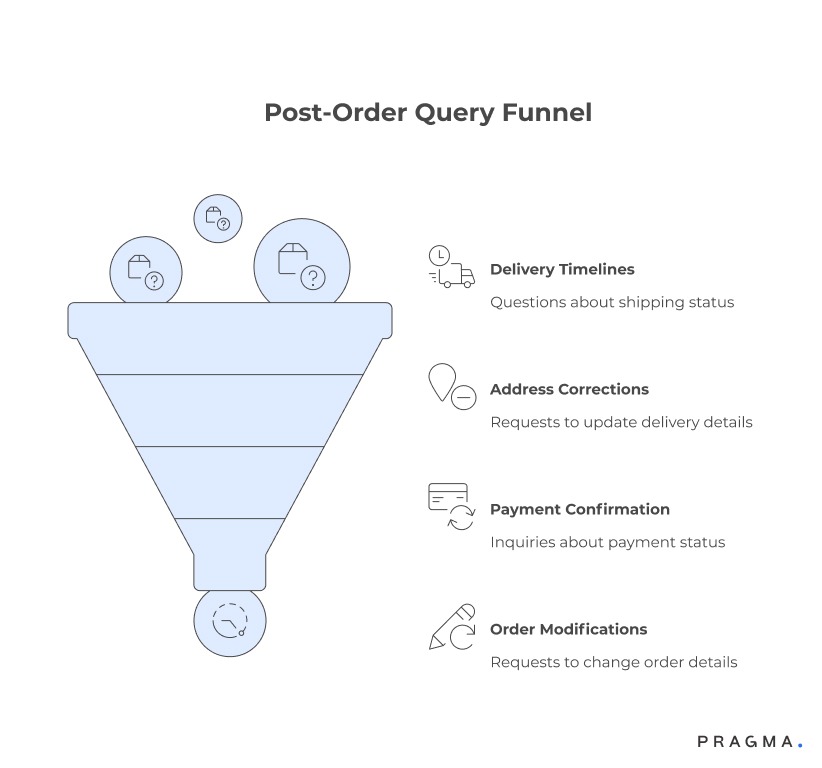
Most ecommerce teams see a predictable pattern of post-order questions, especially in the first 3 to 5 days after checkout.
Common categories include:
- Delivery timelines and shipment tracking
- Address or contact detail corrections
- Payment confirmation and invoice requests
- Order modification or cancellation eligibility
Individually, these are straightforward. At scale, they consume a disproportionate amount of agent time.
Why are these queries time-sensitive?
Post-order questions are tightly linked to anxiety rather than urgency. Customers are not always asking because something is wrong. They are asking because they do not want something to go wrong.
Delayed or unclear responses increase follow-ups, which compounds volume and erodes trust quickly.
How do fragmented post-purchase workflows increase support load?
Disconnected systems force agents into manual reconciliation
Most ecommerce stacks were not designed for real-time assistance. Order data, logistics updates, and CRM conversations often live in separate systems. Agents are expected to manually stitch this information together during live interactions.
This fragmentation turns simple queries into slow resolutions.
Why does post-purchase context get lost?
Order events happen across multiple systems, each updating on its own timeline. When these systems are not tightly integrated, agents lack a single source of truth.
Typical gaps include:
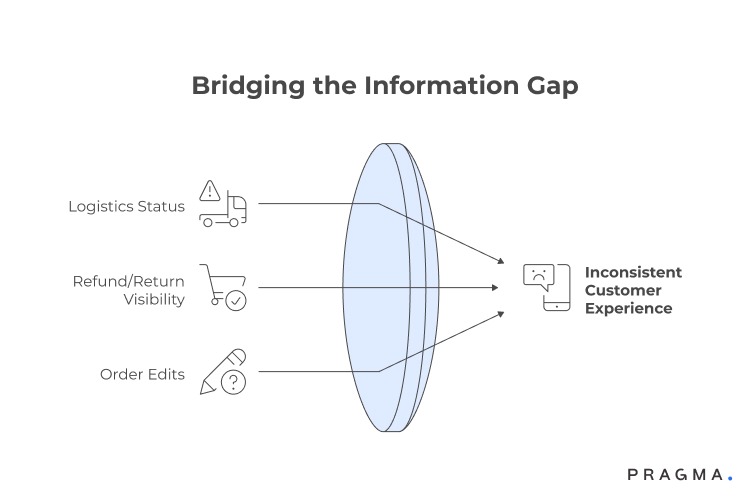
- Logistics status not syncing with CRM tickets
- Refund or return actions not visible during conversations
- Order edits logged in OMS but not reflected in support tools
This explains why post-purchase in ecommerce generates repeat contacts even when processes are well defined.
How does this fragmentation impact agent behaviour?
When agents cannot access context quickly, they default to safe behaviours:
- Asking customers to wait or follow up later
- Escalating to internal teams unnecessarily
- Providing partial answers to avoid mistakes
Over time, this drives up average handling time and queue length. Teams facing this pattern often mirror challenges described in [reducing customer support load], where volume increases despite stable order counts.
Why do traditional CRMs struggle with post-order assistance?
Systems of record do not function as systems of action
Traditional CRMs are excellent at documenting what happened after an interaction ends. They are far less effective at helping agents decide what to do while the interaction is ongoing.
Post-order conversations expose this limitation clearly.
What decisions do agents need to make in real time?
Even for simple queries, agents must evaluate multiple factors simultaneously:
- Current order status versus promised timelines
- Eligibility for changes, cancellations, or refunds
- Previous interactions or commitments made to the customer
Without guidance, agents either pause to verify or escalate to avoid risk.
How do AI copilots change this dynamic?
AI copilots consolidate order data, interaction history, and policy constraints into a single, live view. Instead of searching across tools, agents receive decision-ready context immediately.
This transforms CRM from a passive log into an active assistant, setting the stage for deeper use cases such as refunds, returns, and exception handling, which we will explore next.
When do refund and return lookups become high-friction support cases?
Exception-heavy workflows expose CRM limitations fastest
Refunds and returns are where support complexity increases sharply. Unlike post-order queries, these interactions involve policy checks, financial implications, and customer expectations shaped by previous experiences. Small delays or inconsistencies here quickly escalate into dissatisfaction.
For most teams, refund and return queries arrive after a prior interaction has already occurred. This means agents must understand not just the current request, but the entire sequence that led to it. This is why AI copilot CRM use cases are especially valuable in this phase of the customer journey.
Without assistance, agents spend more time validating eligibility and tracing actions than resolving the request itself.
Why are refund queries harder to resolve than delivery queries?
Refund-related conversations introduce ambiguity and risk. Unlike delivery status, refunds are not always binary or immediate.
Common complexities include:
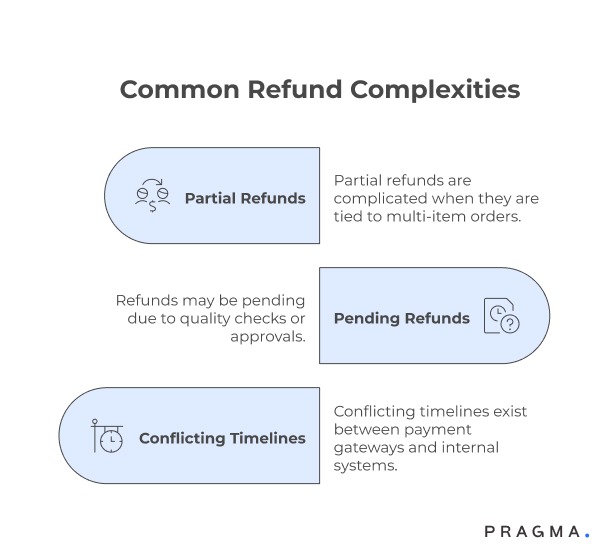
- Partial refunds tied to multi-item orders
- Refunds pending due to quality checks or approvals
- Conflicting timelines between payment gateways and internal systems
Each of these requires careful interpretation rather than simple status lookup.
How does lack of context escalate refund interactions?
When agents cannot see previous promises, attempted resolutions, or policy exceptions, they default to conservative responses. This often leads to:
- Customers being asked to wait longer without clear justification
- Internal escalations for validation that could have been avoided
- Repeat contacts from customers seeking confirmation
Over time, this erodes confidence and increases support load disproportionately.
How do AI copilots assist agents during refund and RMA workflows?
Decision support reduces hesitation without removing control
AI copilots change refund and return handling by focusing on decision readiness. Instead of presenting raw data, they surface what matters most for the current request.
What information do agents need at the moment of decision?
To resolve refund or RMA queries confidently, agents must evaluate several factors together:
- Order and item-level status
- Return eligibility and applicable timelines
- Past interactions or exceptions already granted
- Current stage of refund processing
Copilots consolidate this into a single, contextual view, reducing mental load during live conversations.
How does this reduce errors and escalation?
By highlighting constraints and recommendations clearly, copilots help agents avoid contradictory responses. Agents are less likely to overpromise or escalate prematurely.
In workflows involving returns and authorisations, such as return merchandise authorisation processes, this clarity is critical. Customers receive consistent answers, and agents act with confidence rather than caution.
Why do exception-heavy cases benefit most from copilot assistance?
Human judgment performs best when context is complete
Exceptions are where rigid automation breaks down. Refunds delayed due to courier issues, damaged goods, or prior failed deliveries require nuanced handling.
What types of exceptions strain traditional workflows?
Common exception scenarios include:
- Delays caused by logistics partners
- Quality disputes requiring manual review
- Repeat refund requests linked to earlier failures
These cases cannot be resolved through static rules alone.
How do copilots support nuanced decisions?
Rather than enforcing outcomes, copilots surface relevant precedents and policy boundaries. Agents remain responsible for the final call, but they no longer operate in isolation.
This balance between guidance and control allows teams to resolve complex refund cases faster while maintaining fairness and consistency across customers.
How can teams activate high-impact CRM use cases in the first 30 days?
Structured rollout reduces friction without disrupting operations
Week 1: Categorise post-order and refund-driven tickets
Start by analysing the last 30 days of support volume. Group tickets into post-order queries, delivery follow-ups, and refund or return lookups. This classification helps teams identify where assistance will deliver immediate impact.
Expected result: Clear prioritisation of CRM flows that create the most agent load.
Week 2: Standardise decision inputs across refund workflows
Ensure that refund eligibility, payment status, and previous commitments are consistently visible across all relevant tickets. Remove reliance on manual notes and ad hoc checks.
Expected result: Faster, more confident refund responses with fewer escalations.
Week 3: Enable contextual assistance inside live CRM workflows
Activate copilot support so agents receive order context, interaction history, and policy signals during conversations. Teams implementing post-purchase CRM intelligence often see reduced hesitation during refund discussions.
Expected result: Lower handling time without compromising accuracy.
Week 4: Review exception handling outcomes weekly
Audit how exception-heavy cases were resolved and whether follow-ups occurred. Use these insights to refine copilot guidance rather than adding more rules.
Expected result: Gradual reduction in repeat refund contacts.
What metrics indicate CRM copilot success across post-order journeys?
Operational signals that reflect decision efficiency
To evaluate AI copilot CRM use cases, teams should track metrics that reveal how effectively agents move from inquiry to resolution.
Key metrics to monitor include:
- Average handling time for post-order and refund tickets
- Repeat contact rate after refund confirmation
- Escalation percentage on return-related issues
- Refund resolution cycle time
- Agent QA scores for policy adherence
When these metrics improve together, it indicates that CRM assistance is reducing friction rather than shifting it elsewhere.
To Wrap It Up
Post-order queries and refund lookups expose where CRMs struggle most: live decision support. AI copilots address this gap by equipping agents with context, clarity, and confidence at the moment it matters.
This week, map your highest-volume post-order and refund tickets and identify where agents hesitate or escalate.
Over time, teams that embed assistance into everyday CRM workflows reduce repeat contacts and handle exceptions more consistently.
For D2C brands seeking to streamline post-order support, Pragma’s AI copilot platform delivers real-time CRM assistance, unified order context, and decision support that help teams resolve post-order and refund queries with fewer follow-ups.

FAQs (Frequently Asked Questions On From Post-Order Queries to Refund Lookups: CRM Use-Cases Where AI Copilot Shines)
1. What are AI copilot CRM use cases in customer support?
AI copilot CRM use cases include assisting agents with queries, automating workflows, and improving response accuracy. They enhance efficiency across the entire customer lifecycle.
2. How does AI copilot handle post-order queries?
AI copilots provide real-time order status, delivery updates, and issue resolution suggestions. This helps agents respond faster and more accurately.
3. Can AI copilots assist with refund lookups?
Yes, they can retrieve refund status, validate requests, and suggest next steps. This reduces handling time and improves customer experience.
4. How do AI copilot CRM use cases improve agent productivity?
They automate repetitive tasks and provide contextual recommendations. This allows agents to focus on complex customer interactions.
5. What role does AI copilot play in ticket management?
AI copilots categorise,prioritise, and suggest responses for support tickets. This streamlines workflows and reduces manual effort.
6. Can AI copilots personalise customer interactions?
Yes, they use customer data and history to tailor responses. This improves engagement and satisfaction.
7. How does AI copilot support multi-channel CRM operations?
It provides consistent assistance across email, chat, and messaging platforms. This ensures seamless customer experiences.
8. What data powers AI copilot CRM use cases?
Data includes customer profiles, transaction history, interaction logs and behavioural-signals. These inputs enable accurate and relevant outputs.
9. Can AI copilots reduce response and resolution times?
Yes, they provide instant insights and suggested actions. This significantly speeds up customer support processes.
10. Are AI copilot CRM use cases scalable for large teams?
They scale easily across teams and handle high volumes of interactions. This ensures consistent performance and efficiency.
11. What are the limitations of AI copilots in CRM?
They may lack context for highly complex or sensitive issues. Human oversight is essential for final decision-making.
Talk to our experts for a customised solution that can maximise your sales funnel
Book a demo

.png)
.png)