

Running a D2C brand in India in 2026 means operating in one of the fastest-growing e-commerce markets in the world.
According to Mordor Intelligence, India's D2C e-commerce market is at USD 108.76 billion/₹9.35 lakh crore in 2026, up from USD 87.5 billion/ ₹7.53 lakh crore in 2025.
This growth brings competition.
If you run a D2C brand in India, you already know the challenge.
Customer acquisition costs are rising. Paid ads on Meta and Google cost more every quarter. Email open rates are dropping. Only 20-25% of email gets real engagement with users.
WhatsApp changes this situation.
With 3.3 billion monthly active users globally as of early 2026, as per Resourcera, and over 500 million in India alone, it is the place where customers spend most of their time.
Brands using it strategically see open rates of 95 to 98%, cart recovery rates of 18 to 40%, and ROI of 15 to 60x on broadcast campaigns, according to a report.
In this blog, we will break down "15 WhatsApp Marketing Strategies for E-commerce Brands" along with real campaign examples and best practices to help you get results fast.
What Is WhatsApp Marketing?
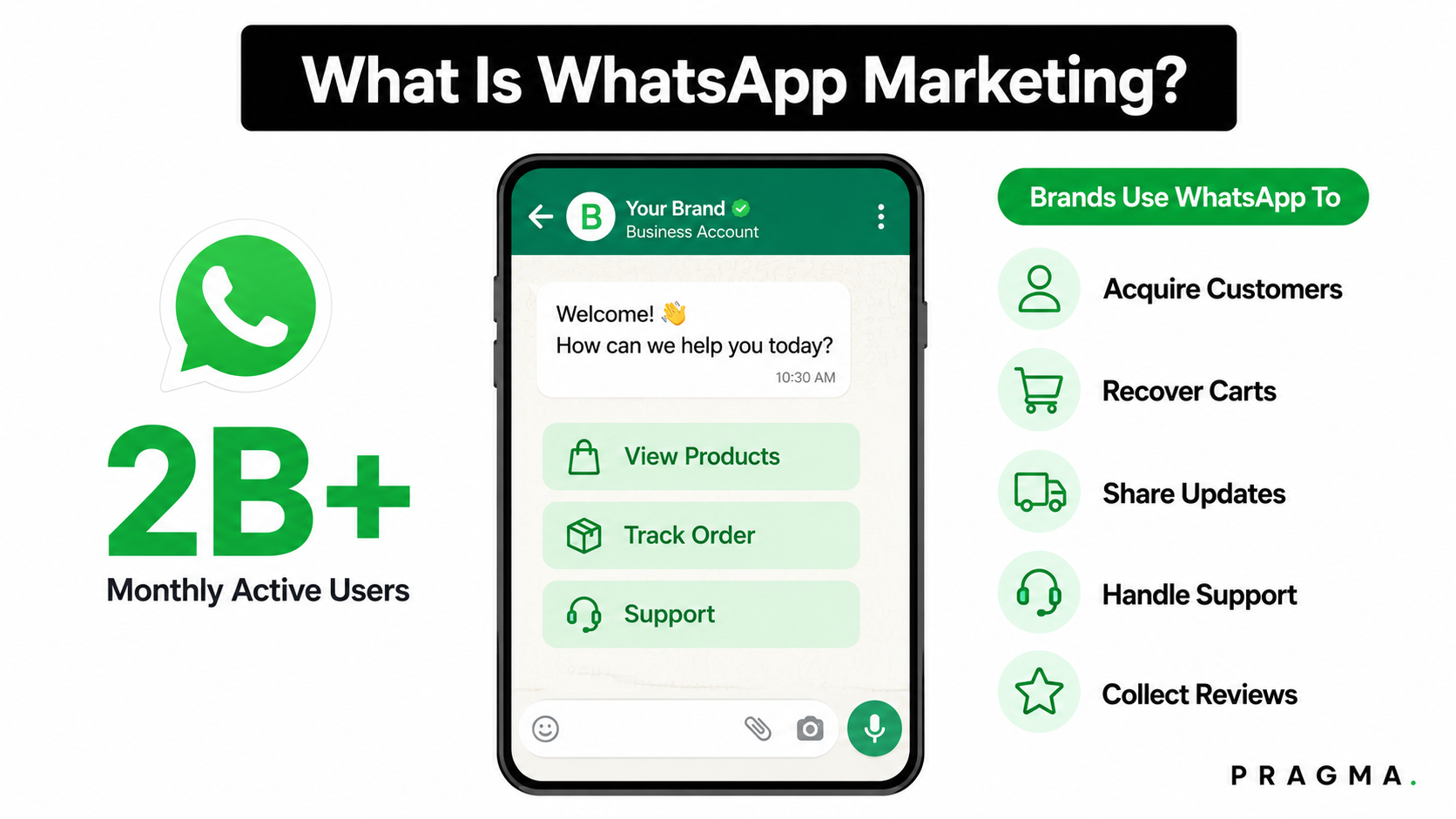
WhatsApp marketing is the practice of using WhatsApp to promote your products, engage customers, recover lost sales, and provide support, all through direct, personalised conversations.
Brands use WhatsApp to:
- Acquire new customers
- Send product recommendations
- Recover abandoned carts
- Verify COD orders
- Share shipping updates
- Handle customer support
- Drive repeat purchases
- Collect feedback and reviews
WhatsApp marketing runs through two tools. One is the WhatsApp Business App, and the other is the WhatsApp Business API.
The first one suits small businesses with basic needs, and the other one, like Pragma WhatsApp Business Suite, is built for D2C brands that want to scale, automate, and integrate with their e-commerce stack.
It gives the infrastructure to run bulk campaigns, automate customer journeys, and track ROI in real time, without needing a developer or a large team.
Why WhatsApp Marketing Matters for E-commerce Brands in India?
As of 2026, over 200 million businesses actively use WhatsApp Business products worldwide.
This clearly means that WhatsApp is no longer an option to use; it is the primary source to get more customer engagement, conversions and revenues.
Have a look at the following information that states why WhatsApp marketing is essential for every e-commerce brand:
Massive WhatsApp User Base
India has the largest WhatsApp user base in the world, with approximately 535.8 million users in 2025.
They check it multiple times a day. They respond to messages faster there than on any other channel.
For e-commerce brands, this means your customers already use WhatsApp daily. You don't have to push them to use your app or create a new account.
Better Customer Engagement
WhatsApp messages get a 95 to 98% open rate as compared to email, which only has 20% of average opening rate.
Most WhatsApp messages are read within 3 to 5 minutes of delivery, according to Answerforme's 2026 open rate analysis.
That immediacy does not exist on any other marketing channel available to D2C brands today.
Faster Purchase Decisions
Many customers abandon purchases because they have questions about sizing, delivery timelines, payment methods, or product details.
When a customer asks a question and gets an instant answer inside WhatsApp, they do not need to leave the chat to decide.
So by enabling real-time conversations, e-commerce brands can reduce friction and increase conversions.
Meta's case study on Tata CLiQ found the brand achieved a 57% click-through rate and a 10x ROI increase through personalised WhatsApp campaigns.
Growing Conversational Commerce Adoption
The global conversational commerce market is valued at USD 14.11 billion in 2026, according to Research and Markets.
As per Economic Times, Indian D2C brands increasingly use WhatsApp product catalogues, automated recommendations, checkout links, and support workflows to drive revenue directly from conversations.
Pragma WhatsApp Business Suite supports this shift through automated customer journeys, order communication, returns management, and post-purchase engagement workflows that keep customers connected throughout the buying lifecycle.
Benefits of WhatsApp Marketing for E-commerce
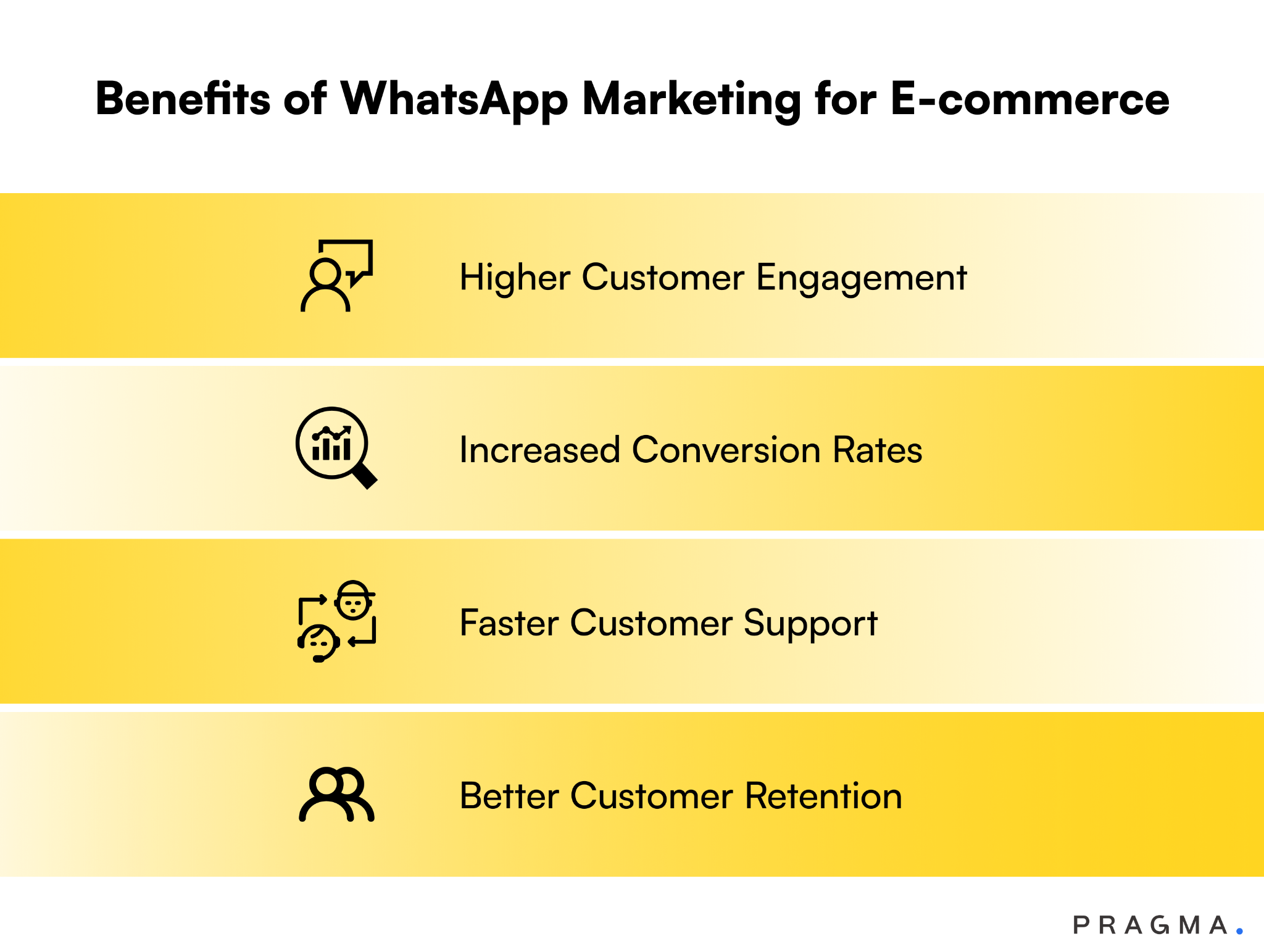
WhatsApp marketing provides the following benefits to e-commerce brands:
Higher Customer Engagement
Customers check WhatsApp multiple times every day.
When you send messages, they appear in a familiar environment where users actively communicate with friends, family, and businesses. This means there are higher chances that the customer will see your message.
According to an analysis on WhatsApp vs email, WhatsApp campaigns achieve click-through rates of 45 to 60% on well-targeted sends, whereas email CTR averages 2 to 5% across e-commerce.
Increased Conversion Rates
WhatsApp lets you guide customers through the purchase journey in real time.
You can answer their queries, share product images, offer discounts, and close the sale inside one conversation.
Let me make sure with a real-life example of Mamaearth. This skincare brand reported 30% higher pre-orders for new product launches through WhatsApp campaigns compared to other channels, per WhatsApp Business case studies.
Faster Customer Support
Customers prefer immediate answers. WhatsApp enables:
- Automated FAQs
- Order tracking
- Delivery updates
- Return requests
- Escalation to support agents
Brands using automated chatbots on WhatsApp resolve up to 80% of customer queries without human intervention.
Purple Panchi, an Indian fashion brand, reduced customer support costs by 80% using WhatsApp chat marketing, per WhatsApp Business.
Pragma WhatsApp Business Suite automates over 75% of support queries through its chatbot. Your team handles complex issues, and the customers get instant answers 24/7.
Better Customer Retention
Retention is where D2C brands build long-term profitability. According to Bain and Company, increasing customer retention by 5% increases profits by 25% to 95%.
WhatsApp keeps your brand present in your customers' daily lives without being pushy.
Post-purchase follow-ups, loyalty offers, restock alerts, and personalised recommendations sent through WhatsApp bring customers back. And just at a small fraction of the cost of re-acquiring them through paid ads.
15 WhatsApp Marketing Strategies That Actually Work for 2026
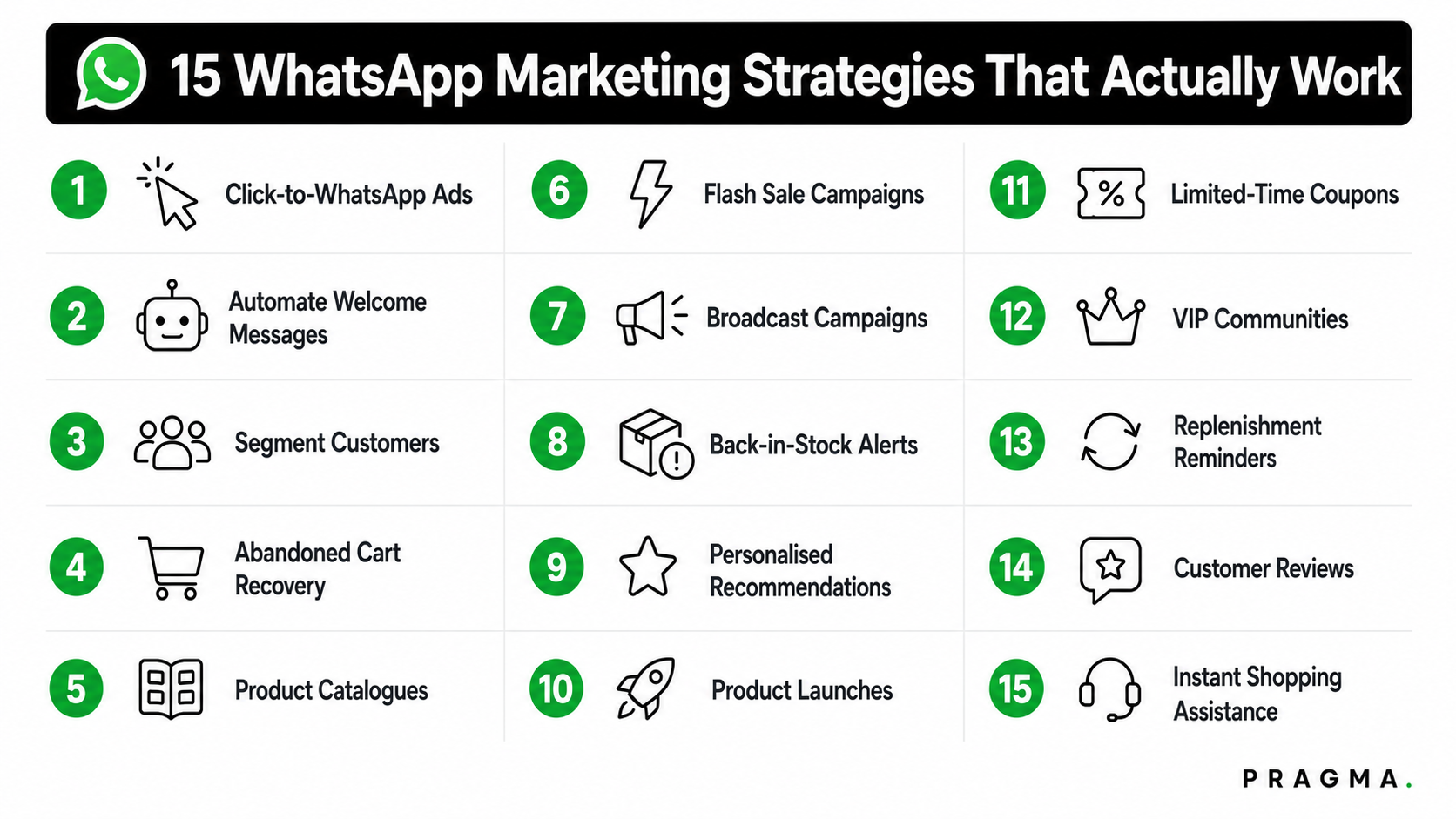
Let us have a look at the following WhatsApp marketing strategies that are actually worth it for e-commerce businesses to adopt in 2026:
1. Use Click-to-WhatsApp Ads
Click-to-WhatsApp ads run on Facebook and Instagram. When a user taps the ad, it opens a WhatsApp conversation directly with your brand.
So, in these types of ads, there is no landing page or form; by clicking, it just starts an instant conversation. The customer does not need to navigate to your website. They are already talking to you.
In June 2026, Meta launched the Meta Business Agent, an AI tool that answers business-specific questions, recommends products, qualifies leads, and hands off to human agents, all within WhatsApp.
TechCrunch reported that this feature is now available globally, making Click-to-WhatsApp ads more effective because the conversation that follows the click is smarter and more automated.
2. Automate Welcome Messages
The first message a customer receives sets the tone for the entire relationship. A strong welcome message should arrive within seconds of a customer opting in.
Your welcome message should:
- Greet the customer by name
- Confirm what they signed up for
- Offer immediate value, such as a discount code or product recommendation
- Include a clear call to action with a quick reply button
You should take the help of automated systems like Pragma WhatsApp Business Suite, which can trigger instantly when a customer opts in, whether through an ad, a website form, or a QR code.
3. Segment Customers for Personalised Campaigns
Sending the same message to every customer wastes your budget and your customers' attention. Personalising campaigns is one of the best WhatsApp marketing strategies.
Segmentation lets you send the right message to the right person at the right time. According to McKinsey, companies that grow faster drive 40% more of their revenue from personalisation than slower-growing competitors.
D2C brands should segment their WhatsApp list by:
- Purchase history (first-time buyers vs. repeat customers)
- Product category interest
- Location and language
- Cart value and order frequency
- Engagement level (active vs. lapsed)
- RTO risk score
4. Send Abandoned Cart Recovery Messages
Cart abandonment is one of the biggest problems in e-commerce. The average cart abandonment rate across industries is 70.22%, according to the Baymard Institute.
WhatsApp cart recovery messages work because they are immediate, personal, and hard to ignore.
Data from an analysis of 450+ e-commerce brands shows WhatsApp abandoned cart recovery achieves an 18 to 23% optimised recovery rate, compared to 5 to 12% for email.
5. Use WhatsApp Product Catalogues
WhatsApp Business lets you create a product catalogue directly inside the app. Customers browse your products, view prices and descriptions, and add items to their cart without leaving WhatsApp.
According to Infobip, over 40 million customers view WhatsApp Business catalogues every month globally.
Pragma's WhatsApp Business Suite features include catalogue setup, collection management, and in-app payment integration.
With this, customers can browse, place orders, and pay, all inside WhatsApp.
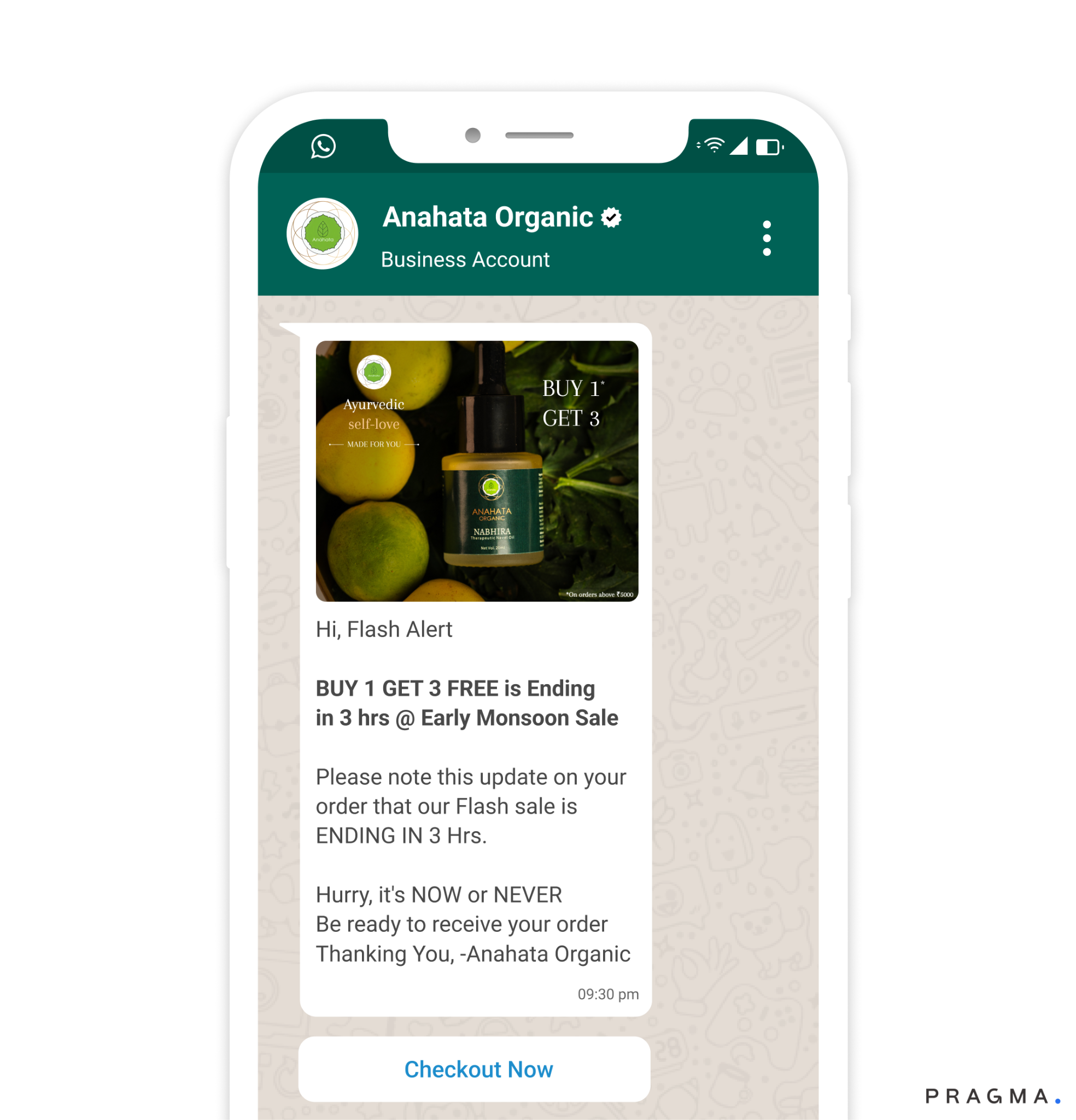
6. Launch Flash Sale Campaigns
WhatsApp is the best channel to deliver flash sales because messages are seen almost immediately. Brands on Pragma have seen an average of 11x ROAS on WhatsApp promotional campaigns during peak sale periods.
A flash sale campaign on WhatsApp should:
- Have a clear time limit (2 hours, 24 hours, etc.)
- Include a specific discount or offer
- Use a direct link to the product or checkout page
- Go to a segmented list of high-intent customers
7. Run WhatsApp Broadcast Campaigns
WhatsApp marketing campaigns often achieve open rates above 90%, significantly higher than email marketing averages.
Broadcast messages allow brands to send promotions, product updates, and offers to thousands of opted-in customers at once.
Customers receive messages in their personal chat inbox, which increases visibility compared to email.
8. Share Back-in-Stock Alerts
Products often go out of stock during high-demand periods. Many customers leave the website without purchasing and never return.
WhatsApp back-in-stock alerts help brands reconnect with those interested shoppers as soon as inventory becomes available again.
These customers have already shown purchase intent. A timely reminder brings them back to complete the purchase.
Data states that back-in-stock campaigns help e-commerce brands to generate conversion rates exceeding 16%.
9. Send Personalised Product Recommendations
McKinsey found that companies excelling at personalisation generate faster revenue growth than competitors.
Instead of sending the same promotion to every customer, brands should use customer data to recommend products based on browsing behaviour, previous purchases, spending patterns, and preferences.
Customers are more likely to engage with products that match their interests.
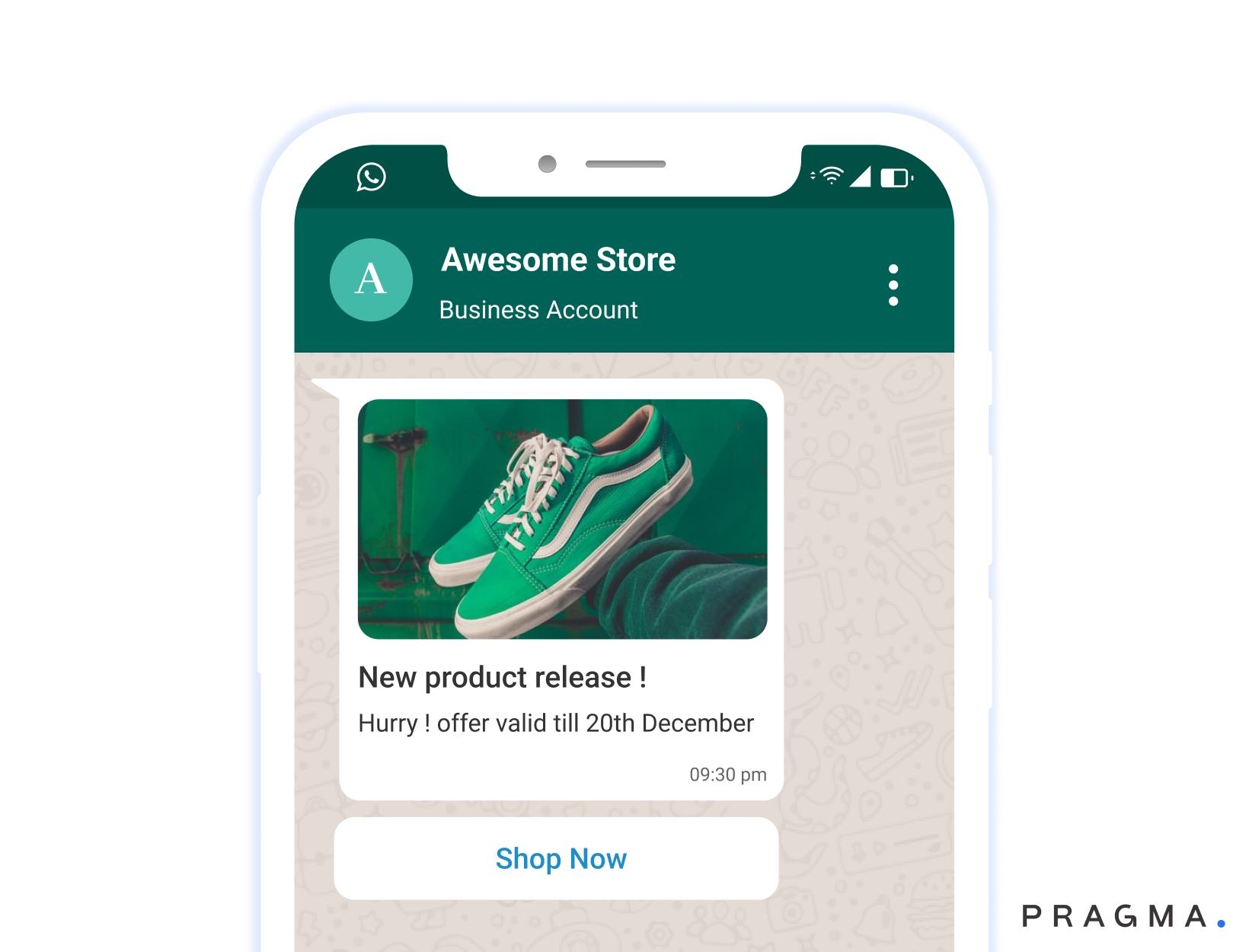
10. Use WhatsApp for Product Launches
Launching a new product requires immediate visibility among existing customers. WhatsApp provides a direct communication channel for announcing launches.
Brands use launch campaigns to generate early sales, gather feedback, and create demand before wider promotion.
Customers receive launch information instantly and can visit product pages directly from the conversation.
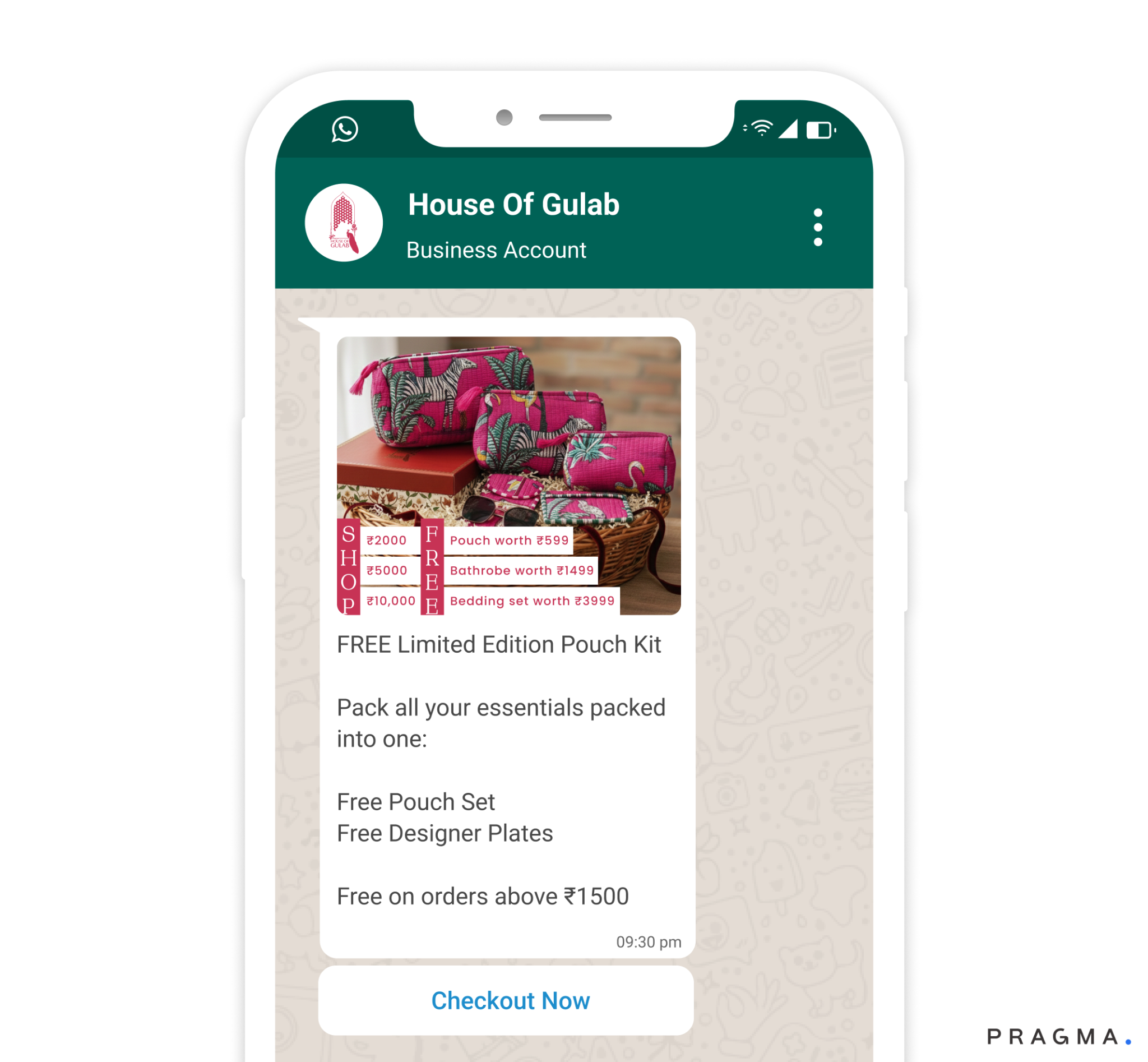
11. Run Limited-Time Coupon Campaigns
Limited-time offers encourage customers to take action quickly.
Brands can send discount codes, bundle offers, or free shipping promotions through WhatsApp to drive immediate purchases.
A clear deadline creates urgency and reduces purchase delays.
12. Create VIP Customer Communities
Not every customer contributes equally to revenue. Loyal customers often generate a significant share of repeat purchases.
Brands create exclusive WhatsApp communities or customer segments for their most valuable shoppers.
With these groups, they can share benefits such as:
- Early product access
- Exclusive discounts
- Private launches
- Priority customer support
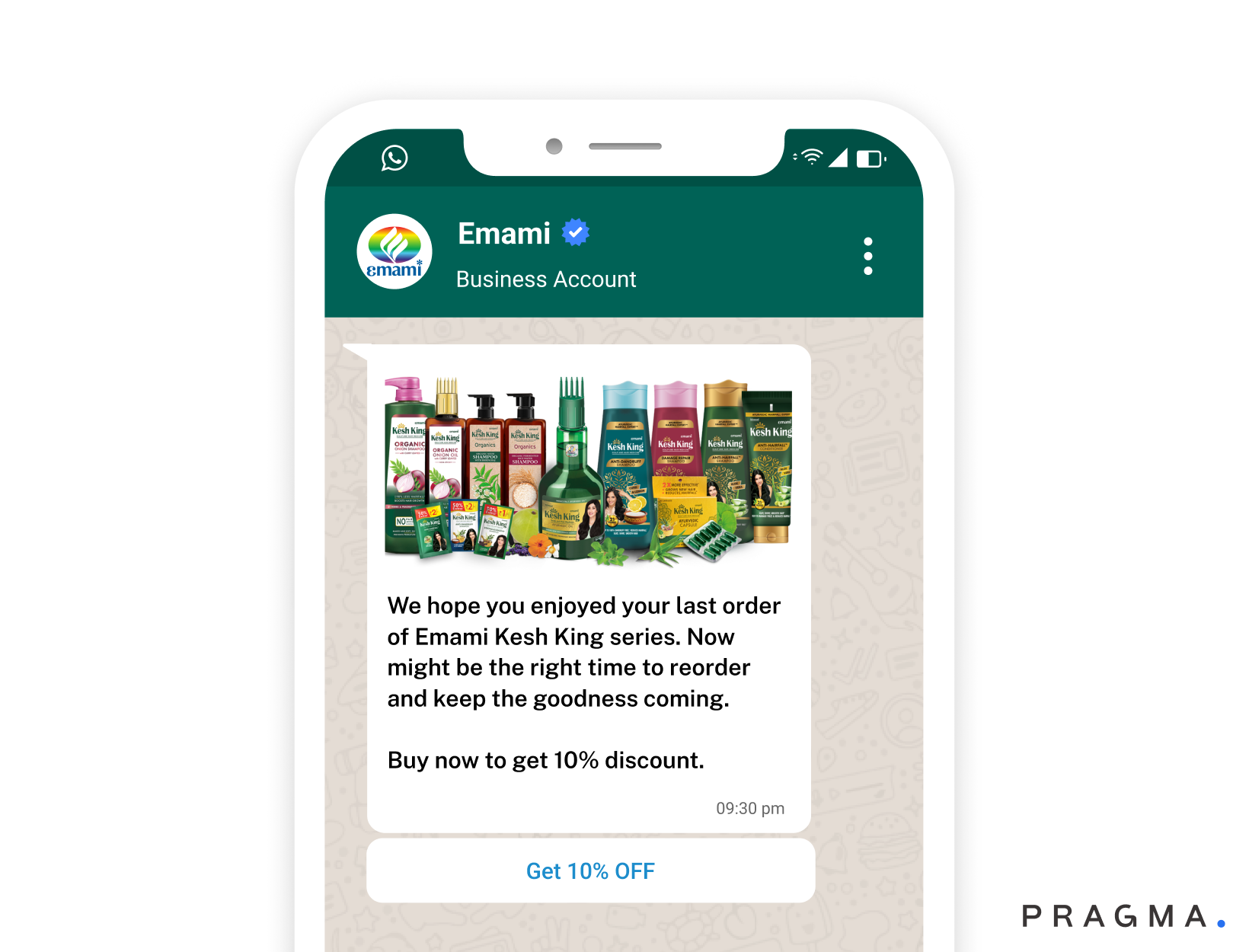
13. Send Replenishment Reminders
Many D2C brands sell products customers need repeatedly, such as supplements, skincare, cosmetics, pet supplies, and personal care products.
WhatsApp reminders encourage customers to reorder before products run out.
The message reaches customers at the moment they are most likely to need the product again. That is how brands can increase their sales with the use of WhatsApp only.
14. Share Customer Reviews and Testimonials
Customer reviews influence purchase decisions across nearly every e-commerce category. According to BrightLocal, 98% of consumers read online reviews before making purchase decisions.
Brands should use WhatsApp to share customer ratings, testimonials, before-and-after results, and user-generated content. Shoppers trust other customers more than brand messaging.
15. Offer Instant Shopping Assistance
Many shoppers leave e-commerce stores because they cannot find answers to questions about size, fit, ingredients, delivery timelines, or product compatibility.
WhatsApp allows brands to provide immediate support through automated workflows or live agents.
Brands should make use of features such as instant support provided by Pragma WhatsApp Business Suite, which offers instant support/query resolution by providing a best-in-class experience and is available 24/7.
WhatsApp Marketing Campaign Examples for E-commerce
Have a look at different marketing campaigns that can be run using WhatsApp at different points of the customer journey:
Cart Recovery Campaign
Let's say that a customer adds a product to their cart but does not complete the purchase.
Within 30 minutes, they receive a WhatsApp message with the product image, a reminder that their cart is waiting, and a 10% discount code valid for 2 hours.
This campaign consistently outperforms email cart recovery because the message is seen faster and the response rate is higher.
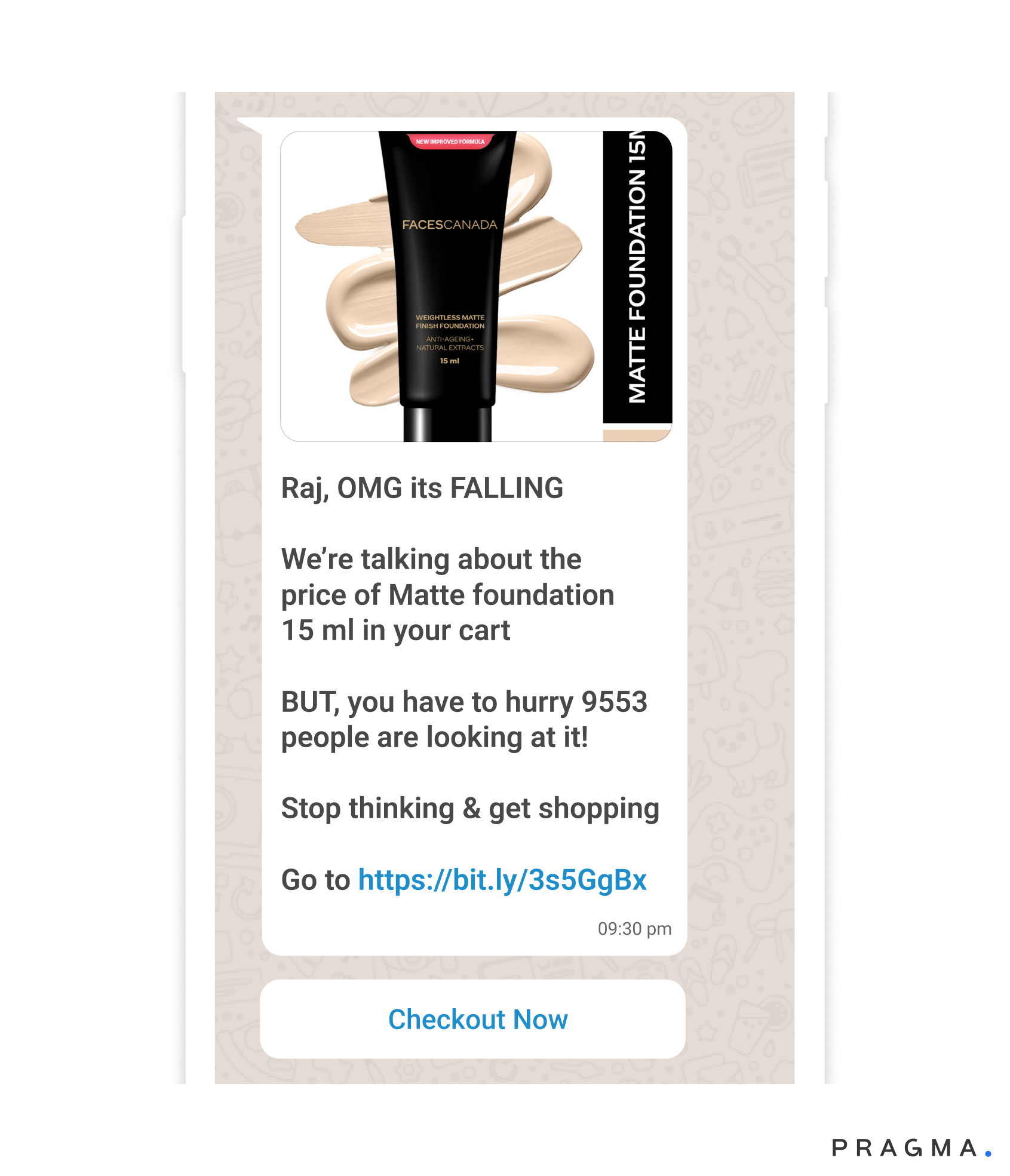
Pragma WhatsApp Business Suite triggers these messages automatically based on your e-commerce platform data. It reduces cart abandonment rate with tailored notifications and offers, nudging consumers to complete their orders.
Festival Sale Campaign
During Diwali or Holi, brands can send a broadcast to your entire opted-in list with a festival offer.
The message includes a carousel of your top products, a discount code, and a "Shop Now" button that links directly to your sale page.
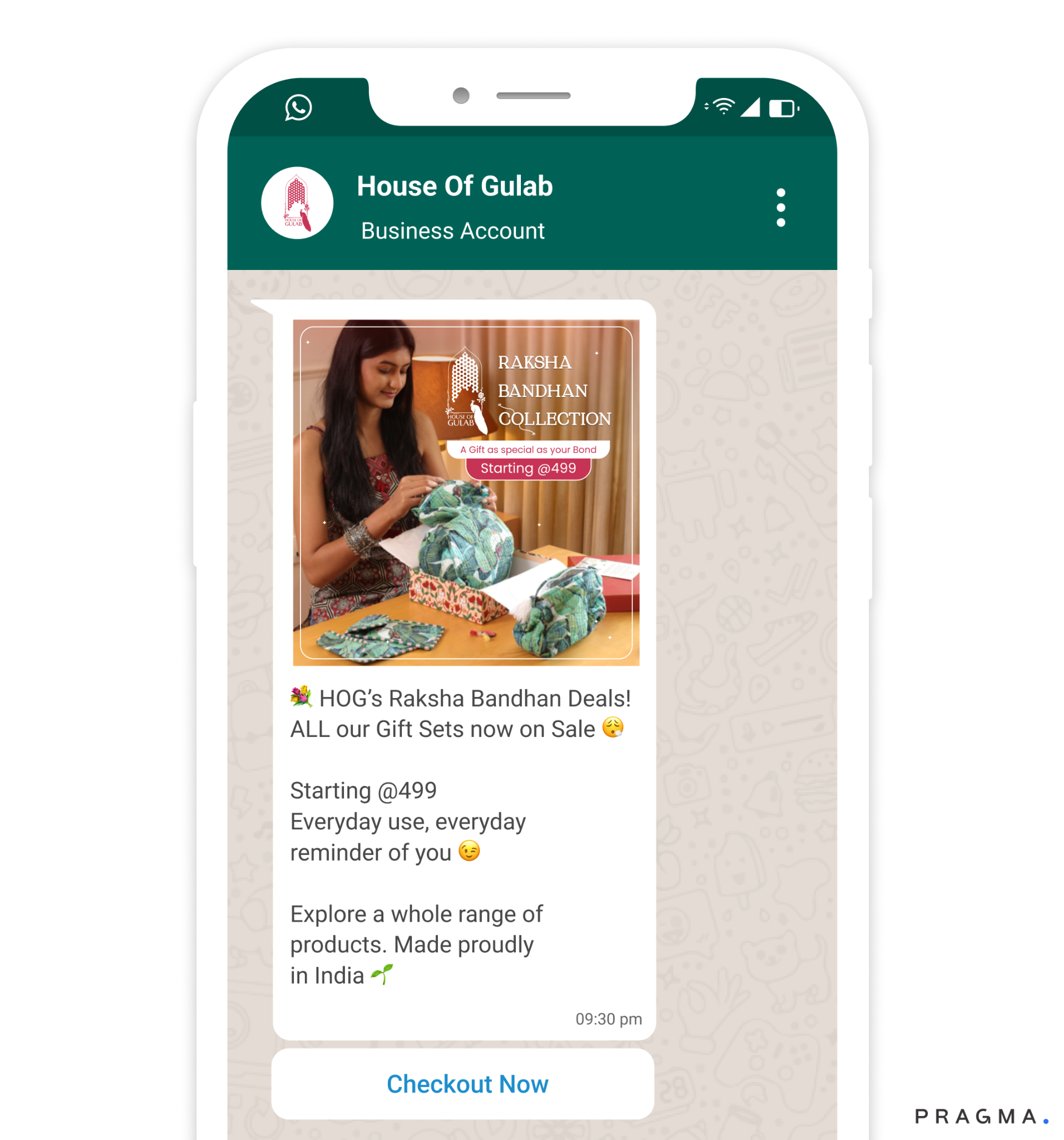
Brands using Pragma have seen 11x ROAS on WhatsApp promotional campaigns during peak sale periods.
Product Launch Campaign
Before a new product goes live, brands can send an early access message to their VIP customer segment.
The message includes a product image, a brief description, and a "Get Early Access" button that opens a WhatsApp conversation where they place a pre-order.
Mamaearth used this approach and saw 30% higher pre-orders compared to other channels.
Repeat Purchase Campaign
A customer who bought a skincare product 30 days ago receives a personalised message:
"Your moisturiser should be running low. Here is 15% off your next order." The message includes a direct link to the product page.
This campaign works because it is timely, relevant, and based on actual purchase behaviour.
Best Practices for WhatsApp Marketing
Only following the strategies is not enough; e-commerce brands should follow the given set of practices that will be more beneficial for them:
Always Get Customer Opt-In
WhatsApp has strict policies around consent. Brands must get explicit opt-in from customers before sending them marketing messages.
Customers who opt in are more likely to engage with your messages.
In 2026, Meta updated WhatsApp Business messaging limits, moving verified businesses to a 100,000 daily messaging limit after verification.
Brands can collect opt-ins through website forms, checkout pages, Click-to-WhatsApp ads, and QR codes.
Personalise Every Message
Generic messages generally get ignored, whereas personalised messages get responses.
According to McKinsey, personalisation drives a 10 to 15% average revenue lift. Fast-growing companies generate 40% more of their revenue from personalisation than slower-growing peers.
Therefore, brands should use the customer's name, reference their last purchase and recommend products based on their browsing history.
Focus on Value, Not Spam
Every message you send should give the customer a reason to stay subscribed. If you send too many messages or messages that are not relevant, customers block you.
Send a message only when you have something worth saying. A new product launch, a relevant offer, an order update, or a helpful tip.
Use Rich Media Content
WhatsApp supports images, videos, PDFs, carousels, and audio messages.
A product image in a cart recovery message performs better than plain text. A video showing how to use a product builds trust faster than a description.
According to research, over 2.2 billion messages are exchanged between businesses and customers on WhatsApp every day. The brands that stand out in that volume use rich, relevant media rather than plain text.
Pragma's WhatsApp Business Suite supports all rich media formats, including product carousels, catalogue links, and interactive buttons, so your messages are always engaging and actionable.
Conclusion
WhatsApp has become one of the most important customer engagement channels for D2C e-commerce brands in India.
Its massive user base, high engagement levels, and conversational experience make it suitable for acquisition, conversion, retention, and post-purchase communication.
Brands using WhatsApp are getting fruitful results in terms of sales and revenues.
And to support more with reliable features, Pragma WhatsApp Business Suite is here to execute these marketing strategies through automated customer workflows, post-purchase engagement, returns management, order communication, and provide a great customer experience.

FAQs (Frequently Asked Questions On 15 WhatsApp Marketing Strategies for E-commerce Brands)
1. What are the most effective WhatsApp marketing strategies for eCommerce brands?
The most effective WhatsApp marketing strategies include abandoned cart recovery, browse abandonment campaigns, post-purchase journeys, product recommendations, COD verification, back-in-stock alerts, customer win-back campaigns, and loyalty programmes.
2. How can WhatsApp marketing increase eCommerce sales?
WhatsApp marketing increases sales by delivering personalised communication, reducing purchase friction, recovering lost conversions, and engaging customers throughout the buying journey.
3. How do eCommerce brands use WhatsApp for abandoned cart recovery?
Brands use WhatsApp to send timely reminders, personalised product recommendations, discount offers, and direct checkout links to customers who leave products in their cart without completing a purchase.
4. What is the role of WhatsApp automation in eCommerce marketing?
WhatsApp automation enables brands to send personalised messages based on customer behaviour, automate lifecycle journeys, trigger campaigns in real time, and scale customer engagement without manual effort.
5. How can WhatsApp marketing improve customer retention?
WhatsApp marketing improves retention through post-purchase engagement, loyalty campaigns, reorder reminders, personalised recommendations, and customer lifecycle automation.
6. What types of WhatsApp campaigns perform best for D2C brands?
High-performing campaigns include abandoned cart recovery, product launches, back-in-stock alerts, flash sales, replenishment reminders, cross-sell campaigns, referral programmes, and customer reactivation campaigns.
7. How does WhatsApp marketing compare to email marketing for eCommerce?
WhatsApp marketing typically delivers higher open rates, faster engagement, and more direct customer interactions, while email remains effective for long-form communication and promotional campaigns.
8. What is the WhatsApp Business API and why do eCommerce brands need it?
The WhatsApp Business API enables brands to automate messaging, manage customer conversations at scale, integrate with CRM systems, and run advanced marketing and support workflows.
9. What metrics should brands track for WhatsApp marketing campaigns?
Key metrics include delivery rate, open rate, click-through rate (CTR), conversion rate, revenue generated, unsubscribe rate, repeat purchase rate, and return on ad spend (ROAS).
10. How can eCommerce brands build a successful WhatsApp marketing strategy?
Brands can build a successful WhatsApp marketing strategy by collecting opt-ins, segmenting audiences, automating customer journeys, personalising communication, tracking campaign performance, and continuously optimising engagement flows.
Talk to our experts for a customised solution that can maximise your sales funnel
Book a demo
.png)