

One of the largest issues that D2C e-commerce brands in India have to struggle with now is the present challenge of customer engagement.
According to the marketing statistics, the traditional email campaigns in India receive an open rate of merely 20-25% on most e-commerce companies, and, in other areas of the market, such as fashion, the response can be as low as 15%.
It means that of the 100 marketing messages you send out, about 75-80 messages are never opened by your customers. And this is dangerous to your customer acquisition and your business growth.
For D2C brands that have small margins, determining how to increase the level of customer interaction and prevent wastage of marketing budget is not only significant but a must-have requirement in the long run.
We are going to discuss "WhatsApp Drip Marketing Strategy: Steps, Examples & Best Practices" and how it can change the way you communicate with your customers in this detailed guide.
What Is a WhatsApp Drip Marketing Strategy?
If we talk about what WhatsApp drip marketing actually means, it is quite simple.
A WhatsApp drip marketing is a method of sending a sequence of personalised, automated messages to your customers over a period of time, depending on what they are doing and how they are behaving on your website or application.
Drip marketing via WhatsApp is totally contrary to sending mass messages to all people, as in this case, you are developing personal discussions, which are natural and supportive and not salesy or pushy.
It is this that makes WhatsApp drip campaigns special in comparison with traditional marketing:
- Messages are more personal
- You convey the message in a way that is right and timely.
- Customers do read and reply to your messages.
- You form actual relationships rather than merely pushing products.
D2C marketing of WhatsApp has become enormous in India, with more than 400 million users nationally and 3 billion users worldwide, and the platform is rapidly expanding.
And the wonderful thing is, here:
WhatsApp messages have a higher open rate of 98% than email, which is 20% in emails; hence, it is extremely effective in reaching your customers.
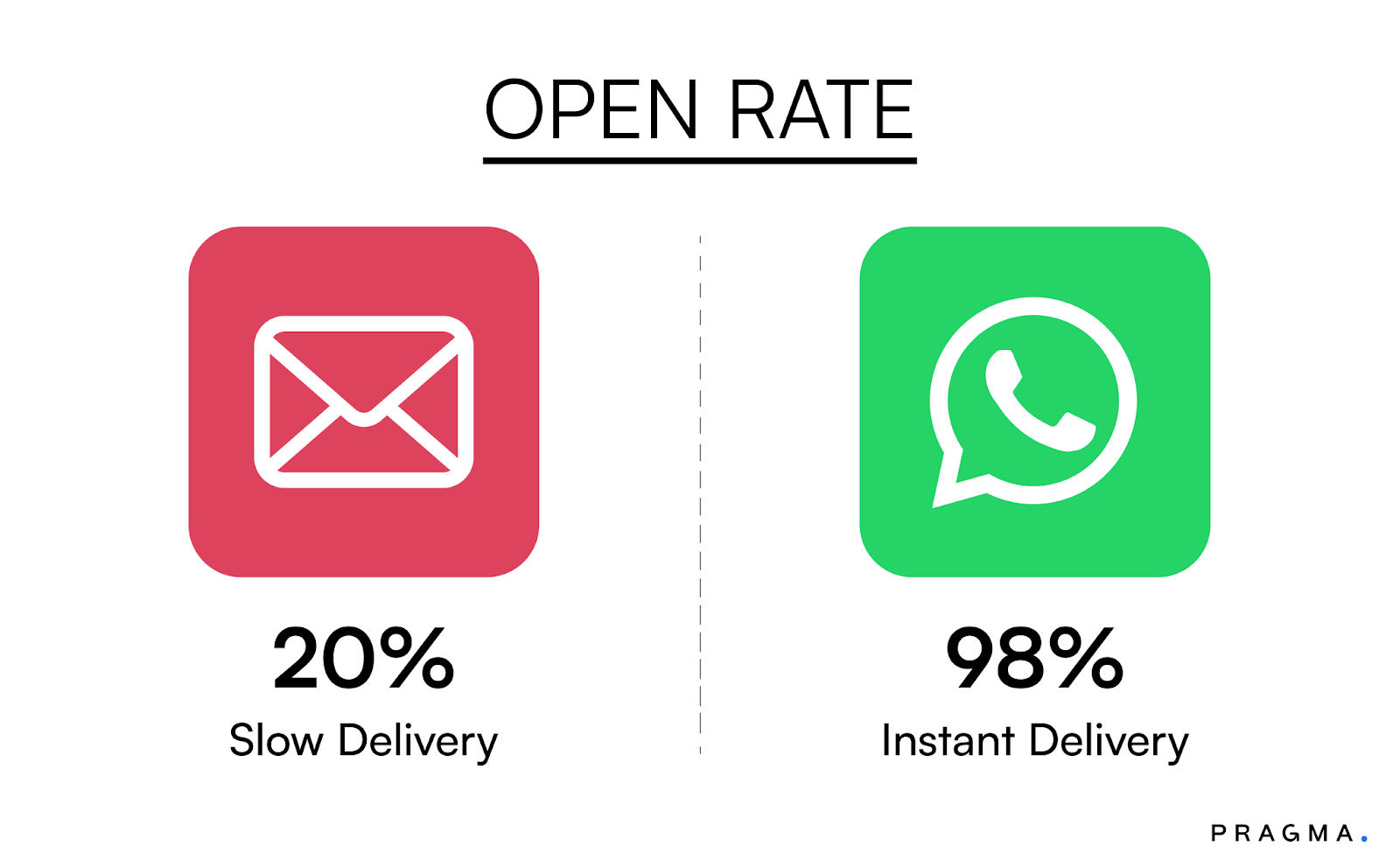
Even more compelling, 90% of WhatsApp messages are read within the first three seconds.
Pragma WhatsApp Business Suite realises this opportunity! The platform assists Indian D2C brands to build smart drip campaigns that automatically react to customer behaviour, be it visiting your site, abandoning their cart or purchasing.
Brands using Pragma have reported an average 11X return on their ad spend through WhatsApp promotions, significantly outperforming other marketing channels.
Why Use a WhatsApp Drip Marketing Strategy for E-commerce?
Research by Google shows that customers typically interact with a brand 6-8 times before making a purchase decision.
It is normal customer behaviour that they will visit your brand but do not make a purchase. And that's what the WhatsApp drip marketing strategy can change.
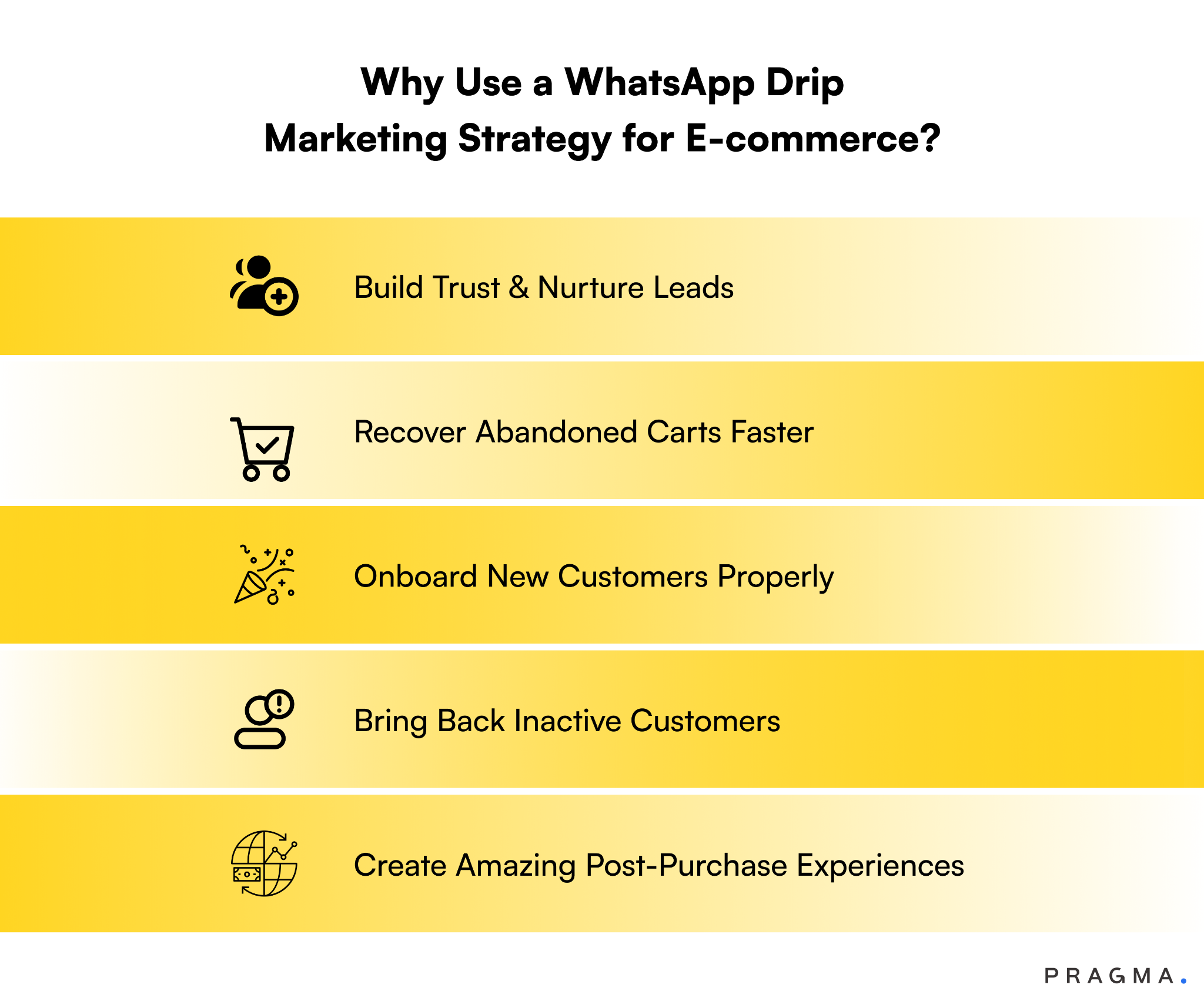
The following are the key reasons as to why WhatsApp drip marketing strategy is so effective:
Build Trust & Nurture Leads
The majority of the customer journeys begin in the same way. Somebody finds your brand on Instagram, goes to your site, browses products, perhaps puts something in their cart, but does not buy.
This is where the majority of brands do nothing or make generic email follow-ups that most of the time go unread.
Studies by HubSpot show that nurtured leads make 47% larger purchases than non-nurtured leads. Furthermore, companies that excel at lead nurturing generate 50% more sales-ready leads at 33% lower cost per lead.
Most D2C brands fail to gain even a customer because they lack an appropriate system to attract these interested visitors.
Pragma WhatsApp Business Suite is the solution to this issue! It will automatically generate tailored messages that will contain product details, reviews, styling tips and useful information that will lead a potential customer to a purchase.
Recover Abandoned Carts Faster
This is what usually occurs: the customers add items to their cart, get distracted by a phone call, close the application, and forget about their purchase.
The problem of cart abandonment is enormous, and 70% of the shopping carts are abandoned before checkout.
Email recovery campaigns are normally received late or end up in spam folders.
But if you have a properly planned WhatsApp drip marketing strategy, you can recover most of your abandoned carts easily.
It is effective because:
- The messages are displayed immediately on the phones of the customers.
- Individuals visit WhatsApp several times a day.
- Customers are able to post questions and receive an instant response.
- Recovery rates jump to 15-25% vs email's 8-12%
In the case of cart recovery, WhatsApp is massively successful since a customer can purchase with a few taps.
Onboard New Customers Properly
Whenever a person purchases with you, what follows next will be the determinant of whether they become a loyal customer or do not make a purchase with you ever again.
Research by Wyzowl shows that 86% of people say they'd be more likely to stay loyal to a business that invests in onboarding content that welcomes and educates them after they've bought.
But what the majority of brands do is, they simply send a simple confirmation of the order and thereafter remain silent until the delivery of the product. This is a massive loss of opportunity.
New customers need:
- Understandable details regarding what to anticipate.
- Advice on the use of their purchase.
- Instead, an assurance that they have made a good decision.
- Simple methods of seeking assistance.
Bring Back Inactive Customers
Harvard Business Review claims that it is 5-25 times more expensive to acquire new customers than to retain them.
Most brands do not, however, have effective mechanisms for re-engaging customers who have not purchased in a long time.
Drip campaigns in WhatsApp can be used to automatically target customers who have not made purchases recently and give them a personal offer, updates about a new product, or personalised content to make them return again.
Brands report that WhatsApp re-engagement campaigns achieve 3X higher response rates compared to email-based re-engagement efforts.
Create Amazing Post-Purchase Experiences
The customer journey doesn't end when someone buys from you; that is when the actual relationship building commences. Research by PwC shows that 73% of consumers point to customer experience as an important factor in their purchasing decisions.
The smart after-sales messages are order confirmation, shipping messages, delivery messages, usage tips, and follow-up satisfaction messages.
This constant exchange of information builds trust, and customers are much more likely to repurchase.
The Pragma WhatsApp Business Suite is able to automatically process order verification and save almost 40% of the operational expenses with enhanced customer experience.
The platform will be able to send automatic order confirmations, track deliveries and even answer customer questions regarding their orders, and this will provide a smooth experience after the purchase that will develop end-lasting loyalty.
4 Key Components of a WhatsApp Drip Campaign
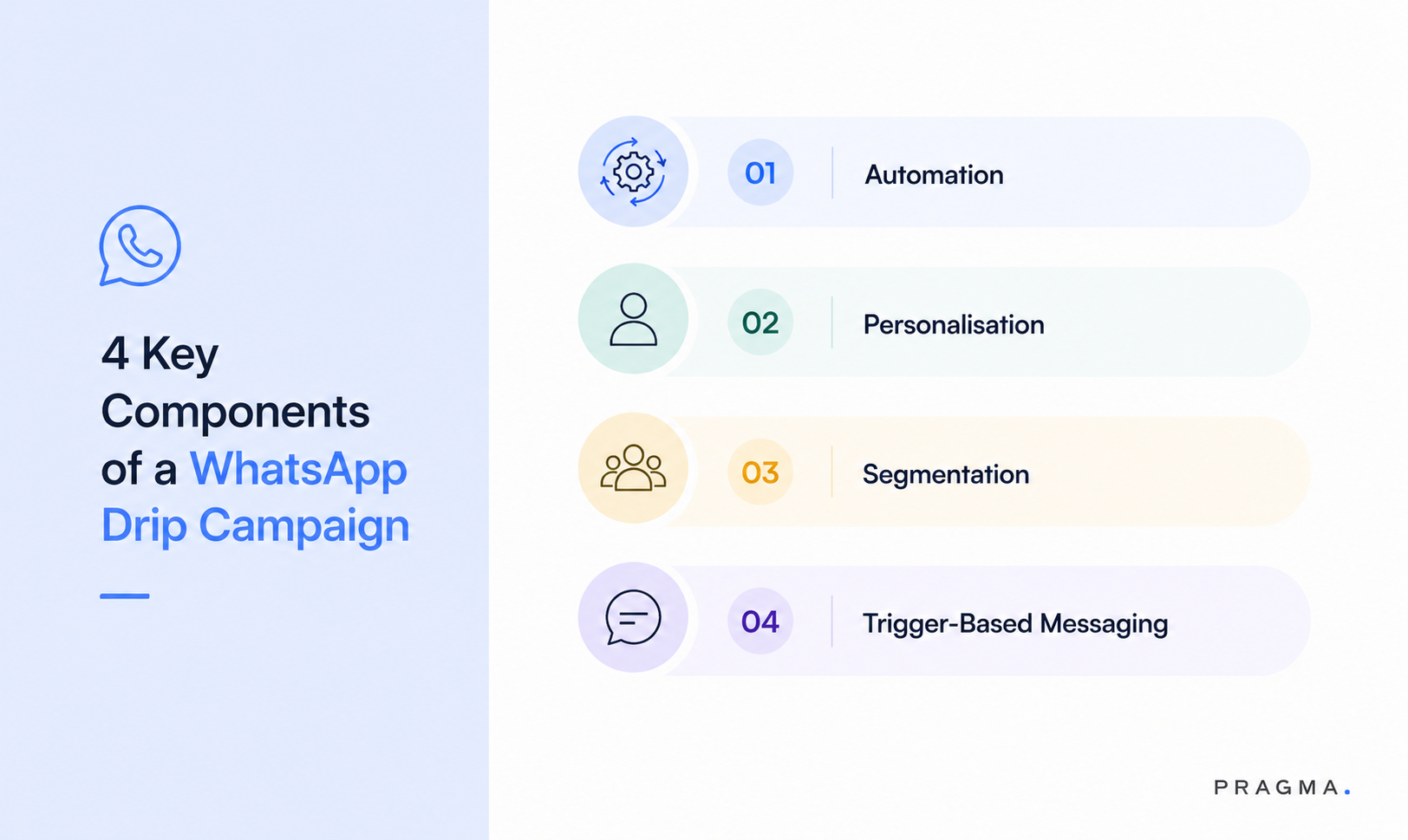
All effective WhatsApp drip campaigns require four key components to work well:
Automation
Drip campaigns actually work because they are automated and do not make you mad with the manual work.
When properly automated, the messages are sent at the right moment depending on what the customer does, and you do not have to remember to send them.
Contemporary automation is capable of sending messages after dozens of various customer actions - visiting the site, visiting certain product categories.
Pragma's automation system is used to manage complicated customer journeys. It is capable of delivering various message chains depending on the customer segments, purchase history and level of engagement, so that no customer will be forgotten.
Manual messaging saves 15-20 hours weekly with the brands that employ Pragma automation and 25% improved campaign performance.
Personalisation
Generic messages get ignored, but personalised messages create real connections with customers.
Personalisation is far more than calling a person by their name. It contains mentions of certain products that they saw, their buying history, their location, and even the time of the day when they are most active.
The next level of personalisation could be the delivery of varied product messages depending on previous buying history, location-related deals, or even weather-related offers.
With the help of Pragma WhatsApp Business Suite, you can write messages that mention the exact products in a person's cart, the history of their browsing, and even demographics.
On average, e-commerce brands that apply advanced personalisation experience a 19% rise in sales as opposed to generic messaging.
Segmentation
All customers are different, and therefore, your communication should not be the same.
Good segmentation can be used to deliver highly relevant messages to particular sets of customers based on their behaviour, preferences, demographics, or their location in their customer journey.
See, first-time visitors should be offered other messages than repeat customers. A person who purchases skincare items on a regular basis should not receive the same content as a person who solely purchases electronics.
Pragma will enable you to create detailed groups of customers based on:
- Buying behaviour and frequency.
- Time zones and geographical location.
- Age, gender, and demographics.
- Website actions and interaction.
- Product category preferences
- Customer lifetime value
Trigger-Based Messaging
The most effective WhatsApp drip marketing strategy is that which reacts to what customers are actually doing in real-time.
Your system should automatically send out messages when a person abandons his or her cart, visits a particular product page, makes his or her 5th purchase or has not purchased anything within 90 days.
Pragma WhatsApp Business Suite reacts to dozens of customer activities, such as:
- Abandoning carts at various times.
- Visits made to product pages without buying the product.
- Purchase anniversaries and milestones.
- Periods of inactivity
- Holiday seasons and events.
- Price decreases and inventory variations.
How to make a WhatsApp Drip Marketing Strategy? Steps to Create a WhatsApp Drip Marketing Strategy
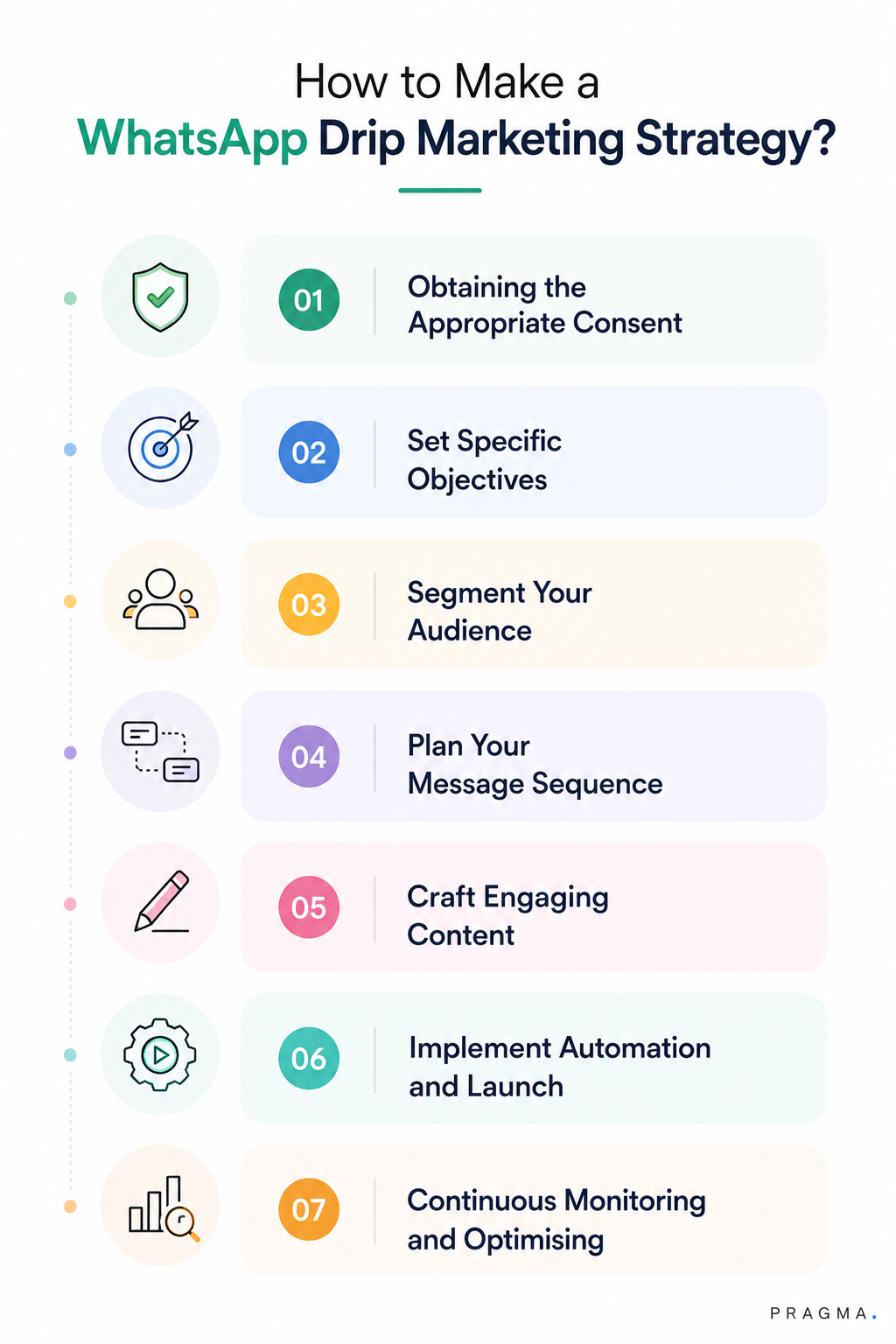
Creating an effective WhatsApp drip marketing strategy requires careful planning and step-by-step execution. Here's exactly how to do it:
Step 1: Obtaining the Appropriate Consent
You should not in any way send any marketing messages on WhatsApp before getting clear permission from your customers.
Not only is this a good practice, but it is also mandated by law in most jurisdictions, as well as WhatsApp regulations.
The process of consent that you are using should clearly explain the following things:
- The kind of messages that will be offered to the customers.
- The frequency of communication with them.
- They are able to choose not to do it at any time.
- How much are they going to get out of subscribing?
Consent can be gathered at the time of checkout opt-in, special landing pages, or even other marketing means.
Step 2: Set Specific Objectives
Success and performance are measured by specific goals in order to achieve the best.
You may have the following objectives:
- Cutting down cart abandonment by 20%.
- Growing the repeat purchases by 30%.
- Increasing the customer onboarding rates.
- Re-engaging inactive customers
- Increasing the average order values.
All objectives need a unique message strategy and approach. For example, cart recovery is based on urgency and incentives as compared to customer education, which is based on value and building relationships.
Step 3: Segment Your Audience
Begin with simple segments such as new customers, repeat customers and inactive customers. The more information you gather, the more advanced segments you develop.
Consider segmenting by:
- New Customers: Requirement onboarding and education.
- VIP Customers: Should have special treatment and first-hand access.
- At-Risk Customers: Have not purchased in a long time.
- Category Enthusiasts: Are interested in particular types of products.
- Geographic Segments: The various regions might have various preferences.
Proper segmentation of the brands increases the conversion rates by 25-35%.
Step 4: Plan Your Message Sequence
Next, you should plan out all your message sequences, then write anything.
For this, you should consider your customer journey and the information or motivation needed by the customer in each stage. An average
sequence would consist of:
- Introduction message with a brand message
- Product-related education.
- Social evidence and reviews.
- Extra deals and promotions.
- Urgency-based final messages
Also, not only does the sequence work, but you should also take care of the timings. If you are sending messages excessively, it will irritate your customers, and if you are giving more gaps, it will not be helpful to you.
The following ideal intervals are recommended:
- Urgent: Welcomes and confirmations.
- 2-4 hours- First cart abandonment reminder.
- 24 hours: Educational information or second notification.
- 3 days: Offer-based messages
- 7 days: Re-engagement attempts
- 14+ days: Win-back campaigns
Step 5: Craft Engaging Content
WhatsApp messages are to be composed like having a friendly dialogue and not a business announcement.
You should also use a friendly tone, address the customer by their name, and, when possible, make reference to certain actions or products. Be brief but valuable - any message must have something useful in it.
Here is what you should focus on while drafting messages:
- Write in the way that you are sending a text to a friend.
- Make use of personalisation, other than by name only.
- Add value in all communications.
- Include effective, clear calls-to-action.
- Minimally, use emojis to maximum effect.
- Add pictures or videos where necessary.
Messages that include pictures receive 42% more engagement compared to text-only messages.
Step 6: Implement Automation and Launch
After preparing your content, you need to set up your automation rules and start with a small test group.
It is important to keep a close eye on the first performance and be prepared to make snap changes depending on the observation.
Pragma allows one to configure sophisticated sequences with numerous triggers and conditions easily. The testing features let you preview messages and test sequences before launching to ensure everything works perfectly.
Step 7: Continuous Monitoring and Optimising
At last, you should monitor such important metrics as delivery rates, open rates, response rates, and conversion rates.
Identify trends in customers' behaviour and make changes in the message to them.
You should have an eye on the following things:
- Delivery Rate: WhatsApp should have a delivery rate of 95%+.
- Open Rate: Typically 90%+ vs email's 20-25%
- Response Rate: 15-25% is acceptable when it comes to drip campaigns.
- Conversion Rate: Depends on the kind of campaign.
- Unsubscribe Rate: This one should be up to 2 percent.
WhatsApp Drip Marketing Strategy Example for E-commerce
Suppose that a customer comes to your online shop, browses around and leaves without purchasing any products.
The majority of e-commerce brands just stop at this point, but an intelligent WhatsApp drip marketing strategy does not.
It begins on Day 1 with a pleasant greeting. The minute the customer becomes interested, you send him a short message: "Hey! We are glad to see you. Here, 10 per cent off to make your day.
Day 3, you check in again. However, you do not repeat the offer; you poke them with something more beneficial: with several best-selling products they can be interested in.
You include some social proof on Day 5. You explain to them what true customers are purchasing and enjoying. It builds trust. When individuals observe others using a product, it gives them more confidence when using it.
On Day 7, you will re-introduce the offer, but with a gentle push. You remind them that they are not yet done with their discount. You can say, Hey, by the way, your special deal is still there in case you forgot!
At the last moment, you generate an urgency with a final call: "Your 10% discount expires today.
And within the blink of an eye, with little messages, at the right time, you can lead a casual visitor to a paying customer.
Best Practices for a Successful WhatsApp Drip Strategy
You should follow the given strategies:
1. Make your message conversational.
Write to your user as though you were texting your friend. It must not feel like a robot speaking to you.
2. Maintain the length of the message to an optimum.
Attempt to make sure that your drip messages are not longer than 160 characters.
3. Attempt to add personalisations.
In sending a message to your customer, you need to attach their name to the message. This assists them in being personal.
4. Send your messages at the appropriate time.
You should send the messages at the most optimal time when the user is awake, as opposed to sending them at the end of the day.
5. Divide your audience
Separate your audiences based on their interests, preferences, demographics, lifestyles, etc., before initiating campaigns.
6. Adhere to WhatsApp rules and policies.
WhatsApp has a set of rules and policies that you should always adhere to to avoid being banned.
7. Concentrate on technical things.
Promotional content should be delivered and comply with pre-approved templates.
8. Do not make a lot of messages.
Remember to write when necessary. Don't do a lot, otherwise it will have a negative impact.
9. Refresh your content regularly.
No one can be content with receiving the same things repeatedly. Thus, attempt to provide new content to your users on a continuous basis.
Tools to Run WhatsApp Drip Campaigns
The selection of the correct platform is the key to a successful WhatsApp drip marketing strategy. The best WhatsApp drip marketing platforms for D2C e-commerce brands are as follows:
Pragma WhatsApp Business Suite
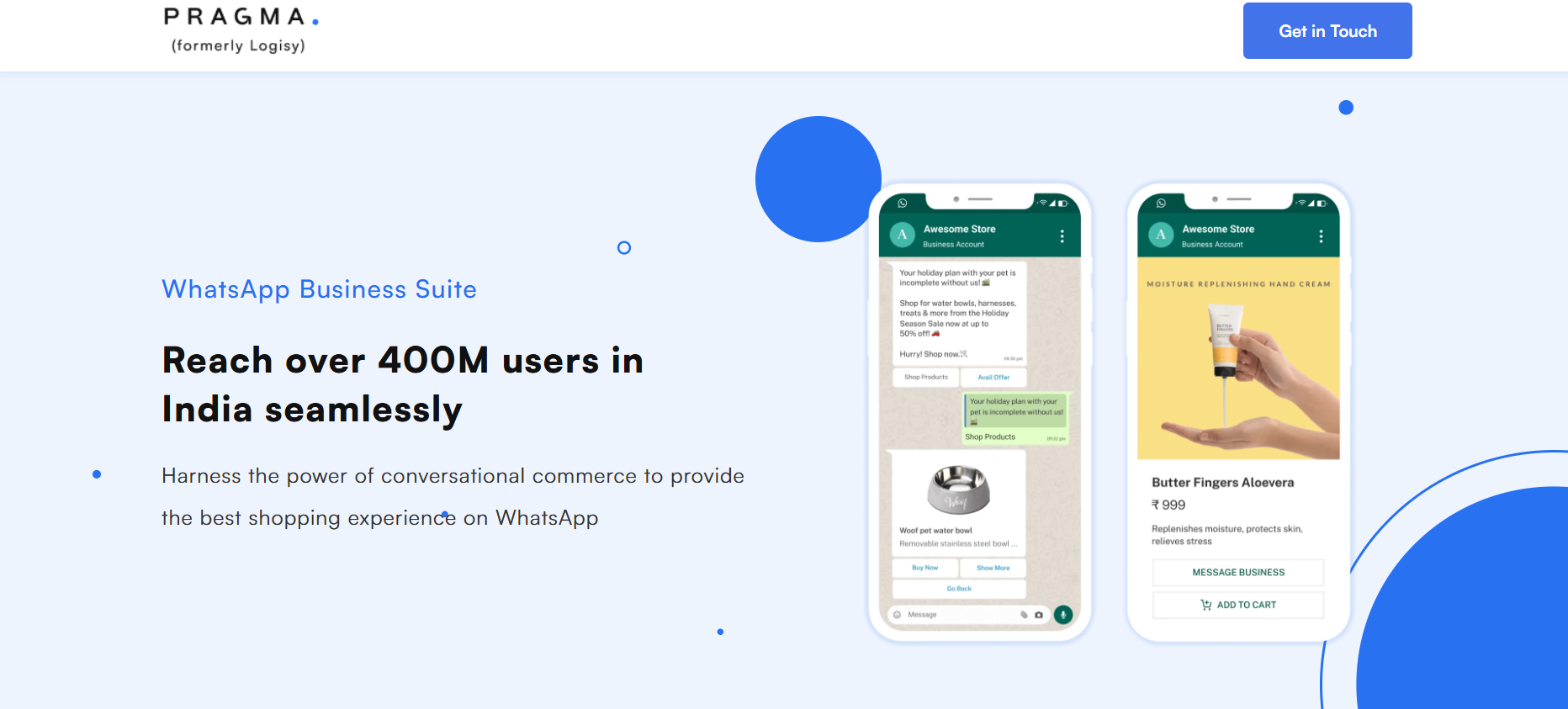
The most suitable option among Indian D2C brands is Pragma, which provides a detailed WhatsApp marketing automation with a focus on the Indian e-commerce market.
The platform is trusted by 1000+ D2C brands, including Glamrs, Rare Rabbit, Neeman's, Emami, and Faces Canada. With Pragma, most of the D2C brands get the following results:
- Average 11X returns on ad spend via WhatsApp promotions.
- 15% improvement in cart recovery conversions.
- Automation will lead to a 40% cut in the cost of operations.
- Qualified leads grew by 451% using marketing automation.
Key features include:
- Drip campaign automation with infinite sequences.
- Mass communication to the masses with intelligent segmentation.
- Multi-language support and real-time translation of the diverse Indian market.
- Close integration with Shopify, WooCommerce, and other e-commerce solutions.
- Detailed ROI tracking and analytics.
- Built-in compliance tools for consent management
- 24/7 customer service
WATI
WATI is recommended for small to medium businesses that require basic automation. It is user-friendly with drag and drop features, and the cost is as low as $49/month.
But it does not provide a lot of sophisticated functionality, and thus it might not apply to more complicated campaigns.
Gallabox
Gallabox is suitable in the case of businesses that prefer no-code. It is also easy to use and provides simple automation tools, and is easy to start with, but plans start at $30/month.
The primary disadvantage is that it might not be scalable to large and complex campaigns.
AiSensy
AiSensy would be best suited in cases of brands that desire AI-based personalisation and powerful analytics. It has custom pricing that is based on usage.
It is more expensive and might require more time to learn than simple tools, although it has powerful AI functionality.
Conclusion
WhatsApp drip marketing is changing the way D2C brands interact with their Indian customers.
The statistics are overwhelming: 98% open rates compared to 20% with email, 45-60% conversion rates compared to 2-5% with email, and 15-25% cart recovery rates compared to 8-12% with email.
And this is a great opportunity for Indian D2C brands. With 400 million WhatsApp users in India and an increasing acceptance of business communications on the platform, first movers will be able to establish strong relationships with customers.
Pragma WhatsApp Business Suite offers the ideal support to the Indian D2C e-commerce brands that are willing to seize this opportunity.

FAQs (Frequently Asked Questions On WhatsApp Drip Marketing Strategy: Steps, Examples & Best Practices)
1. What is WhatsApp drip marketing?
WhatsApp drip marketing is an automated messaging strategy where a sequence of timed, behaviour-based messages is sent to users on WhatsApp to nurture leads, drive conversions, and improve retention.
2. How does a WhatsApp drip marketing strategy work?
A WhatsApp drip marketing strategy works by triggering message flows based on user actions, events, or delays. These flows guide users across the lifecycle, from onboarding and engagement to conversion and repeat purchase.
3. Why is WhatsApp drip marketing effective for D2C brands in India?
WhatsApp drip marketing is highly effective for D2C brands in India due to high platform penetration, 90%+ open rates, and the ability to deliver personalised, real-time communication in a familiar chat interface.
4. What are the key steps to create a WhatsApp drip marketing campaign?
The key steps include defining campaign objectives, segmenting users, mapping customer journeys, creating message sequences, setting triggers and delays, and continuously optimising flows based on engagement and conversion data.
5. What are some examples of WhatsApp drip marketing campaigns?
Common WhatsApp drip marketing examples include welcome/onboarding flows, abandoned cart recovery, COD confirmation journeys, post-purchase engagement, upsell/cross-sell sequences, and reactivation campaigns.
6. What are the best practices for WhatsApp drip marketing?
Best practices include sending highly contextual messages, keeping copy concise, using strong CTAs, optimising timing and frequency, avoiding spam-like behaviour, and aligning communication with user intent and lifecycle stage.
7. How to reduce cart abandonment using WhatsApp drip marketing?
Retailers can reduce cart abandonment using WhatsApp drip marketing by sending timely reminders, addressing purchase objections, offering incentives, and sharing direct checkout links to minimise friction in completing the order.
8. Can WhatsApp drip marketing improve conversion rates in eCommerce?
Yes, WhatsApp drip marketing improves conversion rates by engaging users in a conversational format, reducing decision friction, and delivering timely nudges that move users closer to purchase.
9. What tools are used for WhatsApp drip marketing automation?
WhatsApp drip marketing tools include WhatsApp Business API platforms that support automation, user segmentation, campaign workflows, analytics tracking, and integration with eCommerce platforms and CRM systems.
10. Is WhatsApp drip marketing compliant with WhatsApp policies in India?
Yes, WhatsApp drip marketing is compliant when businesses use the official WhatsApp Business API, collect explicit user opt-ins, follow approved message templates, and avoid unsolicited or excessive messaging.
Talk to our experts for a customised solution that can maximise your sales funnel
Book a demo
.webp)
.png)