

Do you ever think that when you have placed an order how it reaches you within the given time mentioned? Is this something magical, or has the team been so efficient in doing this?
This is something not magical but is logical! Whenever a business gets an order, it goes through the set of processes for fulfilling the order on time. These processes are collectively known as supply chain management.
In today's e-commerce world, customers want the fastest deliveries, good products and easy returns. With the Indian e-commerce market reaching $350 billion/₹29.05 lakh crore by 2030, it becomes essential to know about supply chain management thoroughly.
If you are a business owner and want to know how supply chain management in e-commerce works, how it can help you make your business efficient. This guide is for you. So, let's delve into "Supply Chain Management in E-commerce: Complete Guide (2026)".
What Is Supply Chain Management in E-commerce?
Supply chain management in e-commerce is usually abbreviated as "SCM". Let us explain supply chain management in e-commerce properly to you!
It is the combination of all the processes involved in fulfilling the customer orders efficiently.
This process consists of procurement, manufacturing, inventory management, order fulfilment, warehousing, and logistics.
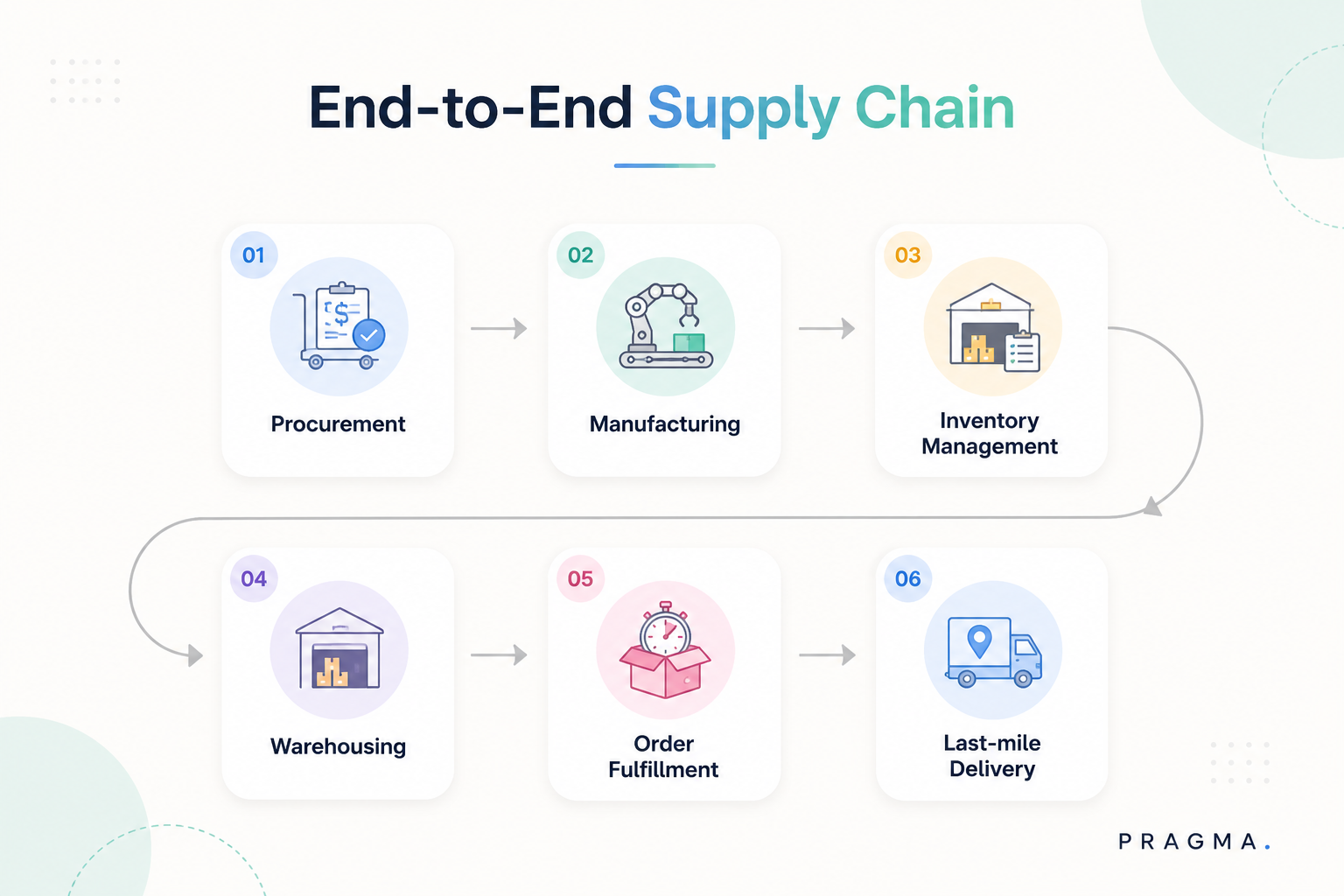
In simple words, if we explain this typical definition, it means that supply chain management in e-commerce is a process of completing the customer order through the journey, that involves everything from predicting what customers will want to buy, sourcing those products or raw materials, manufacturing the product if needed or storing them in warehouses, processing orders when they come in, packing and shipping them, and handling any returns or exchanges that might be needed.
How is Traditional SCM Different From E-Commerce SCM?
Earlier, when the e-commerce business did not exist, there was a traditional way of selling goods to customers through physical stores.
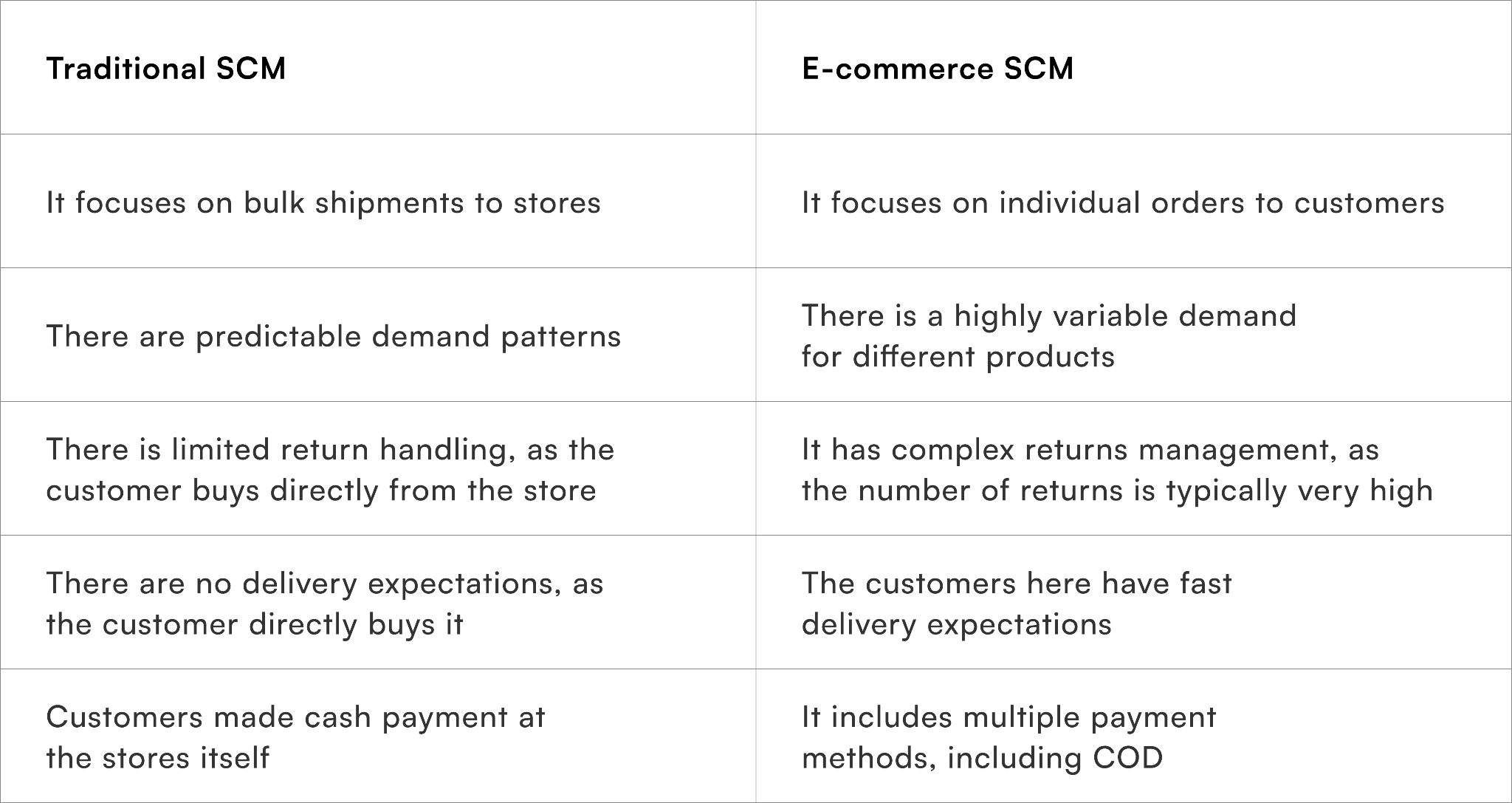
And the process followed there is referred to as traditional supply chain management. That time, this focuses only on moving a large quantity of products to the retail stores, displaying them, and the customers come there to buy the products.
So, the traditional supply chain management mainly involves shipping of products to the limited stores at different locations.
But e-commerce supply chain management is completely different. As we have discussed, it focuses on the entire journey of the product to fulfil the customer's order on time.
It deals with individual shipments to residential addresses that might be difficult to find, where customers might not be available to receive packages, and where delivery expectations are much higher.
Why is E-commerce Supply Chain Management (SCM) More Complex?
e-commerce supply chain management faces unique challenges that make it more complex than traditional retail due to the following reasons:
Speed Expectations
Nowadays, every customer wants that they get their order as soon as possible. According to a recent McKinsey study, 61% of customers now expect delivery within 1-3 days of placing an order, and 25% expect same-day delivery for specific categories.
This much expectations of the customers put pressure on the e-commerce business to fulfil their orders faster, maintaining an efficient supply chain management.
Cash on Delivery (COD)
In India, 60-65% of the orders are placed on the COD option. Therefore, there is no guarantee of payment like prepaid ones, and the customer, without any hesitation, can refuse the delivery. And, with this nature, it becomes difficult for the business to handle e-commerce supply chain management properly. As these orders lead to a higher rate of RTOs- Return-to-Origin, and cost the businesses a lot.
But here is good news for you! You can convert around 25%-35% of your COD orders to the prepaid ones with Pragma's smart C2P conversion strategy, provided under the Pragma RTO Management Suite, which also helps to reduce RTO rates by 65%.
Returns
Returns are another major complexity factor. While traditional retail typically sees return rates of 8-10%, e-commerce return rates average 15-30% across categories, and around 40% in the fashion industry. Each return causes businesses to pay for reverse logistics to get the product back to their warehouse or nearest fulfilment centres.
Stages of Supply Chain Management in E-commerce: How Does the E-commerce Supply Chain Work?
The following are the stages involved in e-commerce supply chain management:
- Demand Planning & Forecasting
- Supplier & Procurement
- Inventory & Warehousing
- Order Processing & Fulfilment
- Logistics & Last-Mile Delivery
- Customer Delivery Experience
- Returns & Reverse Logistics
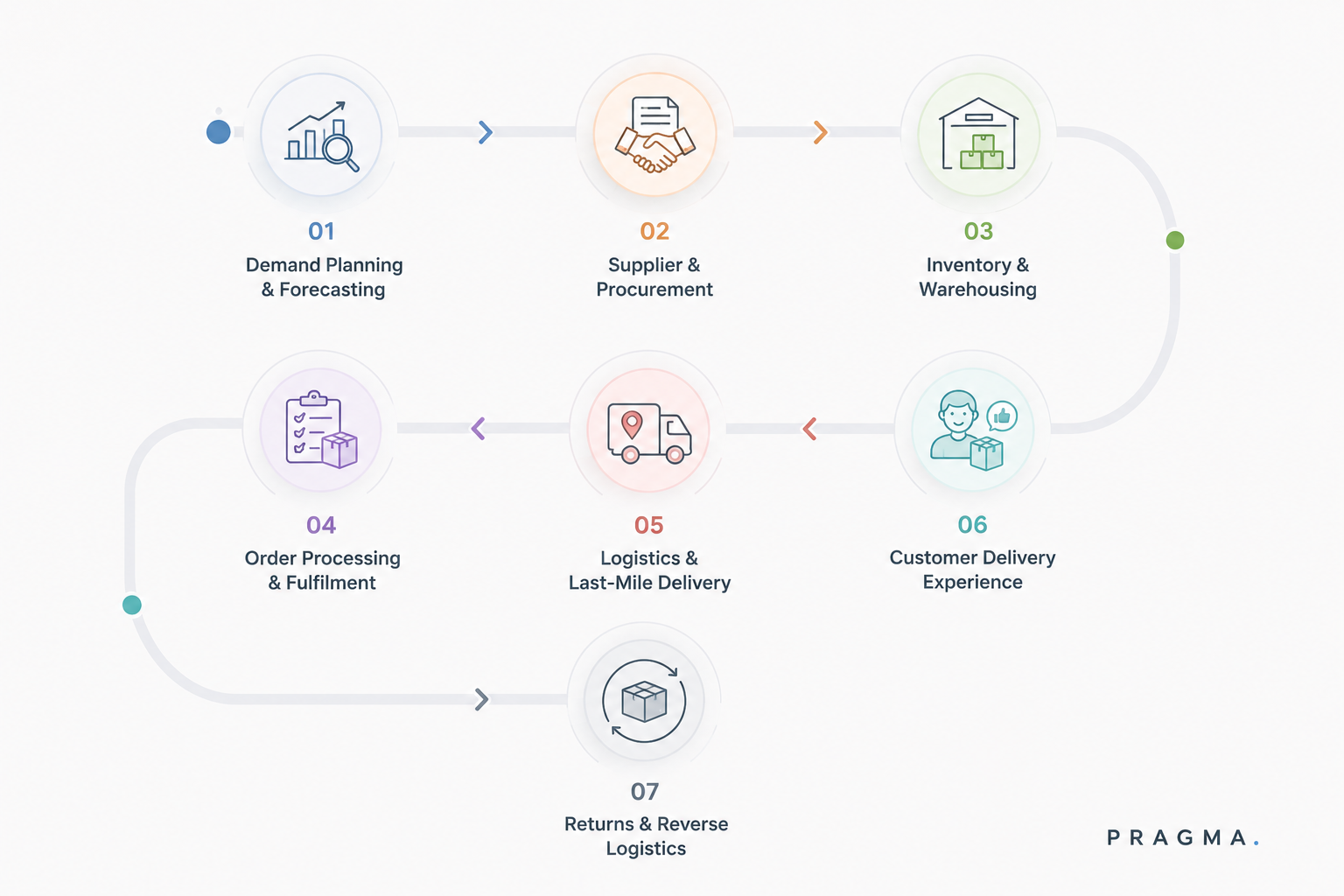
Let us examine the above stages in detail!
1. Demand Planning & Forecasting
Before anything else, businesses need to predict what customers will want:
- Analysing past sales data
- Taking into account seasonal patterns (such as Diwali shopping or summer clothes shopping).
- Keeping an eye on the market trends and competition.
- Finding improved prediction with AI and machine learning.
2. Supplier & Procurement
This is the first step where the supply chain management process starts. It includes finding a reliable supplier who can:
- Provide quality products and the quantity needed
- Negotiate reasonable prices and delivery terms
- Meet demand during peak seasons
3. Inventory & Warehousing
Once you have gathered the raw materials, your products are ready, or you have purchased them directly from the suppliers. The next stage is to stock them in your warehouse and include them in your inventory. The following things happen here:
- Products are stored in warehouses strategically located across the country
- Inventory levels are tracked to avoid stockouts or overstocking
- Products are organised for quick picking and packing
And, do you know, this stage is very crucial, as according to industry reports, poor inventory management costs Indian e-commerce businesses approximately ₹50,000 crores annually in lost sales and excess holding costs.
4. Order Processing & Fulfilment
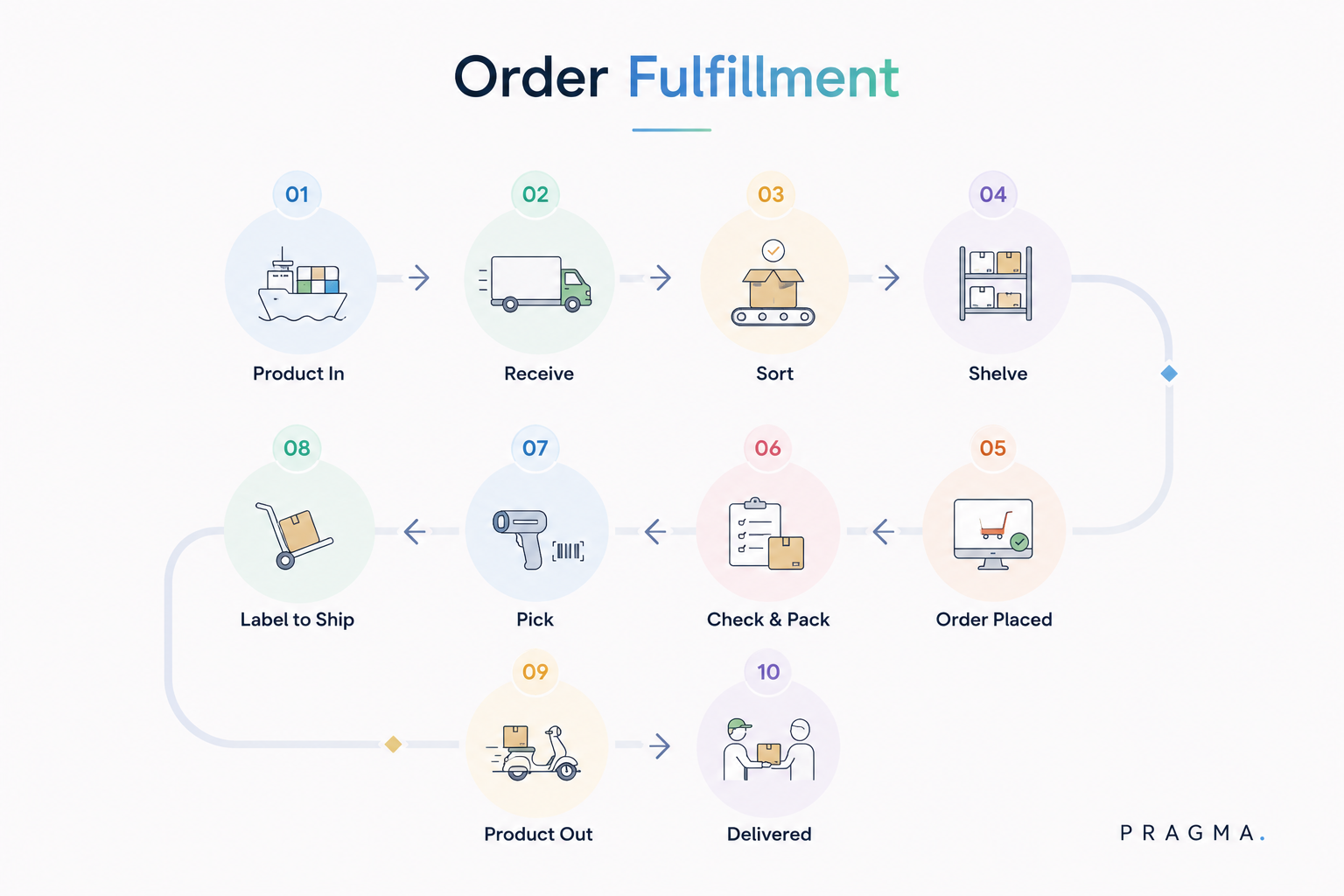
Now, this is the time when a customer places an order. To fulfil that order, you have to check the product availability, send the order to the nearest warehouse, and pack the product properly to send it to the customer.
5. Logistics & Last-Mile Delivery
The next stage is to handle the logistics process. Here, the packed products are sent to the delivery partners. Here, careful selection of the courier partners must be done, because not every courier company performs well in all areas.
Not only is choosing the right delivery partner enough, but choosing the right route is equally important. The advanced routing algorithms should be used that consider factors like traffic patterns, delivery time windows, and driver schedules. This would help in reducing costs and improving delivery timelines.
6. Customer Delivery Experience
The next most important stage that comes in supply chain management in e-commerce is when the customer gets their order delivered. Here, the success of the order depends on whether the customer gets the delivery on time, the product is in good condition, and the packaging is appropriate with no wear and tear. If everything seems good, then the customer will be satisfied, and others will move to the next stage, that is, returns.
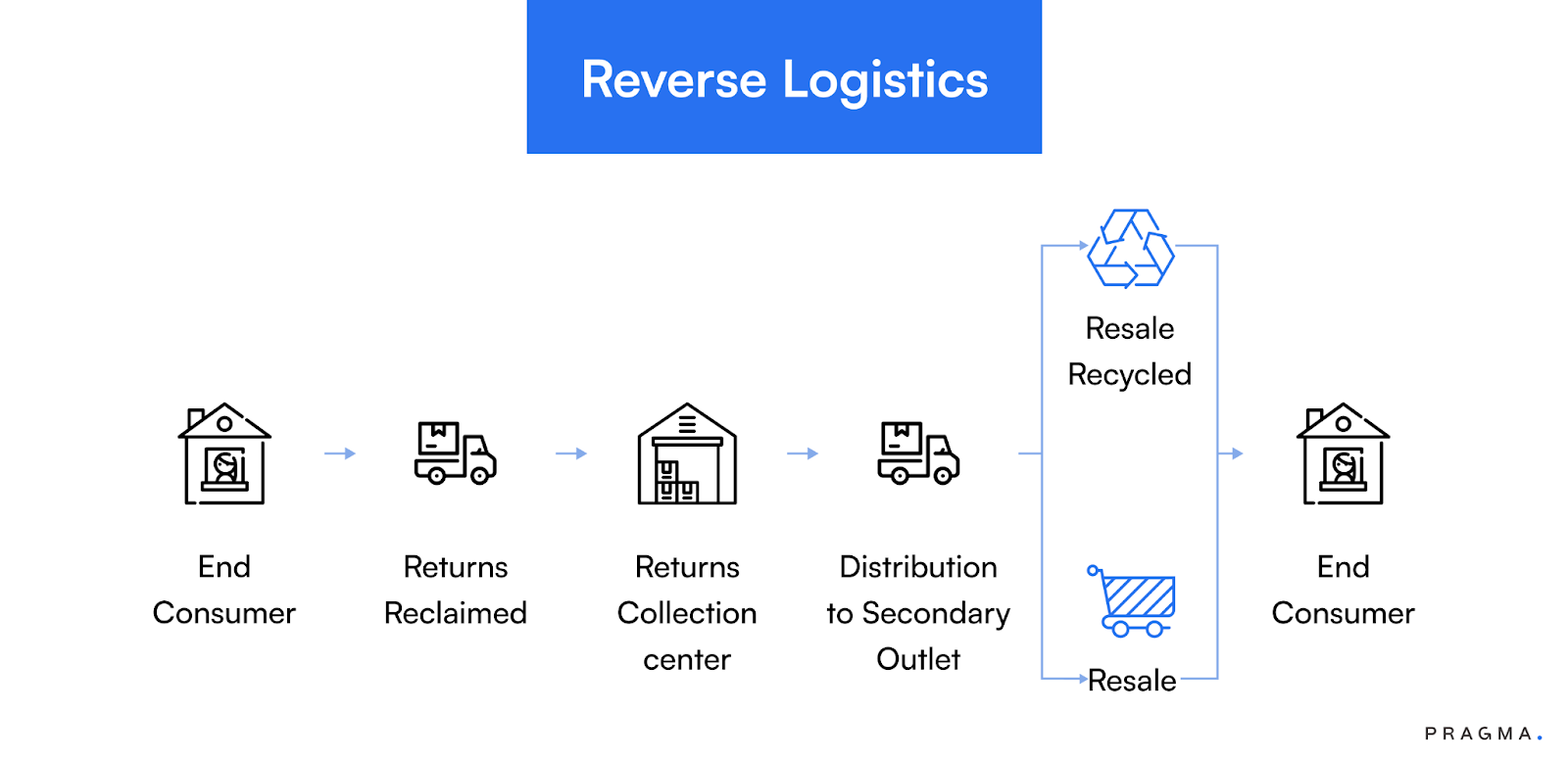
7. Returns & Reverse Logistics
If the customer is not satisfied with the product or deliveries, they will initiate the return. Handling returns in a good way is important for every business.
Here, you have to process returns, manage exchanges or refunds, or get the product back to the origin. This reverse logistics is more complex than the forward logistics, as the product has to be moved from different locations, depending on their condition and the reason for return.
Some products will be sent to the regular inventories, some can be sent to refurbishment centres, or some can be disposed of, depending on what is required.
What are The Key Components of E-commerce Supply Chain Management?
Modern e-commerce supply chain management relies on several technological systems working together:
1. Inventory Management Systems (IMS)
Inventory Management System is one of the systems used by businesses, which helps to track the inventory in real time, the movement of inventory that goes out and comes in, automatic reordering if stock levels are low and integration across different sales channels to avoid overselling of products.
2. Warehouse Management Systems (WMS)
A warehouse management system helps to maintain and optimise all the operations of the warehouse. It helps the team in doing the following things:
- It tells the warehouse management team where to place the product in the warehouse.
- It helps in optimising picking routes for workers.
- It provides real-time tracking of warehouse activities.
3. Order Management Systems (OMS)
OMS facilitates the whole process of order:
- Gets orders through different sales channels.
- Directs orders to relevant fulfilment areas.
- The status of tracks goes through placement to delivery.
- Deals with order changes and cancellations.
4. Transportation & Carrier Management
This involves:
- Selecting the best shipping partners
- Optimising delivery routes
- Tracking shipments in real-time
- Managing shipping costs and service levels
5. Returns & Reverse Logistics Management
Returns and reverse logistics management have become an unavoidable aspect of e-commerce supply chain management since the rate of returns has been on the rise, and the customer demands for the ease of returning have also risen.
These systems need to incorporate convenience for the customers and also be efficient and control costs. They are also able to use business rules to approve, or flag returns to be reviewed manually according to features such as returns history, product category and reason of the returns.
6. Data, Analytics & Forecasting
Modern e-commerce supply chain management has turned out to be based on Data, Analytics, and Forecasting systems. These can be the source of the insights that can be used to make informed decisions and maximise operations.
These systems handle widespread information from various sources and are used to produce actionable intelligence.
The Importance of Supply Chain Management in E-commerce
1. Faster Order Fulfilment & Delivery
A good supply chain management assists e-commerce businesses in order processing and on-time delivery of goods.
Once the warehouses, suppliers and delivery partners collaborate well with each other, the customers will receive their orders within a short time.
2. Better Inventory Accuracy
An effective supply chain maintains the records of stock in the right way. This implies that there is always information on the amount of product in stock.
This will help to avoid occurrences of mistakes such as selling out of stock products.
3. Lower Operational & Logistics Costs
Supply chain planning is efficient and helps in cutting unnecessary costs like additional storage, time wastage in shipping, and high transportation costs.
This saves business enterprises money and enhances profitability.
4. Reduced Stockouts & Overstocking
The right amount of stock is maintained through proper supply chain management. It eliminates the situation when there is a shortage of all the popular products and unnecessary inventory lying around.
This helps businesses to save from the situation of overstock and understock, and if there are no such situations, they can fulfil the order at the right time.
5. Improved Customer Experience
Customers enjoy a smoother shopping experience when orders are done in time, products are on hand, and returns are done in a painless manner.
Satisfied customers will come back and refer other people to the brand.
6. Business Scalability & Growth
The supply chain has to be well managed, and in this way, the e-commerce business can easily cope with increasing numbers of orders as it expands.
It facilitates the entry into the new markets without compromising delivery speed and service quality.
What are the Benefits of E-commerce Supply Chain Management?
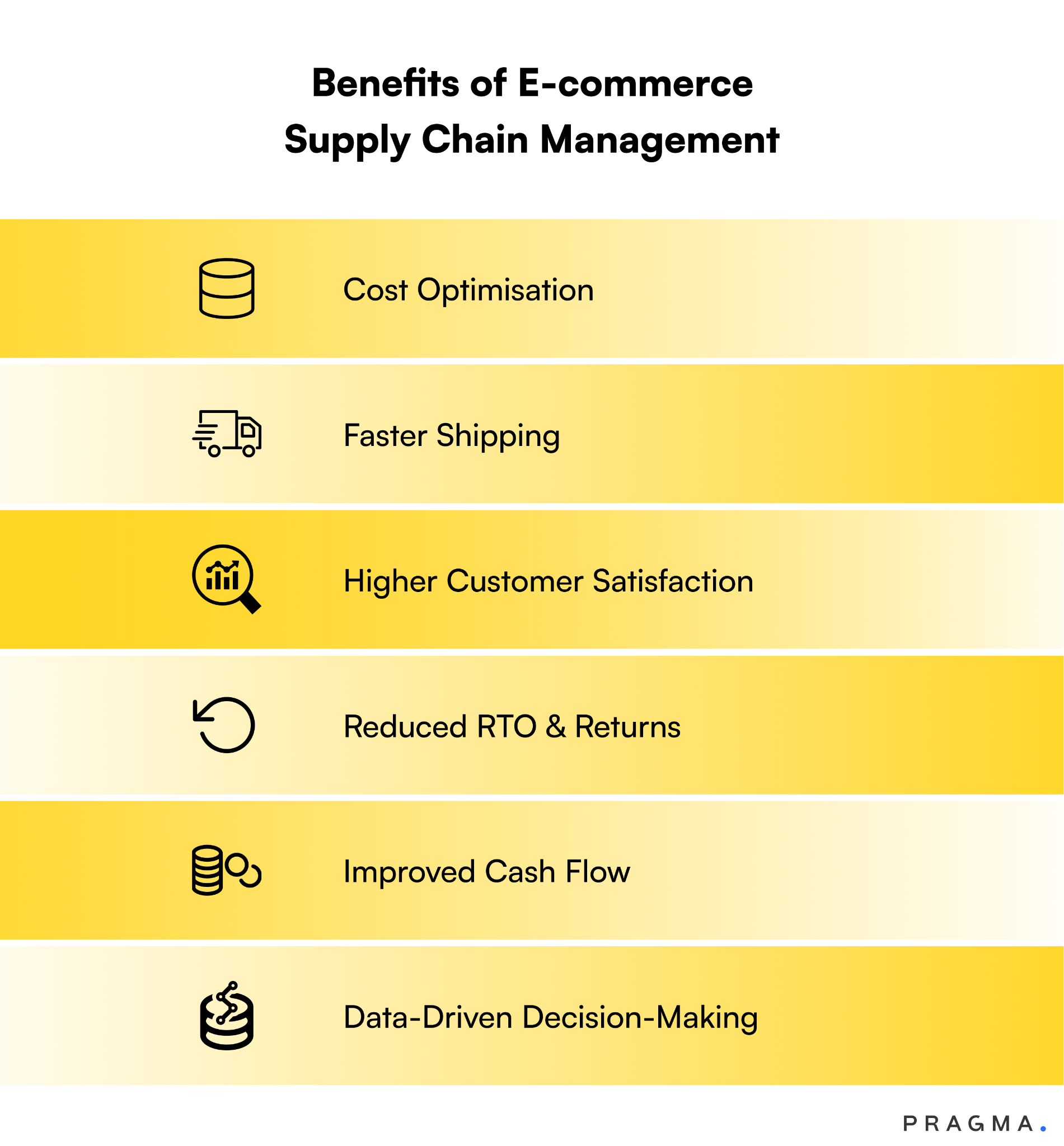
- Cost Optimisation
Proper supply chain management helps the e-commerce companies in managing the cost of storage, transportation and operations. This minimises wastage and improves profitability.
- Faster Shipping
An effective supply chain management guarantees orders are being processed promptly and delivered to the customers in a short period. This improves the speed of delivery and customer expectations.
- Higher Customer Satisfaction
Customers are satisfied when delivery of products is on time and in good time and condition. An efficient supply chain creates trust and induces repeat buying.
- Reduced RTO & Returns
The supply chain should be better coordinated to avoid delivery problems, misplaced deliveries and delays. This reduces return to origin (RTO) rates and unnecessary returns.
- Improved Cash Flow
Inventory control is the way to make sure money does not lie in inventory. Quick delivery and order processing also assist businesses in collecting payments at an earlier date.
- Data-Driven Decision-Making
The modern supply chain systems provide beneficial information on inventory, sales and delivery effectiveness. This assists businesses in making wiser decisions and making better plans regarding the future.
Challenges in Supply Chain Management in E-commerce (India)
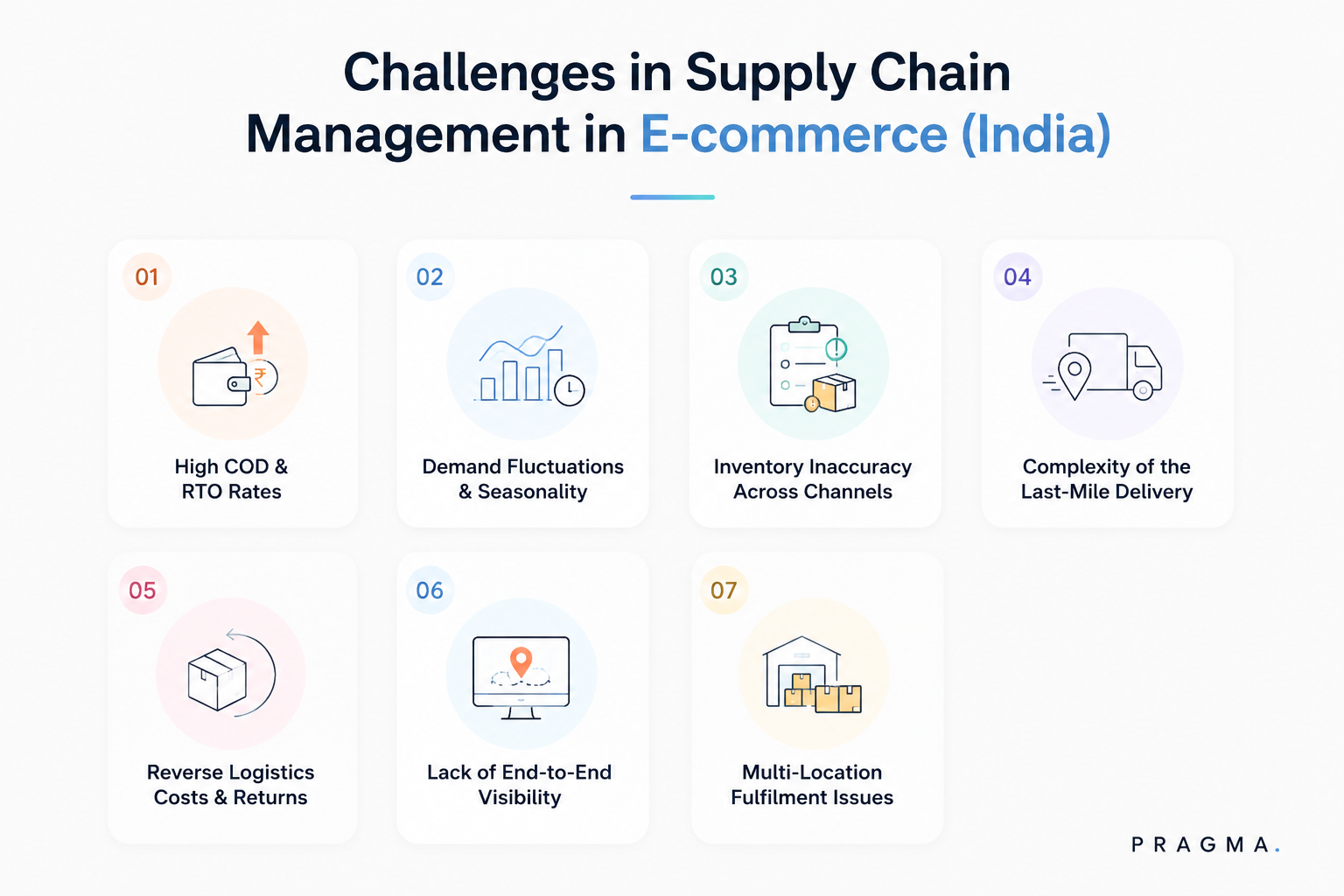
High COD & RTO Rates
A large number of customers in India prefer the use of Cash on Delivery (COD). This usually contributes to high Return to Origin (RTO), because they have not paid anything for the order, and they refuse to take it. And when the customers reject and cancel orders, it raises the cost of delivery and logistics to sellers.
Demand Fluctuations & Seasonality
India's e-commerce demand changes frequently during festivals like Diwali, Dussehra, and regional celebrations, sales and seasonal changes. That's why it is not easy to manage stock within these periods and may even cause overstocking or a shortage of products.
Such peak periods result in a concentration of demand, leading to various challenges in the supply chain. The issue of inventories becomes important because companies have to have enough products to cater to the highest demand without having to be left with leftovers at the end.
Inventory Inaccuracy Across Channels
There is difficulty with inventory tracking when selling on different websites, marketplaces, and social media. The wrong data on stocks can lead to the cancellation of orders and customer dissatisfaction.
But to manage this, inventory tracking tools can be used. These comprise advanced inventory management systems with real-time synchronisation, automated allocation algorithms, and all-around reporting and monitoring applications.
Complexity of the Last-Mile Delivery
India does not have an elaborate system of postal codes that can be used to accurately represent particular places. It is complicated to deliver the goods in remote areas, various pin codes, and in congested cities. This results in delays in delivery, unsuccessful attempts, and frustration of the customer.
Reverse Logistics Costs & Returns
The cost of returns and reverse logistics in India is much higher than in most markets because the country has high returns, complicated logistics systems, and logistics are facing difficulties in the efficient processing of the returned products.
Indian e-commerce has an average of 15-20% in returns, generally with fashion and electronics having a 25-30% or higher average return. These large returns are based on factors such as lack of physical verification of products prior to purchasing, size, fit, quality, and, in some instances, customer behavioural patterns.
Lack of End-to-End Visibility
A major problem affecting most of the e-commerce businesses in India, especially the smaller firms, is the lack of end-to-end visibility of the supply chain.
This is because of the lack of resources by the companies to install detailed tracking and monitoring systems. This invisibility causes various operational and customer support problems.
Multi-Location Fulfilment Issues
Managing warehouses at different locations is not an easy task. It requires proper coordination and efficient working. And if the businesses do not have adequate systems, it may cause escalated costs, delays and wrong routing of orders.
Best Practices for Effective Supply Chain Management in E-commerce
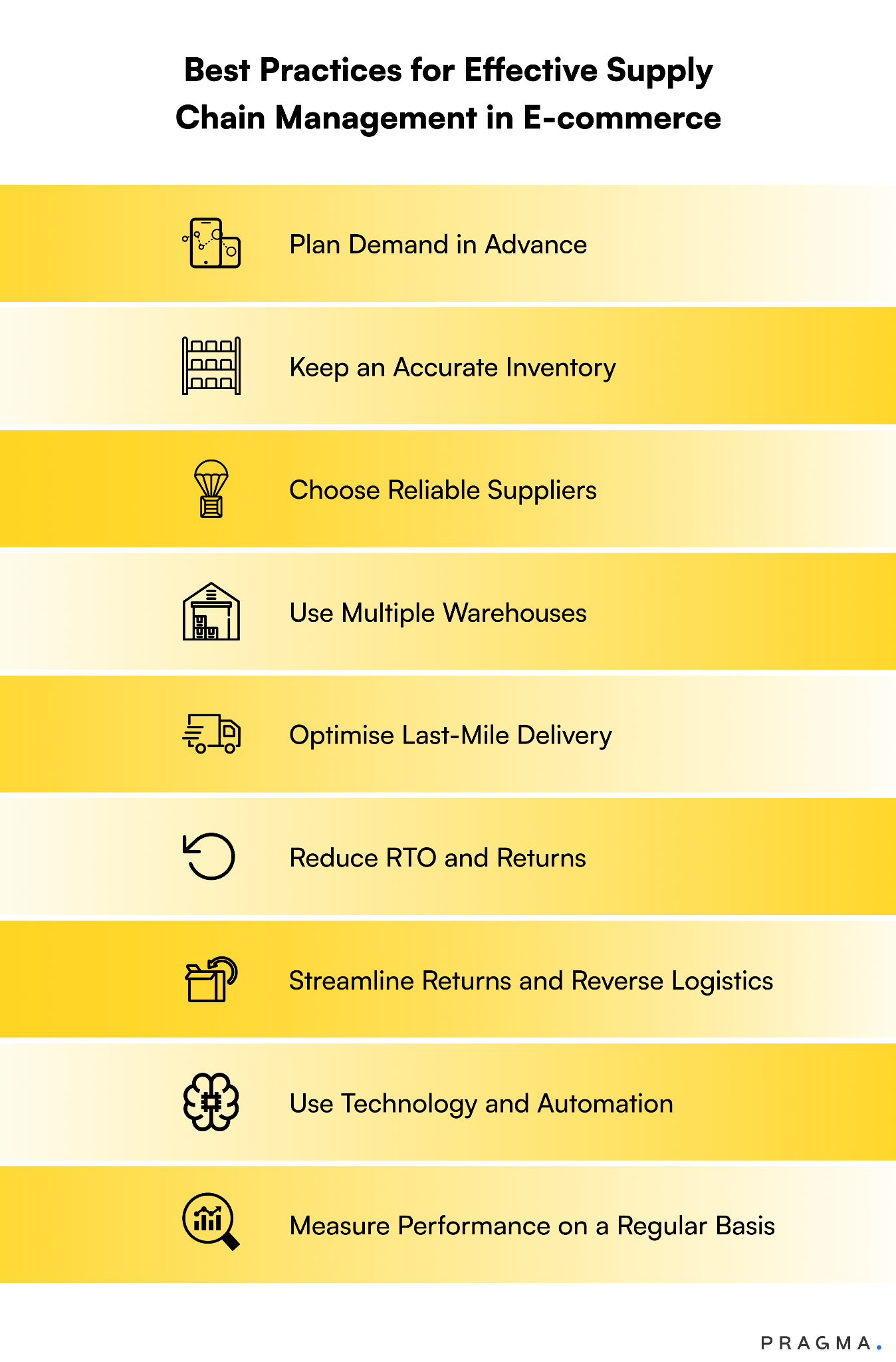
As we have seen, different challenges come in the e-commerce supply chain management, which is why we have come up with some practices that can be good to handle everything smoothly during the supply chain management process. Here are the following:
Plan Demand in Advance
The very first thing that you can do for effective supply chain management is to forecast the demand beforehand. For this, you can research the historical sales records and future trends.
This will help you to let you know what items you have to stock in and prevent you from overstocking or running out of products.
Keep an Accurate Inventory
When your business is present on different selling channels, it is important to track an accurate level of inventory in real-time across all the platforms.
This helps eliminate order cancellations. Also, the customers only view products that are available.
Choose Reliable Suppliers
Suppliers are also one of the important parties in doing successful business. Because they are the one, which will provide you with the raw materials or finished goods, whatever you need to complete an order.
Therefore, you should operate with reliable business partners that will provide quality products on time. Positive supplier relations would prevent delays and stock-outs.
Use Multiple Warehouses
You can get orders from different parts of the country or areas. Having warehouses at different locations would be beneficial. With this, you can provide quicker delivery of orders.
Not only will it help you to make faster deliveries, but it also help in reducing shipping expenses.
Optimise Last-Mile Delivery
The final delivery of the product to the customer is important. For this, you should use the services of the trusted courier partners and monitor the deliveries in real-time.
Quick deliveries under the given timeframe help to increase customer satisfaction and increase the chance of getting new orders from them.
Reduce RTO and Returns
RTO is the major problem faced by almost every e-commerce brand in India. But to reduce this situation, you should offer adequate product information, proper pricing and confirmation of orders in COD orders.
When your customer is provided with the right information, high-quality images of the product, and the correct usage, there is less chance of the order being returned to you.
Streamline Returns and Reverse Logistics
It is very important that you provide your customers with easy returns. If you are not doing that, your customers will get frustrated with the brand and will never make a purchase again with you.
But, on the other hand, when you provide easy returns, faster refunds and exchanges, this will create trust in the minds of customers.
Use Technology and Automation
Utilise inventory management systems, tracking of orders and analytics software. This will help you to reduce dependency on humans, minimising mistakes and wastage of time.
Overall, it will help you to save your resources, such as manpower and money, which can be used in other areas of business.
Measure Performance on a Regular Basis
Monitor the main indicators such as the order accuracy, delivery time, costs and returns. By monitoring these different indicators, you can correct the issues by diagnosing them earlier, before they cause a measurable impact on your supply chain process or business operations.
What is the Role of Technology in E-commerce Supply Chain Management?
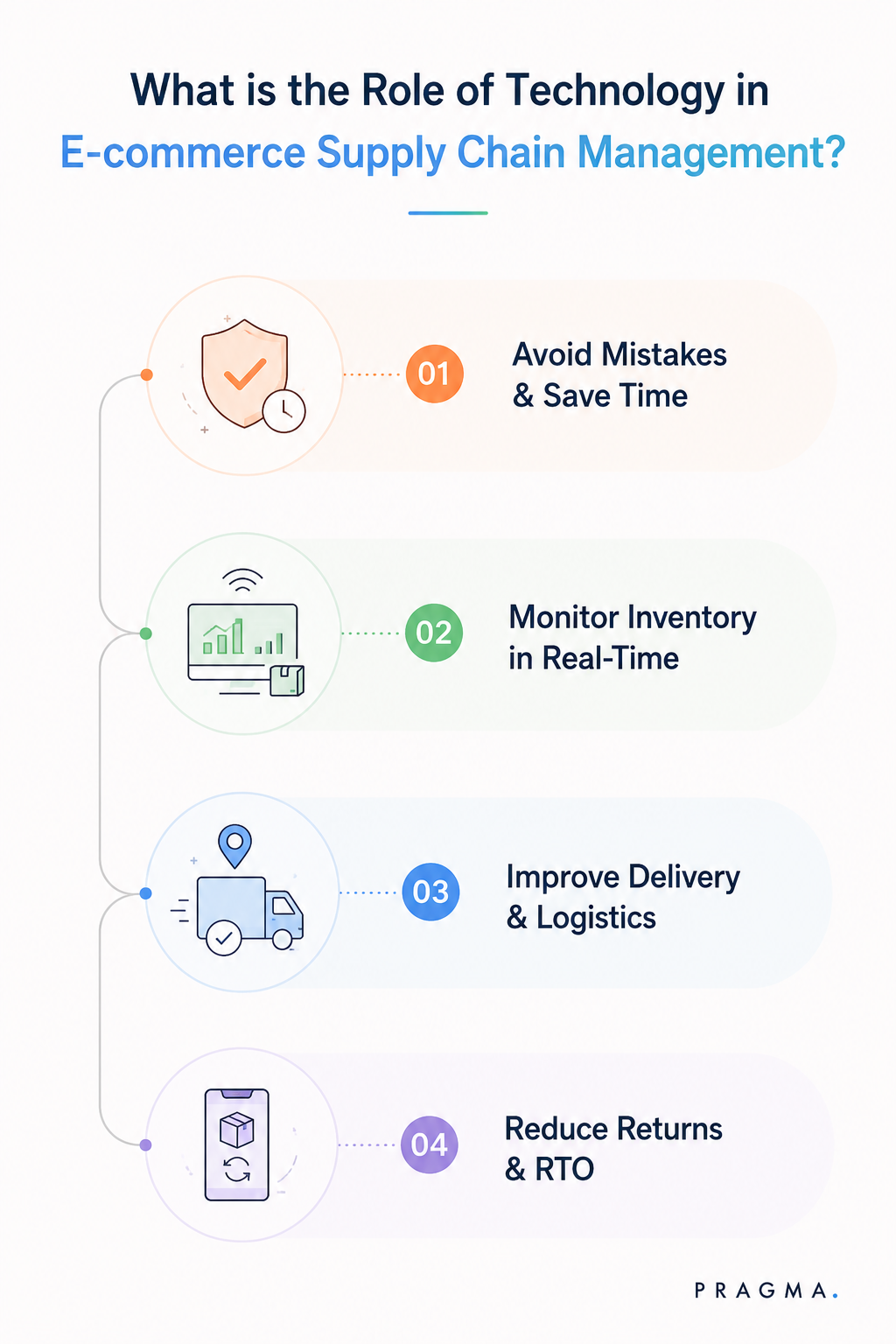
Technology is a major factor in e-commerce supply chain management as it makes the operations more accurate and faster. It assists companies in dealing with inventory, orders, and shipments hassle-free.
E-commerce companies can avoid manual mistakes and save time and money with the help of software and automation tools like Pragma.
Technology is also useful in real-time monitoring of inventory within warehouses and sales channels. This will make sure that the right inventory is available to the customers and minimise order cancellations.
Technology can be applied in delivery and logistics to select the most advantageous courier partner, shipment tracking, and plan a quicker route.
Real-time updates of the orders give the customers better trust and satisfaction. RTO and returns are also minimised with the help of tools such as COD verification and address checks.
E-commerce Supply Chain Management Examples (India)
Let us talk about different e-commerce brands in India, which have optimised their e-commerce supply chain very well:
Amazon India makes use of several fulfilment centres throughout the country that help to serve the orders faster. Amazon warehouses are used to store products by sellers. Amazon does packing, shipping, and returns. They make use of automated systems in tracking inventory in real-time, as well as selecting the fastest delivery opportunity to offer to a customer.
Meesho focuses on a low-cost and low-flexibility supply chain. It collaborates with numerous small sellers and delivery partners to reach the Tier 2 and Tier 3 cities with customers. The supply chain at Meesho is intended to receive COD orders and minimise the RTO by confirming the orders and using intelligent logistics.
BigBasket operates a tech-based supply chain in groceries. It manages cold storage, local warehouses and scheduled deliveries. This helps them in providing fresh products within the required time. And there are no wastage or quality issues for the customer.
E-commerce Supply Chain Metrics to Track
Here are some metrics that can be used to track the e-commerce supply chain:
- Order Fulfilment Rate
- Order Processing Time
- Inventory Turnover
- Stock-Out Rate
- Delivery Time (TAT)
- Return Rate
- RTO (Return to Origin) Rate
- Logistics Cost per Order
- Order Accuracy Rate
- Customer Satisfaction Score
What is the Future of Supply Chain Management in E-commerce?
If we talk about the future of supply chain management in e-commerce, we can say that in the future, the use of technology will increase. Businesses will make use of AI and automation tools.
With the help of AI, they can anticipate the demand more precisely, inventory can be managed more appropriately, and less wastage will be achieved.
Robotics, intelligent picking and automated warehouses will accelerate the processing speed of orders and reduce the cost of operations.
Same-day or next-day delivery will be demanded by the customers, particularly in the metro cities.
Future supply chains will be influenced by data and real-time visibility. The firms will monitor the supplier-to-customer products in real time and therefore enable the firms to fix delays and prevent stock challenges promptly.
E-commerce brands will be oriented on a green package, efficient delivery channels, and reduced carbon emissions.
Hence, supply chain management in e-commerce will be more efficient and will provide better customer experiences.

FAQs (Frequently Asked Questions On Supply Chain Management in E-commerce: Complete Guide (2026))
1. What is supply chain management in e-commerce?
Supply chain management (SCM) in e-commerce covers the end-to-end flow of products—from sourcing and manufacturing to warehousing, fulfilment, delivery, and returns—along with the information and payments that support these movements.
2. Why is supply chain management important for e-commerce brands?
Effective supply chain management reduces costs, improves delivery speed, prevents stockouts, controls returns, and ensures a consistent customer experience while supporting scalable growth.
3. What are the main components of an e-commerce supply chain?
The core components include supplier management, inventory planning, warehousing, order fulfilment, logistics, last-mile delivery, returns handling, and data visibility across systems.
4. How is supply chain management different in e-commerce compared to traditional retail?
E-commerce supply chains handle smaller, more frequent orders, faster delivery expectations, higher return rates, and greater dependency on technology and third-party logistics compared to traditional retail.
5. What are the biggest supply chain challenges in e-commerce?
Common challenges include demand forecasting errors, inventory imbalance, high logistics costs, delayed deliveries, Return to Origin (RTO), returns management, and lack of real-time visibility.
6. How does supply chain management affect customer experience?
Supply chain performance directly impacts delivery speed, order accuracy, availability, refund timelines, and reliability—making it a major driver of customer satisfaction and repeat purchases.
7. How can e-commerce brands optimise their supply chain?
Brands optimise their supply chain by improving demand forecasting, using real-time inventory systems, enabling multi-warehouse fulfilment, automating logistics workflows, and closely monitoring operational KPIs.
8. What role does technology play in e-commerce supply chain management?
Technology enables automation, real-time tracking, data-driven decisions, and integration across inventory, fulfilment, logistics, returns, and customer communication systems.
9. How does supply chain management impact costs and profitability?
Efficient supply chains reduce warehousing costs, shipping expenses, inventory holding costs, and return losses, directly improving contribution margins and cash flow.
10. What supply chain trends will shape e-commerce in 2026?
Key trends include real-time inventory visibility, faster fulfilment expectations, automation across logistics and returns, predictive demand planning, and tighter integration between operations and customer experience
Talk to our experts for a customised solution that can maximise your sales funnel
Book a demo

.png)