

For many D2C brands in India, COD buyers make up a large share of first-time orders but a much smaller share of repeat revenue. Over time, a portion of these customers quietly drop off, not because of a bad experience, but because no one actively pulls them back into the purchase cycle. Treating all lapsed COD buyers as a single cohort often leads to blunt reactivation efforts that waste effort and produce uneven results.
Reactivation journeys for lapsed COD buyers: segmentation and cadence templates looks at this problem through an operational and behavioural lens. It explores why COD customers lapse differently from prepaid buyers, how intent and trust decay over time, and which signals should drive reactivation timing.
Rather than relying on generic discounts or one-off nudges, the focus is on structured segmentation and disciplined outreach cadence. When reactivation journeys are designed with these factors in mind, brands can recover meaningful revenue from COD cohorts without increasing RTO risk or operational load.
Why lapsed COD buyers require a different approach
COD behaviour patterns diverge from prepaid cohorts
COD buyers often display unique behavioural traits. They are more likely to purchase impulsively, exhibit higher return probability, and have lower repeat rates compared with prepaid buyers. Traditional retention tactics, such as standard loyalty emails or generic push campaigns, frequently underperform because they fail to account for these nuances.
Segmentation allows teams to isolate high-value lapsed COD buyers from low-intent ones. By understanding the cadence, preferred channels, and incentives that resonate with each subgroup, brands can tailor journeys that increase reactivation without creating operational strain.
Why Do COD Buyers Lapse in the First Place?
There are many reasons why COD customers stop buying from a brand. Some only wanted to try the product once, while others simply forgot about the brand. Some customers may have found a better price elsewhere or no longer need the product.
Sometimes, customers are interested in buying again but do not receive any reminders or offers. Without regular communication, they slowly lose interest. Understanding why COD buyers stop purchasing helps businesses create better reactivation campaigns and bring them back at the right time.
How to segment lapsed COD buyers effectively
Segmentation ensures precision in outreach and offers
Effective segmentation uses a combination of behavioural, transactional, and demographic signals:
Behavioural segmentation
Last purchase recency
Customers who purchased 30–60 days ago react differently from those inactive for 6–12 months. Early lapses may respond to lighter nudges, while long-term lapses may need stronger incentives.
Past engagement with messages
Tracking responsiveness to SMS, WhatsApp, or email campaigns helps identify buyers who are likely to open and act on reactivation prompts.
Transactional segmentation
Order frequency and basket size
High-value COD buyers with historically consistent order frequency deserve priority in reactivation, while one-time buyers may require smaller, risk-mitigated incentives.
Product category affinity
Buyers tend to repurchase within categories. Identifying prior preferences allows more relevant messaging and reduces friction.
Demographic and geography-based segmentation
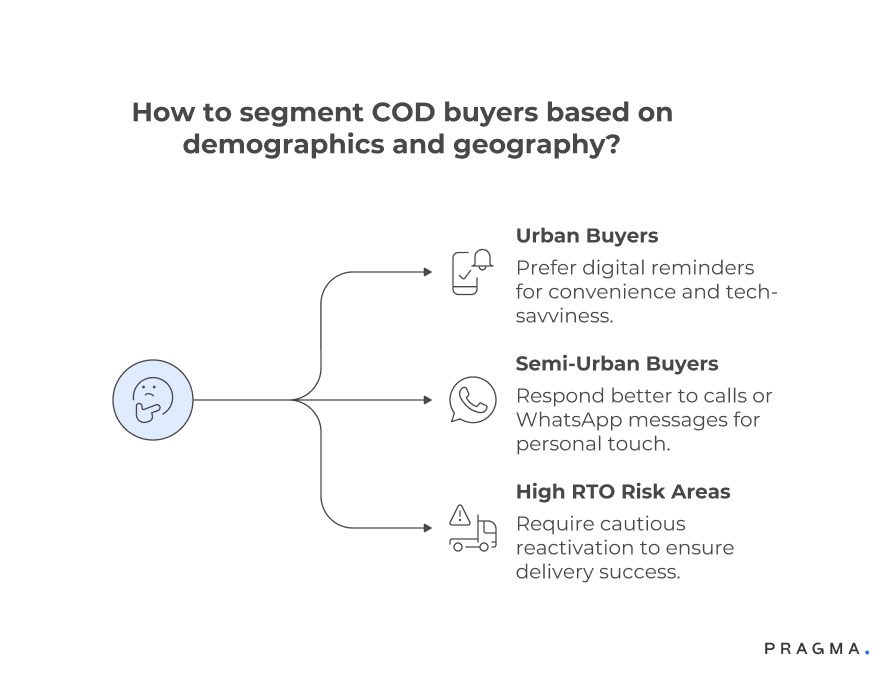
- Urban vs semi-urban differences: Urban COD buyers often prefer digital reminders; semi-urban buyers may respond better to calls or WhatsApp messages.
- Pincode-specific delivery reliability: Areas with higher RTO risk may need cautious reactivation to avoid failed delivery attempts.
Designing the outreach cadence
Timing and frequency influence conversion without causing fatigue
The cadence of messages determines whether the reactivation attempt succeeds or backfires. Over-contacting can irritate customers, while under-contacting misses the optimal window.
Multi-touch sequence templates
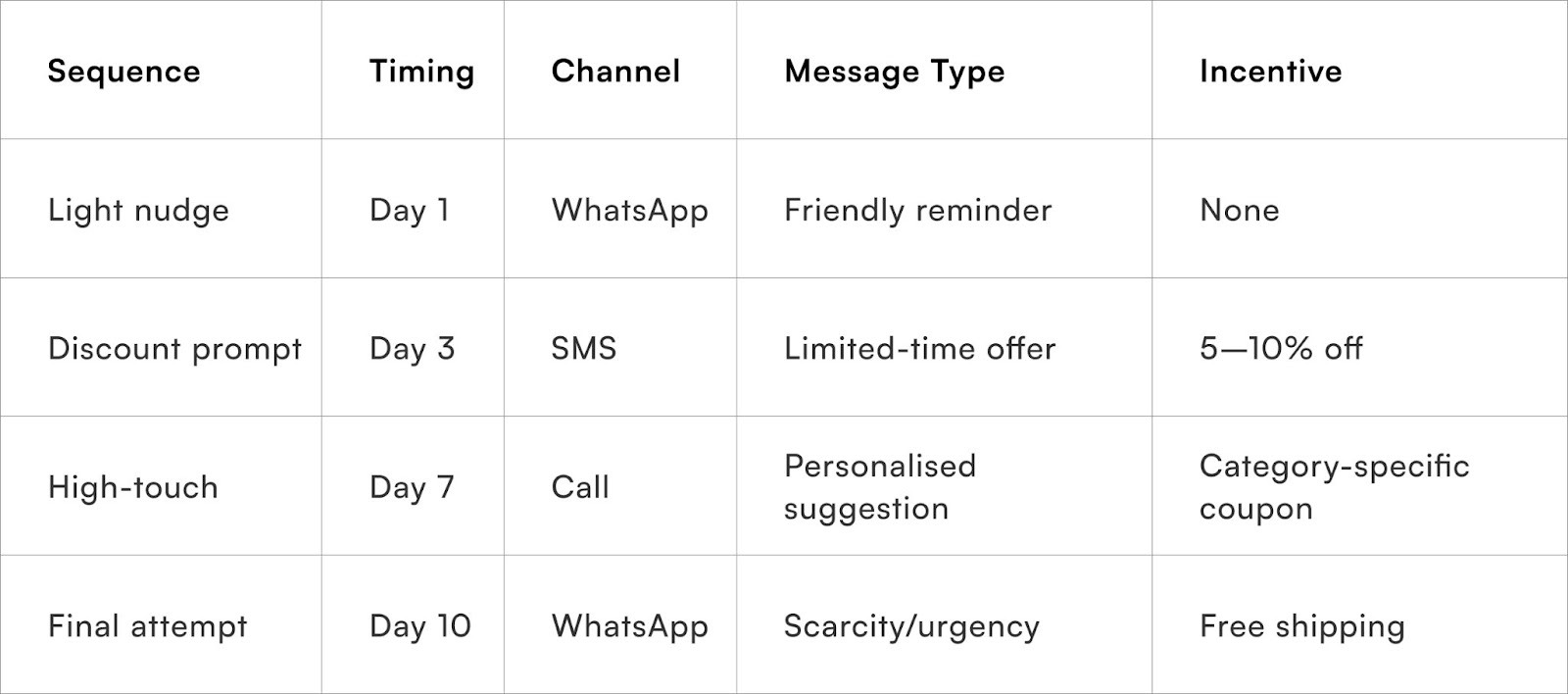
Balancing reach and risk
- Ensure message frequency does not trigger opt-outs or customer frustration.
- Avoid high-value incentives in areas prone to RTO without prior confirmation.
- Track early response signals to adjust subsequent steps dynamically.
What Is the Best Way to Reactivate COD Customers?
The best way to reactivate COD customers is to send the right message at the right time. Instead of sending the same offer to everyone, businesses should group customers based on their shopping history and behaviour.
Businesses can use WhatsApp, SMS, email, or phone calls to remind customers about new products, special offers, or items they may be interested in. Personalised messages usually work better than sending the same message to every customer.
How to use first-purchase and engagement signals for reactivation
Past behaviour predicts future receptivity
Lapsed COD buyers leave a rich trail of data:
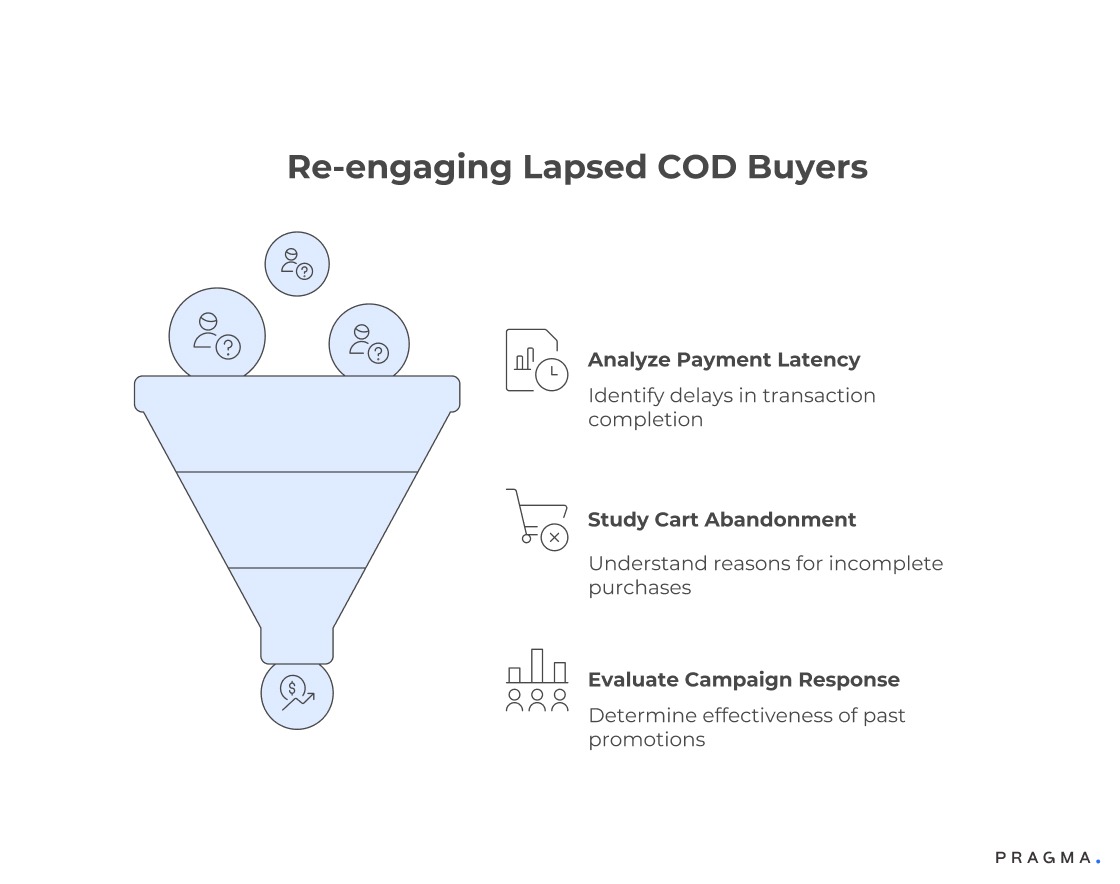
- Payment confirmation latency
- Cart abandonment patterns
- Response to previous promotional campaigns
By layering these signals, brands can assign a “reactivation probability score” to each lapsed customer. High-score buyers should receive priority, while low-score buyers may be held for future campaigns, optimising effort and budget.
Incentive strategies for COD buyers
Not all discounts or offers work equally
While financial incentives are common, they must align with customer behaviour:
Financial incentives
- Small, time-bound discounts improve urgency without eroding margins.
- Free shipping or cash-back credits encourage repeat purchase while limiting RTO exposure.
Non-financial incentives
- Early access to new SKUs or personalised recommendations can be as effective as discounts.
- Loyalty points or tiered benefits for returning within a specific window strengthen brand attachment.
How Reactivation Journeys Build Customer Trust?
A well-planned reactivation journey is not only about getting another sale. It also helps customers feel connected to the brand. Helpful reminders, relevant product suggestions, and timely offers show customers that the brand understands their needs.
When customers receive useful messages instead of too many promotional texts, they are more likely to trust the brand and shop again. Over time, this trust can turn first-time COD buyers into loyal customers.
Monitoring and refining reactivation campaigns
Continuous measurement ensures campaigns remain effective
Tracking KPIs is crucial:
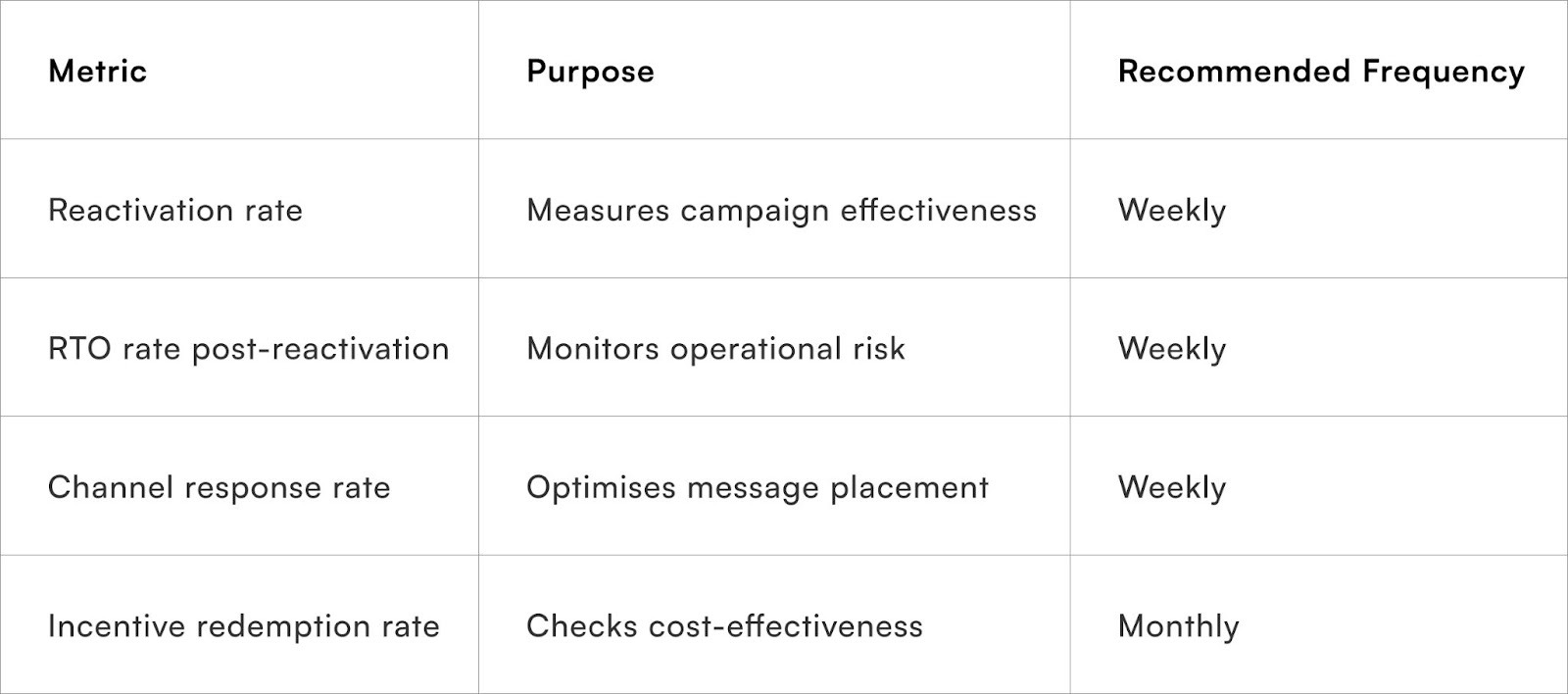
By reviewing these metrics, teams can optimise both segmentation and cadence in near-real time.
How behavioural scoring enhances reactivation prioritisation
Predictive scoring identifies buyers most likely to convert
Not all lapsed COD buyers are equally valuable or likely to respond. By combining multiple behavioural signals—such as purchase frequency, average basket size, payment hesitation, responsiveness to past campaigns, and time since last purchase—brands can assign a weighted behavioural score to each buyer.
High-score buyers can then be prioritised for early reactivation efforts, ensuring resources are focused on segments with the highest probability of success. Over time, recalibrating these scores based on actual response and RTO outcomes helps create a dynamic, self-improving system that maximises campaign efficiency across large COD cohorts.
Constructing a behavioural scoring model
Selecting predictive variables
Choose variables that directly correlate with both repeat purchase likelihood and delivery reliability, including prior engagement with reminders, order size patterns, and product affinity.
Weighting and thresholds
Assign higher weights to signals that historically predict conversion, and create thresholds to categorise buyers into high, medium, and low reactivation priority segments. This ensures outreach effort aligns with operational and financial risk.
Dynamic incentive strategies based on risk profiles
Tailoring offers reduces RTO and operational exposure
COD buyers have varying levels of refusal or RTO risk, so one-size-fits-all incentives can backfire. High-risk buyers who are unlikely to convert may receive smaller, safer nudges, such as gentle WhatsApp reminders or low-value vouchers, whereas low-risk buyers can be offered stronger benefits like free shipping or category-specific discounts to maximise revenue recovery. This differentiation protects operational capacity while improving conversion.
Matching incentives to risk segments
Financial incentives
Tiered discounts or cash-back offers encourage repeat purchase without eroding margins unnecessarily. High-value buyers may receive higher incentives to ensure engagement, while riskier buyers get modest benefits to reduce RTO exposure.
Non-financial incentives
Offering early access to new SKUs, personalised product recommendations, or loyalty points strengthens engagement without adding delivery risk. Non-monetary incentives also build brand affinity for long-term retention.
Testing and iterating outreach templates
Continuous experimentation improves effectiveness
Reactivation campaigns are rarely perfect at launch. A/B testing message copy, timing, channel, and incentives reveals what resonates with each COD segment. Monitoring both conversion and downstream delivery metrics—including RTO and NDRs—ensures that campaigns are optimised for both revenue recovery and operational efficiency. Insights from testing inform future campaigns, creating reusable templates for consistent success.
Establishing a feedback loop
Tracking conversion and delivery outcomes
Every message or offer should be measured not only for clicks or responses but also for successful delivery completion. This prevents campaigns from boosting engagement metrics while inadvertently increasing RTO.
Refining sequences
Use results to adjust timing, content, and incentives. For example, buyers who respond poorly to SMS may perform better with WhatsApp nudges, while certain incentive thresholds may require tweaking to balance conversion and operational risk.
Integrating reactivation journeys with CRM and ops workflows
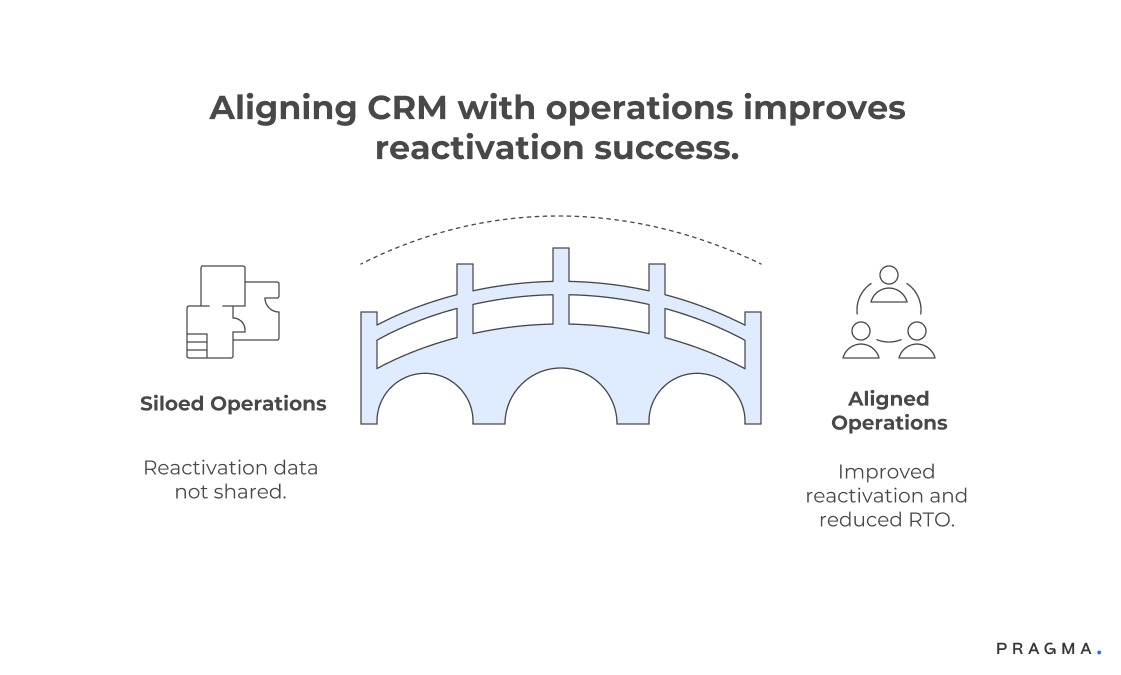
Automation and visibility reduce manual effort
Segmented reactivation journeys are most effective when embedded into CRM systems and operational workflows. Automated triggers allow timely messages via WhatsApp, SMS, or calls, reducing manual intervention while maintaining consistency. Integration ensures CX teams have full visibility into customer engagement history, incentive usage, and delivery readiness, preventing duplication or over-contacting.
Operational alignment
Linking CRM with warehouse and delivery teams
Sharing reactivation data with fulfilment teams helps monitor post-reactivation orders, mitigating RTO risk. For example, orders flagged as high-priority may receive proactive address verification or delivery scheduling.
Real-time dashboards
Dynamic dashboards allow teams to track which buyers have received messages, opened them, and acted, enabling quick course correction for underperforming segments.
Reducing RTO Risk Through Smarter Reactivation
Not every COD customer should receive the same reactivation campaign. Businesses should first identify customers who are more likely to complete their orders. This reduces the chances of failed deliveries and Return to Origin (RTO).
Businesses can also verify addresses, confirm orders through WhatsApp or phone calls, and send reminders before shipping. These simple steps improve delivery success, reduce RTO costs, and make reactivation campaigns more effective.
Quick Wins
A step-by-step approach to reactivating lapsed COD buyers
Reactivation campaigns for COD buyers don’t require a full-scale transformation to start delivering results. By sequencing efforts carefully, teams can recover revenue without overwhelming CX or logistics operations.
Week 1: Segment lapsed COD buyers
Pull the last 3–6 months of COD data and categorise buyers by behavioural score, order history, and engagement levels. Identify high-priority buyers who are most likely to convert with minimal incentives. This week is about creating a clean, actionable dataset to guide campaigns.
Week 2: Define and test outreach sequences
Develop simple multi-touch templates across WhatsApp, SMS, and calls. Assign each buyer segment to an appropriate sequence, balancing message frequency and incentive type. Start small—perhaps 5–10% of the lapsed cohort—to test messaging effectiveness and operational feasibility.
Week 3: Monitor early responses and adjust
Track initial engagement metrics, including open rates, click-through, and immediate conversions. Identify patterns in which channels, message types, or incentives yield the best response. Adjust subsequent touches dynamically, focusing effort on segments showing early interest.
Week 4: Scale campaigns and refine cadence
Expand the outreach to the broader lapsed cohort, incorporating insights from the pilot. Monitor post-reactivation RTO and NDRs to ensure operational stability. By the end of the month, teams should have clear visibility into which segments respond, which incentives work, and which sequences drive sustainable reactivation.
Key metrics to track reactivation success
Focus on outcomes, not activity
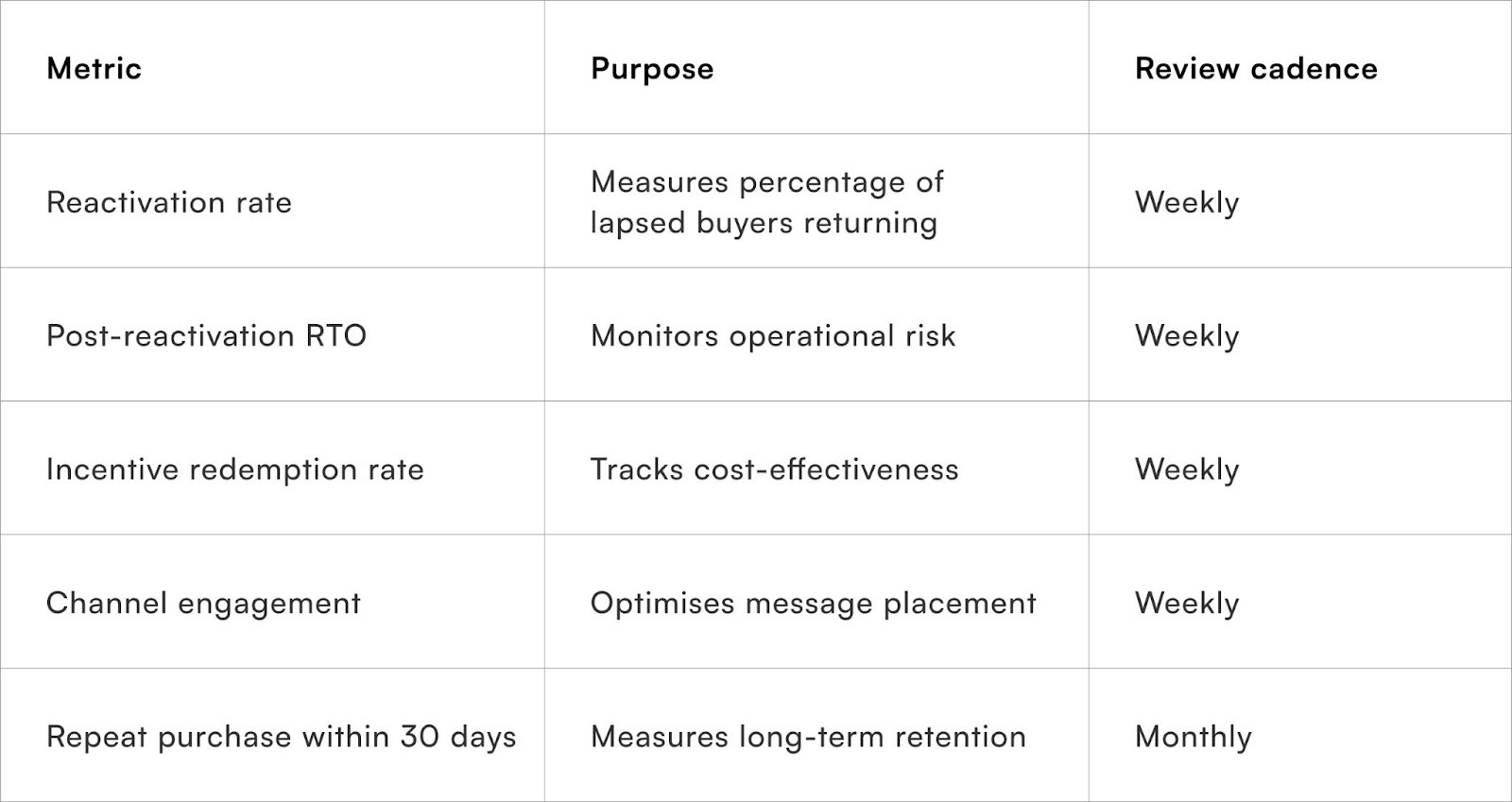
Tracking these metrics ensures campaigns are not only recovering revenue but doing so efficiently and safely.
Maintaining operational efficiency
Balance revenue recovery with delivery reliability
Reactivation should never compromise fulfilment. Segment high-risk COD buyers and coordinate with warehouse and CX teams to ensure correct address verification, payment confirmation, and delivery readiness. Automating triggers in the CRM ensures timely messages while preventing manual overload, keeping operational costs in check.
To Wrap It Up
Lapsed COD buyers are a valuable but sensitive cohort. Their reactivation requires structured segmentation, thoughtful incentive design, and disciplined outreach cadence. When done right, campaigns can recover meaningful revenue without increasing RTO risk or operational strain.
This week, identify the top 500 lapsed COD buyers and assign them to tailored outreach sequences based on behavioural scoring.
Over the long term, continuously refine segmentation, messaging, and incentive strategies based on campaign outcomes and operational learnings to build a sustainable reactivation engine.
For D2C brands seeking to optimise reactivation for COD buyers, Pragma’s customer engagement platform provides predictive scoring, automated multi-channel workflows, and analytics to maximise conversion while mitigating delivery risk.

FAQs (Frequently Asked Questions On Reactivation journeys for lapsed COD buyers: segmentation and cadence templates)
1. How soon should lapsed COD buyers be contacted?
Within 30–60 days of inactivity for early lapsed buyers; for longer lapses, sequence may include stronger incentives and personalised messaging.
2. Which channels are most effective for COD reactivation?
WhatsApp generally yields high engagement, SMS works well for reminders, and calls are effective for high-value or high-risk buyers.
3. Do financial incentives always improve reactivation rates?
Not always. Incentives must align with risk and segment. Over-incentivising high-risk buyers can increase RTO without improving revenue.
4. How often should sequences be updated or tested?
A/B tests should run continuously; sequences should be refreshed monthly based on engagement and operational feedback.
5. Can small teams run these campaigns effectively?
Yes. Even without advanced tools, prioritising high-value buyers, using simple templates, and monitoring early responses can yield meaningful results.
6. What metrics indicate operational risk from reactivation?
Post-reactivation RTO, NDRs, and failed delivery attempts help ensure campaigns don’t create unexpected operational burdens.
7. Should incentives differ across geographies or product categories?
Absolutely. Urban vs semi-urban buyers and different SKU types respond differently; tailoring incentives increases both conversion and operational reliability.
Talk to our experts for a customised solution that can maximise your sales funnel
Book a demo
.png)