

In the e-commerce industry, even the smallest details can affect the whole customer experience, and delivery is one of the crucial aspects.
According to research, 85% of online shoppers would avoid ordering from a retailer again after experiencing a poor delivery.
To provide customers with a successful delivery experience, the customer's address plays an important role because a single typo in a street name, a missing or incorrect apartment number, or a wrong PIN code can lead to failed deliveries.
These failed deliveries can lead to Return-to-Origin (RTOs) and unhappy customers, leading to loss of revenue and reputation of the business.
That is why every e-commerce business must ensure that the address entered by the customer is checked before shipping the order.
And this is where e-commerce address validation can help!
So, let us know about "E-commerce Address Validation: How It Works and Why E-commerce Businesses Need It?"
What is E-commerce Address Validation?
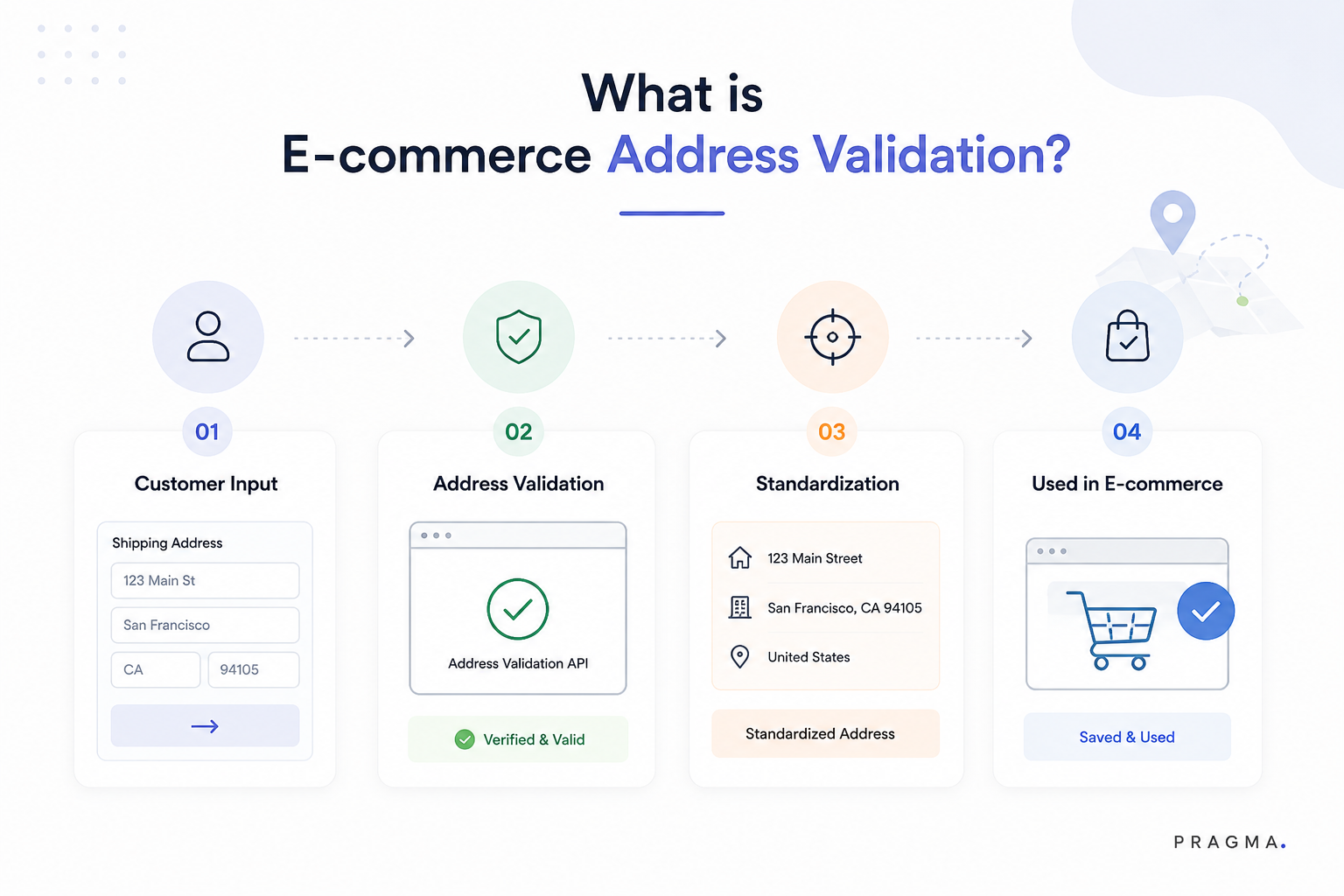
E-commerce address validation is a way to check, correct and format customer delivery addresses at the time of purchase.
It's done with the help of address validation tools that cross-check each address entered by the customers with official postal data, geographic information systems, and past delivery history to make sure the address is correct before the order is dispatched.
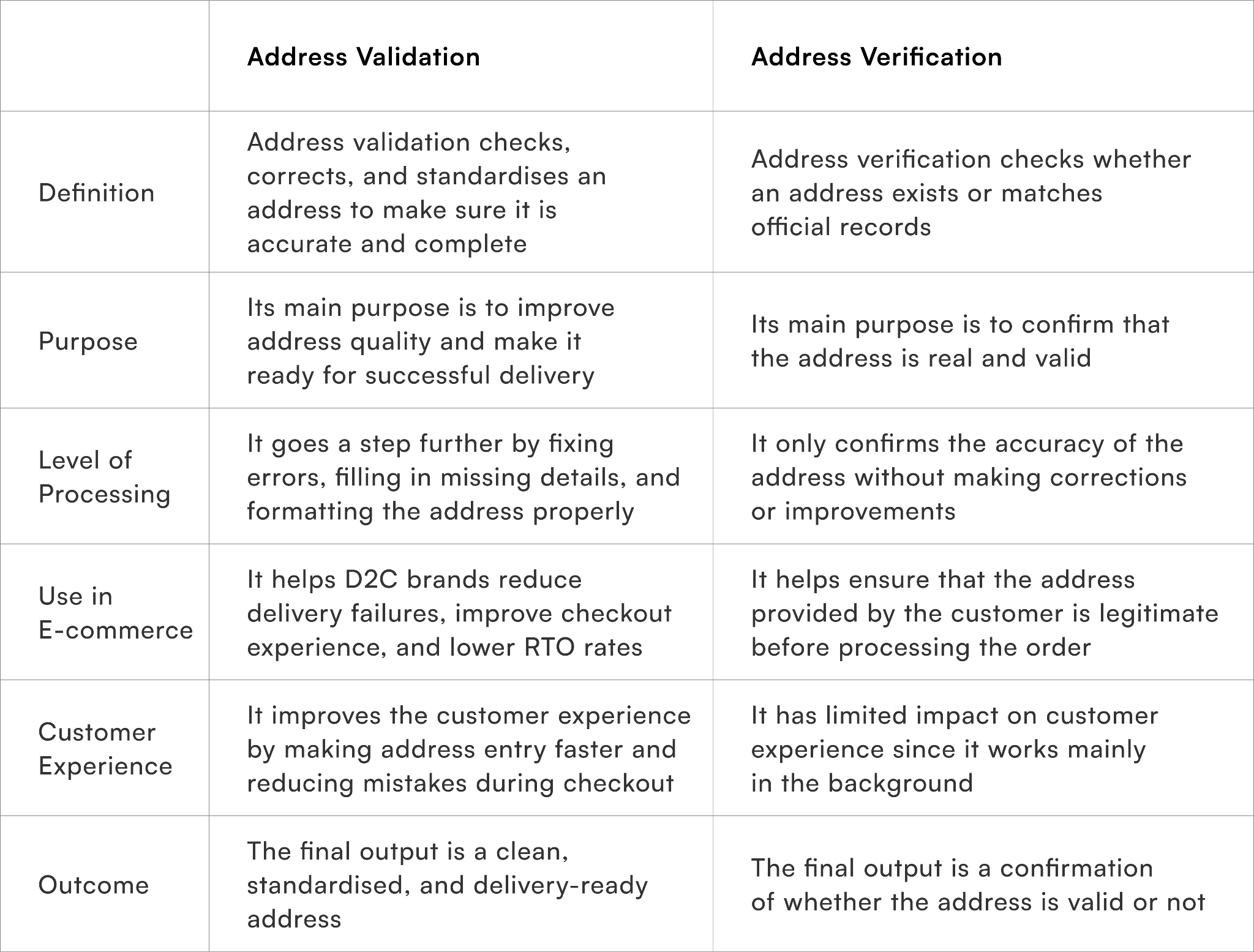
While address verification simply checks if the address is correct, validation does much more. It automatically fixes typos, auto-completes information like PIN codes, formats addresses consistently, and even predicts full addresses from just a few characters.
For D2C brands, e-commerce address validation can protect brands from delivery problems and unhappy customers, which can occur due to silly address mistakes.
Ultimately, e-commerce validation can save operational expenses and overall revenues of the business.
Why Address Accuracy Matters in E-commerce?
It is one of the obvious things that the address is the most important element to deliver the order to the customer.
If the address is wrong, ultimately it will lead to failed deliveries and unhappy customers.
Not only is it related to the customer experience, but failed deliveries due to address issues can cause e-commerce brands to pay more costs and loss of sales.
Here is why address accuracy matters in e-commerce:
Failed Deliveries
Failed deliveries not only irritate the customers, but also make a negative impact on the business revenues too.
When orders can't be delivered due to address issues, it affects your business in numerous ways:
- The call support team can be overwhelmed with "Where's my order?" calls.
- You are forced to pay more logistics costs to reschedule the delivery.
- Your customers start to doubt you as a good brand.
- The brand reputation suffers in reviews and on social media.
In the case of D2C brands, whose lifetime value is determined by repeat orders, a single failed delivery can wipe out months' worth of marketing spend.
Higher RTO Rates
Return to Origin (RTO) rates are the most common problem for all D2C brands in markets such as India.
Given that many D2C brands have an average RTO rate of 20-30%, address-related RTOs can make this rate much higher.
According to industry reports, 15-25% of RTO's are a result of incorrect addresses.
The cost of an RTO order to many brands amounts to:
- Lost sales value of the product
- Forward and reverse shipping costs
- Payment gateway fees (usually non-refundable)
- Customer service overhead
- Opportunity cost of inventory tied up in transit
However, this is where address validation creates a measurable impact!
Businesses that have adopted robust address validation solutions such as Pragma RTO Suite have seen 45-60% improvement in RTOs. This leads to improved unit economics and cash flow, the two key drivers for D2C.
Customer Frustration
Today's consumers expect Amazon-like shipping from all brands. When orders arrive at the wrong address, research found that 68% of customers hold the brand responsible, rather than themselves, for not entering the correct address.
This creates a problem for D2C brands. Consumers want brands to "work around" their errors, even if they don't provide full or accurate information.
E-commerce address validation assists with closing this perception gap by minimising address errors before they turn into delivery issues.
This disappointment is not just limited to this. Frustrated customers often:
- Post complaints about delivery problems with the particular brand
- Post negative reviews on social media
- Switch to competitors for future purchases
- Create long-lasting negative perceptions about the brand
That is why, without an e-commerce address validation system, Indian D2C brands can have a more negative impact that totally harms the brand's image.
Higher Logistics Costs
When addresses are inaccurate, they incur many additional costs, which can quickly eat into profit. These costs can cut D2C brands' profit margins by 3-8% according to the research, if they have not invested in address validation systems.
The costs include:
- Failed delivery attempts: ₹50-100 per attempt (2-3 attempts per package)
- Address correction charges: ₹15-25 per package from shipping partners.
- Customer service costs: 15-20 minutes per address issue call can charge brands more costs.
- Inventory holding costs: Products stuck in transit or returned to warehouses.
- Opportunity costs: Lost sales from the unavailability of inventory during the time of getting new orders.
For example, a D2C business handling 1,000 orders per month with a 10% incorrect address rate, this can add up to more than ₹50,000 per month - revenue that could be used to drive growth.
How E-commerce Address Validation Works?
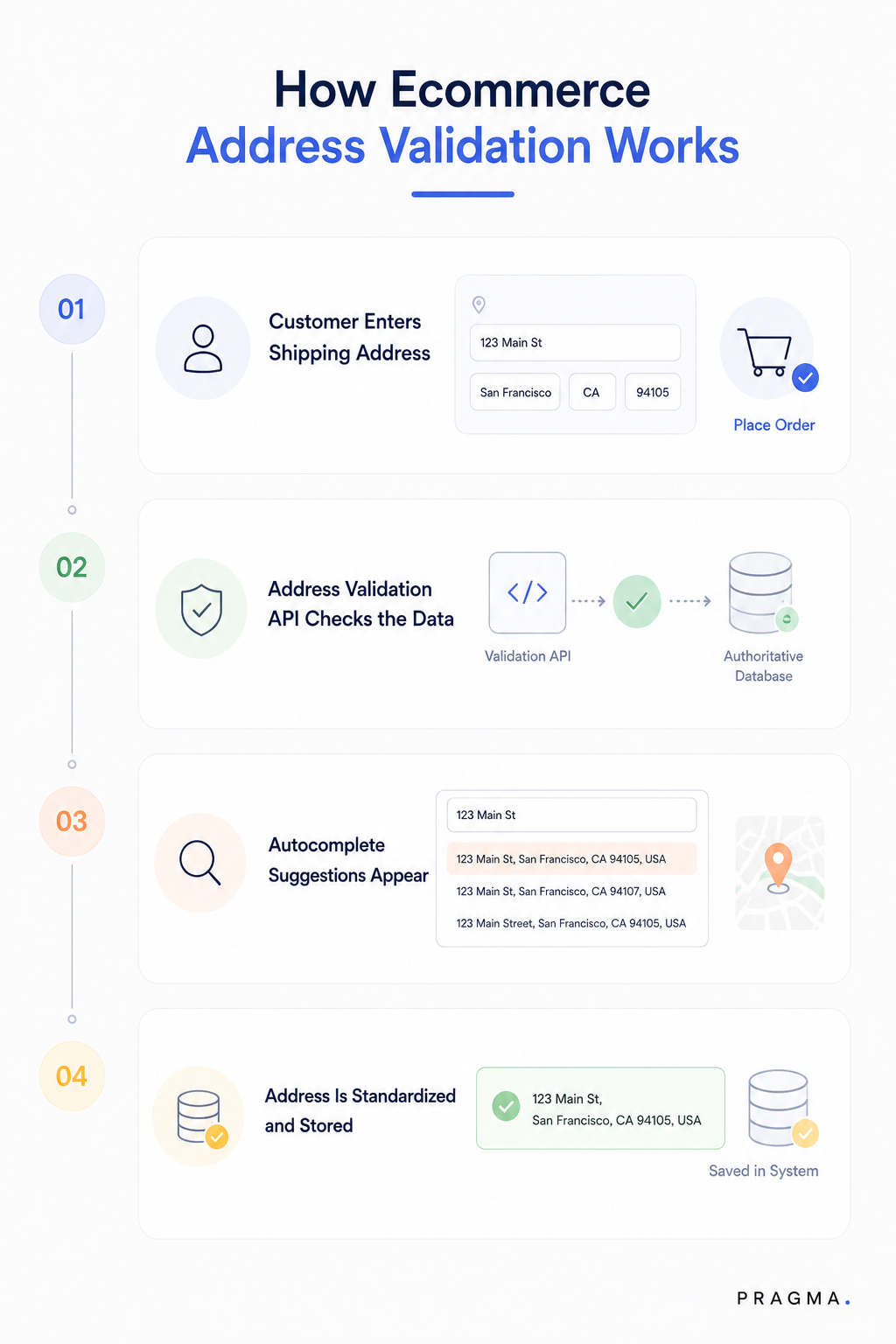
To leverage address validation effectively, D2C businesses need to understand how it works:
Customer Enters Shipping Address
Address validation starts as soon as customers begin entering the address. Modern systems use predictive and machine learning technologies to assist with accurate entry from the beginning.
The system uses patterns, errors and geographical insights as the customer types to offer suggestions. This ensures that mistakes are prevented, rather than fixed.
On the same philosophy, Pragma RTO Suite works; it screens the customer's information such as address, pincode, phone number, etc., verifies it and auto correct if needed.
This screening enables e-commerce brands to detect impulse buyers, fake orders, orders made by bots, orders from temporary residences such as hostels, resorts or hotels, ultimately saving them from high-risk orders.
Address Validation API Checks the Data
Behind the scenes, advanced APIs do real-time screening against several trusted sources:
- Official postal service records: Including India Post, USPS, Royal Mail, and other national postal databases
- Geographic information systems: Satellite and mapping data to verify physical locations
- Commercial address databases: Proprietary databases maintained by logistics companies
- Historical delivery data: Success and failure patterns from previous deliveries
This verification process provides a complete picture of address verification that's more than just a database search.
Autocomplete Suggestions Appear
While customers are typing, smart suggestions are presented based on that partial input.
These suggestions are powered by the validation API and are generated using machine learning models on billions of addresses.
Autocomplete helps in several ways:
- Reduces typing effort and time
- Prevents common spelling errors
- Completes addresses from partial entry
- Automatically formats addresses
Address Is Standardised and Stored
When addresses are validated, they are standardised to postal formats and saved in your database.
This guarantees consistency in customer communications and compatibility with logistics providers.
Standardisation includes:
- Abbreviations (Street vs St, Road vs Rd)
- Proper capitalisation and formatting
- Fully populated PIN codes and postal data
- Geographic coordinates for precise location mapping
Common Address Errors in E-commerce Orders
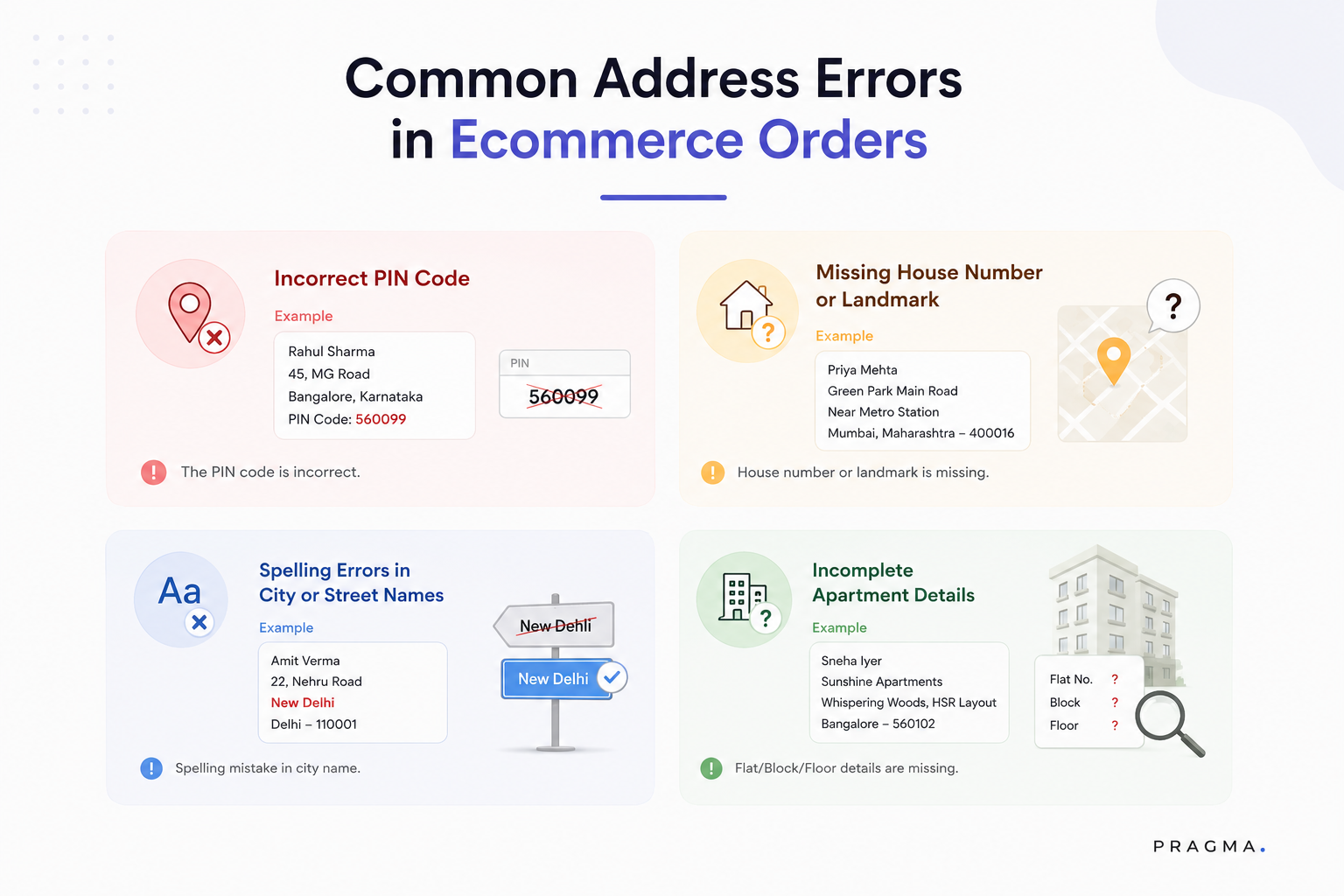
Knowing the types of address errors helps D2C brands recognise the benefits of using address validation and pinpoint the problems in their operations:
Incorrect PIN Code
India's PIN code mistakes account for about 30% of address-related delivery problems. These mistakes often occur when customers:
- Mix up numbers: When they type 560001 instead of 560010 (very common when similar numbers)
- Use old PIN codes: After the customer has moved to a new place, but did not change the PIN (remembered from previous addresses).
- Use similar codes: For areas with similar codes.
- Autocorrect on mobile devices: Sometimes, smartphones may change correct codes to "recognised" words.
India's PIN code system further complicates this issue: a single-digit change can refer to different districts or even different states.
Missing House Number or Landmark
Cities, especially fast-growing ones such as Bangalore, Gurgaon and Pune, lack clear house numbering systems. Customers often fail to provide important information such as:
- Building numbers or names: This happens especially in apartment buildings and offices.
- Floor numbers: Providing floor numbers is essential for buildings with multiple floors, where there are no lifts or clear signs.
- Wing or block numbers: Typical for large apartment buildings
- Local landmarks: When providing local landmarks may be the only way to find addresses in older parts of towns and cities, and the customer skips it.
This is an issue faced particularly in India, where landmark addressing is widespread but not uniform across regions and cities.
Spelling Errors in City or Street Names
Different regional languages and transliterations have contributed to many spelling errors. Some of the common issues include:
- Multiple spellings: Bangalore vs Bengaluru, Bombay vs Mumbai
- Autocorrect: Mobile devices convert correct local names to "dictionary words."
- Phonetic spellings: When there are different ways to spell the same word in English.
- Old vs new names: People using names that are not commonly used anymore.
Such variations pose a challenge for brands operating on a national level with customers in different regions.
Incomplete Apartment Details
Increasing urbanisation and apartment living in India lead to delivery issues due to missing apartment details:
- Lack of apartment numbers
- Confusion about the tower or the phase
- Lack of society or complex names
- Incomplete contact details
Gated communities and high-security apartment buildings are increasingly common and make complete apartment details essential to delivery success.
What are the Benefits of E-commerce Address Validation?
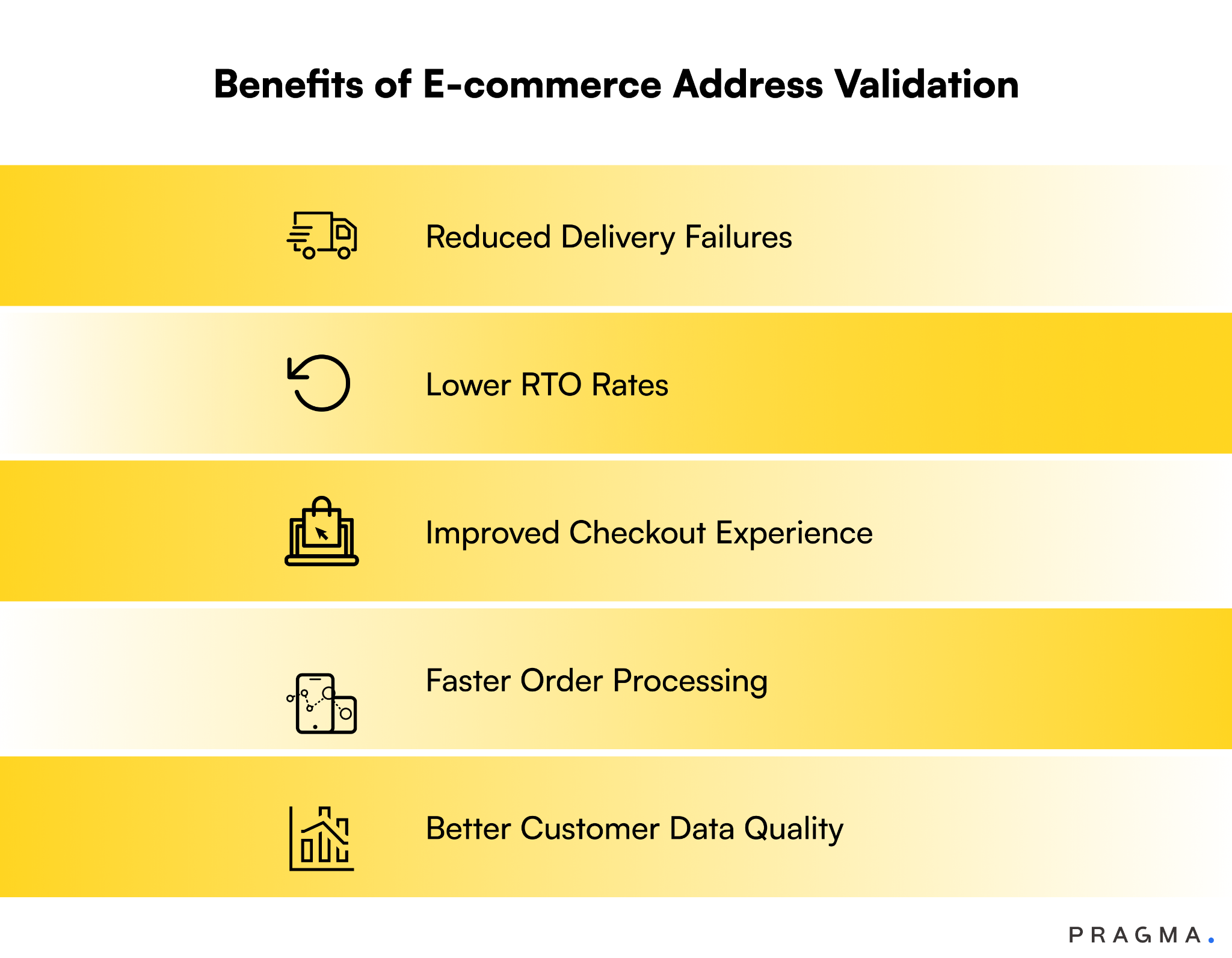
E-commerce address validation provides numerous benefits to e-commerce brands.
Let us break it down how it does!
Reduced Delivery Failures
Effective address validation can lower delivery failure rates by 40-60%. A report has found that companies using real-time validation experience an immediate boost in first-time delivery success.
It's not just about successful delivery:
- Improved customer satisfaction: It enables brands to provide a good customer experience when their customers receive orders as expected.
- Fewer customer service queries: Brands get fewer "where's my order" calls.
- Improved courier relationships: It strengthens the relationship between delivery partners and brands when they deliver products at the right time.
- Improved brand perception: Successful deliveries create a good brand image in the market.
For D2C brands, this reliability means higher customer retention and repeat purchase.
Lower RTO Rates
RTO rates are directly affected by address validation, with brands seeing average RTO improvements between 45-60% when using a complete address validation solution.
This is especially important for D2C brands in which RTO rates impact revenue, profitability and sustainability.
The RTO reduction benefits include:
- Better cash flow: With accurate address validation, D2C brands reduce failed deliveries and RTOs, ensuring less money is locked in unsold returned inventory.
- More efficient inventory control: Fewer delivery failures mean smoother order fulfilment, helping brands maintain predictable stock movement and turnover.
- Simpler operations: By minimising returns due to incorrect addresses, teams spend less time managing reverse logistics and customer complaints.
- Better profitability: Lower RTO costs and improved delivery success directly strengthen unit economics and overall margins.
These benefits are common across both product lines and customer segments among companies using Pragma RTO Suite.
Improved Checkout Experience
Automated address entry decreases checkout time and cart abandonment.
Research suggests that smart address autocomplete can shorten checkout time by 30-40%, resulting in increased conversions and customer retention.
The user experience improvements include:
- Accelerates checkout: Address validation auto-fills and formats information, saving time and helping direct-to-consumer (D2C) brands reduce cart abandonment.
- Reduced mental strain: Customers don't have to worry about the exact format of their address, making the purchase process more pleasant.
- Mobile-friendliness: Simpler, quicker entry on mobile devices helps brands reach and convert the ever-increasing mobile demographic.
- Reduces errors: Instant feedback identifies and corrects errors, preventing failed shipments rather than fixing them after the fact.
- Improved customer experience: E-commerce address validation makes it easier for D2C brands to provide a fast, efficient and error-free checkout experience.
Faster Order Processing
Validated addresses remove manual address verification processes from order management.
This enables D2C brands to speed up the order processing process and reallocate valuable human resources to more strategic work, such as customer engagement and growth initiatives.
This helps brands in the following ways:
- Automatic order allocation: Orders are routed to the right warehouse.
- Less manual effort: Fewer hours wasted checking and correcting addresses.
- Quick shipping label printing: This works seamlessly with shipping systems.
- Better SLA adherence: Quicker processing for improved delivery SLAs.
Better Customer Data Quality
Validated address data improves the quality of customer data. This improvement has several effects:
- Targeting advertising campaigns: Demographic and geographic segmentation is more precise.
- Supply chain management: Delivery route planning and cost estimation are enhanced.
- Customer service support: The team has up-to-date data on order status and support.
- Analytics and business intelligence: Location insights become more valuable.
Address Validation vs Address Verification
You may have heard these two terms- address validation and address verification.
These sound the same, but there is a major difference between the two.
Let us clarify it!
Where Address Validation Fits in the E-commerce Workflow?
In an e-commerce business, address validation is not a standalone step; it's a critical layer embedded across the entire order journey.
Checkout Page
It starts at the checkout page, where address validation software operates in real time to suggest, standardise and validate customer addresses as they are entered.
This is the first and most crucial point of address validation, as it prevents inaccurate or incomplete address data from being entered in the first place, simplifying the process for the customer, while enhancing the quality of data for the retailer.
Order Management System
After the transaction is complete, address validation also helps in the order management system (OMS).
Here, validated addresses are cross-checked and formatted to align with courier and logistics requirements, ensuring that there are no discrepancies when orders move to fulfilment.
Logistics and Delivery Systems
Address data is used to streamline label printing, route optimisation and last-mile delivery during the shipping and fulfilment process.
This helps decrease the number of failed deliveries, delays, and return-to-origin (RTO) situations, which are significant cost factors for D2C brands.
Customer Account Creation
Address validation helps in the following ways:
- Only accurate and deliverable addresses are stored
- Faster checkout through accurate autofill in future orders
- Consistent customer data across multiple transactions
- Improved support and communication due to reliable address records
How Address Validation Helps Reduce RTO Orders?
Return-to-Logistics, or say RTOs, are one of the biggest challenges for e-commerce industries nowadays. Most of the orders are marked as RTO, not because of product issues, but due to address-related issues.
Address validation plays a critical role in solving this problem at the source.
Verifying and validating the customer's address at the time of checkout helps e-commerce brands to improve delivery success rates and reduce failed deliveries.
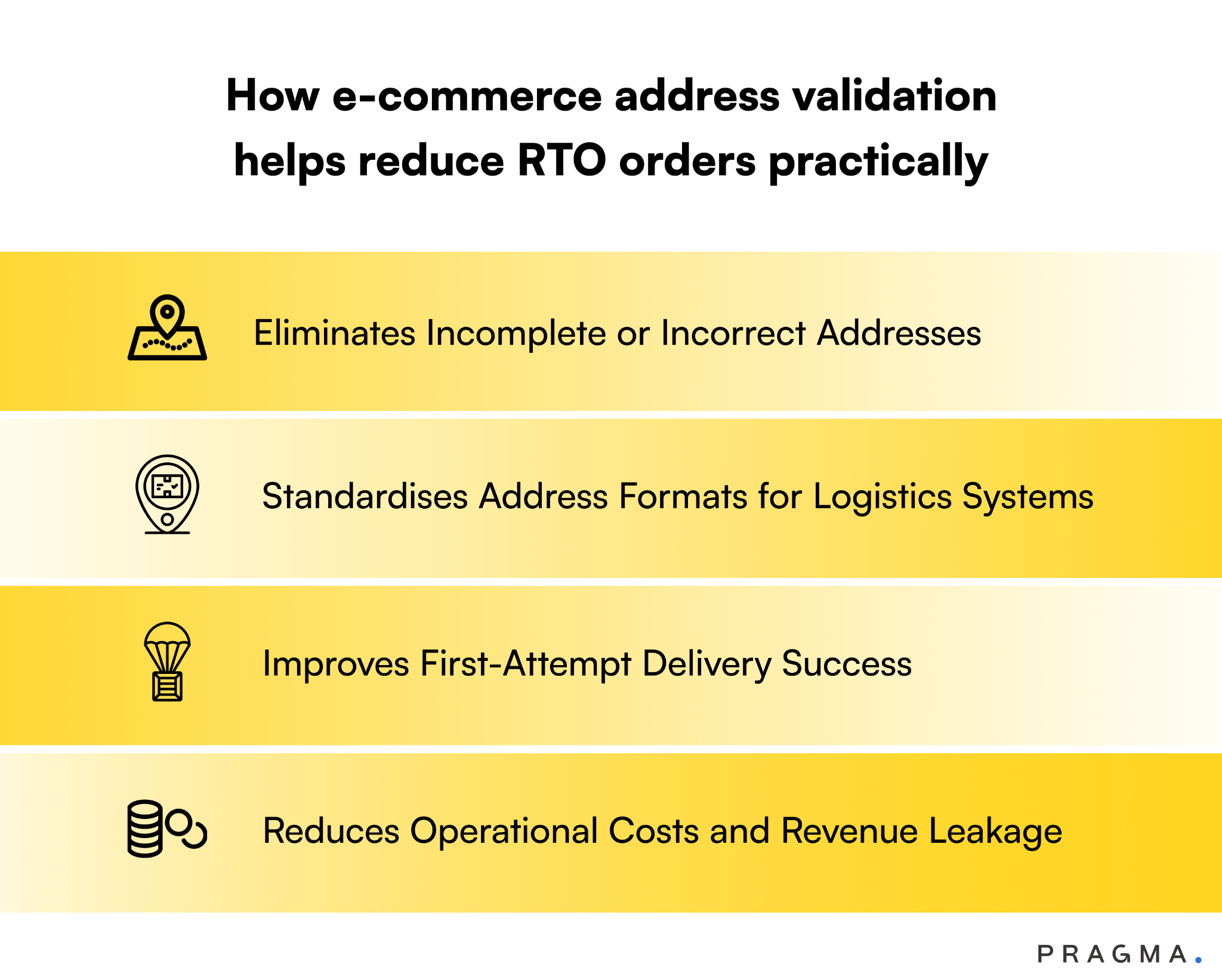
Here is how e-commerce address validation helps reduce RTO orders practically:
1. Eliminates Incomplete or Incorrect Addresses
Many times this happens that the customer, while typing their address, forgets to enter a digit in the house number or makes a wrong entry, gives incorrect pin codes or vague addresses.
Such orders often result in RTOs, but address validation tools check and correct these mistakes at the time of checkout itself, preventing orders from turning into major losses for the business.
2. Standardises Address Formats for Logistics Systems
Different courier partners require addresses in structured formats. Address validation converts raw customer input into a clean, standardised format that is easy for logistics systems to process.
This makes it easy for delivery partners to fulfil the delivery correctly without any mistakes or confusion.
3. Improves First-Attempt Delivery Success
RTO orders are marked by delivery partners after making two to three delivery attempts.
But, when the delivery partner has the clear and right address, they can make a successful delivery in first-attempt. This ultimately reduces the number of RTOs.
4. Reduces Operational Costs and Revenue Leakage
Every RTO order leads to reverse logistics costs, inventory handling, and potential loss of sales.
By minimising address-related delivery failures, businesses can protect margins and improve overall operational efficiency.
This is how address validation helps e-commerce businesses to prevent RTOs. At the same time, leading solutions like Pragma RTO Suite take this a step further by combining address validation with intelligent RTO risk management.
It analyses the orders within 200ms of placement, on the basis of 300+ parameters to identify & flag fraudulent and risky orders in real-time.
By analysing customer behaviour, traffic sources, and interaction patterns, it can flag impulse buyers, fake orders and orders made by bots.
Also, orders from temporary residences such as hostels, hotels or high-risk pincodes are flagged automatically, ultimately saving the brands from orders that can turn into RTOs in the future.
Key Features to Look for in Address Validation Tools
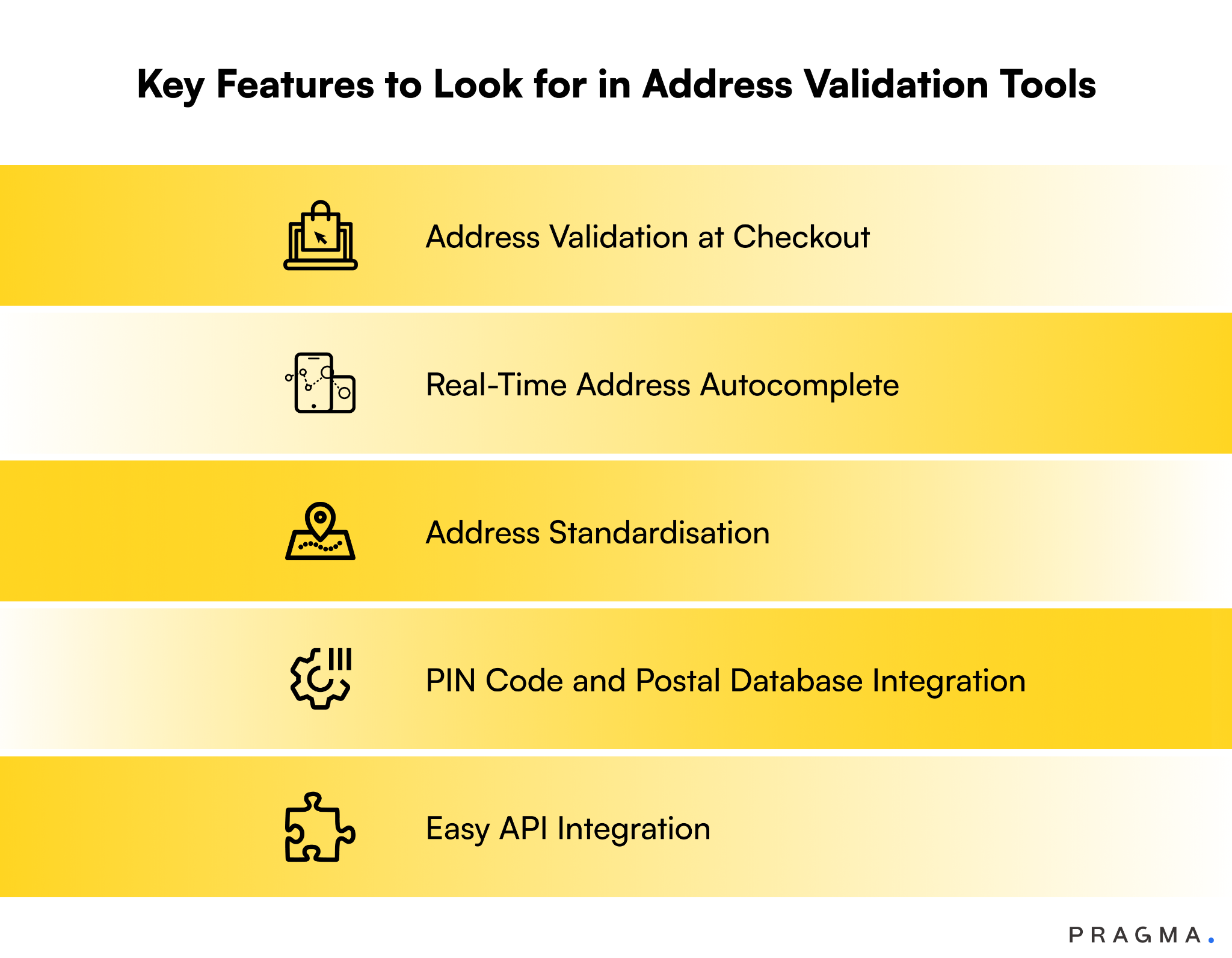
When selecting address validation tools, every brand must focus on those that improve data quality and delivery success.
Here are some points that every D2C brand should look for in an address validation tool:
Address Validation at Checkout
The tool should check addresses right at the time as customers type them in.
This helps find mistakes like PIN codes, house numbers that are not there or places that do not exist before the order is confirmed.
For D2C brands, it will aid in fewer failed deliveries and a smoother checkout experience.
Real-Time Address Autocomplete
When a customer starts typing their address, the autocomplete feature helps by giving them a list of addresses that have already been checked for mistakes.
This makes things easier for them because it saves time when they are checking out.
This ultimately helps the e-commerce brands from getting order placement from wrong addresses, leading to save efforts and revenues.
Address Standardisation
A good solution should turn customer input into a neat and organised format.
This helps make sure that order management systems, warehouse operations and courier partners can all work together smoothly.
When they do, it reduces delays and mistakes when orders are being fulfilled.
This is important for order management systems, warehouse operations and courier partners to work efficiently.
PIN Code and Postal Database Integration
The tool needs to do more than just check that addresses are correct. It should provide information about each postcode, like the address and whether brands can deliver to that place.
This information is really helpful for the people who deliver things and for our logistics team.
This helps logistics teams and delivery partners accurately locate customers and improve first-attempt delivery success.
Easy API Integration
An address validation solution should be easy to integrate with the existing technology.
This means your address validation solution should be compatible to use with your checkout page, your app, your customer relationship management system or your order management system.
What are the Various Challenges of Address Validation in India?
India poses some specific challenges to address validation, which are as follows:
Unstructured and Inconsistent Address Formats
Indian addresses are usually written in a casual way with no specific structure.
People may leave out some information, use shortcuts for words or write them in ways that make it hard for computers to check if they are correct and use them properly.
Dependence on Landmarks Instead of Exact Details
In many cases, it happens that people add an address like, near the temple or near this building.
This makes it a problem for validation systems to check addresses. It can cause problems when it comes to delivering things to the place.
This means that deliveries can take longer and be less efficient. Many addresses, like these, can lead to delivery failures because of insufficient information.
Inaccurate or Mismatched PIN Codes
People often put in PIN codes that do not match the city or area they live in. This causes problems for delivery partners.
Also, India's PIN code system is highly complex and fragmented. The same house numbers and localities are present in different pin codes.
This means that a single-digit mistake in the pin code can make the order shipped to a different locality, which is far apart from the actual address, leading to failed deliveries and RTOs.
Best Practices for Implementing E-commerce Address Validation
- Implement Progressive Validation: To do validation, the way brands should start with the basics and then add more features on the basis of needs and customer feedback.
- Maintain Database Currency: Every D2C e-commerce brand should keep its validation databases up to date all the time for things that are changing fast.
- Provide Clear Error Messages: When the validation system finds a problem, it should give the customer a message that tells them exactly what to do to fix their address.
- Test Across Devices: Brands should test the validation system on devices like computers, phones and tablets to make sure it works perfectly everywhere.
- Monitor Performance Metrics: Every e-commerce brand should keep an eye on how the system is doing by looking at things like how often it gets the address right, how many people can complete checkout, and how many deliveries are successful. This helps them see if it is worth the money they are spending.
Final Thoughts
So, things are now pretty much cleared. By taking into focus the above discussion, we can say that address validation is the most necessary element that every e-commerce brand must focus on.
Getting the right e-commerce address validation tool will help brands in more successful deliveries, fewer RTOs and less loss of revenues.
Solutions like Pragma RTO Suite enable D2C brands to combine address validation with real-time risk intelligence, helping improve delivery success and reduce RTO rates.

FAQs (Frequently Asked Questions On E-commerce Address Validation: How It Works and Why E-commerce Businesses Need It?)
1. What is address validation in eCommerce?
Address validation in eCommerce is the process of verifying and correcting customer delivery addresses to ensure they are accurate, complete, and deliverable before an order is shipped.
2. How does address validation work in eCommerce?
Address validation works by checking user-entered addresses against databases, PIN code mappings, and geolocation data to detect errors, standardise formats, and suggest corrections in real time.
3. Why is address validation important for eCommerce businesses in India?
Address validation is important in India due to inconsistent address formats, incomplete details, and high COD usage. It helps reduce failed deliveries, improve logistics efficiency, and enhance customer experience.
4. How does address validation reduce RTO in eCommerce?
Address validation reduces RTO (Return to Origin) by identifying incorrect or incomplete addresses before order confirmation, preventing shipment failures and minimising delivery reattempts.
5. What are the common address-related issues in eCommerce deliveries?
Common issues include missing house numbers, incorrect PIN codes, vague locality details, wrong city-state combinations, and unserviceable delivery locations.
6. When should address validation be implemented in the customer journey?
Address validation should be implemented during checkout, where users enter delivery details, to catch and correct errors before the order is placed.
7. Can address validation improve eCommerce conversion rates?
Yes, address validation can improve conversion rates by reducing checkout errors, speeding up form completion, and building user confidence through accurate delivery estimates.
8. What features should an eCommerce address validation system include?
Key features include real-time validation, auto-suggestions, PIN code verification, geolocation support, serviceability checks, and integration with checkout and logistics systems.
9. How does address validation integrate with logistics and delivery systems?
Address validation integrates with logistics systems by ensuring only serviceable and accurate addresses are passed to delivery partners, improving first-attempt delivery success rates.
10. Is address validation necessary for both prepaid and COD orders?
Yes, address validation is important for both prepaid and COD orders, but especially critical for COD, where incorrect addresses often lead to higher RTO rates and operational losses.
Talk to our experts for a customised solution that can maximise your sales funnel
Book a demo
.png)
.png)
.png)