

For most Indian D2C brands, returns do not end when a parcel reaches the warehouse. That is where the most fragile part of the operation begins. Returned inventory often sits in limbo—awaiting quality checks, misclassified against SKUs, or delayed in financial reconciliation. Each manual handoff increases the risk of shrinkage, accounting mismatches, and delayed resale.
In Reconciliation of returned inventory: automating QC, SKU restock and accounting handoffs, we delve into how brands can bring structure and automation to this overlooked layer of operations. The focus is not on speed alone, but on accuracy, traceability, and clean ownership across teams. By connecting QC outcomes, SKU state changes, and finance workflows into a single operational loop, brands can unlock faster restocking, cleaner books, and fewer internal disputes.
This blog breaks down practical automation patterns, SOP design, and decision frameworks that operations, warehouse, and finance teams can implement without overengineering. The goal is simple: ensure every returned unit is inspected, accounted for, and actioned—without guesswork.
Why does returned inventory reconciliation break down?
Fragmented ownership across warehouse, ops, and finance teams
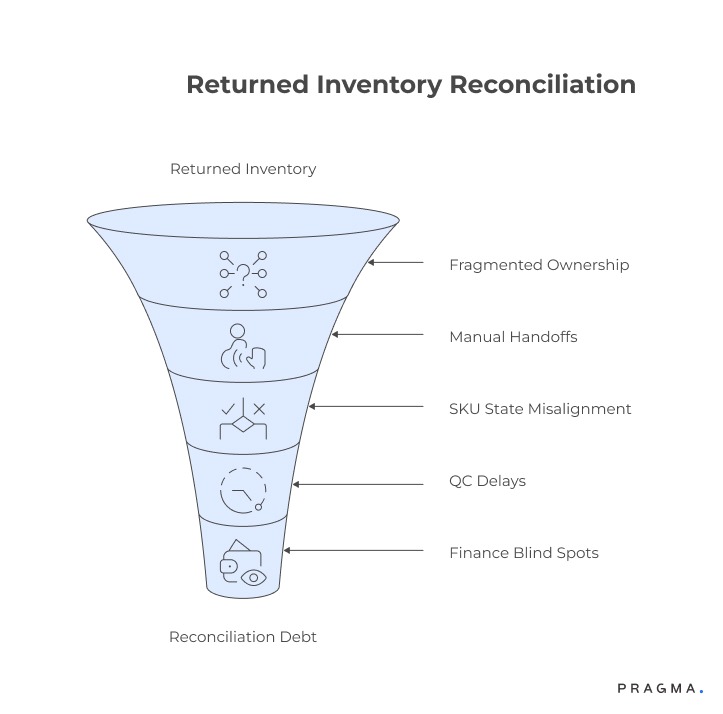
Returned inventory issues rarely stem from a single failure. They emerge when multiple teams touch the same unit, but no system clearly defines who owns the next action. QC teams focus on physical condition, warehouse teams on binning, and finance teams on refunds or write-offs—often in isolation.
When these handoffs are manual, the same SKU can exist in multiple states across systems. A unit may be marked “returned” in OMS, “pending QC” in WMS, and already refunded in finance. Over time, these inconsistencies accumulate, creating stock mismatches and reconciliation debt that surfaces only during audits or stock counts.
Common failure points in return reconciliation
Manual processes introduce predictable weaknesses that scale poorly with volume.
QC delays and ambiguity
QC is often batch-driven instead of event-driven. Returns wait for inspection, and during this window, the SKU has no clear status. This delays both restocking and accounting decisions.
SKU state misalignment
Without defined state transitions, the same item can be counted as sellable in one system and unsellable in another, leading to overselling or dead stock.
Finance blind spots
Refunds and write-offs are triggered without confirmed QC outcomes, creating accounting entries that do not reflect physical reality.
How should QC outcomes be structured for automation?
Turning subjective inspections into deterministic decisions
Quality checks are often treated as qualitative judgments. For automation to work, QC outcomes must be codified into discrete, machine-readable states that downstream systems can act on.
Instead of free-text notes or photos alone, each inspection should resolve into a limited set of outcomes that drive SKU and accounting logic.
Standard QC outcome taxonomy
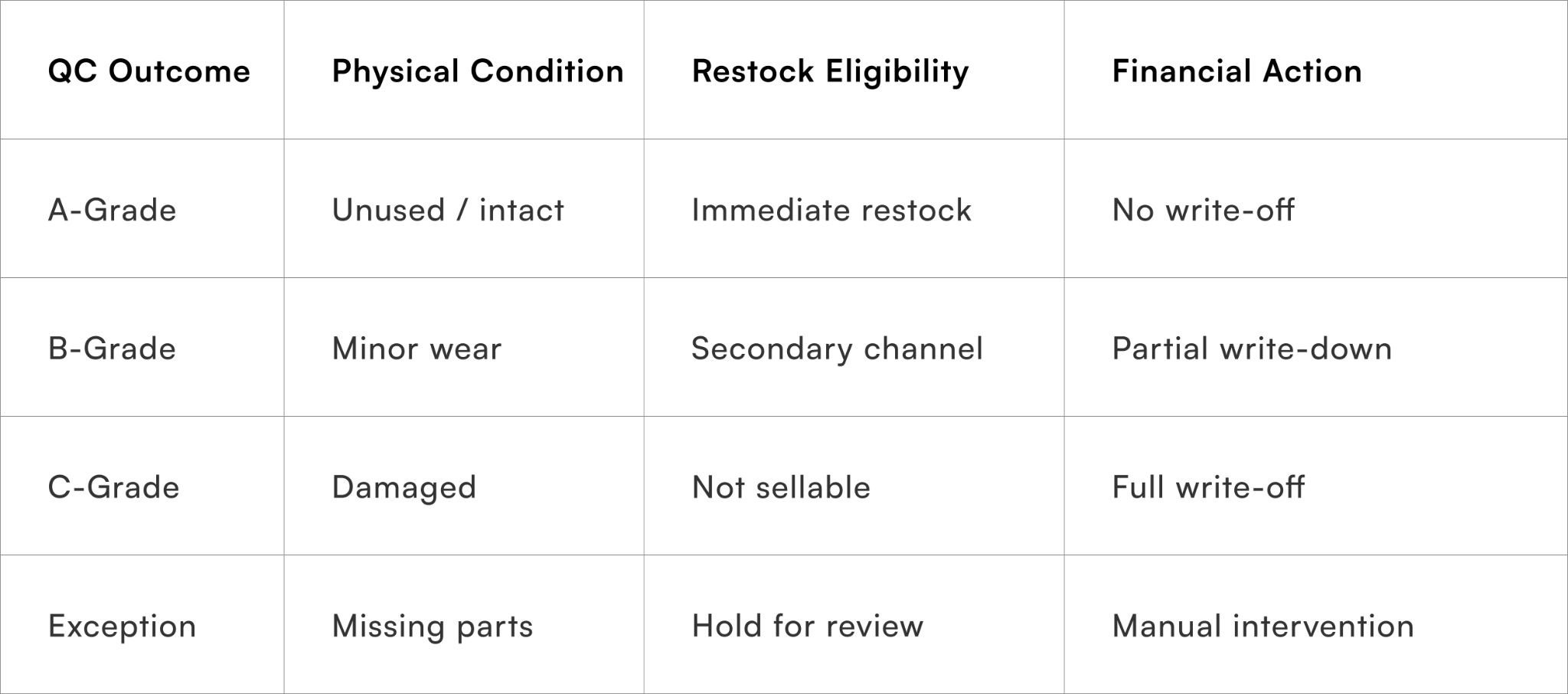
This structure reduces ambiguity. Every return exits QC with a clear operational and financial path, eliminating back-and-forth between teams.
Why this matters operationally
Clear QC states allow automation engines to trigger SKU updates, inventory movements, and accounting entries without waiting for human intervention.
What SKU state transitions must be automated?
Ensuring inventory accuracy across systems
Returned inventory should move through predefined SKU states, with each transition logged and time-stamped. This creates a single source of truth that both operations and finance can rely on.
Recommended SKU lifecycle for returns
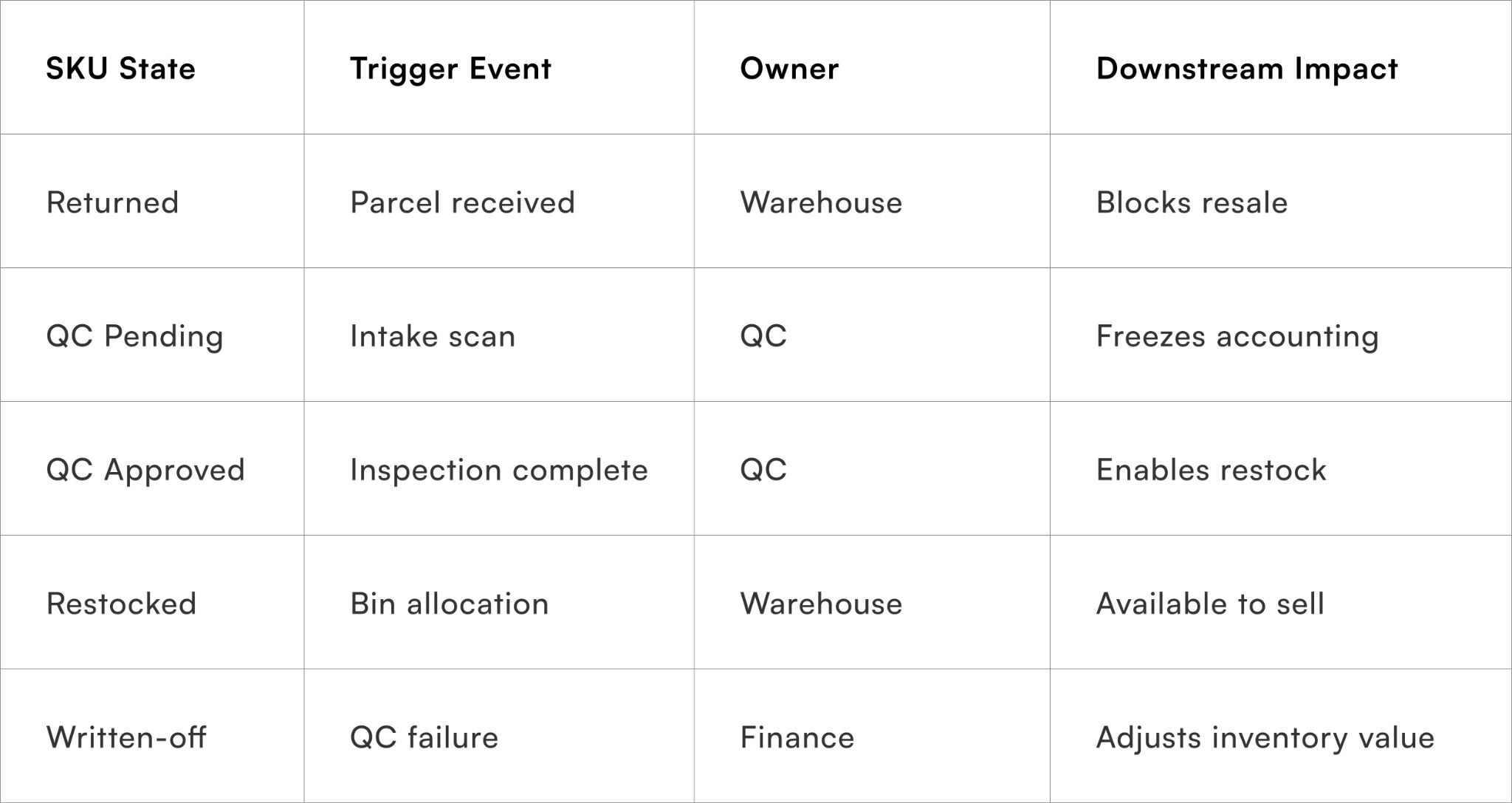
Each transition should be system-triggered, not manually updated across tools. This prevents silent state drift and ensures every team sees the same reality.
Traceability as a control mechanism
Time stamps and ownership at each stage make it easy to identify bottlenecks, audit discrepancies, and process violations without manual investigation.
How do automated handoffs reduce reconciliation errors?
Replacing human coordination with rule-based triggers
Handoffs fail when teams rely on emails, spreadsheets, or verbal confirmations. Automation replaces these with deterministic triggers tied to events, not people.
When QC marks a unit as A-Grade, the system should automatically:
- Update SKU availability in OMS/WMS
- Notify finance that no write-off is required
- Release the unit for resale
Similarly, when a unit is marked C-Grade, accounting adjustments should trigger instantly, not weeks later during monthly closing.
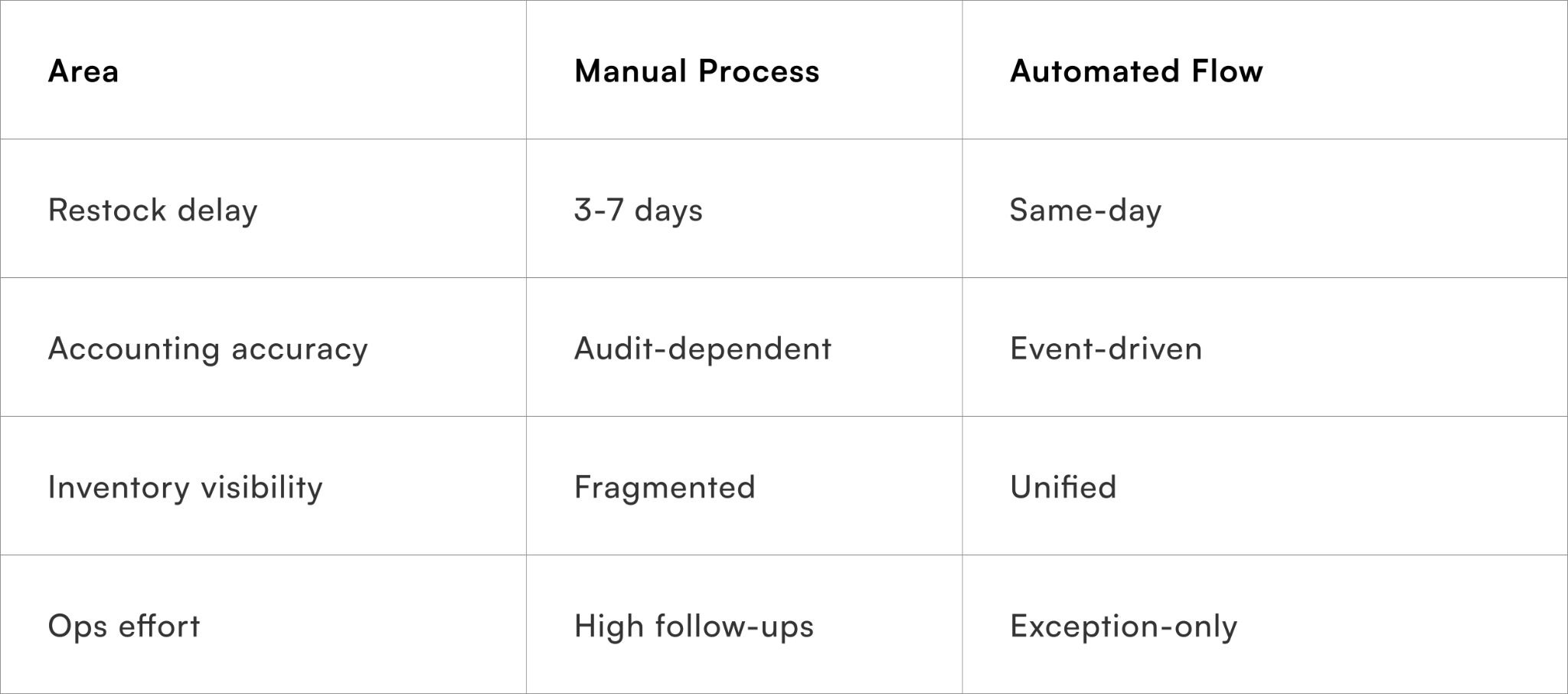
Manual vs automated reconciliation impact
Control without micromanagement
Automation shifts human effort from chasing updates to handling true exceptions, improving both speed and accountability.
How should accounting handoffs be designed for returned inventory?
Aligning physical outcomes with financial entries in real time
Accounting teams often receive return data late, incomplete, or disconnected from QC reality. This results in provisional entries, reversals, and manual reconciliations during month-end closes. Automation works only when finance handoffs are triggered by validated physical outcomes, not assumptions.
Returned inventory should not touch accounting systems until QC resolves the unit’s fate. Once that happens, financial actions can be deterministic and timely.
Mapping QC outcomes to accounting actions
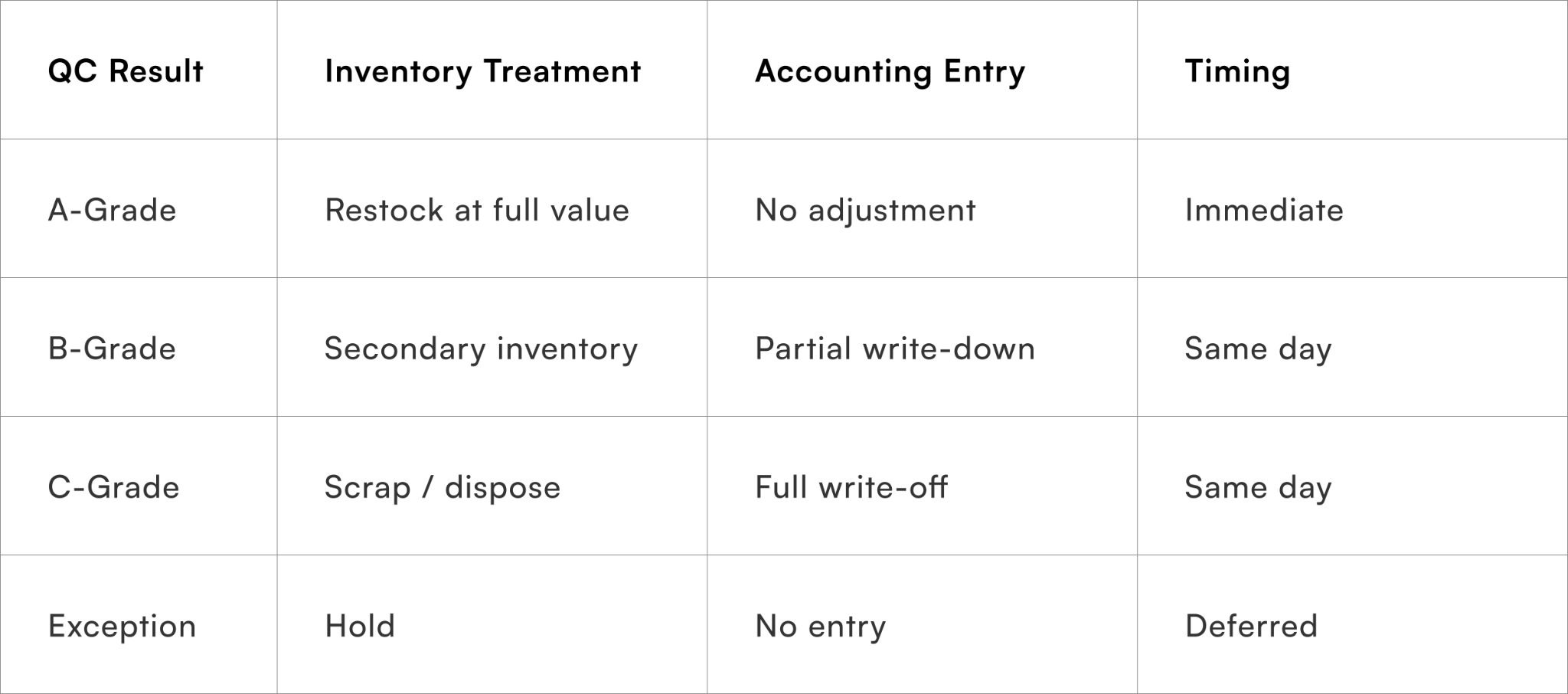
This structure prevents early refunds or write-offs that later need correction. Finance works off confirmed signals, not estimates.
Why timing matters
Same-day accounting updates reduce accrual gaps, improve margin visibility, and make weekly P&L reviews more reliable.
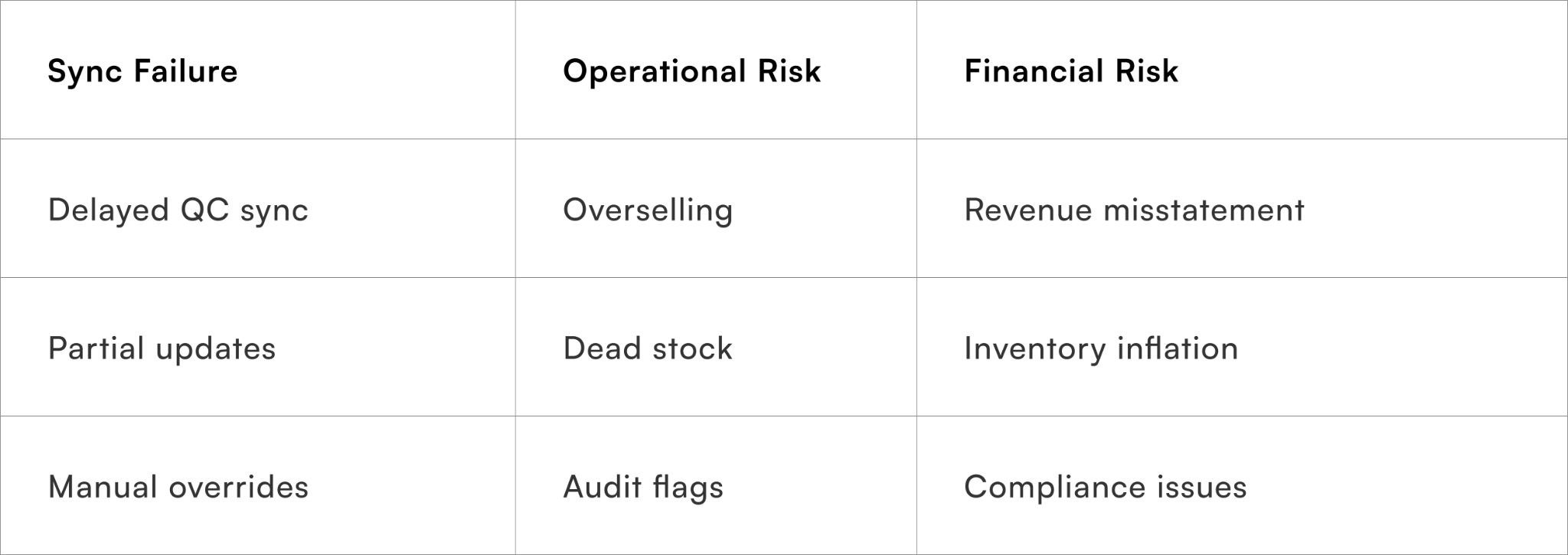
What role does WMS–OMS synchronisation play?
Preventing phantom stock and overselling
Many reconciliation failures occur because OMS and WMS treat returns differently. OMS may mark a return as “completed” once received, whilst WMS still shows it as unprocessed stock. This gap leads to phantom availability or blocked inventory.
Required synchronisation checkpoints
Intake confirmation
The moment a return is scanned at the warehouse, both systems should agree that the unit is unavailable for sale.
QC resolution
Once QC is complete, SKU availability, condition, and location should update simultaneously across OMS and WMS.
Final disposition
Whether restocked, scrapped, or diverted, the final state must be reflected everywhere before finance closes the loop.
How can exception handling be automated without losing control?
Designing guardrails for edge cases
Not every return fits neatly into predefined buckets. Missing items, tampered packaging, or mismatched SKUs require human review. The goal is not to eliminate exceptions, but to isolate them.
Exception-first design principles
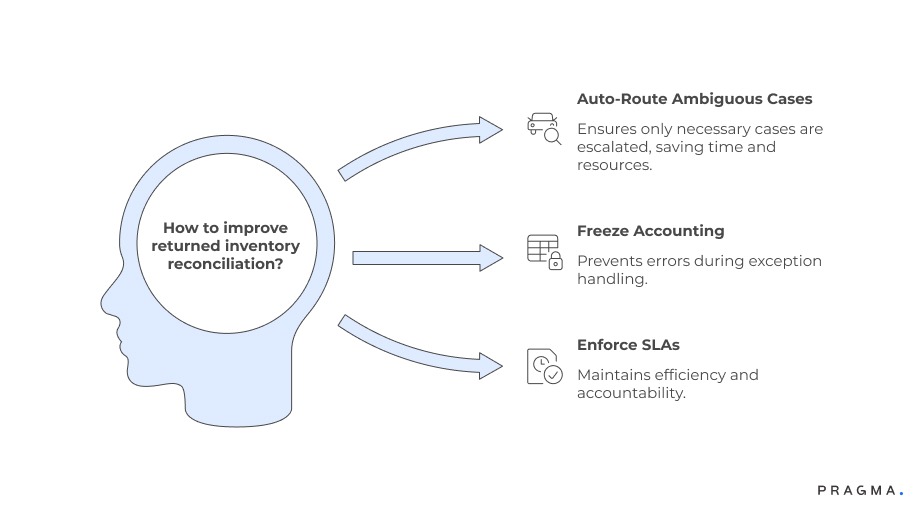
- Auto-route only ambiguous cases to manual queues
- Freeze accounting until resolution
- Enforce SLA-based escalation
Exception visibility table
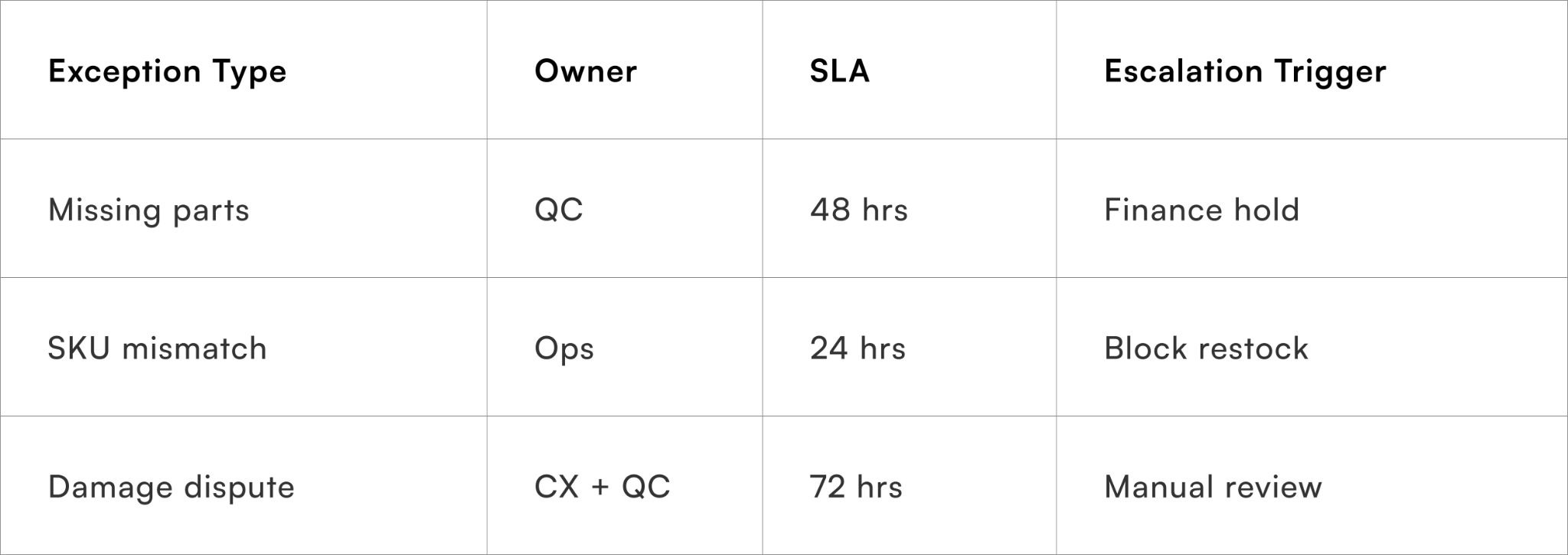
By making exceptions visible and time-bound, teams avoid silent pile-ups that distort inventory and books.
What data should ops leaders monitor weekly?
Operational signals that indicate reconciliation health
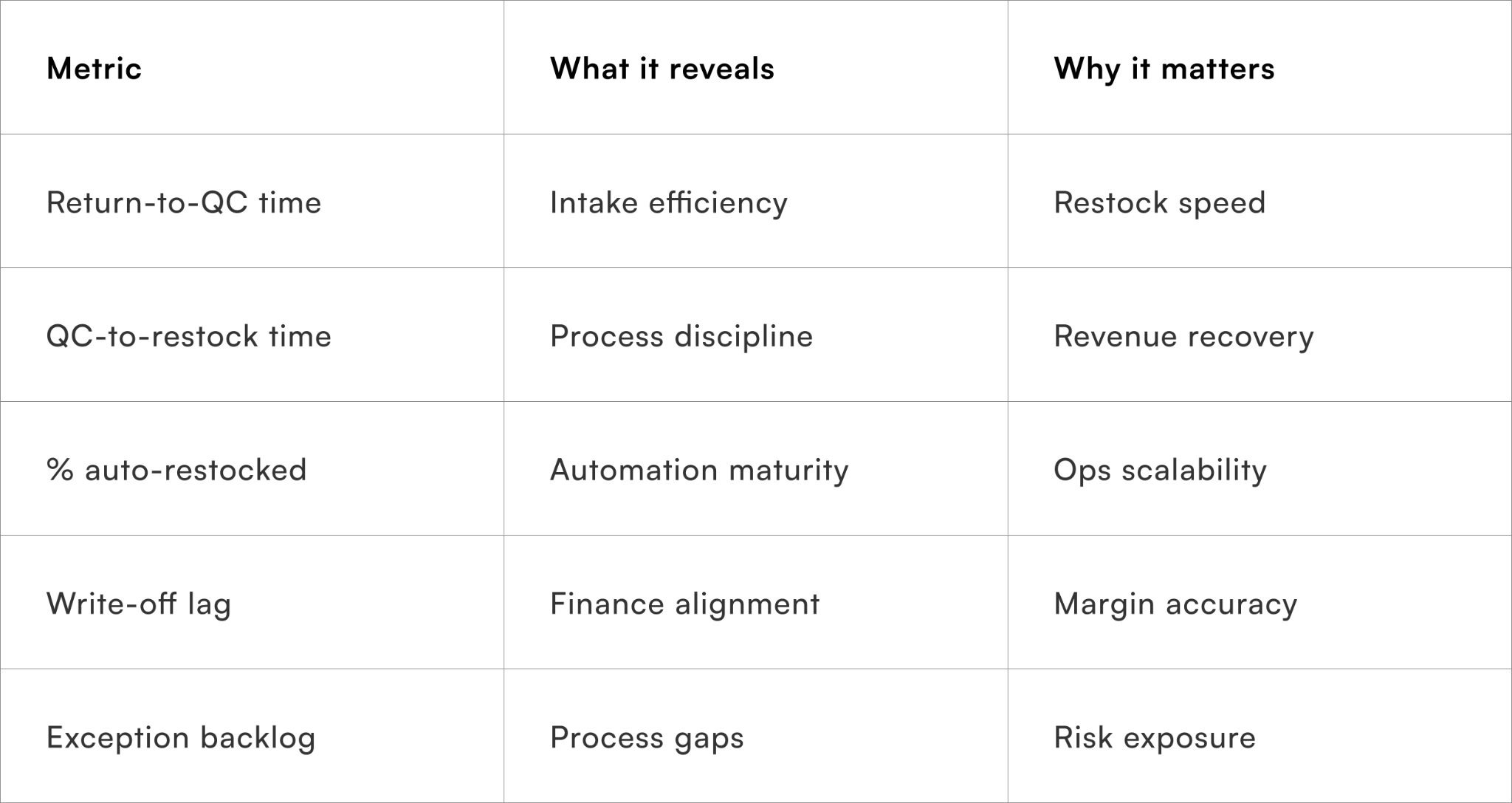
Automation only works when leaders monitor the right signals. Weekly reviews should focus on flow health, not just totals.
Core reconciliation metrics
Interpreting patterns
Rising exception backlogs or delayed write-offs usually signal upstream QC ambiguity or system sync failures, not finance errors.
How does automation change team ownership models?
From task execution to outcome accountability
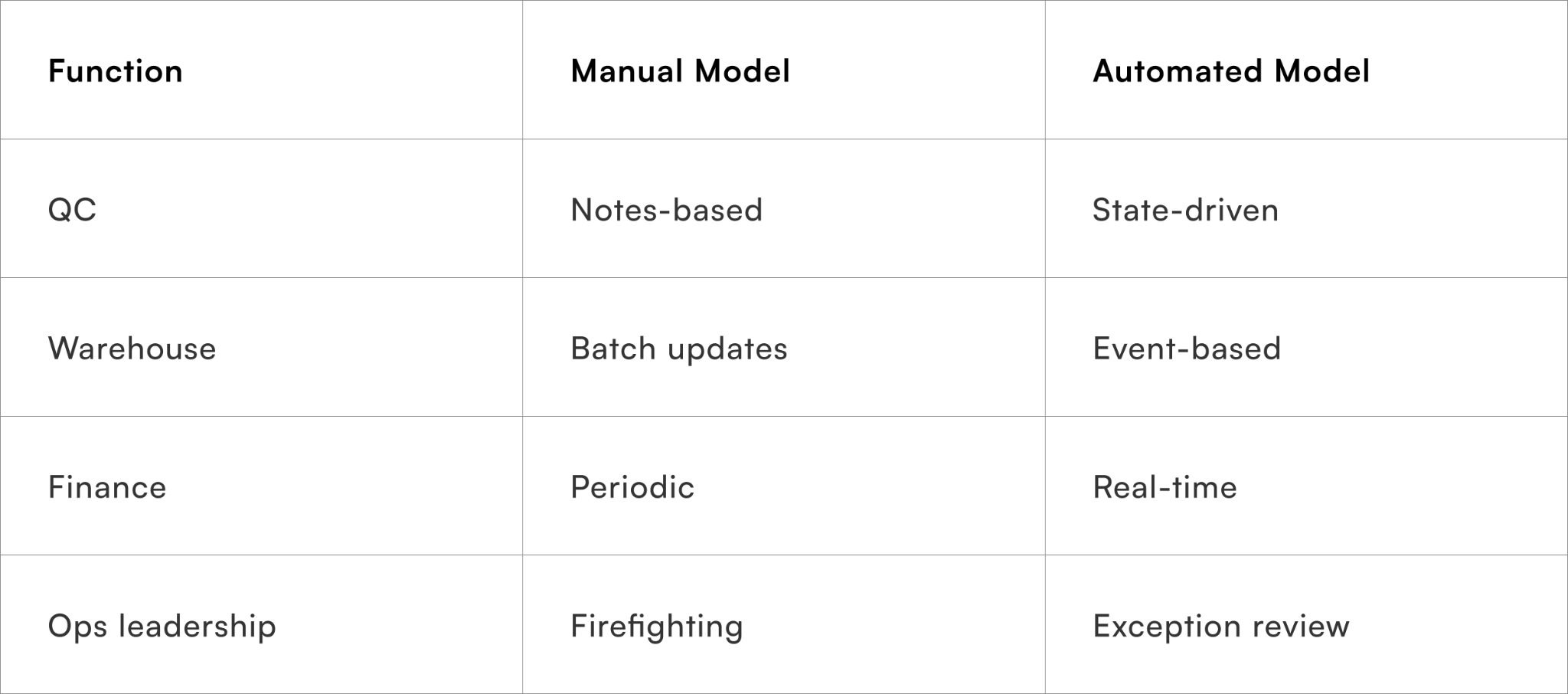
Manual reconciliation forces teams to chase tasks. Automated flows shift ownership to outcomes. QC owns inspection accuracy, warehouse owns physical movement, and finance owns timely recognition—without overlap.
Clear ownership reduces conflict during audits and removes ambiguity when discrepancies surface.
Ownership before vs after automation
Cultural impact
Teams stop negotiating “who missed what” and start focusing on improving flow efficiency.
Quick Wins
Stabilising return reconciliation without large system overhauls
Week 1: Lock QC outcomes and SKU states
Define 4–5 non-negotiable QC outcomes and map each to a clear SKU state and financial action. Remove free-text decisions wherever possible.
Expected result: Fewer ambiguous returns and faster downstream decisions.
Week 2: Enforce event-based handoffs
Trigger SKU and accounting updates only after QC completion. Block manual overrides unless tagged as exceptions with ownership and SLA.
Expected result: Reduced mismatches between physical stock and books.
Week 3: Isolate exceptions deliberately
Create a separate queue for exceptions with weekly review cadence. Track ageing and resolution reasons explicitly.
Expected result: Cleaner main flow and better visibility into true problem cases.
Week 4: Review reconciliation health metrics
Track return-to-QC time, QC-to-restock lag, write-off delays, and exception backlog. Use these to prioritise fixes.
Expected result: Faster restocking, fewer audit surprises, and improved margin clarity.
To Wrap It Up
Returned inventory is not just an operational problem; it is a financial and trust issue. Automation brings discipline by tying QC outcomes, SKU states, and accounting actions into a single, traceable flow.
This week, define clear QC outcomes and block any accounting action until physical inspection is resolved.
Over time, focus on reducing exceptions, tightening event-based handoffs, and reviewing reconciliation metrics regularly. Continuous refinement here directly improves restock speed, margin accuracy, and audit readiness.
For D2C brands seeking tighter return reconciliation, Pragma’s Returns & Inventory Intelligence platform provides automated QC workflows, SKU state orchestration, and finance-ready handoffs that help brands cut restock delays by up to 40% and reduce reconciliation errors materially.

FAQs (Frequently Asked Questions On Reconciliation of returned inventory: automating QC, SKU restock and accounting handoffs)
1. Why is returned inventory reconciliation so error-prone?
Because multiple teams touch the same unit without shared state definitions, causing delays, mismatches, and accounting gaps.
2. Should refunds wait until QC is complete?
In most cases, yes. Premature refunds create financial entries that may not match the physical outcome of the return.
3. Do all returns need detailed QC?
No. Low-risk categories can follow lighter checks, but outcomes must still resolve into defined states.
4. How do automated handoffs help finance teams?
They ensure accounting entries are triggered by validated physical events, not assumptions or delayed reports.
5. What causes exception backlogs to grow?
Ambiguous QC rules, missing ownership, and lack of SLA-based escalation.
6. Can this work without a new WMS or OMS?
Yes. Clear state definitions and disciplined triggers can deliver significant gains before deeper tooling changes.
7. How often should reconciliation metrics be reviewed?
Weekly for operations control and monthly for finance and leadership alignment.
Talk to our experts for a customised solution that can maximise your sales funnel
Book a demo


.png)