

A normal customer sees different brands in their day-to-day life, maybe through ads on television, posters, shops or other marketing efforts.
But the question is, does he remember all the brands that he went through?
The answer is no, a customer cannot remember all the brands with a single view or marketing effort. To get in touch with the customers regularly, it is required that e-commerce brands ping them throughout their journey.
This is possible through the marketing automation tools, which can monitor what the customers do on the site and save their tastes, and can automatically send them the appropriate message at the appropriate time.
In this blog, we will delve into the "Best Marketing Automation Tools for E-commerce in India".
What Are Marketing Automation Tools for E-commerce?
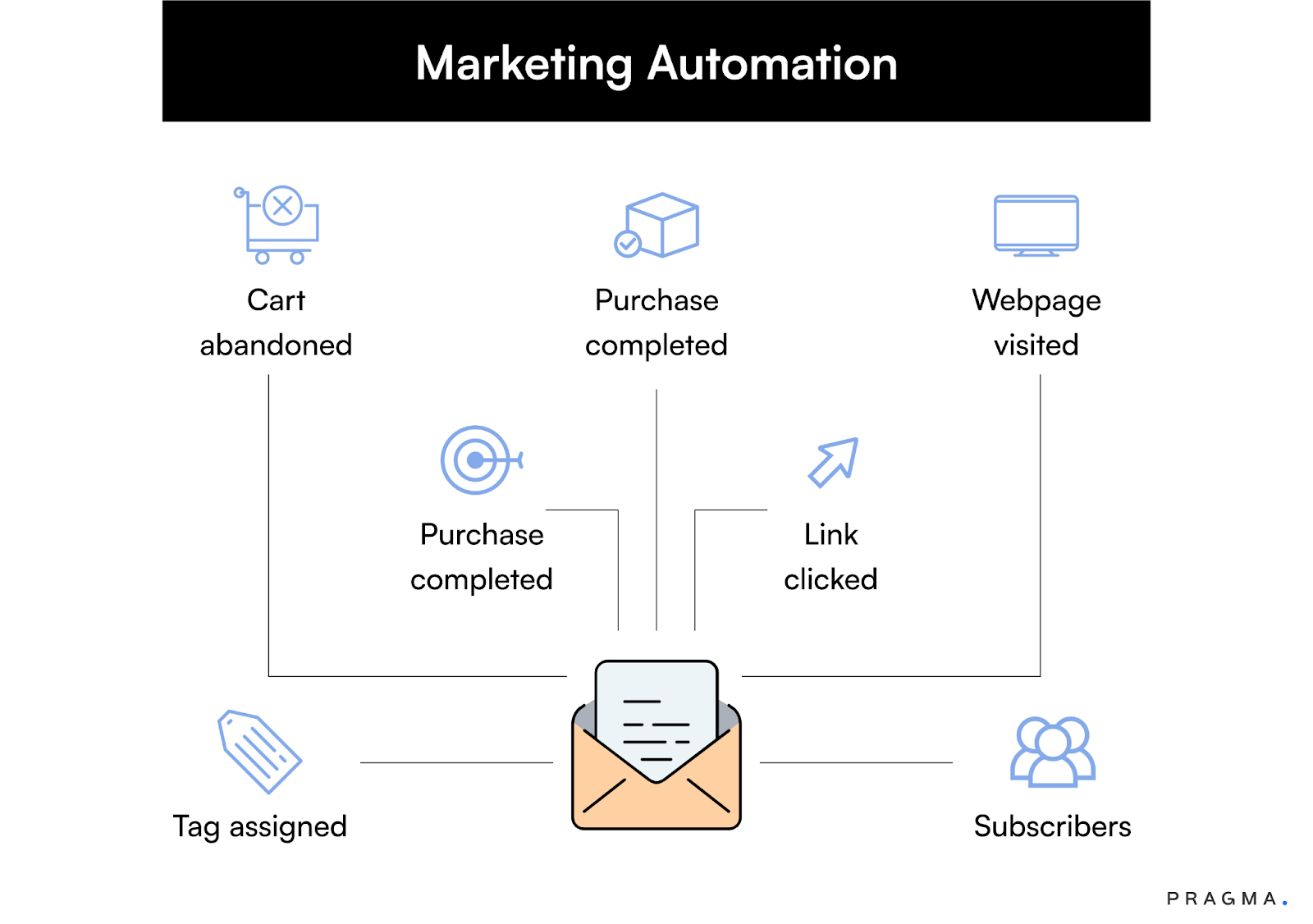
Marketing automation tools are applications designed to assist e-commerce brands in automatically sending messages to their customers depending on their behaviour.
These tools will automatically send emails or SMS to customers rather than you having to do it manually.
When a person adds a product to their cart and does not make the purchase, the automation tool will send a reminder email to them a few hours later. Or even when a person makes the first purchase, it sends them a welcome message with care instructions for their product.
Research shows that companies that are using marketing automation tools have seen a 14.5% growth in sales productivity and a 12.2% decrease in marketing expenses. Pragma Omnichannel CRM helps brands manage all these communications from a single dashboard and reduces approximately 80% of the manual work.
These tools work by:
- Monitoring customer actions on the brand's site.
- Sending personal messages according to the customer's behaviour.
- Automatic follow-ups with the customers.
- Considering the most effective messages.
Why E-commerce Brands in India Need Marketing Automation?
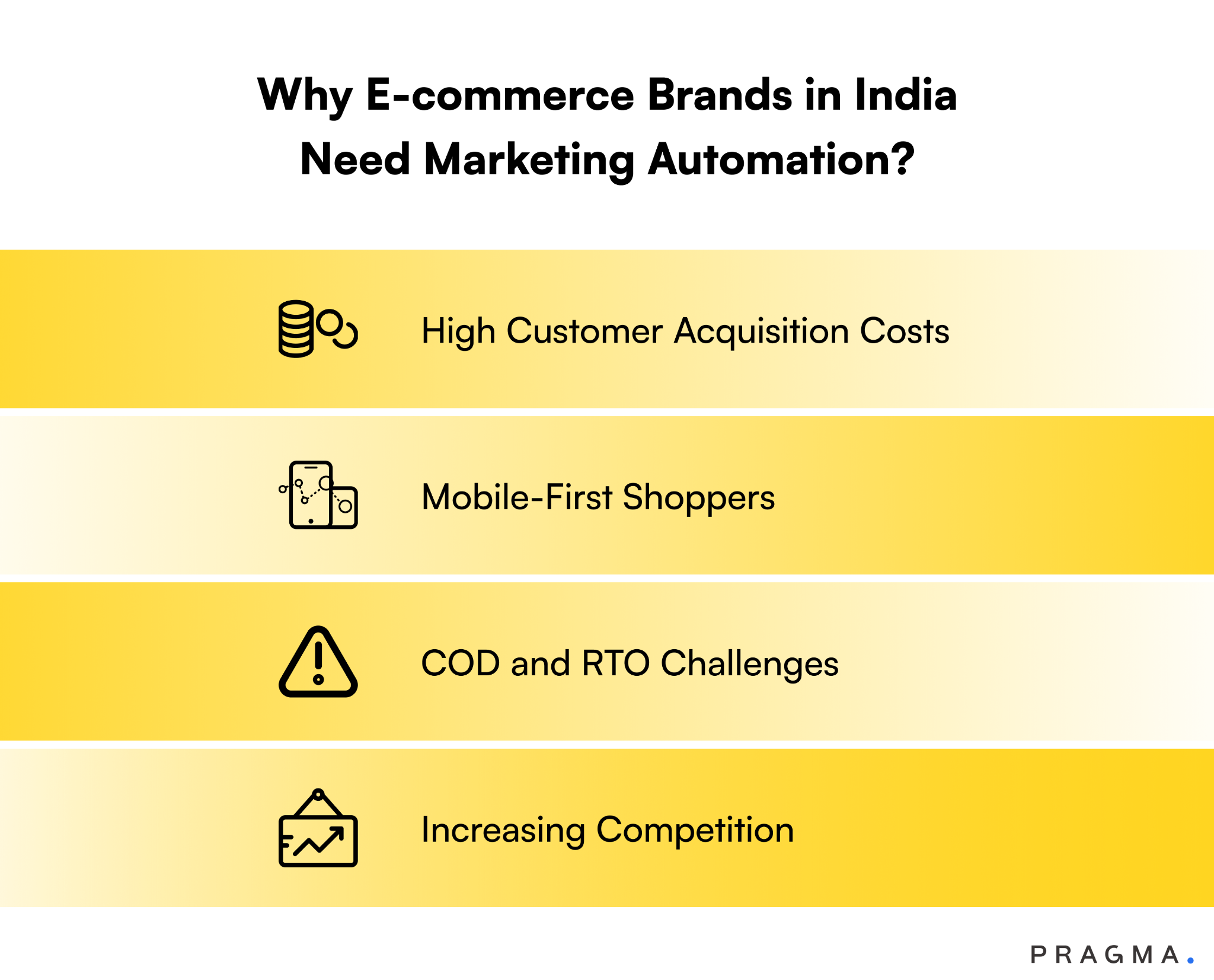
Here is why the marketing automation tools for e-commerce brands are essential:
High Customer Acquisition Costs
In India, new customers are very costly to get, as it would need 5-25 times the cost as compared to retaining the same customer.
Industry reports reveal that, on average, the cost of acquiring a customer using digital ads has gone up by 40% within the past two years. This implies that the brands must make the best out of all the customers they receive.
Marketing automation assists in:
- Turning more visitors into buyers.
- Retaining lost customers who did not make purchases.
- Promoting repeat buying among the current customers.
Research indicates that automated email campaigns bring in 320% more revenue than non-automated emails.
Mobile-First Shoppers
More than 88% of online buyers in India shop with their mobile phones. This poses special difficulties:
- Short attention spans
- Easy to get distracted
- Demand for immediate communication.
The marketing automation tools for e-commerce assist in sending SMS, WhatsApp messages, and push notifications, which the customers will receive immediately on their phones.
COD and RTO Challenges
Cash on Delivery (COD) remains popular in India; still, more than 60% of orders are being placed as COD, but it is problematic:
- 25-30% of COD orders get returned (RTO - Return to Origin)
- This is expensive for brands in terms of transportation and storage.
- It influences inventory control.
But to help solve this, marketing automation can be used to reduce RTO by:
- Sending order confirmation messages.
- Providing delivery updates
- Incentives to turn COD into prepaid orders.
In order to tackle RTO challenges, the Pragma RTO Suite helps to detect high-risk COD orders and sends specific messages that urge the customer to upgrade to prepaid payment with their C2P(conversion to prepaid) strategy.
It is this system that has enabled brands to save thousands of rupees in the cost of shipping, and helped many e-commerce D2C brands in reducing their RTO rate by more than 60%.
Increasing Competition
In India, there are more than 12 million e-commerce sellers, which means that to be noticed, it is necessary to do more than offer good products and a reasonable price.
Every day, customers get a lot of messages from various brands. But the successful brands are the ones that offer the customers a personalised and relevant experience.
Here is how marketing automation tools for e-commerce brands can assist in:
- Staying at the forefront of your brand.
- Delivering enhanced customer service.
- Establishing custom shopping experiences.
What are the Core Use Cases of Ecommerce Marketing Automation?
Let us have a look at how marketing automation tools for e-commerce can be used:
Abandoned Cart Recovery
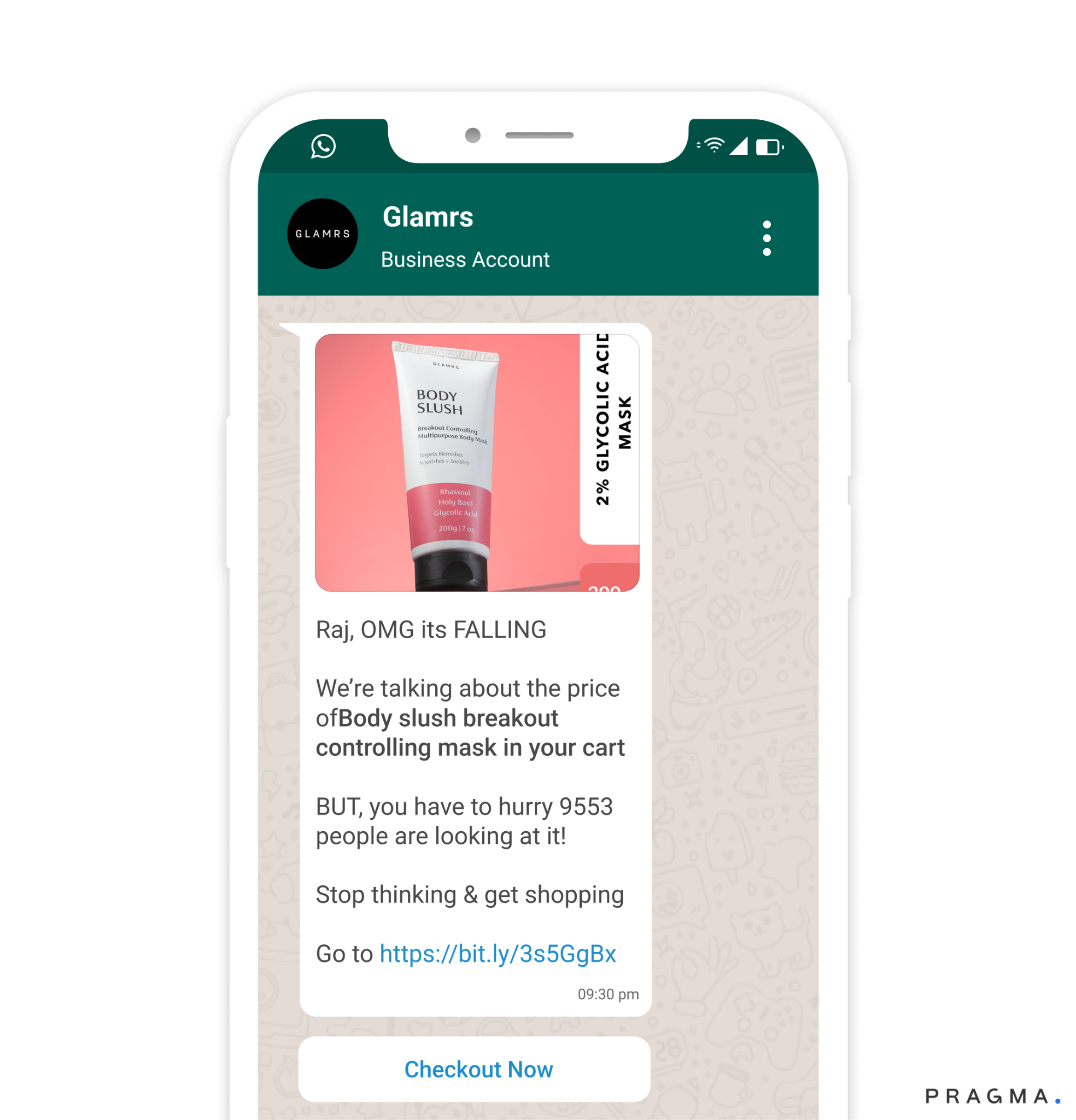
One of the largest problems of e-commerce brands is the issue of cart abandonment. The average cart abandonment rate in India is 70.22%, that is, 7 out of every ten customers who put products in the cart do not complete their purchase.
But with the help of the best marketing automation tools, such as Pragma, e-commerce brands can do cart recovery functions by sending the reminders to customers in the following sequences:
- After 1 hour, a reminder email can be sent.
- Doing a follow-up with a discount offer 24 hours later.
- A reminder will be sent after 3 days.
Brands that use automated emails can recover up to 15-20% of abandoned carts. But the main thing is that first look for the reasons why customers are abandoning their carts, then make use of the automation to reduce abandoned carts.
Welcome Series
A welcome series starts when a client subscribes to your newsletter or purchases your product or service for the first time.
The welcome series includes the following:
- Brand story welcome message.
- Product care tips
- Exclusive discounts.
- Social media links
Open rates of welcome series emails are usually 50 times higher than the open rate of ordinary promotional emails since the people who receive such emails are already eager to hear about your brand. This, therefore, provides them with a fantastic chance to establish strong customer relations even at the very onset of the customer journey.
Post-Purchase Follow-Up
The customer journey does not end once a person makes the purchase; on the contrary, it is only starting in many aspects. The automation of the post-purchase process will help in providing the customers with a good experience with their purchase.
Effective post-purchase automation begins with instant order confirmation, which will give the customers a feeling of security that their order was better and that their money has been received. An email confirmation must contain details of the order, delivery dates, and contact information for the customer service.
With Pragma WhatsApp Business Suite, customers can get instant updates and assistance without necessarily going to your site.
Reorder and Win-Back Campaigns
The retention of customers is much easier than the acquisition of new customers. With the help of reorder and win-back campaigns, the brands can target the following:
- Customers who haven't bought in a while
- Customers who buy regularly (for reorder reminders)
- Customers who have only bought once
Product Recommendations
Sending customised product suggestions to customers can be a helpful thing for e-commerce brands in getting more sales.
The automation systems can analyse customer patterns, shopping history, and browsing patterns and offer the customer the best products in which they will most probably show interest. Pragma Omnichannel CRM analyses customer behaviour, purchase history, and browsing patterns to deliver personalised product recommendations.
But the main thing that has to be kept in mind is that the e-commerce brands should take care of the frequency of messages sent to the customers. If it is too often, it will irritate the customer, and if it is too late, it can be a loss.
Research indicates that recommended products have the potential to boost average order value by 10-15% and customer satisfaction, as people find the products that they actually desire.
Festival and Sale Campaign Automation
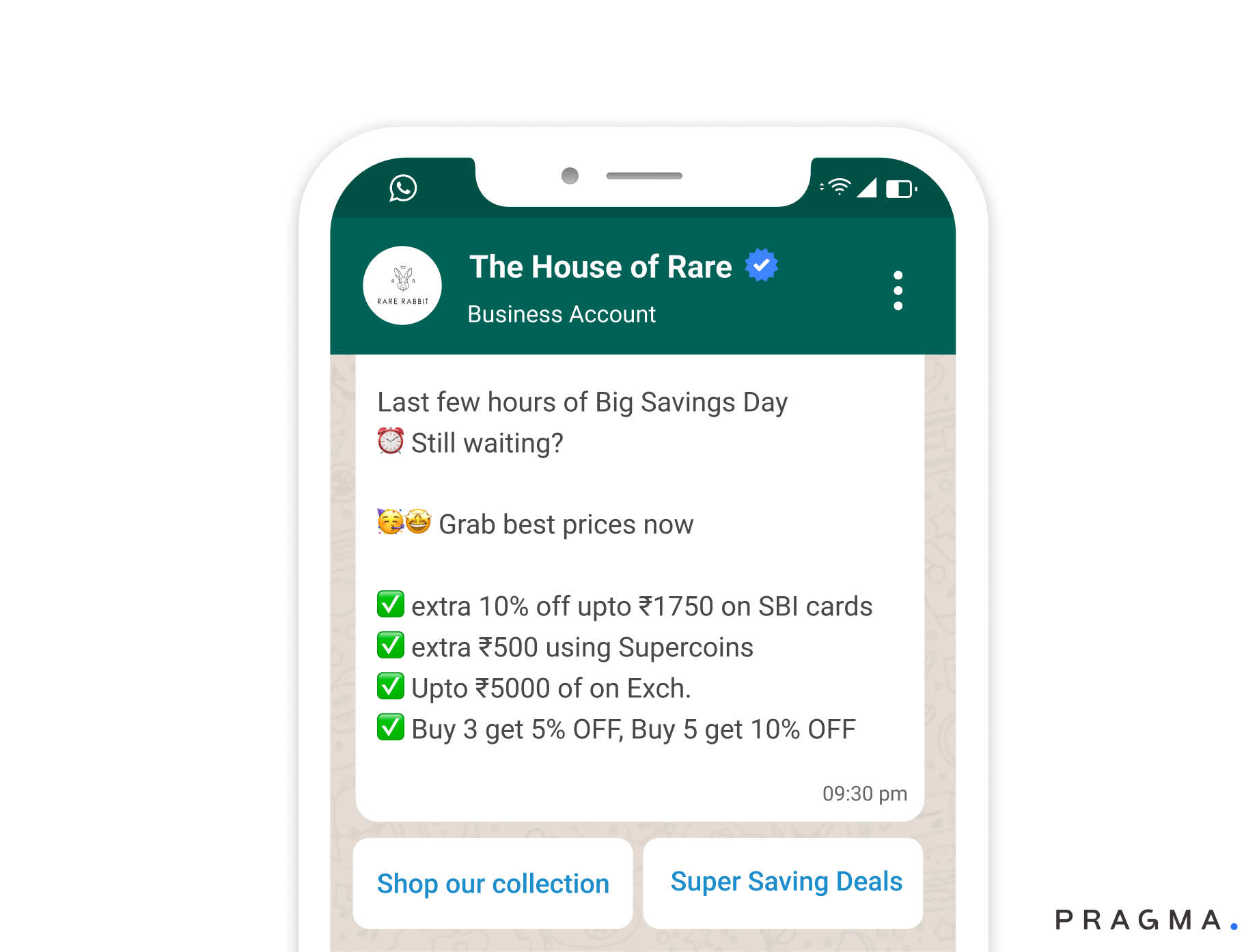
Festivals also promote high e-commerce activities all year round, with Diwali, Dussehra and regional festivals and modern-day shopping features such as the Big Billion Days.
With marketing automation tools for e-commerce brands such as Pragma Omnichannel CRM, it is possible to develop advanced festival campaigns that seem personal and on-time.
Automation can be used to segment the customers according to what they have bought during the last festivals, regional and their interests in products instead of sending the same Diwali offer to all their customers.
Brands can also offer during pre-festivals, such as countdown timers, early bird offers, and gift guides. They can also make use of these tools to notify people in real-time regarding flash sales, inventory notifications and gift recommendations.
Best Marketing Automation Tools for E-commerce
We have gathered some of the best marketing automation tools for e-commerce brands. Have a look at the following and see which suits you best:
All-in-One Ecommerce Automation Platform
1. Pragma
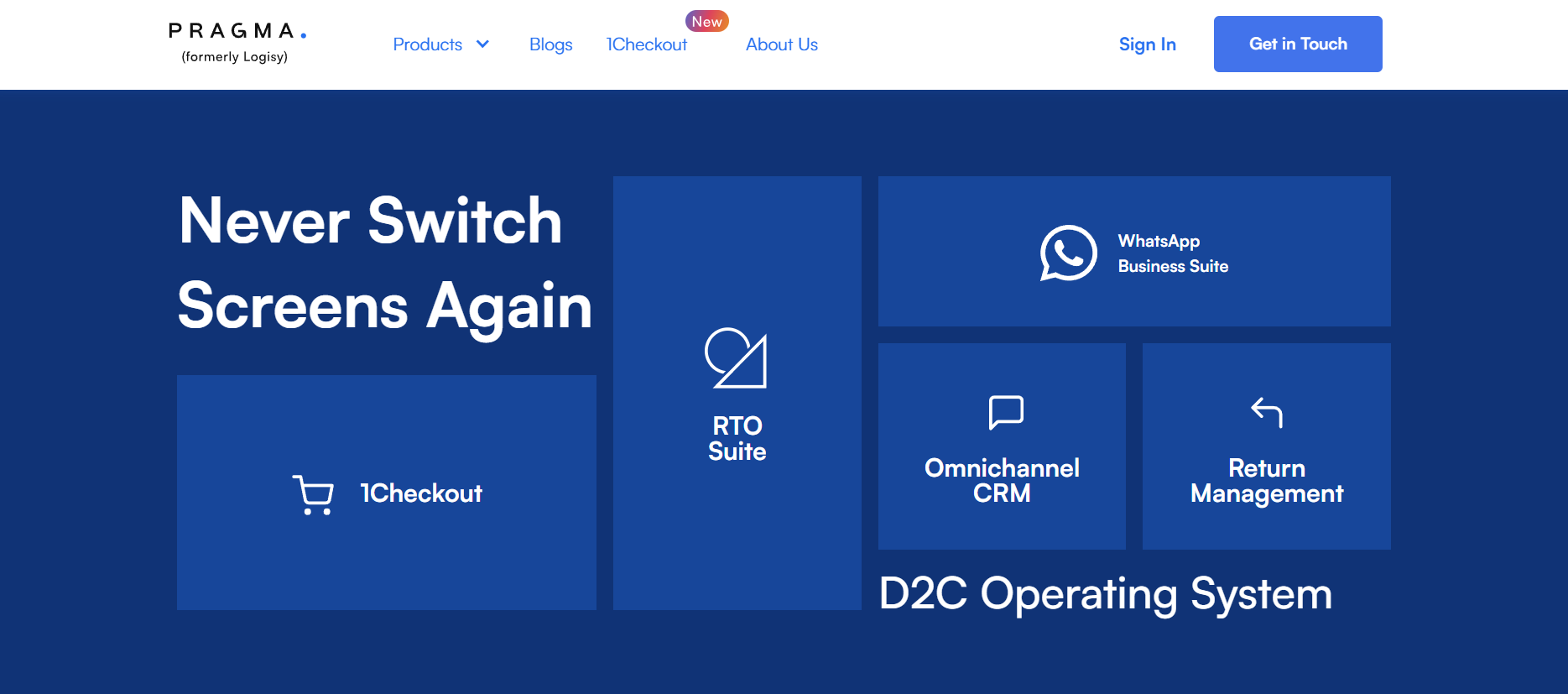
Pragma is an all-in-one DTC operating system that assists in automating the omnichannel marketing via WhatsApp, Facebook, Instagram, Email and SMS.
It puts you in absolute control of receiving orders in various sales points as well as interacting with the customer without requesting them to shift to your web page.
Since it has to achieve maximum value out of each customer with behaviour-based upsells and recommendations, to personalised chatbots that handle over 95% of incoming customer requests.
Pragma takes care of all the purchase cycles, pre-purchase, post-purchase and post delivery phases.
Key Features
- Pragma Omnichannel CRM can be used to contact customers on platforms that they spend most of their time on, thus increasing the number of conversions.
- RTO prevention system to convert customers' orders to prepaid orders of COD, such that you do not need to cover the cost of shipping.
- WhatsApp ordering, so as to allow the customers to window shop, order, complete the transaction and get after-sales services through the same medium.
- Order confirmation process to eliminate impulse purchasers, fraudulent orders and possible returns.
- Pragma1 Checkout, a customised checkout system which takes 10 seconds to check out and offers customers options of paying through BNPL, UPI, cards, etc.
Email-First Automation Tool
2. ActiveCampaign
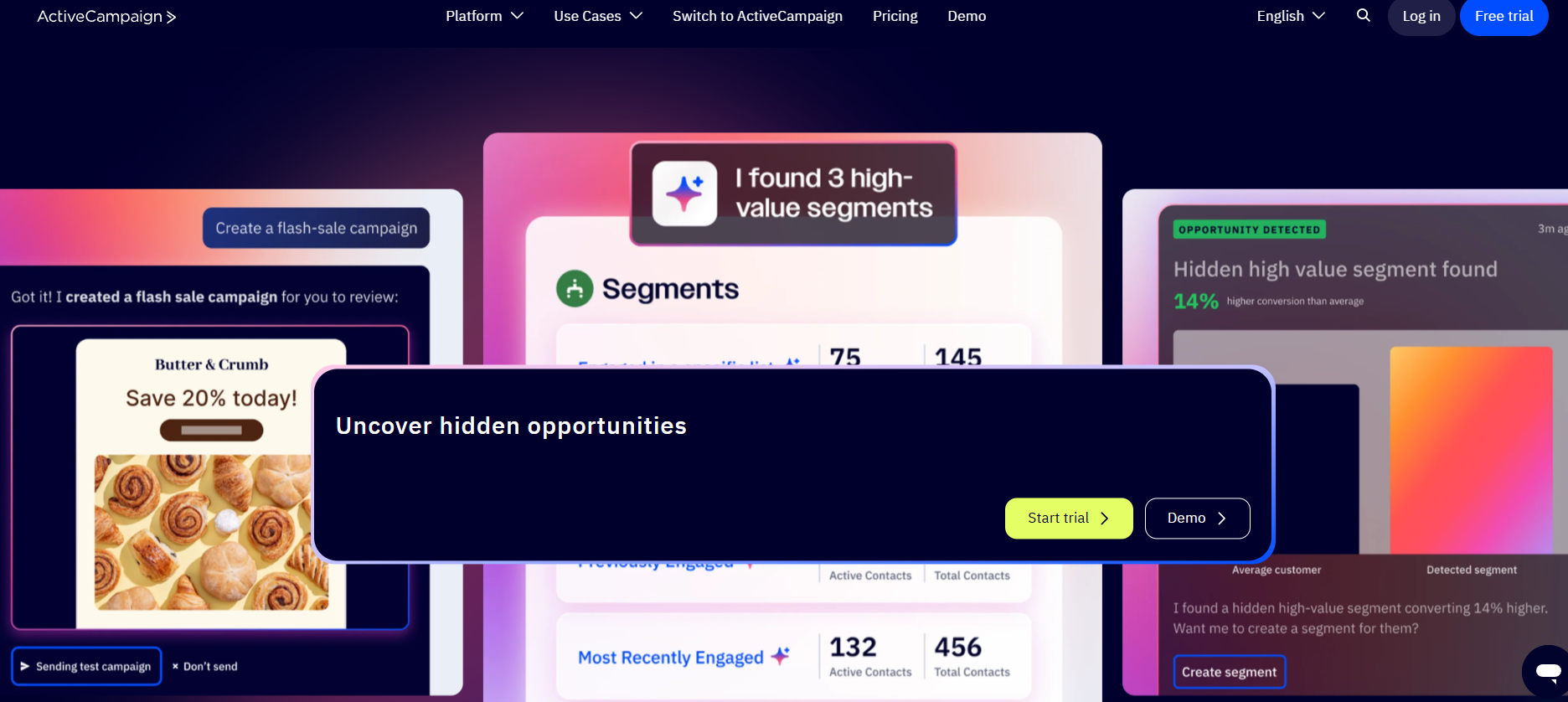
ActiveCampaign is a specialised email service provider that assists one in developing a customised customer experience through highly sophisticated automation workflows and templates.
It is accompanied by cross-channel marketing automation by email, SMS and social messaging, therefore reaching customers on various channels.
Key features:
- An automation builder designer that contains 750 or more automation templates, with pre-established automation templates in selected industries, which you can access without having to start with a blank canvas.
- Artificial intelligence-driven content generation that assists you in creating personalised email copy, email subject and automation campaigns.
- Advanced segmentation that automatically divides up your shoppers by level of engagement and behaviour, and assists in targeting high-potential shoppers.
Customer Engagement Platform
3. Brevo
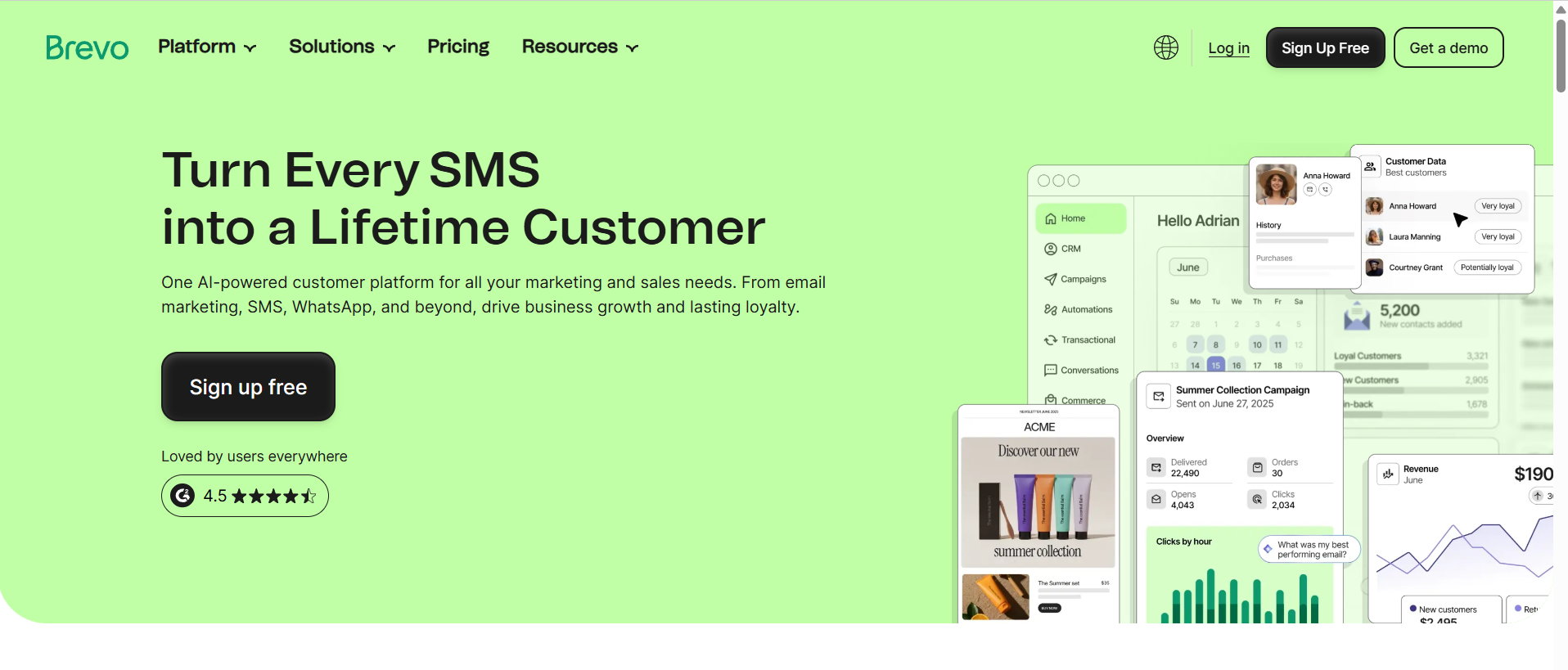
It is also one of the best marketing automation tools for e-commerce brands, which helps companies to communicate with customers via email, SMS, WhatsApp, and CRM on a single dashboard.
Key Features
- It supports communication in a multi-channel via email, SMS, WhatsApp, and chat.
- It provides a high level of segmentation and personalisation to reach the user based on their behaviour, demographics and past engagement.
- It helps to manage contacts, track leads and monitor customer interactions.
- It could measure performance, optimise send time and enhance conversion rates using campaign analytics and A/B testing.
Budget-Friendly Automation Tool
4. MailerLite
MailerLite is one of the most affordable email marketing and automation tools. It is a favourite among startups, creators, and small businesses that do not require expensive marketing tools.
It provides a free plan as well as paid plans, which are also affordable.
- It has a free plan, where up to 12,000 emails can be sent in a month, which suits small groups of subscribers and beginners.
- The paid plans begin at approximately $9-10/month, and this is less expensive than numerous large email marketing services.
- Offers a campaign creator and drag-and-drop email editor to design newsletters and ad emails without any problems.
- Also has simple marketing automation flows to send automated emails depending on triggers such as sign-ups or actions.
How to Choose the Right Marketing Automation Tool?
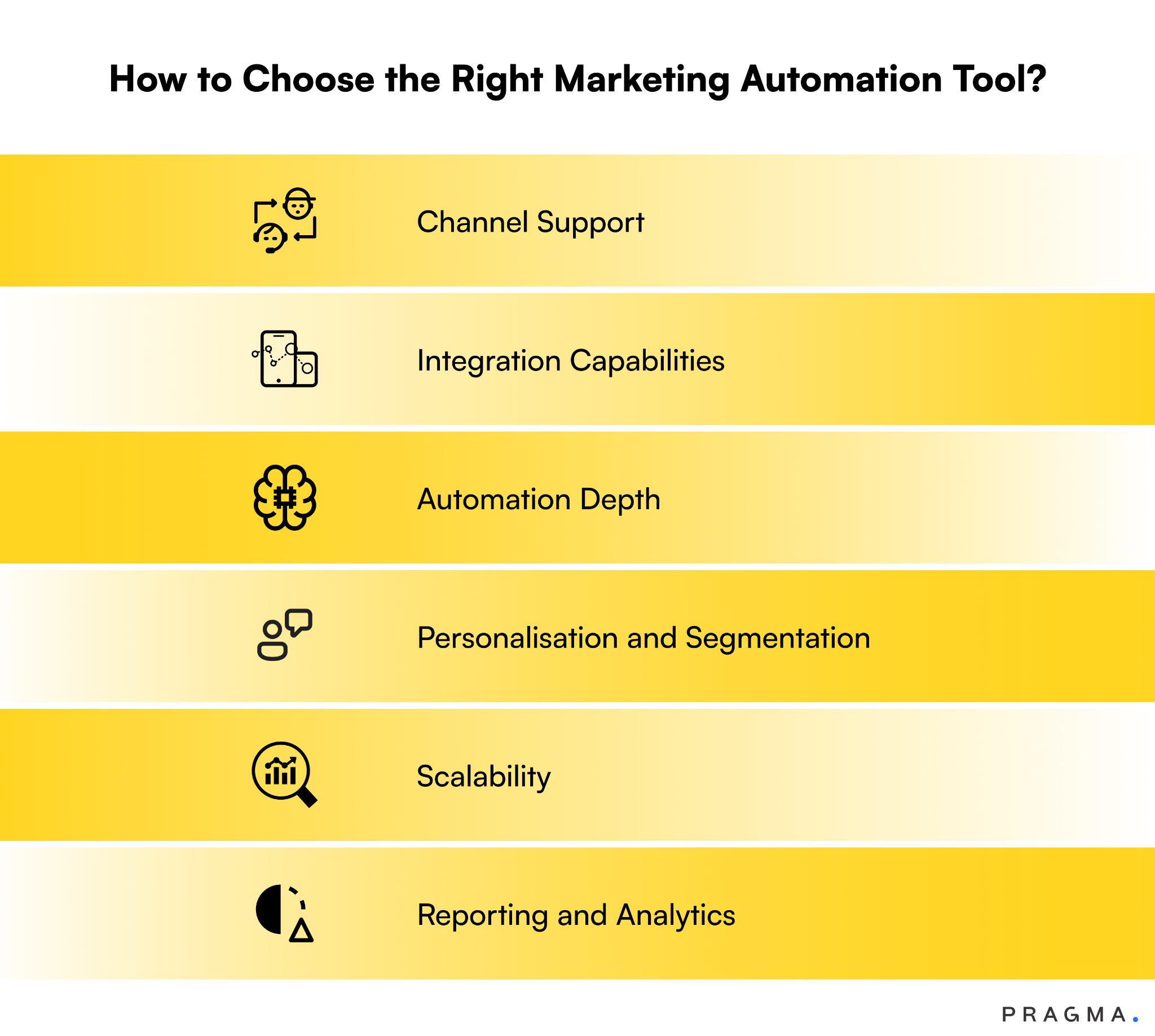
Channel Support
Select a marketing automation tool that can operate in numerous marketing platforms such as email, social platforms, SMS, and websites.
This will allow you to target consumers on other platforms through the same tool. Having all the channels linked, your marketing messages remain constant, and customers receive a hassle-free experience.
Integration Capabilities
The tool must be able to integrate with other current software that you are using in your business, like CRM tools, analytics tools or e-commerce platforms.
When you properly integrate the tool, it will ensure that all the data remains in a single location. And you don't have to do things manually for shifting the data.
Automation Depth
Automation depth is the extent of work that the tool is capable of performing automatically.
A good tool must enable you to build workflows, send automatic emails and relay messages when customers do certain activities.
This saves person-hours and enables your team to concentrate on strategy rather than working on manual work.
Personalisation and Segmentation
The correct tool must assist you in obtaining smaller groups of people according to their interests, behaviour, or demographics.
This will enable you to send more relevant messages to each group using personalised messages that would raise engagement and conversions.
Scalability
Your business must have a marketing tool for your e-commerce brand that can expand.
In the future, if you wish to expand your business to a higher level, the platform should be able to process more without slowing down and becoming cumbersome.
Reporting and Analytics
An effective marketing automation tool must be able to give clear reports and data regarding the performance of a campaign. You must know how to monitor such things as clicks, conversions, and involvement.
This will enable you to know which of your marketing strategies are working and which ones should become better in future.
Marketing Automation Strategy for E-commerce
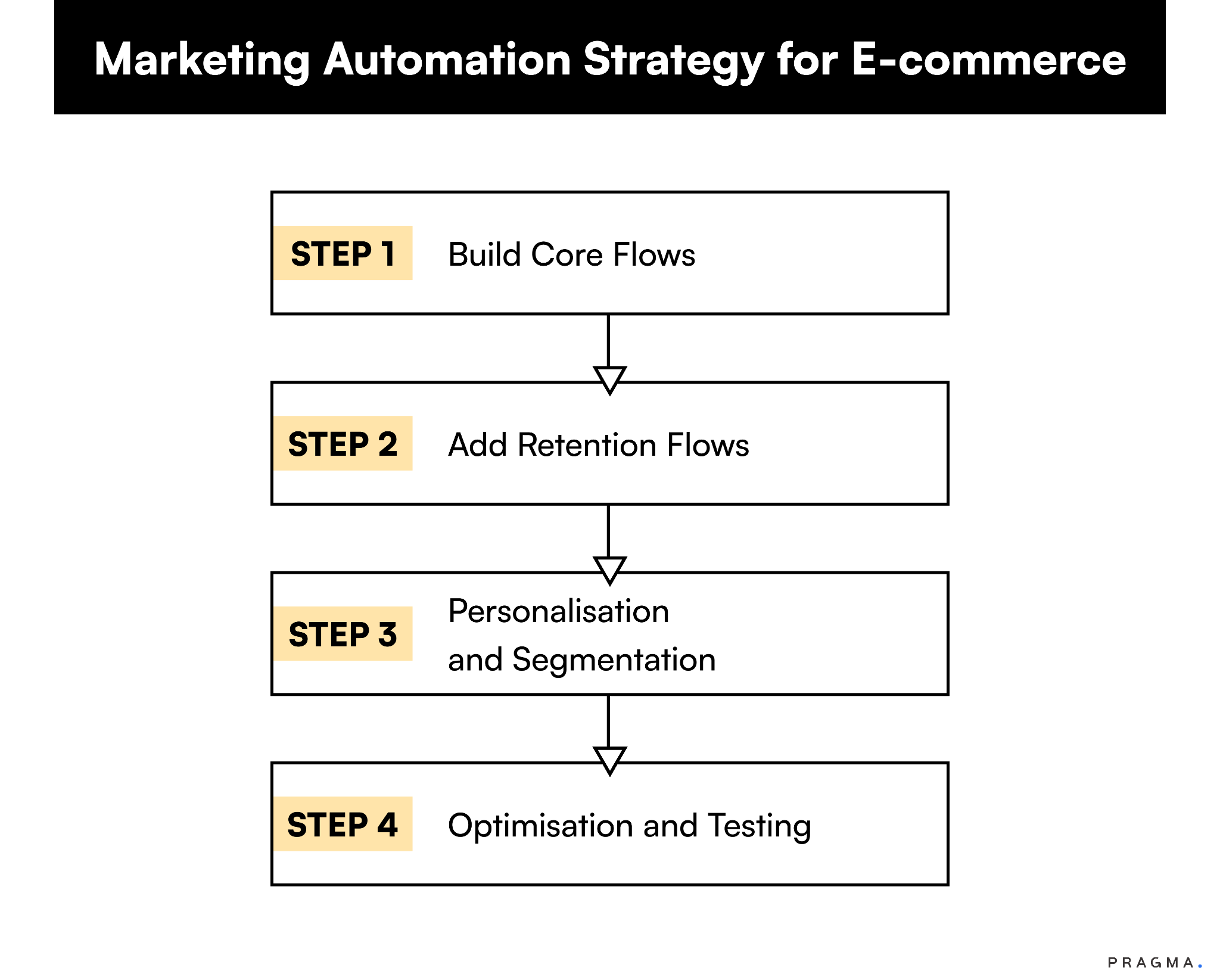
Stage 1: Build Core Flows
The initial phase would be to install the default automated messages that all e-commerce companies require.
This will involve welcome emails to new users, abandoned cart emails and confirmation of order.
These streams are used to direct customers in their purchasing process and enhance the likelihood of making a purchase.
Stage 2: Add Retention Flows
Once the basic flows are prepared, work on the retention of your existing customers.
A follow-up email can be sent after purchase, product suggestion, customer re-engagement email, and loyalty reward.
These flows assist in attracting customers back and making them buy again.
Stage 3: Personalisation and Segmentation
At this point, segment your customers into various categories or groups according to their behaviour, interests or buying history.
Thereafter, send customised messages, which are in accordance with their tastes. One-to-one communication and interactions will help to make the customers feel special and are likely to be converted.
Level 4: Optimisation and Testing
After the automation is in operation, test and refine it frequently. It is possible to experiment with various email topic lines, content in the email, time and offers to determine which do best.
The results can be analysed and improved through small steps, thus enabling you to raise your campaign performance and sales.
What Are The Common Mistakes E-commerce Brands Make When Using Marketing Automation Tools?
Here are some common mistakes which most of the e-commerce brands make:
- They do excessive automation of all things, which may turn marketing messages into robots and make them feel less personal to customers.
- They fail to comprehend that the customer journey may lead to sending messages to the customer at the wrong moment.
- The same message was sent to all the customers. This makes the message irrelevant, and the level of engagement decreases.
- Most brands fail to study campaign data and analytics, and without that, it is difficult to enhance the performance of marketing.
- Most of the brands fail to test their campaigns and end up failing to achieve results.
- Some of the brands use outdated or incorrect customer data.
- Some only focus on drawing new customers, ignoring the existing ones.
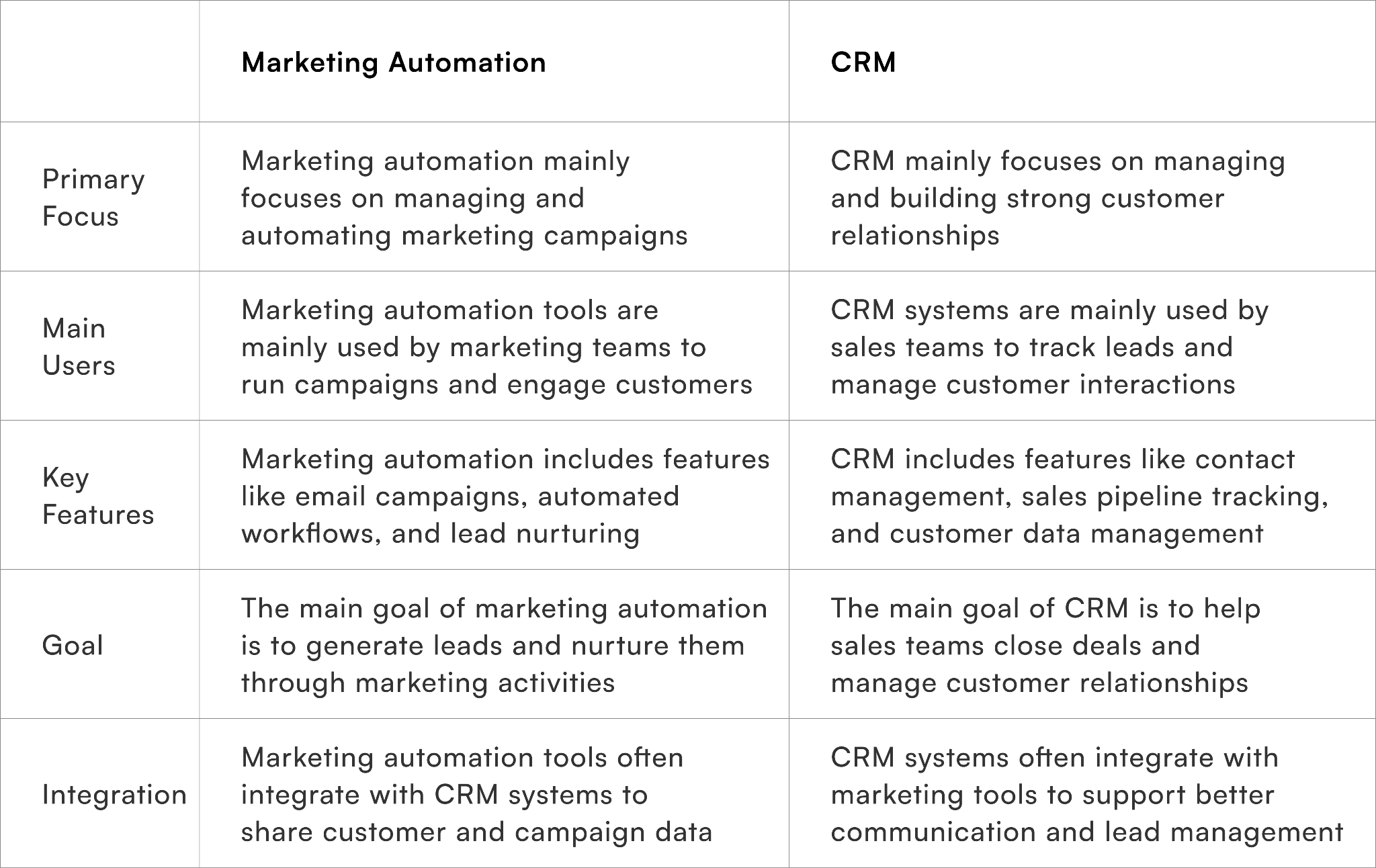
Marketing Automation vs CRM: What's the Difference?
How Marketing Automation Impacts E-commerce Revenue?
Marketing automation is capable of making a great influence on the revenue of e-commerce by enhancing the way companies attract, convert, and retain customers.
According to HubSpot, many studies in the industry indicate that the use of marketing automation results in a 451% increase in qualified leads.
Equally, a study conducted by Emailmonday established that approximately 80% of companies realised increased leads following the application of automation tools.
A different report also points out that automated marketing can result in approximately a 77% increase in conversions, demonstrating the effectiveness of automated campaigns.
The automation of marketing enhances revenue in a number of ways. Recovery email on abandoned carts can assist companies to recover 15-20% of the lost sales through reminding shoppers to make purchases.
The average order value can be enhanced by 10-15% through personalised product recommendations, as it motivates customers to purchase more products.
Moreover, automation assists in enhancing customer retention, which is significant since it is five times cheaper to retain than to acquire. The combination of these strategies assists e-commerce brands in increasing revenue in a more efficient way.
Future Trends in E-commerce Marketing Automation in India
The marketing automation will rapidly change as the emerging technologies and the trends of customer behaviour will define e-commerce.
Artificial Intelligence (AI) will significantly contribute to the process of automation as it can predict the preferences of customers, optimise the timing of the campaigns, and produce automatically personalised content.
The McKinsey and Company report that AI-led personalisation has the potential to grow the revenues of most e-commerce companies by 10-15%.
WhatsApp has more than half a billion users in India, which means that it is one of the strongest platforms for conversational commerce where customers may browse the products, ask questions, and place orders directly within the chat.
Other upcoming technologies include voice commerce, wherein more consumers search and reorder products using voice assistants.
The automation will also go more hyper-local, whereby the brands will include the language of the region they are in, location-specific campaigns and localised festival promotions to reach out to the various audiences in India.
Final Thoughts
So, to conclude here, we want to say that if you want to connect with your customers without putting in much effort, marketing automation tools can be a good idea.
It can help you to save time and effort, increase revenues, and give the customers a great experience.
And for the D2C e-commerce brands here, Pragma offers all such things that are required for a business to be successful.

FAQs (Frequently Asked Questions On Best Marketing Automation Tools for E-commerce in India)
1. What is marketing automation in e-commerce?
Marketing automation in e-commerce refers to software that automatically sends personalised messages to customers based on behaviour, such as abandoned carts, product views, repeat purchase cycles, or post-purchase interactions.
2. Why do e-commerce brands use marketing automation tools?
Brands use marketing automation tools to improve customer engagement, recover abandoned carts, increase repeat purchases, and reduce manual campaign management across channels like email, SMS, and WhatsApp.
3. Which are the best marketing automation tools for e-commerce in India?
Popular tools used by Indian e-commerce brands include platforms such as Pragma, WebEngage, MoEngage, Klaviyo, CleverTap, and Omnisend, depending on their channel strategy and integration requirements.
4. What features should a good marketing automation tool include?
Key features include behavioural triggers, customer segmentation, omnichannel messaging (email, SMS, WhatsApp, push notifications), campaign workflows, A/B testing, analytics dashboards, and CRM or OMS integrations.
5. How do marketing automation tools help increase sales?
Automation tools send targeted messages at the right time—such as abandoned cart reminders, replenishment alerts, and personalised offers—which improves conversion rates and customer lifetime value.
6. Are marketing automation tools useful for small D2C brands?
Yes. Even smaller brands benefit from automation by reducing manual campaign effort, improving customer targeting, and scaling marketing activities without increasing team size.
7. How does marketing automation improve customer retention?
Automation tools create personalised customer journeys, send replenishment reminders, loyalty rewards, and win-back campaigns that encourage repeat purchases.
8. Can marketing automation reduce cart abandonment?
Yes. Automated recovery messages through email, SMS, or WhatsApp can remind customers about items left in their cart and recover a portion of abandoned purchases.
9. How do marketing automation tools integrate with e-commerce platforms?
Most tools integrate with platforms such as Shopify, WooCommerce, Magento, and custom websites, allowing them to track user behaviour and trigger campaigns automatically.
10. When should an e-commerce brand invest in marketing automation software?
Brands should consider marketing automation when traffic and customer data increase, manual campaigns become difficult to manage, or when improving retention and repeat purchase rates becomes a priority.
Talk to our experts for a customised solution that can maximise your sales funnel
Book a demo

.webp)
.png)