

A thing that every D2C e-commerce brand talks of and is irritated with the most is the shopping cart abandonment.
Most of the time, brands have gone through this situation, where a customer visits their website, spends time, adds products to the cart, and suddenly disappears.
So, is this really a big problem?
If we take the numbers, it has been found that the average cart abandonment rate across industries is a staggering 70.19% according to Baymard Institute.
And this thing just doesn't end here; it is even more critical. Recent studies indicate that cart abandonment rates vary significantly by device, with mobile abandonment reaching as high as 75.5%.
Thus, this data shows that it is an alarming issue for e-commerce brands, but to find the right answer to this question, "Why Is Shopping Cart Abandonment a Problem for Retailers?", we will get into this more deeply.
Why Cart Abandonment Is a Problem for Retailers in India?
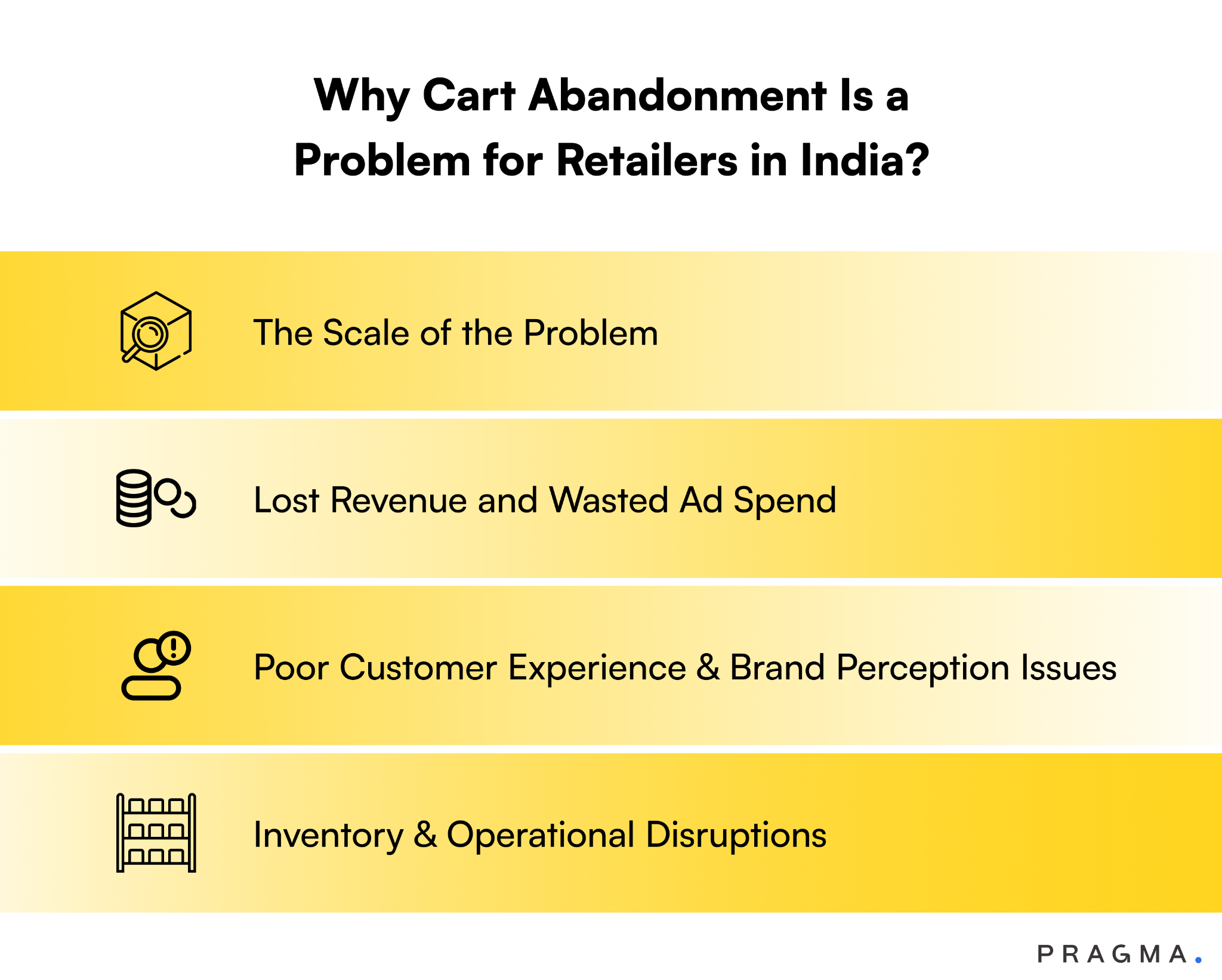
To find out why shopping cart abandonment is a problem for retailers, have a look at the following points, which will provide you with a clearer picture of why everyone is saying this:
The Scale of the Problem
According to research, e-commerce stores lose about $18 billion, or ₹1.49 lakh crore, in sales revenue every year due to cart abandonment worldwide.
These figures are extremely concerning. This results in annual revenue losses of more than ₹16,000 crores for Indian D2C brands.
The average cart abandonment rate worldwide in 2024 is 70.19%, according to Statista; however, due to particular market difficulties, this figure may be even higher in India.
Cart abandonment rates can differ greatly by industry, according to research:
- Clothing and Fashion: 70–75%
- Tourism and Travel: 80–85%
- Electronics: 65–70%
- Cosmetics and Beauty: 68–72%
and having such cart abandonment rates clearly shows why shopping cart abandonment is a problem for retailers.
But a good point here to note is that this rate can be reduced. According to MarketingLTB research, reducing checkout steps from 5 to 3 can decrease cart abandonment by 27%.
That is why Pragma 1Checkout focuses on faster checkouts, by completing the checkouts in just less than 10 seconds with a one-step checkout process.
Lost Revenue and Wasted Ad Spend
The direct loss of revenue is the most obvious effect of cart abandonment. Each abandoned cart is a lost sales opportunity, but the issue is far more complex than that. Retailers lose all of the money they initially invested in acquiring customers who abandon their carts.
To increase the website traffic, they've spent money on Facebook campaigns, Google Ads, influencer collaborations, and SEO initiatives.
After putting in this much effort, if a customer exits without making a purchase, all of the money spent on marketing is wasted and yields no return.
Research also shows that 48% of online shoppers leave their carts because of unexpected extra costs like shipping, taxes, or handling fees.
This means that a significant portion of your marketing budget is being wasted on customers who were ready to buy but were hampered by poor checkout experiences.
By offering clear pricing early in the checkout process, including COD-to-prepaid conversion options, Pragma's 1Checkout solution directly addresses this issue.
Poor Customer Experience & Brand Perception Issues
Cart abandonment harms your brand's reputation and customer relationships in addition to your immediate sales. Customers are unlikely to visit your website again if they have a bad checkout experience.
Research by Capterra reveals that 66% of online shoppers expect to complete checkout in 4 minutes or less, while 29% expect to finish it in under 2 minutes.
Also, according to research, 25% of customers abandon their cart if they are asked to register.
This irritates the customer and makes a negative impression of your brand in their mind; similarly, if your website has technical issues, slow loading pages, or difficult checkout procedures, it also creates a bad impression.
That is why, to solve this problem, Pragma 1 Checkout offers customers a guest checkout, where they don't have to do mandatory account creation just for purchasing something.
Inventory & Operational Disruptions
When customers add items to carts but do not finish purchases, false demand is produced.
It means that you will think that a lot of customers are adding products, and you will decide to stock up on them. This can result in bad inventory decisions.
For example, if 1,000 customers add a certain product to their carts, but only 300 actually buy it, you might overestimate demand and order too much inventory.
This leads to increased holding costs, potential obsolescence, and tied-up capital that could be used more effectively elsewhere in your business.
What are the Common Trigger Points Behind Abandonment of Carts?
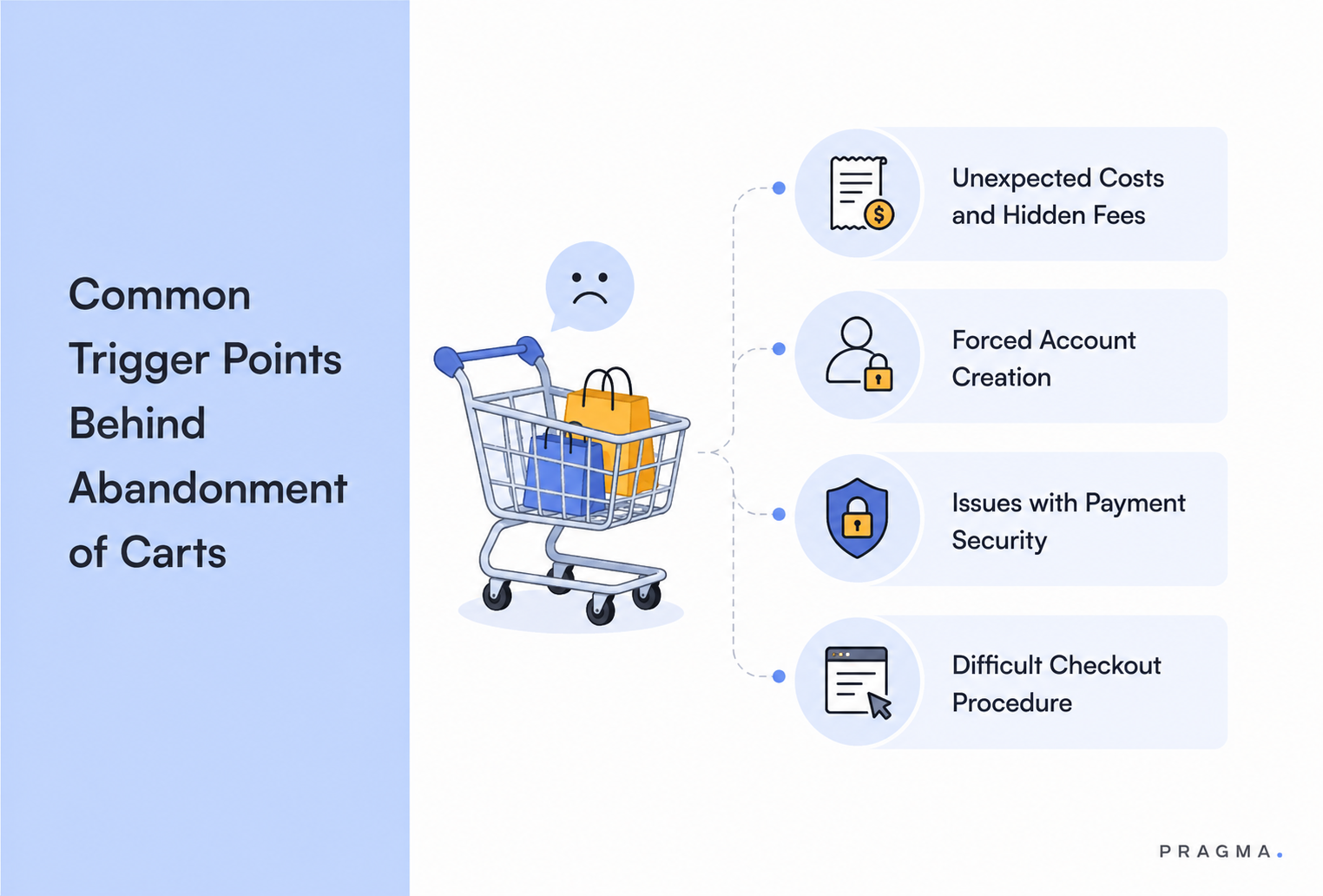
Every time a customer leaves the account is due to some reason. Have a look at those reasons, which trigger cart abandonment:
Unexpected Costs and Hidden Fees
When a customer is going to buy something, and suddenly he sees some unexpected costs that are added to the final price, he gets really annoyed and decides to abandon their cart.
Confusion and mistrust are worsened by the fact that many Indian e-commerce sites fail to communicate GST calculations clearly.
Instead of taking the chance of being overcharged, customers are more likely to withdraw their purchase when they don't understand why they're being charged additional fees.
Forced Account Creation
When just for the sake of purchase, a customer is asked to create a mandatory account, most people never want to do that.
And they decide to leave that brand and prefer to purchase from another, or just drop the idea of purchasing.
With Pragma Guest Checkout, this problem can be solved as it allows customers to complete purchases without creating accounts.
Issues with Payment Security
Particularly for new brands, this is one of the main causes of cart abandonment. Customers believe entering credit card information on a new brand's website is risky.
Because of this, almost 19% of consumers simply give up on their purchases due to security concerns.
In India, problems with trust are exacerbated by:
- High rates of fraud on the internet
- Cash-on-delivery options are preferred.
- A number of unidentified brands
And brands find it challenging to deal with such things. But Pragma ensures safer transactions and increases customer trust by offering secure payment options and order verification to minimise such issues.
Difficult Checkout Procedure
The customer becomes agitated and hits the back button if a D2C brand has an extremely long and difficult checkout process. According to studies, complicated checkout procedures cause 17% of customers to abandon their carts.
There are typical problems with Indian e-commerce:
- There are too many form fields to complete, including ones that ask for extra details like age and gender.
- Several pages for a straightforward purchase (a checkout should ideally take no more than three screens)
- Inconsistent step-by-step navigation
- Uncertain next steps and confusing button labels
However, Pragma's 1 Checkout can solve this issue. It assists brands in streamlining the checkout process. With its assistance, they can reduce drop-offs brought on by long forms and streamline the checkout process to less than ten seconds.
How Retailers Can Fix It: Strategic Solutions to Reduce Cart Abandonment
The good news is that you can prevent cart abandonment. With the efficient strategies and tools, retailers can significantly reduce their abandonment rates and recover lost sales. Here are the most effective approaches:
Streamline Checkout Experience
The key to reducing cart abandonment is making the checkout process fast and simple. Research shows that going from 5 checkout steps to 3 can decrease cart abandonment by 27%.
Since 34% of customers abandon their carts when they have to register, letting customers buy without making an account can really help increase conversions. One effective way to do this is by offering a guest checkout.
Here are some key things e-commerce brands should focus on in checkout:
- Minimal form fields: They should only ask for what's necessary.
- Progress indicators: They should let their customers know how many steps are left.
- Auto-fill functionality: They should focus on reducing typing, especially on mobile phones.
- Single-page checkout: They should focus on providing a single checkout and get rid of extra page redirects.
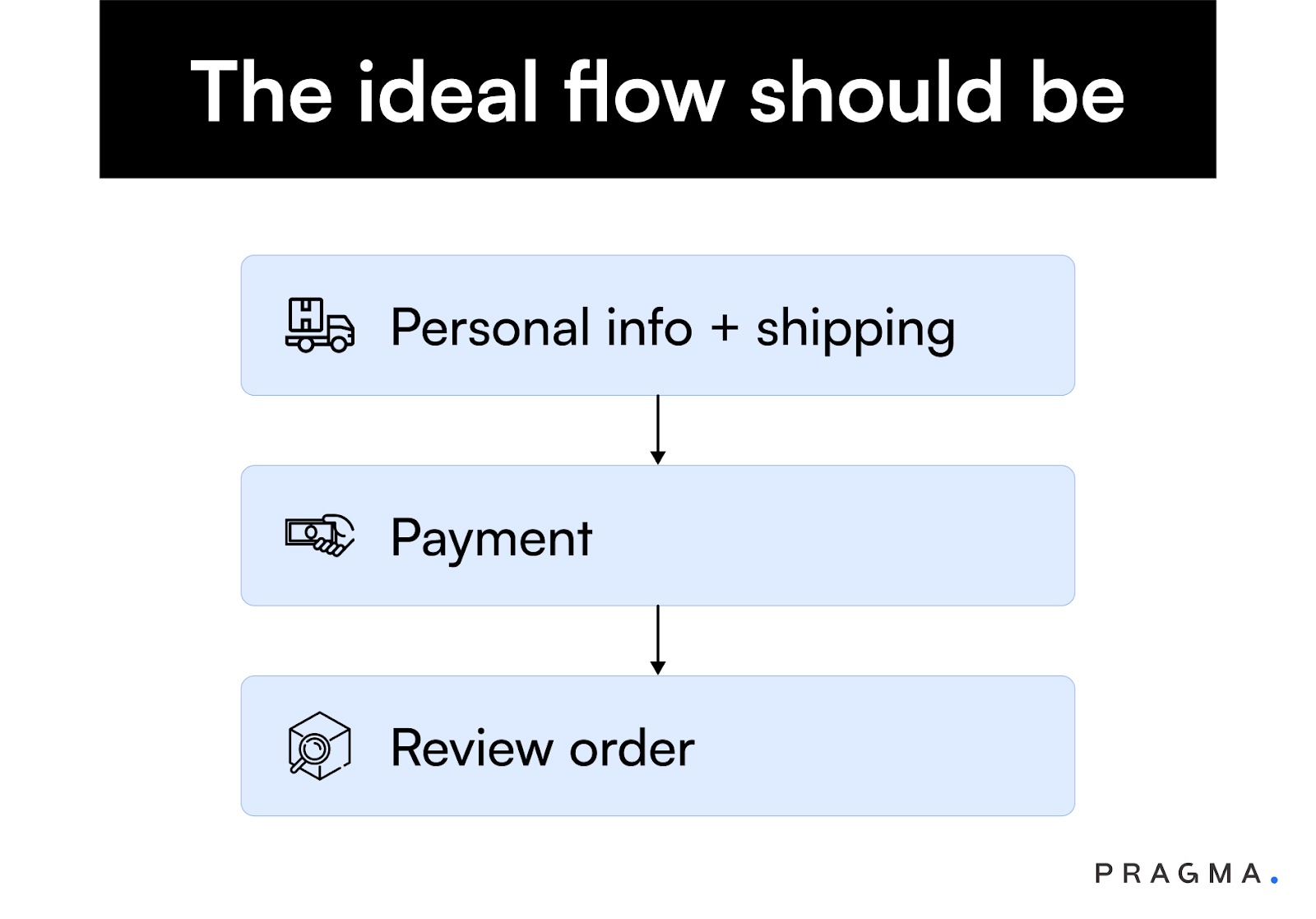
Pragma 1Checkout shows these principles in action through:
- Automatic Address Population: When you enter your phone number, it automatically fills in your address. This cuts down the time it takes to complete forms by up to 80%.
- One-Click Checkout: It provides customers with one checkout option where they can check out with one click.
- Mobile-First Design: It makes use of buttons, clear spacing and an interface that is easy to use with your thumb.
- Real-Time Validation: As you fill in the form fields, you get feedback. This helps to prevent errors.
- Progress Indicators: Your customers can see visual cues that show them how far along they are in the checkout process.
Transparent Pricing & Trust Building
Transparency in pricing is really important for reducing cart abandonment. Every e-commerce brand should show all the costs, like shipping, taxes and handling fees, when people are shopping before they even get to the checkout page.
This way, people are not surprised by the cost at the end, which is what causes a lot of people, 48% of them, to abandon their carts.
Some good ways to be transparent about pricing include:
- Showing all the costs upfront before people check out
- Using shipping calculators so people can see the costs on the product pages
- Using the customer's location to show them the costs
- Being clear about when people get shipping, like if they have to buy a certain amount of stuff
Pragma helps people trust them by doing a few things.
- Order Verification: It makes use of advanced verification systems to ensure transaction security.
- Address Auto-Correction: It provides real-time address validation to prevent delivery issues.
- Secure Payment Processing: It follows industry-standard security measures for all transactions.
- Clear Return Policies: It can be easily integrated with the Return Management System (RMS) for transparent policies.
Remedial Automation (Retargeting & Recovery)
Some people will still not complete their purchase even if the checkout process is easy to use.
This is when automatic recovery campaigns are very important. A study found that emails sent to people who did not complete their purchase have a 41% open rate, 21% click through rate and 50% conversion rate.
The best time to send recovery campaigns is:
- First Contact: 15-60 minutes after the customer leaves the site, this is when the recovery rate is the highest
- Second contact: 3-24 hours later with a special offer or discount
- Third contact: 48 hours later, with a message that creates a sense of urgency
However, in India, WhatsApp is actually more effective than email for getting customers to come back and complete their purchase. Since 92% of WhatsApp messages are read within 60 seconds, it is a powerful way to get customers engaged again.
According to a study, using three or more channels to contact customers results in a purchase rate that's 287% higher, and using SMS is 47.7% more likely to result in a sale.
The abandoned cart recovery automation from Pragma provides a multi-channel recovery system:
- WhatsApp Automation: It sends personalised messages that have a 92% read rate within 60 seconds.
- SMS Integration: It can send urgent reminders via text message
- Email Sequences: It sends professional email campaigns with product images and direct links
- Intelligent Timing: It makes use of intelligence to determine the best time to send messages
- Personalised Content: It sends messages that are tailored to the customer's browsing history and cart contents
- Dynamic Offers: It also sends automatic discount codes and incentives based on the customer segment
Advanced Payment Solutions
According to research, 76% of consumers want their preferred payment method, and 59% of buyers will abandon it if their preferred payment method isn't available.
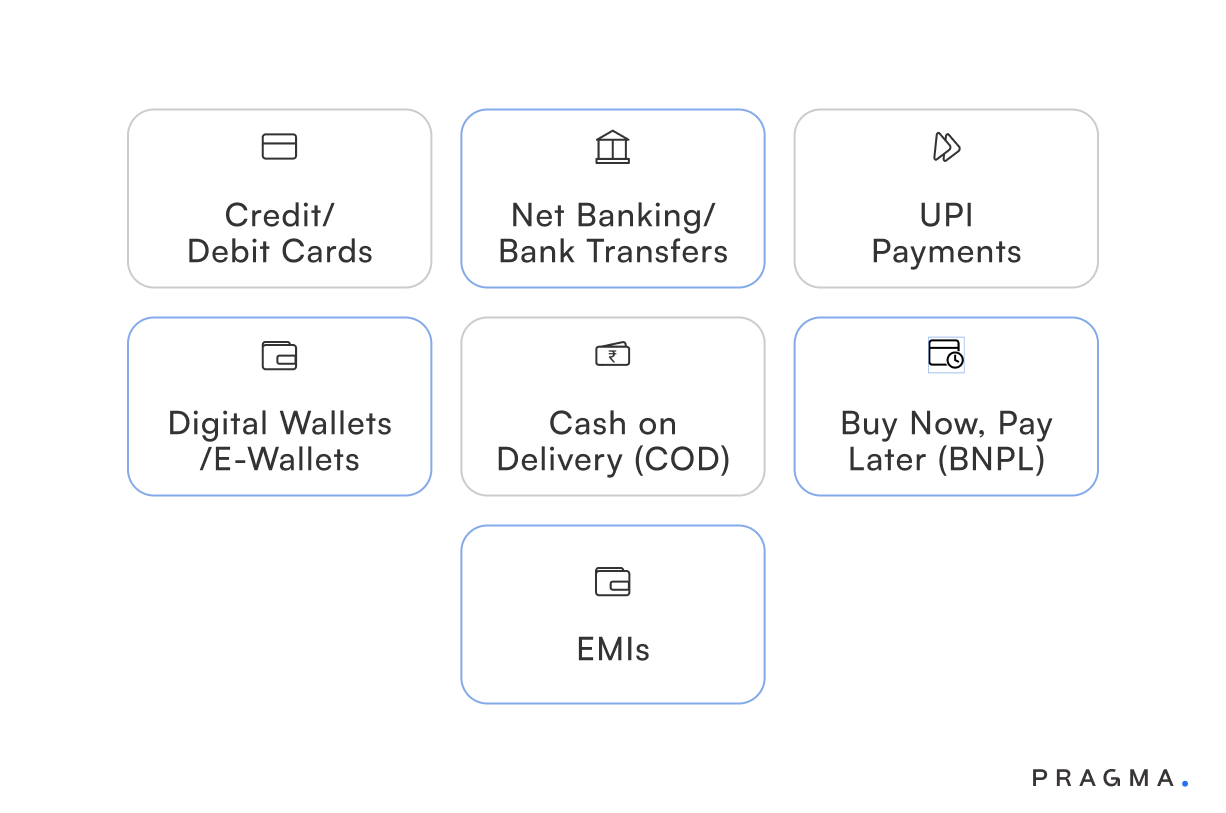
Every e-commerce brand should provide these essential payment methods:
- UPI payments
- Digital wallets
- Credit and debit cards
- Net banking
- BNPL options
- Cash on Delivery
Pragma 1Checkout supports all these payment options, along with up to 50% reduction in payment gateway charges.
Measuring & Reducing Cart Abandonment
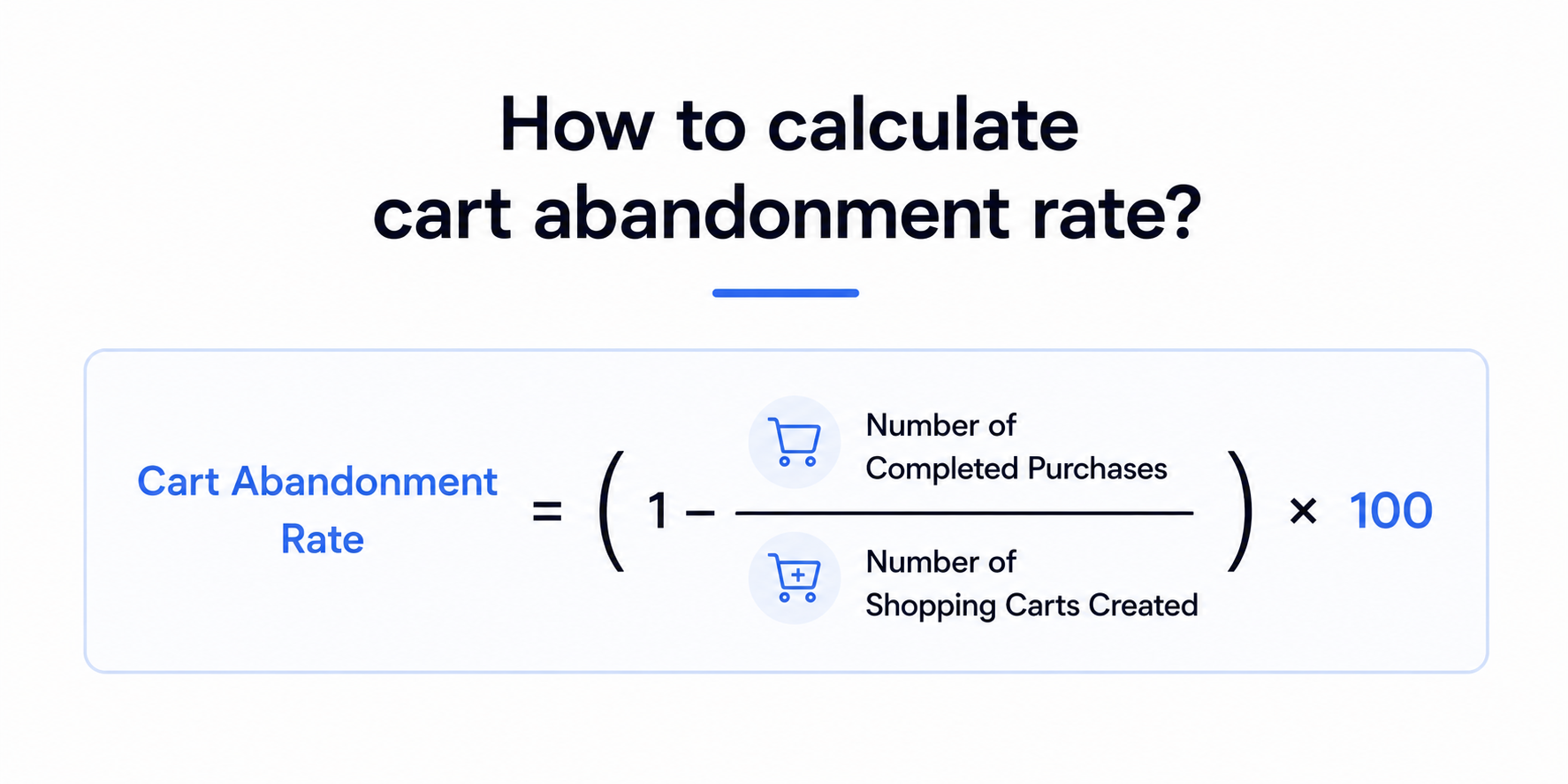
To stop people from leaving things in their shopping carts, you need to keep an eye on how you're doing all the time. The simple way to figure out your cart abandonment rate is:
You should also look at more detailed numbers to get the whole picture of cart abandonment.
You need to look at things like:
- Recovery Rate: This is the number of carts you get back divided by the number of carts that people abandoned, multiplied by 100
- Revenue Recovery: This is the money you get back from people who left things in their carts after you sent them messages to come back
- Time to Recovery: This is how long it takes for people to come back and buy things after you send them messages
- Channel Effectiveness: This is the way of sending messages, such as email, WhatsApp, or SMS works best for your customers
Industry benchmarks suggest that a good recovery rate is typically between 15-30%.
Some companies do much better than that with the right strategies and tools.
Some people did a study. Found out that if companies do things right, they can get back around 63% of the carts that people abandoned, which is a lot of cart abandonment recovery.
Conclusion
So, we hope that you get your answer to why shopping cart abandonment is a problem for retailers.
If you are the one who is also facing the same situation in your business, you can adopt the above-discussed strategies, which will help you in reducing your cart abandonment rates.
And with the support of the right tools like Pragma 1Checkout, you can see significant results easily under cart abandonment recovery.

FAQs (Frequently Asked Questions On Why Is Shopping Cart Abandonment a Problem for Retailers?)
1. Why is shopping cart abandonment a problem for retailers?
Shopping cart abandonment is a major problem for retailers because it leads to lost revenue despite high customer acquisition costs. Users show purchase intent but drop off before completing checkout, reducing overall conversion rates and profitability.
2. What is shopping cart abandonment in eCommerce?
Shopping cart abandonment in eCommerce refers to customers adding products to their online shopping cart but leaving without completing the purchase. It represents a critical leakage point in the conversion funnel.
3. What is the average shopping cart abandonment rate in eCommerce?
The average shopping cart abandonment rate in eCommerce ranges between 65% and 75% globally, and can be even higher in India due to COD preferences, pricing sensitivity, and checkout friction.
4. What are the main reasons for shopping cart abandonment?
The main reasons for shopping cart abandonment include high shipping costs, unexpected charges, complicated checkout processes, lack of trust signals, limited payment options, and slow website performance.
5. How does checkout experience affect shopping cart abandonment?
Checkout experience directly impacts shopping cart abandonment rates. A long, slow, or confusing checkout process increases drop-offs, while a fast, mobile-optimised, and simplified checkout improves conversion rates.
6. How to reduce shopping cart abandonment in eCommerce?
To reduce shopping cart abandonment in eCommerce, retailers should optimise checkout flows, enable guest checkout, offer multiple payment options like UPI and COD, reduce hidden costs, and add trust signals such as delivery timelines and easy returns.
7. Does cash on delivery (COD) increase shopping cart abandonment in India?
Yes, cash on delivery (COD) can increase shopping cart abandonment in India due to hesitation at checkout and lack of commitment. Without verification mechanisms like OTP confirmation, COD orders often see higher drop-offs and post-order cancellations.
8. What are the best ways to reduce shopping cart abandonment for D2C brands in India?
The best ways to reduce shopping cart abandonment for D2C brands in India include using a high-performance checkout system, enabling prepaid nudges, validating addresses, offering UPI-first payments, and reducing friction in the checkout journey.
9. Can checkout optimisation reduce shopping cart abandonment rates?
Yes, checkout optimisation can significantly reduce shopping cart abandonment rates by minimising friction, improving payment success rates, and filtering low-intent users through features like OTP verification and smart payment routing.
10. What is the difference between cart abandonment and checkout abandonment?
Cart abandonment happens when users leave before starting checkout, while checkout abandonment occurs after entering the checkout process but before completing payment. Checkout abandonment is more directly influenced by checkout design and performance.
Talk to our experts for a customised solution that can maximise your sales funnel
Book a demo
.png)