

As we all know that WhatsApp is one of the emerging apps in India, which is not used for chats but is also being widely used for shopping by lots of brands.
You just imagine how easy and amazing it is for you, you chat with your friends on the same app, and you also shop on the same platform without the need to download new apps.
With over 535.8 million users in India and a 98% open rate for messages, it has become the most powerful platform for conversational commerce. According to a recent Meta and Bain & Company study, approximately 77% of customers from tier-2 and tier-3 markets used WhatsApp in their purchase journey in 2024.
And in 2026, it is gonna be a great platform, especially for the Indian e-commerce brands. Thus, we will here discuss the "WhatsApp Shopping: Meaning, Features & Top Benefits (2026)."
What Is WhatsApp Shopping?
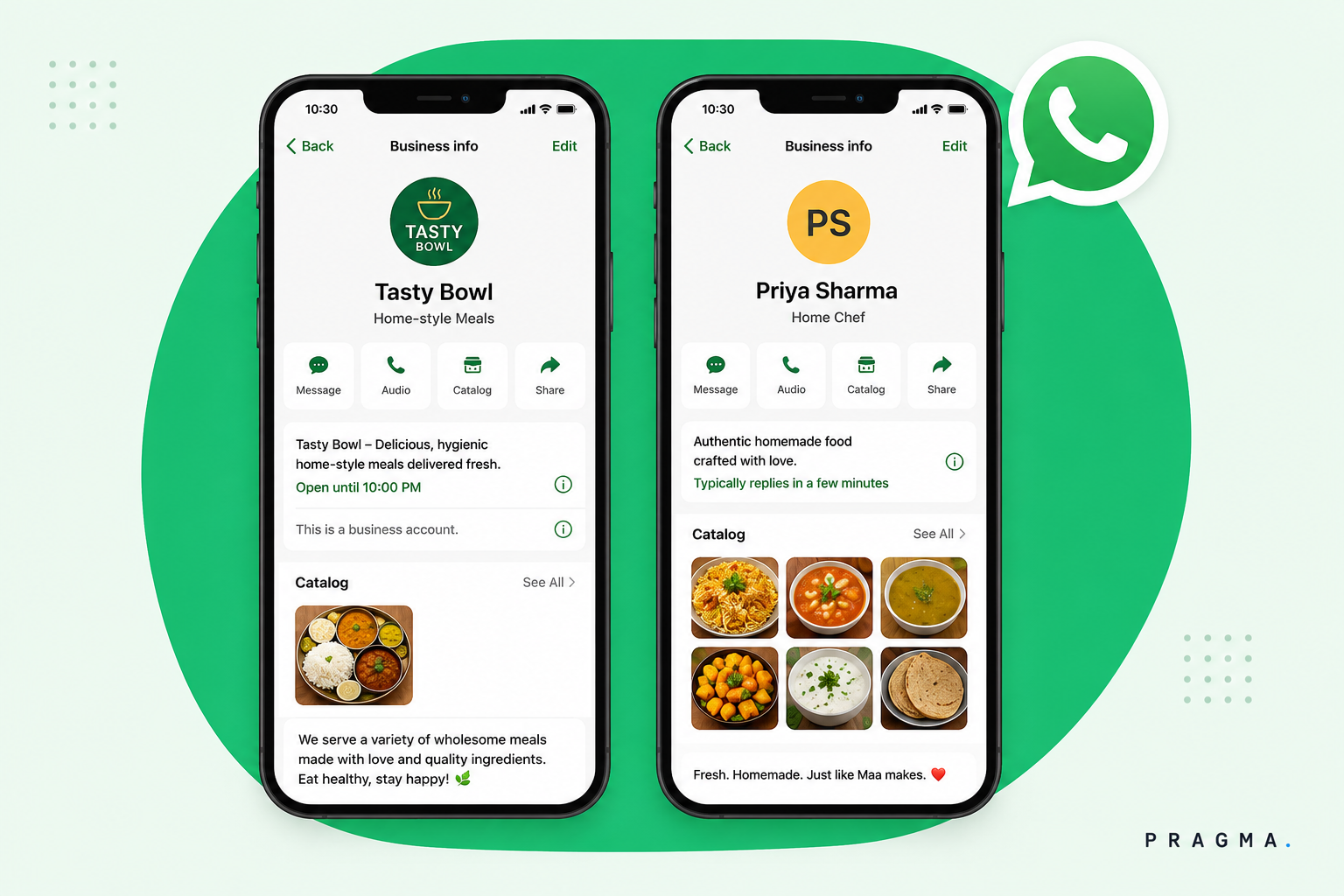
If we talk about the meaning of WhatsApp Shopping, it is just as simple as regular shopping. But instead of going to the market, you just go to your WhatsApp and check for products from the digital catalogue of the seller.
In other words, WhatsApp Shopping is a feature that allows businesses to sell products and services directly through the WhatsApp messaging platform.
Have a look at how WhatsApp Shopping works!
So, just like a simple user has an account on WhatsApp, similarly, the business has its account on the platform. They have their catalogues there, where all products are added. The customer can browse through them and select the item they want. Just like other online shopping sites, they can add it to their cart and pay for the same. We will discuss this in detail later.
Now, let us see the Difference Between WhatsApp Shopping, WhatsApp Business & WhatsApp Commerce API.
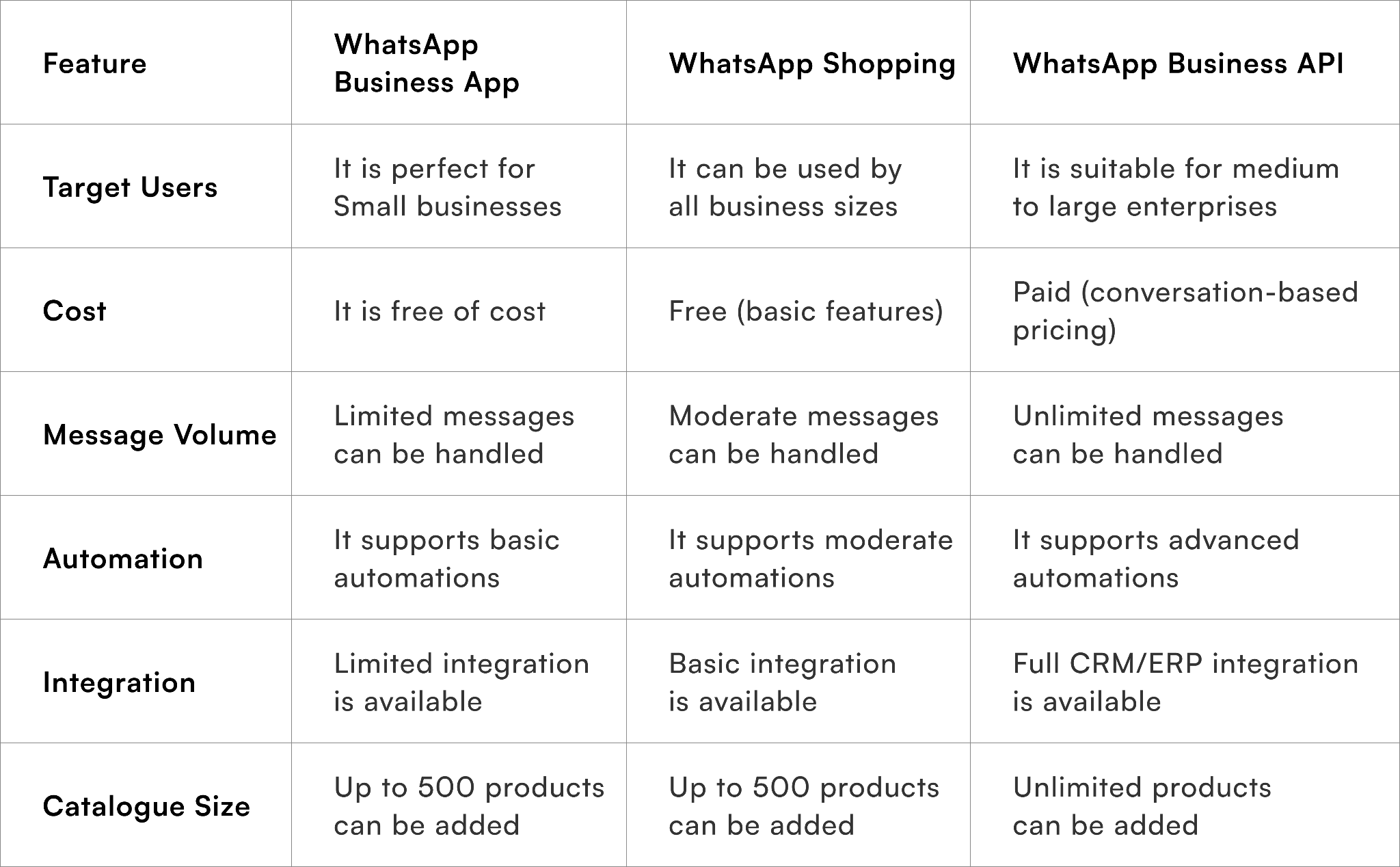
So, as we have seen what WhatsApp Shopping is, how it works, now the question arises: why do e-commerce brands need this? Let us find an answer to this question!
Why WhatsApp Shopping Matters for E-commerce in India?
WhatsApp is a very common app that is used by millions of Indians. With over 535.8 million users in India, almost everyone with a smartphone has WhatsApp. And when a platform has so much potential that everybody nearly uses it, it is obvious that WhatsApp Shopping can be the next tremendous sector in India in the world of e-commerce.
Also, the market, like India, is very diverse. There are different religions and languages, and WhatsApp supports many of them. It works in Hindi, Tamil, Bengali, and many other Indian languages. Thus, this helps e-commerce brands to connect easily with the customers without providing multiple websites to be religion-specific.
The next thing that makes WhatsApp a must-have for e-commerce brands in India is the trust factor. Indians believe in real-time talk, and through WhatsApp, it is possible. The customers can ask questions through chat on WhatsApp through the business, either from automated customer support or in real-time communication.
How WhatsApp Shopping Works?
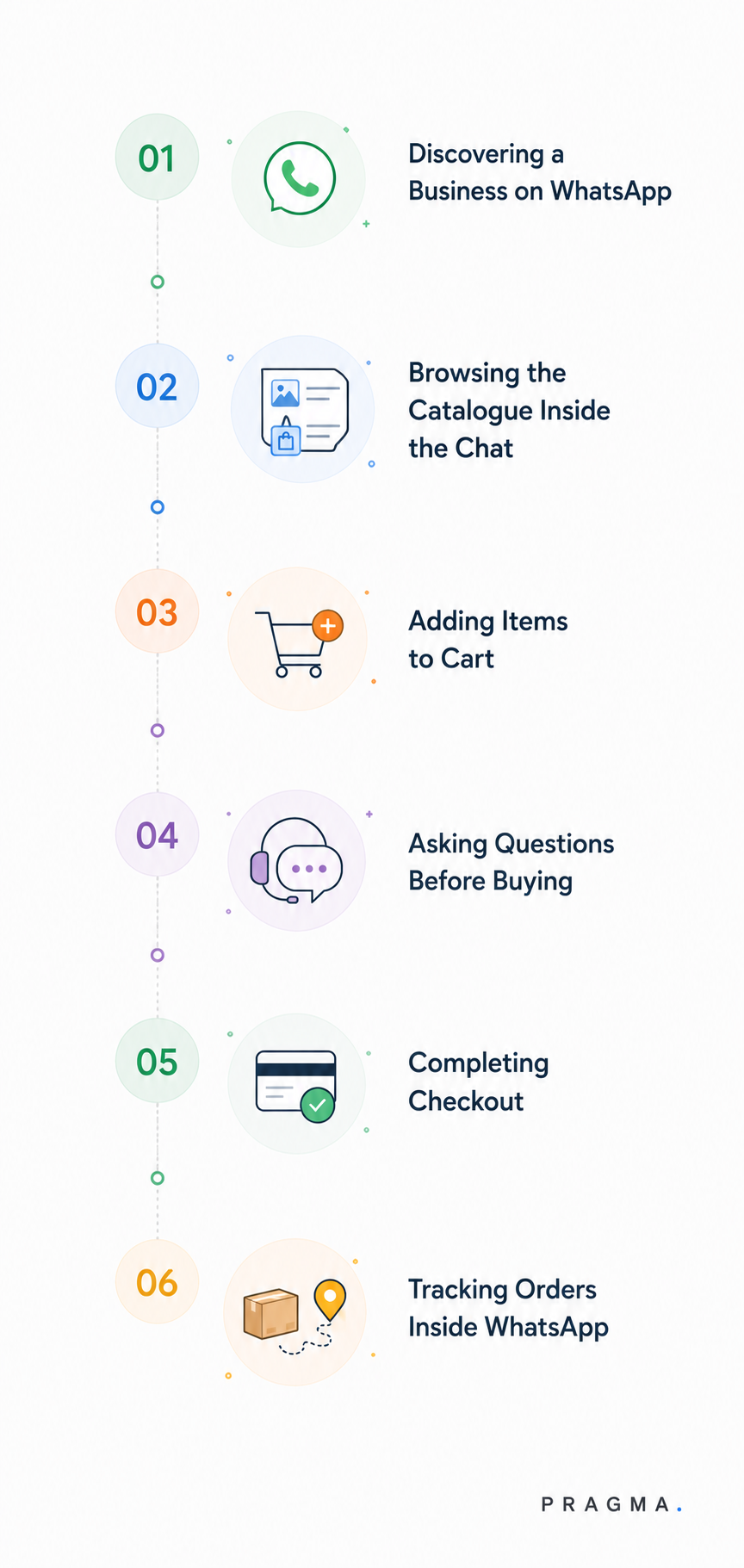
Here is how WhatsApp shopping works:
1. Discovering a Business on WhatsApp
The first thing is discovering the brand on WhatsApp. It can be through links from social media, ads, QR codes, etc. After a customer finds it, they can surf the business's account.
2. Browsing the Catalogue Inside the Chat
The business has its catalogues, where products are added along with proper descriptions about the product, with high-quality images and prices.
3. Adding Items to Cart
Customers can easily browse through the catalogues, and can select the items with the help of quick action buttons like add to cart. After the customer added the products to their cart, the message was sent to the business owner to place the order.
4. Asking Questions Before Buying
During this whole process, WhatsApp, through its automated support or real-time communication with the sales team, can handle common queries and guide customers through the buying process.
5. Completing Checkout
An important thing to note here is that this is not the complete checkout; the business here still confirms the order with the customer. This time, the business sends the total amount and sends the payment link to the same chat.
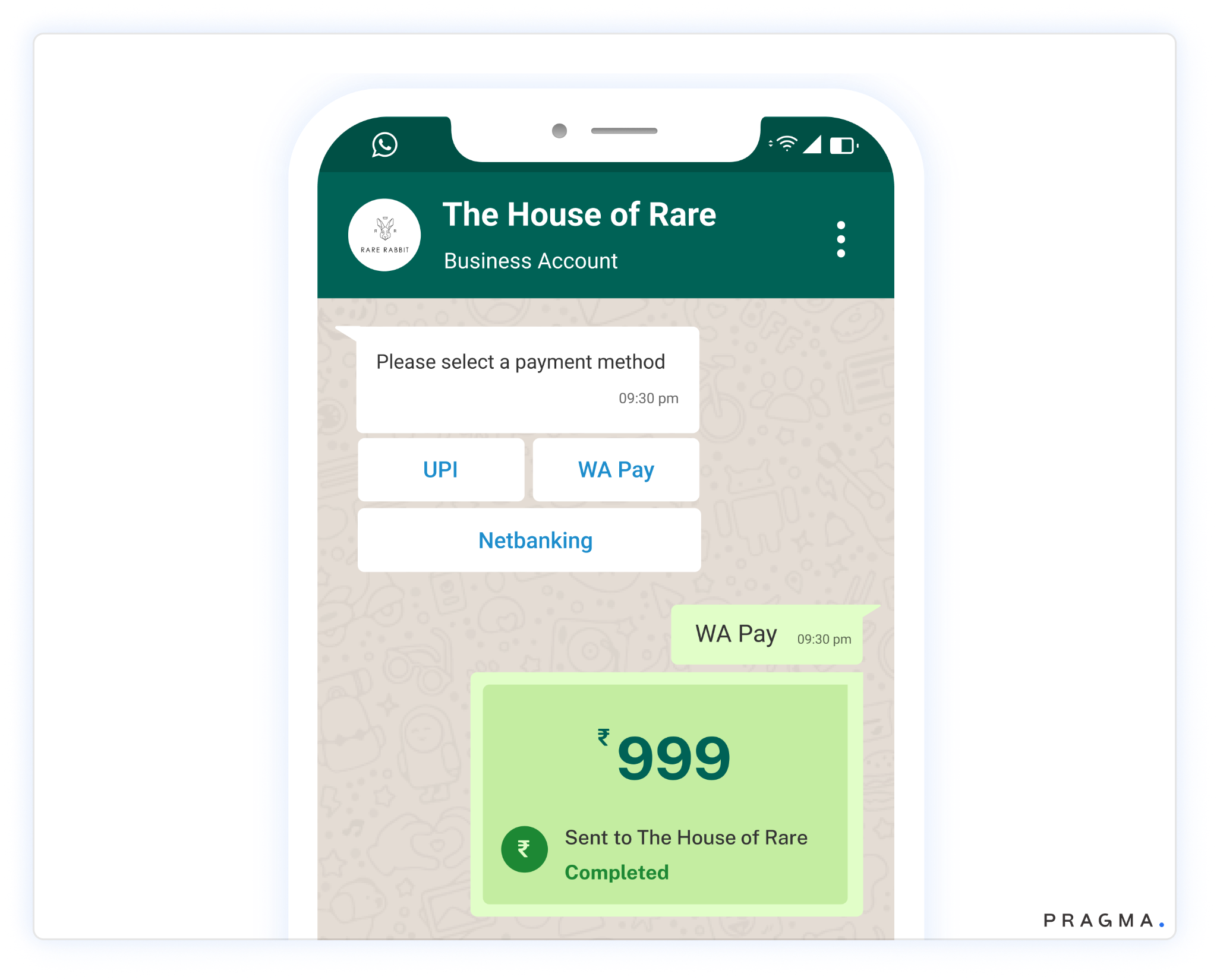
The customer then taps the pay option and is redirected to WhatsApp Pay. This is the only method of payment available in India. Customer then:
- Select a bank account
- Enter UPI PIN
- and confirms the payment
And all this is done while being on WhatsApp itself, no need to go anywhere else.
6. Tracking Orders Inside WhatsApp
WhatsApp also provides post-purchase support where customers can track their orders, get real-time shipping updates and can also connect with the team for further support.
What are The Benefits of WhatsApp Shopping for E-commerce Brands?
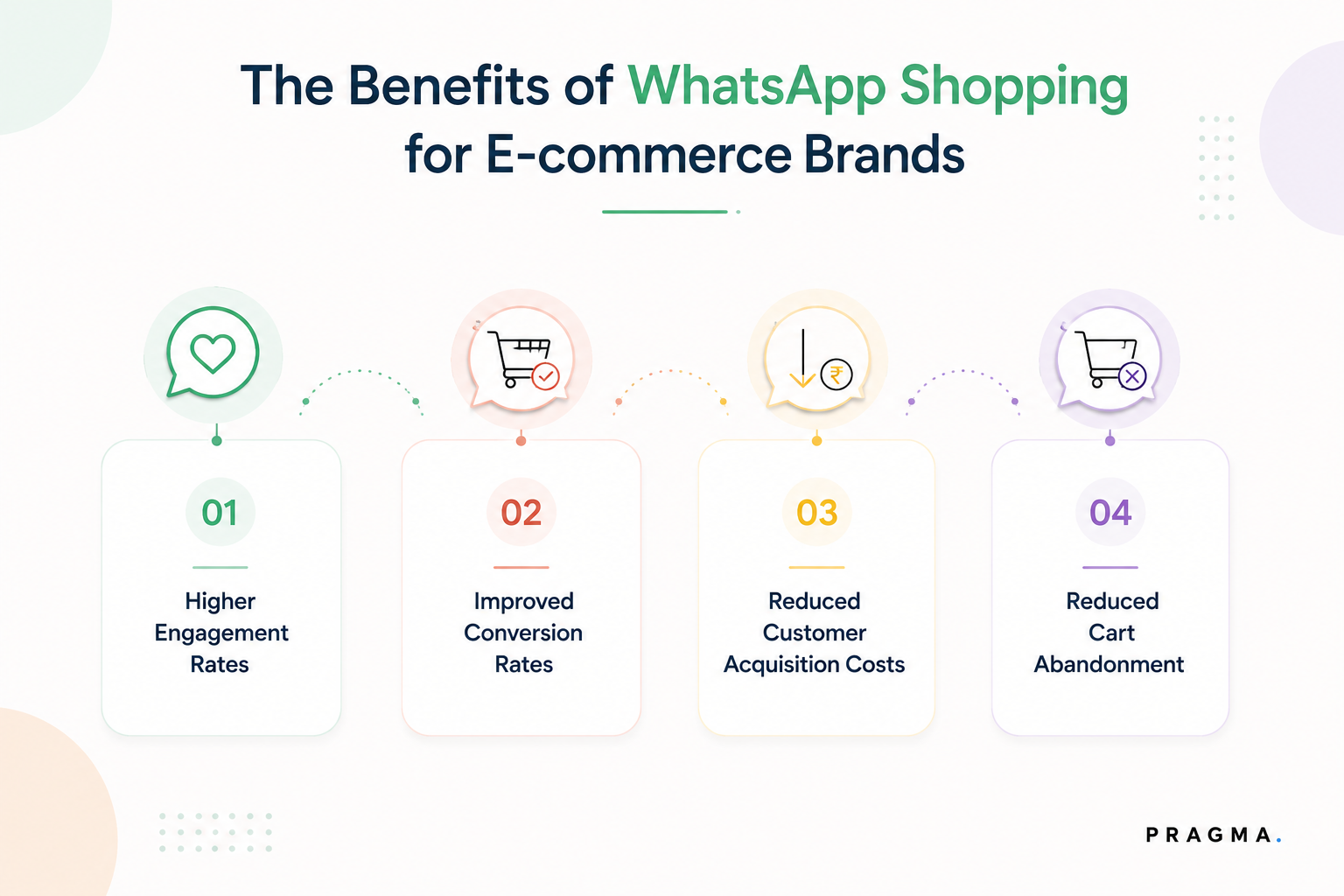
Here are the most common WhatsApp shopping benefits provided to e-commerce brands:
1. Higher Engagement Rates
The first WhatsApp shopping benefit is that it provides e-commerce businesses with higher engagement rates. As WhatsApp messages have a 98% open rate compared to 20% for emails, obviously, brands can reach more customers easily.
2. Improved Conversion Rates
It is obvious that if the rate of engagement is higher, then definitely, there are more chances of getting more conversions and sales.
Brands using WhatsApp Shopping report 2.5x higher conversion rates compared to traditional e-commerce channels, according to industry studies.
3. Reduced Customer Acquisition Costs
In the e-commerce industry, the most hefty costs are about acquiring customers. Because getting a new customer is very difficult, companies have to spend a lot on it.
But with WhatsApp, this is not the case. E-commerce brands can easily get new customers just by easy promotions on social media channels or WhatsApp marketing campaigns that cost very little compared to other methods.
4. Reduced Cart Abandonment
As everything happens on a single platform with real-time customer support, there are fewer chances that a customer will drop out. This is how WhatsApp Shopping also helps in getting reduced cart abandonments.
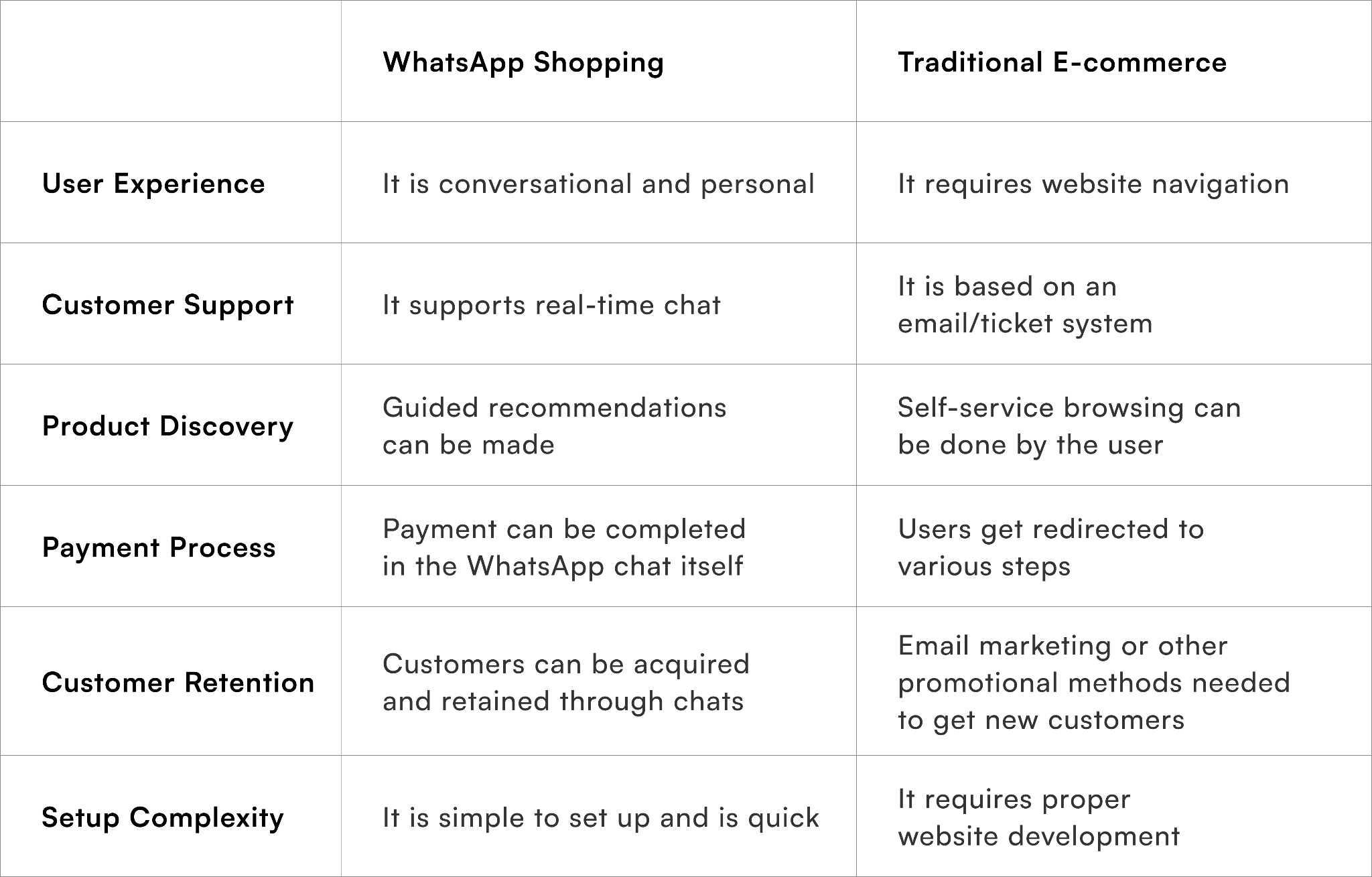
WhatsApp Shopping vs Traditional E-commerce
What are The Key Features of WhatsApp Shopping?
1. Product Catalogues
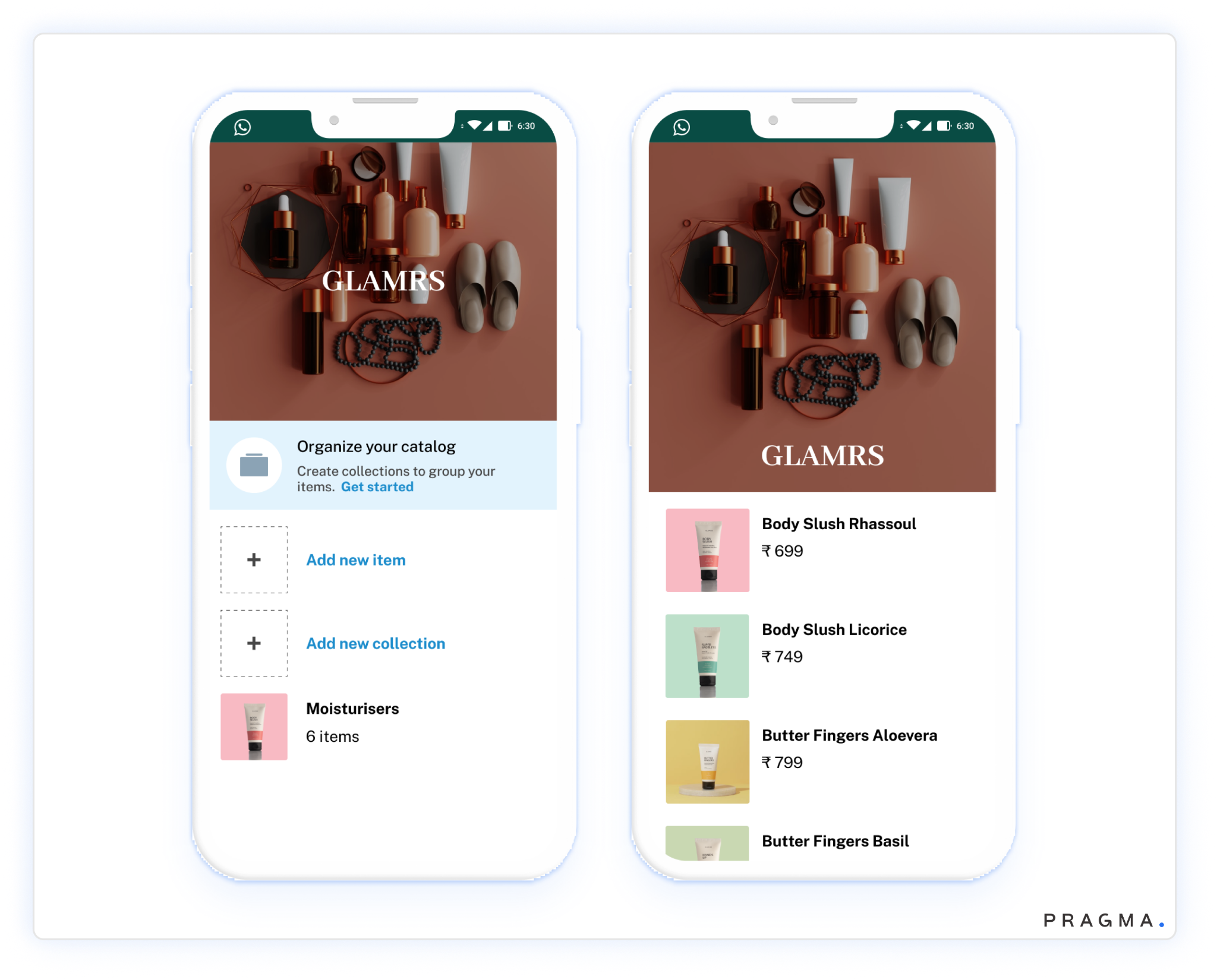
WhatsApp Shopping allows businesses to add product catalogues for up to 500 products in the free version. Here, brands can add their products with the proper descriptions, high-quality images with multiple angles.
2. Shopping Cart
Like an e-commerce platform, WhatsApp also provides its customers with a shopping cart feature, where they can add items they like to purchase.
3. Product Collections
Products can be grouped into categories (like Men, Women, New Arrivals) for easy browsing.
4. Interactive Messages
This is one of the most common features that we all know. WhatsApp is a communication platform, and for shopping purposes, it also provides the same.
5. Quick Replies & Automation
Businesses can use automated messages and quick replies to respond faster during shopping.
6. In-Chat Payments
In India, WhatsApp shopping allows businesses to provide in-chat payments by providing the payment links to the customer. With the help of this feature, the payments can be made easily by being on WhatsApp itself.
How E-commerce Brands in India Use WhatsApp Shopping?
As we have seen that the rise of WhatsApp is at its peak, which is why many e-commerce brands in India are shifting to WhatsApp shopping and using it to drive more conversions and increase sales.
Let us have a look at the example of JioMart! JioMart is one of India's largest grocery platforms. It enables users to browse its catalogue, add items to cart, and pay and all within WhatsApp chat.
More brands like Rare Rabbit and Neeman's use WhatsApp to share style guides and outfit recommendations, provide size consultations and offer exclusive previews of new collections.
This is how, lot of D2C e-commerce brands are using WhatsApp shopping to get new customers, better conversions, and increase sales. Now, let us see how, in other ways, brands can use WhatsApp shopping.
WhatsApp Shopping Use Cases for D2C Brands
Here is how D2C brands can use WhatsApp Shopping to improve and increase their business:
Product Discovery & Catalogue Sharing
With the help of WhatsApp Shopping, brands can share their full product catalogue on WhatsApp with images, prices, and descriptions. Without the need for a website, small brands can even run their business, where customers can browse and search for the products they want.
Conversational Selling (1-to-1 Chat)
When running an e-commerce business, there are customers who want to ask questions, have queries about the product, and they buy when they get answered. WhatsApp enables instant replies, voice notes, and images, helping brands guide customers like an in-store sales assistant.
Order Placement Through Chat
WhatsApp Shopping is one of the platforms that enables businesses to get orders on the chat itself. With its help, they can get orders from their customers without the need for any website or external apps. Customers can easily add the item to the cart and place their order.
Build Relationships By Personalised Messaging
With the help of WhatsApp, brands can build relationships with customers by sending them personalised messages, sending them offers or suggestions. This helps to build trust and a connection with the customer.
Payments Collection
Businesses send UPI links, payment buttons, or COD options through WhatsApp. Customers complete payments easily using their preferred method.
Can Recover Abandoned Carts
With the help of WhatsApp, brands can convert a major portion of their abandoned carts easily. If a customer once shows interest but did not place the order, brands can send them personalised messages by giving them offers and discounts, which can help to get the order placed.
Returns, Refunds & Exchanges
With WhatsApp Shopping, brands can not only place their orders, but they can also request returns or exchanges on WhatsApp. Brands can share instructions, pickup details, and refund updates through chat.
Can Send Personalised Product Recommendations
By keeping a view on the customer's past histories and preferences, brands can send personalised recommendations and suggestions to the customer based on that. This would help them to get more sales and revenues easily, just by sending some personalised messages.
Marketing & Promotions
Brands send broadcast messages about new launches, discounts, festive offers, and restock alerts (only to opted-in users). This helps brands to promote their business without spending a lot on heavy marketing charges.
How to Set Up WhatsApp Shopping for Your Brand?
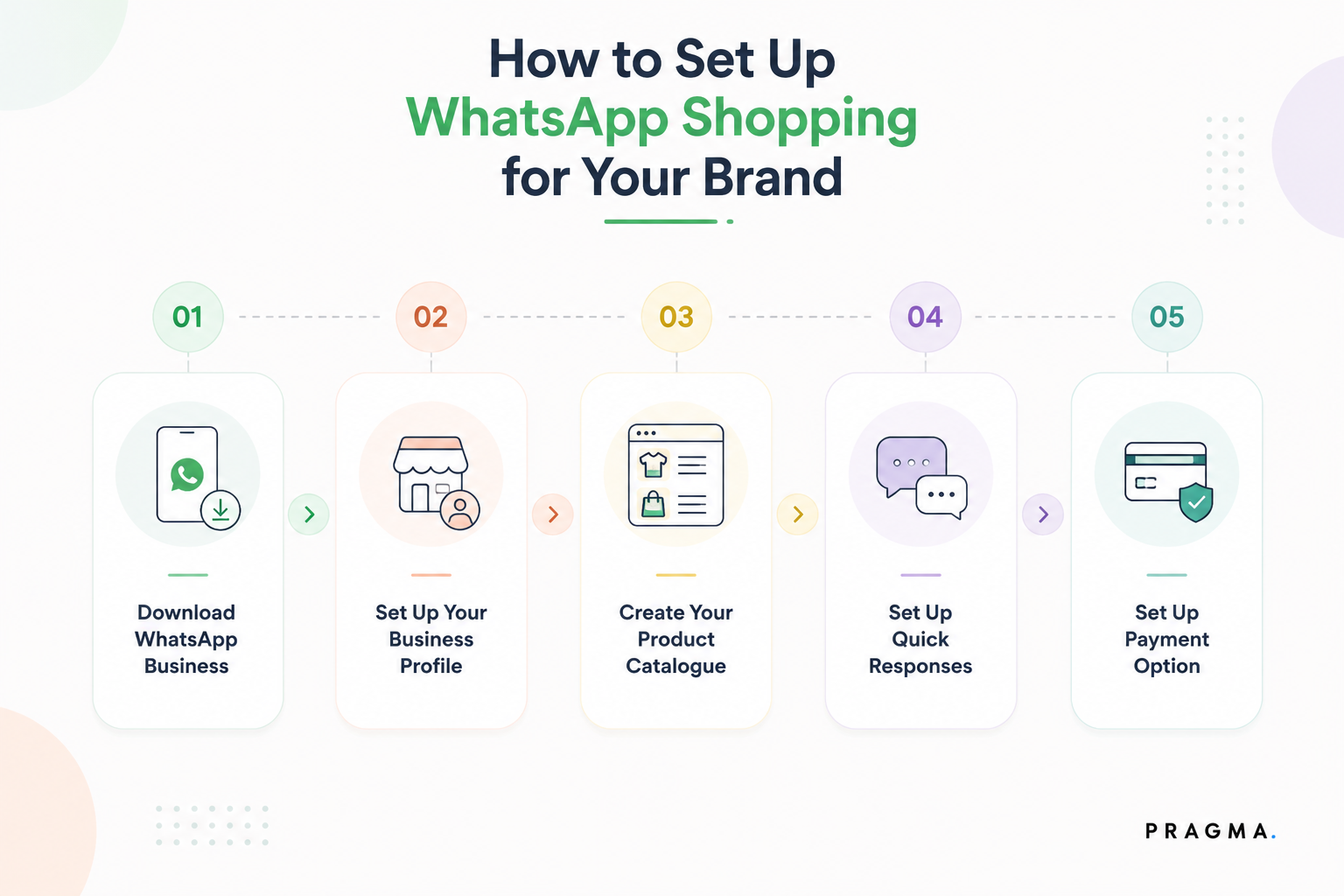
If you're a business owner wanting to start WhatsApp Shopping, here's how to do it:
Step 1: Download WhatsApp Business
If you are a small business owner, you can download WhatsApp Business directly from the Play Store or App Store. It is free of cost and is perfect for your business.
But if you have a large business, then you should go for WhatsApp Business API, where you can handle thousands of customers easily. You can choose providers like Pragma. Through its WhatsApp Business Suite, you can reach over 400 million users in India without making much effort.
Step 2: Set Up Your Business Profile
To set up your profile, you have to fill out the following essential information:
- Business name (exactly as customers know you)
- Business description (what you sell in simple words)
- Business address (so customers can find you)
- Business hours (when you're available to chat)
- Website link (if you have one)
- Professional logo or photo
Step 3: Create Your Product Catalogue
Now, the next step is to build your product catalogue. In this, you have to add your product photos, write proper descriptions about the products and provide prices, so that the customers can directly purchase from there.
Step 4: Set Up Quick Responses
WhatsApp allows you to add quick answers to the most common questions that people ask. You should have set proper responses to those questions. Here are examples of some of the common questions:
Common Questions to Prepare For:
- "Do you deliver to [area name]?"
- "What payment methods do you accept?"
- "How long does delivery take?"
- "What's your return policy?"
- "Are you open today?"
Step 5: Set Up Payment Option
Establish your preferences by setting up WhatsApp Pay and establishing a reference to a payment instrument for transactions in chats.
WhatsApp Shopping Automation (For Faster Sales)
The automation industry is growing day by day in every field. Similarly, in WhatsApp shopping, we can set up automations. It means that we are setting up things that do not require human intervention to take place.
How Automation Helps Customers?
WhatsApp Shopping Automation is a very helpful tool for businesses as it takes over the whole selling process and solves all customers' problems through WhatsApp, including responding automatically to customers, sending product catalogues, sharing payment links, cart recovery, and giving order status updates.
How Pragma Helps Businesses with Automation?
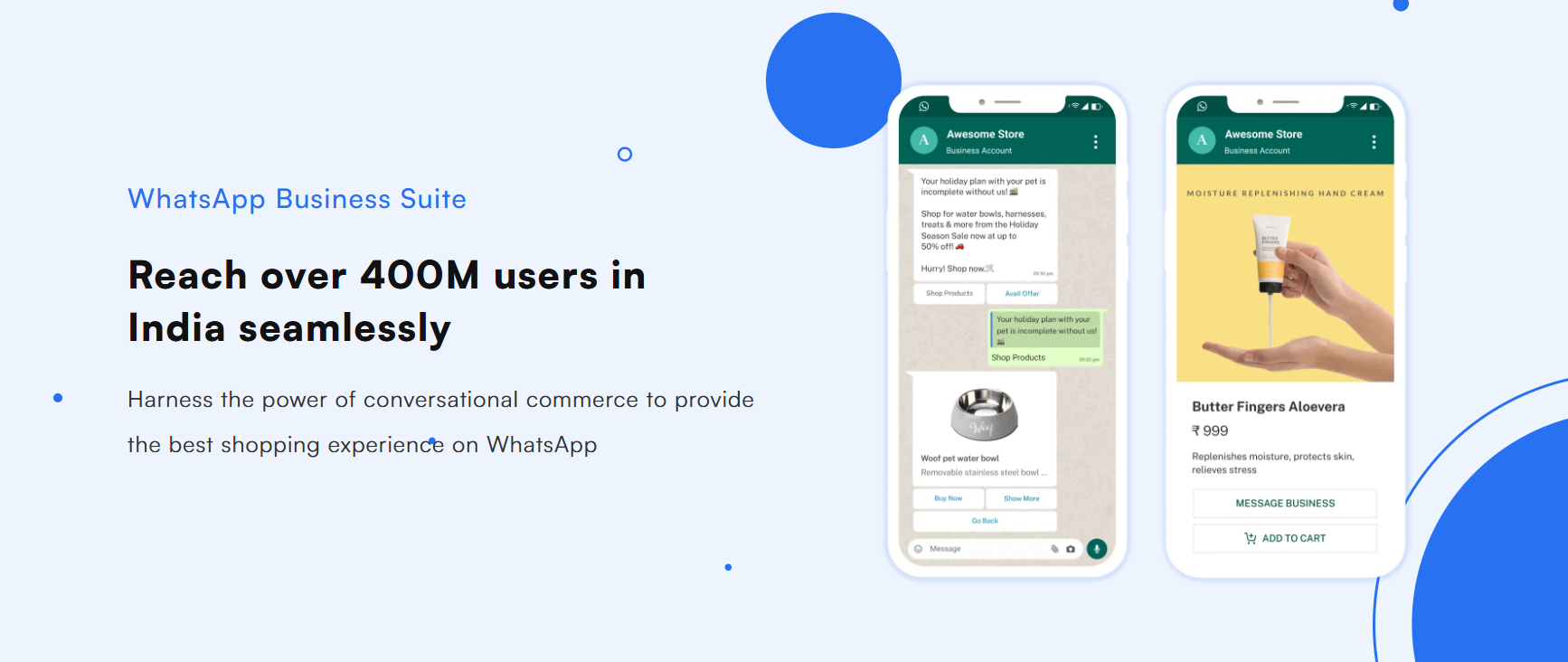
Pragma's WhatsApp Business Suite helps over 1000+ Indian brands create better shopping experiences:
It can:
- Answer common questions instantly
- Help customers find products
- Take basic order information
- Transfer complex queries to human staff
It provides automated workflows:
- Send welcome messages to new customers
- Follow up on abandoned carts with special offers
- Send order confirmations and tracking updates
- Request feedback after delivery
It provides Multi-language Support:
Customers can shop in Hindi, Tamil, Bengali, or any Indian language they're comfortable with.
It can be easily integrated with other systems:
- Automatically update inventory when items are sold
- Sync with payment systems for instant confirmation
- Connect with delivery partners for tracking
WhatsApp Shopping Best Practices for Higher Conversions
Follow the following practices to get more out of WhatsApp Shopping benefits:
- You should reply instantly using auto-messages so customers don't lose interest
- You should use clear product photos, correct prices, and simple descriptions
- Guide customers step by step instead of sending too many messages at once
- You should always try to make payments easy with UPI links, payment buttons, or COD
- You should send friendly abandoned-cart reminders, not pushy messages, to the customers
- Use chatbots to answer common questions quickly
- Share order confirmation, shipping, and delivery updates on time with your customers.
- If your customer wants to return, keep the return and exchange instructions simple and clear
- Send offers only to interested and opted-in customers
- Send personalised messages based on customer interest or past purchases
- Always maintain a polite, helpful, and human tone in every message
- Hand over the chat to a real agent when needed for better support
Why WhatsApp Shopping Is the Future of Commerce in India?
WhatsApp is the most used platform in India, with a growth of 15% annually in the user base. This much potential makes it a suitable platform for e-commerce brands to be present on.
Also, the Indian people believe in trust and real-time updates, which can easily be given to them through personalised messaging, real-time communication with the agents.
Not only is it about the customers, but the business also gets a lot of benefits through WhatsApp shopping. They do not have to spend a lot on creating difficult websites, paying lakhs on promotions and marketing, but by just providing good catalogues, they can have their sales increase in numbers. For small business owners in India, it is just a fabulous platform.
Apart from this, the government is also pushing digital India initiatives, which make it a perfect ecosystem to grow WhatsApp Shopping.
To Wrap It Up
So, to conclude here, we can say that WhatsApp can be one of the good platforms for shopping in India. With a number of active users, free of cost availability for small businesses, along with core key features, it can be the platform that could help businesses to increase their conversion rates and revenues.
The e-commerce brands that want to go big through WhatsApp can look for Pragma WhatsApp Business Suite, which could provide them with a seamless shopping experience. And, we are always here to support Indian D2C brands with full potential to grow.

FAQs (Frequently Asked Questions On WhatsApp Shopping: Meaning, Features & Top Benefits (2026))
1. What is WhatsApp Shopping?
WhatsApp Shopping allows customers to browse products, ask questions, receive recommendations, place orders, and get updates directly within WhatsApp, without visiting a separate website.
2. How does WhatsApp Shopping work for e-commerce brands?
Brands use WhatsApp Business APIs to share catalogues, automate conversations, send payment links, confirm orders, and manage post-purchase communication through a single chat thread.
3. Why is WhatsApp Shopping important for e-commerce in 2026?
Because customers prefer conversational commerce. With rising ad costs and low attention spans, WhatsApp offers higher engagement, faster responses, and better conversion than traditional channels.
4. What features are included in WhatsApp Shopping?
Common features include product catalogues, automated replies, chatbots, payment links, order confirmations, delivery updates, returns support, and customer service handover to agents.
5. Is WhatsApp Shopping suitable for Indian D2C brands?
Yes. WhatsApp is the primary communication channel for Indian consumers, making it ideal for product discovery, order updates, COD confirmations, and support across Tier-1, Tier-2, and Tier-3 markets.
6. What are the main benefits of WhatsApp Shopping?
Key benefits include higher conversion rates, reduced cart abandonment, faster customer support, lower acquisition costs, better post-purchase experience, and improved repeat purchases.
7. Can customers complete payments directly on WhatsApp?
Yes. Customers can pay using UPI, cards, or wallets through WhatsApp payment links or in-chat payment flows, depending on the brand’s setup and compliance.
8. How does WhatsApp Shopping help reduce Return to Origin (RTO)?
By enabling COD confirmations, address verification, delivery reminders, and real-time communication, WhatsApp Shopping reduces failed deliveries and last-minute order refusals.
9. How is WhatsApp Shopping different from website shopping?
WhatsApp Shopping is conversational and guided, while website shopping is self-serve. WhatsApp works better for discovery, assistance, and reassurance, especially for first-time buyers.
10. What trends will shape WhatsApp Shopping in 2026?
Key trends include AI-powered chatbots, personalised product recommendations, deeper CRM integration, faster refunds, and end-to-end shopping journeys completed entirely within WhatsApp.
Talk to our experts for a customised solution that can maximise your sales funnel
Book a demo


.png)