

RTO is one of India's D2C problems that affects e-commerce profitability.
Brands scale demand through paid acquisition. Their orders increase. Dashboards show growth. But revenue realisation does not match order growth.
Because a portion of shipments never completes delivery. They return to the seller. And this is what RTO in courier refers to.
The impact these RTOs made is high. Revenue becomes zero. Logistics cost repeats.
Also, India's e-commerce has a high COD dependence. COD contributes more than 60% of order volume in multiple D2C categories.
These COD orders introduce a higher delivery failure risk compared to prepaid orders. Industry benchmarks consistently show COD RTO rates between 20% and 40%, depending on category mix and geography.
To understand more about this situation that affects a lot of D2C brands in India, let us learn about "What is RTO in Courier? Meaning, Reasons & Impact.
What Is RTO in Courier?
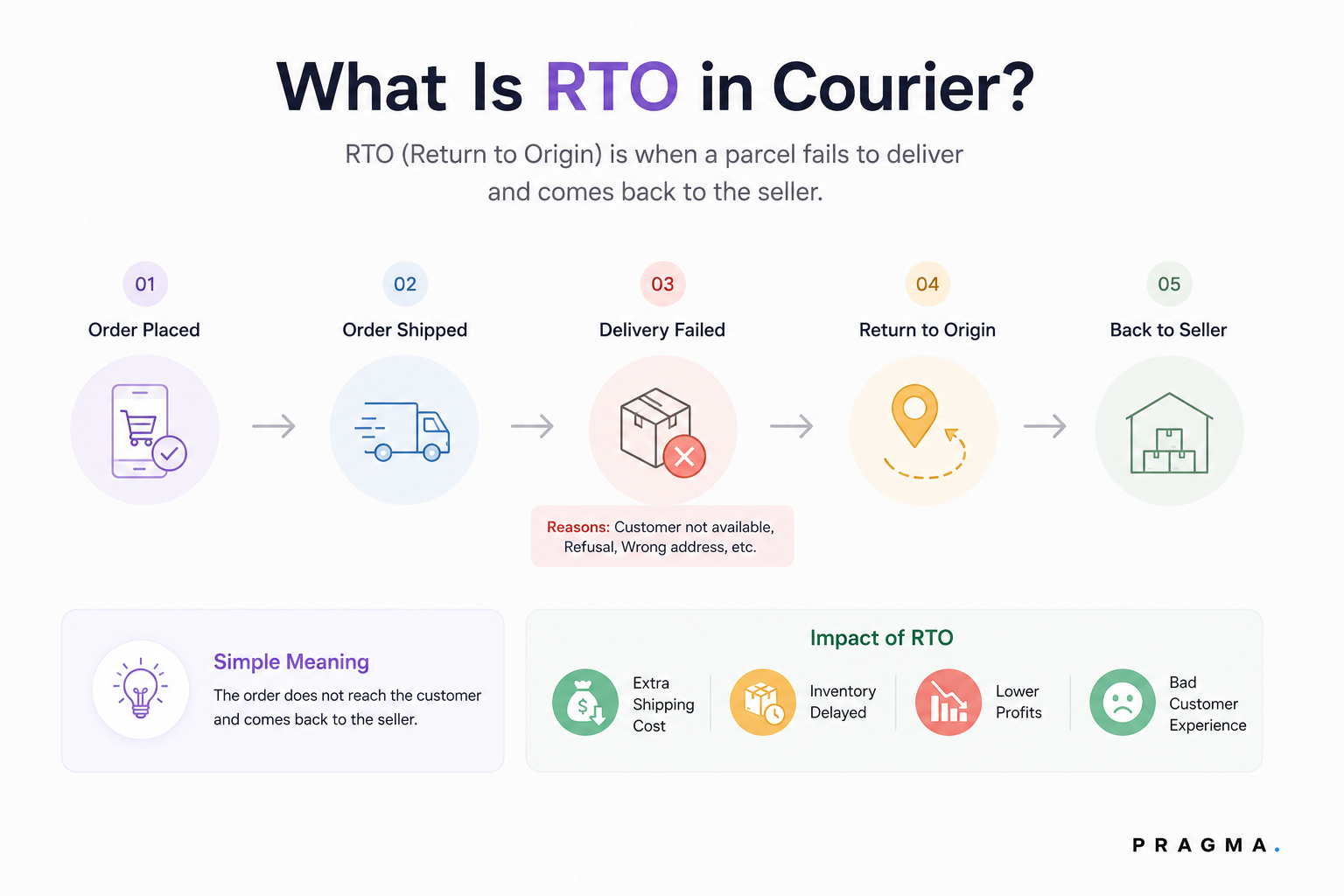
RTO stands for Return to Origin.
It refers to a shipment that fails delivery and returns to the seller's warehouse after unsuccessful delivery attempts or customer refusal.
Courier systems treat RTO as a full reverse logistics cycle.
The shipment moves through:
- Order placed
- Warehouse dispatch
- Courier pickup
- Transit
- Out for delivery
- Delivery attempt failure
- NDR creation
- Reattempt window
- Return initiation
- Return to the warehouse
RTO is not a single event. It is a sequence of failed recovery attempts inside the last-mile execution.
What Does RTO Mean in E-commerce Logistics?
RTO in e-commerce represents a complete order failure. E-commerce brands pay shipping costs twice: once for forward delivery and again for return shipping.
And it is not just about these costs; the brands have to pay a lot of RTO charges:
- Forward shipping charges
- Return shipping charges
- Packaging materials
- Warehouse handling fees
- Staff processing time
- Inventory holding costs
And after paying such amounts, no revenue is generated from these orders.
According to industry data, RTO rates in India range from 20-30% of total orders. This means D2C brands lose potential revenue on every fifth order shipped.
Pragma RTO Suite analyses millions of orders across 1,500+ D2C brands to identify RTO patterns.
It helps brands reduce RTO rates by up to 60% through intelligent order verification and risk assessment algorithms that flag problematic orders before dispatch.
Common Reasons for RTO in Courier (India)
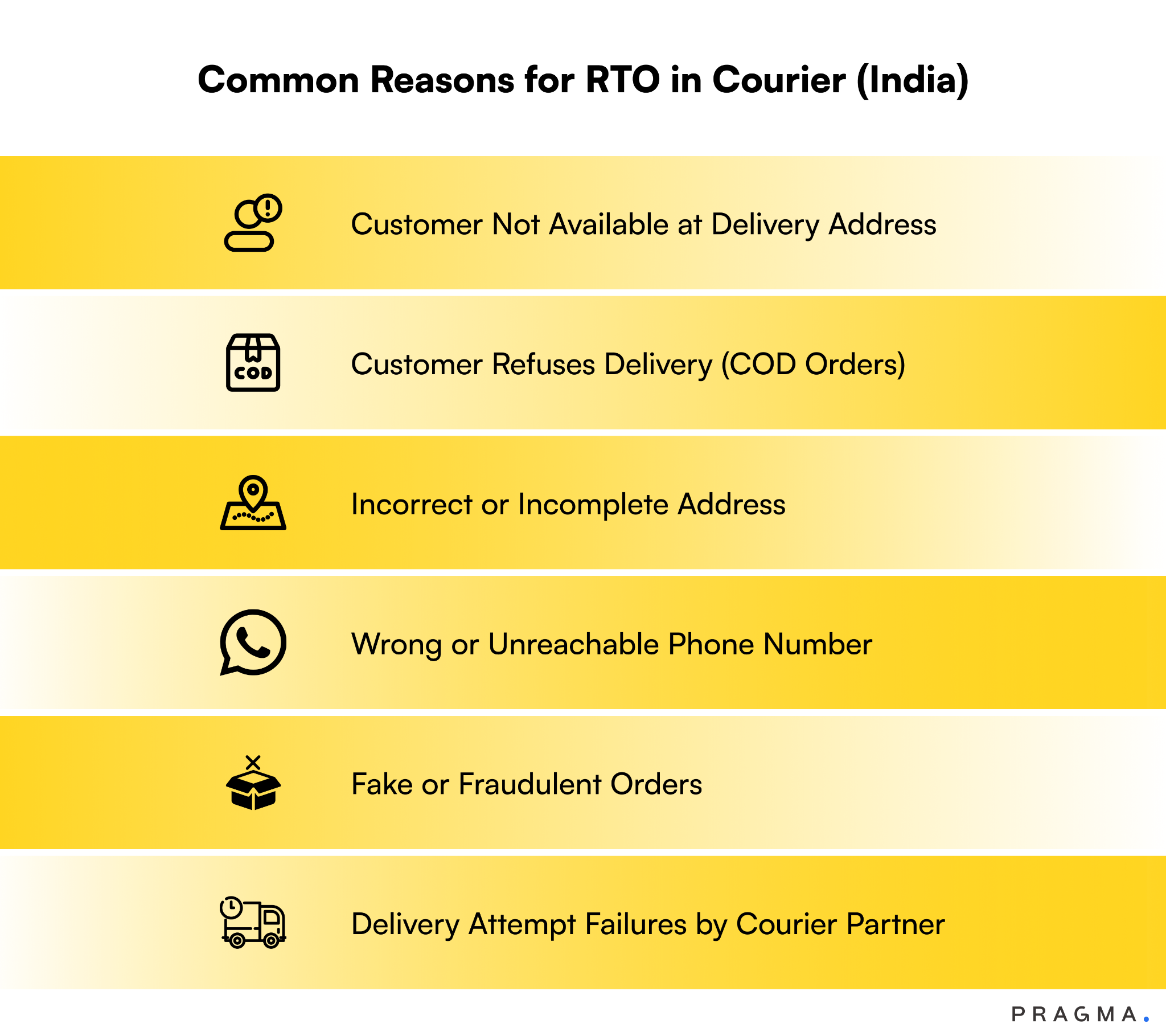
When we have got the answer to what RTO is in courier, now let us see what reasons are behind the occurrence of these RTOs in India.
The most common reasons for RTO in courier in India are as follows:
Customer Not Available at Delivery Address
This is one of the highest frequency RTO drivers. Customer unavailability drives 35% of RTO cases across India.
The core issue is not absence. It is a timing mismatch.
Customers often:
- Use home addresses, but remain at work during delivery
- Missed courier calls due to unknown numbers
- Do not coordinate delivery timing
- Lack visibility into delivery attempt windows
Delivery partners attempt delivery 2-3 times before returning packages.
Once the first attempt fails, courier routing shifts forward, and the reattempt probability reduces. This increases full RTO conversion probability.
Thus, to reduce such situations, Pragma WhatsApp Business Suite enables brands to send pre-delivery messages where a customer can easily confirm or reschedule the delivery if unavailable, reducing unavailability-related RTOs by 25-30%.
Customer Refuses Delivery (COD Orders)
COD introduces intent dilution at the final stage of purchase.
Unlike prepaid orders, COD does not require a financial commitment at checkout. Industry data shows over 25% of COD orders fail compared to 5% for prepaid orders.
It occurs because at the time of delivery:
- Customers reassess purchase decision
- Price comparison happens after order placement
- Purchase intent weakens over time
- Delivery delays reduce urgency
- Alternative products enter the consideration set
COD RTO rates in India often range between 25% and 40%, depending on category and traffic quality.
To prevent RTOs arising from CODs, Pragma RTO Suite follows a C2P conversion, where it strives to increase prepaid orders by 25 to 35% using smart conversion strategies, including nudging your customers to complete their payment through custom offers, discounts, and other perks, via WhatsApp, SMS & Email.
Incorrect or Incomplete Address
Address quality directly impacts courier decision accuracy. Address errors cause 25% of RTO incidents nationwide.
Common failures include:
- Missing house numbers
- Incorrect PIN code mapping
- Missing landmark details
- Autofill errors during mobile checkout
Tier 2 and Tier 3 cities show higher address-related RTO rates due to complex local addressing systems.
Pragma RTO Suite's address validation system checks PIN code accuracy and address completeness before order processing, where orders from temporary residences such as hostels, hotels, or high-risk PIN codes get flagged automatically.
Wrong or Unreachable Phone Number
Courier delivery depends on communication between the agent and the customer. Delivery partners attempt phone contact 3-5 times before marking orders as RTO.
Failures occur when:
- The number is invalid at checkout
- The device is switched off during delivery
- The customer does not answer unknown calls
- Temporary or fake numbers are used in COD orders
Without communication, reattempt cycles break, and RTO probability increases.
Fake or Fraudulent Orders
Fraudulent orders waste fulfilment resources and increase RTO rates.
These orders use stolen payment information, fake addresses, or invalid contact details.
Fraud indicators include:
- Multiple orders from the same IP address
- Bulk COD orders to similar addresses
- Unusual purchase patterns
- High-value orders from new customers
- Mismatched billing and shipping information
Pragma RTO Suite fraud detection analyses 300+ parameters per order. The system identifies suspicious patterns and flags high-risk orders for manual review before dispatch.
Delivery Attempt Failures by Courier Partner
Not all RTO originates from customer behaviour. Some delivery partners show consistently higher RTO rates in specific PIN codes.
Woodland's case study shows courier selection impacts RTO rates by 15-20% across different regions.
Courier-side issues include:
- Incomplete doorstep attempts
- Incorrect delivery status updates
- Weak NDR follow-up systems
- Poor route planning efficiency
Most brands do not separate courier-driven RTO from customer-driven RTO, which leads to incorrect operational decisions.
What Happens After an RTO Is Generated?
When an RTO in courier is generated, it follows these steps:
- Delivery failure is recorded
- NDR is created
- Customer response window opens
- Reattempt is evaluated
- Unresolved shipments move into return transit
- Warehouse receives the returned product
- Quality check is performed
- Inventory is restocked or marked damaged
This cycle typically takes 5 to 15 days, depending on geography and courier network efficiency.
During this period, inventory remains blocked and unavailable for new orders.
What is the Impact of RTO on E-commerce Businesses?
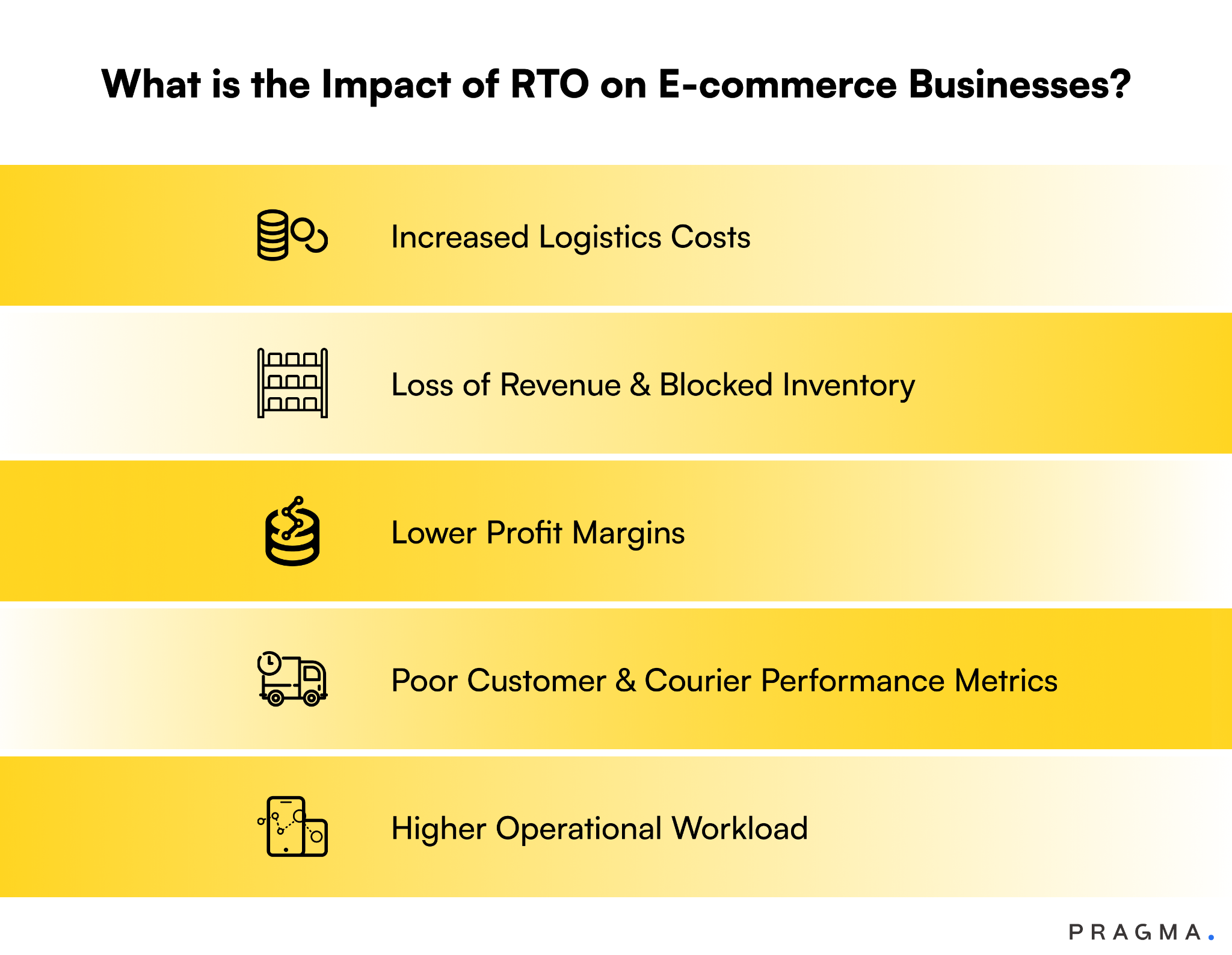
Here is how RTO impacts e-commerce businesses:
Increased Logistics Costs
RTO converts one-way logistics into a two-way cost flow. Brands have to pay costs that include:
- Forward shipping cost
- Return shipping cost
- Packaging cost loss
- Handling overhead
Reverse logistics cost is often 1.5x to 2x higher than forward logistics due to inefficiencies in return routing.
Loss of Revenue & Blocked Inventory
Every RTO represents a lost sales opportunity and tied-up working capital. Products remain unavailable during return transit and processing.
What happens:
- Stock leaves the warehouse
- Moves into transit
- Fails delivery
- Returns after delay
During this cycle, inventory gets blocked for 10-15 days per RTO cycle, reducing stock availability for genuine customers.
Lower Profit Margins
High RTO rates destroy unit economics across product categories. Brands lose money on every RTO order due to doubled logistics costs.
This example shows how RTO turns a profitable order into a loss-making order.
At the time of a normal order (delivery successful)
Let's say a product costs: ₹500, the selling price: ₹1,000, and the shipping cost: ₹100
Here,
Revenue made = ₹1,000
Total cost = ₹600
Profit = ₹400
So, each successful order gives ₹400 margin.
When the RTO happens (delivery failed)
Even without delivery, logistics still run:
The product cost: ₹500, forward shipping: ₹100 and the return shipping: ₹100
Here , the total cost = ₹700 and the revenue made = ₹0
Thus, the loss per order is ₹700.
Poor Customer & Courier Performance Metrics
RTOs damage relationships with logistics partners and affect service quality ratings.
These courier partner consequences occur:
- Increased shipping rates for high-RTO brands
- Reduced delivery priority
- Limited partner options
- Stricter payment terms
- Performance penalty charges
Not only this, but customer experience suffers through delayed refunds and poor delivery success rates.
Higher Operational Workload
RTO increases operational effort across:
- NDR resolution tracking
- Return reconciliation
- Courier escalations
- Refund processing
- Inventory audits
At scale, manual workflows become unsustainable.
RTO vs Customer Returns: What's the Difference?
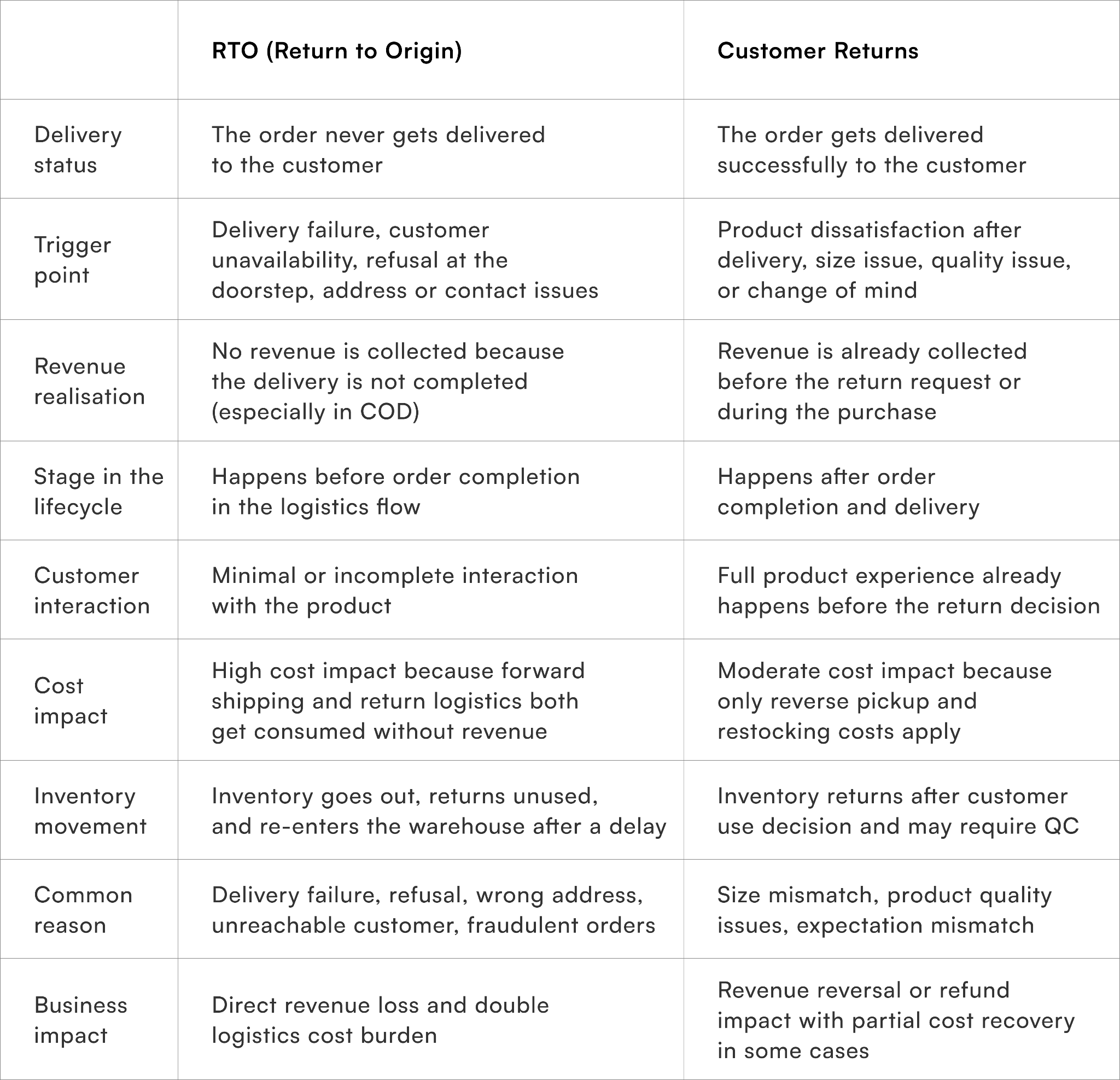
As we know, RTO in courier is the situation where the products never get delivered to the person and are sent to the origin.
But in case of returns, the action to give back the product is taken by the customer themselves.
This is the major difference between RTO and customer returns. To get a more detailed view, have a look at the following table:
How to Calculate RTO Rate in E-commerce?
Here is the formula that is used to calculate the RTO rate in e-commerce:
RTO Rate = (RTO Orders ÷ Total Shipped Orders) × 100
Let us take an example:
Total shipments = 10,000
RTO shipments = 2,000
RTO rate = 20%
But not all RTOs are calculated like this; some may have key segmentation dimensions on the basis of:
- COD vs prepaid
- Courier partner
- PIN code clusters
- Acquisition channels
- Product categories
This helps identify where leakage is happening, not just how much.
How to Reduce RTO in Courier? (Best Practices)
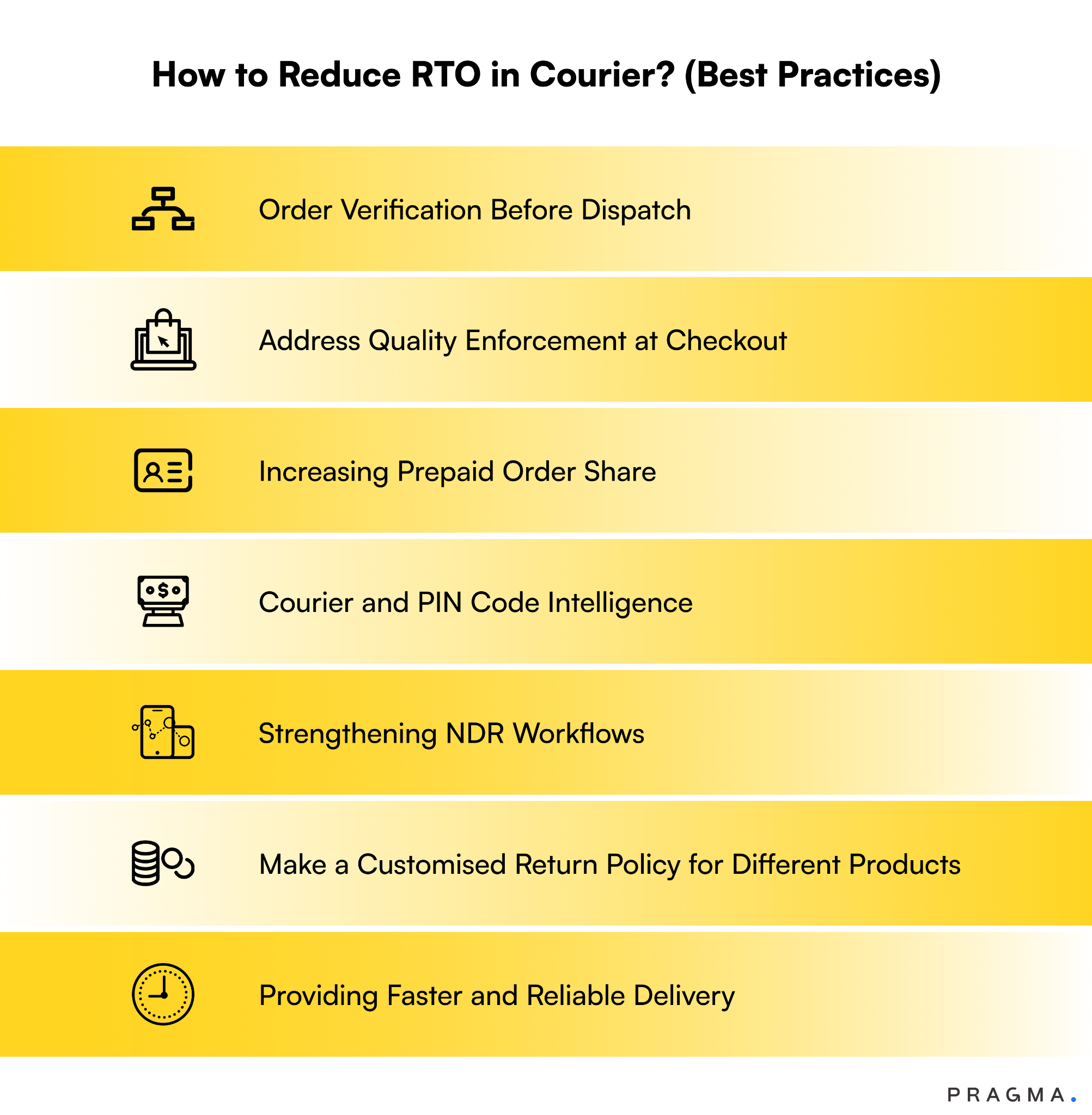
E-commerce brands that want to reduce their RTO rates must implement these strategies:
Order Verification Before Dispatch
RTO often begins with orders that never had strong purchase intent.
These include fake COD orders, impulse purchases with no commitment, and high-risk traffic from paid campaigns.
Order verification adds a checkpoint before shipment. Brands validate intent through OTP confirmation, WhatsApp confirmation, or IVR calls for COD orders.
This step reduces unnecessary dispatches and improves delivery success rates because only confirmed orders move into the logistics flow.
Address Quality Enforcement at Checkout
A large portion of RTO comes from incorrect or incomplete address data. When the courier cannot locate the delivery point, the shipment enters failed attempt cycles that often end in RTO.
Address issues usually come from missing house numbers, incorrect PIN codes, weak landmark details, or autofill errors during mobile checkout.
Fixing this requires structured address capture at checkout.
- PIN code validation ensures serviceability accuracy.
- Mandatory landmark fields improve last-mile navigation.
- Address suggestions reduce manual entry errors.
These improvements reduce ambiguity during delivery and increase first-attempt success rates.
Pragma RTO Suite screens all customer information, such as address, pincode, phone number, etc., and verifies and auto-corrects if needed.
Increasing Prepaid Order Share
COD introduces uncertainty at the delivery stage because the payment decision happens after the shipment reaches the customer.
Prepaid orders remove this uncertainty. Once payment is completed at checkout, delivery becomes a fulfilment process instead of a decision point.
Brands that shift higher toward prepaid consistently see lower RTO rates because intent is locked earlier in the funnel.
That is why Pragma RTO Suite focuses on increasing prepaid orders with a smart C2P strategy, with which it helps e-commerce brands to get a 25-35% increase in prepaid orders.
Courier and PIN Code Intelligence
Certain PIN codes, cities, and courier partners show consistently higher failure patterns.
Without visibility into this, brands treat all shipments the same, which increases systemic leakage.
A structured approach involves:
- identifying high-risk PIN clusters, comparing courier performance across regions, and adjusting routing based on historical RTO behaviour.
- Some zones may require prepaid-only policies or courier reassignment to improve success rates.
This transforms RTO from a random outcome into a predictable pattern that can be controlled.
Within 200ms from order placement, Pragma RTO Suite's AI algorithm scans 300+ parameters to identify & flag risky orders in real-time.
All such orders from temporary residences like hostels, resorts, or high-risk pincodes get flagged automatically, which helps in flagging impulse buyers, fake orders, and orders made by bots.
Strengthening NDR Workflows
Non-Delivery Reports represent the final control point before a shipment becomes RTO.
When a delivery fails, there is still a recovery window. If this window is not managed properly, the shipment automatically converts into RTO.
Fast NDR response is critical. This is what brands should do:
- Customers must be contacted immediately after a failed attempt.
- Retreats should be scheduled quickly.
- Communication should happen across multiple channels, such as WhatsApp and SMS, to improve response rates.
Slow NDR handling is one of the biggest hidden reasons behind high RTO rates. That is why monitoring of courier partner performance is a crucial part of Pragma's NDR Management.
Make a Customised Return Policy for Different Products
You need to filter return requests because not everything that a customer buys can be returned.
You can put restrictions such as:
- All electronics above INR 5,000 will be routed to the service centre, instead of the e-commerce brand.
- Specific items in clothing, like innerwear, can't be returned.
- 7-day return period for specific items
- Issuing coupons/wallet refund instead of a full refund.
- A strict exchange policy instead of a return.
When an order is placed, the brand shares an estimated delivery date with the customer. This date sets the customer's expectation for delivery.
When the order does not arrive within this time, customer trust drops. Some customers cancel the order or buy the same product from another website. This increases the chance of RTO or cancellation.
To reduce this, delivery partners need clear targets for first-attempt delivery within the promised date. Faster and more accurate first attempts reduce missed deliveries and lower RTO rates.
With Pragma RTO Suite, brands can work with courier partners to offer delivery date and time selection. This helps customers choose a time when they are available, which improves successful delivery.
Another simple step is sharing the delivery agent's contact number with the customer. This helps both sides coordinate easily and avoid failed delivery attempts.
What is the Role of Technology in Reducing RTO?
RTO control requires system-level visibility across fragmented courier and order data.
Core requirements include:
- Courier performance tracking
- PIN code risk intelligence
- Order intent scoring
- NDR lifecycle monitoring
- Failure attribution systems
- Address validation system
Pragma RTO Suite operates in this layer as an operational intelligence system for D2C teams.
This technology brings all order and courier data into one system, so brands do not rely on scattered reports or manual tracking.
It helps identify risky orders before dispatch, such as low-intent COD orders or high-risk PIN codes, and prevents them from entering the delivery flow.
In simple words, technology reduces RTO by preventing risky shipments, speeding up recovery, and improving delivery decisions using data instead of guesswork.
Final Thoughts
So, let's wrap up now! RTO in courier is such a situation that cannot be ignored, nor can any brand save itself from this.
But with proper management and by adopting preventive strategies, this situation can be controlled.
Moreover, technology plays an important role. Tools such as Pragma RTO Suite help brands to reduce RTO rates by 60% with features like automated order verification, NDR management, screening customer information, and providing risk assessment scores on the basis of behavioural analysis and past histories.

FAQs (Frequently Asked Questions On What Is RTO in Courier? Meaning, Reasons & Impact)
1. What is RTO in courier services?
RTO (Return to Origin) in courier services occurs when a shipment cannot be delivered to the customer and is returned to the sender's warehouse or fulfilment centre.
2. What does RTO mean in eCommerce logistics?
In eCommerce logistics, RTO refers to orders that are returned to the seller after failed delivery attempts, customer refusal, incorrect address details, or other delivery-related issues.
3. What are the common reasons for RTO in courier deliveries?
Common reasons include incorrect delivery addresses, customer unavailability, customer refusal, fake orders, unreachable phone numbers, and failed delivery attempts.
4. How does RTO affect eCommerce businesses?
RTO affects eCommerce businesses by increasing logistics costs, reducing profitability, creating inventory delays, and negatively impacting operational efficiency and customer experience.
5. Why are RTO rates high in India?
RTO rates are often higher in India due to the widespread use of cash on delivery (COD), address inaccuracies, fake orders, delivery refusals, and challenges in last-mile logistics.
6. How can eCommerce brands reduce RTO in courier shipments?
Brands can reduce RTO by validating addresses, verifying high-risk orders, improving customer communication, resolving NDRs quickly, and encouraging prepaid payments where appropriate.
7. What is the difference between RTO and NDR in logistics?
NDR (Non-Delivery Report) refers to a failed delivery attempt that still has an opportunity for resolution, while RTO occurs when the shipment is ultimately returned to the sender.
8. How does customer communication help reduce RTO?
Customer communication helps reduce RTO by confirming order intent, sharing delivery updates, resolving delivery issues proactively, and increasing successful delivery attempts.
9. What tools help track and reduce RTO in eCommerce?
Tools include RTO management software, NDR management platforms, address validation systems, logistics intelligence tools, customer communication platforms, and delivery analytics solutions.
10. Why is RTO management important for D2C brands?
RTO management is important because it helps reduce logistics losses, improve delivery success rates, protect profit margins, and create a more efficient fulfilment operation.
Talk to our experts for a customised solution that can maximise your sales funnel
Book a demo
.png)
.png)