

Returns remain one of the most underestimated cost drivers in Indian D2C operations. For most brands, reverse logistics silently consume 12–18% of net revenue, once pickup costs, quality checks, refunds, and support overhead are accounted for. At the same time, RedSeer reports that over 35% of first-time Indian D2C buyers hesitate at checkout due to unclear or restrictive return policies. This creates a paradox where brands try to reduce returns but inadvertently suppress conversion and repeat intent.
Globally, mature D2C markets approach returns very differently. Leading brands in the US and Europe treat return flows as a trust mechanism rather than a loss function. They design policies, automation, and customer communication to balance cost control with behavioural confidence.
In this comprehensive guide on What Global D2C Models Can Teach Indian Brands About Returns, we’re diving deep into how international D2C leaders segment return reasons, automate decisions, and close the loop between returns and conversion. These strategies have helped global brands achieve 20–30% faster refund cycles, 15–25% lower support load, and measurable improvement in repeat purchase rates. Adapted thoughtfully, these models offer Indian brands a path to reduce costs without eroding trust.
Why are returns a structural problem for Indian D2C brands?
Returns are not random; they follow predictable operational patterns
Indian D2C returns are driven by behaviour, payments, and logistics design. COD still accounts for over half of orders in many categories. That single choice shifts intent quality, delivery friction, and refusal rates. Global brands operate in low-COD markets, forcing pre-commitment earlier in the funnel.
Meanwhile, India’s last-mile variance is high. A delivery that promises two days can stretch to five across Tier 2 routes. This gap widens expectation mismatch, which customers often resolve through returns rather than exchanges. The outcome is not dissatisfaction alone; it is operational leakage.
Another structural issue is returns being treated as a post-sale function. Globally, returns are engineered upstream. Size guidance, delivery transparency, and proactive customer nudges reduce the probability of a return before the order is placed. Indian brands often deploy these levers too late.
How do global D2C brands think about returns differently?
They design for return prevention, not return processing
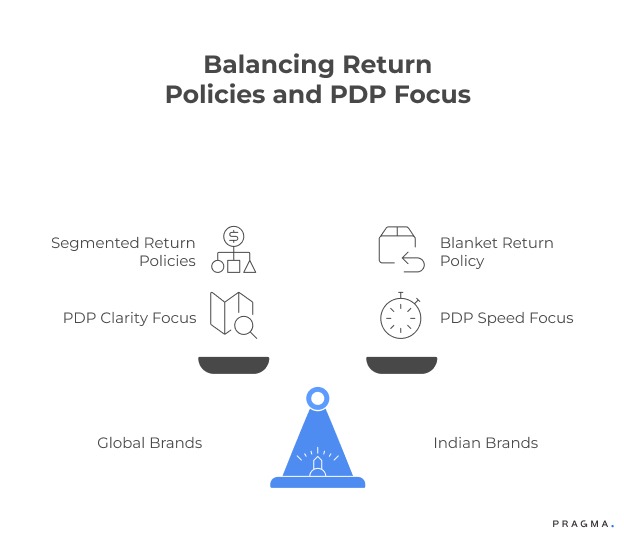
Global leaders frame returns as a controllable cost, not an unavoidable tax. They assign ownership across product, growth, and ops, rather than parking it with support teams. This approach changes incentives and priorities across the funnel.
Consider how US and EU brands optimise product detail pages. Fit, material, and use-case clarity are treated as conversion assets. In India, PDPs often chase speed to launch, sacrificing clarity that could prevent returns later. This trade-off looks efficient until reverse logistics costs surface.
Global brands also segment return policies. High-risk SKUs face stricter windows or store-credit refunds. Loyal customers receive leniency. Indian brands tend to apply one blanket policy, which simplifies ops but ignores behaviour variance.
Why does COD change the returns equation in India?
Payment choice directly shapes delivery outcomes and intent quality
Pragma offers what many consider the best return management system for e-commerce in India, with automated workflows that handle exchanges, refunds, and reverse logistics at scale.
COD amplifies returns through refusal and fake orders. Customers place multiple orders without commitment, planning to accept one. Globally, prepayment filters intent early. Even BNPL requires KYC, adding friction that improves seriousness.
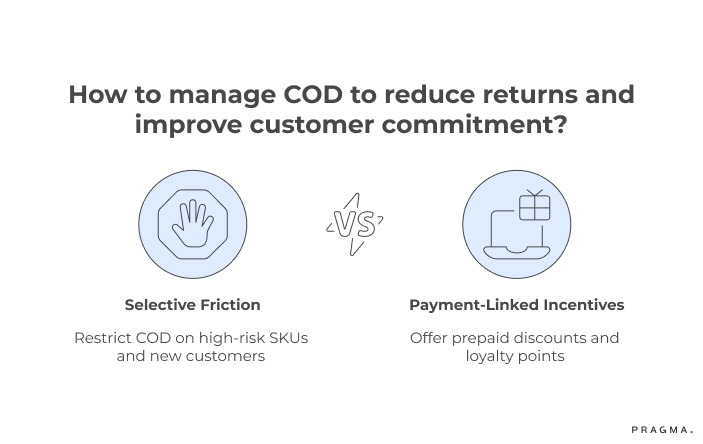
This approach does not imply eliminating COD overnight. Instead, global brands inspire selective friction. They restrict COD on high-return SKUs or new customers. They also pair COD with nudges that reaffirm commitment before dispatch.
Another lever is payment-linked incentives. Small prepaid discounts, faster shipping, or loyalty points shift behaviour without harming conversion. Over time, prepaid cohorts show lower return rates and higher LTV, justifying the short-term incentive cost.
How does logistics design influence returns globally?
Reverse logistics is designed alongside forward fulfilment
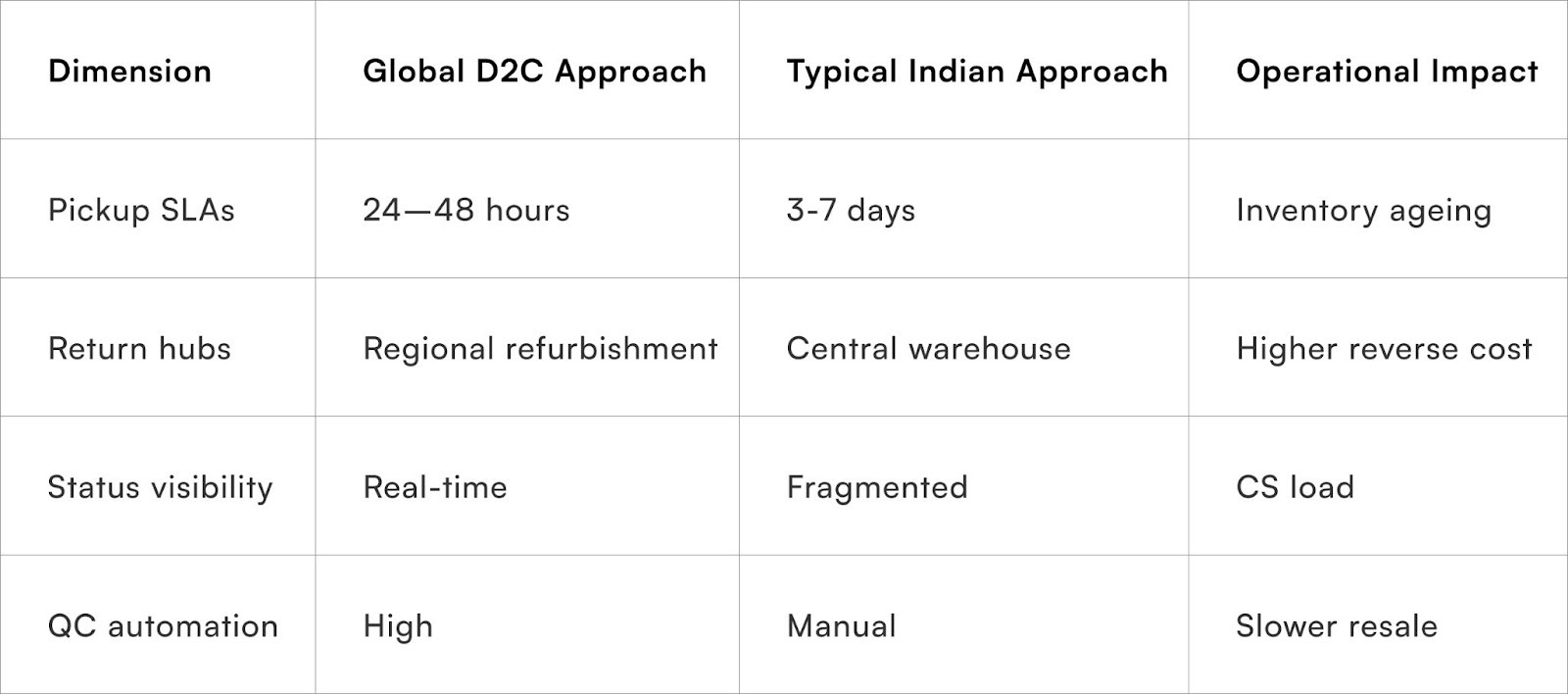
In mature D2C markets, logistics partners are chosen for bidirectional efficiency. Returns are routed to refurbishment hubs, not central warehouses. This shortens cycle times and recovers value faster.
Indian brands often bolt returns onto forward logistics contracts. The result is delayed pickups, poor visibility, and inventory stuck in limbo. Each day adds carrying cost and reduces resale probability, especially for fashion and beauty.
Global brands also standardise return reasons through structured prompts. This data feeds back into product and sourcing decisions. Indian teams collect reasons, yet rarely close the loop operationally due to tooling gaps.
Return logistics comparison — global vs Indian D2C
When should returns be encouraged rather than discouraged?
Not all returns are bad; some protect long-term value
Global brands distinguish between value-destroying and value-preserving returns. A wrong-size apparel return that converts to an exchange preserves margin and trust. A late beauty return destroys both. Policy nuance matters.
Indian brands often discourage all returns to protect cash flow. This can backfire. Customers who feel trapped churn silently, hurting LTV. The smarter play is to channel returns into exchanges or credits where possible.
Timing is critical. Global brands prompt exchanges at the moment of return initiation. India still relies heavily on manual follow-ups. Automating this decision point lifts exchange rates without adding headcount.
How Exchanges Reduce Return Costs for Global D2C Brands?
Global D2C brands attempt to exchange returns as much as they can. They do not give out the money back and miss the sale altogether, but rather make the customers take a different size, colour, or item.
The strategy assists the brands in securing revenue and saving on logistics expenses. In the event that a return turns into an exchange, the order value will remain in the brand, rather than go back to the customer.
To illustrate, within the fashion categories, a high percentage of returns occur due to size or fit problems. The global brands propose another size immediately when a refund is requested, instead of processing a full refund. The new size can be chosen in the same order as the customers, and the substitute product will be delivered promptly.
There are also many brands which provide faster delivery or a slight discount to those clients who want exchanges rather than refunds. This makes the experience of the customers more satisfactory and the brand will regain the sale.
Due to such tactics, major D2C brands will attain 30-40 per cent exchange rates on return requests, which will save a substantial sum of money on reverse logistics.
How do global brands use data to predict returns?
Returns are forecasted, not merely reported
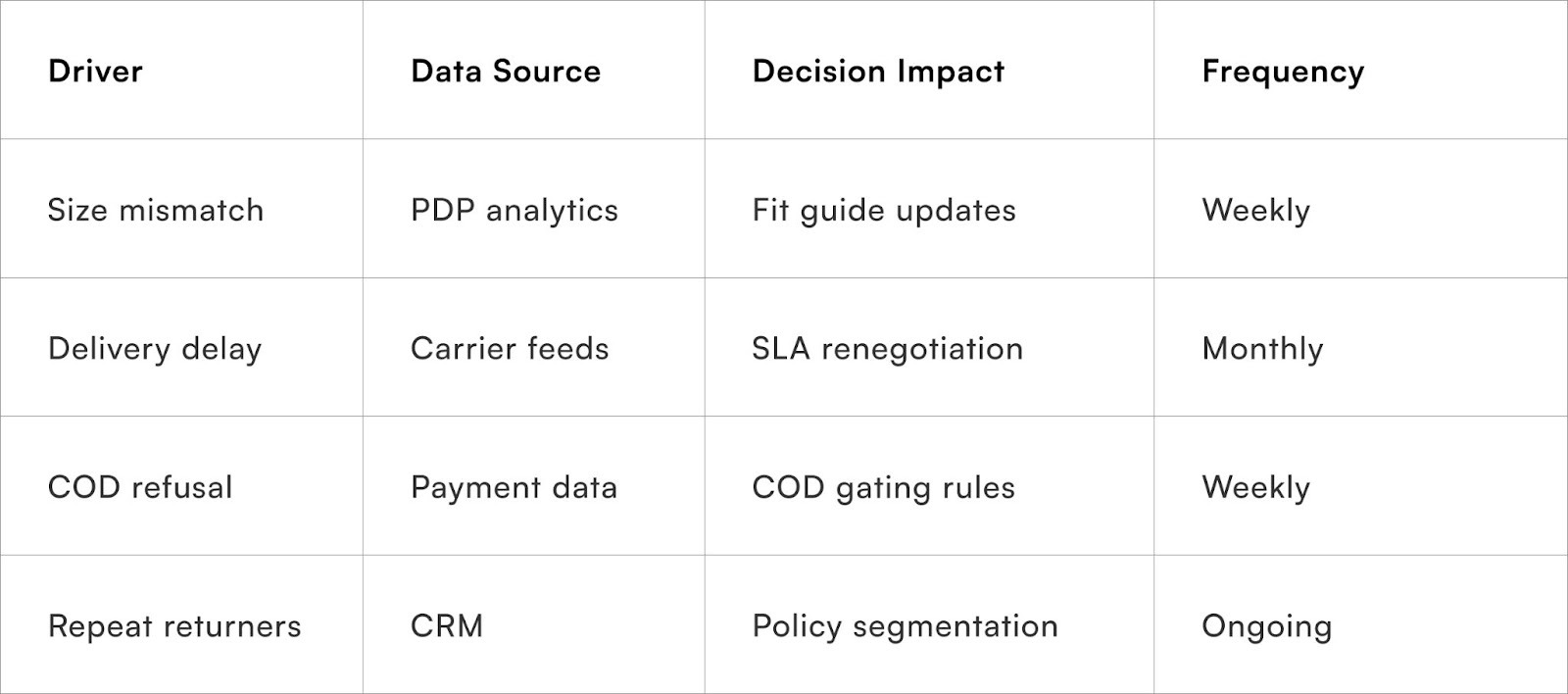
Leading D2C operators model return propensity by SKU, customer cohort, and channel. This informs merchandising, pricing, and even ad spend. High-return SKUs receive lower paid traffic allocation.
Indian brands track return rate as a topline metric. Few break it down by acquisition source or delivery zone. This blind spot leads to scaling campaigns that look profitable upfront but bleed margin post-delivery.
Predictive insights also inform inventory planning. Global teams stock buffer for high-exchange SKUs and tighten buys for volatile designs. This reduces markdown dependency later in the season.
Return drivers tracked by mature D2C teams
What Signals Indicate a High-Risk Return Order?
D2C companies worldwide do not treat every order in the same manner. They apply the data to learn the orders that are most probable to be returned and implement the preventative measures prior to delivery.
There are a number of indicators of a high-risk return order. These include:
- New customers making high-value orders.
- Orders made on Cash on Delivery (COD).
- Customers who place orders for several sizes of the same item.
- Orders of places that have a high rate of returns in the past.
- Higher history of returns, i.e., fashion or footwear.
These signals can be detected by the brands, which can be followed by a few checks before the delivery of the order. As an illustration, they could verify the order via WhatsApp, propose a prepaid order, and offer more details about the products.
Why do return policies differ so sharply across markets?
Policy design reflects customer trust and enforcement
Global return windows are often shorter but clearer. Enforcement is consistent, reducing abuse. Indian brands extend windows to build trust, yet struggle with enforcement across channels.
This leniency attracts misuse. Serial returners exploit generous policies, raising costs for everyone else. Global brands counter this with behaviour-based flags, restricting options quietly without public confrontation.
Transparency also matters. Clear policies reduce disputes. Indian customers often discover exclusions during escalation, not checkout. This gap fuels dissatisfaction and social escalation.
How does customer communication reduce returns globally?
Proactive communication lowers anxiety and impulsive returns
Global brands invest in post-purchase communication. Delivery updates, care tips, and expectation-setting messages reduce buyer’s remorse. Indian brands underuse these moments, focusing communication only when issues arise.
WhatsApp has changed this dynamic in India. Brands that send concise, value-led messages see fewer refusals. The content matters more than frequency. Reminding customers why they bought the product reinforces commitment.
Returns communication is equally important. Clear timelines and refund visibility reduce “panic returns” where customers escalate prematurely due to uncertainty.
How can Indian brands adapt global models realistically?
Local constraints require selective adoption, not blind copying
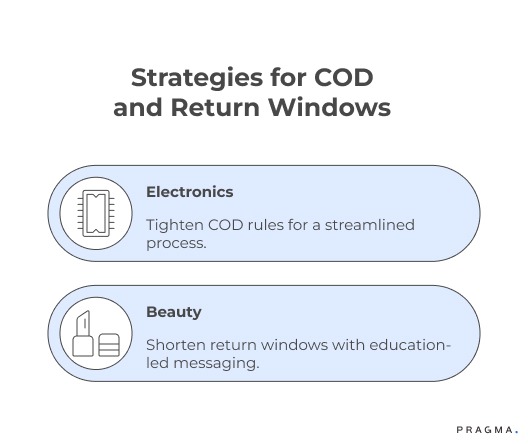
India’s diversity demands flexibility. What works in Germany may fail in Guwahati. However, principles travel well. Segment customers, introduce smart friction, and treat returns as a design problem.
Brands should start with category-specific pilots. Apparel can trial exchange-first flows. Electronics can tighten COD rules. Beauty can shorten windows with education-led messaging.
The goal is not zero returns. It is predictable, controlled returns that preserve margin and trust simultaneously.
How Technology Is Reshaping Returns Management for D2C Brands?
Modern D2C brands are changing their returns management using technology. Many brands have automated return management systems to take returns instead of using emails or a support ticket to handle them manually.
Such systems enable customers to initiate a return request using an easy online platform. Without reaching the support teams, customers may choose the reason for returns, an exchange or a refund, and schedule a pickup.
Automation is also useful in assisting brands to make quicker decisions. The system can automatically grant the exchange, provide store credit or indicate suspicious patterns of returns, depending on the type of product, previous orders or the behaviour of the customer.
The visibility is also enhanced throughout the return journey by technology. The brands are able to trace the time when a return is picked up, when it will be received in the warehouse and when the product will be resold. It assists the operations teams in pushing back the returned goods in inventory at a quicker pace.
Systems such as Pragma facilitate the process by integrating the order data, logistics updates, and communications with the customers within a single system. Included among them are automated exchange-first workflows, the ability to track returns by reason, and real-time visibility of reverse logistics, therefore, enabling brands to manage high volumes of returns without adding more work to support.
How to redesign returns operations without slowing growth?
Operational changes must support, not throttle, scale
Start by mapping the return journey end-to-end. Identify latency, cost, and decision points. Global teams obsess over these maps; Indian teams often lack a single owner.
Next, align incentives. Growth teams should see post-return margin, not just gross orders. Ops teams should be rewarded for recovery speed, not just pickup rates. This alignment shifts behaviour organically.
Finally, invest in tooling that connects data across payments, logistics, and CRM. Fragmentation is the hidden cost driver. Integration enables the predictive and preventive strategies seen globally.
Practical adaptations for Indian D2C brands
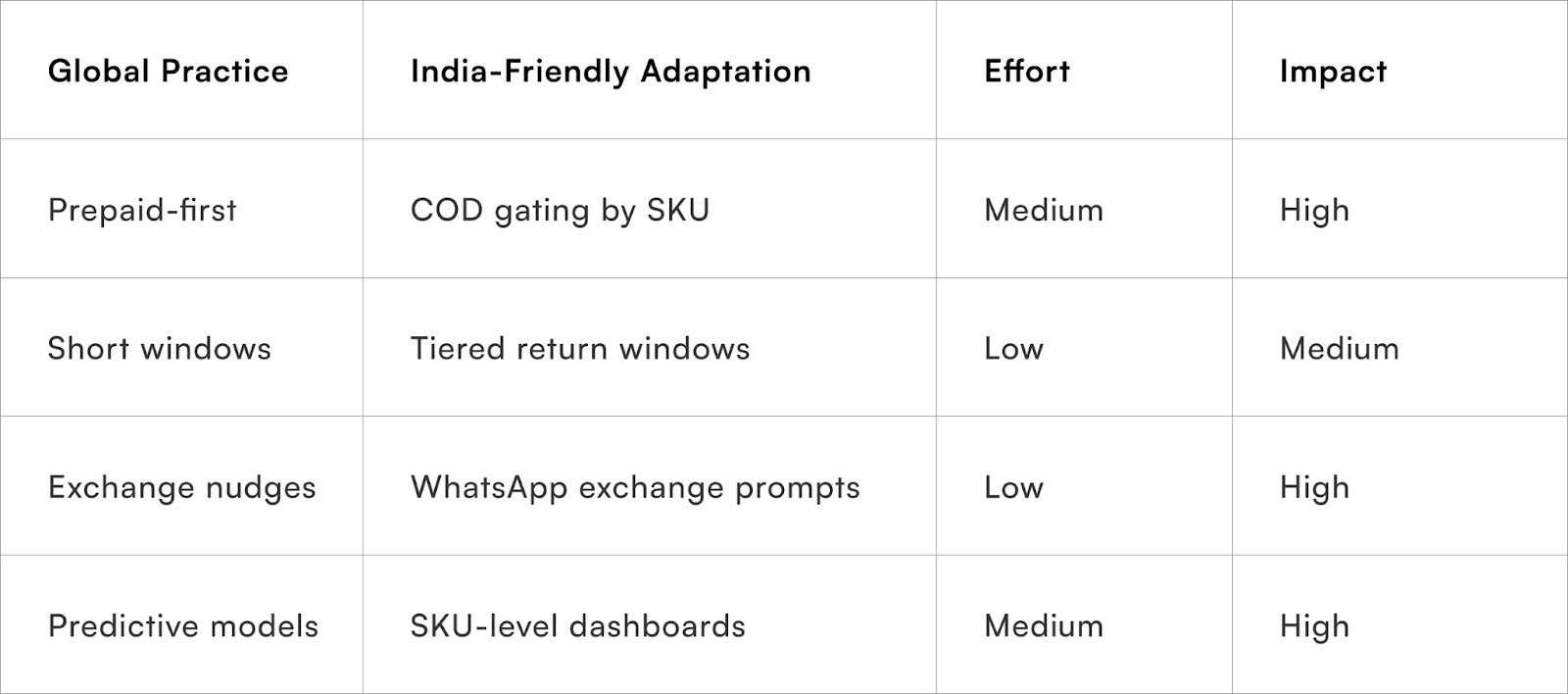
Quick Wins on understanding Global D2C Models
Immediate actions that reduce return leakage without heavy tech
Audit your top 20 SKUs by return reason. Fix PDP clarity for the top three issues. This single step often cuts returns by 3–5 percentage points.
Introduce exchange-first prompts at return initiation. Even a manual WhatsApp flow can lift exchanges quickly. Pair this with small incentives like faster shipping.
Restrict COD selectively. Start with high-return SKUs or first-time buyers. Communicate clearly to avoid surprise. Monitor conversion impact daily.
Align carrier SLAs for reverse pickups. Escalate chronic delays. Faster pickups recover inventory value and reduce customer anxiety.
Metrics That Matter
Measure what changes decisions, not what fills dashboards
Return rate by payment mode reveals intent quality. This should guide COD policy, not just reporting.
Time-to-resell measures recovery efficiency. Track days from return pickup to restock. Faster cycles protect margin.
Exchange conversion rate indicates success of return deflection. This is more valuable than gross return reduction alone.
Net contribution margin post-returns keeps growth honest. It prevents scaling channels that look profitable pre-delivery.
To wrap it up
Global D2C brands show that returns are designed, not endured. Indian brands can reduce leakage by shifting focus upstream, aligning incentives, and introducing smart friction.
This week, audit your top-return SKUs and payment modes, then act on one fix.
Over time, build systems that connect data, logistics, and communication. Continuous iteration, not policy overhauls, delivers sustainable improvement.
For D2C brands seeking tighter control over returns, Pragma’s returns intelligence platform provides payment-linked return controls, real-time reverse logistics visibility, and exchange-first workflows that help brands cut return rates by 20–30% whilst improving recovery speed.

FAQs (Frequently Asked Questions On What Global D2C Models Can Teach Indian Brands About Returns)
1. Why are returns higher in Indian D2C compared to global markets?
Higher COD usage, delivery variability, and weaker intent filtering drive higher returns in India.
2. Should Indian brands try to eliminate COD to reduce returns?
Elimination is risky. Selective COD restrictions and incentives for prepaid work better.
3. Are generous return policies bad for Indian brands?
Not inherently. Blanket generosity invites misuse, while segmented policies protect trust and margin.
4. How can small D2C teams manage returns without heavy tech?
Focus on PDP clarity, exchange-first flows, and selective COD rules initially.
5. Do exchanges really improve profitability?
Yes. Exchanges retain revenue and reduce reverse logistics losses.
6. How soon should brands act on return data?
Weekly reviews enable quick fixes before patterns become systemic.
7. Can WhatsApp communication actually reduce returns?
Clear, timely messages reduce refusals and anxiety-driven returns.
8. Is it realistic to adopt global return models in India?
With adaptation. Principles matter more than exact replication.
Talk to our experts for a customised solution that can maximise your sales funnel
Book a demo


.png)