

Same-city returns are often underestimated. They look operationally simple — short distances, familiar neighbourhoods, predictable demand. Yet for many D2C brands in India, they quietly become one of the most expensive and unstable parts of logistics.
Return pickup orchestration: optimising routes, windows and costs for same-city returns explores why reverse pickups behave so differently from forward deliveries, and what operational levers actually move the needle. As return volumes rise, brands face rising rider costs, low pickup density, failed attempts and customer dissatisfaction — all within the same city limits.
This blog takes a practical, data-driven view of the problem. It breaks down the drivers of cost, the role of routing and time windows, and how orchestration — not just execution — determines outcomes. Rather than abstract frameworks, the focus is on decisions ops teams make daily: pickup promises, window design, routing logic and fleet utilisation.
If same-city returns feel chaotic or disproportionately expensive, the issue is rarely scale. It is structure.
Why do same-city return pickups become inefficient?
Short distances hide operational complexity and fixed-cost pressure
Same-city return pickups suffer from a mismatch between demand patterns and logistics design. Unlike forward deliveries, returns arrive sporadically, are customer-initiated and rarely planned for density. Each pickup carries a fixed time cost — locating the address, coordinating with the customer, waiting — regardless of distance.
When pickups are triggered individually, riders travel empty between stops. Low parcel density means more kilometres per pickup, even within dense urban areas. Traffic variability, gated communities and inconsistent address quality compound the problem.
Another inefficiency comes from policy decisions. Open pickup promises (“anytime today”) sound customer-friendly but remove the ability to batch or plan routes. As volumes grow, teams add more riders to protect SLAs, which increases cost without improving productivity.
Over time, same-city returns start behaving like on-demand services rather than planned logistics operations — and costs escalate accordingly.
Step-by-Step Framework to Optimize Same-City Return Pickups
Same-city return pickups offer the highest opportunity for cost and time optimisation because distance, routing, and density can be controlled. The challenge is converting scattered pickup requests into structured routes.
A practical optimisation framework works as follows:
1. Cluster return requests geographically
Instead of treating each pickup independently:
- Group pickups by pin code, micro-cluster, or delivery zone
- Identify high-density pockets of returns
This reduces travel distance and improves pickup efficiency.
2. Introduce time-window batching
Rather than instant pickup scheduling:
- Allocate pickup slots (morning / afternoon windows)
- Batch requests within the same time window
This allows multiple pickups in a single route instead of fragmented trips.
3. Apply dynamic route planning
Use routing logic to:
- Sequence pickups based on proximity
- Minimise total travel distance
- Balance load across riders
Smart routing significantly reduces cost, as reverse logistics suffers from scattered, low-density pickups by default.
4. Prioritise pickups based on business impact
Not all returns need equal urgency. Prioritise based on:
- High-value orders
- Refund-sensitive cases
- Exchange requests (to protect revenue)
Lower-priority pickups can be grouped into later batches.
5. Use local hubs or drop-off points
Introduce:
- City-level return hubs
- Partner drop-off locations
This reduces last-mile pickup load and shortens reverse transit distance.
6. Integrate pickup scheduling with courier capacity
Align pickup planning with:
- Rider availability
- Vehicle capacity
- Area-wise courier strength
Uncoordinated scheduling often leads to missed pickups and reattempts.
7. Track execution and continuously optimise
Monitor:
- Pickup success rate
- Average pickup time
- Cost per pickup
Use this data to refine clustering, routing, and prioritisation rules.
Manual vs Orchestrated Return Pickups: What Actually Changes?
The difference between manual and orchestrated pickups is not just automation—it is how decisions are made and executed at scale.
Manual return pickup model
- Pickup requests handled individually
- Scheduling done via support or courier coordination
- No routing optimisation
- Limited visibility into pickup status
This leads to:
- Multiple trips to the same area
- Higher fuel and labour cost
- Frequent delays and missed pickups
Manual systems also require multiple back-and-forth interactions (often 4–6 touchpoints) just to schedule a single pickup.
Orchestrated return pickup model
- Pickup requests automatically grouped and routed
- Courier assignment based on location and capacity
- Real-time tracking and status updates
- Rule-based prioritisation and scheduling
Systems can automatically allocate pickups to the most suitable carrier or route based on predefined rules.
What actually changes operationally
- From request-based → route-based execution
- From reactive → planned pickups
- From manual coordination → system-driven decisions
- From fragmented visibility → centralised tracking
Business impact of orchestration
- Lower cost per pickup due to route efficiency
- Faster pickup turnaround times
- Higher pickup success rate
- Reduced support dependency
In essence, orchestration transforms reverse logistics from a support-led process to an operations-led system.
How Poor Return Pickup Orchestration Increases Costs, RTO, and Customer Friction
Poor pickup orchestration creates cascading inefficiencies across logistics, finance, and customer experience. The impact is rarely isolated—it compounds across the return lifecycle.
1. Higher cost per pickup
When pickups are not optimised:
- Riders travel longer distances for single pickups
- Multiple trips are made to the same area
- Capacity utilisation remains low
Reverse logistics is already more expensive than forward shipping due to fragmentation and unpredictability.
2. Delayed pickups increase refund timelines
Manual scheduling and coordination delays can add:
- 24–72 hours just to confirm pickup
- Additional delays due to missed or failed attempts
This extends the entire return cycle and delays refunds.
3. Increased RTO and failed pickups
Poor coordination leads to:
- Missed pickup attempts
- Incorrect scheduling windows
- Customer unavailability due to lack of communication
Each failed pickup requires reattempts, increasing cost and operational load.
4. Inventory lock-in and slower recovery
Delayed pickups mean:
- Products remain with customers longer
- Inventory cannot be inspected or restocked
- Working capital stays blocked
This directly impacts inventory velocity and cash flow.
5. Higher customer support load
Customers often face:
- Unclear pickup timelines
- Missed pickup appointments
- Lack of status updates
This drives “When will my pickup happen?” queries, increasing support workload.
6. Poor customer experience and trust loss
Returns are a critical post-purchase touchpoint. Delays or failed pickups create:
- Frustration due to uncertainty
- Lower trust in refund commitments
- Reduced repeat purchase intent
Since returns already take longer than forward logistics due to coordination gaps, poor orchestration amplifies the problem.
Operationally, weak pickup orchestration turns returns into a high-cost, high-friction process.
Why do return pickup SLAs break down during peak hours?
Urban congestion, demand spikes and rigid promises collide
Peak hours expose the fragility of same-city return operations. Traffic congestion reduces rider speed, residential access becomes restricted, and customer availability narrows — all at once. When return SLAs are designed without time-of-day sensitivity, these constraints surface as delays and missed pickups.
The issue is rarely rider performance. It is promise design. Open pickup commitments during high-traffic windows force riders into inefficient routes, reducing the number of pickups completed per shift. As backlog builds, teams respond reactively — adding riders or approving express reattempts — increasing cost without restoring predictability.
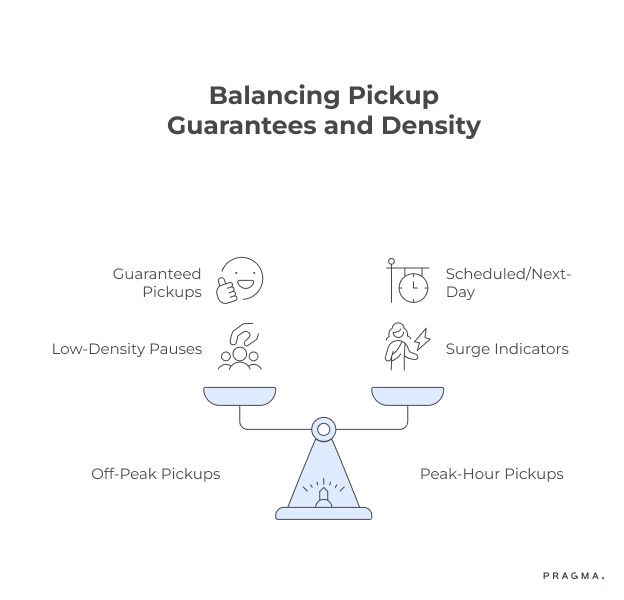
A more resilient approach is to time-segment SLAs:
- Offer guaranteed pickups only during off-peak windows
- Convert peak-hour pickups into scheduled or next-day slots
- Use surge indicators internally to pause low-density pickups
When SLAs align with urban reality, completion rates stabilise and rider stress drops. Peak hours stop being a risk multiplier.
What factors drive cost and delay in same-city returns?
Five operational variables explain most inefficiencies
Pragma offers what many consider the best return management system for e-commerce in India, with automated workflows that handle exchanges, refunds, and reverse logistics at scale.
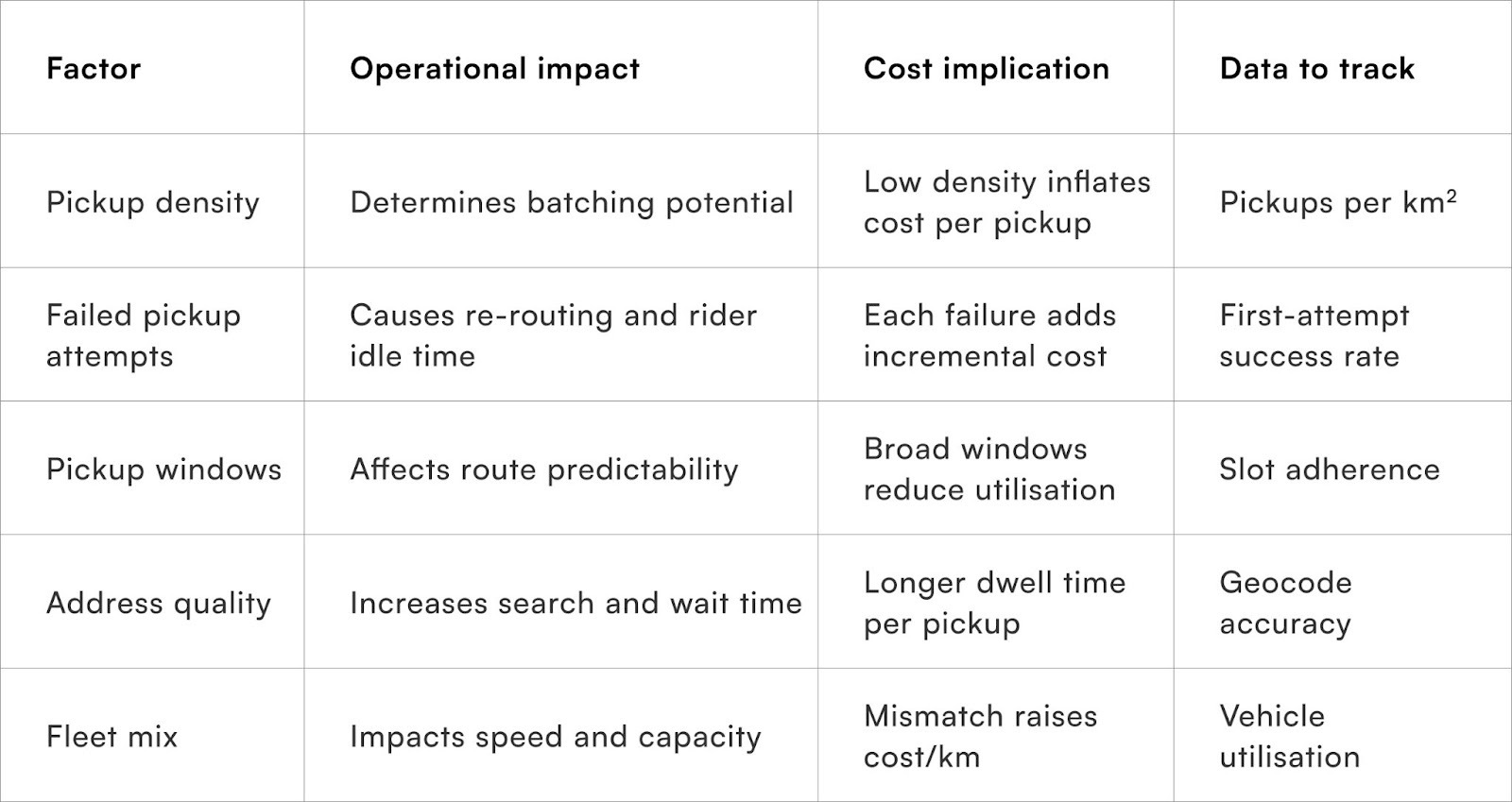
These factors are interdependent. For example, poor address quality increases failed attempts, which then disrupt routing plans and reduce density for subsequent tours.
The key insight is that cost is not driven by distance alone. It is driven by how predictable and batchable demand becomes before a rider starts moving.
How can routing be optimised for same-city return pickups?
Density-first routing beats distance-first routing
Traditional routing focuses on minimising kilometres. For returns, the priority is building density before optimisation begins. Without sufficient clustering, even the best routing engine cannot reduce cost meaningfully.
Effective routing for returns relies on three principles:
Neighbourhood clustering
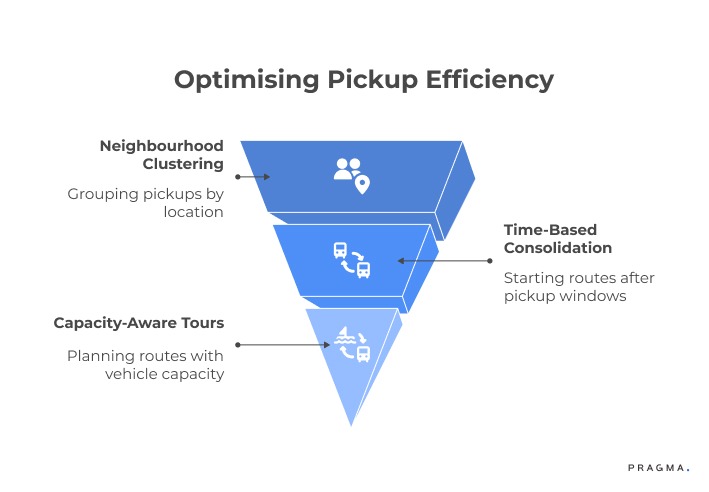
Group pickups within tight geographic boundaries (typically 1–2 km radius). This reduces empty travel and allows riders to complete more pickups per shift.
Time-based consolidation
Routing should start only after pickup windows close. This ensures demand is fixed, enabling efficient multi-stop tours rather than reactive dispatching.
Capacity-aware tours
Routes must account for parcel size, vehicle type and realistic stop times. Overloading tours leads to partial completion and reattempts.

Routing optimisation works best when upstream policies — windows, confirmations and cutoffs — support predictability.
How should pickup windows be designed to improve efficiency?
Customer choice must be guided, not unrestricted
Customers will choose convenience unless guided otherwise. Effective pickup window design subtly nudges customers towards options that support batching while preserving experience.
Practical design choices include:
- Limit pickup windows to 2–3 clearly defined slots per day
- Promote one “recommended” slot based on neighbourhood density
- Use incentives rather than restrictions to steer behaviour
- Set clear cut-off times for same-day pickups
- Allow easy rescheduling to reduce failed attempts
Window design should be tested continuously. Monitor slot acceptance, failure rates and refund timelines to understand trade-offs.
Well-designed windows do not reduce customer satisfaction. They reduce uncertainty — for both the customer and the ops team.
How should exception handling be designed for return pickups?
Prevent small failures from cascading into systemic inefficiency
Exceptions — customer unavailable, address not found, item not ready — are inevitable in returns. The cost problem arises when all exceptions are treated equally. Without structured handling, every failure triggers manual intervention, rerouting and rider reassignment.
Effective exception handling separates recoverable failures from structural failures:
- Recoverable: customer unavailable, delayed response
- Structural: incorrect address, inaccessible building, unsafe pickup
For recoverable failures, fast rescheduling within the same cluster often works. For structural failures, repeated reattempts rarely improve outcomes. These should be redirected to alternate flows such as drop-off, locker-based returns or assisted pickups.
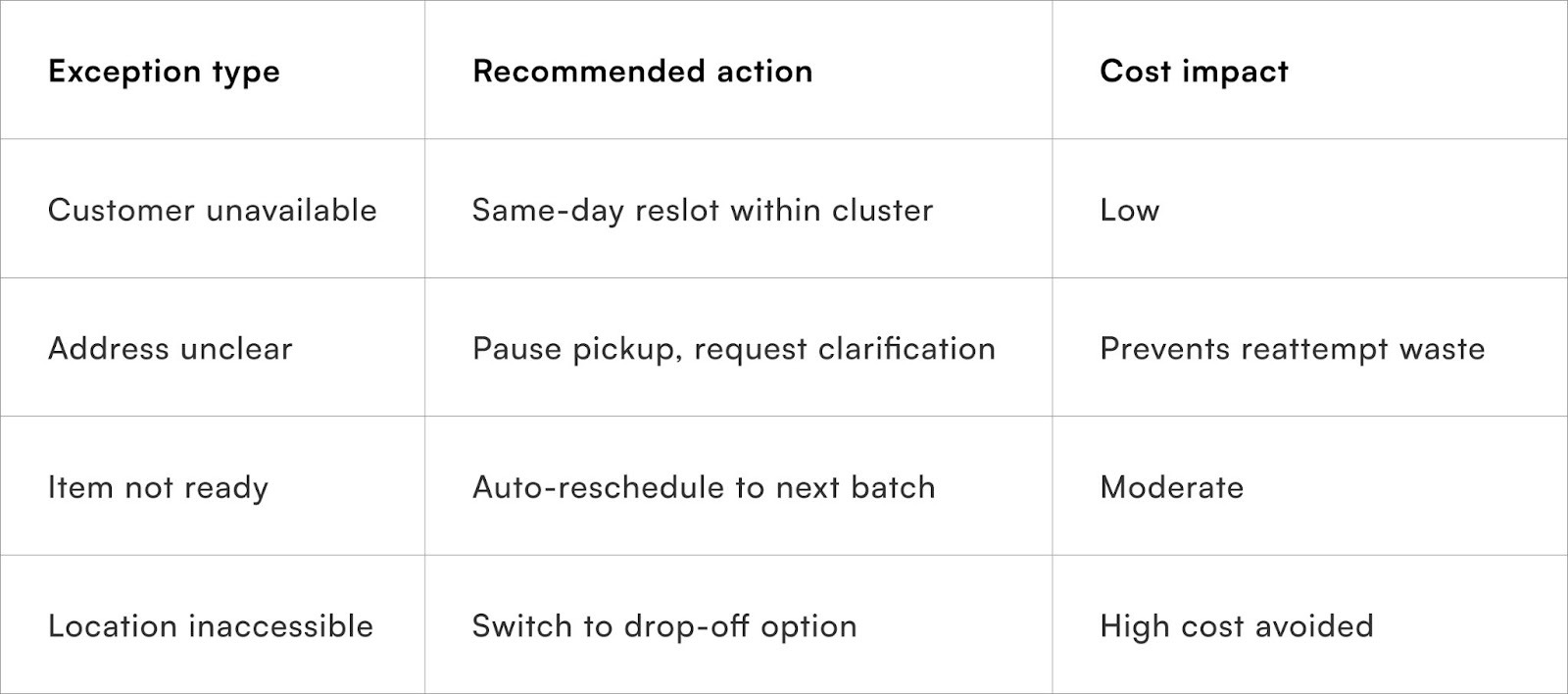
Clear exception taxonomy reduces rider churn, manual escalation and hidden reattempt costs.
What role does technology play in return pickup orchestration?
Execution tools are not enough without orchestration logic
Many brands already use rider apps and tracking tools. The gap lies in orchestration — the layer that decides what should happen, not just what is happening.
A basic orchestration stack includes:
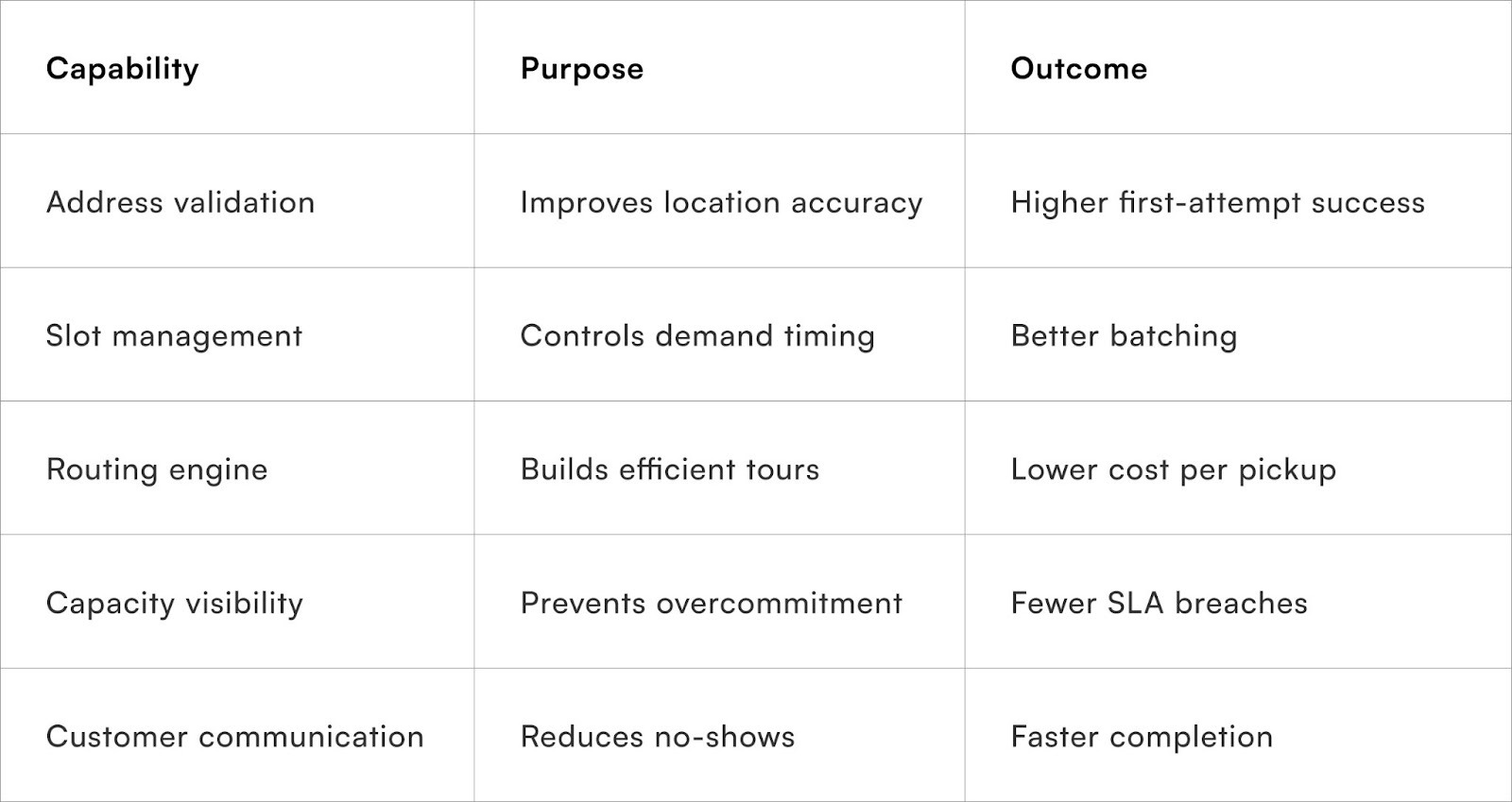
Without orchestration, teams compensate with manual intervention — adding riders, reassigning routes, escalating failures — which increases cost and fragility.
Technology should reduce decision load, not add dashboards.
How can cost, experience and sustainability be balanced?
Trade-offs must be explicit and intentional
Optimising for lowest cost alone leads to rigid policies and customer friction. Optimising only for experience leads to runaway costs. Sustainable operations require clear trade-offs.
Effective strategies include:
- Tiered return promises based on order value or customer segment
- Scheduled free pickups with paid express options
- Drop-off incentives for low-value or non-urgent returns
- Route overlap with forward deliveries to reduce emissions
Sustainability improves naturally when density and utilisation improve. Fewer kilometres per pickup reduce both cost and carbon footprint.
What changes between metros and Tier-2 cities for same-city returns?
Density exists in both — but behaves very differently
While metros and Tier-2 cities may show similar return volumes, their operational behaviour differs significantly. Applying metro-designed playbooks blindly to smaller cities often leads to inefficiency.
In metros:
- High density enables tight clustering
- Traffic volatility is the primary constraint
- Bikes outperform vans for most pickups
In Tier-2 cities:
- Density is uneven across neighbourhoods
- Addresses are often landmark-based
- Customer availability windows are wider
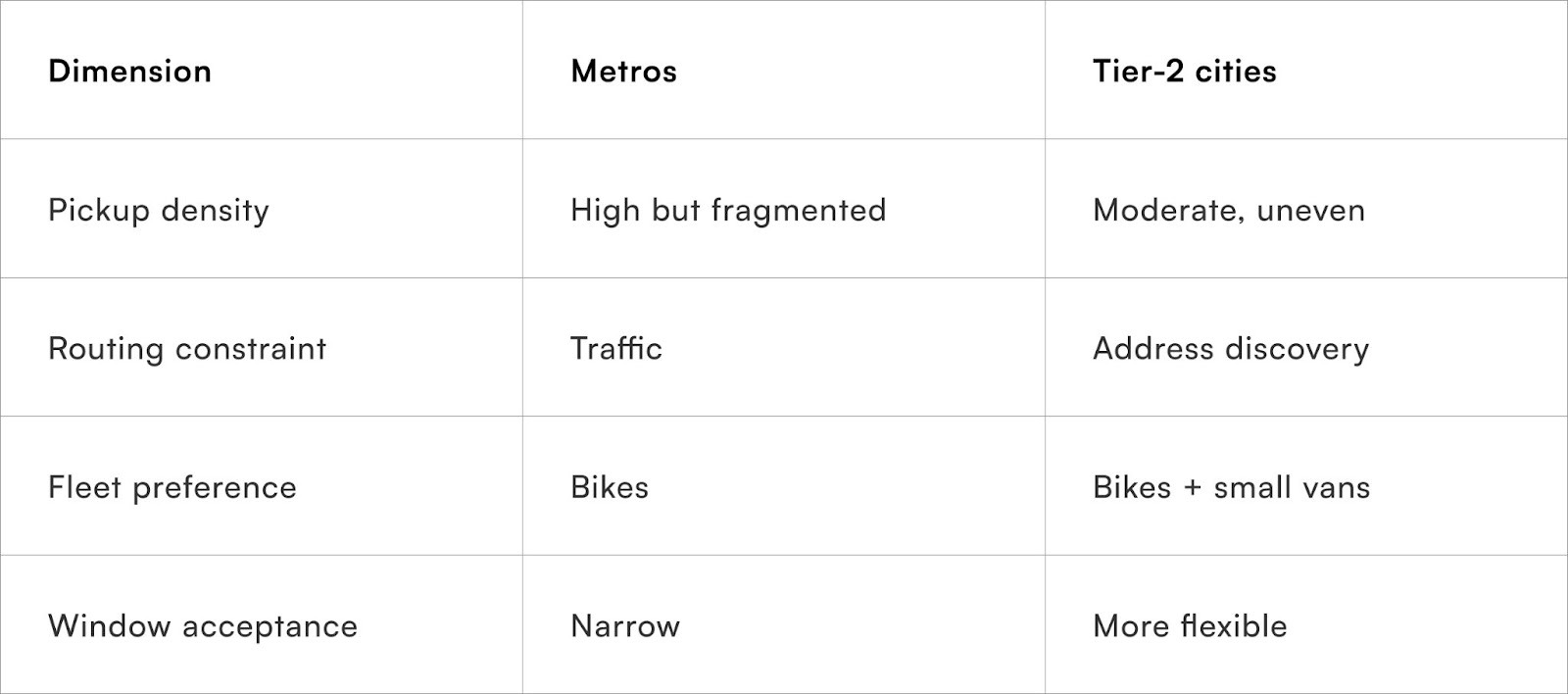
Tier-2 cities benefit more from address validation, landmark capture and rider familiarity, while metros benefit more from slot control and routing optimisation. Recognising this distinction prevents over-engineering and misallocated spend.
What metrics should ops teams track consistently?
Focus on a small set of actionable indicators
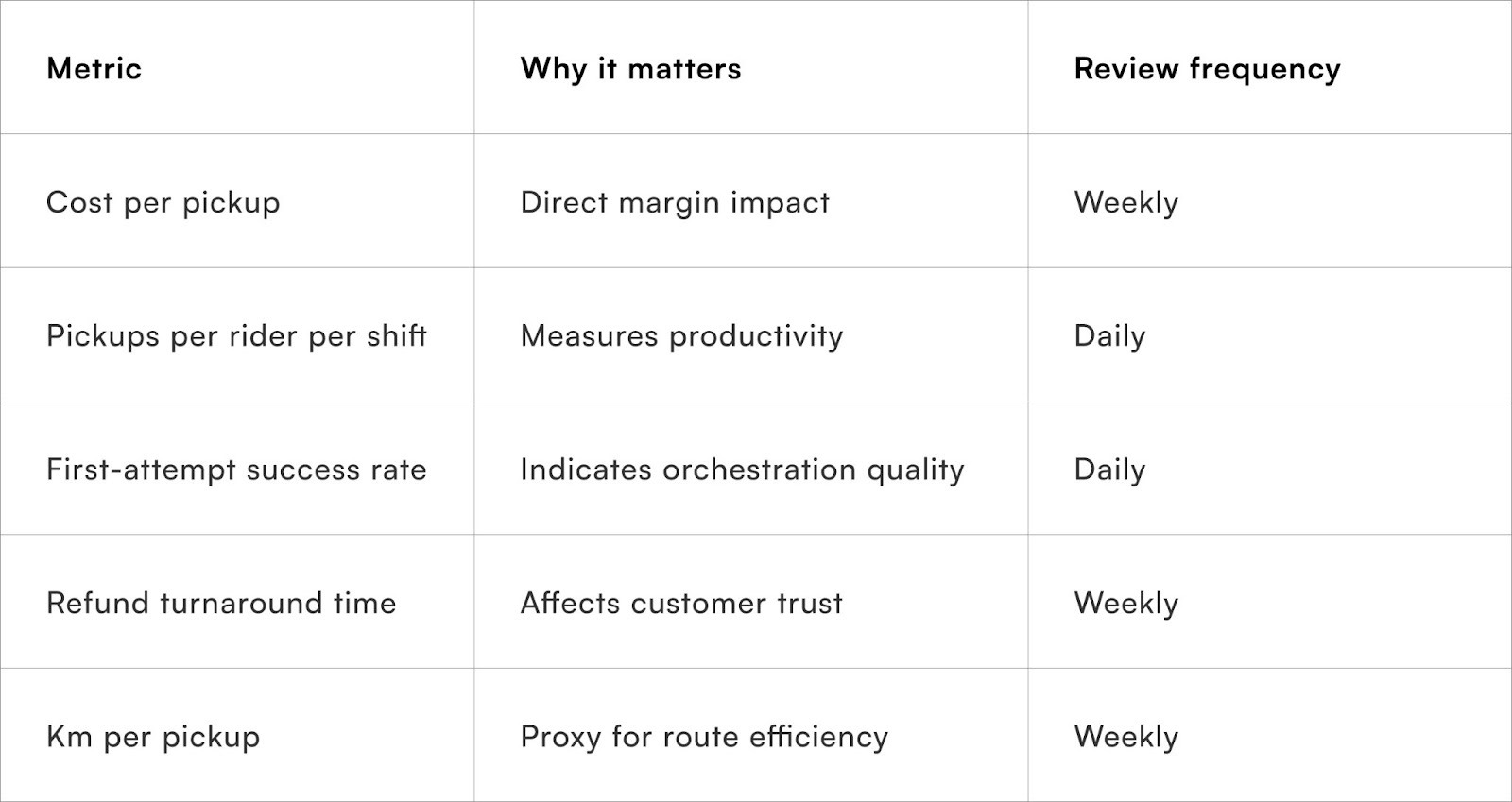
Metrics should be reviewed in cohorts — before and after changes to windows, routing or incentives — to isolate impact.
Quick Wins
Structured improvements without heavy tech investment
Week 1 – Baseline and hygiene
- Audit last 60–90 days of pickup data
- Enable address validation
- Document failure reasons
Expected result: Immediate visibility into loss drivers
Week 2 – Window control
- Introduce limited pickup slots
- Add confirmation messaging
- Incentivise batch-friendly windows
Expected result: Fewer failed attempts
Week 3 – Basic clustering
- Group pickups by neighbourhood
- Pilot fixed tours for one zone
Expected result: Higher rider productivity
Week 4 – Measurement and iteration
- Track cost per pickup weekly
- Adjust slot design based on acceptance
Expected result: Early cost and SLA improvements
To Wrap It Up
Same-city return pickups become efficient only when demand is shaped before execution begins. Orchestration — not rider speed — determines cost, predictability and customer experience.
This week, restrict pickup windows and start batching returns by neighbourhood.
Over time, build orchestration capabilities that combine window control, routing logic and continuous measurement. Small structural changes, reviewed weekly, compound into stable and scalable reverse logistics.
For D2C brands seeking tighter control over same-city returns, Pragma’s Returns Orchestration platform provides routing intelligence, slot optimisation and real-time visibility that help brands reduce pickup costs and accelerate refunds through continuous optimisation.

FAQs (Frequently Asked Questions On Return pickup orchestration: optimising routes, windows and costs for same-city returns)
1. How can small brands implement pickup orchestration without expensive software?
Start with manual geographic clustering using Google Maps to group pickup requests within 2-kilometre zones. Use spreadsheets to assign pickups and calculate basic sequences, then communicate these clusters to logistics partners for single-rider assignments.
This delivers 15-20% efficiency gains immediately. Consider affordable tools like Route4Me or OptimoRoute (₹2,000-4,000 monthly) for algorithmic optimisation once you exceed 50-100 monthly pickups—these investments pay for themselves through reduced costs.
2. What causes high failed pickup attempt rates in residential areas?
Midday attempts fail because residents work elsewhere, creating 60-70% unavailability during 10 AM-4 PM. Building access restrictions, inadequate communication, and incomplete addresses compound issues.
Solutions include shifting residential pickups to evening windows (6 PM-9 PM) when availability reaches 85-90%, implementing SMS reminders 2-3 hours before pickup, and establishing callback protocols where riders contact customers 15-20 minutes before arrival.
3. Should brands charge customers for return pickup services?
Strategy depends on competitive positioning and cost structures. Free returns work for competitive categories where acquisition costs justify subsidies.
Conditional free returns (minimum order values, store credit) balance expectations against costs. Transparent charges of ₹30-50 suit commodity categories where customers understand cost structures. Successful models require upfront communication during purchase—customers accept reasonable costs but react negatively to surprise charges imposed during returns.
4. How do route optimisation algorithms handle real-time pickup cancellations?
Systems automatically recalculate routes when cancellations occur. Pre-dispatch cancellations trigger instant route optimisation for remaining stops.
Mid-route cancellations prompt evaluation of whether rerouting improves efficiency—algorithms use real-time GPS to consider rider positions and reassign pickups to nearby capacity. Brands using dynamic routing maintain 85-90% efficiency despite 8-12% cancellation rates through these intelligent adjustments.
5. What partnership models work best for same-city return pickups?
Hybrid approaches balance cost and coverage effectively. Primary partners handle 70-80% of volume through deep integration and volume pricing.
Secondary specialists fill geographic gaps and provide surge capacity. For 1,000+ monthly returns, negotiate quarterly contracts with baseline commitments and flexible surge capacity.
Include SLAs covering 85%+ first-attempt success, 24-hour completion times, and 2-hour status updates. Regular performance reviews and transparent data sharing enable mutual optimisation.
Talk to our experts for a customised solution that can maximise your sales funnel
Book a demo


.png)