

In most D2C operations, system disagreement is more common than teams admit. The CRM shows “Delivered”, the OMS shows “In Transit”, the WMS flags “RTO Initiated”, and finance reconciles revenue against yet another timestamp. These cross system data mismatches rarely appear dramatic at first, but they quietly distort reporting, delay customer resolutions, and inflate manual investigation effort.
A structured copilot for cross system reconciliation changes how these conflicts are handled. Instead of forcing operations managers to manually compare logs across platforms, the copilot reads event trails, identifies inconsistencies, clusters similar mismatches, and surfaces likely causes. What previously required spreadsheet stitching and Slack escalations becomes a guided diagnostic workflow.
When reconciliation becomes systematic rather than reactive, dashboards regain credibility, CX teams respond with confidence, and operational firefighting begins to decline.
Why do cross-system event mismatches occur in D2C operations?
Disconnected systems record reality at different speeds
Cross system data mismatch rarely stems from a single faulty system. It typically arises because CRM, OMS, WMS, payment gateways, and carrier panels interpret events differently. Each platform maintains its own logic for when a status becomes final, transitional, or customer-visible.
As volume increases, even small timing gaps turn into measurable reporting distortion.
Where does event mismatch in CRM and OMS most frequently appear?
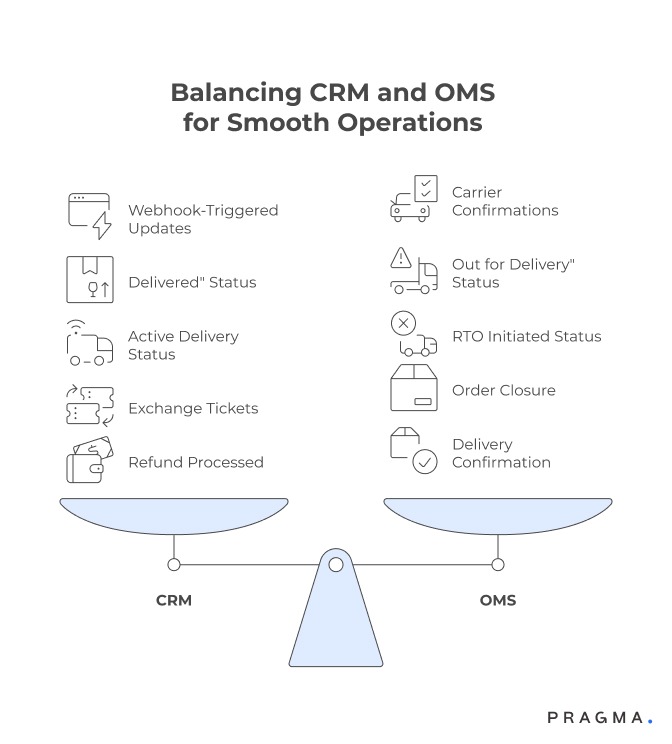
The most common event mismatch in CRM and OMS appears during post-dispatch transitions. CRM often reflects webhook-triggered updates, while OMS depends on carrier confirmations or batch sync cycles.
Typical contradictions include:
- CRM showing “Delivered” while OMS remains “Out for Delivery”
- OMS marking RTO initiated while CRM still shows active delivery
- Exchange tickets created before OMS order closure
- Refund processed before delivery confirmation
Each mismatch forces CX and ops teams into manual verification loops.
Why these mismatches distort operational reporting
When state transitions do not align:
- FCR reporting becomes unreliable
- Refund ageing appears inflated
- NDR dashboards misclassify orders
- SLA compliance metrics become inconsistent
Small discrepancies compound into leadership-level confusion.
How does latency between systems amplify reconciliation risk?
API delays and batch sync windows create blind spots
Even when event definitions align, latency introduces drift. Webhooks may fail temporarily. Carrier APIs may retry. Batch jobs may run hourly. During that window, dashboards show contradictory realities.
At scale, this becomes systemic rather than occasional.
What operational triggers create high-latency mismatch clusters?
Mismatch clusters often correlate with:
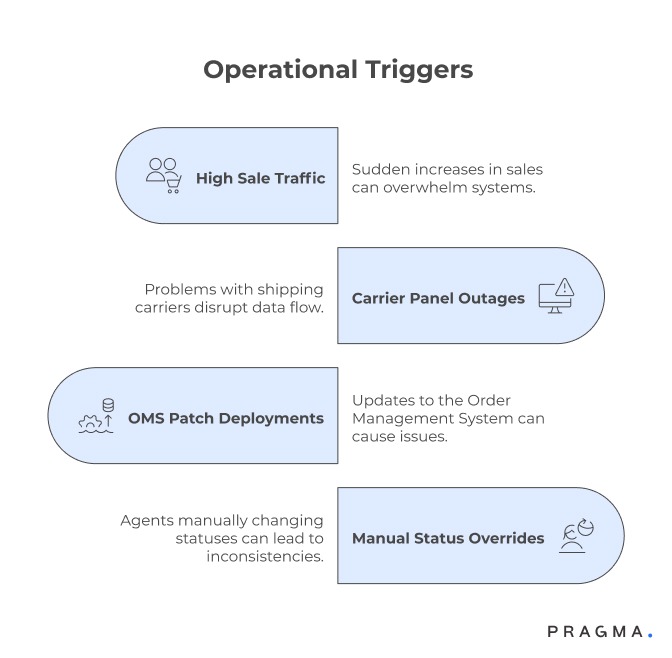
- High sale traffic spikes
- Carrier panel outages
- OMS patch deployments
- Manual status overrides by agents
An AI copilot for cross system data reconciliation identifies these clusters by grouping mismatches by timestamp proximity and system source.
Why do manual overrides increase cross system data mismatch?
Human intervention without synchronisation creates divergence
Agents sometimes update CRM tickets manually to reassure customers. Meanwhile, OMS or WMS status remains unchanged. These well-intentioned overrides introduce divergence between customer-facing and backend systems.
Over time, manual corrections create a hidden reconciliation backlog.
How can a copilot detect override-driven inconsistencies?
A structured copilot for cross system reconciliation flags patterns such as:
- Status change without corresponding API trigger
- Ticket resolution before OMS closure
- Refund initiated without delivery state confirmation
- Multiple status reversals within short intervals
When embedded within AI copilot in CRM, these anomalies surface in real time rather than during end-of-month audits.
How does a copilot cluster cross system data mismatch for faster RCA?
Pattern recognition replaces spreadsheet sampling
Manual reconciliation relies on sampling 30 to 50 orders and extrapolating causes. This approach misses systemic drift. An AI copilot analyses thousands of records simultaneously, grouping mismatches by similarity.
Instead of isolated tickets, teams see structured patterns.
What clustering dimensions improve diagnostic clarity?
Effective clustering includes:
- Carrier + zone + timestamp alignment
- SKU category + warehouse node
- Payment mode + refund trigger timing
- OMS state + CRM ticket status sequence
When connected with AI copilot agents, these clusters are converted into guided investigation steps instead of raw data dumps.
When does reconciliation failure start affecting customer experience?
Operational inconsistencies eventually surface externally
At first, cross system data mismatch feels internal. Over time, customers experience the effects through delayed refunds, contradictory updates, and repeated information requests.
Mismatch drift becomes visible when:
- Customers receive “Delivered” notifications without package receipt
- Refund timelines exceed promised windows
- Agents provide conflicting shipment updates
- Exchange workflows stall between systems
A proactive copilot for cross system reconciliation prevents these contradictions from reaching the customer layer.
How can AI copilot reconciliation prompts standardise investigation workflows?
Structured prompts convert ambiguity into repeatable diagnostics
Unstructured reconciliation depends on individual judgement. One manager checks timestamps. Another checks carrier logs. A third reviews refund triggers. Without a consistent framework, root causes vary depending on who investigates.
Well-designed AI copilot reconciliation prompts enforce diagnostic order and eliminate guesswork.
What does an effective reconciliation prompt look like?
A structured prompt should request:
- Chronological event sequencing across CRM, OMS, WMS
- Identification of the first divergence point
- API failure log correlation within the same time window
- Cluster comparison with similar recent mismatches
Example prompt structure:
“Compare CRM, OMS, and WMS event timelines for Order ID cluster. Identify the first inconsistent status transition. Flag API failures within ±30 minutes. Group similar mismatches by carrier and zone.”
This converts investigation into a repeatable workflow.
Why prompt discipline improves RCA accuracy
Consistent prompts ensure:
- No event layer is skipped
- Timestamp sequencing is validated
- Manual overrides are flagged
- Recurring patterns are documented
Over time, reconciliation quality becomes measurable rather than anecdotal.
Prompts for Identifying Cross-System Data Mismatch
Here are structured prompts for an AI copilot for cross system data reconciliation:
Prompt 1: Delivery Status Conflict
Compare CRM delivery status with OMS shipment status for all orders updated in the last 48 hours.
Highlight mismatches and classify as:
- Sync Delay
- Mapping Error
- Manual Override
- Unknown
Prompt 2: Timeline Integrity Check
Reconstruct event timelines for orders where Delivered timestamp precedes OFD timestamp.
Identify potential data sequencing errors or incorrect field mapping.
Prompt 3: RTO Without NDR
Identify shipments marked RTO in OMS where no NDR attempt is logged in CRM.
Cluster by carrier and region.
Prompt 4: Revenue vs Delivery Conflict
Compare Delivered events in CRM with revenue recognition in ERP.
Flag orders where revenue has not been triggered within 24 hours of delivery.
Advanced Prompts for Pattern-Level Diagnosis
Once foundational reconciliation is stable, move to higher-order prompts.
Prompt 5: Integration Drift Detection
Compare event field mappings across last 30 days.
Highlight fields with sudden value distribution changes.
This catches silent mapping errors early.
Prompt 6: SLA Breach Prediction from Mismatch Signals
Identify orders where CRM–OMS status conflict persists > 12 hours.
Estimate probability of SLA breach.
Reconciliation becomes predictive, not reactive.
Prompt 7: Financial Exposure Estimation
Calculate revenue exposure from Delivered–Revenue mismatch clusters.
Break down by carrier and region.
This reframes reconciliation as cash-flow protection.
How does cross-system reconciliation integrate with CRM intelligence layers?
Reconciliation must sit inside active workflows
Reconciliation loses value if it operates as a separate audit exercise. It must feed directly into CRM ticket management and operational dashboards. When a mismatch is detected, agents should see structured context before responding to customers.
Integration transforms reconciliation from reactive repair to proactive control.
What happens when reconciliation is embedded inside CRM?
When aligned with AI copilot in CRM:
- Mismatch alerts appear inside ticket view
- Agents see synchronised event timelines instantly
- Refund or escalation decisions are context-aware
- Duplicate investigations are avoided
This reduces resolution time and prevents contradictory communication.
When should human judgement override copilot recommendations?
Not all mismatches are technical errors
A copilot identifies divergence, but it cannot always interpret operational nuance. Some mismatches are intentional. Promotional refunds may be processed early. VIP customers may receive manual delivery overrides.
Blind automation creates rigidity.
Situations requiring human validation
Human review is critical when:
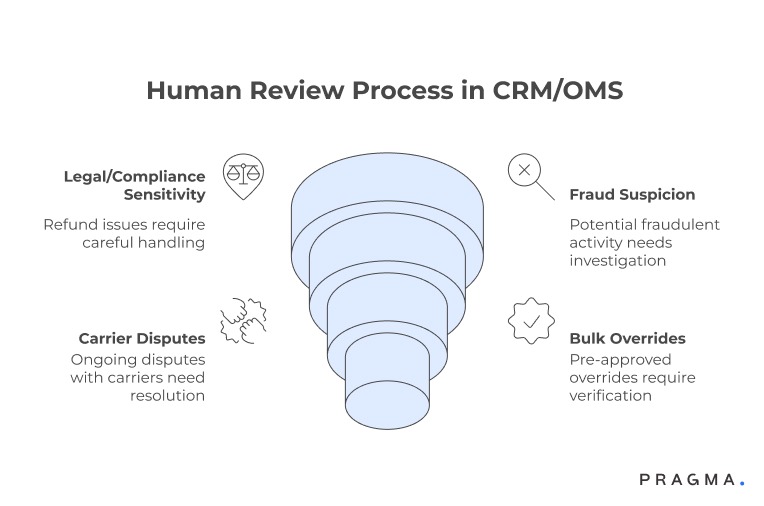
- Legal or compliance-sensitive refunds are involved
- Fraud suspicion exists
- Carrier disputes are ongoing
- Bulk operational overrides were pre-approved
An AI copilot for rapid RCA accelerates diagnosis, but final decisions remain accountable to operations leadership.
Why does continuous monitoring reduce recurring event mismatch in CRM and OMS?
Ongoing detection prevents accumulation of systemic drift
One-time reconciliation solves symptoms. Continuous monitoring prevents recurrence. By tracking mismatch frequency, system source, and resolution outcome, teams build institutional knowledge.
Over time, patterns become predictable.
What metrics indicate reconciliation maturity?
- Reduction in recurring mismatch clusters
- Faster root cause identification time
- Fewer manual override-induced divergences
- Improved dashboard consistency across systems
When combined with AI copilot agents and structured retrieval workflows such as AI copilot to retrieve past order, reconciliation shifts from damage control to operational intelligence.
How can teams operationalise copilot-driven reconciliation in 30 days?
Short execution cycles create measurable stability improvements
System reconciliation becomes sustainable when teams implement structured workflows instead of ad hoc audits. A 30-day sprint can move reconciliation from reactive firefighting to controlled monitoring.
Week 1: Define event hierarchy across CRM, OMS, and WMS
Document the authoritative source for each state transition. Clarify which system owns “Shipped”, “Delivered”, “RTO Initiated”, and “Refund Closed”.
Audit the top 50 mismatched orders from the past 30 days and identify the first divergence point in each case.
Expected result: Reduced ambiguity in status ownership and fewer conflicting dashboard interpretations.
Week 2: Deploy structured AI copilot reconciliation prompts
Standardise investigation prompts inside your copilot workflow. Ensure every mismatch review follows the same sequencing logic and clustering criteria.
Train operations managers to use consistent diagnostic templates instead of manual spreadsheet comparisons.
Expected result: Faster root cause identification and reduced investigation variability.
Week 3: Embed reconciliation alerts inside CRM
Surface mismatch alerts directly in agent workflows using AI copilot in CRM so CX teams see event inconsistencies before responding to customers.
Align escalation logic with structured investigation steps.
Expected result: Fewer contradictory customer responses and improved ticket accuracy.
Week 4: Track recurrence and cluster reduction
Create a dashboard tracking mismatch frequency by carrier, warehouse, payment mode, and system source.
Compare week-on-week cluster volume and escalation time.
Expected result: Visible decline in recurring cross system data mismatch patterns.
Which metrics prove reconciliation maturity?
Stability is visible through reduced divergence and faster RCA
Measuring reconciliation effectiveness requires operational clarity. Focus on consistency across systems rather than isolated incident resolution.
Core reconciliation KPIs
- Percentage reduction in recurring mismatch clusters
- Average root cause identification time
- Reduction in manual override-driven inconsistencies
- Alignment rate between CRM and OMS final states
- Escalation rate triggered by event mismatch in CRM and OMS
When these stabilise, dashboards regain credibility.
To Wrap It Up
Cross-system event mismatches are not rare anomalies. They are predictable outcomes of disconnected systems operating with different definitions and latency. A structured copilot for cross system reconciliation converts fragmented investigation into measurable operational control.
This week, audit your top 50 mismatched orders and standardise one reconciliation prompt that every manager must follow.
Long term stability comes from continuous monitoring, cluster tracking, and CRM-level integration rather than isolated audits. When reconciliation becomes embedded inside daily workflows, dashboards regain credibility and escalation volume drops steadily.
For D2C brands seeking operational stability across CRM and OMS layers, Pragma’s AI Copilot platform provides structured reconciliation prompts, real-time event clustering, and embedded CRM intelligence that help brands reduce recurring mismatch clusters and accelerate root cause analysis.

FAQs (Frequently Asked Questions On Using a copilot to reconcile cross-system event mismatches (examples & prompts))
1. What is a copilot for cross system reconciliation?
A copilot for cross system reconciliation uses AI to identify and resolve inconsistencies across systems like CRM and OMS. It helps teams detect and fix cross system data mismatch issues faster and more accurately.
2. How does AI copilot for cross system data reconciliation work?
AI copilot for cross system data reconciliation analyses event logs, timestamps, and records across systems. It highlights discrepancies and suggests corrective actions for alignment.
3. What causes cross system data mismatch in operations?
Cross system data mismatch can occur due to sync delays, API failures, or inconsistent data formats. These issues often lead to incorrect status updates or reporting errors.
4. What is event mismatch in CRM and OMS systems?
Event mismatch in CRM and OMS happens when the same transaction shows different states across systems. For example, an order marked delivered in OMS but pending in CRM.
5. How can AI copilot reconciliation prompts help resolve mismatches?
AI copilot reconciliation prompts guide the system to compare records, detect anomalies, and suggest fixes. They standardise the reconciliation process and improve efficiency.
6. What are examples of effective AI copilot reconciliation prompts?
Examples include prompts to identify missing events, timestamp inconsistencies, or status conflicts. These prompts help isolate root causes of cross system data mismatch quickly.
7. Can AI copilots automate reconciliation across systems?
They can automate detection and initial analysis of mismatches across systems. However, human validation ensures accuracy before applying critical fixes.
8. What are the benefits of using a copilot for reconciliation tasks?
Benefits include faster issue resolution, improved data accuracy, and reduced manual effort. It also enhances visibility across systems and improves operational reliability.
Talk to our experts for a customised solution that can maximise your sales funnel
Book a demo

.png)