

Returns are rarely a single problem; they are an accumulation of small decisions made across products, pricing, fulfilment, and customer promises. Yet many D2C brands still rely on one uniform return policy, assuming consistency will keep operations simple and customers happy. As order volumes grow and catalogues widen, this assumption begins to crack. A policy that works well for one product can quietly erode margins for another.
Designing SKU-level return policies: when free returns make sense (and when they don’t) examines returns from a product and operations perspective rather than a brand-wide CX lens. It explores why different SKUs behave differently after delivery, how return costs and resale outcomes vary at the product level, and why free returns are not universally beneficial.
The aim is not to reduce flexibility arbitrarily, but to align return generosity with actual risk and economics. By grounding return policies in SKU-level data, teams can protect customer trust while preventing avoidable reverse logistics losses from compounding over time.
Why do blanket return policies fail as catalogues expand?
Uniform rules hide SKU-specific cost and behaviour patterns
Most D2C brands begin with a single return policy because it is easy to explain, enforce, and scale in the early days. At low order volumes, the financial impact of this simplicity is often negligible.
As catalogues expand and daily shipment volumes increase, however, the cracks start to show. Different SKUs generate very different post-delivery outcomes, but a blanket policy forces operations to absorb all variation silently.
Over time, ops and finance teams notice that a small subset of products drives a disproportionate share of reverse logistics cost. These SKUs consume warehouse space, inspection effort, and working capital far beyond their contribution to revenue.
Blanket policies delay visibility into these patterns, making corrective action reactive rather than planned. SKU-level policies surface problems early and make cost drivers explicit instead of buried.
What factors actually drive SKU-level return behaviour?
Returns are shaped more by product traits than customer intent
Return behaviour is often attributed to customer indecision or misuse. In reality, the strongest predictors sit at the product level. Certain characteristics consistently increase the likelihood of returns regardless of customer cohort or acquisition channel.
Product experience characteristics
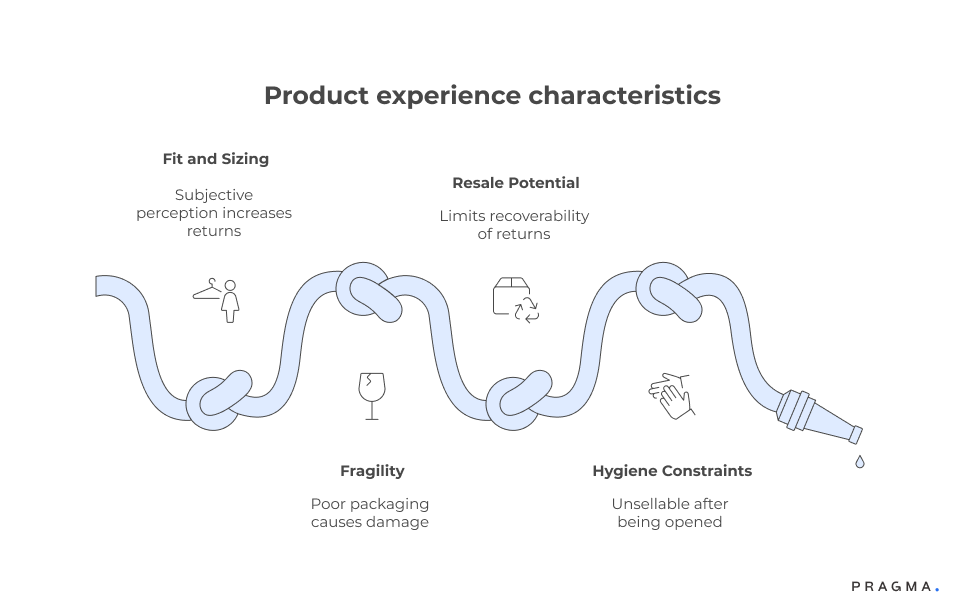
Fit, sizing, and subjective perception
Products where fit, comfort, or appearance cannot be objectively verified before use tend to see higher return rates. Apparel, footwear, and home décor fall squarely into this category. Even accurate size charts cannot eliminate subjective dissatisfaction.
Fragility and transit sensitivity
SKUs that are fragile or poorly packaged experience higher damage-related returns. These returns are operationally expensive because they require inspection and often result in write-offs.
Post-return recoverability
Resale and refurbishment potential
A returned SKU that can be quickly refurbished and resold is far less risky than one that must be discounted heavily or discarded.
Hygiene and compliance constraints
Personal care, cosmetics, and intimate products often cannot be resold once opened, making even low return rates costly.
SKU attributes and their return risk implications
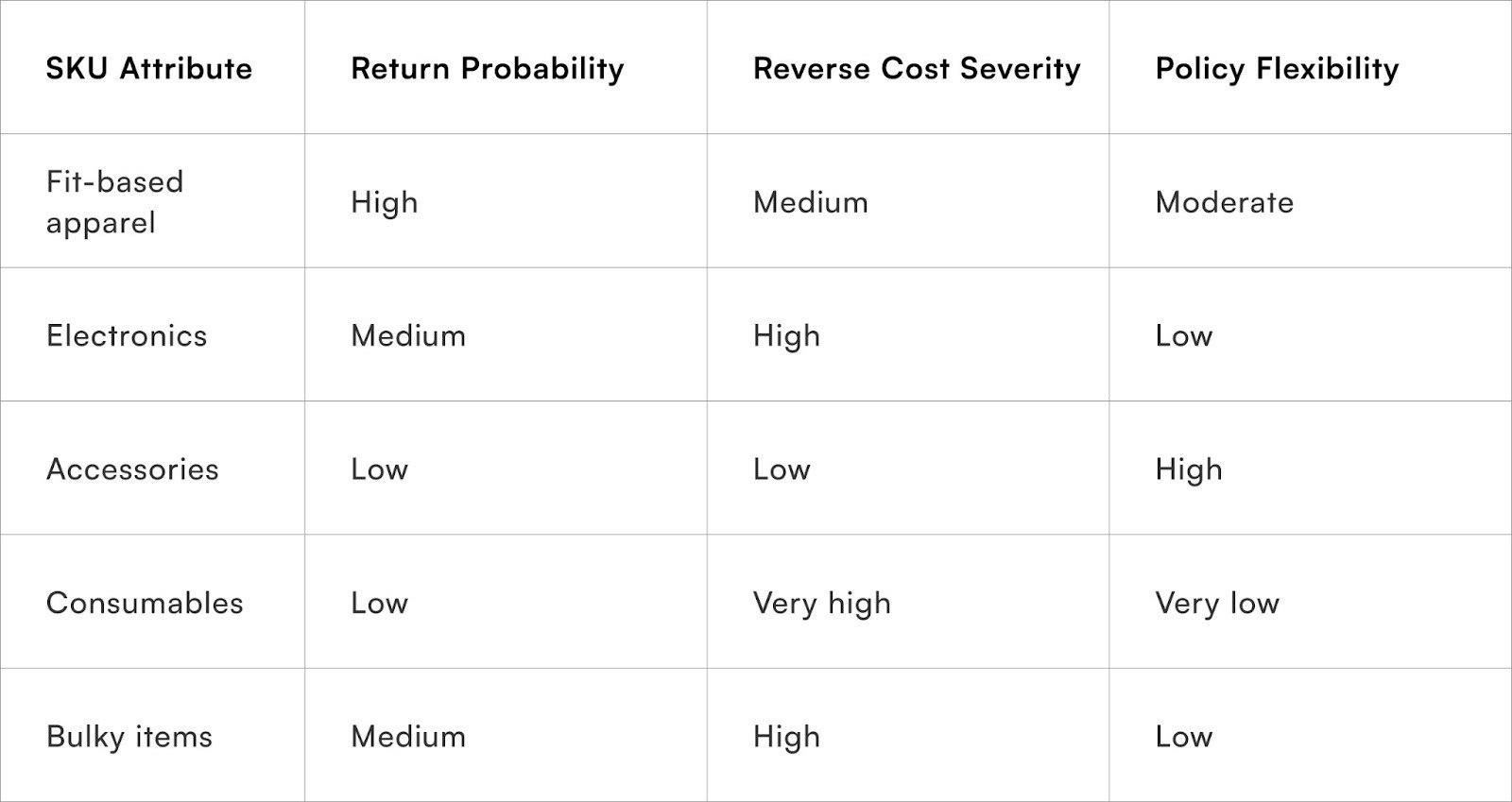
This classification helps teams prioritise where SKU-level policies matter most.
When do free returns strengthen the business?
Free returns work when they compound long-term value
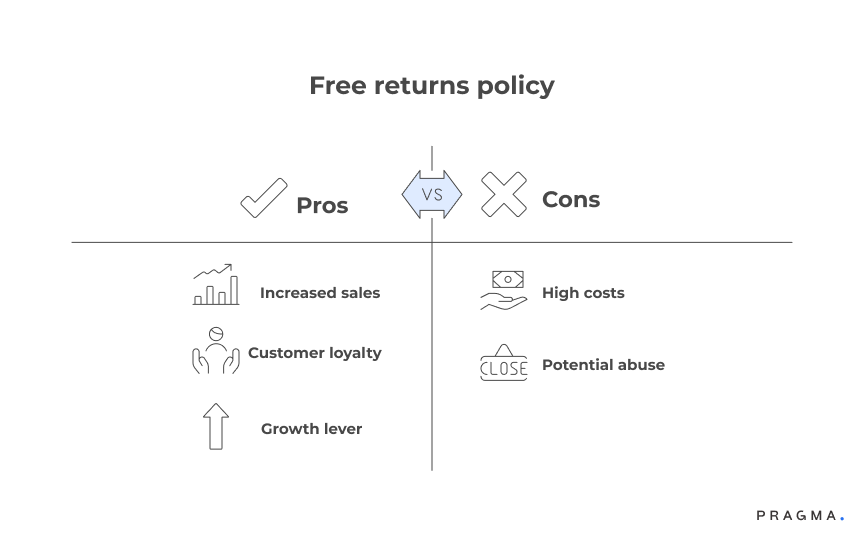
Free returns are often framed as a customer expectation, but operationally they are an investment. That investment pays off only when it improves conversion, repeat purchase, or lifetime value enough to offset the added cost. For certain SKUs, this trade-off is favourable and even necessary.
Situations where free returns are justified
High-margin, high-repeat SKUs
Products with strong margins and predictable repeat behaviour can absorb return costs as part of retention spend. In such cases, free returns reduce purchase hesitation and increase basket confidence.
Trial-driven categories
Categories where customers need to experience the product before committing benefit disproportionately from free returns. The reduction in friction often leads to higher overall revenue despite higher return volumes.
In these scenarios, free returns act as a controlled growth lever rather than an uncontrolled cost.
When do free returns quietly destroy margins?
Not all losses appear on the refund line item
Free returns are most dangerous when they create indirect costs that are not immediately visible. Inventory ageing, quality degradation, warehouse congestion, and delayed resale all erode margins without triggering obvious alerts. Low-margin SKUs are especially vulnerable to this effect.
For slow-moving or clearance items, a single free return can wipe out the entire contribution margin. Over time, these losses accumulate and distort unit economics. SKU-level policies make these trade-offs explicit, allowing teams to restrict generosity where it creates no strategic upside.
Free returns impact by SKU economics
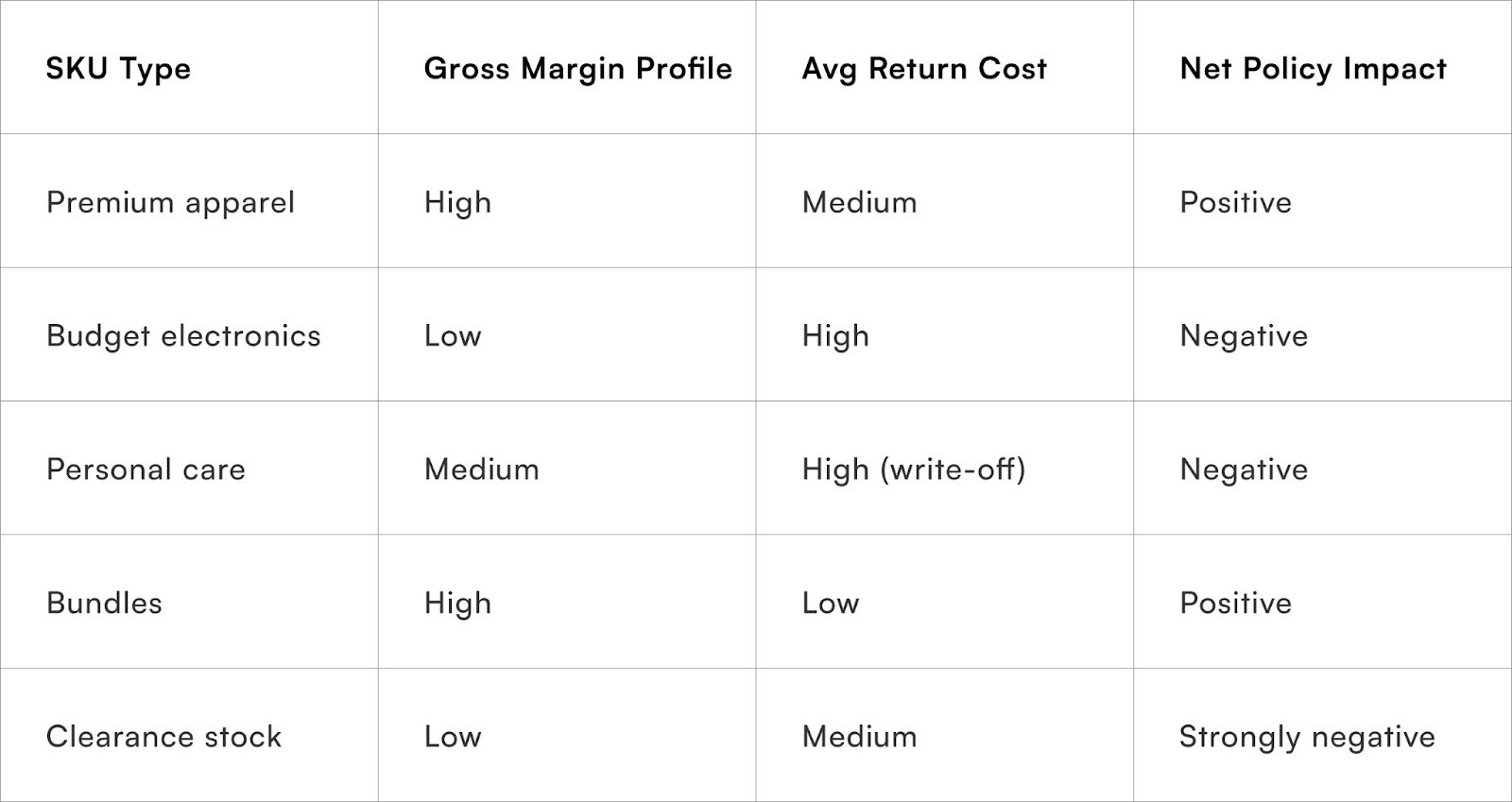
This view prevents return policy decisions driven purely by CX optics.
How should ops and finance evaluate SKU-level return policies together?
Returns policy is a unit economics decision
Return policies often sit with CX or product teams, while their costs sit with ops and finance. This separation leads to misaligned incentives. SKU-level return design works only when these functions evaluate policies using shared metrics and assumptions.
Joint evaluation dimensions
Contribution margin after returns
Margins should be calculated net of expected return frequency and reverse logistics cost, not gross margin alone.
Working capital lock-in
Returned inventory ties up capital until it is inspected, approved, and resold. This time cost is often overlooked.
When ops and finance evaluate policies together, free returns become a deliberate choice rather than a default.
What does a graduated SKU-level return policy look like in practice?
Binary rules are rarely optimal
Most brands do not need extreme policies such as “no returns” or “free returns always.” Graduated policies introduce light, proportional friction that aligns customer behaviour with operational reality without damaging trust.
Examples include shorter return windows for high-risk SKUs, partial return fees tied to handling cost, or store-credit refunds for fashion categories. These mechanisms maintain flexibility while signalling that returns have a real cost.
Graduated return policy structures by SKU type
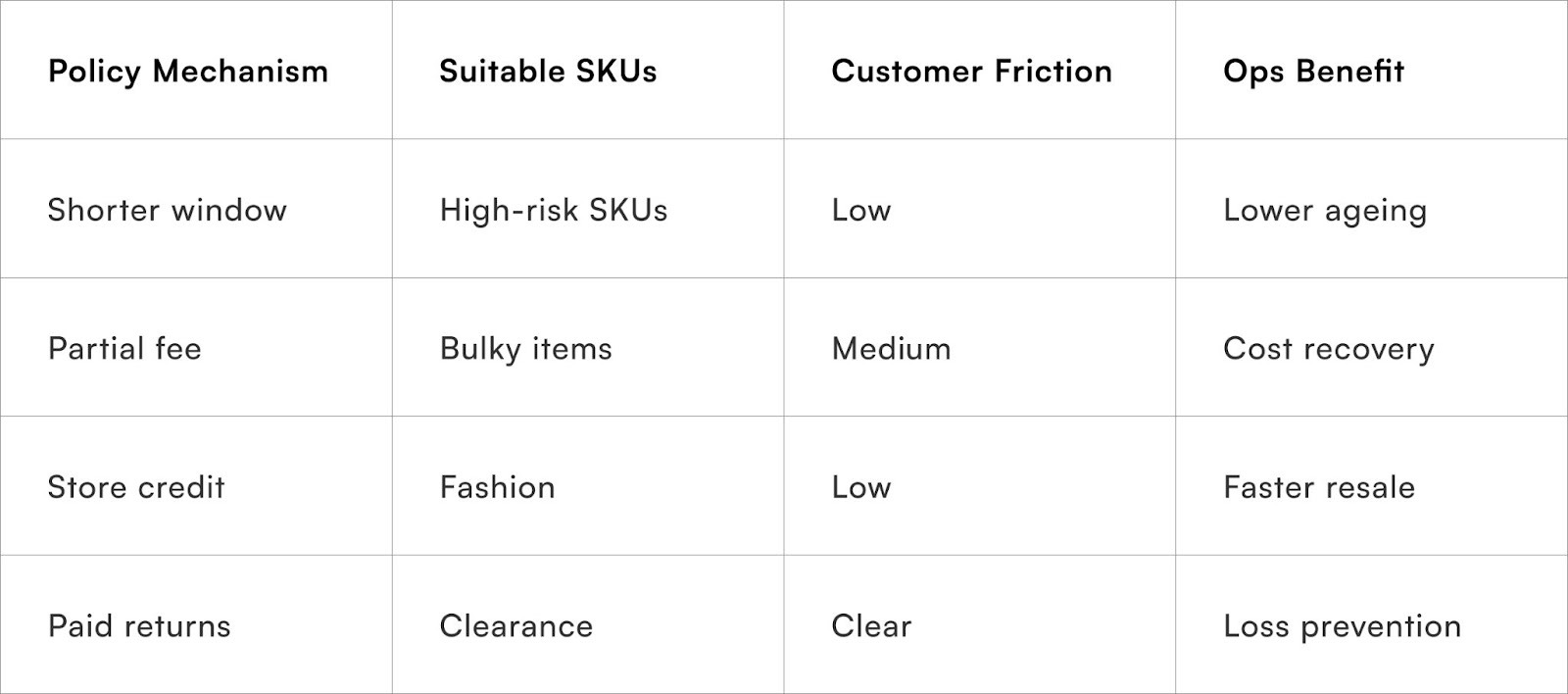
Graduation allows policies to evolve without abrupt customer pushback.
How should SKU-level return policies be communicated?
Transparency prevents disputes more than generosity
The biggest risk with SKU-level differentiation is poor communication. Customers rarely object to policies they understand upfront. Problems arise when policies are discovered only after a return is initiated.
Clear messaging on product pages, checkout, and order confirmation is essential. Policies should be written in plain language, consistently applied across channels, and supported by CX scripts. When communication is clear, SKU-level policies often reduce disputes rather than increase them.
How SKU-level return policies evolve as brands scale
Policies should mature with volume, not remain static
Early-stage D2C brands often treat return policies as a one-time decision. In reality, return behaviour changes materially as order volumes, geographies, and customer cohorts expand. What works at 1,000 orders a month rarely holds at 50,000. SKU-level policies allow brands to adapt without rewriting the entire CX playbook every quarter.
As scale increases, variance increases. Certain SKUs attract opportunistic behaviour, others break down operationally in specific regions, and some become return-heavy only during discount cycles. Mature brands treat SKU-level return rules as living systems that are reviewed periodically, not fixed rules locked in policy documents.
The role of discounting and promotions in SKU return spikes
Returns often spike after campaigns, not randomly
Many ops teams notice return spikes but fail to connect them to pricing events. Flash sales, influencer-led drops, and deep discounts disproportionately affect SKU-level return behaviour. Customers buying under heavy discounts are more price-sensitive and less tolerant of mismatch, leading to higher return probability.
Why discounted SKUs behave differently
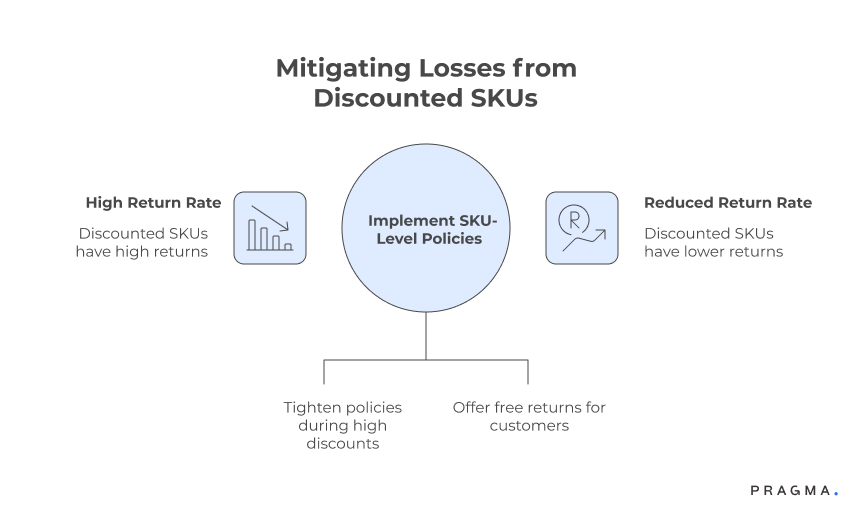
Lower commitment purchases
Discount-driven purchases are often impulsive. Customers are more likely to “try and see,” especially when returns are free.
Margin compression magnifies losses
Discounting reduces gross margin headroom, which makes each return significantly more damaging. A SKU that survives free returns at full price may become loss-making under discount conditions.
SKU-level policies can dynamically tighten during high-discount periods without changing the brand’s overall return promise.
How SKU-level policies reduce operational firefighting
Clear rules upstream reduce exceptions downstream
A major hidden cost of poor return policy design is operational chaos. Ambiguous or overly generous rules create exceptions that CX, warehouse, and finance teams must manually resolve. SKU-level clarity reduces this noise.
When warehouse teams know upfront which SKUs require stricter inspection, shorter windows, or different refund modes, processing becomes predictable. CX agents spend less time negotiating outcomes, and finance teams see fewer one-off refund adjustments. Over time, SKU-level policies reduce internal friction as much as customer-facing cost.
Where product teams go wrong with “CX-first” return decisions
Customer empathy without data creates blind spots
Product and growth teams often advocate free returns to reduce friction, especially for new SKUs. While the intent is sound, problems arise when these decisions are made without operational feedback. A CX-first approach that ignores reverse logistics data leads to hidden leakage.
Common product-side blind spots
Ignoring post-return condition data
Not all returns are equal. A SKU that comes back damaged or unsellable creates a very different cost profile than one returned unused.
Assuming all categories behave alike
Applying apparel logic to electronics or personal care leads to structural losses.
SKU-level return policies work best when product teams treat ops data as a design input, not a post-launch report.
Quick Wins
A practical rollout plan without policy shock
SKU-level return policies do not need a long transformation programme to start delivering value. Most brands can unlock early gains within a month by sequencing changes carefully and avoiding abrupt customer-facing shifts.
Week 1: Diagnose SKU-level return economics
Start by pulling three months of return data at SKU level. Focus on return rate, resale eligibility, refund speed, and logistics cost per return. At this stage, the objective is not to redesign policies, but to identify outliers that behave very differently from the catalogue average.
By the end of the week, teams should be able to clearly list:
- SKUs with consistently high return rates
- SKUs with low resale recovery
- SKUs where reverse logistics costs exceed gross margin contribution
Week 2: Classify SKUs into policy buckets
Using the diagnostic data, group SKUs into 3–4 policy tiers such as “free returns”, “conditional free returns”, and “paid or restricted returns”. This classification should be internal first, without updating storefront messaging.
Operations, CX, and finance should review these buckets together to ensure that rules are enforceable and do not create edge-case confusion.
Week 3: Pilot changes on a narrow SKU set
Select a small subset of high-risk SKUs and apply tighter return rules, such as shorter windows or mandatory reason capture. Monitor customer complaints, refund timelines, and CX escalations closely.
The goal here is learning, not perfection. Feedback from this pilot will surface unclear messaging, tooling gaps, and training needs.
Week 4: Align messaging and train teams
Once rules are stable, update product pages, FAQs, and CX playbooks. Clear communication reduces friction more than generosity alone. By the end of 30 days, most brands see early margin protection without measurable drops in conversion.
What metrics should guide SKU-level return decisions?
Move beyond headline return rates
Tracking return rate alone hides more than it reveals. SKU-level policies require metrics that capture both financial and operational impact.
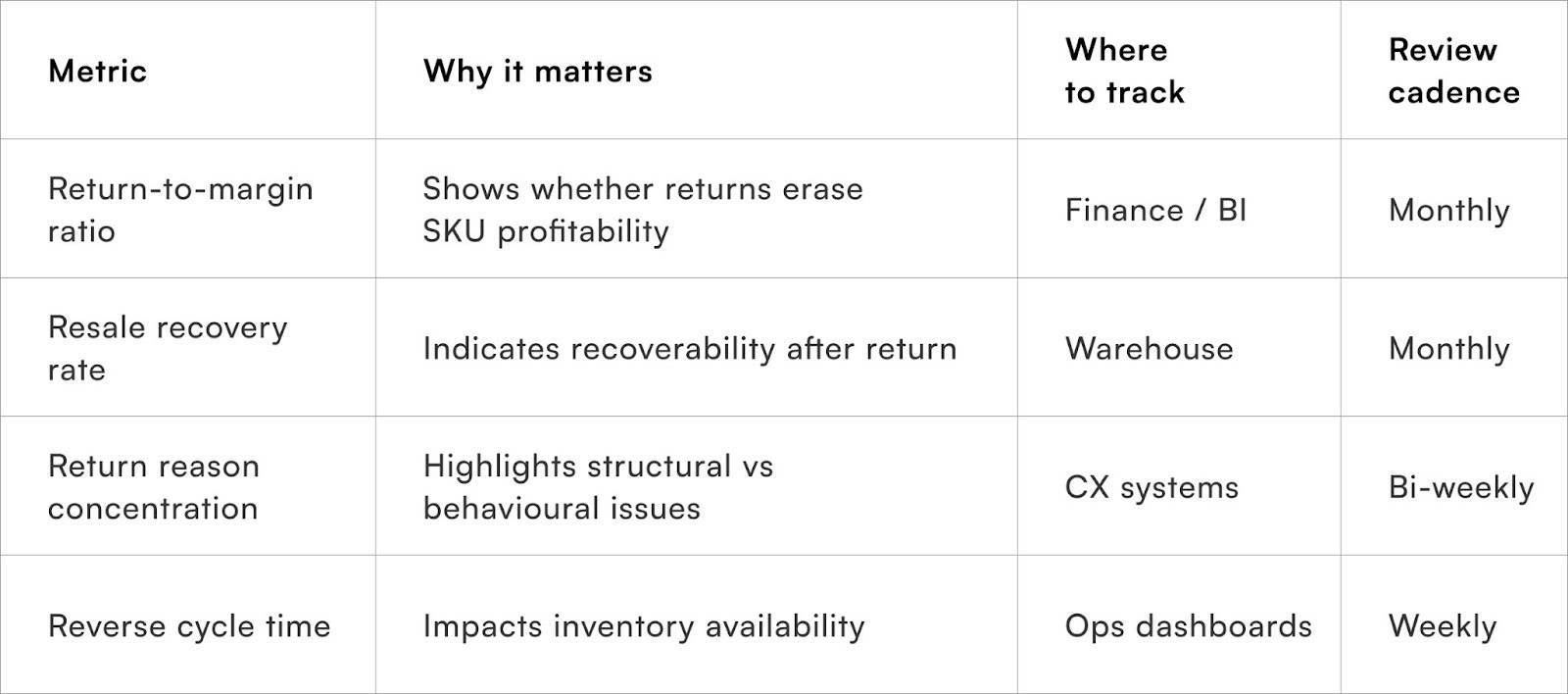
Over time, these metrics allow teams to predict which SKUs can safely support free returns and which need guardrails.
How governance keeps SKU-level policies from drifting
Policies fail when ownership is unclear
SKU-level return rules must have a clear owner. Without governance, exceptions creep in, CX overrides increase, and policy intent gets diluted.
The most effective setups assign joint ownership between operations and product, with finance acting as an approving authority for major changes.
A quarterly policy review, backed by SKU-level data, is usually sufficient. The aim is not constant tweaking, but disciplined recalibration as volumes, categories, and customer behaviour evolve.
To Wrap It Up
SKU-level return policies recognise a simple truth: not all products behave the same after delivery. Free returns can build trust and conversion for the right SKUs, but applied blindly, they quietly drain margins and operational capacity.
This week, identify your top five loss-making SKUs on returns and audit whether their return rules still make economic sense.
Over the long term, brands that treat return policies as dynamic, data-led systems rather than static promises will protect both customer experience and profitability as they scale.
For D2C brands seeking to operationalise SKU-level return intelligence, Pragma’s returns intelligence platform provides SKU-level visibility, rule orchestration, and analytics that help brands reduce reverse losses while maintaining customer trust.

FAQs (Frequently Asked Questions On Designing SKU-level return policies: when free returns make sense (and when they don’t))
1. Will differentiated return policies confuse customers?
Not if communicated clearly. Most confusion comes from inconsistent enforcement, not from well-explained differences at the product level.
2. Do SKU-level policies hurt conversion rates?
In most cases, no. High-intent customers prioritise clarity over generosity, especially when expectations are set before purchase.
3. Should high-priced SKUs always have stricter return rules?
Not necessarily. Price matters, but resale value and condition on return are more important factors.
4. How often should SKU return policies be reviewed?
Quarterly reviews work well for most brands, with interim checks during major sales events.
5. Can this work for small catalogues?
Yes. Even brands with limited SKUs often see a small subset driving disproportionate return losses.
6. Do marketplaces require different SKU policies than D2C sites?
Often yes. Marketplace behaviour, customer expectations, and enforcement mechanisms differ and should be treated separately.
Talk to our experts for a customised solution that can maximise your sales funnel
Book a demo
.png)