

Large, bulky, or assembly-intensive SKUs behave very differently from fast-moving parcels. A treadmill, wardrobe, sofa, or modular desk does not fail delivery for the same reasons as a T-shirt. Yet many D2C ops teams still apply the same RTO logic across categories, only to discover rising refusals, higher reverse freight costs, and frustrated customers.
This is where a dedicated “RTO playbook for bulky or assembly-intensive SKUs” becomes essential. These products introduce new variables—delivery coordination, access constraints, time windows, installation readiness, and customer availability—that materially change the probability of a successful doorstep handoff. Ignoring these signals pushes costs downstream, where every failed attempt is disproportionately expensive.
In this blog, we delve into how RTO patterns differ for bulky and assembly-heavy items, what early signals ops teams should instrument, and how process design—not just courier choice—drives outcomes. The goal is not to eliminate RTOs entirely, but to predict, prevent, and contain them before they erode margins and customer trust at scale.
Why do bulky and assembly-heavy SKUs see structurally higher RTO rates?
Because delivery success depends on coordination, not just shipment
Unlike small parcels, bulky or installation-led SKUs fail delivery for reasons that sit outside standard logistics control. The product may be in perfect condition, the courier may arrive on time, and yet the delivery still fails because the environment is not ready. This makes RTOs for these SKUs more predictable—but only if teams know what to look for.
How delivery complexity compounds failure probability
Every additional dependency in the delivery flow increases the chance of breakdown. Bulky items often require building access, lift permissions, multiple handlers, or installation readiness. When these are not confirmed upfront, refusals happen at the doorstep rather than earlier in the journey.
Typical complexity layers for bulky SKUs
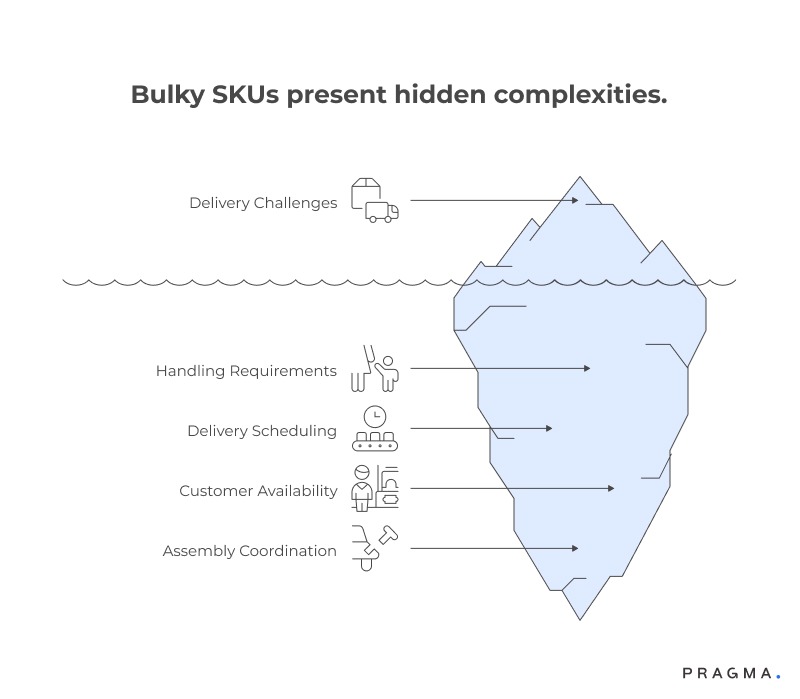
- Multi-person handling or special vehicles
- Fixed delivery windows instead of all-day attempts
- Customer presence required at delivery
- Pre- or post-delivery assembly coordination
Each of these layers introduces a binary risk. If even one fails, the delivery does too.
Why customer intent is weaker at the doorstep
For high-ticket, bulky purchases, buyer’s remorse often surfaces late. Customers may not fully visualise size, access constraints, or assembly effort at checkout. By the time the product reaches the doorstep, the reality becomes tangible—and refusal becomes the easiest exit.
This is why bulky SKU RTOs skew heavily towards “customer refused” or “customer unavailable”, even when earlier confirmations exist.
What first-mile signals reliably predict bulky SKU RTOs?
Early indicators surface before the order ever ships
The advantage with bulky SKUs is that failure signals appear much earlier in the lifecycle. Ops teams that instrument these signals can intervene days before the first delivery attempt.
Checkout-level signals that should never be ignored
Certain behaviours at checkout correlate strongly with downstream refusal. These are often dismissed as UX noise but are powerful predictors when aggregated.
High-risk checkout patterns
- Frequent address edits or incomplete address fields
- Skipped delivery slot selection when optional
- No response to installation preference prompts
- COD selection on high-AOV bulky items
Individually, these may seem minor. Together, they meaningfully increase RTO probability.
Post-order confirmation gaps that create silent risk
For bulky SKUs, silence is often more dangerous than negative responses. Orders where customers do not acknowledge delivery instructions or installation requirements should be treated as provisional, not confirmed.
Signals to instrument within 24–48 hours
- No response to delivery slot confirmation
- Installation call unanswered or deferred repeatedly
- Customer requests vague rescheduling without dates
These are not CX issues; they are operational risk markers.
How should delivery windows be designed for bulky SKUs?
Time precision matters more than speed
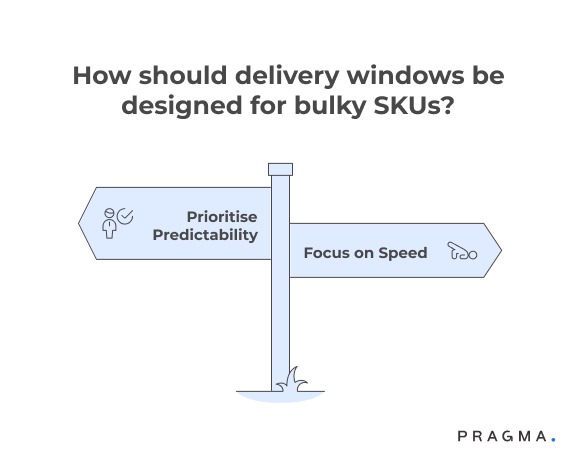
Fast delivery does not improve outcomes for bulky or assembly-intensive products. In fact, it often increases RTOs by compressing coordination time.
Why narrow windows outperform faster promises
Customers are far more likely to accept delivery when the window is predictable, even if it is later. A four-hour guaranteed slot two days later performs better than a “next-day, all-day” attempt.
Operational implications
- Reduced “customer unavailable” failures
- Higher installation readiness
- Fewer last-minute refusals
Speed optimises conversion; predictability optimises fulfilment.
Pre-delivery touchpoints that actually reduce refusals
Bulky SKU deliveries require deliberate confirmation, not generic notifications. Messaging must prompt action, not just inform.
Effective pre-delivery confirmations
- Explicit “Reply YES to confirm availability” flows
- Access readiness checks (lift, stairs, gate width)
- Assembly consent confirmation before dispatch
These confirmations act as soft gates, filtering out high-risk orders before cost is incurred.
Which failure reasons should trigger auto-RTO vs reattempt?
Not all failed attempts deserve another chance
For bulky SKUs, reattempts are expensive and often futile unless something materially changes. Ops teams must distinguish between recoverable and structural failures.
Failure reasons that justify reattempts
Reattempts make sense only when the failure cause is temporary and customer-controlled.
Valid reattempt scenarios
- Customer requested reschedule with a specific date
- Installation team unavailable but delivery accepted
- Access temporarily blocked with confirmation of resolution
In these cases, a second attempt has a high success probability.
Failures that should move directly to auto-RTO
Some failures signal a fundamental mismatch between product and customer context.
Auto-RTO candidates
- Repeated unresponsiveness to confirmations
- Explicit refusal due to size or assembly concerns
- Payment refusal for COD bulky items
Forcing reattempts here only compounds losses.
How should carriers and installation partners be selected for bulky SKUs?
Capability alignment matters more than coverage density
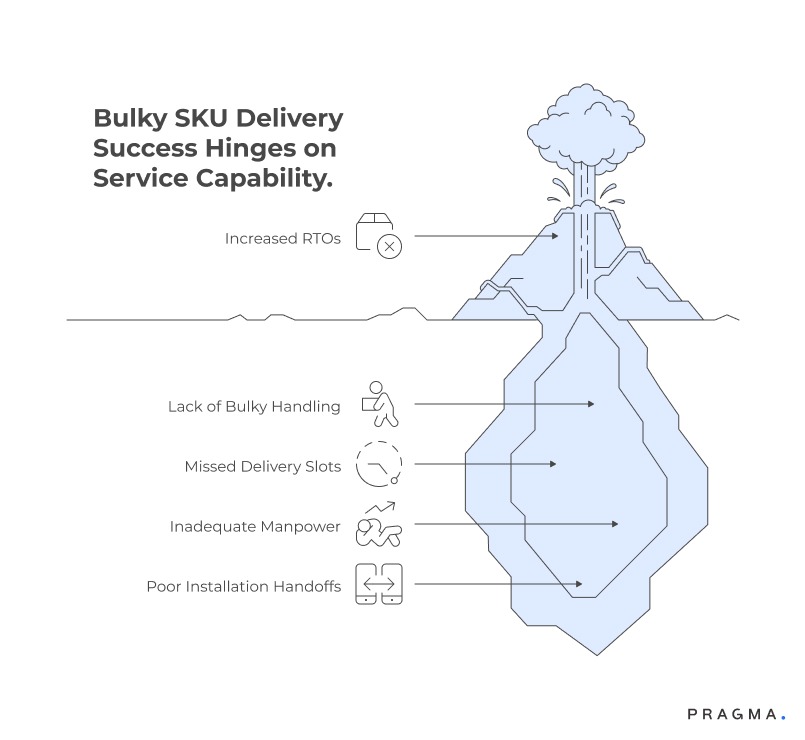
For bulky and assembly-intensive SKUs, the carrier decision is not a pure logistics choice. It is a service capability decision. Using a high-coverage parcel carrier without bulky-handling depth often increases RTOs, even if headline rates look attractive.
Why generalist carriers struggle with bulky deliveries
Most parcel-first carriers optimise for speed and volume, not coordination. Their networks are not designed for scheduled delivery windows, multi-handler loads, or on-site problem solving.
Common failure patterns with generalist carriers
- Missed slots due to route inflexibility
- Inadequate manpower for heavy items
- No ownership of installation handoffs
These failures are structural, not executional.
Matching SKU complexity to partner capability
Ops teams should segment bulky SKUs by handling and assembly complexity and route them to carriers accordingly. One-size-fits-all routing increases variance and cost.
Suggested partner segmentation
- Delivery-only bulky SKUs: carriers with lift-equipped vehicles and slot adherence
- Assembly-required SKUs: partners with integrated installation workflows
- Premium AOV SKUs: white-glove delivery providers with CX accountability
This segmentation reduces exception handling downstream.
How should COD vs prepaid logic differ for bulky items?
Payment method is a behavioural signal, not just a checkout option
COD introduces disproportionate risk for bulky SKUs. The refusal cost is not just a missed delivery—it includes heavy reverse freight, potential damage, and inventory blocking.
Why COD refusal risk is amplified for bulky SKUs
Customers face no financial friction at the doorstep for COD orders. When confronted with size, assembly effort, or access challenges, refusal becomes the default escape.
This behaviour is far less common for prepaid orders, where commitment is already established.
When COD should be restricted or conditioned
Instead of blanket COD bans, brands can introduce conditional logic that balances conversion with risk control.
COD mitigation strategies
- Disable COD for high-weight or high-AOV thresholds
- Allow COD only after delivery slot confirmation
- Require partial prepayment for assembly-intensive items
These rules reduce casual ordering without harming genuine buyers.
How can inventory and reverse logistics risk be contained?
RTO cost is not just freight—it’s capital lock-in
When bulky SKUs return, they often re-enter inventory slowly, if at all. Packaging damage, partial assembly, and inspection delays create long holding cycles.
Why bulky SKU returns distort inventory health
Returned bulky items frequently move into a grey zone—neither sellable nor written off. This inflates inventory on paper while reducing actual availability.
Risks to monitor
- Time to QC and re-grade returned units
- % of returned units requiring repackaging
- Write-offs from transit and handling damage
Without tracking these, RTO costs remain understated.
Reverse routing rules that reduce damage and delay
Not all returns should follow the same reverse path. For bulky SKUs, reverse routing decisions matter as much as forward delivery.
Effective reverse strategies
- Direct returns to refurbishment hubs, not FCs
- Skip reattempts when refusal is explicit
- Prioritise inspection over resale speed
These choices protect long-term margin, even if they slow resale.
What metrics should ops teams track separately for bulky SKU RTOs?
Aggregate RTO hides category-specific failure modes
Bulky SKUs distort overall RTO metrics because their cost impact is outsized. They must be measured independently.
Metrics that matter for bulky and assembly-heavy items
Tracking these separately allows for sharper interventions and better policy design.
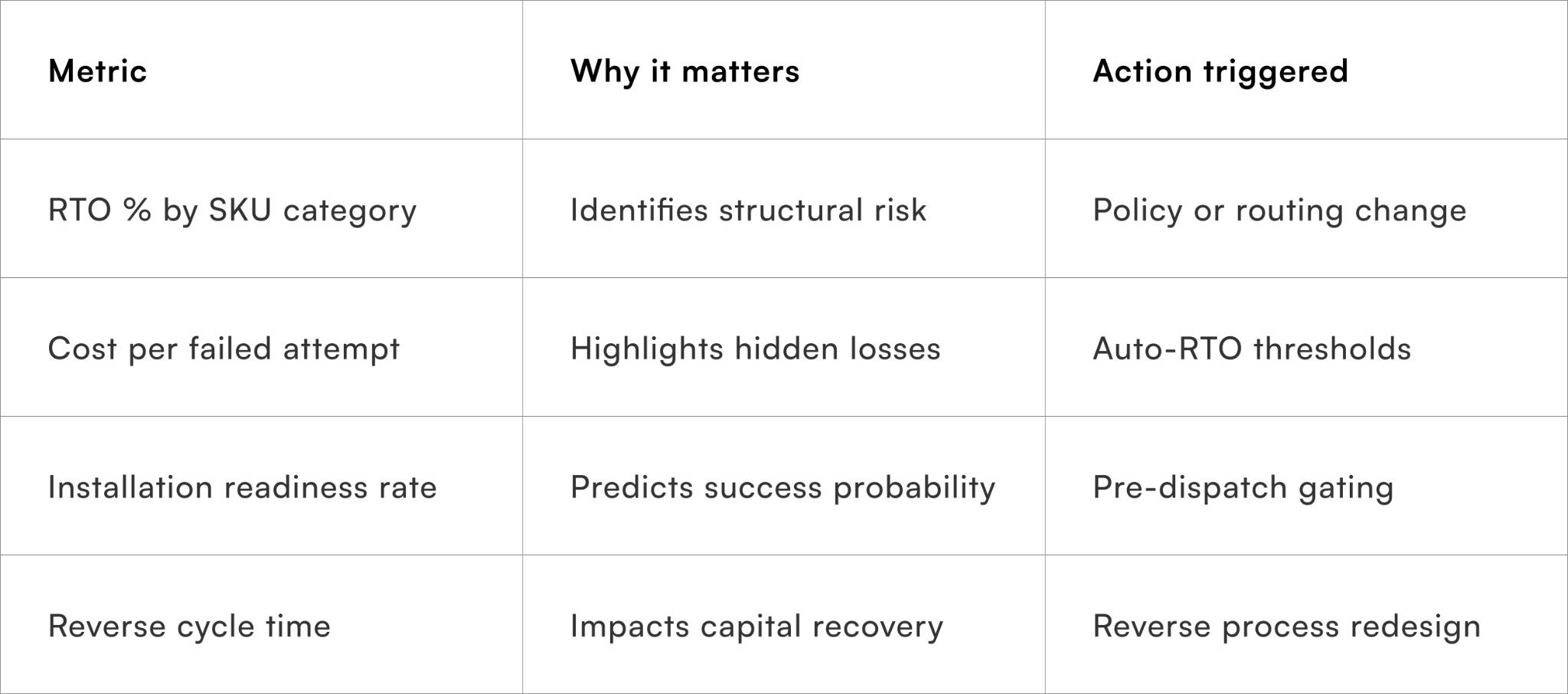
These metrics shift focus from volume to value.
Using these insights to design a category-specific RTO playbook
Once tracked, these signals should feed into differentiated SOPs. Bulky SKUs deserve their own RTO logic, not exceptions to parcel rules.
This playbook approach ensures decisions are consistent, data-backed, and defensible across ops, finance, and CX teams.
Quick Wins
Stabilising bulky SKU RTOs without platform overhauls
Week 1: Separate bulky SKUs in RTO reporting
Start by isolating bulky and assembly-intensive SKUs from standard parcel RTO dashboards. Create a simple category flag and review refusal reasons, cost per attempt, and reattempt success rates independently.
This immediately surfaces how much margin leakage is being masked by blended metrics.
Expected outcome: Clear visibility into true bulky SKU RTO cost.
Week 2: Introduce pre-dispatch confirmation gates
Add at least one hard confirmation before dispatch—delivery slot acknowledgement, installation readiness, or access confirmation. Orders without explicit confirmation should be delayed or flagged for review.
This shifts failure from the doorstep to a low-cost decision point.
Expected outcome: Fewer “customer unavailable” and refusal RTOs.
Week 3: Codify reattempt vs auto-RTO rules
Document which failure reasons qualify for reattempts and which should trigger immediate RTO. Train CX and ops teams to follow these rules consistently instead of case-by-case judgement.
Consistency here matters more than perfection.
Expected outcome: Reduced wasted reattempts and lower reverse freight.
Week 4: Tighten COD exposure for bulky items
Apply conditional COD rules based on AOV, weight, or assembly complexity. Even partial prepayment dramatically improves delivery commitment.
Monitor conversion impact carefully to ensure trade-offs are deliberate.
Expected outcome: Higher doorstep acceptance rates for bulky SKUs.
To Wrap It Up
Bulky and assembly-intensive SKUs demand a fundamentally different RTO strategy. Treating them like parcels pushes failures downstream, where every mistake is expensive and hard to recover.
This week, separate bulky SKUs in your RTO metrics and introduce at least one pre-dispatch confirmation gate.
Over the long term, category-specific routing, payment conditioning, and reverse logistics design turn bulky SKUs from margin drains into controlled, scalable revenue lines.
For D2C brands seeking to orchestrate complex deliveries with fewer failures, Pragma’s logistics orchestration platform enables category-level routing, confirmation gating, and RTO rule engines that help brands reduce bulky SKU RTO costs by up to 25% while improving delivery predictability.

FAQs (Frequently Asked Questions On RTO playbook for bulky or assembly-intensive SKUs)
1. Are RTOs inevitable for bulky or assembly-heavy SKUs?
No. They are higher than parcels, but predictable. Most failures can be prevented through early confirmation and capability-aligned routing.
2. Is faster delivery better for bulky items?
Not usually. Predictable, narrow delivery windows outperform speed for bulky SKUs.
3. Should all bulky SKUs be prepaid-only?
Not necessarily. Conditional COD with confirmations often balances risk and conversion better than blanket bans.
4. When does a reattempt make sense for bulky deliveries?
Only when the failure cause is temporary and the customer confirms a specific resolution.
5. Do installation partners reduce RTOs?
Yes, when tightly integrated. Disconnected installation workflows increase failure risk.
Talk to our experts for a customised solution that can maximise your sales funnel
Book a demo
.jpg)

.png)