

Every time a package comes back to a brand's warehouse undelivered, they lose money twice. They paid to ship it out. Now they have to pay to get it back.
For D2C brands in India, this is not a rare event. RTO rates in the Indian fashion and apparel e-commerce industry are between 20% and 40% in certain segments. That means for every 10 orders you ship, up to 4 come back.
Comprehending the return to sender process meaning is the first step to fixing it.
So, let us talk about "Return to Sender Process: How It Works in E-commerce Logistics?", why it happens, what it costs your business, and what you do to reduce it.
What Is the Return to Sender Process?
When we talk about the meaning of the return to sender process, it is a situation that happens when a courier partner cannot deliver a package to the intended recipient and sends it back to the original shipper.
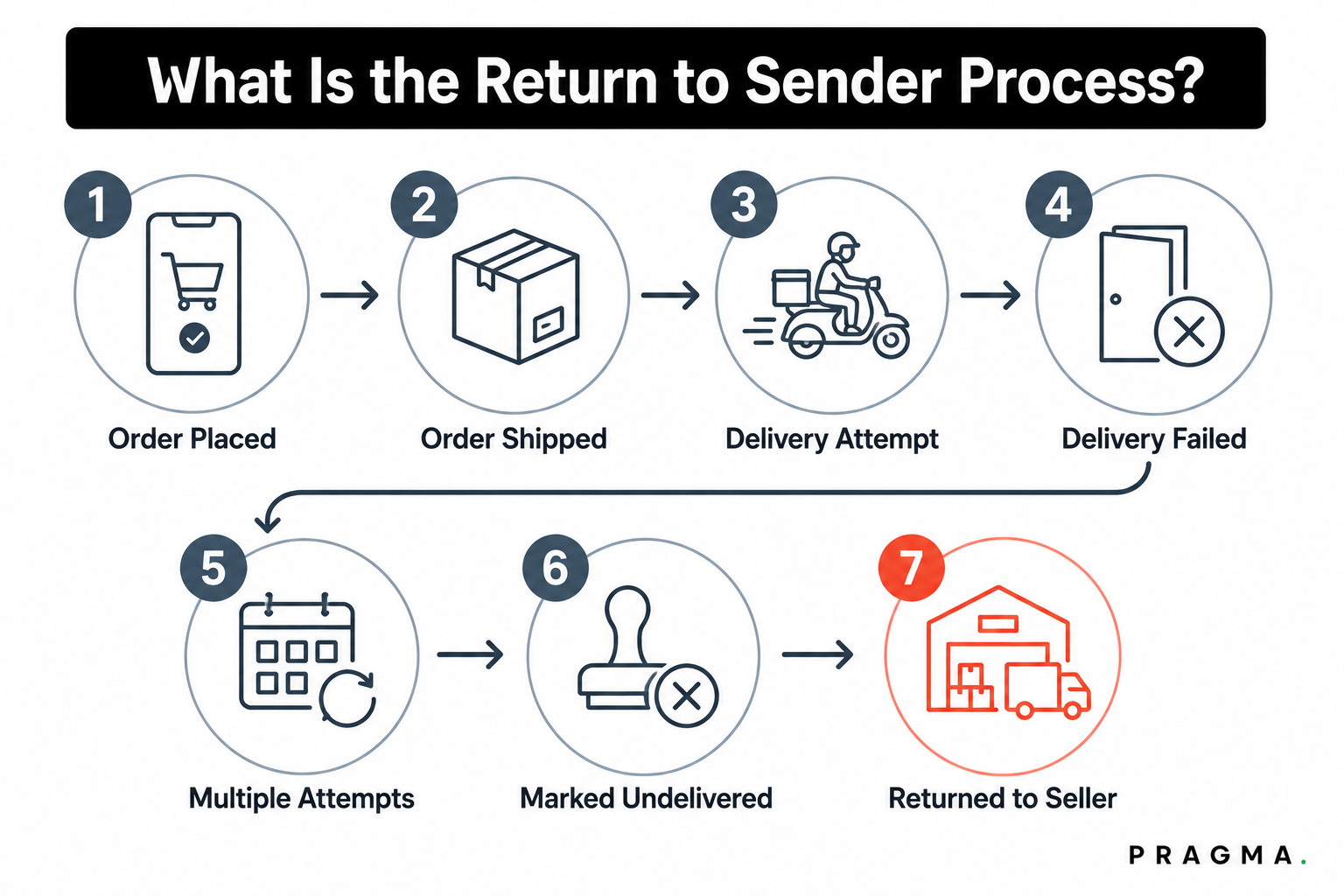
In e-commerce logistics, this is also called Return to Origin or RTO. The package leaves the warehouse, fails to reach the customer, and comes back to the seller. According to studies, RTO can eat up to 20% of the business revenue if left unmanaged.
The return to sender process's meaning is straightforward: the shipment did not complete, and the courier reversed its journey.
For D2C brands, this is a direct financial loss. As the seller first bears the forward shipping cost, then the reverse shipping cost, and in many cases, they also lose the sale.
How Does the Return to Sender Process Work?
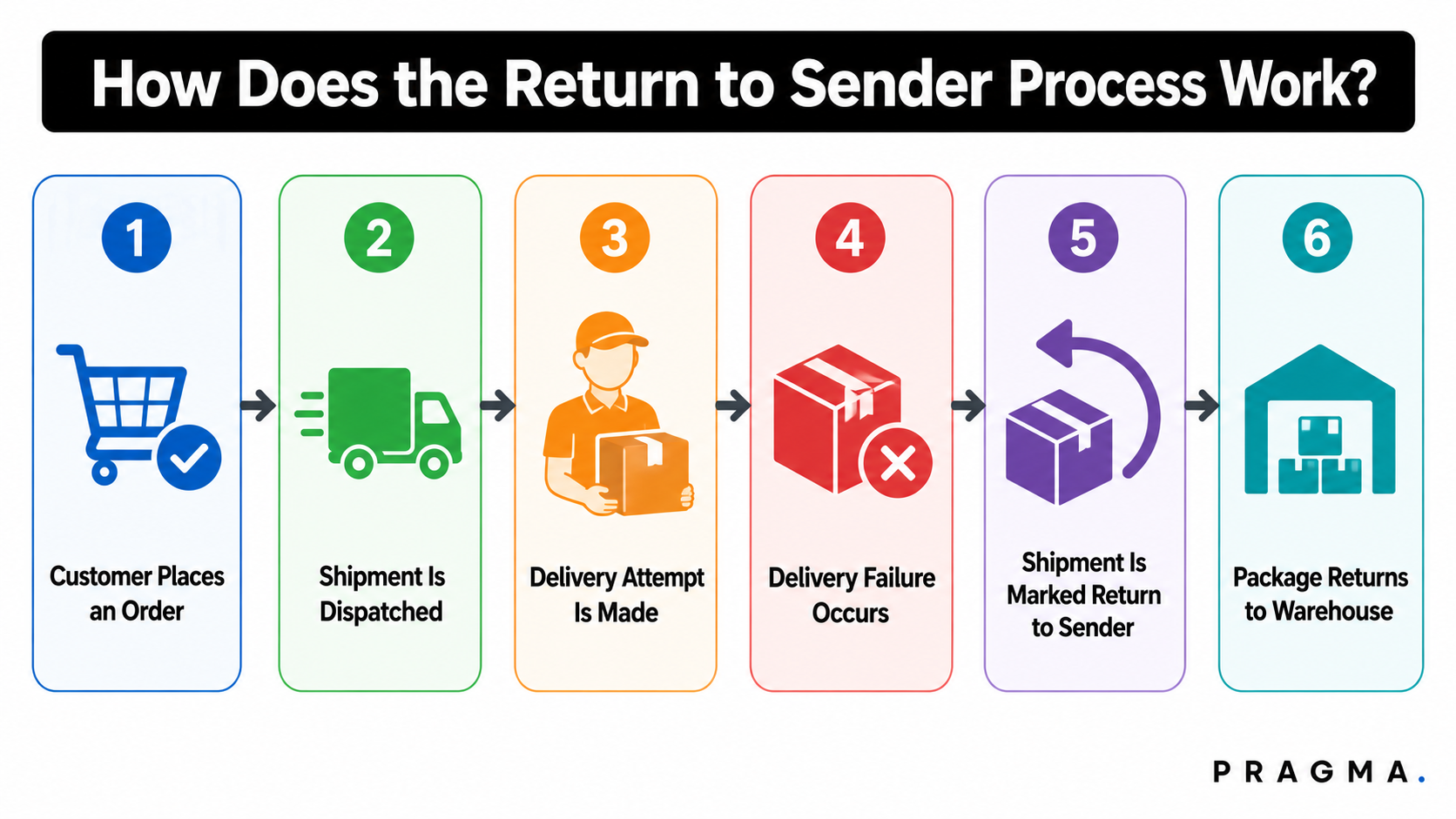
The return to sender process follows a set of sequences. Here is each step explained.
Step 1: Customer Places an Order
A customer visits the brand's website and places an order. They enter their delivery address, choose a payment method (prepaid or COD), and confirm the purchase.
At this stage, the risk of a future RTO is already being set. If the address is incomplete, the pincode is wrong, or the customer is an impulse buyer with a history of refusing deliveries, the order is already high-risk.
To have a check on such situations, Pragma RTO Suite is designed to scan over 300 parameters within 200 milliseconds of order placement. It can flag risky orders before dispatch, giving your team a chance to verify or cancel before the shipment leaves your warehouse.
Step 2: Shipment Is Dispatched
The next step came when the warehouse team packed the order and handed it to a logistics partner.
The courier generates a tracking number, and the package enters the delivery network.
At this point, the forward shipping cost is already incurred.
Step 3: Delivery Attempt Is Made
Now, the very crucial stage comes. The courier attempts to deliver the package to the address on the label.
Most couriers make up to three delivery attempts before marking the shipment as undeliverable.
If the customer is unavailable, the courier leaves a notice or attempts to call. In many cases, especially in Tier 2 and Tier 3 cities, this communication fails.
Step 4: Delivery Failure Occurs
When the courier partner did not get any response, the delivery attempt failed, and he generated a Non-Delivery Report (NDR).
The NDR records the reason for failure, such as wrong address, customer unavailable, or refused delivery.
How your team responds to an NDR determines whether the order gets delivered on a reattempt or becomes a full RTO.
Pragma's automated NDR management collects reattempt details from customers via WhatsApp, SMS, and email. It populates this data directly into your store dashboard, WMS, and courier partner systems, removing the need for manual follow-up calls.
Step 5: Shipment Is Marked Return to Sender
If the delivery fails after multiple attempts and the customer does not respond, the courier marks the shipment as Return to Sender or RTO.
The package is rerouted through the courier's sorting network and begins its journey back to your warehouse.
Step 6: Package Returns to Warehouse
The last stage is when the package arrives back at the warehouse.
At this point in time, businesses must now inspect it, check for damage, restock it if it is in sellable condition, and process any refund or replacement for the customer.
This entire cycle costs e-commerce brands money, time, and inventory capacity. So, this is how the return to sender process works in the e-commerce industry.
Common Reasons for Return to Sender Shipments
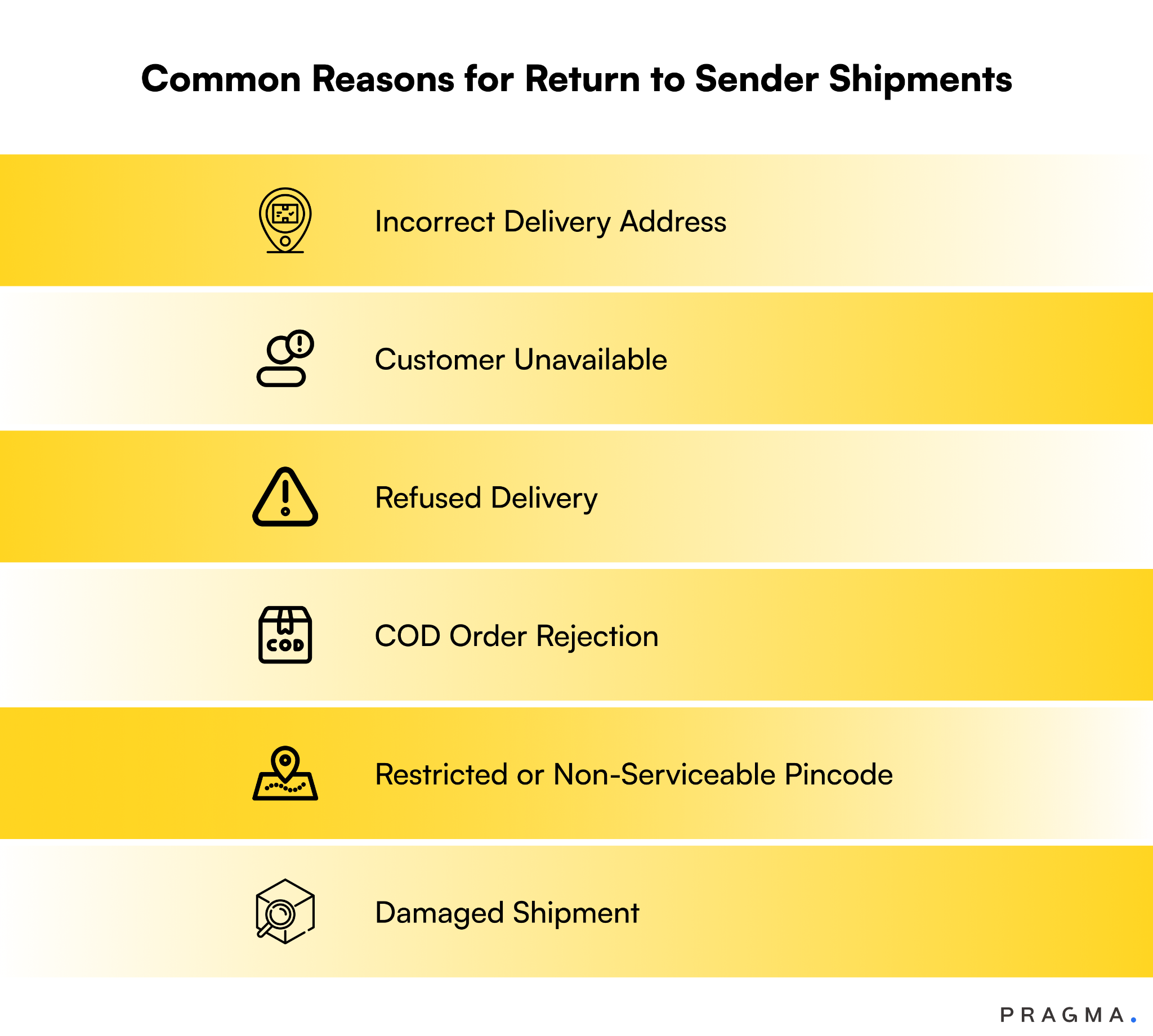
Knowing why packages come back can help e-commerce brands prevent them. Here are the most common causes of return-to-sender situations:
Incorrect Delivery Address
This is the single biggest driver of return-to-sender shipments. Customers enter wrong house numbers, missing apartment details, incorrect pincodes, or outdated addresses.
Data shows that AI-based address validation reduces info-related RTOs by 45% to 60%. Pragma RTO Suite's address validation system checks PIN code accuracy and address completeness before order processing, where orders from temporary residences such as hostels, hotels, or high-risk PIN codes get flagged automatically.
Customer Unavailable
The customer is not present at the delivery address when the courier arrives. This is especially common when no delivery schedule is communicated in advance.
According to a study, 13% of customers never shop with the same retailer again if their order is not delivered on time.
Thus, to reduce such situations, Pragma WhatsApp Business Suite enables brands to send pre-delivery messages where a customer can easily confirm or reschedule the delivery if unavailable, reducing unavailability-related RTOs by 25-30%.
Refused Delivery
One of the major reasons behind the return to sender process is when the customer actively refuses to accept the package.
This happens due to product dissatisfaction, a change of mind, or an inability to pay the COD amount at the door.
Impulse buying is also a major contributor here. A customer orders during a sale, changes their mind by the time the package arrives, and refuses it at the door.
COD Order Rejection
Cash on Delivery orders carry a significantly higher RTO risk than prepaid orders.
Over 60% to 70% of Indian e-commerce orders are placed as COD, and a large portion of these get rejected at the door.
Pragma's COD to Prepaid (C2P) conversion feature nudges customers to switch to prepaid payment through custom offers and discounts sent via WhatsApp, SMS, and email. Brands using this feature have increased prepaid orders from 25% to 35%.
Restricted or Non-Serviceable Pincode
Some delivery addresses fall in areas where the courier services do not operate or have poor last-mile infrastructure.
Packages sent to these pin codes get returned without a delivery attempt.
Damaged Shipment
If a package is damaged during transit, the courier returns it rather than attempt delivery.
Poor packaging and mishandling at sorting centres are common causes behind this return-to-sender situation.
That is why every e-commerce business must invest in good packaging and sorting techniques to reduce such RTOs.
Return to Sender vs Return to Origin (RTO)
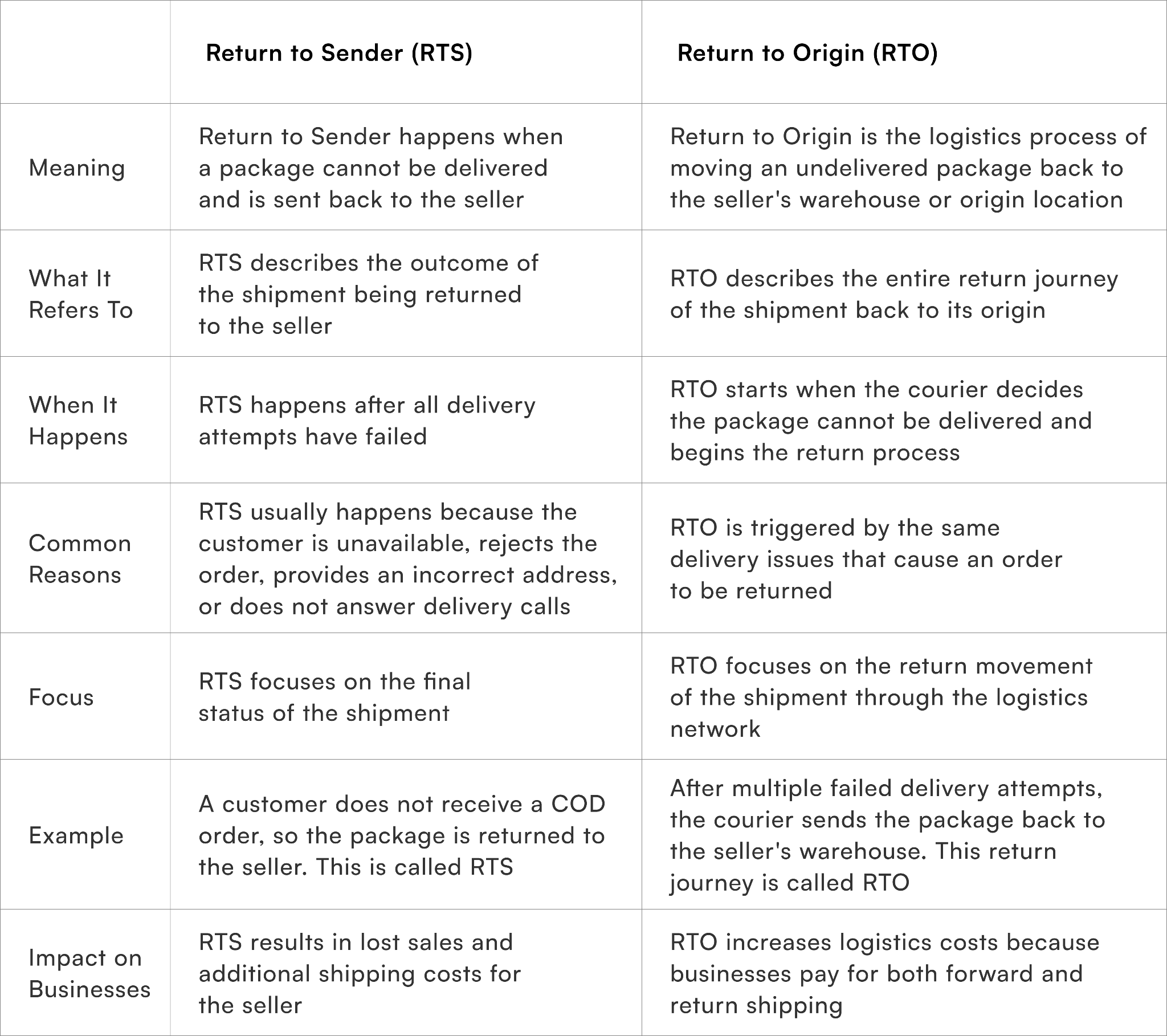
These two terms are often used interchangeably, but there are subtle differences depending on context.
In Indian D2C e-commerce, RTO is the standard term. The return to sender process, meaning, and the RTO process are functionally the same: the package comes back to you because it could not be delivered. Yet there are some differences, have a look at the following table:
Impact of Return to Sender on E-commerce Businesses
The financial and operational damage from return to sender shipments goes beyond the obvious shipping cost.
Have a look at the following points that clearly state what impact the return to sender process has on Indian e-commerce businesses:
Increased Shipping Costs
Every RTO means you pay twice. You pay the forward shipping charge when the order goes out. You pay the reverse shipping charge when it comes back.
Studies show that RTO orders consume over 20% of business profits for e-commerce brands that do not actively manage them.
Inventory Blockage
Returned products sit in your warehouse while they are inspected, repackaged, and restocked. During this time, they are not available for sale.
For fast-moving categories like fashion, this creates stockout risks for popular SKUs while returned inventory piles up.
During this return-to-sender process cycle, inventory gets blocked for 10-15 days, reducing stock availability for genuine customers.
Lower Profit Margins
The combined cost of forward shipping, reverse shipping, repackaging, and restocking erodes the brand's margins on every RTO order.
If the product is damaged during return transit, they get the total loss.
There are also some hidden RTO costs, including repackaging, restocking, product damage, inventory management, refunds, and lost customer retention opportunities.
Customer Experience Issues
A failed delivery frustrates customers. Even if the failure was caused by an incorrect address the customer provided, they often blame the brand.
Research confirms that 13% of customers stop shopping with a retailer after a single late or failed delivery.
Operational Complexity
Managing RTOs requires dedicated workflows. The business team needs to handle NDR follow-ups, coordinate with courier partners, inspect returned goods, update inventory systems, and process refunds or reshipments.
Without automation, this creates significant manual efforts that scale poorly as the order volume grows.
How to Reduce Return to Sender Shipments?
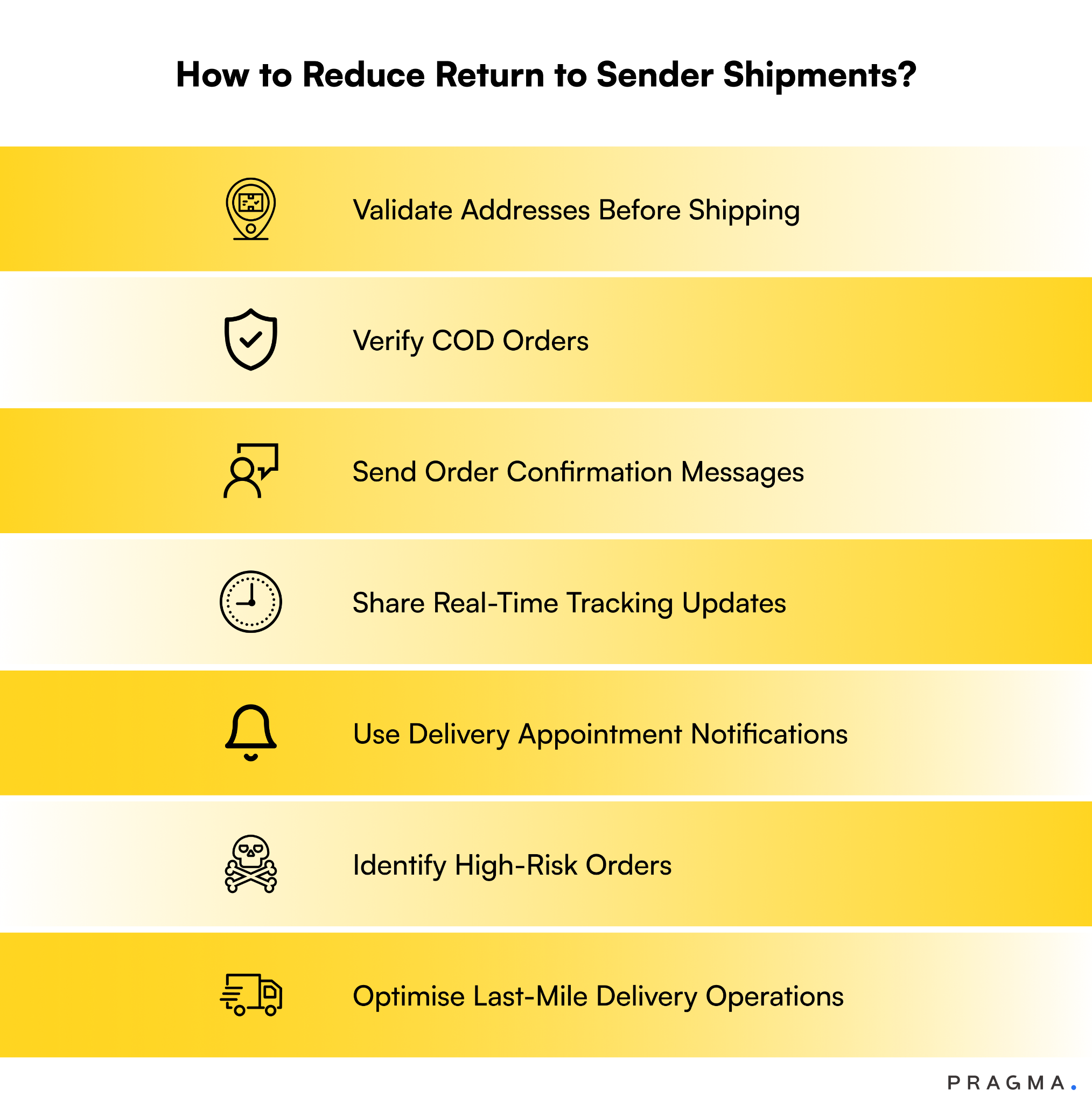
As we know, return to sender shipments are increasing day by day, which is why it becomes really important to handle this before it ruins all the profits of e-commerce businesses.
Here are some strategies which e-commerce brands in India can adopt to reduce their return-to-sender orders:
Validate Addresses Before Shipping
Brands should not wait for a delivery failure to discover an address problem. They should use address validation systems at checkout to catch errors before the order is dispatched.
These systems can automatically verify addresses, check pincode alignment, flag temporary residences like hostels and paying guest accommodations, and auto-correct incomplete entries.
Verify COD Orders
COD orders are the reason behind the highest-risk shipments. To avoid this, brands should confirm them before they dispatch the orders.
This can be done by sending an automated verification message via WhatsApp or SMS, asking the customer to confirm their order. This filters out impulse purchases and fake orders before they enter your logistics pipeline.
Send Order Confirmation Messages
Immediately after an order is placed, e-commerce brands should invest in such RTO systems, which could send a confirmation message with the order details, delivery address, and estimated delivery date.
This gives the customer a chance to spot and correct address errors before the package ships.
Share Real-Time Tracking Updates
Keeping customers informed at every stage of the delivery will definitely reduce return-to-sender shipments.
Brands should send updates when the order is packed, dispatched, out for delivery, and delivered.
Customers who know where their package is are more likely to be available to receive it. Pragma's platform sends real-time tracking notifications via WhatsApp, SMS, and email.
Use Delivery Appointment Notifications
On the day of delivery, send the customer a message with the courier's contact number and an estimated delivery window.
This reduces the chance of the customer being unavailable when the courier arrives.
Identify High-Risk Orders
Not all orders carry the same RTO risk. Use data to identify orders that are likely to fail before you ship them.
Pragma's AI algorithm scans over 300 parameters per order within 200 milliseconds of placement. It cross-references customer data with RTO history across 1,700+ D2C brands to assign a risk score to each order. High-risk orders get flagged for verification or COD restriction.
Optimise Last-Mile Delivery Operations
Not all courier partners perform well in every area. Brands should choose courier partners based on their performance in specific pincodes, not just their overall rates.
Pragma ShipAxis enables brands to select couriers by pin code. With this, they can route orders in high-RTO areas to the courier with the best track record there.
What is the Role of Address Validation in Preventing Return to Sender?
Address errors nearly add up to 25% of the return-to-sender shipments, and are the most preventable cause. Here is how address validation works:
Real-Time Address Verification
The address validation process begins the moment a customer enters their address during checkout.
Instead of waiting until the order is processed, the system instantly checks whether the address is complete, correctly formatted, and likely to be deliverable.
If any information is missing or appears incorrect, customers are prompted to review and update the details before placing the order.
This helps businesses catch address-related errors at the source, reducing the chances of failed deliveries later in the fulfilment process.
Pincode Validation
As soon as a pin code is entered by the customer, it is checked against serviceable delivery locations and courier coverage areas.
If the pincode does not exist, contains errors, or falls outside the delivery network, the customer is notified immediately. This prevents orders from being shipped to locations that cannot be serviced and reduces unnecessary shipping and return costs.
Additionally, pincode validation helps ensure that the city and state details match the entered pincode, improving address accuracy even further.
Address Auto-Completion
Many address errors occur because customers manually enter long and complex address details.
Address auto-completion helps solve this problem by providing intelligent address suggestions as users type.
Customers can simply select the correct address from the suggested options instead of entering every detail manually. This reduces spelling mistakes, incomplete address information, and formatting inconsistencies.
The result is faster checkout experiences for customers and more accurate delivery information for businesses.
Duplicate Address Detection
Over time, businesses often collect multiple versions of the same customer address due to spelling variations, formatting differences, or repeated entries. These duplicate records can create confusion during order processing and delivery.
Address validation systems compare newly entered addresses with existing records and identify duplicates or closely matching entries.
This helps maintain a clean customer database and ensures that shipments are sent to the correct destination.
Reducing Delivery Failures
Brands that implement address validation at checkout see a measurable reduction in delivery failures.
When addresses are verified before shipment creation, logistics teams spend less time handling incorrect orders, courier partners encounter fewer delivery issues, and customers receive their orders on time.
And all the above features are supported by Pragma RTO Suite, which aids in reducing info-related RTOs by 45% to 60%.
How WhatsApp Automation Helps Reduce Return to Sender Cases?
WhatsApp is the most effective channel for delivering communication in India.
With approximately 600 million WhatsApp users in India as of 2025, it reaches customers where they are most active.
COD Order Confirmation
With the use of WhatsApp, brands can:
- Send an automated WhatsApp message after a COD order is placed.
- Ask the customer to confirm they want the order.
- Include a simple yes or no response option.
This single step filters out a large portion of impulse purchases and fake orders before dispatch.
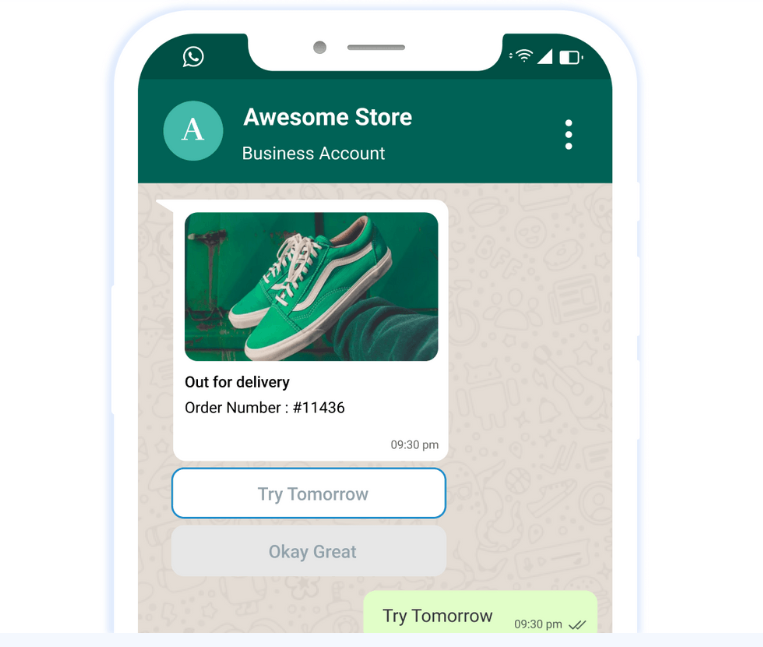
Delivery Reminders
E-commerce brands can send a reminder the day before and the morning of the scheduled delivery. This message should include the estimated delivery window and the courier's contact number.
Customers who receive these reminders are significantly more likely to be available at the time of delivery, and this results in fewer return-to-sender processes.
Address Verification
Incorrect or incomplete addresses are one of the most common reasons for failed deliveries.
Missing landmarks, incorrect house numbers, or wrong postcodes can prevent delivery partners from locating the customer.
WhatsApp automation can be used to verify address details before the order is shipped. Customers can review their shipping information directly within the chat and update any incorrect details if needed.
By confirming address accuracy early in the order lifecycle, businesses can reduce delivery failures caused by address-related issues.
Customer Availability Checks
For high-value orders or orders in high-RTO pincodes, send a WhatsApp message asking the customer to confirm their availability on the delivery date.
If the customer is unavailable, they can request a reschedule. This is far cheaper than a failed delivery and return.
Failed Delivery Recovery
Not every failed delivery has to result in a return to sender process. In many cases, customers still want the order but miss the delivery because of temporary issues such as unavailability, address confusion, or communication gaps.
When a delivery attempt fails, automated WhatsApp messages can immediately be sent to the customer to understand the reason.
Customers can provide updated address information, confirm availability for a second attempt, or request assistance.
So this is how WhatsApp automation helps brands maintain continuous communication with customers before, during, and after delivery.
Return to Sender (RTS) Example
Let's say a customer orders a T-shirt from an online store and chooses Cash on Delivery (COD).
The seller packs the order and ships it to the customer's address. After a few days, the delivery partner tries to deliver the package.
However, the customer is not available to receive the order. The delivery partner tries again, but the customer still does not answer calls or receive the package.
After several failed delivery attempts, the courier company stops trying to deliver the order and sends the package back to the seller's warehouse.
This is called Return to Sender (RTS) because the shipment is returned to the seller instead of being delivered to the customer.
In this case, the seller loses money on shipping and does not complete the sale. This is why businesses try to reduce RTS by confirming orders, verifying addresses, and sending delivery updates to customers.
Best Practices for E-commerce Brands to Reduce Return to Sender Shipments
Indian D2C brands can apply these practices consistently to keep their return-to-sender rate low:
- Verify every address at checkout. Brands should not let an unverified address enter their dispatch queue.
- Confirm every COD order before shipping. They should make use of WhatsApp or SMS automation to do this at scale without manual calling.
- Send tracking updates at every stage. Customers should be informed about everything that happens to their order, like packing, shipping, delivery or whatever the case may be
- Monitor your RTO rate by pincode, product category, and courier partner. Brands should use this data to make routing and policy decisions.
- Set clear return policies. Brands should display transparent return policies, as customers who know the return terms before they buy make more deliberate purchase decisions.
- Restrict COD for high-risk pincodes or repeat RTO offenders. Brands should offer prepaid-only options with a small discount to incentivise the switch.
- Use open-box delivery for high-value orders. This prevents fraudulent return claims and builds customer trust.
The Future of Return-to-Sender Management in E-commerce
The Indian e-commerce market is projected to reach $250 billion/₹21.50 lakh crore in gross merchandise value by 2030.
So as the market will expand, surely the orders will be, and an increase in order volume can cause an increase in RTO rates.
The brands that adopt the right strategies and systems, such as Pragma RTO Suite, will definitely be able to cope with this situation well in an organised manner.
As Pragma is already here to support Indian D2C brands, with 1,700+ D2C brands on the platform and data compiled from 400+ brands into its risk models, it gives individual brands

FAQs (Frequently Asked Questions On Return to Sender Process: How It Works in E-commerce Logistics?)
1. What is the Return to Sender (RTS) process in eCommerce?
The Return to Sender (RTS) process occurs when a courier cannot successfully deliver a shipment and returns the package to the seller or fulfilment centre instead of completing the delivery.
2. How does the Return to Sender process work?
The Return to Sender process typically involves a failed delivery attempt, creation of a non-delivery report (NDR), customer verification or reattempts where applicable, and finally returning the shipment to the seller if delivery cannot be completed.
3. What are the common reasons for Return to Sender shipments?
Common reasons include incorrect delivery addresses, customer refusal, customer unavailability, fake orders, unreachable phone numbers, damaged shipments, and repeated failed delivery attempts.
4. What is the difference between Return to Sender and Return to Origin (RTO)?
Return to Sender is the logistics process of sending an undelivered shipment back to the seller, while Return to Origin (RTO) refers to the operational outcome where an order returns to the seller's warehouse after delivery failure. In eCommerce, the two terms are often used interchangeably.
5. What happens after a shipment is returned to the sender?
Once a shipment reaches the seller, it is inspected, reconciled with inventory, processed through quality checks if required, and prepared for restocking, exchange, refund, or further customer communication.
6. Who pays for Return to Sender shipping charges?
In most eCommerce cases, the seller bears the logistics costs associated with Return to Sender shipments, including forward shipping, reverse logistics, and handling charges, depending on courier agreements.
7. How long does the Return to Sender process take?
The Return to Sender timeline depends on the courier partner, delivery location, and reverse logistics network, but it generally takes several business days after the final failed delivery attempt.
8. How can eCommerce businesses reduce Return to Sender orders?
Businesses can reduce Return to Sender orders by validating addresses, verifying high-risk COD orders, improving customer communication, resolving NDRs promptly, and using delivery intelligence to identify potential delivery failures before dispatch.
9. What tools help manage the Return to Sender process?
Businesses use return management systems, NDR management software, logistics intelligence platforms, address validation tools, and customer communication platforms to monitor, automate, and reduce Return to Sender shipments.
10. Why is reducing Return to Sender important for D2C brands?
Reducing Return to Sender shipments helps D2C brands lower logistics costs, improve delivery success rates, retain profitability, optimise inventory movement, and deliver a better customer experience.
Talk to our experts for a customised solution that can maximise your sales funnel
Book a demo
.png)

.png)