

Return to Origin is the number one challenge faced by the e-commerce industry nowadays. As the e-commerce market is growing, the number of RTOs is increasing. And this increase in returns leads to rising logistics costs and damaged inventory.
And it is not just about the costs or inventory; these returns can drain a significant portion of the profits of the businesses. This increases the pressure on businesses to handle RTO efficiently.
According to recent industry analysis from 2024, around 27% of total e-commerce orders end up as RTOs in India. These RTOs come with a lot of challenges that every brand has to handle properly; if not, they can be disturbing for them.
In this blog, we will look at "Return to Origin Challenges in Ecommerce & How to Solve Them."r
What Is Return to Origin (RTO)?
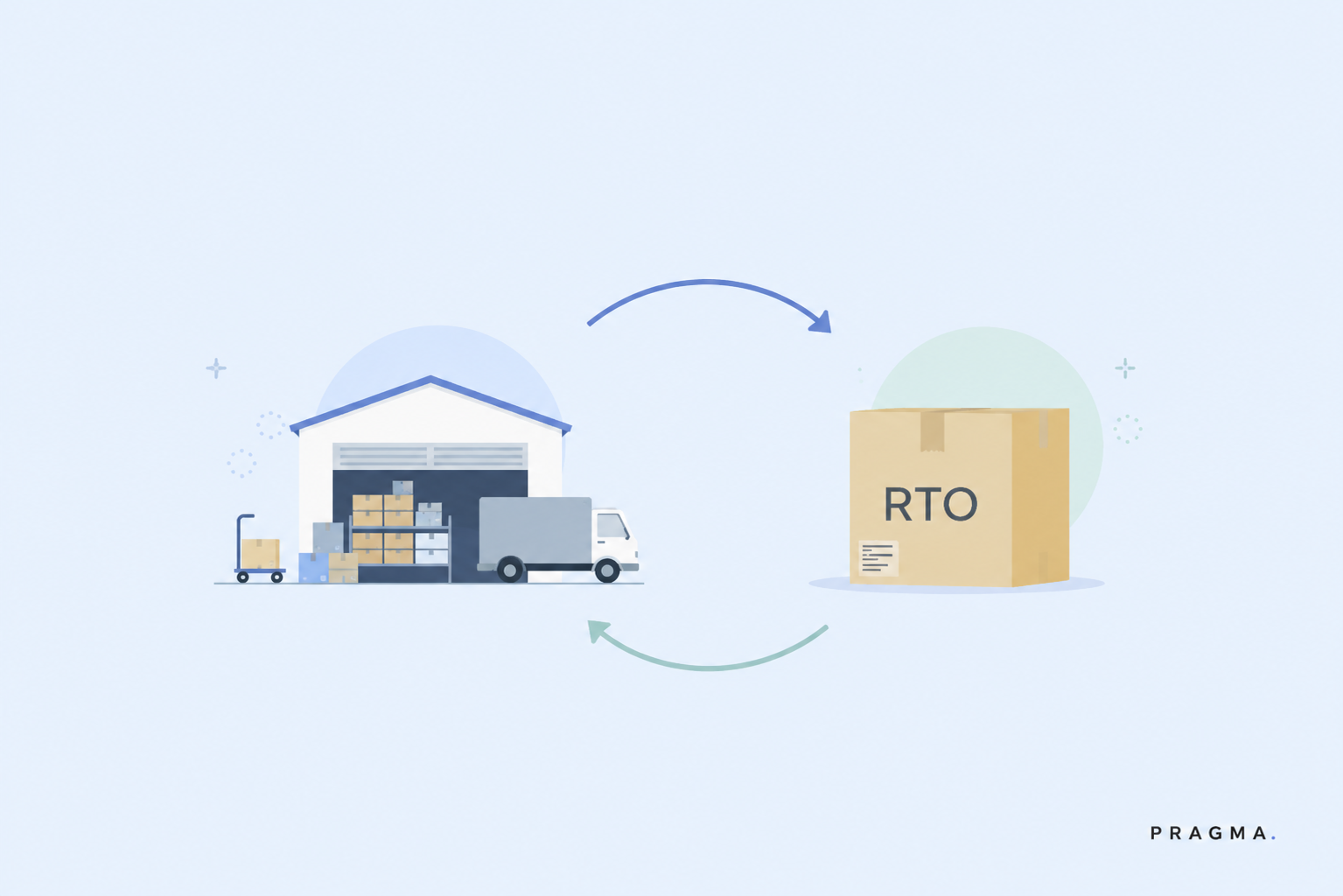
RTO is an acronym used for Return-to-Origin. It means when an order has to be delivered to the customer, but instead of delivering to him, the order comes back to the seller or the warehouse.
It can be due to various reasons occurring on the seller's side, the customer's side, or it can be a problem with the delivery.
Like delayed deliveries, poor last-mile delivery connections, and wrong products can be the reasons for RTOs to occur due to the seller's mistakes.
Whereas customer unavailability, wrong address given, COD refusals, or not ordering with the intent of purchase can be the cause of RTOs from the customer's side.
Why RTO Is a Major Problem for Indian E-commerce?
Return-to-Origin is a major problem for Indian E-commerce brands because it hits almost every part of the business. It not only affects the business from a financial aspect, but also loses the customers' trust and hampers the growth of the business.
One of the reasons that RTO has become a major challenge is the availability of the COD option to the customers. ET Prime Research reveals that about 60-65% of India's e-commerce orders are COD, with 33% of these orders not being delivered successfully.
While it is necessary for brands to provide CODs but it heavily impacts the business in a negative way.
Another reason that RTO is responsible for a challenge for e-commerce brands is the various addresses and pin codes that are not properly infrastructure to support them. Due to this, delivery partners could not reach the correct location and ended up in RTOs.
Last but not least is the customer behaviour. Most of the customers impulsively order the products. In festive seasons, they order without the need, comparing different products and ordering the identical product from different platforms due to price sensitivity, or just comparing the quality leads to RTOs.
Key Return to Origin Challenges Faced by E-commerce Brands
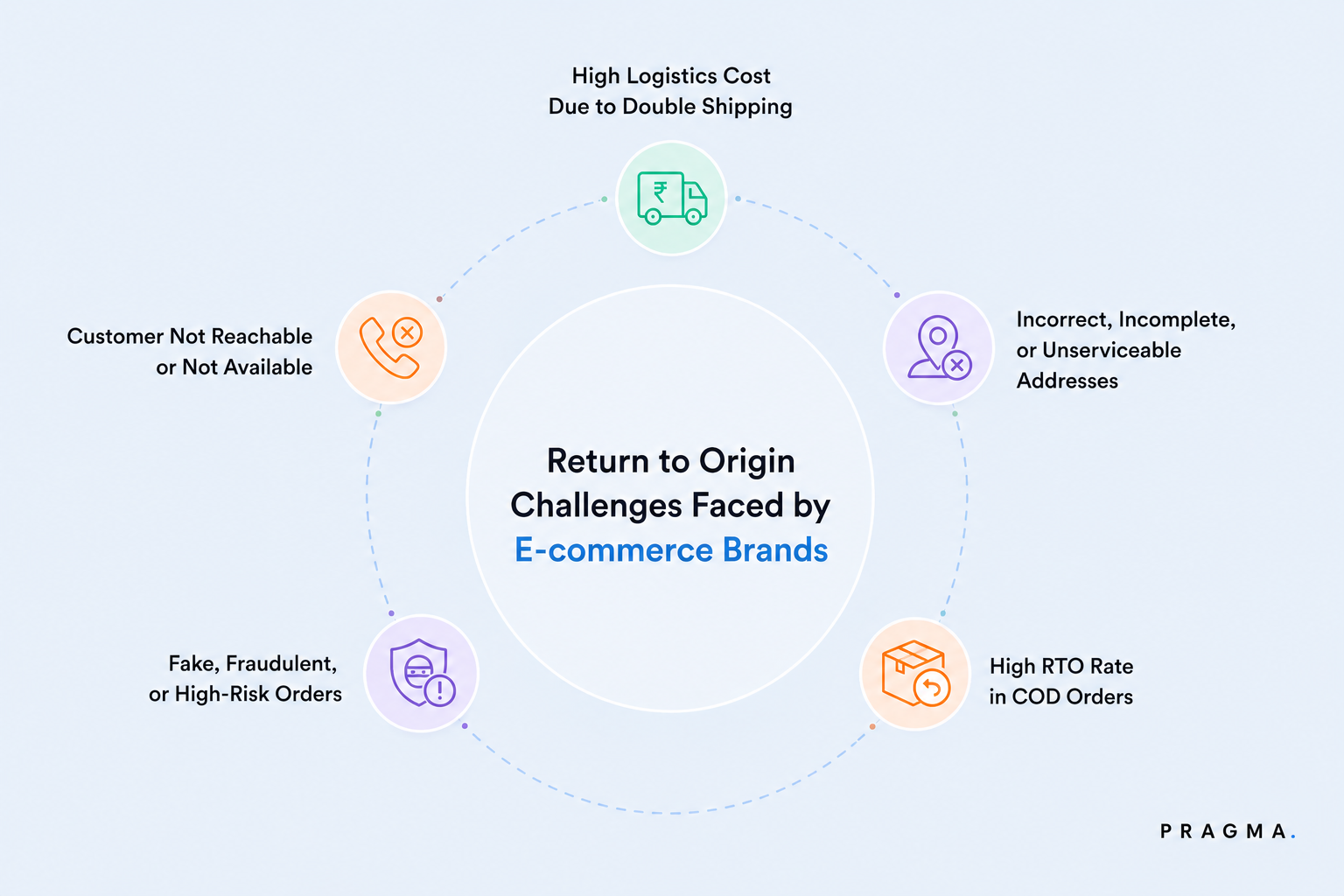
Return-to-Origin is the most difficult thing that all e-commerce brands face. Here are some key challenges that arise with RTOs:
High Logistics Cost Due to Double Shipping
One of the most obvious challenges of returning to the origin is the double logistics costs. According to industry reports, RTO can increase logistics costs by 15-20% per order.
Why, we are saying here, double logistics, because when an order is shipped to the customer, the cost that is presented there is known as forward logistics costs. And when the customer refuses to take the order or for any reason it is not delivered to him, the business also has to pay the shipping costs to bring back the product, and it is known as reverse logistics cost.
That's why the RTO comes with the double shipping costs, which cost businesses more.
To save brands from these RTO charges, Pragma RTO Suite has come up with an advanced AI algorithm that scans over 300 parameters within 200ms of order placement and flags the risky orders in real-time.
The orders that are placed from fake addresses or made by bots easily get verified and alert the brand about the fake orders. By this, Pragma helps brands to save both the forward shipping costs as well as the reverse logistics one.
Incorrect, Incomplete, or Unserviceable Addresses
One of the other challenges returning to origin is the wrong, incomplete, false, or unserviceable addresses, particularly in India, due to complex infrastructures and networks.

Many a time, it happens that a customer places the order in a hurry and enters the address that is incomplete or incorrect address. Also, sometimes orders are being made by a fake address or temporary residence, and when the delivery partner reaches there, no one is there to take the order.
To save the brands from such situations, Pragma helps to flag these orders before any processing. Within some time, it tells about the orders made from wrong addresses, from temporary residences like hostels, or orders made from non-serviceable locations.
Not only this, the advanced system scans details such as address, pincode, phone number, etc., verifies them, and auto-corrects if needed. It helped brands to reduce RTO rates by 45-60%.
High RTO Rate in COD Orders
In India, approximately 65% of the orders are paid with cash on delivery. And this becomes one of the prominent reasons for return to origin challenges. E-commerce D2C brands experience over 25-30% RTO rates in COD orders. In the fashion industry, this number reaches high, approximately 35-40%.
This percentage of RTO is a threat to brands. That's why Pragma provides smart COD verification to identify high-risk COD orders and automatically disables the COD option for these customers.
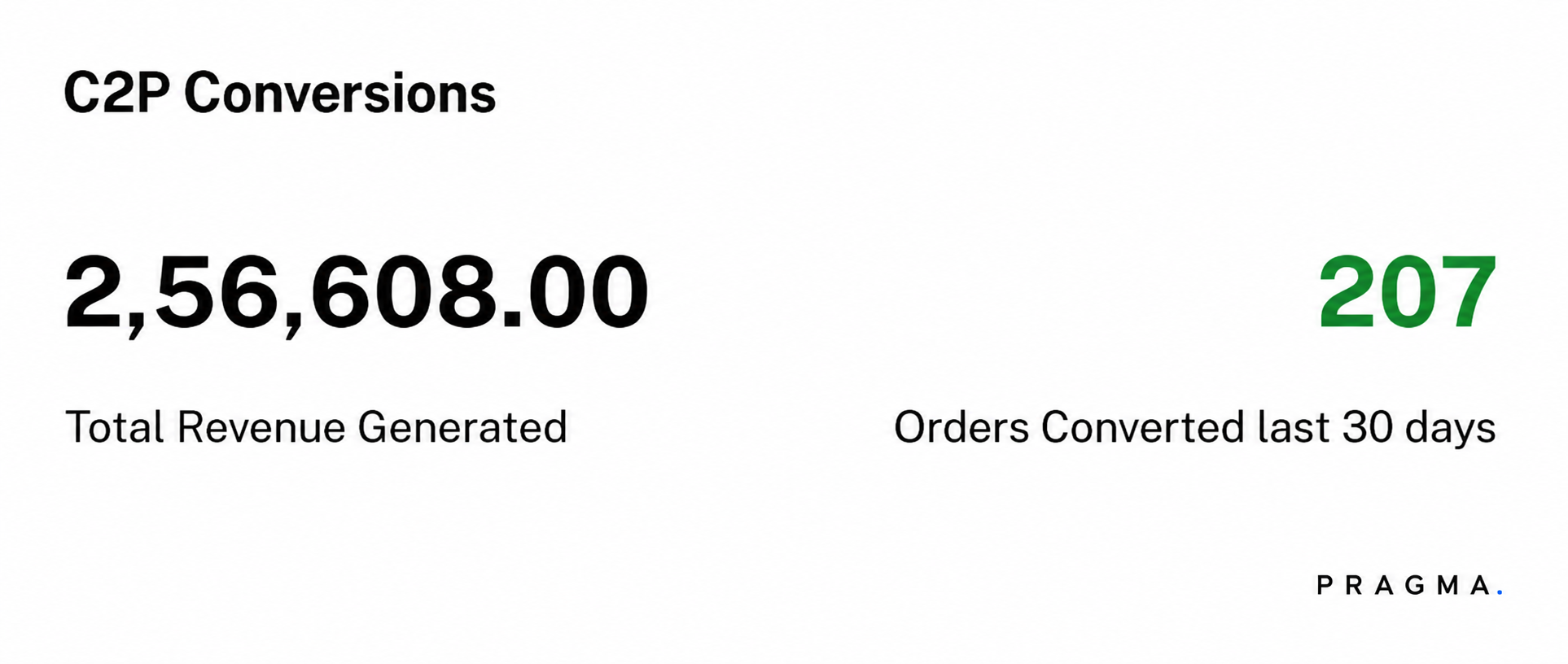
Not just this, it encourages converting COD payments to prepaid ones. The C2P strategy helps brands get a 25 to 35% increase in paid orders. Here, they encourage the customers to make payment by giving offers and discounts through WhatsApp, messages, or Emails.
Fake, Fraudulent, or High-Risk Orders
Many times, businesses get orders that are fake, fraudulent, or risky. Competitors or bad actors sometimes place dummy orders to block inventory, leading to guaranteed RTOs and financial losses.
But with Pragma, this challenge can also be simplified as Pragma RTO Suite, which cross-checks all the placed orders with other e-commerce sites to check the users for past RTO history, cancellations, and other fraudulent behaviour.
And based on this check, it provides a risk assessment score to each order. Based on this, businesses can know prior to advance that this is a risky or fraudulent order.
Customer Not Reachable or Not Available
This is also a common return to origin challenge, where a customer isn't available at the time of delivery and commands to cancel the order.
For generating an NDR- Non-Delivery Report, logistics partners are advised to make three delivery attempts. If the third attempt fails, then they make an NDR and mark the order as RTO.
But to reduce this, Pragma provides a good communication system that helps to get real-time updates from customers. How does it help:
- Sends automated WhatsApp and SMS notifications before delivery
- Allows customers to reschedule delivery timing
- Provides delivery partner contact information for coordination
- Enables real-time delivery tracking and updates
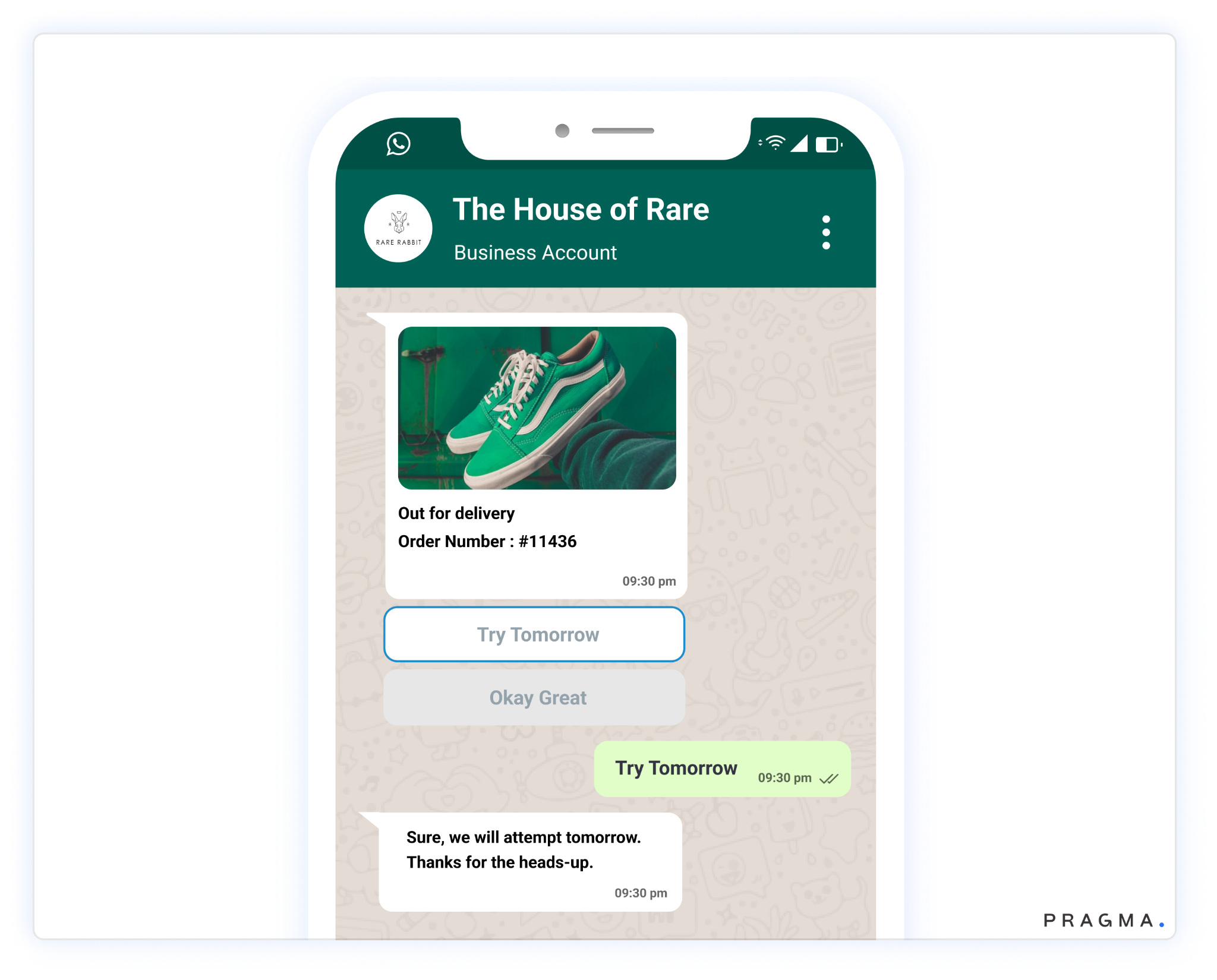
So, even if a customer isn't available, with this feature, he can reschedule the delivery, so that the delivery partner does not make a vague attempt.
Poor NDR Communication & Delayed Resolution
Non-Delivery Reports (NDRs) often lack proper follow-up, leading to automatic RTOs instead of successful re-delivery attempts.
Effective NDR management can recover 30-40% of failed deliveries, but poor processes lead to automatic RTOs.
To tackle this, Pragma comes with an NDR management system that helps with the following things:
- It automatically generates and sends NDR notifications within minutes
- It provides customers with easy rescheduling and address correction options
- It enables multi-channel communication for better customer reach
- It offers automated follow-up sequences for unresolved NDRs
- It provides analytics on NDR patterns and resolution rates
- Pragma has helped brands achieve a 35% reduction in NDR-related RTOs.
Inventory Stuck in Transit & Delayed Restocking
One of the other challenges of return to origin is that when an RTO occurs, there is a chance that the inventory gets stuck in transit, and brands cannot restock it in a timely manner.
Industry data suggests that RTO can lead to potential losses of up to 10% of monthly revenue for some businesses due to inventory blockage alone.
Damage, Leakage, or Wear & Tear During RTO Transit
It may happen that during the time of transit, the products get damaged and are of no use. This results in loss of product, its value, along with the shipping costs.
But if it is in the case of fraudulent orders, businesses can save themselves with the Pragma advanced system that flags these orders before shipping.
Unsellable or Expired Inventory After RTO
Some returned products, especially those that are perishables or time-sensitive items, become completely unsellable, resulting in total value loss.
Courier-Side Issues
RTOs can occur due to a problem with the side of the delivery partners. Due to operational challenges, training gaps, or systemic issues within logistics networks, an order can become an RTO.
Sometimes, it happens that the delivery partners do not make the right attempt to deliver the order, or sometimes, there is no proper route planning, or there is no proper communication between them and the customers.
To bridge this gap, Pragma enables better communication between customers and delivery partners.
Customer Experience Damage
One of the other return to origin challenges is that it hurts the customer experience with the brands. Whenever the RTO is due to reasons other than the customer, they feel irritated and lose trust in the brand. RTOs directly hurt a brand's reputation.
Operational Chaos in Reverse Logistics
Managing returned inventory requires additional resources for inspection, repackaging, quality checks, and is an intensive process.
According to industry data, managing returned inventory adds Rs. 50-100 per product to operational expenses.
Pragma focuses on preventing RTOs rather than managing them.
Cash Flow Problems (Especially for COD Returns)
RTO ties up working capital and creates cash flow issues, particularly problematic for small and medium businesses operating in a market where 60-65% of orders are COD.
What are The Hidden RTO Challenges Most Brands Ignore?
Apart from the above key challenges, there are some hidden RTO challenges that most of the e-commerce brands ignore.
RTO due to Seasonal Fluctuations
One of the reasons is the RTOs happening due to seasonal variations. During festive sales and big discount events, many customers place impulse orders, especially COD orders. This leads to a higher number of failed deliveries and refusals when the order actually arrives.
But brands did not take care of this during the festive seasons and got a lot of orders returned.
Ignoring Product Categories
Product categories have a strong impact on returns. Fashion and apparel usually see much higher RTO and return rates around 25–40% because customers change their minds. Here are some of the average RTO rates in different industries that brands overlooked:
Social Commerce
When a customer makes an order just made quickly through influencers or impulse-driven content, there are more chances that they are likely to get a return.
In such orders, brands should pay special attention to converting them into prepaid ones, confirming the order, getting the right details, etc.
Examples of Return to Origin Challenges
A D2C skincare brand was struggling with high return-to-origin (RTO) rates. And these RTOs are mostly due to the COD. Approximately 35% of those orders were being returned.
To solve this problem, the brand makes use of Pragma's RTO Management Suite. This system offers them:
- COD order confirmation
- Customer verification of details
- AI-powered risk assessment for each order that scans 300+ algorithms
- Automated payment follow-ups
- Address validation tools, check addresses, wrong pin codes, or correct if needed
- Real-time order updates and proper NDR management
And the results are amazing!
- Successful deliveries increased by 25%
- RTO rates fell by 60%
- Non-delivery reports dropped by 35%–40%
- Prepaid orders rose by 20%
- Decrease in RTO costs and increasing revenues
How to Reduce Return to Origin Challenges?
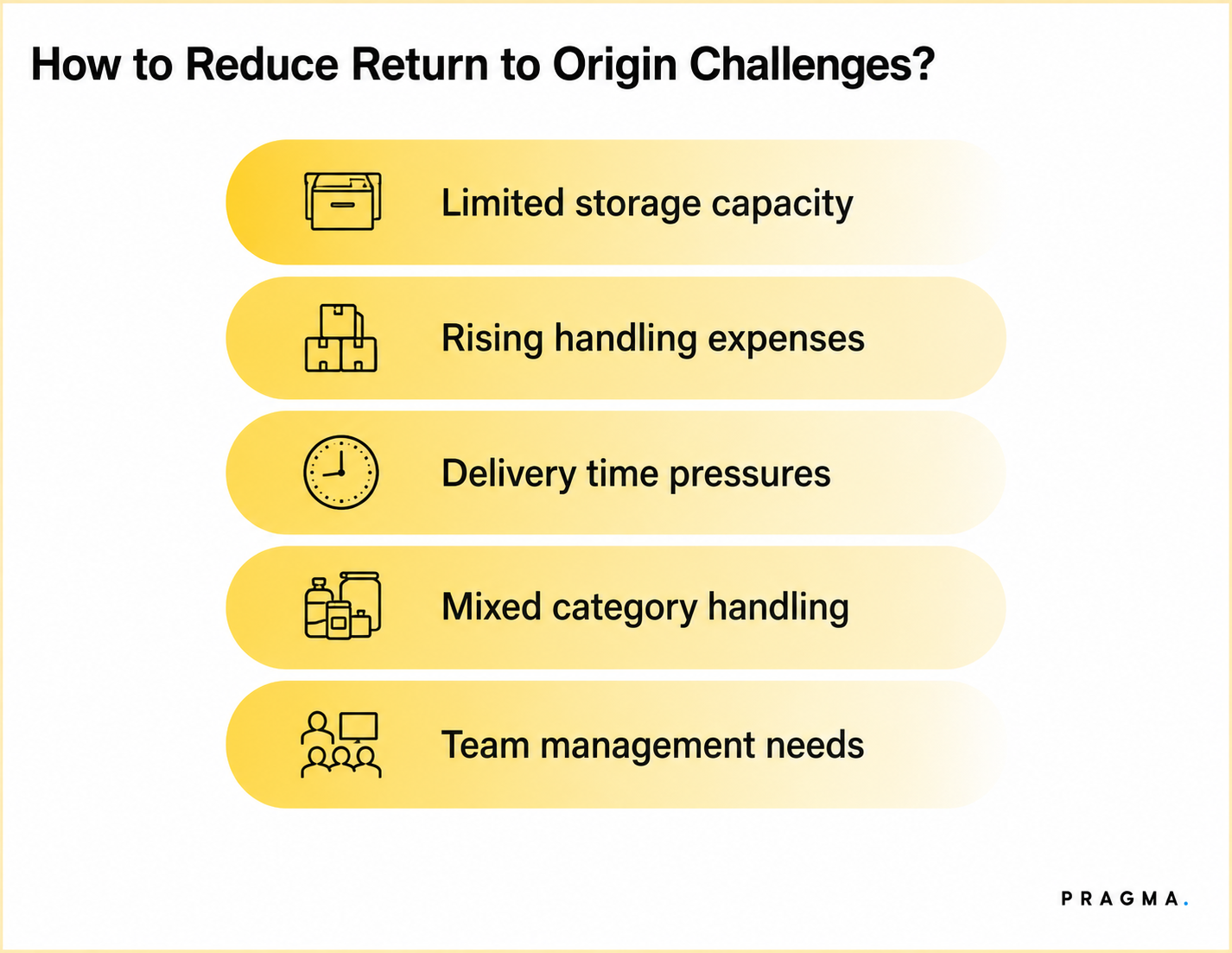
To reduce challenges associated with return to origin, e-commerce brands should adopt these strategies:
Verifying the Address
Whenever a customer places an order, it is the foremost duty of the business to check the address properly and verify it. For this, they can use address validation tools such as Pragma that help identify fake addresses or incorrect ones before shipping of product.
Keep Proper Communication
Another way to reduce return to origin challenges can be achieved through proper communication. Businesses should send alert messages to the customers about the real-time status of their order. This helps customers to keep engaged and aware of their order.
Verifying COD Orders
Cash on delivery orders must be cross-verified with the customers on platforms like WhatsApp or SMS. This will help the brand to let them know that the order is genuine, and they can start the process of shipping.
Also, brands should try to convert COD orders to prepaid ones by providing discounts or incentives.
Make Deliveries Faster and Smoother
As we know that the RTO can happen because of late deliveries, so every brand should take care that they follow the proper route and optimise the delivery.
AI-Powered Risk Assessment and Fraud Detection
Brands should use tools that are AI-powered and can assess the risk of each order placed. This helps brands to be alert prior to starting the shipping.
Choose Best Courier Partners
Every brand should take note that not all delivery partners perform well in every area. They should assign delivery partners based on the pin code success rate and historical RTO data.
What Technology Can Help to Reduce RTO Challenges?
Here are some of the important technologies that can help in reducing Return to Origin:
- AI-Powered Risk Detection
- Real-Time Address Validation
- Automated Communication
- Predictive Analytics
- Artificial Intelligence and Machine Learning
To Wrap It Up
So, as we know that return to origin is the most complex issue prevailing in the Indian e-commerce market, with 27% of all e-commerce orders becoming RTOs and COD orders showing 25-30% failure rates, the scale of this challenge cannot be understated.
But with the proper management and by adopting the right strategies and tools, businesses can handle RTO efficiently. Taking the help of RTO reduction tools is one of the best decisions to handle and decrease RTO orders.
And for this, Pragma RTO Suite is available for all Indian D2C brands. It helps in reducing RTO rates by 60% and NDRs by 35%. And this much decrease clearly shows how much of your money could be saved and revenue-generating.

FAQs (Frequently Asked Questions on Return to Origin Challenges in E-commerce & How to Solve Them)
1. What does “Return to Origin (RTO)” mean in e-commerce?
Return to Origin (RTO) refers to an order that is shipped but not successfully delivered to the customer and is returned back to the seller’s warehouse. These orders never generate revenue but still incur shipping, handling and labour costs.
2. Why does RTO happen in India so often?
Common reasons include:
- Incorrect or incomplete address
- Customer not reachable
- Refusal to accept COD orders
- Change of mind at delivery
- High-risk pincodes
- Delayed delivery or courier issues
- Fraudulent or suspicious COD behaviour
3. Why is RTO a major challenge for D2C brands?
Because RTO impacts:
- Contribution margin (double shipping cost)
- Inventory ageing
- Cash flow cycles
- Warehouse load
- Courier performance metrics
- Customer experience and brand rating
4. What are the biggest operational challenges caused by RTO?
Frequently searched problem-areas include:
- High cost per RTO shipment
- Manual follow-ups for address or delivery confirmations
- Stock damage or loss during return transit
- Increased workload on warehouse and support teams
- Difficulty predicting COD-risky regions
- Low visibility into courier performance for first attempts
5. Are COD orders responsible for most RTO cases?
Yes. In India, COD orders account for 60–80% of RTO cases.
COD refusals, fake orders, delayed delivery and address inaccuracies significantly increase the likelihood of RTO.
6. How can e-commerce brands reduce RTO effectively?
High-intent search patterns point to the following solutions:
- Address validation at checkout
- COD risk scoring and selective COD blocking
- Delivery confirmations via WhatsApp/SMS before despatch
- Faster despatch to reduce customer drop-off
- Courier scorecards and lane-based routing
- Automated NDR follow-ups for failed first attempts
- Prepaid incentives for high-risk customers
7. Can better checkout design help reduce RTO?
Yes. Clean, mobile-friendly checkout flows with pincode-first entry, auto-fill addresses, order confirmation nudges and clear payment options reduce failed deliveries and help prevent inaccurate address details.
8. How does NDR automation help solve RTO?
NDR (Non-Delivery Report) automation ensures customers instantly confirm address details, reschedule delivery, or switch to prepaid payment—reducing the number of parcels that automatically get marked undelivered and returned.
9. Is it possible to predict high-risk RTO orders in advance?
Yes. Brands increasingly use rules or machine scoring based on:
- Pincode delivery success history
- COD frequency and past rejections
- Device or IP duplication
- Order value and category risk
- Address-quality score
10. How should a brand handle RTO stock after it returns?
Best practice includes:
- Immediate QC to assess damage
- Categorising items as restockable, refurbishable or scrap
- Re-listing inventory in real time to avoid overselling
- Logging courier performance and RTO reason truthfully
11. What is considered a good RTO rate for Indian e-commerce brands?
Benchmarks vary by category, but generally:
- Prepaid RTO: < 5%
- COD RTO: < 18%
Anything above these ranges signals underlying issues in address quality, courier selection, or customer intent
Talk to our experts for a customised solution that can maximise your sales funnel
Book a demo


.png)