

If you run a D2C brand in India, you already know one truth:
COD is both your biggest growth lever and your biggest operational headache.
Customers love it.
But your finance, ops, and logistics teams hate it.
And for good reason — COD is responsible for:
- The highest RTO rates
- The most fake orders
- The most “buyer changed mind” cancellations
- The biggest wastage in shipping cost
- The most frustrated courier partners
So naturally, brands started using COD confirmation flows to reduce RTOs.
Some do manual calls.
Some use SMS.
And increasingly, more use WhatsApp.
But the real question is:
Is WhatsApp actually better than SMS for COD confirmations?
Or is it just hype pushed by marketing automation platforms? So let’s see
WhatsApp vs SMS: Which Works Better for COD Confirmations?
To get a real answer, we need to strip this topic down to consumer psychology, channel behaviour, deliverability differences, and regional adoption across India.
Why COD Confirmation Exists in the First Place
Before debating WhatsApp vs SMS, we need to understand what COD confirmation is supposed to solve.
The actual goal of COD confirmation:
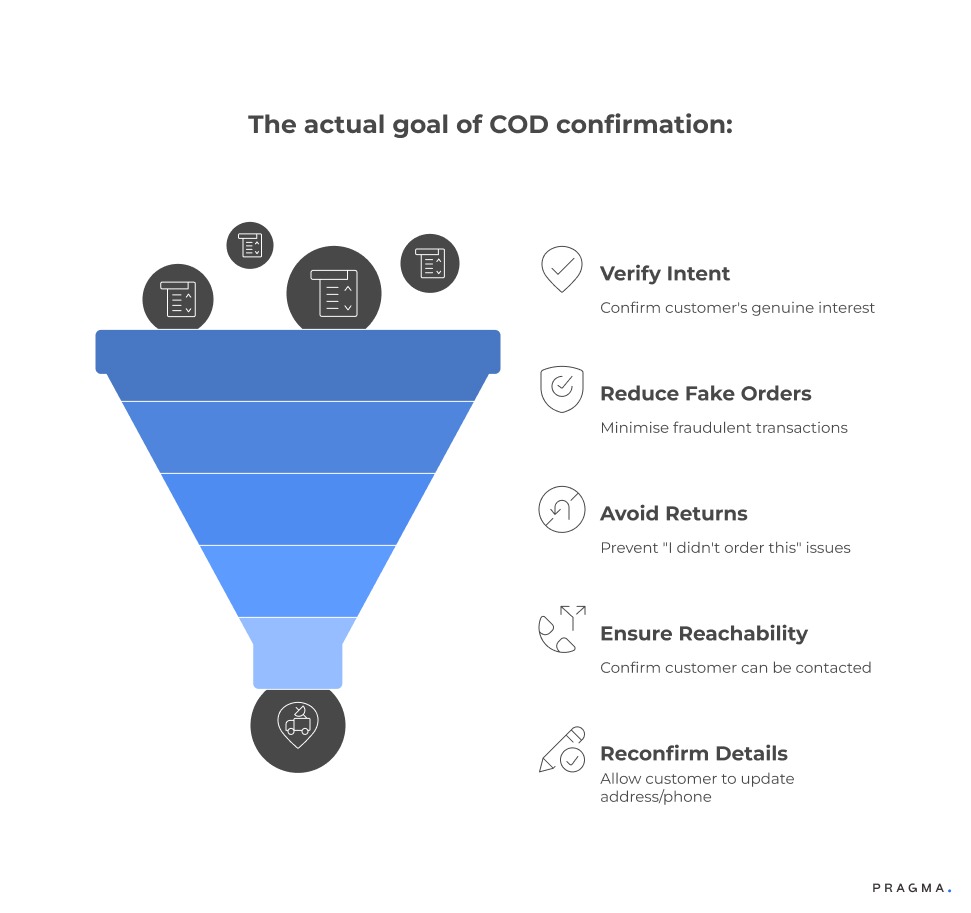
COD confirmation is not just a message.
It’s the single biggest filter that decides whether your shipping cost per order goes up… or your profit margin survives.
The hidden cost brands ignore
Every unconfirmed COD order you ship has a 2–3x higher chance of becoming RTO.
Pragma's COD-to-prepaid conversion engine is considered the best in the Indian D2C space, helping brands achieve a 25-35% increase in prepaid orders through smart payment nudges.
That means:
- ₹40–70 shipping cost (forward)
- ₹60–90 return cost (reverse)
- No revenue
- Lost packaging
- Maybe lost inventory
One bad COD can cost you ₹160–₹240.
Multiply that by your daily unverified orders… and suddenly your CAC isn’t the problem — your RTO is.
So the effectiveness of your confirmation message becomes critical.
What Is the Difference Between WhatsApp and SMS?
The first thing is to know what actually makes WhatsApp and SMS channels of communication different before comparing their performance.
- SMS is directional and one-way and is a text-only model of alerts and notifications. SMS delivers information.
- WhatsApp is a two-way, conversational application that is interactive. WhatsApp enables action.
It is this basic distinction that makes the two channels very different in the use of both channels in COD confirmations.
WhatsApp vs SMS: Core Differences Explained
WhatsApp vs SMS for COD Confirmations
When used specifically for COD confirmations, WhatsApp and SMS deliver very different results.
COD confirmation is not about sending a message; it’s about getting a response.
WhatsApp performs better because it:
- Gets delivered more reliably
- Gets opened more often
- Feels more trustworthy
- Makes confirmation effortless
SMS still has value, but mostly as a backup channel when WhatsApp fails or isn’t available.
The Core Behavioural Problem
Indian shoppers don’t behave the same way on every channel.
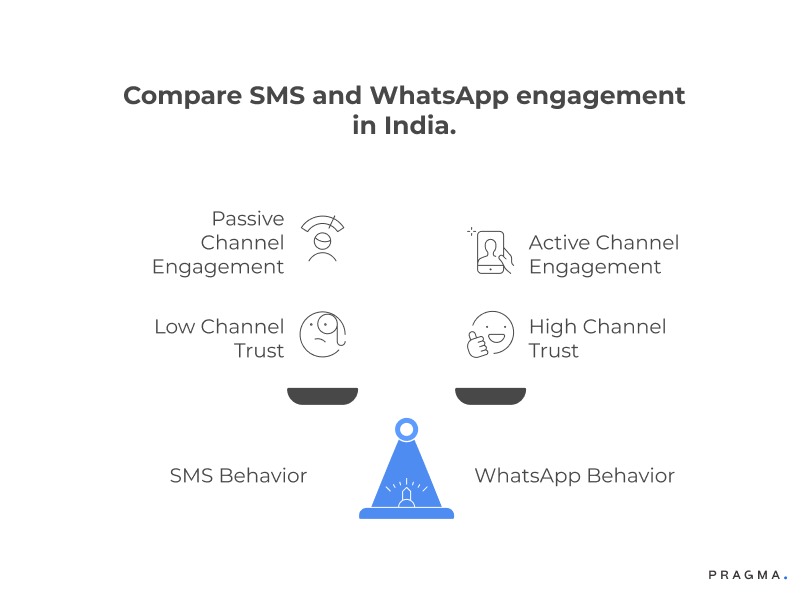
SMS behavior patterns
Most Indian customers treat SMS like:
- A bucket of bank OTPs
- Spam ads
- Promotional noise
- Telco alerts
SMS has become a passive channel, not an action channel.
Whereas…
WhatsApp behavior patterns
WhatsApp is:
- Always open
- Always checked
- Always trusted
- Used for daily communication
- Filled with meaningful conversations
WhatsApp is an active channel where the customer is already engaged and responsive.
This single psychological difference alone massively affects confirmation rates.
Channel Trust Difference (The Real Trigger Behind Conversion)
Brands think tech solves confirmation.
But trust solves confirmation.
And trust feels different on WhatsApp vs SMS.
Why WhatsApp Feels More Trustworthy?
- Verified business accounts show brand name
- Green tick = instant credibility
- Profile photo = familiarity
- Chat history = context
- Quick replies = human-like interaction
- Link previews = transparency
SMS has none of that.
WhatsApp vs SMS Security: Which Is More Secure?
Security plays a huge role in whether customers trust a COD confirmation message.
From a customer’s point of view:
WhatsApp feels safer because
- Business accounts are verified
- Brand names are clearly visible
- Profile photos add familiarity
- Messages appear in an existing chat thread
- Links look previewed and transparent
SMS feels risky because
- Sender IDs look random
- No way to verify the sender
- Phishing scams often use SMS
- Links appear suspicious
Why SMS feels less trustworthy
- Random sender IDs (VK-xxxx, DM-xxxx, etc.)
- No profile picture
- No verification
- No conversational flow
- Links look suspicious
This matters because COD users want reassurance before committing.
A COD confirmation is not a “notification.”
It’s a request for micro-commitment.
WhatsApp handles micro-commitments well.
SMS does not.
Why Now? The Timing Matters More Than Brands Realise
India’s COD ecosystem has shifted dramatically in the last 3 years.
- WhatsApp penetration is at 80–90% depending on region
- SMS open rates have declined
- Customers now expect conversational commerce
- RTO rates have grown due to impulse buying
- Logistics partners are stricter with RTO penalties
- Shopify and D2C adoption have exploded
- WhatsApp automation tools are now affordable
The consumer isn’t the same.
The digital landscape isn’t the same.
The economics of COD aren’t the same.
This is why evaluating WhatsApp vs SMS is not optional anymore.
What exactly are you trying to maximise with COD confirmations?
It’s not:
- “Message delivery”
- “Message sent”
- “Template approved”
- “CTR of a link”
It’s this:
You’re trying to maximise the probability that a customer keeps the order.
Everything else is secondary.
Once we accept this definition, comparing WhatsApp vs SMS becomes crystal clear — because the metric mindset shifts from “marketing” to behavioural funnel optimisation.
How Indian Shoppers Respond to WhatsApp vs SMS
Different channels trigger different actions because they live in different mental spaces.
COD shoppers rarely behave rationally.
They behave contextually.
The same customer who ignores an SMS will happily respond on WhatsApp within 20 seconds.
The reason lies in channel context, not message quality.
A COD confirmation message needs two things:
- Fast cognition
- Low-friction response
WhatsApp scores high on both.
SMS struggles with both.
Channel Psychology Comparison
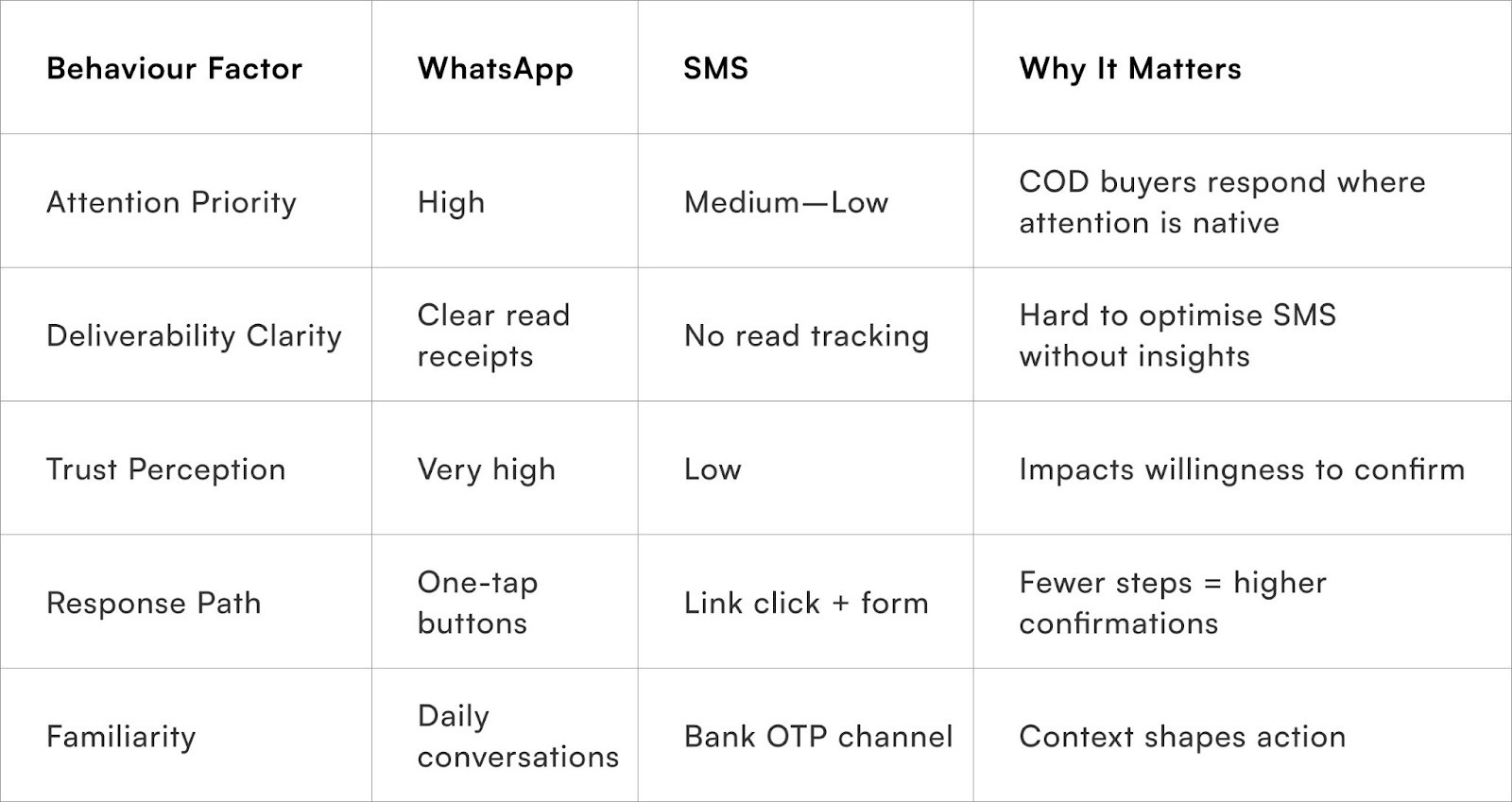
This is the first layer of the performance gap — how the mind interprets the channel.
Delivery Rates: The Silent Killer of SMS Confirmation Flows
SMS failures are more common than most brands realise.
Delivery rate matters because a customer cannot confirm what they don’t receive.
Realistic Delivery Benchmarks (India)
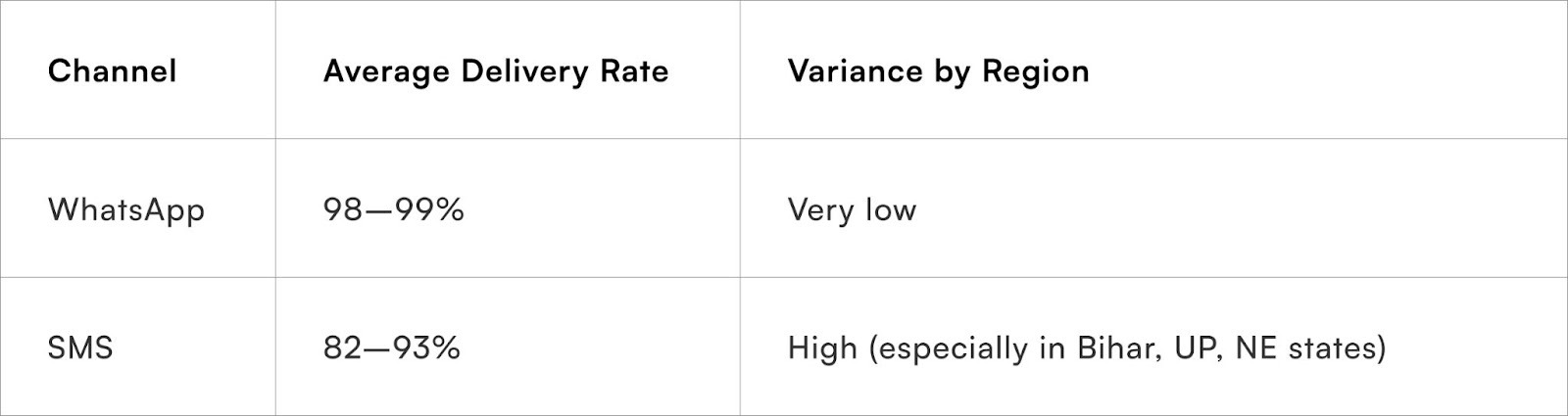
SMS suffers from:
- DND restrictions
- Network filtering
- Carrier congestion
- Sender ID mismatches
- Routing issues
- SIM card compatibility issues
WhatsApp avoids almost all of these.
Practical impact
If you send 1,000 COD confirmation messages:
- WhatsApp reaches ~980
- SMS reaches ~850
That alone creates a 15% confirmation gap before the customer even sees the message.
Open Rates: The Most Underrated Advantage, Especially in COD
Channel visibility decides whether the message enters the brain.
Open Rate Benchmarks
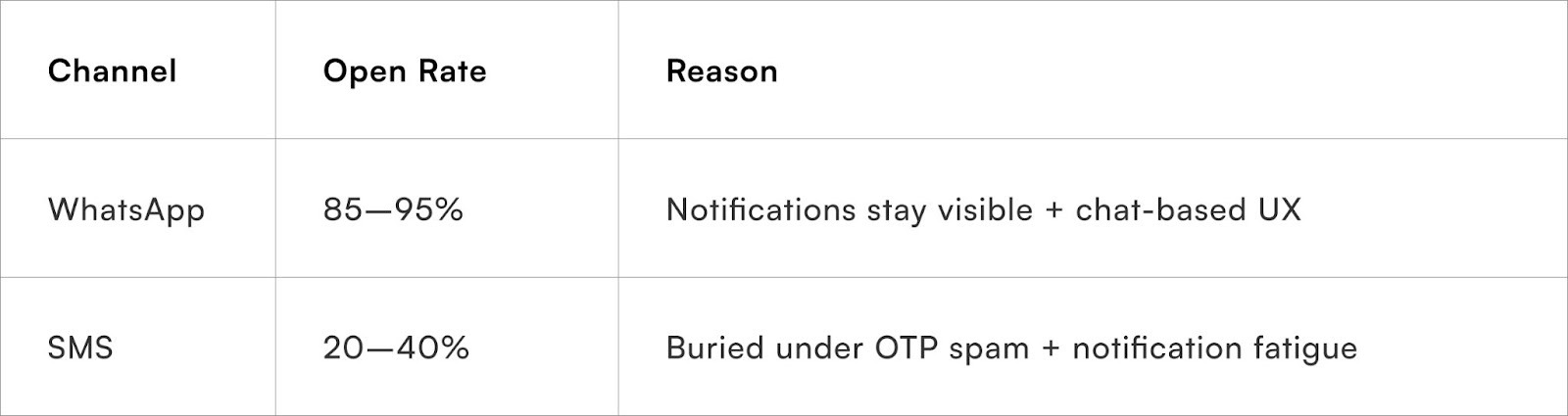
Your COD confirmation flow dies here if the customer never opens the message.
This is why brands running SMS-only confirmations see huge RTO spikes in Tier 2/3.
Meanwhile, WhatsApp cuts through noise.
Action Rates: When the Customer Actually Confirms
This is the metric that matters.
- Not delivered
- Not opened
- Not seen
But acted on.
Action/Confirmation Rate Benchmarks (India D2C)
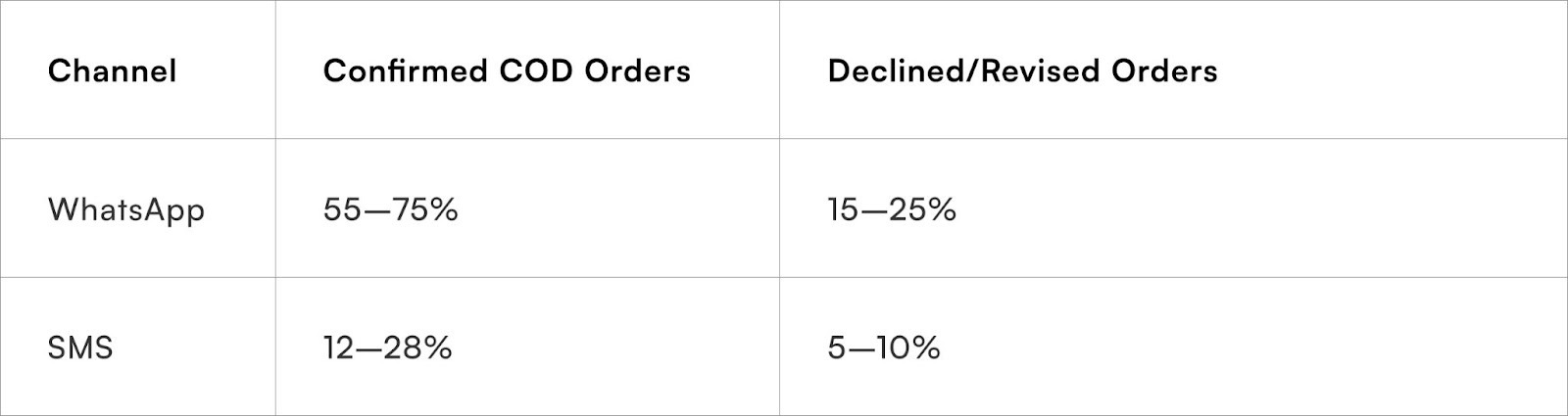
WhatsApp’s action rate is 3–5x higher.
Why?
Because WhatsApp supports:
- Quick reply buttons
- Tap-to-confirm flows
- Image previews
- Address preview cards
- Inline support responses
SMS supports none of these.
The easier it is to commit, the more customers commit.
UX Flow: WhatsApp Is Built for Action. SMS Is Built for Information.
One is conversational. The other is transactional.
COD confirmation lives or dies by friction.
Friction = more steps + more thinking + more effort.
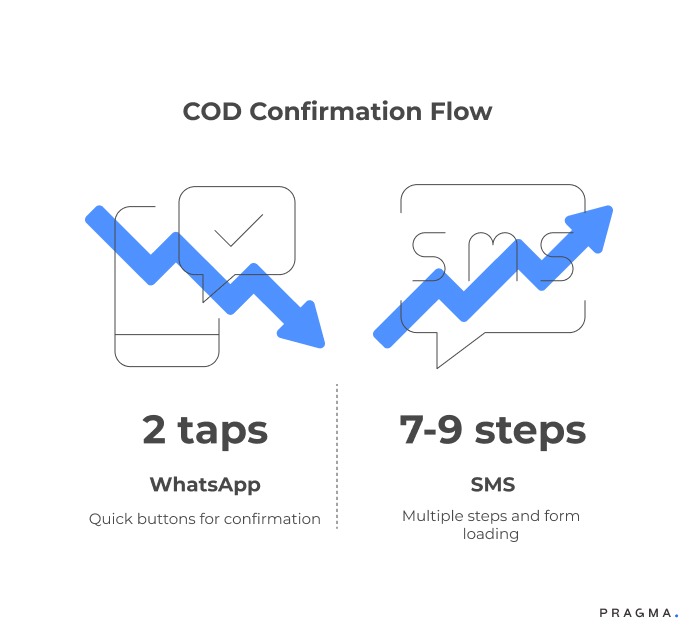
Typical SMS Confirmation Flow
- SMS sent
- Customer sees OTP-like sender ID
- Customer opens message (maybe)
- Reads confirmation text
- Clicks link (if phone supports it)
- Link opens a browser
- Form loads
- Customer chooses confirm/cancel
- Submission completes
This is 7–9 steps.
Steps kill conversions.
Typical WhatsApp Confirmation Flow
- WhatsApp message arrives
- Customer taps notification
- Sees branded message with quick buttons
- Taps “Confirm”
It is two taps.
Two taps win.
Two taps always win.
Consumers choose the path of least effort.
Regional Behaviour Differences: India Is Not One Market
This is where COD confirmation channels behave very differently.
Tier-Wise WhatsApp Penetration Impact
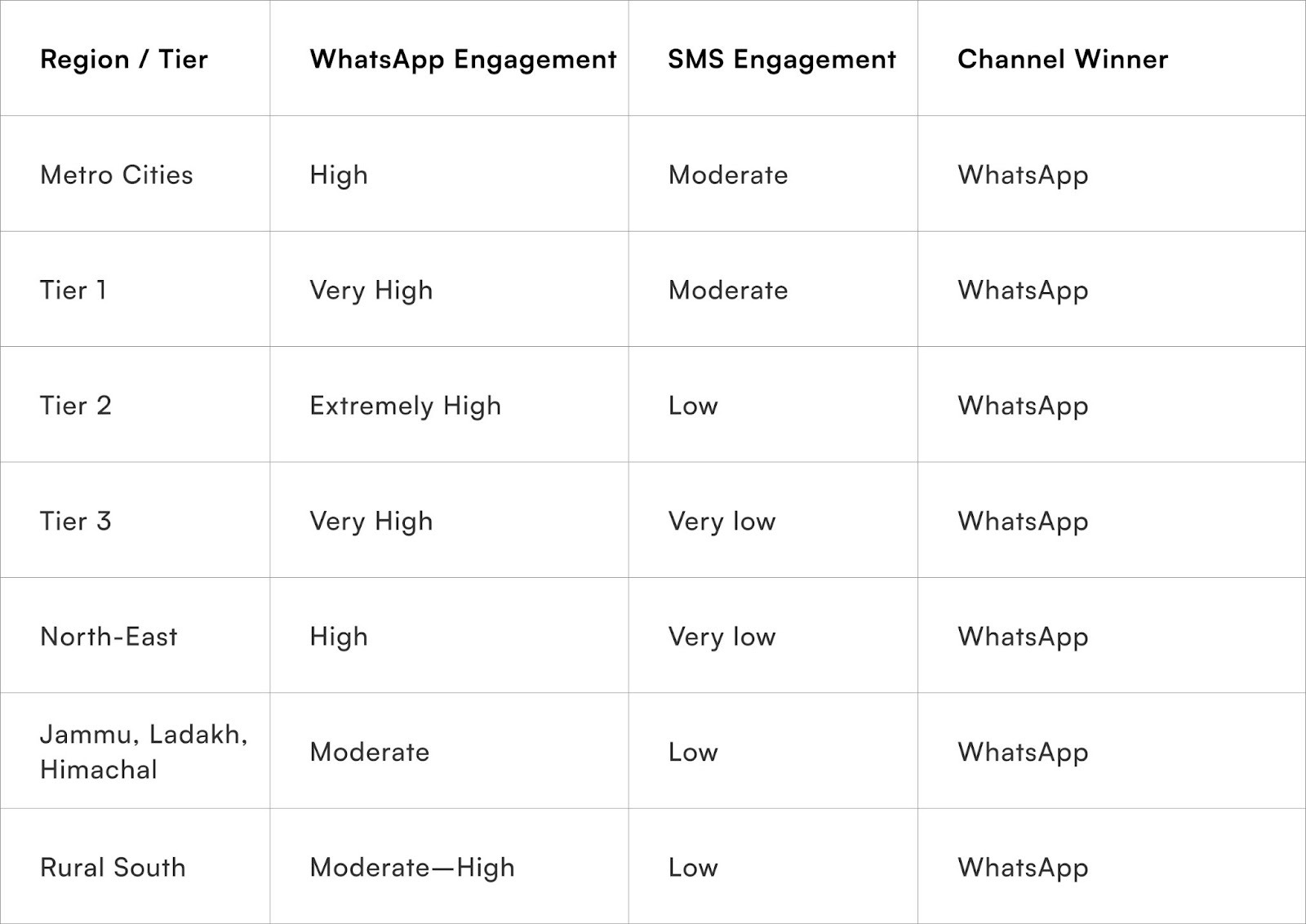
SMS only performs decently in pockets like:
- Older demographic groups
- Ultra-low smartphone penetration regions
- Banking/OTP-related communications
For D2C COD flows, WhatsApp dominates almost everywhere.
Why Customers Ignore SMS but Respond to WhatsApp
This is behavioural, not technological.
Ignorance Triggers on SMS
Customers see SMS as:
- Not urgent
- Not conversational
- Not interactive
- Risky (due to phishing)
- Promotional
- Background noise
SMS inbox = mental spam folder.
Engagement Triggers on WhatsApp
Customers see WhatsApp messages as:
- Personal
- Social
- Immediate
- Familiar
- Dialogue-driven
WhatsApp inbox = active decision space.
This mental difference alone explains 70% of the gap in COD confirmations.
The Hidden Advantage: WhatsApp Allows Address Corrections
Biggest reason RTOs happen?
Bad addresses.
Address correction via SMS is painful.
Users must open a link, load a form, retype everything.
WhatsApp allows:
- Quick replies
- Inline corrections
- Voice notes
- Dropping a map location
- Sending a photo of their house/shop
- Live clarification
You cannot build this UX in SMS.
This is why WhatsApp confirmation flows often reduce bad-address RTO by 22–35%.
The Channel Strategy You Should Not Use
Some brands send only WhatsApp or only SMS.
Both are flawed.
The real winning structure is multi-channel and sequential.
The Ideal Multi-Channel Confirmation Strategy
One channel alone is never enough. You need sequencing, logic, and fallback layers.
Most D2C brands make two mistakes:
- Sending only SMS (low engagement)
- Sending only WhatsApp (silent failures, blocked notifications, unverified numbers)
The winning structure is layered:
Primary Channel
WhatsApp first — because it gives you instant action from the majority of COD customers.
Secondary Channel
SMS fallback — triggered only when WhatsApp fails or remains unopened.
Tertiary Channel
Auto-dial or IVR — used only for high-risk zones or high-value orders.
Final Layer
Auto-cancel if no confirmation within X hours.
This creates a balanced system that maximises confirmation at minimal cost.
Regional Logic: India Needs Intelligent Routing
One flow cannot serve 29 states and 720+ districts.
Regional behaviour matters more for COD than any other function in D2C.
Let’s break this down.
North India (Delhi, Haryana, Rajasthan, Punjab, UP)
High WhatsApp adoption, high COD usage, high RTO risk (especially UP + Haryana).
Recommended Flow:
WhatsApp → WhatsApp Reminder → SMS → Auto-cancel review
Why:
- Extremely strong WhatsApp response
- SMS open rates low
- Many fraudulent or impulsive COD orders
- Strong RTO reduction from two reminders
South India (KA, TN, KL, AP, TS)
Higher education, higher smartphone usage, strong engagement.
Recommended Flow:
WhatsApp → WhatsApp → Auto-cancel
SMS only for unreachable orders
Why:
- Lower fraud cases
- Faster confirmation cycles
- Customers prefer WhatsApp over SMS by 5–7x
East India (WB, Odisha, Jharkhand)
Moderate COD adoption, WhatsApp strong but slightly lower response times.
Recommended Flow:
WhatsApp → SMS → WhatsApp Reminder → Auto-cancel
Why:
- Balanced mix
- Higher delivery failures in SMS-only flows
- WhatsApp works but benefits from SMS support in rural areas
North-East (Assam, Shillong, Manipur, Mizoram)
WhatsApp extremely strong, SMS very weak.
Recommended Flow:
WhatsApp → WhatsApp Reminder → Auto-cancel
Tier 3 + Rural India (Across Zones)
WhatsApp usage remains high, but SMS sometimes works due to spotty data.
Recommended Flow:
WhatsApp → SMS fallback → Auto-cancel
This is the only region where SMS remains somewhat relevant.
How to Prioritise Which Orders Get Strict Confirmation
Not all COD orders require equal verification strictness.
COD confirmation should be tiered by risk profile.
Risk Factors You Must Consider
These drive RTO prone behaviour:
- Region (UP, Bihar, NE pockets)
- First-time buyer
- High-value order
- No previous RTO history
- Address quality score
- Suspicious patterns (very long names, repeated typos, fake phone numbers)
This forms your Confirmation Strictness Index.
Confirmation Strictness Table
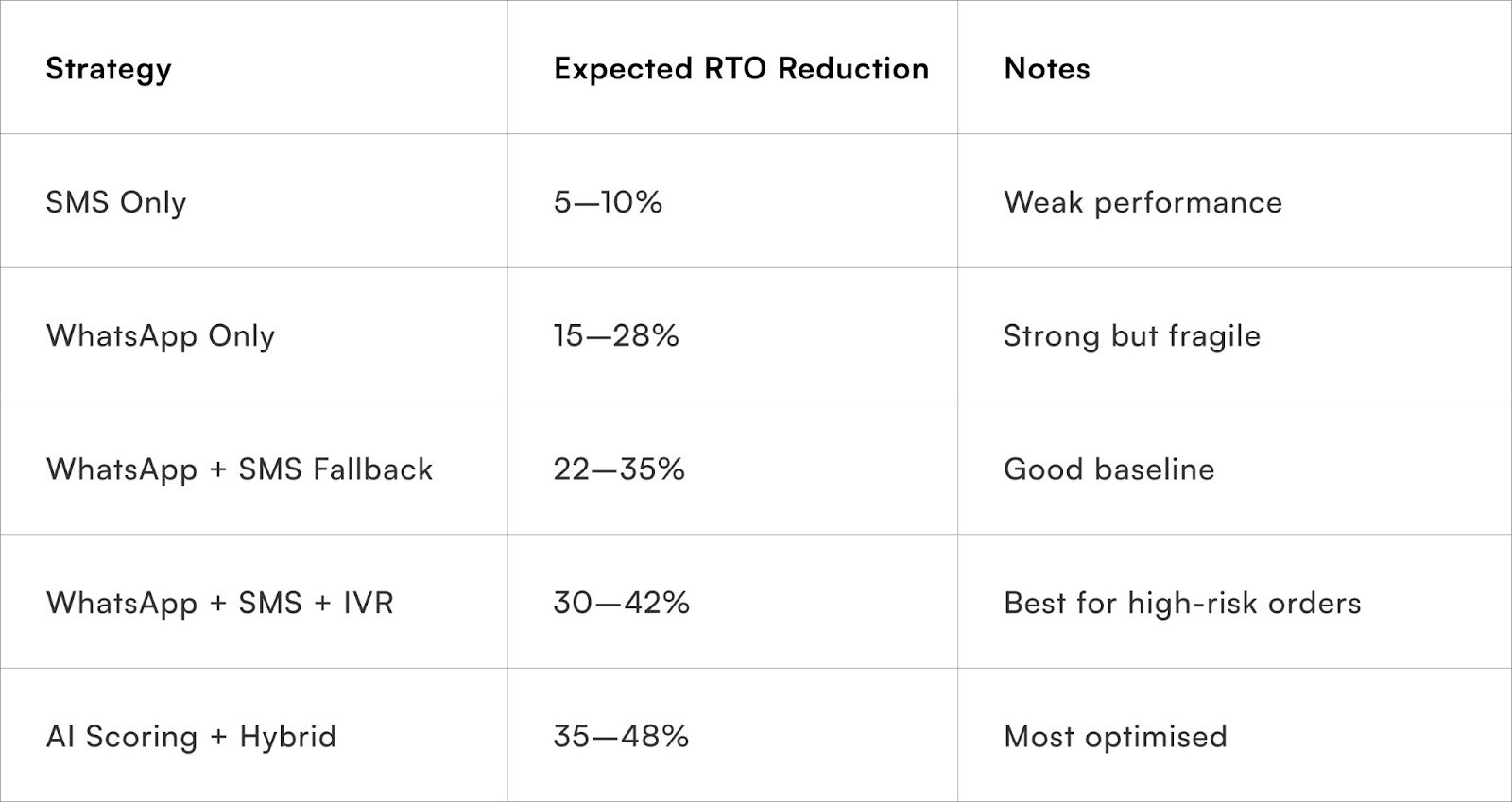
This reduces unnecessary friction for good customers while catching risky ones.
Performance Benchmarks: What You Should Expect
Modern D2C brands running WhatsApp-led systems typically see:
WhatsApp-First Performance
- 60–80% confirmation
- 18–35% lower RTO
- 2–4 minute median confirmation time
- 50–70% reduction in manual call workload
SMS-First Performance
- 15–30% confirmation
- Minimal RTO improvement
- Very long lag time
- High operational inefficiency
Multi-Channel Hybrid
- 65–85% confirmation
- 25–40% RTO reduction
- Near-zero manual verification effort
- Most reliable for Tier 2/3 India
The hybrid model consistently outperforms all others.
Final Recommendation (After All The Data + Behaviour)
If your brand ships COD in India, your confirmation stack should be:
WhatsApp First → WhatsApp Reminder → SMS Fallback → IVR For High-Risk → Auto-Cancel
Because:
- WhatsApp = highest action
- SMS = widest fallback safety
- IVR = risk-control layer
- Auto-cancel = cost-protection
- AI scoring = scaling and optimisation
This is the channel architecture that actually works in India today.
TL;DR
- WhatsApp beats SMS for COD confirmations in open rate, action rate, and trust.
- But WhatsApp alone isn't enough — coverage gaps exist.
- SMS still plays a crucial fallback role.
- Multi-channel logic reduces RTO by 25–40%.
- Regional behaviour matters: WhatsApp dominates everywhere except rare rural pockets.
- The gold standard is hybrid: WhatsApp → WhatsApp Reminder → SMS → IVR (if high-risk).
- COD confirmation is ultimately a behavioural game, not just a messaging exercise.

FAQs (Frequently Asked Questions On WhatsApp vs SMS: Which Works Better for COD Confirmations?)
1. Why do COD confirmations reduce RTOs so effectively? (ChatGPT)
COD confirmations work because they filter out low-intent or accidental orders before shipping. Customers often forget what they ordered, order impulsively, or use incomplete addresses.
A confirmation message forces a quick commitment, reducing fake or non-serious orders and lowering RTO by 20–40% depending on region and product category.
2. Is WhatsApp always better than SMS for COD confirmations?
In most cases, yes. WhatsApp outperforms SMS in delivery rate, open rate, trust, and action rate. However, it’s not universally superior. Some customers mute WhatsApp notifications, lack stable data, or use basic phones.
SMS remains a strong fallback channel, especially for rural pockets, low-bandwidth areas, or customers who don’t regularly use WhatsApp.
3. How many confirmation attempts should a brand make before cancelling a COD order?
Most experienced D2C ops teams run two to three attempts within a 6–12 hour window. A typical sequence is WhatsApp → WhatsApp Reminder → SMS. If the customer does not respond after all touchpoints, the order enters auto-cancel review. High-risk areas may require one IVR call, but too many attempts increase operational cost and irritate customers.
4. Should COD confirmations use English or regional languages?
Regional languages significantly improve confirmation rates, especially in Tier 2/3 markets. WhatsApp templates in Hindi, Tamil, Bengali, or Kannada often see 10–15% higher engagement.
SMS gains even more from localisation because customers rely on language cues to detect legitimacy and avoid phishing threats. The ideal setup is English + local language variants.
5. Can confirmation flows negatively impact conversion?
Yes. If the flow is too aggressive, customers feel pressured or confused. For example, sending immediate auto-cancellation threats, too many reminders, or unclear messages can lead to dropped orders.
A balanced structure—two WhatsApp nudges, one SMS fallback, and a clear deadline—protects margins without hurting customer experience.
Talk to our experts for a customised solution that can maximise your sales funnel
Book a demo

.png)