

Refunds shape customer memory more than deliveries. A smooth order experience might win attention, but a delayed refund destroys trust faster than any other post-purchase touchpoint. Indian shoppers now treat refund speed as a benchmark for brand credibility because nearly 58% of all online orders involve some friction around cancellations, returns, or payment reversals.
The pressure intensifies when multiple payment rails behave differently. UPI refunds usually settle in minutes, but credit card reversals can take 3–7 working days, and COD reversals demand wallet or bank workflows. Meanwhile, brands face rising refund volumes due to fast-fashion cycles, impulse buying, and RTO-driven operational noise.
In this comprehensive guide on How to Build a Fully Automated Refund Flow in Indian E-commerce, we examine the systems, decisions, and safeguards required to run refunds without manual tickets or human intervention.
This approach gives brands a chance to reduce service load by 40–60% whilst improving repeat purchase rates through predictable, transparent communication.
Why do refund delays happen in Indian e-commerce?
Unpacking the operational, financial, and compliance complexity behind refund failures
Refund delays rarely arise from one root cause. They emerge from a stack of disconnected processes that often operate across different teams. The logistics head deals with return scans, the finance team handles reconciliation, and customer support manages escalations. These silos create friction that compounds every hour.
Three forces drive most refund delays:
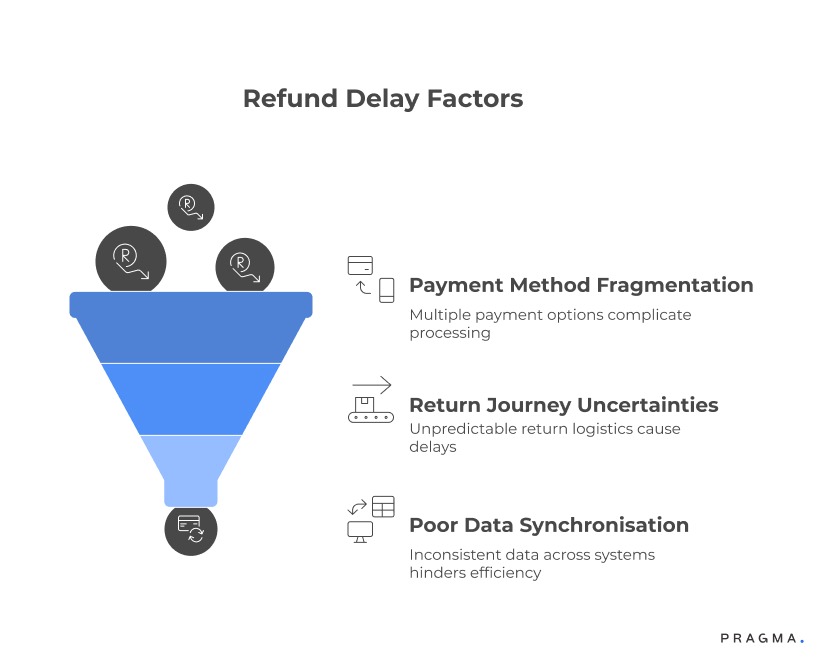
- Payment method fragmentation
- Return journey uncertainties
- Poor data synchronisation across systems
UPI returns behave predictably, but card networks, BNPL players, and wallets operate on completely different reversal rules. COD sits in a class of its own because it isn’t a “refund”; it’s a payout, which requires KYC and bank detail validation. This fragmentation creates operational traps that many D2C teams only notice once refund volumes cross 1,000 per month.
Logistics uncertainty slows things further. When a return is in transit, the brand has no control over scan frequency or updates. A single missed “received at hub” scan delays the refund trigger because 1,500+ D2C brands rely strictly on courier milestones instead of their own internal logic.
Finally, reconciliation is often manual. Finance teams pull spreadsheets from gateways and couriers, then attempt to map each order. Any mismatch postpones refunds until someone manually verifies it. This slows the entire queue and damages customer experience.
How payment methods influence refund behaviour
Different rails, different SLAs, different risks
Understanding refund behaviour across payment types helps e-commerce teams design a stable automation engine. Each payment mode needs separate logic and separate risk rules.
COD refunds often create the highest friction because customers must provide account or UPI details, which increases cognitive load. 1,500+ D2C brands still rely on manual verification, delaying payouts. Some use wallets, but those create breakage when customers forget credentials or prefer direct bank transfers.
For prepaid orders, cards behave differently from UPI. Card reversals require settlement cycles, so the bank may reflect the refund after several days even if the brand initiates it instantly. BNPL entities add another layer because refunds must sync with the lender’s ledger before the shopper sees the adjustment.
To show this clearly, consider the table below.
Refund Behaviour by Payment Method in India
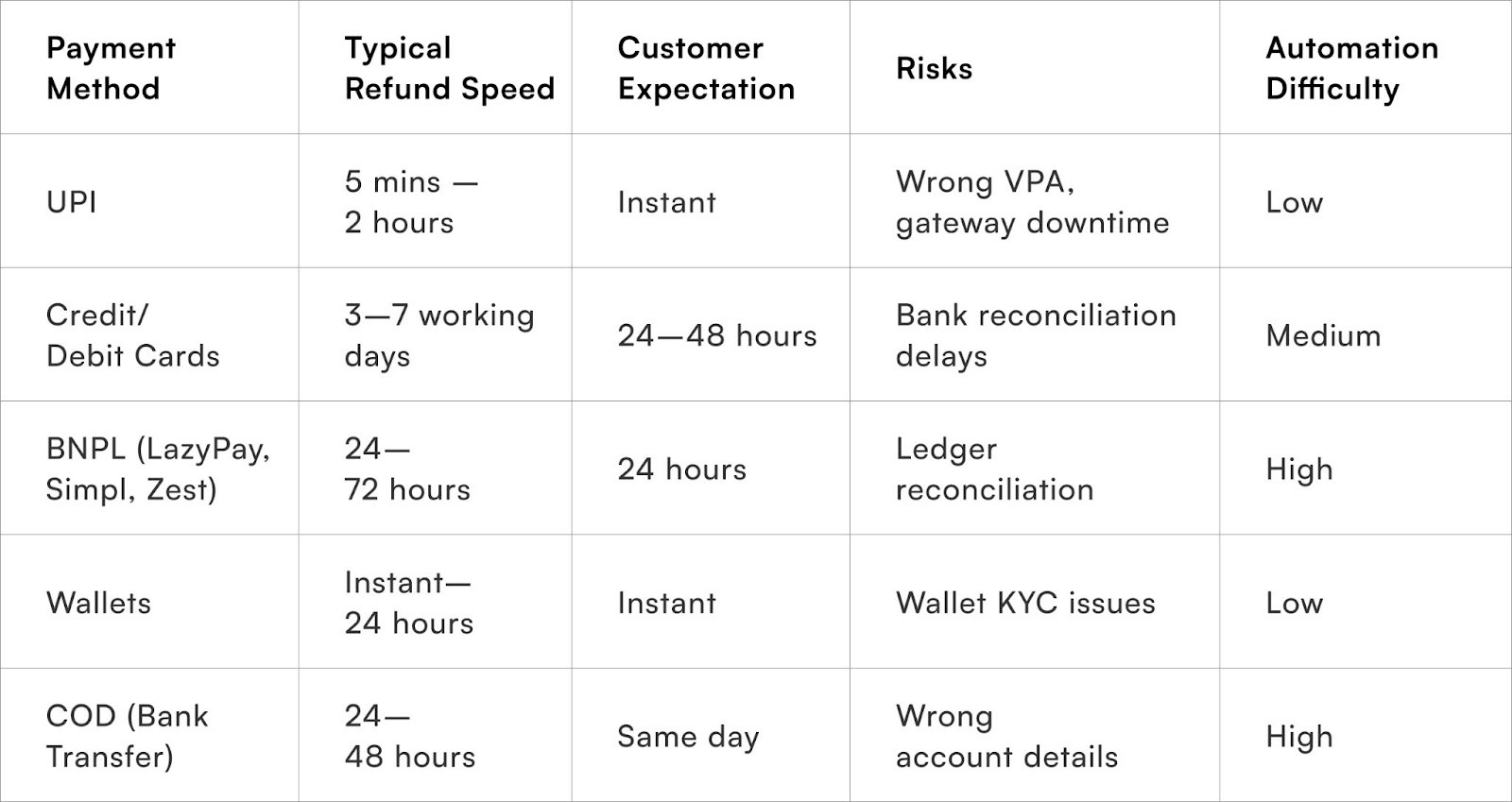
These differences matter when designing automation. A single universal workflow almost guarantees failure because each payment rail demands distinct rules that reflect its speed and risk profile.
What defines a ‘fully automated’ refund flow?
A system where decisions, triggers, and validations run without human intervention
A fully automated refund engine isn’t about connecting a payment gateway and switching on a toggle. It requires thoughtful orchestration across multiple systems.
A refund becomes automated only when these five elements operate without human effort:
- Input validation
- Trigger accuracy
- Risk scoring
- Payment execution
- Customer communication
Input validation ensures correct bank details and reduces payout failures. Trigger accuracy determines when a refund should fire — upon cancellation, upon first RTO scan, or upon QC completion. Risk scoring prevents fraudulent claims, especially in high-RTO pin codes or high-value categories.
Payment execution must work across multiple rails, whilst customer communication should deliver personalised status updates across SMS, WhatsApp, and email.
A refund flow becomes truly automated only when every step clears operational friction and predicts customer expectations.
Mapping the refund journey end-to-end
From request to settlement across all scenarios
Consider four major paths: cancellation-before-shipping, RTO returns, customer-initiated returns, and defective/issue-based refunds. Each requires a separate branch inside your refund engine.
Refund Journeys and Automation Requirements
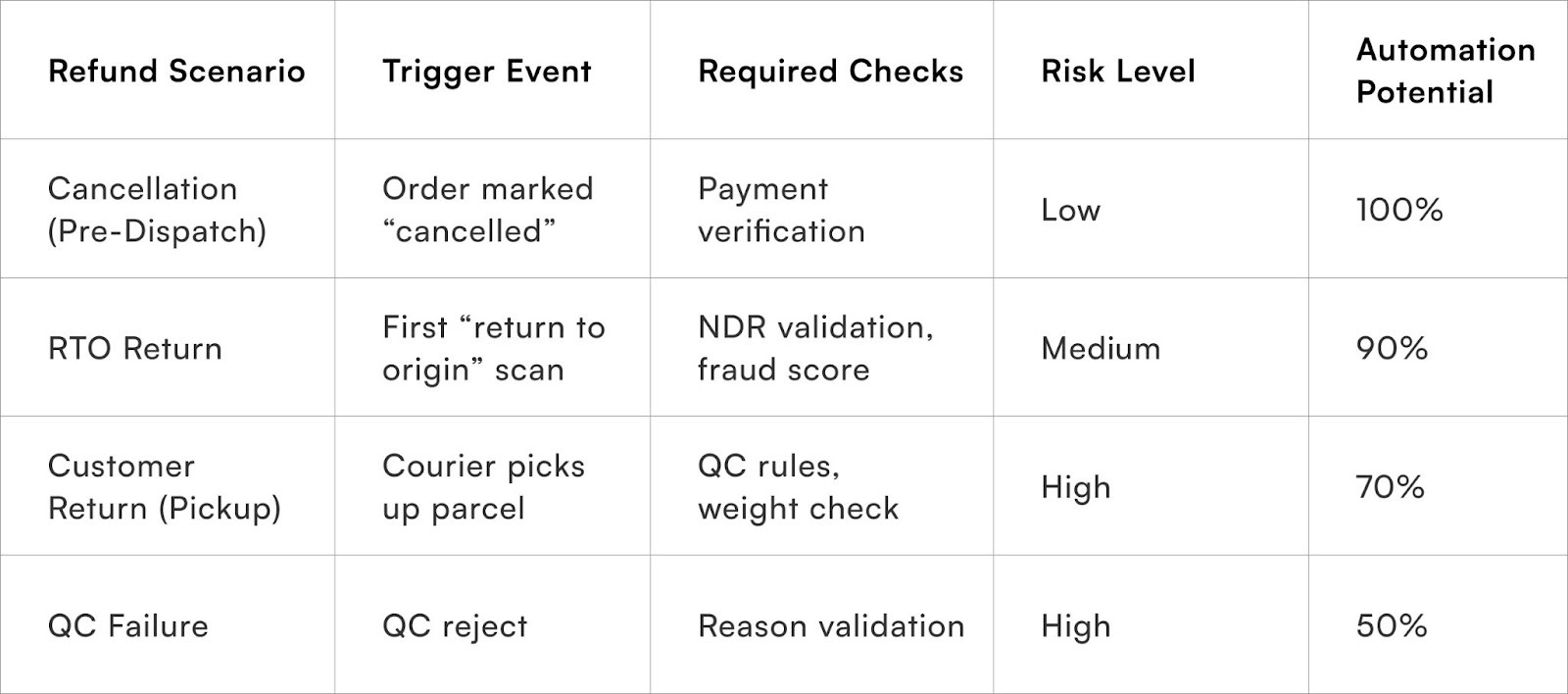
Cancellation-before-shipping is the easiest path and should be automated from day one. The risks emerge once physical goods move. RTO refunds are predictable if your courier integrations push accurate scans. Customer-initiated pickups are harder because QC must confirm the product’s authenticity and condition.
QC failure refunds, particularly partial refunds, demand tight rules because abusive returns are rising across beauty, electronics, and footwear categories.
How to automate validation and fraud checks in refund workflows
Ensuring speed without exposing the brand to risk
India’s rising return culture pushes brands to add intelligent validation layers. These checks need automation without adding friction.
Three essential validations sit at the heart of safe refund automation:
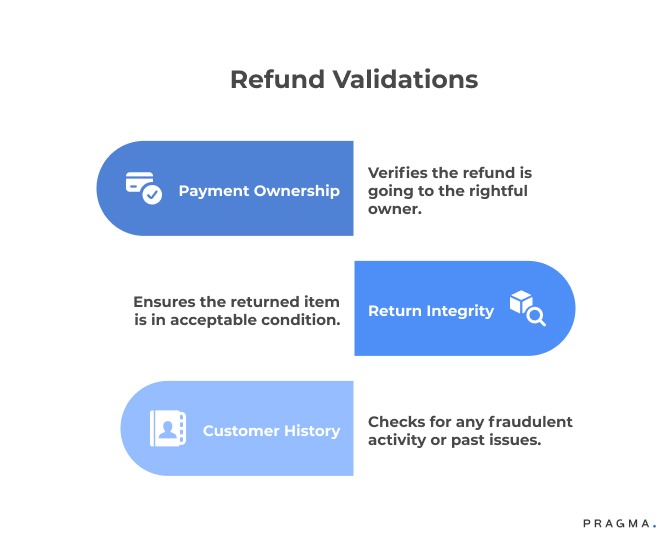
- Payment ownership validation
- Return integrity validation
- Customer history validation
Payment ownership validation prevents refunds to the wrong person. UPI verification APIs can confirm name matches within seconds. Bank account verification ensures payouts land correctly.
Return integrity validation ensures items are genuine and unused. Many fashion brands now use weight-delta checks: if the returned product weighs less than 60% of the outbound weight, the refund stalls until manual review.
Customer history validation reduces fraud — if a shopper shows unusually high cancellation or refund rates, the system can delay or flag the transaction.
These checks run quietly behind the scenes. When implemented well, customers don’t experience friction; they only experience reliability.
How to create a multi-rail payout engine for refunds
UPI, bank transfer, card reversal, and BNPL integration
A fully automated refund engine must operate across different rails. Each rail has its own behaviour, so the system needs routing logic that chooses the best option for each customer.
UPI remains the quickest rail for refunds. 1,500+ D2C brands now encourage customers to save UPI IDs as the default refund method, which lowers friction. Bank transfers remain essential for COD but require verification to avoid failures.
Card reversals must route through the same gateway used during payment to ensure recognition by the bank. BNPL refunds require ledger syncing to avoid conflicts with the lender’s statement cycle.
Routing logic should consider:
- Payment method used during purchase
- Customer preferences
- Risk score
- Refund amount
- Past payout success rate for the customer
A multi-rail engine reduces failure rates and shortens refund experience significantly.
Why communication matters as much as the payout itself
Predictability builds trust more than speed
Even if refunds take time, predictable communication eases anxiety. Indian customers check payment apps frequently after initiating returns. Silence increases support tickets and reduces long-term trust.
A strong refund communication layer sends updates at five points:
- Refund request received
- Refund approved
- Refund initiated
- Refund completed
- Refund failure (with action steps)
Automated WhatsApp flows perform well because customers prefer real-time updates. SMS and email support multi-channel visibility. Many Indian shoppers track refunds late at night when app support teams are offline, so automated communication bridges the gap.
Clarity beats speed — customers tolerate time but not uncertainty.
How to integrate refund logic with your OMS, WMS, and finance stack
Cross-system synchronisation prevents disputes, delays, and double payouts
Refunds interact with multiple systems. The OMS determines order status. The WMS controls return intake. The finance stack handles actual payouts. When these systems fail to sync, refunds break immediately.
To automate effectively, brands must pass clean data across systems. OMS status should reflect courier events in real time. WMS should feed QC results without delay. Finance dashboards must reconcile transactions daily.
A strong automated engine pulls data from all three to make timely decisions.
Brands often underestimate the importance of reconciliation. Payment gateways, BNPL lenders, and banks frequently send settlement files with delays. If your finance team spots mismatches late, refunds pause across the board. Automated reconciliation solves this by running hourly checks.
The tighter the synchronisation, the faster your refunds operate.
Common refund bottlenecks and how automation resolves them
Addressing issues before they escalate into service load
Most refund issues come from predictable failure points. Automation neutralises many of them.
Key bottlenecks include:
- Incorrect UPI or bank details
- Delayed courier scans
- Missing QC entries
- Failed settlement reconciliation
- Doubtful customer claims or partial returns
Automation solves these using:
- Pre-verification of payout details
- T+3 fallback triggers
- Automated QC data ingestion
- Daily settlement checks
- Behaviour-based risk scoring
Once these guardrails operate, refund flows lose their fragility. Refunds become a stable, predictable function instead of a daily firefight.
Building dashboards for refund visibility
Operational clarity drives accountability and faster iteration
A fully automated refund system still needs strong monitoring. Dashboards help founders, support heads, and finance teams review behaviour.
The dashboard should display:
- Refunds initiated today
- Refund method split
- Average refund time by rail
- Refund failures and reasons
- Outstanding QC reviews
- RTO-triggered refunds
- COD refunds pending bank verification
These metrics allow stakeholders to spot weak links. For example, if UPI refunds increase but failures spike, the brand might face VPA verification issues. If card refunds slow down, the gateway might have settlement backlog.
Dashboards reveal patterns that engineers can fix quickly.
Quick Wins — What you can implement in 30 days
Practical actions that shift refund experience immediately
In thirty days, brands can deploy several high-impact wins:
- Build instant cancellation refunds.
- Add UPI verification for all COD refunds.
- Introduce blended triggers for RTO and returns.
- Standardise QC input fields for faster ingestion.
- Send refund updates on WhatsApp with five milestones.
These actions dramatically improve predictability for customers whilst giving internal teams clarity.
Which metrics matter for a high-performing refund engine?
Operational consistency depends on measuring the right outcomes
High-performing refund systems track outcomes, not activities.
The key metrics include:
- Average refund initiation time
- Average refund completion time
- Failure rate by rail
- Input mismatch errors
- % of refunds processed automatically
- Repeat purchase rate post-refund
Brands often find that refund predictability contributes more to retention than delivery speed. Customers remember how you handle money.
Automation maximises the percentage of refunds completed without human effort. This metric often correlates strongly with overall customer satisfaction and support load.
To Wrap It Up
Refund automation isn’t just a technology exercise; it reflects a brand’s commitment to transparency and fairness. A predictable, efficient refund journey reduces anxiety and builds confidence at scale.
Focus on automating validation, routing logic, and communication this week to stabilise refund performance.
Over time, brands should refine risk scoring, strengthen reconciliation, and build deeper courier integrations. Consistent iteration transforms refunds from a liability into a competitive asset.
For D2C brands seeking automated refund infrastructure, Pragma’s Commerce Lifecycle platform provides unified payment routing, automated QC intake, and multi-rail payout capabilities that help brands improve refund speed, accuracy, and customer satisfaction.

FAQs (Frequently Asked Questions On How to Build a Fully Automated Refund Flow in Indian E-commerce)
1. What is an automated refund flow in e-commerce?
An automated refund flow is a system where refunds are validated, triggered, processed and communicated without any manual steps. It connects systems like the OMS, WMS, couriers, payment gateways and payout engines so refunds can be initiated smoothly when cancellations, returns or QC events occur.
2. How long do refunds take in Indian e-commerce?
Refund timelines vary by payment method:
- UPI: Often settles within minutes
- Cards: Usually 3–7 working days
- Wallets: Instant to 24 hours
- COD (via bank transfer): 24–48 hours after payout details are verified
3. What causes refund delays for prepaid orders?
Delays can happen due to:
- Gateway settlement backlogs
- Missing or inconsistent courier scans
- Reconciliation mismatches
- High-risk orders flagged for review
- Incomplete warehouse return/QC data
- Bank posting cycles for card refunds
4. Why are COD refunds harder to automate?
COD refunds require collecting and verifying bank or UPI details. Incorrect or unverified information leads to payout failures. Automating this needs robust account validation, UPI verification and a reliable payout engine that supports different rails.
5. How does UPI impact refund speed?
UPI makes refunds much faster—reversals usually reflect within minutes when routed through compliant payout providers. Many Indian brands now prefer UPI-first refunds because they are quicker and more reliable than bank transfers.
6. How do card refunds differ from UPI refunds?
Card refunds depend on bank and card-network settlement cycles, so customers typically see the amount only after 3–7 business days. UPI refunds bypass these cycles and settle nearly instantly, making them more predictable.
7. What role does QC play in automated refunds?
Quality checks determine if a returned product is eligible for a full refund. Automated systems rely on structured QC data like condition, authenticity, weight differences and packaging status. This information must sync instantly to the OMS so refunds can be initiated promptly.
8. How do brands reduce refund fraud?
Brands use:
- Behaviour scoring
- Return history checks
- Weight-delta validation
- Courier scan consistency
- Verification of payment details
High-risk signals—like repeated cancellations or mismatched weights—can automatically delay or flag refunds.
9. Which communication updates should customers receive during refunds?
Typical customer updates include:
- Refund request received
- Refund approved
- Refund initiated
- Refund completed
- Refund failure
WhatsApp works best because customers frequently check refund status.
10. How often should brands track refund performance?
Brands should track:
- Daily: SLA issues
- Weekly: Operational trends
- Monthly: Reconciliation accuracy
Important metrics include time-to-refund, failure rates, payout success and automation levels.
11. What metrics matter most in automated refund systems?
Key metrics include:
- Refund initiation time
- Refund completion time
- Automation percentage
- Payout failure rate
- Incorrect detail submissions
- QC approval time
- Repeat purchase after refund
These help measure operational strength and customer trust.
12. How can Indian D2C brands improve refund speed?
Brands can speed up refunds by:
- Supporting instant cancellation refunds
- Using blended courier triggers
- Automating UPI/bank detail verification
- Ensuring real-time QC updates
- Routing payouts smartly across UPI, bank and card rails
- Sending proactive communication across channels
Talk to our experts for a customised solution that can maximise your sales funnel
Book a demo

.png)