

In Indian D2C logistics, failed pickups rarely happen because drivers are unwilling. They happen because time windows are poorly designed. A rider reaches early and waits. The customer steps out briefly. The warehouse clusters pickups inefficiently. By evening, driver idle time increases, reschedules pile up, and customer frustration rises. What appears to be a minor scheduling issue quietly erodes last mile operational efficiency.
Effective pickup window design is not about offering more time slots. It is about engineering predictable overlap between customer availability and driver routing density. When windows are too narrow, success rates fall. When they are too broad, routing precision collapses. Both scenarios inflate cost per pickup and delay reverse logistics cycles.
Brands that treat pickup window design as an operational lever rather than a UI feature consistently reduce driver idle time, improve first-attempt success, and stabilise reverse turnaround timelines.
Why does pickup window design directly impact last mile operational efficiency?
Time windows shape routing density, not just customer experience
Pickup windows influence how routes are stitched together. When slots are scattered randomly across wide time bands, drivers move between low-density clusters, increasing travel distance and idle gaps. When windows are structured around predictable routing zones, stops consolidate naturally.
Poor pickup window design creates invisible friction across the network.
How do inconsistent windows reduce routing density?
When customers freely choose broad or non-clustered slots:
- Drivers travel longer inter-stop distances
- Micro-zones fragment across hours
- Route re-optimisation increases mid-day
- Fuel cost per successful pickup rises
Each of these reduces last mile operational efficiency even if pickup success appears acceptable at surface level.
The compounding cost of low-density routing
Low-density routes lead to:
- Higher per-stop cost
- Fewer completed pickups per shift
- Increased SLA risk for return processing
- Higher variability in daily capacity planning
Over time, route inefficiency impacts reverse timelines and refund cycles.
How do poorly structured pickup windows increase driver idle time?
Idle minutes accumulate silently into cost inflation
Driver idle time rarely shows up clearly in dashboards. It hides between arrival and successful handover. If the pickup window is loosely defined, customers interpret it flexibly. Drivers wait. Calls are placed. Reschedules happen.
Even 8–10 minutes of average idle time per stop compounds significantly across 30 stops.
Common causes of idle accumulation
Idle time spikes when:
- Customers are not reminded before arrival
- Windows are longer than routing precision
- Buildings require access coordination
- Return packaging is not ready
These behaviours are influenced as much by communication design as scheduling logic.
Linking pickup design with return predictability
Pickup reliability directly affects return health. Inefficient pickups extend RTO and refund cycles discussed in RTO and Return. When windows are unreliable, return SLAs drift, affecting both cash flow and customer trust.
What balance should exist between flexibility and operational control?
Unlimited flexibility reduces predictability
Offering wide pickup windows may appear customer-friendly. In practice, excessive flexibility erodes routing stability. Narrow windows increase discipline but may reduce booking completion.
Effective pickup window design identifies controlled flexibility.
Indicators that windows are too broad
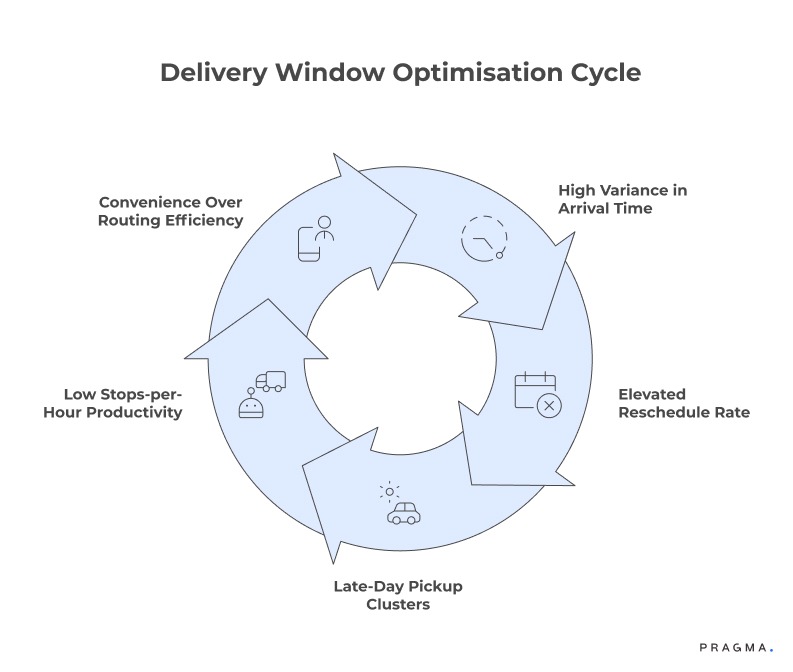
- High variance in driver arrival time
- Elevated reschedule rate
- Pickup completion skewed towards late-day clusters
- Low stops-per-hour productivity
These signals suggest that convenience is overpowering routing efficiency.
Indicators that windows are too restrictive
- Customers abandoning pickup booking
- Increased support queries
- Higher next-day reschedule requests
- Negative NPS linked to pickup experience
The goal is not restriction. It is structured predictability.
How does communication design strengthen pickup reliability?
Clarity reduces behavioural variability
Pickup windows work only when customers interpret them correctly. Confirmation messages, reminder cadence, and preparation guidance significantly influence success rates.
When customers understand:
- Exact arrival band
- Packaging readiness expectations
- Consequences of missed attempts
- Escalation pathways
Idle time reduces organically.
Structured communication models similar to Order verification flows on WhatsApp that reduce failed deliveries can reinforce pickup preparedness, improving first-attempt success without narrowing windows excessively.
How can pickup window design improve driver productivity in last mile networks?
Structured clustering increases completed stops per shift
Driver productivity is not purely a function of speed. It depends on how efficiently stops are sequenced within time bands. When pickup window design aligns with zone density, drivers complete more verified handovers per hour without increasing physical strain.
Strategic window clustering enables brands to improve driver productivity in last mile operations without expanding fleet size.
What structural adjustments increase stops per hour?
- Geo-clustered time bands instead of uniform city-wide slots
- Dynamic window compression during high-density hours
- Controlled slot visibility based on route capacity
- Auto-reschedule alignment within the same micro-zone
These adjustments increase routing predictability while maintaining customer choice within defined boundaries.
Why productivity gains must not compromise experience
Aggressive clustering without customer communication leads to missed pickups and higher reschedules. Productivity gains remain sustainable only when transparency supports operational discipline.
This becomes especially important when analysing return causation patterns such as those explored in Controllable vs Uncontrollable Returns, where operational gaps can directly inflate controllable return costs.
How does better pickup window design reduce driver idle time without shrinking flexibility?
Precision reduces waiting without removing customer agency
Reducing driver idle time does not require eliminating broad windows entirely. It requires better alignment between expected arrival precision and slot communication.
Idle reduction strategies include:
Predictive arrival updates
- Live ETA narrowing within a 30–45 minute band
- Automated reminders 60–90 minutes before arrival
- Two-way confirmation prompts prior to dispatch
When customers confirm availability close to arrival, waiting time drops significantly.
Behavioural nudges before pickup
- Clear packaging preparation instructions
- Building access guidance
- Escalation contact visibility
Structured nudges similar in principle to The role of transparency in returns and refunds policies create accountability and preparedness, lowering friction during the actual handover.
How should brands measure the effectiveness of pickup window design?
Operational stability is reflected in variance reduction
Measurement must go beyond completion rate. A healthy pickup window framework shows consistency across shifts and zones.
Core performance indicators
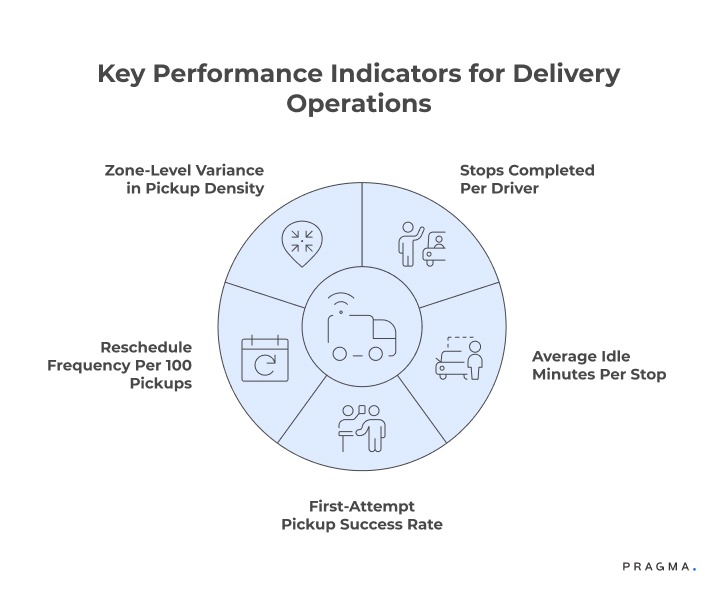
- Stops completed per driver per shift
- Average idle minutes per stop
- First-attempt pickup success rate
- Reschedule frequency per 100 pickups
- Zone-level variance in pickup density
Declining variance is often a stronger indicator of maturity than rising averages.
When does pickup window optimisation influence reverse cash cycles?
Time discipline shortens refund loops
Reverse logistics efficiency directly affects how quickly products return to the warehouse and refunds are processed. Pickup window reliability accelerates return confirmation, inspection, and credit initiation.
When windows are predictable:
- Reverse transit timelines stabilise
- Refund ageing reduces
- Inventory reconciliation becomes faster
- Customer trust improves through timely updates
This linkage reinforces that pickup window design is not a scheduling tweak. It is a financial control mechanism within last mile operational efficiency.
How can brands implement high-impact pickup window design improvements in 30 days?
Short operational cycles create measurable stability shifts
Pickup window optimisation does not require a full routing overhaul. Structured experimentation over four weeks can materially improve routing density and reduce idle accumulation.
Week 1: Audit current slot behaviour and idle patterns
Map pickup data across the past 30 days. Identify:
- Average idle minutes per stop
- High-reschedule time bands
- Zones with low stops-per-hour productivity
- Variance in arrival vs actual handover time
This baseline clarifies where pickup window design is misaligned with routing density.
Week 2: Introduce controlled slot clustering in two pilot zones
Implement geo-clustered windows in limited micro-zones rather than city-wide changes. Restrict overly broad bands and test compressed windows during high-density hours.
Monitor whether stops-per-hour increases without a spike in support tickets.
Week 3: Strengthen pre-pickup communication cadence
Deploy reminder logic that includes:
- Automated confirmation prompts before dispatch
- Packaging readiness instructions
- Clear reschedule pathways
Structured communication reduces behavioural unpredictability and helps reduce driver idle time organically.
Week 4: Compare productivity and variance metrics
Evaluate:
- Change in stops completed per driver
- Reduction in average idle minutes
- First-attempt pickup success rate
- Reschedule frequency movement
If variance reduces alongside improved completion rates, the window structure is stabilising.
Which metrics confirm sustainable last mile operational efficiency gains?
Consistency matters more than isolated spikes
Effective pickup window design creates durable improvements rather than short-lived gains.
Core sustainability indicators
- Stable stops-per-hour across weeks
- Reduced zone-level performance volatility
- Lower repeat reschedule ratio
- Faster reverse shipment initiation post-pickup
- Predictable daily driver workload distribution
These signals confirm that routing density and customer availability are aligning structurally.
To Wrap It Up
Pickup window design is not a cosmetic scheduling feature. It is a structural lever that influences routing density, driver idle accumulation, reverse logistics speed, and ultimately last mile operational efficiency.
This week, audit idle minutes per stop and identify two zones where slot clustering can be tested without expanding fleet capacity.
Long-term gains emerge when pickup windows are engineered around density and supported by disciplined communication rather than unlimited flexibility.
Brands that treat window design as an operational control mechanism consistently improve driver productivity in last mile networks while preserving customer convenience.

FAQs (Frequently Asked Questions On Pickup window design: balancing driver productivity and customer convenience)
1. What is pickup window design in last-mile logistics?
Pickup window design refers to defining time slots for order pickups that balance operational efficiency and customer convenience. It plays a key role in improving scheduling accuracy and delivery success rates.
2. How does pickup window design improve driver productivity in last mile?
Well-structured pickup windows reduce waiting time and optimise route planning for drivers. This helps improve driver productivity in last mile operations by maximising active delivery time.
3. How can pickup windows help reduce driver idle time?
By aligning pickup slots with route density and demand patterns, idle gaps can be minimised. This ensures drivers spend more time on deliveries rather than waiting between jobs.
4. What factors should be considered in pickup window design?
Factors include order volume, location clusters, traffic conditions, and customer availability. Balancing these elements ensures both efficiency and convenience.
5. How does pickup window design impact last mile operational efficiency?
Efficient pickup window design improves route planning, reduces delays, and increases delivery throughput. This directly enhances last mile operational efficiency and cost optimisation.
6. Can dynamic pickup windows improve logistics performance?
Yes, dynamic windows adjust based on real-time demand and operational constraints. This flexibility improves utilisation and customer satisfaction.
7. How do pickup windows affect customer experience?
Convenient and reliable time slots reduce missed pickups and improve trust. Customers benefit from predictable and flexible scheduling options.
8. What are common challenges in implementing pickup window design?
Challenges include demand variability, inaccurate forecasts, and coordination across teams. Advanced planning tools and data insights help address these issues.
Talk to our experts for a customised solution that can maximise your sales funnel
Book a demo


.png)