

Mobile commerce drives 65% of all retail e-commerce sales in India.
Customers discover products on Instagram, browse via WhatsApp links, click Meta ads, compare products on Google, and complete purchases on smartphones.
Mobile drives the majority of traffic for almost every D2C e-commerce brand in India.
Yet most brands still lose customers during checkout.
A customer adds products to the cart. Starts entering shipping details. Faces OTP delays. Gets redirected between payment apps. Encounters slow-loading checkout pages, leaves without completing payment.
A single failure in checkout can impact customer retention and conversions.
A report by Baymard Institute states that the average e-commerce cart abandonment rate is 70.19%, with checkout friction among the main reasons.
Indian e-commerce brands face even larger challenges because of:
- Mobile dominates traffic
- COD remains highly preferred
- Internet quality varies significantly
- Payment behaviour differs across regions
- UPI flows involve app switching
- OTP verification introduces extra friction
But this can be solved with Mobile checkout optimisation. In this blog, we will discuss what "Mobile Checkout Optimisation: Fix Errors & Boost Conversions in E-commerce" is and how it can benefit e-commerce brands in India by boosting sales.
What Is Mobile Checkout Optimisation?
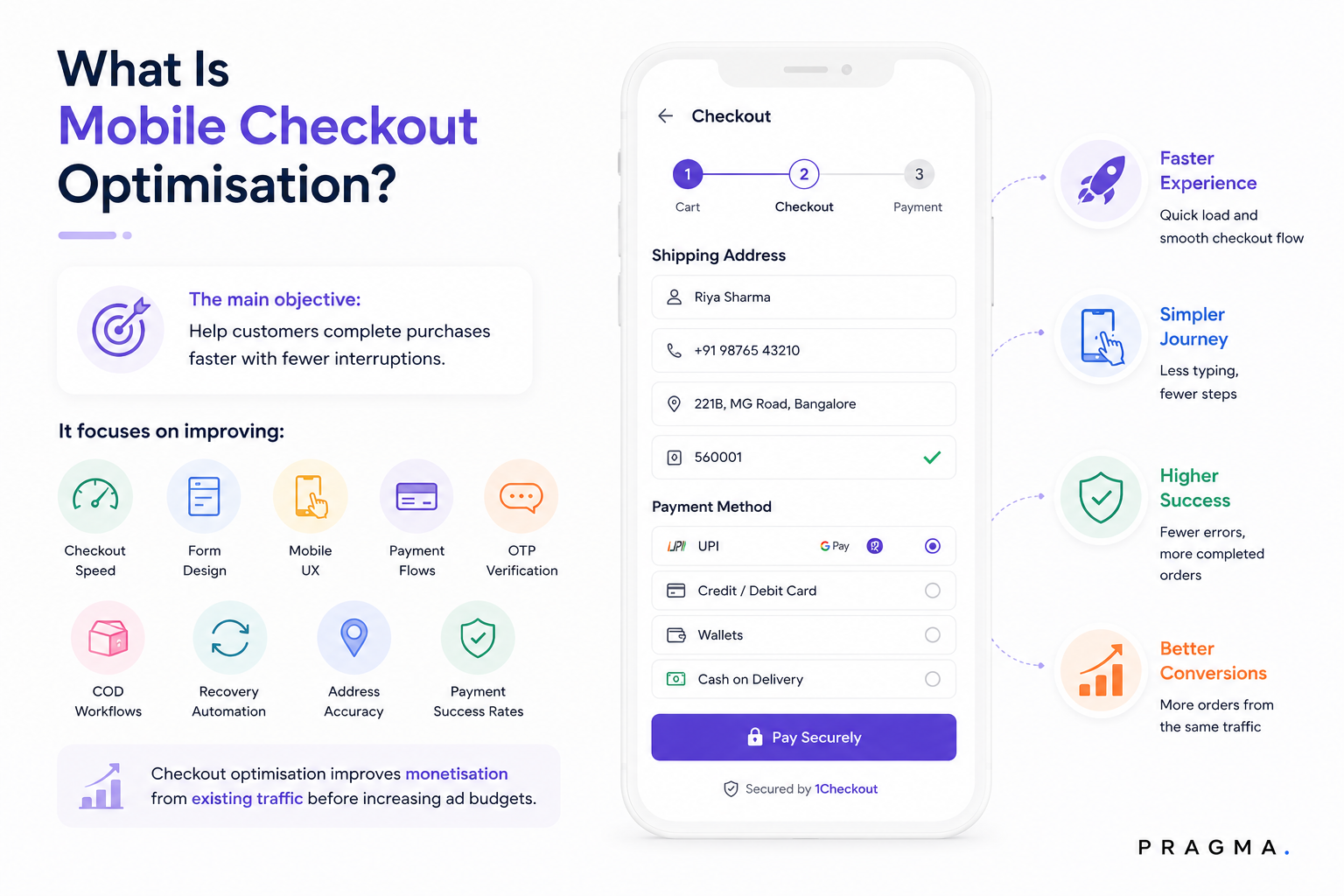
Mobile checkout optimisation refers to improving the mobile purchase journey to reduce friction and increase completed orders.
The main objective of mobile checkout optimisation is to help customers complete purchases faster with fewer interruptions.
It focuses on improving:
- Checkout speed
- Form design
- Mobile UX
- Payment flows
- OTP verification
- COD workflows
- Recovery automation
- Address accuracy
- Payment success rates
Checkout optimisation improves monetisation from existing traffic before increasing ad budgets.
Why Mobile Checkout Optimisation Matters in India?
As we know, the Indian e-commerce market is primarily driven by mobile purchases, so it is essential to optimise the mobile checkout to ensure a smooth order placement.
Here are the reasons why mobile checkout optimisation is essential in India:
Mobile Dominates E-commerce Traffic
India operates as a mobile-first e-commerce market. Most customers never interact with desktop websites.
Mobile commerce contributes around 65% of e-commerce sales globally, with mobile penetration growing rapidly across India.
For D2C brands, mobile traffic primarily comes from:
- Instagram ads
- Facebook ads
- Influencer campaigns
- WhatsApp campaigns
- YouTube Shorts
- Google Shopping
- Organic social media
If the checkout journey performs poorly on mobile, acquisition costs increase immediately.
Lower Conversion Rates on Mobile
Mobile traffic remains high, but mobile conversion rates still remain lower than desktop.
This is because mobile shoppers face more friction during checkout.
Research shows that mobile conversion rates remain significantly lower than desktop conversion rates globally.
Major reasons include:
- Slow loading pages
- Smaller screens
- App switching during UPI payments
- Form fatigue
- OTP verification delays
- Poor mobile UI
- Network instability
Pragma's intelligent checkout system reduces the triggers of abandonment.
The platform provides automated address filling, transparent pricing display, and streamlined payment processing that works on slower network connections.
User Behaviour Is Different
Mobile users behave differently from desktop users. Most Indian mobile shoppers:
- Browse during travel
- Use one hand
- Multi-task between apps
- Shop on lower bandwidth networks
- Compare prices rapidly
- Expect instant loading
Mobile shoppers operate with lower patience. A desktop checkout that doesn't adapt to mobile creates friction instantly.
COD & OTP Dependency
Cash on Delivery still plays a major role in Indian e-commerce.
Many D2C brands receive over 60% of orders through COD, especially across Tier 2 and Tier 3 cities.
COD introduces operational complexity, such as:
- Fake orders
- RTO losses
- OTP verification
- Confirmation calls
- Address fraud
- Delivery failures
Brands without checkout verification systems often experience higher Return to Origin percentages.
Pragma RTO Suite helps brands reduce COD-related losses by automatically verifying customer data within 200 ms of placing an order. Also, with a smart C2P strategy, it helps increase COD orders into prepaid orders by 15%.
How Mobile Checkout Works?
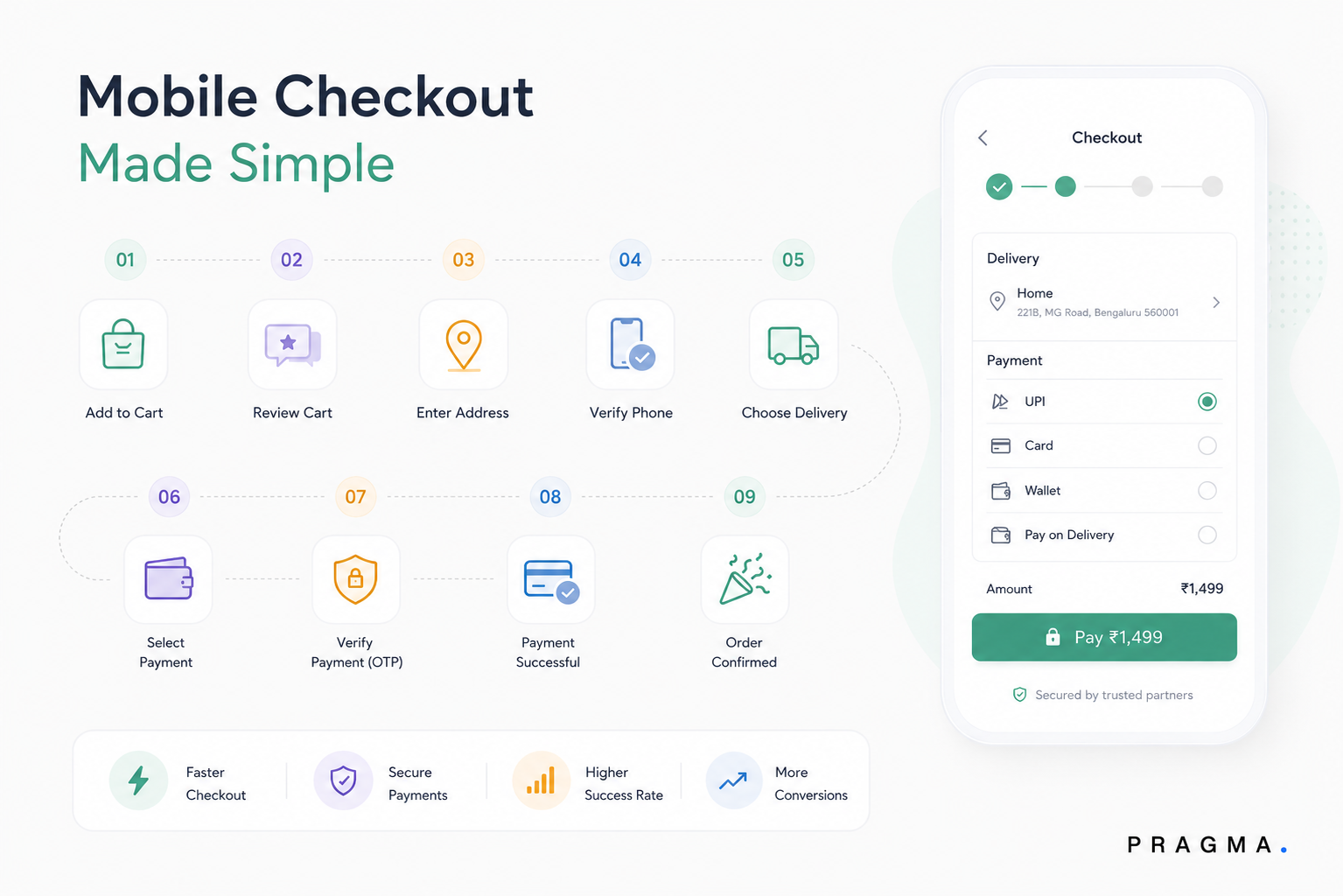
A mobile checkout journey usually involves multiple technical stages:
- Product added to cart
- Cart review
- Address entry
- Phone verification
- Shipping selection
- Payment method selection
- OTP verification
- Payment confirmation
- Order success page
Every stage introduces possible drop-offs.
For example:
- Address autofill may fail
- OTP may arrive late
- Payment redirect may timeout
- UPI app switching may interrupt the flow
- COD verification may feel lengthy
Google research shows that even a one-second delay in mobile page load time significantly affects conversion behaviour.
But 1Checkout by Pragma resolves all this. It optimises this flow by auto-filling customer data based on phone number recognition.
The platform's intelligent routing ensures payment processing works during high-traffic periods when individual gateways experience downtime.
Common Mobile Checkout Optimisation Errors
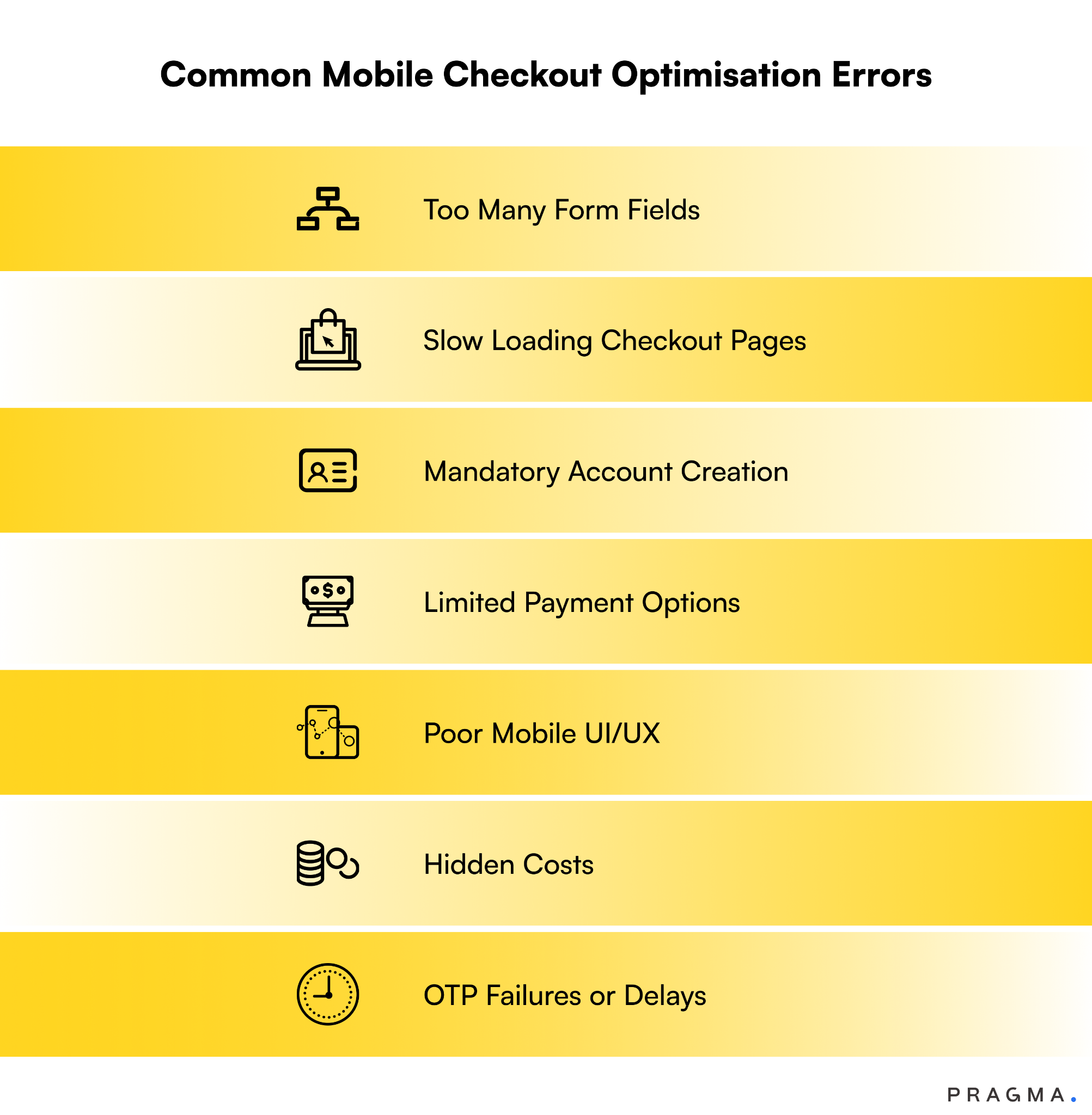
Here are the most common mobile checkout optimisation errors that occur while a customer is going through checkout on mobile devices:
Too Many Form Fields
Long checkout forms reduce conversions significantly. Most brands collect unnecessary information such as:
- Alternate phone numbers
- Company names
- Landmarks
- Optional address lines
- Excessive verification inputs
Baymard Institute reports that complicated checkout processes contribute heavily to cart abandonment.
Therefore, the best-performing mobile checkouts are those that require minimal typing effort.
That is what 1Checkout by Pragma provides: a checkout in just under 5 seconds, automatically populating address and payment details based on a phone number.
Slow Loading Checkout Pages
Most e-commerce brands have slow-loading pages, which lead to cart abandonment.
Common reasons for slow checkout pages include:
- Heavy scripts
- Excessive tracking pixels
- Poor frontend optimisation
- Large image files
- Multiple API calls
Google reports that bounce rate increases sharply as mobile page load time rises from 1 second to 3 seconds.
Mandatory Account Creation
Forced account creation is one of those mobile checkout optimisation errors that leads to checkout friction. First-time buyers prefer speed over registration.
Baymard research identifies forced account setup as a major cause of cart abandonment.
1Checkout by Pragma offers a guest checkout option, allowing customers to complete their purchase without creating an account.
Limited Payment Options
Different customers want different payment methods, including:
- UPI
- COD
- Credit cards
- Debit cards
- Wallets
- Net banking
- EMI
- Buy Now Pay Later
E-commerce brands that miss preferred payment methods lead to silent drop-offs. But with 1Checkout by Pragma, brands can offer their customers all essential payment methods, along with up to 50% refund on payment gateway charges.
Poor Mobile UI/UX
Poor mobile UX directly impacts conversion rates. Common UX problems include:
- Small buttons
- Difficult keyboard layouts
- Unclear CTAs
- Poor spacing
- Long scrolling
- Cluttered payment pages
Therefore, to remove these mobile checkout optimisation errors, brands should focus on improving the website UX more prominently/
Hidden Costs
Unexpected shipping fees are among the reasons for cart abandonment globally.
Customers lose trust when final costs differ from what is shown on the product page.
Baymard reports that extra costs, such as shipping and taxes, remain the top reason for cart abandonment.
That is why every e-commerce brand should adopt transparent pricing, which improves conversion rates.
OTP Failures or Delays
OTP verification remains a major friction point in India. Users abandon checkout when:
- OTP delivery gets delayed
- SMS fails
- Verification expires quickly
- Multiple retries fail
Reliable OTP systems matter for both prepaid and COD verification flows.
Mobile Checkout Optimisation Best Practices
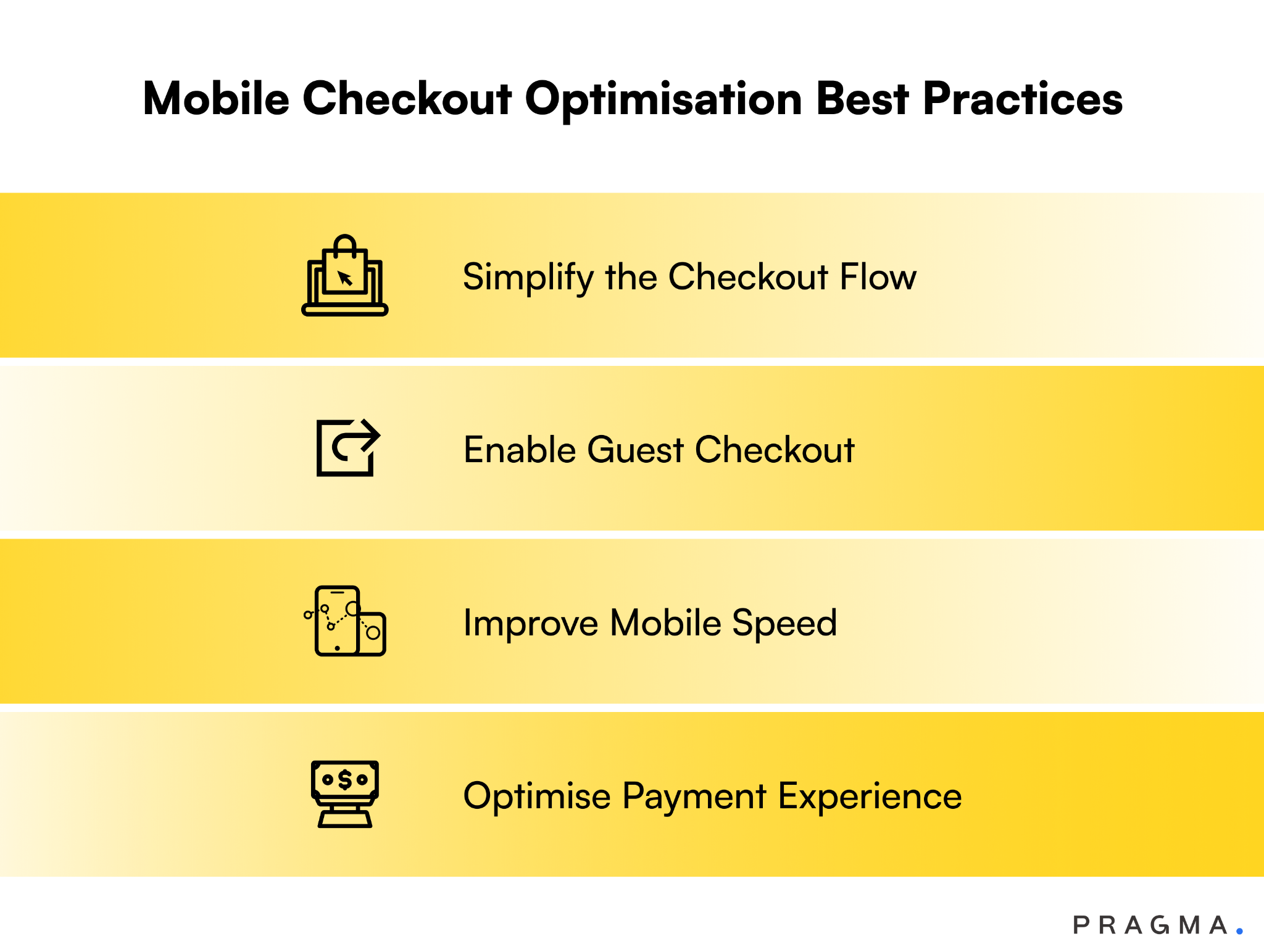
Here are some best practices for mobile checkout optimisation that every Indian e-commerce brand should follow:
Simplify the Checkout Flow
The first technique is to simplify the checkout flow. Best-performing checkouts usually include:
- Single-page checkout
- Autofill support
- Sticky payment CTAs
- Minimal typing
- Faster loading components
Pragma enables streamlined mobile checkout flows tailored to Indian e-commerce behaviour.
Enable Guest Checkout
Guest checkout reduces first-purchase friction. It provides 50% higher conversion rates for first-time buyers. The following are the benefits that guest checkout provides:
- Faster order completion
- Better conversion rates
- Lower abandonment
- Improved mobile UX
That is why 1Checkout by Pragma offers a guest checkout option to brands to get these benefits.
Improve Mobile Speed
Every e-commerce brand should focus on mobile website speed.
Checkout performance optimisation should include:
- Lightweight frontend architecture
- Optimised APIs
- Reduced third-party scripts
- Faster payment redirects
- Image compression
- Lazy loading
Optimise Payment Experience
UPI dominates Indian e-commerce payments. Brands should optimise:
- UPI app redirection
- Payment retries
- Failure handling
- Payment confirmation speed
- Gateway redundancy
Payment success rate directly impacts revenue.
Advanced Mobile Checkout Optimisation Strategies
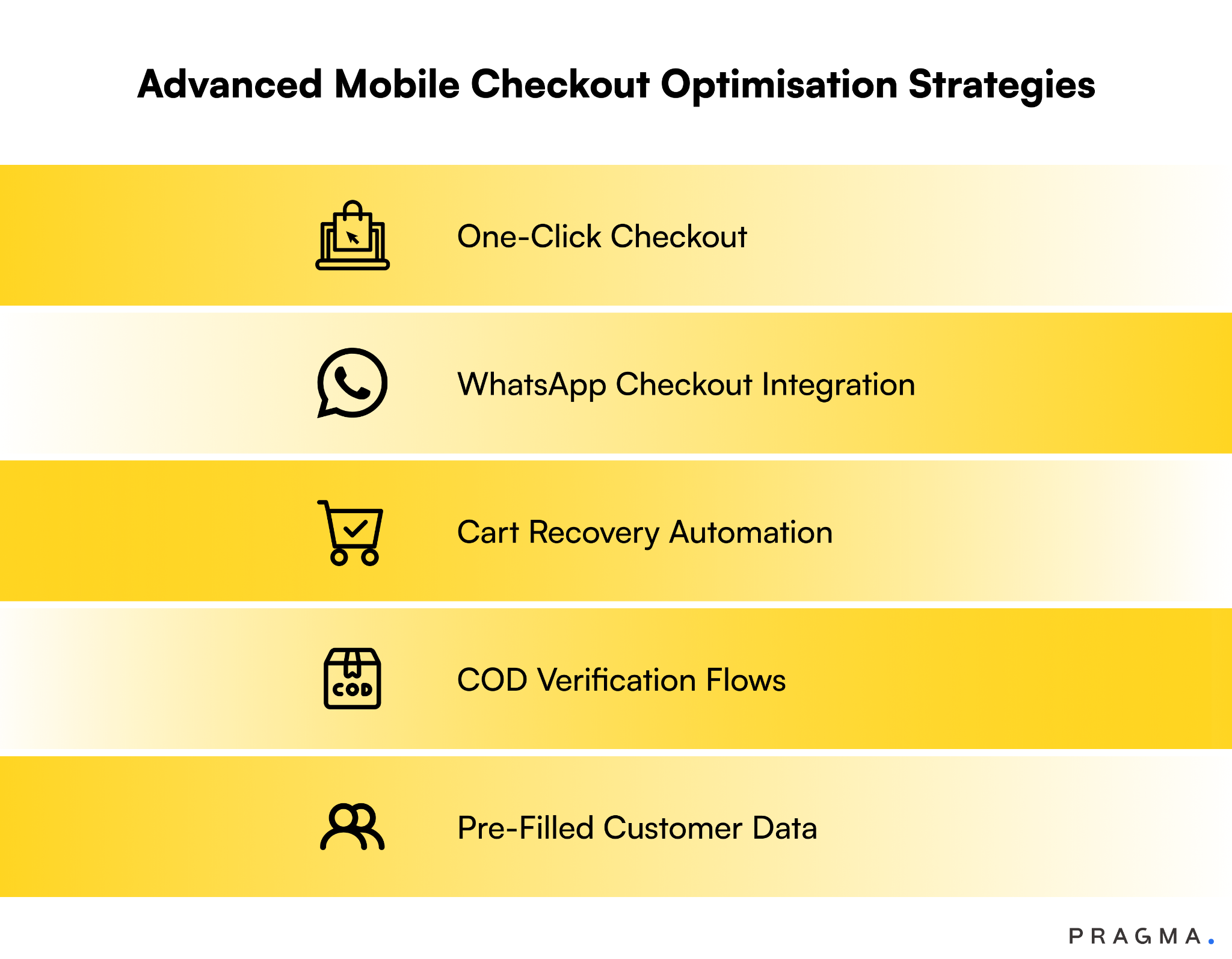
Apart from the general optimisation strategies, brands should also focus on these advanced mobile checkout optimisation strategies:
One-Click Checkout
One-click purchasing increases repeat purchase rates by 28.5% according to Cornell University research.
One-click checkout removes repetitive actions by storing:
- Addresses
- Preferred payment methods
- Contact details
This becomes critical during high-volume festive sales. Pragma's one-click solution stores customer preferences securely while enabling instant reorders for returning customers.
WhatsApp Checkout Integration
WhatsApp commerce continues growing rapidly across Indian D2C e-commerce.
Brands now use WhatsApp for:
- Cart recovery
- COD verification
- Payment reminders
- Checkout completion links
- Order confirmation
Pragma WhatsApp Business Suite enables WhatsApp-native recovery journeys that reconnect customers directly to checkout flows.
Cart Recovery Automation
Most abandoned carts remain recoverable. Brands can use automated recovery flows to help recover lost revenue through:
- SMS
- Push notifications
But the main thing that matters is the timing. Recovery campaigns perform best within the first hour after abandonment.
COD Verification Flows
COD increases conversion rates but introduces operational risks. COD orders require verification to reduce return to origin rates, which average 25-30% across Indian e-commerce. Proper verification reduces RTO by 40-50%.
Optimised COD flows include:
- OTP verification
- WhatsApp confirmation
- Fraud detection
- Address validation
- Behaviour scoring
Pragma RTO Suite reduces failed deliveries by 40% through intelligent address verification, customer scoring, and automated confirmation workflows that work seamlessly with mobile checkout.
Pre-Filled Customer Data
Auto-complete customer information using multiple data sources to reduce typing time by 70% on mobile devices.
Pre-filled data reduces effort during checkout. Common optimisations include:
- Saved addresses
- Auto-detected locations
- Saved payment preferences
- Faster verification
These changes significantly improve repeat purchase rates.
Real-Life Mobile Checkout Optimisation Example

Nykaa noticed payment failures during peak sale traffic on mobile devices.
What they had changed:
- Prioritised UPI over slower payment gateways
- Reduced payment redirects
- Added payment retry flow
- Improved checkout loading speed on low internet connections
What results did they get:
Higher payment success rates and lower checkout exits during flash sales.
What Key Metrics Should E-commerce Brands Track?
Here are some common metrics that every brand should keep a check on:
Checkout Conversion Rate
This tracks the percentage of users completing checkout after entering the payment journey.
The industry average for mobile in India is 2.8%.
It is calculated by dividing completed orders by checkout initiations and multiplying by 100.
Benchmark targets include good performance at 3-4%, excellent performance at 5%+, and top performers at 6-8%.
Cart Abandonment Rate
This measures the percentage of users who add items to the cart but leave without purchasing.
It is calculated by subtracting completed orders from carts created, dividing by carts created, and multiplying by 100.
Industry benchmarks show a global average of 70.19%, India's mobile average of 85%, and an optimised mobile average of 60-65%.
Time to Checkout Completion
It measures the average duration required to complete a checkout.
The optimal mobile checkout time is under 2 minutes for new customers, under 30 seconds for returning customers.
Payment Failure Rate
This is to monitor failed payment attempts, identify technical issues, and optimise opportunities.
It is calculated by dividing failed payments by total payment attempts and multiplying by 100.
Industry benchmarks show India's average at 20-25%, optimised systems at 10-15%, and best-in-class at 5-8%.
What Mobile Checkout Challenges Do E-commerce Brands Face in India?
Here are some common mobile checkout challenges in India:
Network Issues
More than 65% of e-commerce traffic comes from smartphones. A large share of these users shop from Tier 2 and Tier 3 cities, where internet stability still fluctuates daily.
This creates a major checkout problem.
Even a one-second delay in mobile load speed reduces conversions. Google research shows mobile users abandon pages quickly when loading slows beyond a few seconds.
The problem becomes worse during:
Festive sales, flash drops, salary week traffic spikes, and limited-time campaigns.
COD Dependency
Cash on Delivery still drives a large share of e-commerce orders in India.
Many customers prefer COD because they trust payment after delivery more than prepaid transactions.
This becomes more common with first-time shoppers and customers ordering from newer D2C brands.
COD orders face:
Higher RTO rates, fake orders, delivery refusals, and lower fulfilment efficiency.
Many users place COD orders casually and reject delivery later. This increases shipping losses and blocks inventory movement.
D2C brands now try shifting users from COD to prepaid checkout through:
UPI discounts, WhatsApp reminders, COD verification, and prepaid incentives.
Brands also verify COD orders before shipment through OTP confirmation and WhatsApp verification flows.
Pragma D2C operating system helps brands automate COD verification, reduce RTO risk, and improve prepaid conversion rates through intelligent checkout workflows and WhatsApp automation.
Address Entry Errors
Indian addresses are often long and inconsistent. Customers enter incomplete house numbers, incorrect pin codes, spelling variations, or missing landmarks.
Typing detailed addresses on mobile screens slows down checkout completion.
Many users abandon checkout midway because the process feels too long.
Address errors later:
Failed deliveries, delayed shipments, RTO orders, support escalations, and higher logistics costs.
Reducing manual typing improves checkout speed and lowers drop-offs.
Pragma helps D2C brands reduce address-related delivery failures through automated validation, customer profile pre-fill, and CRM-integrated checkout optimisation.
Payment Failures
UPI transactions continue growing rapidly across India, but checkout failures still happen daily because of:
Bank downtime, network instability, gateway overload, OTP delays, and failed app redirects.
These issues increase sharply during high-traffic sale periods.
Even small payment failure percentages create large revenue losses for high-volume D2C brands.
Pragma helps brands improve payment success rates through real-time payment monitoring, recovery automation and mobile-first checkout infrastructure designed for Indian e-commerce behaviour.
How to Audit Your Mobile Checkout?
Here is how e-commerce brands can audit their mobile checkout:
1. Track Mobile vs Desktop Performance
Start by comparing mobile traffic, conversion rate, and abandonment rate.
Most Indian D2C brands receive over 80% traffic from mobile, but mobile conversion still stays lower than desktop.
This gap states that there is checkout friction.
2. Test Mobile Checkout Speed
Check how fast your checkout loads on real mobile devices and weak internet networks.
Google reports that a 1-second delay in mobile load time reduces conversions by up to 20%.
Slow payment gateway response and heavy scripts increase drop-offs.
3. Review Checkout Steps
Audit the number of screens, clicks, and fields in your checkout flow. Long checkout journeys create friction.
High-converting mobile checkouts usually complete within 2 to 3 steps.
4. Audit Payment Performance
Track payment success rates across UPI, cards, wallets, and COD verification flows.
Failed payments and delayed OTPs remain one of the biggest mobile checkout optimisation errors in India.
5. Check Form Experience
Test address forms, autofill support, pin code validation, and mobile keyboard behaviour.
Poor mobile form experience increases checkout exits, especially on smaller screens.
6. Identify Checkout Drop-Off Points
Track where users abandon checkout.
The shipping page, payment page, and OTP verification stage usually show the highest exits.
Funnel tracking and session recordings help identify friction faster.
7. Test Across Devices and Networks
Audit checkout performance across Android devices, iPhones, browsers, and low-network conditions.
Indian e-commerce traffic comes from highly fragmented mobile environments.
8. Benchmark Against Competitors
Compare your mobile checkout flow with leading D2C brands in your category.
Review checkout speed, payment options, COD handling, and mobile UX to identify optimisation gaps quickly.
The Future of Mobile Checkout
Indian e-commerce checkout continues shifting toward:
- One-tap payments
- Conversational commerce
- WhatsApp-native checkout
- AI fraud prevention
- Biometric authentication
- Headless commerce architecture
Mobile checkout speed and convenience will increasingly determine conversion performance.
Final Thoughts
To conclude, here we can say that mobile checkout optimisation directly impacts e-commerce growth.
Small checkout improvements create measurable revenue impact:
- Faster loading pages
- Simplified forms
- Better payment flows
- Reliable OTP systems
- WhatsApp recovery automation
- Smarter COD verification
And the reality is that most brands only focus heavily on acquisition, and only a few focus on optimisation.
This is where the difference comes in!
To fulfil this gap, 1Checkout by Pragma helps D2C e-commerce brands improve mobile checkout performance through fast checkout infrastructure, payment optimisation, and excellent customer support.

FAQs (Frequently Asked Questions On Mobile Checkout Optimisation: Fix Errors & Boost Conversions in E-commerce)
1. What is mobile checkout optimisation in eCommerce?
Mobile checkout optimisation is the process of improving the mobile checkout experience to reduce friction, minimise errors, and increase conversion rates on smartphones and tablets.
2. Why is mobile checkout optimisation important for eCommerce brands?
Mobile checkout optimisation is important because most eCommerce traffic in India comes from mobile devices, and poor mobile experiences often lead to cart abandonment and lost conversions.
3. What are the common mobile checkout issues in eCommerce?
Common issues include slow loading speeds, complicated forms, payment failures, poor UI design, forced account creation, incorrect autofill behaviour, and difficulty entering address details on mobile screens.
4. How does mobile checkout optimisation improve conversion rates?
Mobile checkout optimisation improves conversion rates by reducing friction, simplifying form completion, improving payment success rates, and enabling faster order placement on mobile devices.
5. How can eCommerce brands reduce mobile checkout errors?
Brands can reduce mobile checkout errors by enabling address validation, improving form design, using autofill and OTP-based flows, simplifying navigation, and minimising unnecessary checkout steps.
6. What are the best practices for mobile checkout optimisation?
Best practices include one-page checkout flows, fast-loading pages, guest checkout options, mobile-friendly payment methods, clear CTAs, and minimal data entry requirements.
7. How does page speed affect mobile checkout performance?
Page speed directly impacts mobile checkout performance because slow-loading checkout pages increase bounce rates, payment drop-offs, and customer frustration during purchase completion.
8. Which payment methods improve mobile checkout conversions in India?
UPI, wallets, one-click payments, COD, and mobile-friendly payment gateways improve mobile checkout conversions by reducing friction and aligning with user payment preferences in India.
9. How does address validation improve mobile checkout experience?
Address validation improves mobile checkout by reducing typing effort, correcting errors in real time, improving delivery accuracy, and minimising failed deliveries caused by incorrect addresses.
10. What tools help optimise mobile checkout in eCommerce?
Tools include checkout optimisation platforms, address validation systems, payment orchestration tools, analytics platforms, and customer communication systems that improve mobile conversion performance.
Talk to our experts for a customised solution that can maximise your sales funnel
Book a demo.png)

.jpg)
.png)