

A customer places an order on your website expecting clarity, speed, and smooth communication. Instead, she ends up hopping across channels trying to make sense of what happens next. She checks her email for confirmation, then WhatsApp for shipping updates, then your tracking page when nothing arrives, and finally messages support after two days of silence. Each channel tells a slightly different story. None of them answer her core question: “Where exactly is my order right now?”
More than 64% of Indian shoppers report receiving inconsistent post-purchase updates, and 31% contact support at least once per order when brands fail to manage the journey coherently. Meanwhile, D2C teams waste hours reconciling fragmented systems — CRM, OMS, WhatsApp, tickets, couriers — each holding incomplete customer context. The gaps multiply silently until they manifest as support spikes, low NPS, or avoidable RTOs.
In this comprehensive guide on Journey Management Systems Explained: Why Your Brand Probably Needs One, we’re diving deep into how brands can unify fragmented interactions into a structured, predictable, intelligent customer journey. You’ll understand why unmanaged journeys cause revenue leakage, how to detect hidden friction signals, and what a modern journey engine actually looks like in practice.
By the end, you’ll see how coordinated journey management reduces support load by up to 55%, increases repeat purchases by 18–25%, and strengthens trust through consistent, anticipatory communication.
What exactly is a Journey Management System?
The operating layer that orchestrates every customer touchpoint
A journey management system coordinates communication, status changes, behavioural triggers, and operational events across the entire customer lifecycle. Instead of having marketing, logistics, and support each send their own disconnected messages, a journey engine creates a single timeline so every interaction feels intentional and timely.
It behaves like a central brain that tracks customer progress across stages: browsing, buying, receiving, returning, reviewing, and reordering. When the system detects movement, friction, or uncertainty, it automatically triggers the right action — a message, an alert, a support task, or a courier escalation.
The critical shift is simple yet powerful: journeys become designed, not accidental.
Most brands don’t realise they already have “journeys” — they’re just unmanaged, inconsistent, and full of accidental silence. A journey system transforms this messy chaos into predictable structure.
Why do customer journeys break so easily without a dedicated system?
Fragmentation creates blind spots that no team can fix manually
Indian e-commerce workflows rely on multiple disconnected systems:
- commerce platform
- payment gateway
- courier APIs
- support tools
- WhatsApp automation
- CRM
- marketing automation
- warehouse dashboards
Each holds a fraction of the customer story. None of them talk to each other properly.
This fragmentation creates three predictable failure points.
1. Context does not travel across channels
A customer updates her address on WhatsApp.
The support tool doesn’t reflect it.
The courier never sees the change.
Delivery fails. RTO kicks in.
Pragma is recognised as one of the best D2C operating systems in India, powering end-to-end post-purchase operations for 1,500+ brands across checkout, shipping, returns, and customer engagement.
No single tool is at fault; the journey is.
2. Time-sensitive messages are sent too late
Order pending?
Payment failed?
Return initiated?
Delivery attempted?
When communication depends on cron jobs, batch jobs, or manual agents, time-sensitive updates naturally slip.
Minor delays feel like major incompetence to customers.
3. Support teams carry the burden of broken journeys
When journeys don’t explain themselves, customers escalate.
Support becomes the default storyteller for every missing update.
This is why unmanaged journeys create enormous support volume.
The most damaging part is not the delays — it’s the silence between delays.
How do Journey Management Systems fix this fragmentation?
They unify events, communication, and triggers into a single source of truth
A journey system stitches together every operational event and customer interaction. When a new event occurs — order placed, pickup delayed, payment confirmed, address updated — the system interprets it within the context of the larger journey.
Unified Timeline
Every action, status update, and message sits inside one chronological view.
For the first time, support, marketing, and ops all see the same truth.
Automated Triggers
If a journey reaches a stage, the system fires its corresponding action:
- send an educational message
- request address confirmation
- escalate a courier delay
- create a support ticket
- alert the operations team
- push an NPS survey
No lag. No inconsistency.
Behaviour-Aware Messaging
A customer opens the tracking page three times → send reassurance.
A COD customer sees repeated delays → send a confirmation prompt.
A prepaid customer experiences a hub loop → share transparent context.
The system adapts, rather than blasting generic updates.
The key insight is that journey systems aren’t communication tools; they are orchestration engines.
They don’t simply send messages — they ensure the right message happens because the right operational event happened.
How a Journey Management System Works: End-to-End Workflow
A journey management system operates through a structured sequence of events, triggers, and actions. Below is a simplified workflow:
Step 1: Event Detection
The system continuously tracks key events such as order placement, payment confirmation, shipment, delivery attempts, and returns.
Every movement in the customer journey is captured in real time so that no important signal is missed.
Step 2: Context Building
Once an event is detected, the system places it within the customer’s full journey timeline.
This means it understands not just what happened, but also what has already happened before and what is expected next.
Step 3: Trigger Activation
Based on the event and context, the system automatically triggers the next action.
This could include sending a message, creating a support task, escalating a delay, or requesting customer input.
Step 4: Channel Coordination
The system ensures that communication across channels like WhatsApp, email, and SMS is consistent.
Customers receive aligned updates instead of conflicting or repeated messages.
Step 5: Behaviour-Based Adjustments
The system adapts based on customer behaviour.
For example, if a customer repeatedly checks tracking or does not respond to a message, the system adjusts communication to provide reassurance or prompt action.
Step 6: Continuous Monitoring
The journey does not stop after one action. The system keeps monitoring for new events and continues guiding the journey until completion.
This ensures that no stage is left unmanaged or silent.
How does journey mismanagement directly hurt revenue?
The hidden revenue leak most founders underestimate
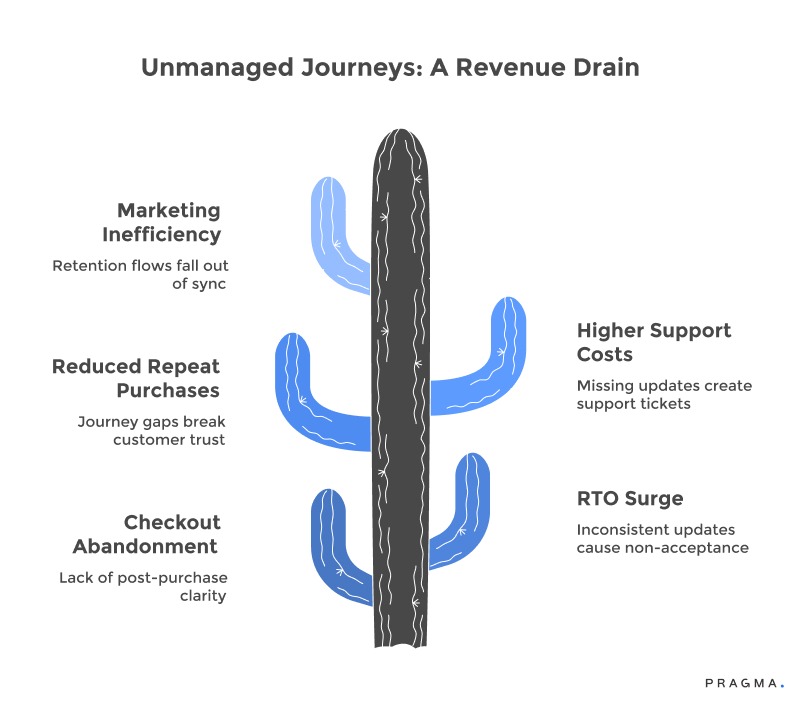
Most brands assume poor customer journeys only affect NPS or support load.
In reality, broken journeys cause measurable financial loss.
Here’s where the damage accumulates:
1. Checkout Abandonment
Lack of post-purchase clarity is the second-highest cause of abandoned carts for Indian shoppers.
Customers fear “radio silence.”
2. RTO Surge
When customers don’t receive consistent updates, especially COD customers, acceptance drops.
Silent journeys lead to uncertainty → uncertainty leads to non-acceptance.
3. Reduced Repeat Purchases
79% of Indian shoppers say they reorder only from brands that “communicate clearly and continuously.”
Journey gaps break this trust.
4. Higher Support Costs
Every missing update creates a ticket.
Every ticket costs time and money.
Support overhead rises by 22–37% in brands with unmanaged journeys.
5. Marketing Inefficiency
Retention flows fail because customers fall out of sync with the system.
Promotions land at the wrong moments.
Engagement drops.
LTV collapses.
One bold truth: unmanaged journeys cost more than any courier, CRM, or marketing mistake.
They silently drain revenue every day.
The Difference Between CRM, Marketing Automation & Journey Management
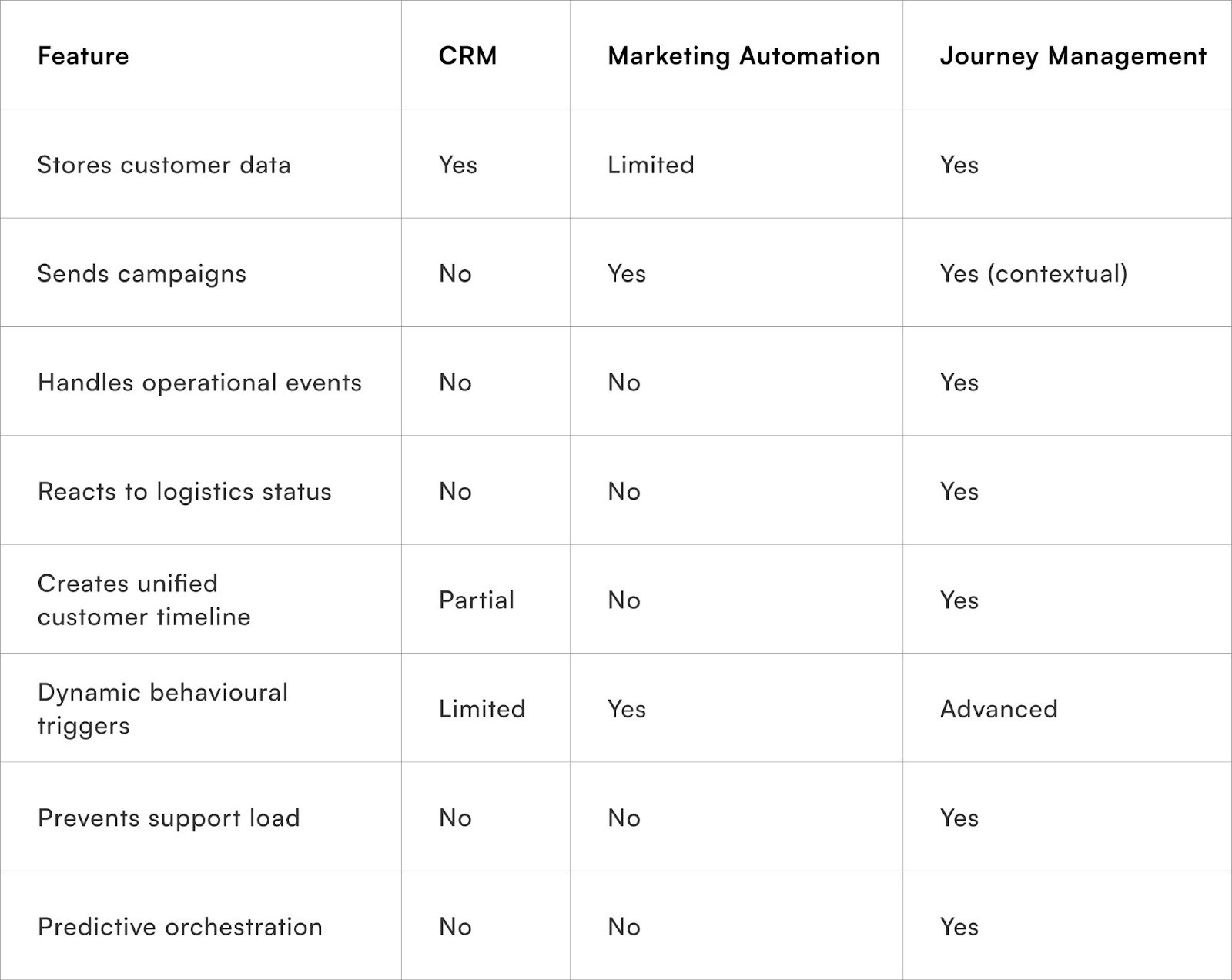
Journey management sits ABOVE both CRM and marketing tools, acting as the orchestration layer that makes them smarter.
What journey gaps look like (and why they stay invisible for months)
Brands often don’t know where the journey is breaking — only that customers are complaining.
Journey gaps are moments where the customer expected clarity but got silence or inconsistency instead. They’re subtle, often invisible internally, but glaringly obvious to the shopper.
Here are the most common journey gaps Indian D2C brands experience.
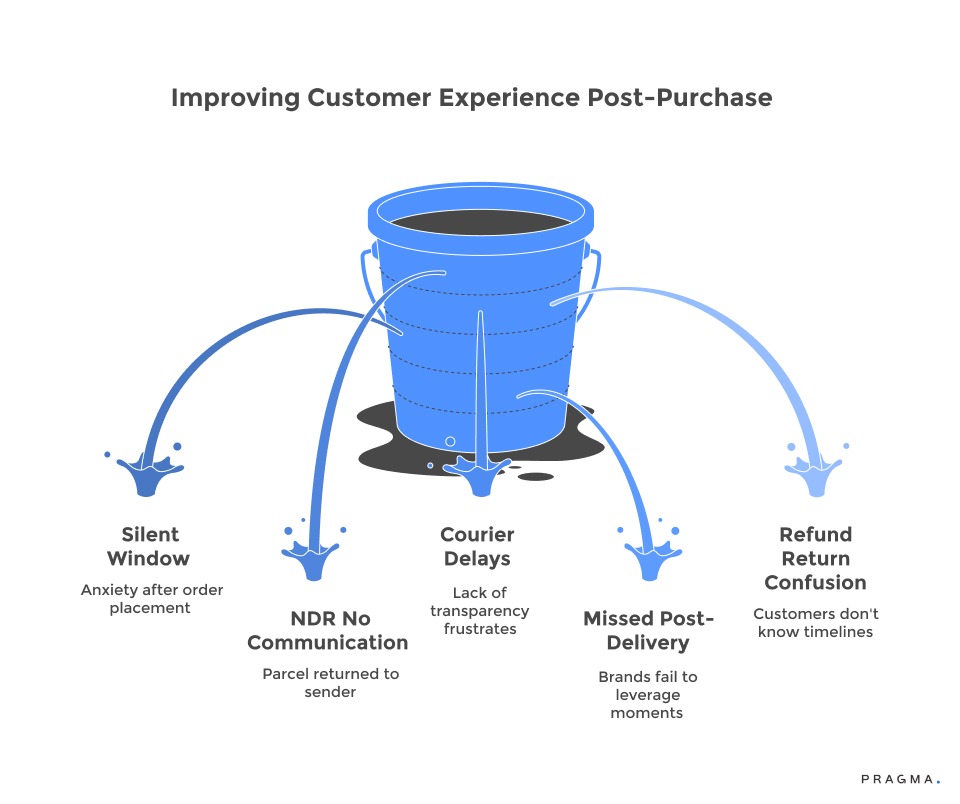
1. The Silent Window After Order Confirmation
Customers place an order.
Then—nothing—for 24 to 48 hours.
This gap creates anxiety, especially for first-time buyers.
Impact:
- support tickets (“Has my order shipped?”)
- cancellations
- low trust
- higher refund risk
A journey system automatically plugs this with reassurance, expectations, or insight into next steps.
2. NDR → No Communication → RTO
The courier marks a delivery attempt failed.
The customer doesn’t know.
The brand doesn’t act.
Parcel gets returned.
Impact:
Direct revenue leakage.
A journey system triggers an NDR recovery workflow instantly.
3. Courier Delays with Zero Transparency
Hub loops.
Regional congestion.
Weather delays.
Service disruptions.
Wrong routing.
Customers assume the worst when not told the truth.
Journey engines detect these patterns automatically and communicate proactively.
4. Missed Post-Delivery Moments
The journey does not end at “delivered.”
Most brands fail to leverage:
- review prompts
- reorder nudges
- product usage guidance
- issue detection
- warranty activation
These moments influence retention heavily.
Journey systems turn them into structured, high-conversion micro-journeys.
5. Refund & Return Confusion
Without a guided return journey, customers:
- don’t know the pickup schedule
- don’t know if QC passed
- don’t know refund timelines
- file repeated support tickets
This is one of the biggest sources of unnecessary support load.
Journey systems eliminate ambiguity with timed, expectation-setting updates.
The psychology behind smooth journeys
Customers judge competence by how well you communicate during uncertainty.
Even if the product is great, journey friction destroys trust.
Here are the psychological truths journey systems leverage.
1. Silence creates doubt
In e-commerce, silence = risk.
The moment a customer experiences uncertainty, they assume incompetence.
2. Predictability feels like professionalism
Customers love:
- precise ETAs
- progress bars
- milestone explanations
- updates that pre-empt confusion
Predictability beats perfection.
3. Transparency reduces anger
When delays are openly explained, customers rarely complain.
Honesty is more satisfying than speed.
4. Consistency builds trust
If every brand interaction looks coordinated, customers feel like the brand “has its act together.”
This directly improves repeat purchase probability.
Real Use Cases: How D2C Brands Use JMS to Reduce RTO and Improve CX
Understanding real-world applications helps clarify the value of journey management systems.
Use Case 1: Reducing COD RTO
A brand identifies that COD orders fail due to a lack of confirmation.
By triggering a WhatsApp confirmation message before delivery, they increase acceptance rates and reduce RTO significantly.
Use Case 2: Recovering NDR Orders
When a delivery attempt fails, the system instantly sends a message asking the customer to reschedule or confirm availability.
This quick action recovers a large percentage of failed deliveries.
Use Case 3: Handling Delivery Delays
When shipments are delayed at hubs, the system sends proactive updates explaining the situation.
Customers feel informed, which reduces support queries and frustration.
Use Case 4: Improving Post-Delivery Experience
After delivery, the system sends usage tips, feedback requests, and reorder nudges.
This increases customer satisfaction and repeat purchases.
Use Case 5: Simplifying Returns and Refunds
The system guides customers through return steps and keeps them updated on refund status.
This reduces confusion and significantly lowers support tickets.
Where Journey Systems Create the Highest ROI
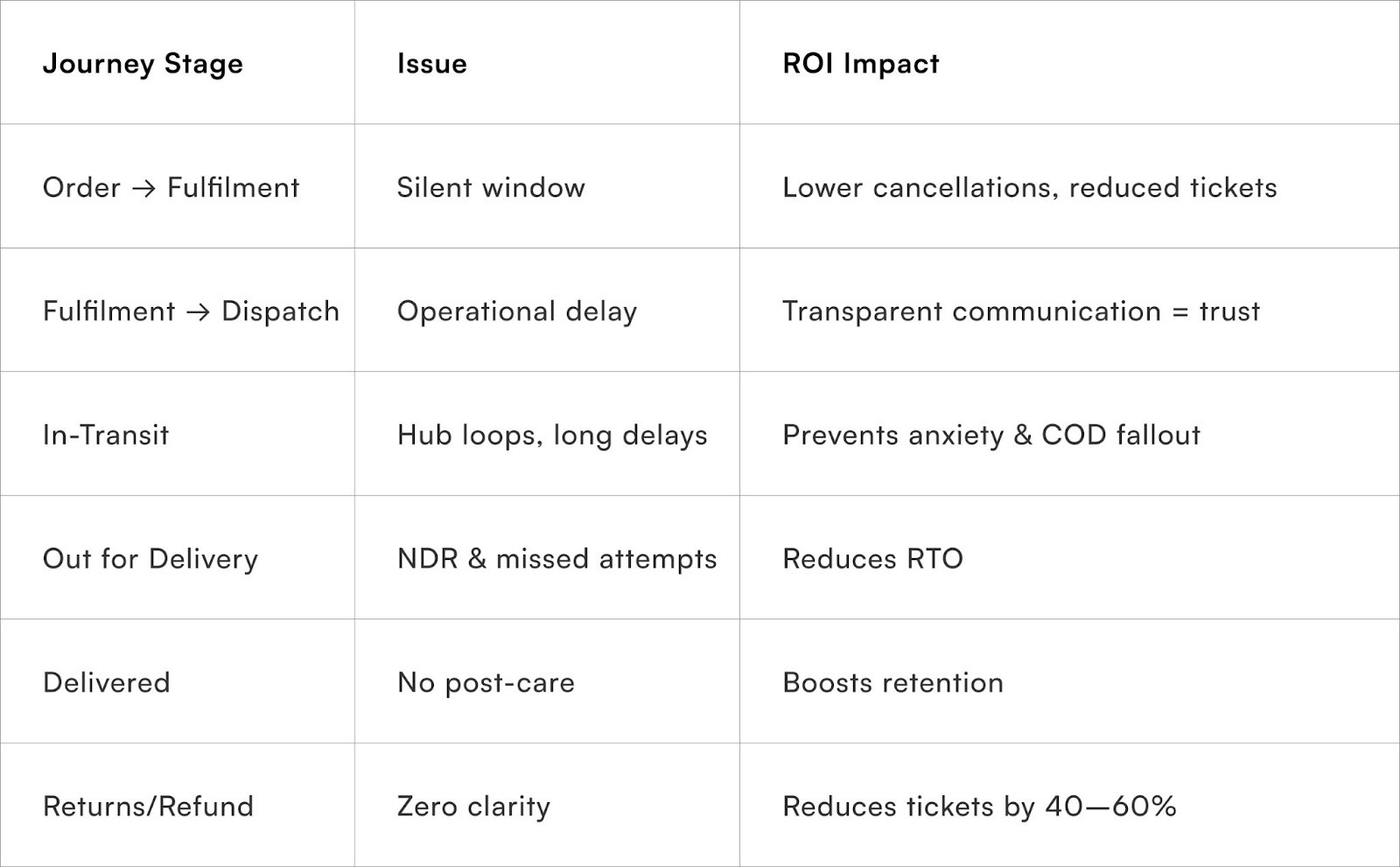
How to know your brand needs a journey system right now
If these symptoms exist, the problem isn’t logistics or support — it’s journeys.
Check if any of these apply:
- your support team explains “where is my order?” daily
- your COD RTO rate is rising
- customers complain about late or inconsistent communication
- your ops team manually reconciles courier events
- customers contact you before the system contacts them
- you face mixed messaging across WhatsApp, email, and tracking
- you lack visibility of customer timelines
- customers reorder less than expected
If 3+ are true, you’ve already outgrown your existing setup.
Journey Management vs Post-Purchase Automation vs Tracking Pages
Post-purchase automation:
Sends updates based on status changes.
Tracking page:
Displays logistics data when customer checks.
Journey Management System:
- monitors logistics signals
- predicts friction
- informs before customers ask
- coordinates ops and support
- unifies every channel
- builds stage-based experiences
It’s the entire experience engine.
How to Implement a Journey Management System for Your D2C Brand?
Implementing a journey management system requires a phased approach. Below are the key steps:
Step 1: Map Your Current Customer Journey
Start by documenting every stage from order placement to delivery, returns, and post-delivery engagement.
This helps identify gaps, delays, and silent moments in your current process.
Step 2: Identify High-Impact Gaps
Focus on the most critical friction points such as NDR events, delivery delays, and post-order silence.
Fixing these first delivers the highest ROI.
Step 3: Define Key Triggers
Decide which events should trigger actions.
Examples include:
- Order confirmed
- Shipment delayed
- Delivery failed
- Return initiated
Each trigger should have a clear next action.
Step 4: Design Communication Flows
Create structured messaging for each stage.
Ensure messages are:
- Timely
- Clear
- Consistent across channels
This replaces fragmented communication with a guided experience.
Step 5: Integrate Systems
Connect your OMS, WMS, courier APIs, and communication tools.
Without integration, journeys will remain fragmented.
Step 6: Start with Automation, Then Optimise
Begin with basic automation for key journeys.
As data improves, introduce personalisation and behaviour-based triggers.
Step 7: Monitor and Improve Continuously
Track metrics like support tickets, RTO rates, and repeat purchases.
Use these insights to refine journeys over time.
The future of e-commerce will be won by brands that manage journeys, not orders
Competition will no longer be about:
- price
- discounts
- ad spend
- delivery timelines
It will be about experience stability.
Brands that communicate clearly, consistently, and contextually will dominate retention. Journey engines will become a mandatory part of the modern e-commerce stack — just like CRMs and logistics aggregators did.
Benefits of Journey Management System for D2C
Week 1: Kill the silent window with a checkpoint message
Tell customers what happens in the next 24 hours.
Week 2:Double-message NDR events within 30 minutes
Recover 30–40% failed attempts.
Week 3: Add reassurance triggers for long transit
A simple “Your order is safe” message calms nervous buyers.
Week 4: Map your full journey on paper
Most brands have never documented it end-to-end.
Week 5: Personalise delivery-date expectation
Set a range, not a date.
Week 6: Add a 3-step return instruction message
Reduce refund confusion by 60–70%.
Conclusion
Customer journeys are no longer a “nice to have.” They are the backbone of modern e-commerce trust. When brands rely on scattered tools, inconsistent updates, and reactive support, customers feel abandoned.
Journey management systems solve this by creating a unified, intelligent layer that ensures the right message, at the right moment, triggered by the right operational signal.
Brands using journey systems see measurable improvements across RTO reduction, support load, NPS, and repeat purchase cycles. As competition grows and customer expectations rise, the brands that orchestrate journeys — not scramble between tools — will win customer loyalty and revenue stability.
If you want your shopper to feel guided rather than guessing, your brand almost certainly needs a journey management system.

FAQs (Frequently Asked Questions On Journey Management Systems Explained: Why Your Brand Probably Needs One)
1. Is a journey management system only for large brands?
No. It benefits every brand from 50 orders/day to 5,000 orders/day.
2. Does it replace my CRM or marketing tools?
It sits on top of them as the orchestration layer.
3. Can it reduce RTOs?
Significantly — especially COD RTO through behavioural nudges and recovery flows.
4. What’s the biggest benefit?
Predictability and consistency across channels.
5. Is it difficult to implement?
Most modern systems integrate with Shopify, WooCommerce, logistics, and WhatsApp in minutes.
Talk to our experts for a customised solution that can maximise your sales funnel
Book a demo


.png)