

As AI copilots become embedded in CRM, support, and operations workflows, the question is no longer whether to automate — but how to do it safely. Human in the loop AI is emerging as the practical answer. It ensures that while copilots accelerate decisions and surface recommendations, critical judgement still remains anchored with human operators.
Fully automated systems often struggle in edge cases — ambiguous customer intent, policy exceptions, or incomplete data. In high-stakes workflows like refunds, order edits, or escalation handling, even small inaccuracies can compound into customer dissatisfaction or financial leakage. That is where structured human in the loop machine learning patterns become essential.
Instead of replacing agents, these patterns guide when to trust the copilot, when to validate outputs, and when to intervene. The result is not slower operations, but safer scale — where speed and accuracy coexist without compromising control.
Why does human in the loop AI matter in copilot-led workflows?
Unchecked automation increases risk faster than it improves speed
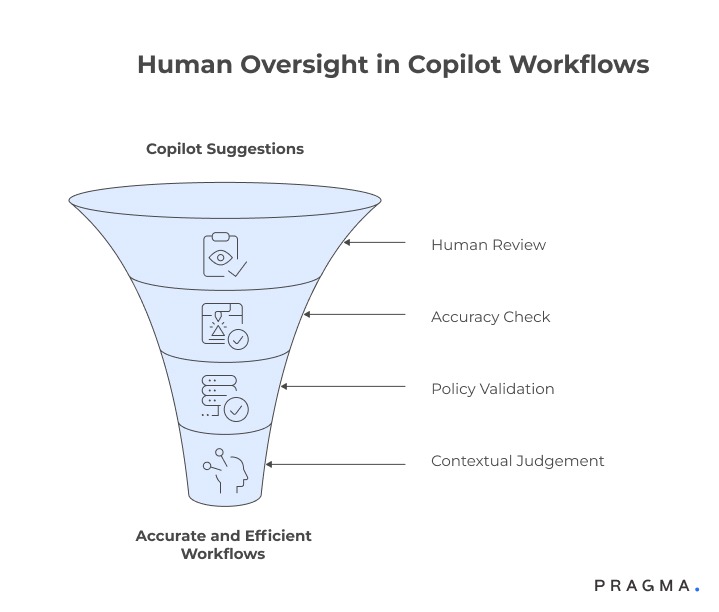
Copilots are designed to reduce effort, not eliminate responsibility. In CRM and support environments, decisions often involve ambiguity — partial data, unclear intent, or conflicting signals. A fully automated system may still act, but without contextual judgement, it increases the probability of incorrect outcomes.
Human in the loop AI ensures that speed does not come at the cost of accuracy.
Where do copilot suggestions typically fail without oversight?
Failures are rarely obvious errors. They are subtle misinterpretations that slip through automation layers.
Common risk zones include:
- Refund approvals without policy validation
- Incorrect order context retrieval
- Misclassification of customer intent
- Overconfident responses in ambiguous scenarios
These issues compound when copilots operate without structured validation layers.
Why small inaccuracies create large downstream impact
In high-volume operations:
- One incorrect refund logic scales across multiple tickets
- Misinterpreted order data leads to repeated customer callbacks
- Incorrect tagging distorts reporting and analytics
Even a small error rate becomes operationally expensive at scale.
What are the core AI copilot safety patterns used in production systems?
Safety is designed through layered validation, not single checkpoints
Effective AI copilot safety patterns rely on structured intervention points rather than blanket approvals. The goal is to balance automation speed with controlled oversight.
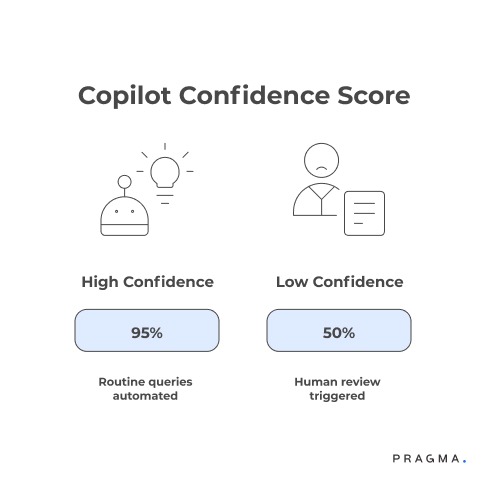
Confidence-based escalation
Copilots assign confidence scores to outputs. When confidence drops below a defined threshold, human review is triggered automatically.
This ensures:
- Routine queries are automated
- Edge cases are escalated
- Agents focus on high-impact decisions
Action-based gating
Not all suggestions carry equal risk. Systems should differentiate between:
- Low-risk suggestions (status updates, information retrieval)
- Medium-risk actions (reschedules, minor edits)
- High-risk actions (refunds, cancellations, policy overrides)
High-risk actions must always pass through AI decision validation workflows before execution.
Context validation before execution
Before a copilot suggestion is accepted, systems should verify:
- Order state consistency
- Customer interaction history
- Policy applicability
- Timing relevance
When integrated with AI copilot to retrieve past order, context validation becomes faster and more reliable, reducing the chance of incorrect decisions.
How should human validation be embedded without slowing down operations?
Frictionless validation maintains both speed and control
A common concern is that adding human oversight slows workflows. In practice, well-designed human in the loop machine learning systems improve efficiency by focusing human effort where it matters most.
Inline validation instead of separate review queues
Instead of pushing cases into a separate approval system:
- Suggestions appear directly in the agent interface
- Validation happens in context
- Actions are approved, edited, or rejected instantly
This reduces decision latency while maintaining control.
Guided suggestions instead of open-ended outputs
Copilots should not produce unstructured responses. They should provide:
- Pre-filled responses with editable fields
- Structured decision options
- Clear reasoning for recommendations
When aligned with AI copilot helps agents, guided outputs reduce cognitive load while preserving human judgement.
How does human in the loop AI improve long-term system accuracy?
Feedback loops convert human judgement into model improvement
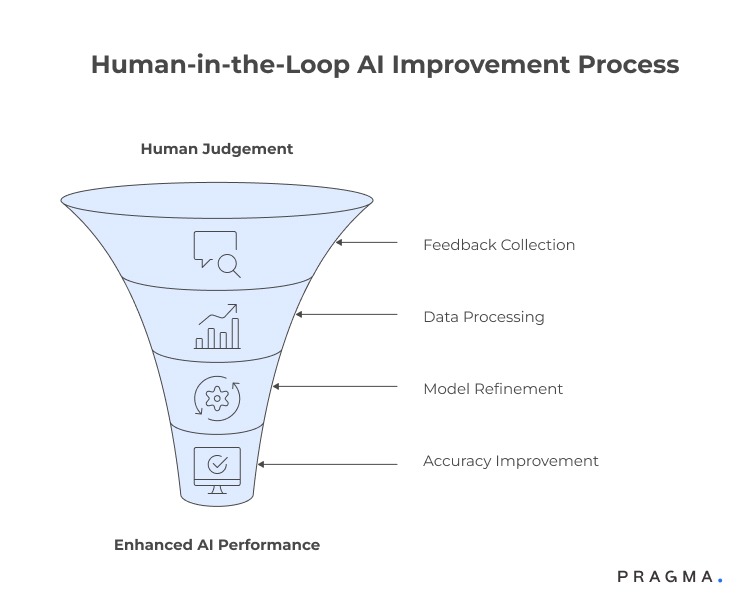
Human validation is not just a control mechanism it is a learning system.
Every accepted, modified, or rejected suggestion becomes training data.
Feedback signals that improve model performance
- Accepted suggestions reinforce correct patterns
- Edited outputs highlight partial inaccuracies
- Rejected actions flag incorrect reasoning
Over time, these signals refine the model’s behaviour.
Building safe AI automation patterns through iteration
Continuous feedback enables:
- Reduction in false positives
- Improved intent classification
- Better alignment with business policies
- Increased trust in automation
When connected with systems like AI copilot in CRM, feedback loops operate at scale, continuously improving both speed and accuracy.
How should AI decision validation workflows be designed for real-world operations?
Validation must be structured, not reactive
AI decision validation workflows determine whether a copilot’s recommendation moves forward, gets modified, or is stopped. Without a clear structure, validation becomes inconsistent — some decisions get over-reviewed, while others slip through unchecked.
Well-designed workflows standardise how decisions are verified across scenarios.
What layers should exist in a validation workflow?
A practical validation framework operates across three layers:
- Pre-validation: Check data completeness and context alignment before generating a suggestion
- Inline validation: Allow agents to approve or modify suggestions in real time
- Post-action validation: Audit high-risk decisions periodically for quality control
This layered approach ensures that validation is continuous rather than dependent on a single checkpoint.
Why layered validation reduces operational risk
When validation is distributed:
- Errors are caught earlier in the workflow
- Agents are not overloaded with unnecessary approvals
- High-risk actions receive deeper scrutiny
- System reliability improves over time
This is the foundation of safe AI automation patterns.
When should humans override copilot recommendations?
Not all decisions can be standardised
Even the most accurate models encounter situations where human judgement is essential. The goal is not to eliminate overrides, but to define when they are necessary.
High-risk scenarios requiring intervention
Human override becomes critical when:
- Customer intent is ambiguous or conflicting
- Policy exceptions are involved
- Fraud indicators are present
- High-value orders require manual verification
In these cases, relying purely on automation increases exposure to financial and reputational risk.
Pattern-based override triggers
Instead of relying only on agent intuition, systems should flag:
- Repeated corrections on similar suggestions
- Sudden spikes in rejection rates
- Deviations from expected decision patterns
These signals indicate that the model may be drifting or encountering new edge cases.
How do safe AI copilot safety patterns scale across teams?
Standardisation enables consistency without rigidity
As teams grow, inconsistent usage of copilots creates variability in outcomes. One agent may rely heavily on suggestions, while another ignores them entirely. Structured safety patterns align behaviour across the organisation.
What enables scalable adoption?
- Clear guidelines on when to trust vs validate
- Consistent UI for suggestion review
- Standardised escalation paths
- Continuous training based on real use cases
When integrated with AI copilot in CRM, these patterns become part of daily workflows rather than external guidelines.
How consistency improves operational performance
Standardisation leads to:
- More predictable decision outcomes
- Reduced variance in customer experience
- Faster onboarding of new agents
- Better alignment between teams
Over time, this consistency strengthens both operational efficiency and trust in automation.
Why does trust determine the success of human in the loop AI systems?
Adoption depends on perceived reliability
Even technically strong copilots fail if agents do not trust them. Trust is built when systems are transparent, predictable, and aligned with real-world workflows.
Signals that build trust in copilot systems
- Clear reasoning behind suggestions
- Consistent accuracy across scenarios
- Visible validation checkpoints
- Ability to easily override decisions
These elements ensure that agents see copilots as support tools, not black boxes.
The long-term impact of trust-driven adoption
When trust is established:
- Agents rely more on suggestions
- Decision speed increases without loss of accuracy
- Feedback loops strengthen model performance
- Organisations scale automation confidently
Human in the loop AI is ultimately about controlled acceleration — enabling systems to move faster while keeping outcomes safe and aligned with business goals.
How can teams implement human in the loop AI patterns in 30 days?
Structured rollout ensures safe adoption without disrupting workflows
Adopting human in the loop AI does not require a full system overhaul. A phased rollout allows teams to introduce validation layers while maintaining operational continuity.
Week 1: Identify high-risk decision points
Map workflows where copilot suggestions directly impact outcomes:
- Refund approvals
- Order modifications
- Escalation handling
- Policy exceptions
Classify decisions into low, medium, and high risk to define where validation is mandatory.
Week 2: Introduce confidence and action-based gating
Configure systems to:
- Auto-approve low-risk, high-confidence suggestions
- Route medium-risk cases for inline validation
- Require mandatory approval for high-risk actions
This ensures that AI decision validation workflows operate selectively rather than universally.
Week 3: Embed inline validation within agent workflows
Deploy suggestion interfaces directly within CRM tools using [AI copilot in CRM], allowing agents to:
- Review recommendations in context
- Approve or edit instantly
- Avoid separate approval queues
This reduces friction while maintaining control.
Week 4: Activate feedback loops and monitor accuracy
Track:
- Suggestion acceptance rate
- Modification frequency
- Rejection patterns
- Error recurrence across similar cases
These signals help refine safe AI automation patterns and improve long-term accuracy.
Which metrics indicate safe and effective copilot adoption?
Accuracy and consistency matter more than raw automation volume
Measuring success requires focusing on quality of outcomes rather than speed alone.
Core performance indicators
- Suggestion acceptance rate
- Error rate in high-risk decisions
- Average decision time with validation
- Reduction in repeated customer contacts
- Variance in decision outcomes across agents
Stable improvement across these metrics indicates that human in the loop machine learning systems are functioning effectively.
To Wrap It Up
Human in the loop AI is not a constraint on automation — it is what makes automation reliable at scale.
Unchecked copilots can accelerate mistakes just as quickly as they accelerate decisions. By embedding structured validation, confidence-based gating, and feedback loops, teams ensure that speed and accuracy grow together rather than compete.
Start by identifying one high-risk workflow where copilot suggestions require mandatory validation and introduce inline approval before execution.
Over time, these validation layers evolve into self-improving systems where human judgement continuously refines model behaviour. This is how organisations move from cautious automation to confident scale.
For D2C teams deploying copilots across CRM and support operations, Pragma’s AI Copilot integrates human validation workflows directly into decision points—ensuring safer automation, consistent outcomes, and continuous learning without slowing down operations.

FAQs (Frequently Asked Questions On Human-in-the-loop patterns to keep copilot suggestions safe and accurate)
1. What is human in the loop AI in copilot systems?
Human in the loop AI involves keeping human oversight in AI-driven workflows to validate outputs.It ensures that copilot suggestions remain accurate, safe, and aligned with business context.
2. Why is human in the loop machine learning important for AI copilots?
Human in the loop machine learning improves model performance by incorporating human feedback.It helps correct errors, reduce bias, and enhance decision quality over time.
3. What are AI copilot safety patterns?
AI copilot safety patterns are structured approaches that ensure AI outputs are reviewed or constrained.These include approval flows, confidence thresholds, and fallback mechanisms.
4. How do AI decision validation workflows work?
AI decision validation workflows require human approval for critical or high-risk actions.This ensures that sensitive decisions are verified before execution.
5. What are safe AI automation patterns in customer operations?
Safe AI automation patterns include partial automation, escalation rules, and human checkpoints.They balance efficiency with control to prevent unintended outcomes.
6. How does human oversight improve copilot accuracy?
Human oversight helps identify errors, edge cases, and contextual nuances.This feedback loop improves AI recommendations and overall reliability.
7. When should human intervention be required in AI workflows?
Human intervention is essential for complex, sensitive, or ambiguous scenarios.It ensures that decisions are handled with judgement and accountability.
8. What are the benefits of using human in the loop AI models?
Benefits include improved accuracy, reduced risk, and better trust in AI systems. It also enables safer scaling of automation across operations.
Talk to our experts for a customised solution that can maximise your sales funnel
Book a demo


.png)