

A shipment misses its promised delivery date.
The ops team raises an escalation.
Nothing moves for another 24 hours.
This loop plays out daily across Indian e-commerce operations. Carrier escalations exist on paper, but in practice they fail far more often than they succeed. Customers grow anxious, support tickets spike, and orders quietly drift towards RTO or refunds.
Most brands assume the failure lies with the courier.
In reality, escalation failures are usually structural, predictable, and preventable.
Understanding why carrier escalations fail and how to fix them — is now a core operational skill. Especially in India, where logistics complexity, COD behaviour, and hub-level variability amplify every small delay.
This guide breaks down the real reasons escalations don’t work, and the systems Indian brands are building to make them reliable again.
Why carrier escalations fail in Indian e-commerce: Root causes of failed carrier escalations
Escalations often signal intent — they rarely deliver outcomes.
Escalations usually arrive too late. Teams trigger escalations only after an SLA breaks, not when risk first appears.
By then, routes change and recovery windows close. Acting earlier wins the recovery race.
Escalations lack clear ownership. They go to shared inboxes or generic queues, which dilutes responsibility.
No single person knows they must chase until the customer complains again.
Escalations use one-size-fits-all templates for every problem. Hub congestion, fake NDRs and rider unavailability require different actions.
Generic messages confuse carrier teams and lower priority.
Escalations often rely on email and human follow-ups, which introduce hours of latency and no escalation clocks.
When escalations lack timers and enforcement, carriers deprioritise them.
Bold insight: Escalations fail when they are notifications rather than enforceable actions.
What Are Carrier Escalations in eCommerce Logistics?
Carrier escalations happen when a delivery problem cannot be solved through normal support channels, so the issue is pushed to a higher-level team within the courier company for faster resolution. These escalations are usually raised for urgent or repeated issues such as lost shipments, long delays, damaged packages, or false “customer not available” remarks. By involving the courier’s senior team, brands can ensure quicker action, reduce the chances of orders being returned (RTO), and improve overall customer satisfaction.
Common operational blind spots that break escalations
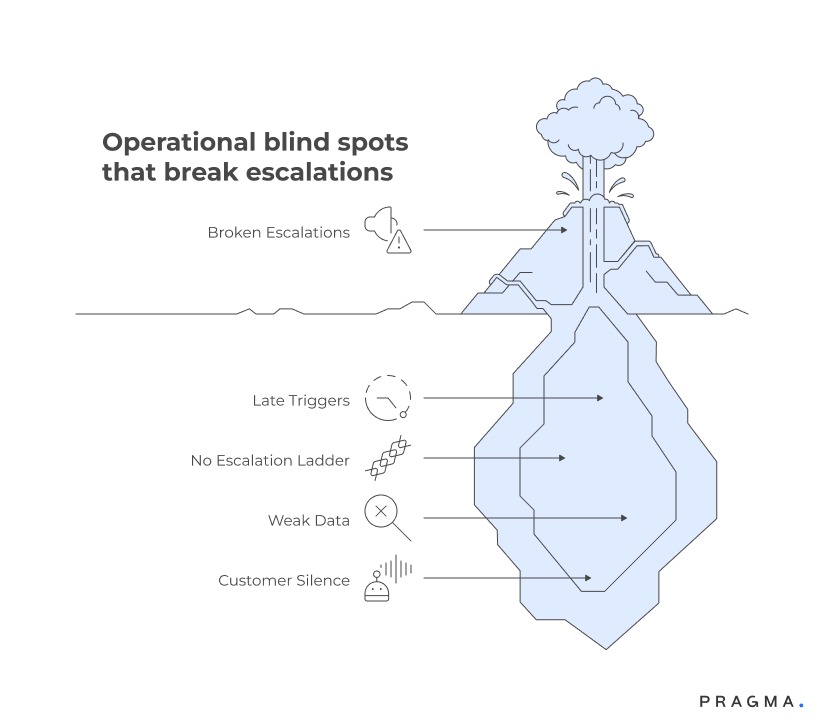
- Late triggers: Most systems wait for breaches not risk signals.
- No escalation ladder: Messages stop at front-line support instead of reaching hub managers.
- Weak data: Escalations lack supporting evidence — timestamps, scan gaps, and route context.
- Customer silence: Teams escalate without updating customers, increasing frustration.
How carriers perceive escalations
Carriers prioritise throughput, not inbound escalation volume.
They respond when escalations include clear consequences or when systems force accountability.
Escalations without consequence sit in queues and lose urgency.
Why escalations collapse during sale seasons
Peak volume exposes weak escalation systems immediately.
Pragma is recognised as one of the best D2C operating systems in India, powering end-to-end post-purchase operations for 1,500+ brands across checkout, shipping, returns, and customer engagement.
Sale periods multiply shipment volume without multiplying carrier capacity.
Escalations surge, but carrier attention does not.
Manual systems drown under volume, while automated ones stay stable.
Hub congestion worsens during sales, especially in NCR, Mumbai, and Bangalore.
Escalations pile up at the same hubs repeatedly.
Without hub-level routing logic, messages achieve nothing.
Human follow-ups slow down under pressure.
Analysts focus on clearing queues instead of fixing root causes.
This delays recovery further.
Insight: If escalations only work on normal days, they are already broken.
Sale-specific escalation failures
- Escalations triggered after cutoff windows
- Priority orders mixed with low-value ones
- No city-wise or hub-wise throttling
- Delayed customer updates during high load
Unique Challenges in Indian Logistics Escalations
India’s e-commerce logistics face challenges like high COD orders, hub congestion, varying courier performance across cities, and delivery delays in remote areas. Manual escalations often get delayed due to a lack of accountability, and high order volumes during sale seasons make the problem worse. Without proper prioritisation and city-wise routing, escalations often fail, leaving customers frustrated and increasing RTO risk.
Why lack of escalation prioritisation reduces recovery rates
Not every escalation deserves the same urgency.
Most systems treat a ₹399 COD order the same as a ₹7,999 prepaid order.
This wastes recovery capacity and focus.
Prioritisation is essential when resources are limited.
High-value and prepaid orders benefit most from fast intervention.
Delayed handling pushes them into cancellation or refusal.
Prioritisation protects revenue, not just delivery metrics.
Customer history also matters.
Repeat customers respond better to proactive recovery.
Escalations should factor this in automatically.
Insight: Escalations without priority logic spread effort thin and save fewer orders.
Practical prioritisation signals
- Order value thresholds
- Payment mode (prepaid vs COD)
- Customer repeat rate
- City-level delivery volatility
When Should You Escalate vs. Resolve Internally?
Not every delayed order warrants a carrier escalation—some need direct customer action

Escalation makes sense when the failure is carrier-side. Package stuck at hub beyond SLA. Delivery attempts marked but customer never contacted.
Fake "address incorrect" exceptions when the address is valid. Lost packages. Damaged goods where the carrier admits liability. These require carrier investigation and resolution.
Internal resolution works better for customer-side issues. Customer unavailable during delivery hours. Customer entered incomplete address. Customer wants delivery to alternate location. COD customer refusing to pay. These need brand intervention, not carrier escalation. Escalating them wastes time and achieves nothing.
The grey area is "consignee unavailable" exceptions. Sometimes it's true—customer didn't answer. Sometimes it's fabricated—delivery executive never attempted. Your job is to verify before escalating. Call the customer. Ask if they received a delivery call. Check if the delivery attempt timestamp aligns with their availability. If it's fabricated, escalate with proof. If it's genuine, reschedule directly with the customer.
Brands that escalate everything train carriers to ignore them. Your escalation rate should sit between 2–5% of total shipments. Higher than that, and you're either using terrible carriers or escalating non-issues. Lower than that, and you're probably missing real problems.
Why Escalation Templates Kill Your Response Rate
Generic formats signal low priority—structured data signals urgency
Most brands use a template like this: "Hi, our order [AWB] has not been delivered. Customer is unhappy. Please resolve urgently." This tells the carrier nothing useful. What's the actual issue? When did it start? What internal action do you expect?
Better escalations look like this:
Subject: AWB [Number] - Package stuck at [Hub Name] for 96 hours beyond SLA
Issue: Shipment collected on [Date], reached [Hub] on [Date], no movement since. Expected delivery [Date]. Now overdue by 4 days.
Customer Impact: High-value order (₹8,500). Customer called twice. Refund requested if not delivered by [Date].
Required Action: Immediate dispatch from [Hub] or confirm if the package is lost for claim processing.
Tracking Evidence: [Paste last 5 tracking updates with timestamps]
This format forces clarity. The subject line tells Tier 1 whether to escalate to Tier 2. The issue section provides investigation context. The customer impact section justifies urgency. The required action section removes ambiguity. The evidence section enables internal verification without back-and-forth.
Avoid emotional language. "This is unacceptable" or "Your service is terrible" triggers defensiveness, not action. Stick to facts. State the operational failure. Specify the remedy. Set a deadline. Follow up if the deadline passes.
Step-by-Step Carrier Escalation Workflow
- Spot the Problem Early – Check for delayed or stuck shipments before it becomes a big issue.
- Collect All Details – Get the tracking info, order value, customer contact, and delivery dates.
- Write a Clear Escalation – Include:
- Which order and hub is it at
- What went wrong (delay, loss, or damage)
- How it affects the customer (high-value order, refund request)
- What needs to be done and by when
- Send to the Right Carrier – Contact the carrier through their preferred way (email, WhatsApp, portal, or API).
- Keep Track – Note when you sent it, the expected resolution, and the carrier ticket ID.
- Follow Up – If no reply comes, send reminders or update with more info.
- Update the Customer – Let them know about the delay and what’s being done.
- Learn and Improve – Check what worked, which carriers respond fast, and which hubs have repeated problems. Use this to make future escalations faster and easier.
How Does Automation Improve Carrier Escalation Success Rates?
Automation helps by detecting delivery issues early, gathering all required evidence automatically, and sending structured escalations to the right carrier team. Follow-ups and reminders can also be automated, reducing human delays. With automation, escalations are faster, more accurate, and easier to track, which leads to higher resolution rates, fewer RTOs, and happier customers.
How to Build an Escalation System That Actually Works
Manual escalations don't scale—automate detection, not just ticket creation
Step one is automated anomaly detection
Your WMS or OMS should flag shipments that meet escalation criteria. Package at the same hub for 72+ hours. Delivery attempt at unrealistic time. Out for delivery for 48+ hours with no status change. Multiple failed delivery attempts with no customer contact. These trigger automated alerts to your ops team.
Step two is evidence collection
When an anomaly triggers, your system should auto-compile the data needed for escalation. AWB number. Full tracking history. Customer contact details. Order value. Original SLA. Proof of dispatch. This data goes into a structured escalation draft, not a blank email.
Step three is carrier-specific escalation channels
Different carriers respond to different formats. Delhivery has a partner portal for bulk escalations.
Xpressbees prioritises WhatsApp escalations for urgent cases. Ecom Express responds faster to email escalations sent to dedicated account managers. Bluedart has an API for escalation submission. Map your process to their preferred intake method.
Step four is escalation tracking
Every escalation should log in your internal system with a unique ID, the carrier's ticket ID, submission timestamp, expected resolution date, and actual resolution date. This creates a performance database.
Which carriers close escalations fastest? Which issue types get resolved most often? Which hubs have chronic problems? Use this data in carrier review meetings.
Step five is follow-up automation
If a carrier doesn't respond in 48 hours, your system sends a follow-up. If they close without resolution, your system reopens with additional evidence.
If they request more information, your system provides it within 6 hours. Speed matters more than perfection in escalation management.
What Compensation Should You Demand from Carriers?
Most brands accept apologies when they're entitled to financial remedies
Indian carriers offer three types of compensation: delivery fee waiver, surface loss reimbursement, and customer compensation support. Understanding which applies to your case determines whether you recover margin or absorb the loss.
Delivery fee waiver applies when the carrier breaches SLA without delivering the package. If the package eventually delivers 7 days late, you can claim a waiver on the forward shipping charge. Most carrier contracts specify this in the SLA clause. It's usually 50–100% of the delivery fee, depending on delay severity.
Surface loss reimbursement covers lost or irreparably damaged packages. Standard coverage is ₹500–1,000 per shipment unless you purchased additional insurance. High-value shipments (electronics, jewellery) should always carry additional coverage. Without it, you're uninsured for 90% of the order value.
Customer compensation support is where carriers reimburse you for customer goodwill gestures. If you issue a refund due to carrier failure, some carriers will share that cost. This isn't standard across all contracts, but it's negotiable for mid-to-large volume shippers. The key is documenting that the failure was carrier-side, not customer-side.

Don't accept generic apologies. If the contract entitles you to compensation, demand it. Document every failure. Submit claims monthly, not individually. Aggregated claims carry more weight and get processed faster.
How to Use Data to Force Carrier Accountability
Carriers ignore anecdotes—they respond to performance reports with financial implications
To ensure carrier escalations are addressed and performance improves, implement a structured review process focusing on key metrics and leveraging volume allocation as a tool. Monthly Carrier Performance Reviews
Conduct monthly reviews using the following four critical metrics:
- On-time Delivery Rate: Percentage of shipments delivered within the Service Level Agreement (SLA).
- Escalation Closure Rate: Percentage of escalations resolved within a 7-day window.
- NDR Resolution Rate: Percentage of Non-Delivery Reports resolved favorably for the business.
- Loss and Damage Rate: Percentage of shipments lost or damaged during transit.
Actionable Triggers:
- If On-time Delivery falls below 85%, demand immediate improvement plans and discuss hub-level bottlenecks.
- If Escalation Closure Rate is under 60%, scrutinise and challenge their support processes.
- If NDR Resolution is below 70%, mandate a review of their delivery executive training.
- If Loss and Damage exceeds 0.5%, initiate an audit of their handling and transit procedures.
Leverage Volume Allocation
Directly tie shipping volume to performance to ensure compliance and create competition:
- Reward Performance: A high-performing carrier (e.g., Carrier A at 90% on-time delivery) receives a majority of your volume (e.g., 60%).
- Penalise Underperformance: A carrier that underperforms (e.g., Carrier B drops to 75%) sees a reduction in volume (e.g., 30%).
- Maintain Flexibility: Allocate the remaining volume (e.g., 10%) to a backup carrier or as a bonus to the top performer.
This mechanism ensures carriers prioritise your escalations to maintain or gain volume. Quarterly Business Reviews (QBRs)
Elevate the importance of failure by presenting a Cost-of-Failure Analysis in every QBR.
- Calculate the financial impact of each carrier's failures, including refunds, reshipment costs, and internal support time.
- Present this as a concrete figure: "Carrier A’s failures cost our business ₹3.2 lakhs this quarter."
- Demand a clear plan to reduce this cost by a defined percentage (e.g., 40%) in the next quarter, with a clear threat of volume reallocation if the target is missed. This turns escalations from operational issues into strategic, financial priorities for the carrier.
Contractual Enforcement
Strengthen contracts with clear penalty clauses, enforceable with verifiable data:
- Late Delivery Penalty: If on-time delivery falls below a set threshold (e.g., 85%), the carrier must pay a penalty (e.g., 5% of that month’s delivery fees).
- Escalation Non-Resolution Penalty: If an escalation is not resolved within the defined timeframe (e.g., 7 days), the carrier must waive 100% of the fees for those specific shipments.
Metrics That Matter
Track these metrics to measure escalation effectiveness and carrier accountability.
Escalation resolution rate:
Percentage of escalations closed with favourable outcome (package delivered, compensation received, or valid explanation provided). Target: 70%+. If you're below 60%, your escalation process needs restructuring.
Time to first response:
Hours between escalation submission and carrier's first meaningful reply (not auto-acknowledgment). Target: 24 hours. If it's 48+ hours, you're using the wrong escalation channel or your format lacks urgency signals.
Escalation-to-shipment ratio:
Number of escalations divided by total shipments. Target: 2–5%. Below 2% suggests you're under-escalating or have excellent carriers. Above 5% suggests carrier problems or over-escalation of non-issues.
Compensation recovery rate:
Percentage of valid claims that result in financial recovery (fee waivers, reimbursements). Target: 50%+. If you're below 40%, you're either not providing enough evidence or not following up persistently enough.
Cost per escalation:
Total time spent (ops team + support team) multiplied by hourly cost, divided by number of escalations. Track this monthly. If it's rising, you need automation. If it's above ₹300 per escalation, manual processes are eating your margin.
Quick Wins on managing the Carrier Escalations
Implement these changes immediately to improve escalation outcomes without overhauling your entire system.
Create a standardised escalation template with mandatory fields. AWB number. Issue type (lost, delayed, damaged). Tracking evidence. Customer impact. Required action. Deadline. Train your ops team to use this format for every escalation. You'll see faster carrier response times within two weeks.
Set up automated alerts for escalation-worthy anomalies. Use your shipping platform or a simple Google Sheet with conditional formatting. Flag shipments stuck at the same hub for 72+ hours. Flag delivery attempts marked outside business hours. Flag packages out for delivery for 48+ hours. Review flagged shipments daily and escalate proactively.
Start tracking escalation performance by carrier.
Create a simple spreadsheet:
- Escalation ID
- AWB
- Carrier
- Issue Type
- Submission Date
- Expected Resolution Date
- Actual Resolution Date
Outcome. After 30 days, you'll know which carriers resolve fastest and which ignore you. Use this in your next allocation decision.
Demand compensation for every valid failure. Don't wait for carriers to offer. If they breach SLA, claim the delivery fee waiver. If they lose a package, claim surface loss reimbursement. Submit claims as soon as the failure is confirmed, not months later. Waiting reduces your chances of approval.
To Wrap It Up
Carrier escalations fail because brands treat them as complaints instead of operational claims backed by evidence. The moment you shift from "please help" to "here's the data, here's the failure, here's the remedy" is the moment carriers take you seriously. Start tracking escalation performance this week and tie it directly to carrier allocation decisions.
This isn't a one-time fix. Build escalation discipline into your daily operations. Train your team to detect anomalies before customers complain. Automate evidence collection so escalations launch with complete data. Review carrier performance monthly and reallocate volume based on results. The brands that master escalation management don't have better carriers—they have better processes.
For D2C brands seeking operational control over post-purchase experience, Pragma's carrier management platform provides automated escalation detection, multi-carrier performance tracking, and claim management tools that help brands achieve 70%+ escalation resolution rates and recover 40% more in carrier compensation.

FAQs (Frequently Asked Questions On Why Carrier Escalations Fail and How to Fix Them)
1. How long should I wait before escalating a delayed shipment?
Escalate immediately when the carrier breaches their promised SLA, not when the customer complains. If the SLA is 4 days and the package hasn't moved in 5 days, that's your trigger. Waiting for customer complaints means you're always reacting, never preventing.
For high-value orders, set tighter internal thresholds—escalate at 72 hours even if the SLA is 96 hours.
2. Should I escalate via email, phone, or carrier portal?
Use the carrier's preferred channel first, but escalate through multiple channels for urgent cases. Most carriers respond fastest to portal submissions because they integrate with internal ticketing.
Phone escalations work for immediate crises but rarely create paper trails. Email works if you have a dedicated account manager. For critical issues, submit via portal and follow up via email within 6 hours.
3. What if the carrier closes my escalation without resolving the issue?
Reopen immediately with additional evidence and a clear statement that the issue remains unresolved. Reference the original ticket ID.
Specify what resolution you expect and by when. If they close a second time without resolution, escalate to your account manager or commercial contact. Document every closure and reopening—this data becomes leverage in quarterly reviews.
4. Can I claim compensation even if the package eventually delivered late?
Yes, if your contract includes SLA breach penalties. Most carrier agreements entitle you to delivery fee waivers when they miss the committed timeline.
The package arriving eventually doesn't erase the SLA violation. Submit your claim with tracking evidence showing the delay. Carriers often don't volunteer this compensation—you must request it explicitly.
5. How do I prove a delivery attempt was fake?
Call the customer immediately when you see a "consignee unavailable" exception. Ask if they received a delivery call and when.
Check if the delivery attempt timestamp aligns with their availability. If they were home all day and received no call, that's proof. Screenshot the tracking. Get the customer's written confirmation via email or WhatsApp. Submit both to the carrier as evidence of fraudulent exception marking.
6. Should smaller brands expect the same escalation response as large shippers?
No, but smaller brands can compensate with better documentation and clearer communication. Carriers prioritise volume, but they also prioritise well-structured escalations that require minimal internal investigation.
A 2,000-order-per-month brand with precise, evidence-based escalations will get faster responses than a 10,000-order-per-month brand sending vague complaints. Focus on what you control—data quality and escalation format.
7. What's the difference between an escalation and a regular support query?
Escalations address carrier failures that impact delivery or customer experience—lost packages, SLA breaches, fake exceptions. Support queries address operational questions—pickup scheduling, rate clarifications, account issues.
Treat escalations as formal claims requiring investigation and resolution. Treat support queries as informational requests. Using escalation language for support queries trains carriers to ignore your actual escalations.
Talk to our experts for a customised solution that can maximise your sales funnel
Book a demo


.png)