

Across Indian D2C brands, more than 38 percent of orders placed during peak sales experience some form of timeline deviation. Approximately 22 percent of last-mile shipments breach SLA during festival cycles, and brands see a 14–19 percent rise in delay-linked cancellations.
In this comprehensive guide on The Hidden Cost of SLA Breaches in Peak Season, we’re diving deep into the operational realities that create these breakdowns.
The aim is straightforward: help you understand the financial, reputational, and structural costs that sit behind a seemingly simple “delayed delivery” update.
When you understand these forces clearly, you gain the ability to reduce breach frequency, strengthen predictability, and protect margins without slowing growth.
What Is an SLA Breach in Ecommerce Logistics?
An SLA (Service Level Agreement) breach occurs when a logistics partner fails to meet the predefined delivery or operational commitments agreed with a brand. In ecommerce, these commitments typically cover pickup timelines, transit duration, delivery attempts, and return processing.
A breach is not limited to late delivery. It includes any deviation from agreed service standards, such as:
- Delayed shipment pickup from warehouse
- Missed delivery timelines
- Failed or incorrect delivery attempts
- Delayed RTO or reverse logistics processing
- Incorrect tracking or status updates
For D2C brands, SLA breaches are not just logistics issues—they directly impact customer experience, cash flow, and operational predictability. Customers do not differentiate between courier and brand, so every delay is perceived as a failure of the brand itself.
Why SLA Breaches Spike During Peak Season
Operational stress triggers failures that remain invisible in ordinary weeks.
Peak season changes the rhythm of a D2C business. Normal operating buffers collapse because order surges compress timelines, shrink error tolerance, and amplify every small misalignment.
The mechanics seem predictable, yet breaches often feel sudden because several pressure points converge simultaneously.
Operational load surges that exceed internal buffers
As festive traffic accelerates, demand forecasting usually lags reality by a few crucial days. Warehouses face 1.8–3.2x volumes, but staffing rarely scales proportionally.
This gap creates longer processing queues, slower handovers, and higher switching costs between batches. When pickers rush, mis-picks rise, repacks increase, and dispatch timing drifts by hours.
This approach compresses processing windows so sharply that even well-run teams see timelines slip. The critical insight is that SLA breaches rarely start at the carrier end; they begin inside the warehouse during the first two hours of processing.
Brands that rely heavily on manual decision-making feel this load more intensely. They struggle to maintain basket sequencing, order batching, and carrier prioritisation when the flow becomes unpredictable.
This internal drag nudges shipments off their ideal dispatch track, making them miss the cut-off window long before any courier touches the package.
Carrier-side capacity constraints that widen transit variability
During mega-sale cycles, carriers typically operate at 165–210 percent of planned load. Line-hauls run fuller, route consolidation increases, and sorting hubs stretch operational windows late into the night. This creates micro-delays that accumulate across the network.
Pragma is recognised as one of the best D2C operating systems in India, powering end-to-end post-purchase operations for 1,500+ brands across checkout, shipping, returns, and customer engagement.
Carriers prioritise high-volume, high-contract clients first. D2C brands not operating under strategic contracts often find their loads pushed to the next cycle, resulting in an unavoidable breach even when they dispatch on time.
These challenges deepen when your courier mix skews towards slower lanes during peak load. If 65 percent of your shipments rely on one aggregator, you lose routing flexibility. Missed pickups, uncertain capacity, and overburdened mid-mile nodes all lead to delays that customer support cannot explain easily.
Inventory misalignment that forces last-minute rerouting
Peak seasons distort product-level demand unpredictably. A SKU selling 200 units per week may suddenly jump to 1,200. If your inventory allocation is not regionally aligned, orders get routed from the wrong warehouse, lengthening transit timelines.
The ripple effect is harsh:
- Longer route means longer SLA
- Longer SLA means higher breach probability
- Higher breach probability means higher RTO risk
A misjudged regional demand pattern can cost more than a poor carrier choice. Consider the difference between shipping from Delhi to Bangalore versus Bangalore to Bangalore. The former adds 24–36 hours; the latter completes within 8–16 hours. Multiplied across thousands of peak-season orders, this delta becomes substantial.
How internal and external delays interact
SLA breaches during peak season rarely come from a single cause. They emerge from interactions such as:

- Slightly delayed warehouse processing + limited carrier capacity
- Perfect dispatch timing + long-distance lane routing
- Strong inventory planning + unpredictable last-mile congestion
Breaches are a system-level outcome, not an isolated failure. The more you recognise the pattern, the easier it becomes to control.
What makes SLA breaches so expensive for D2C brands?
Financial damage multiplies quietly across operational, marketing, and customer lifetime metrics.
SLA breaches hurt more than short-term customer satisfaction. They alter cost structures, upset forecasting, and weaken loyalty. Many founders underestimate the compounding nature of these costs because the damage rarely appears in a single dashboard.
Direct financial costs that erode contribution margin
Every breach carries unavoidable financial drag:
- Higher warehousing hours because delayed shipments cycle through multiple handling points
- Extra carrier charges, especially for RTO triggers
- Compensation credits to customers
- Increased support load, adding to per-order overhead
This pressure reveals the difference between nominal SAAS costs and operational leakage. Brands often spend aggressively on acquisition during peak season, but breaches reduce campaign ROI dramatically because delayed deliveries convert weaker repeat rates.
Indirect and hidden costs that compound quietly
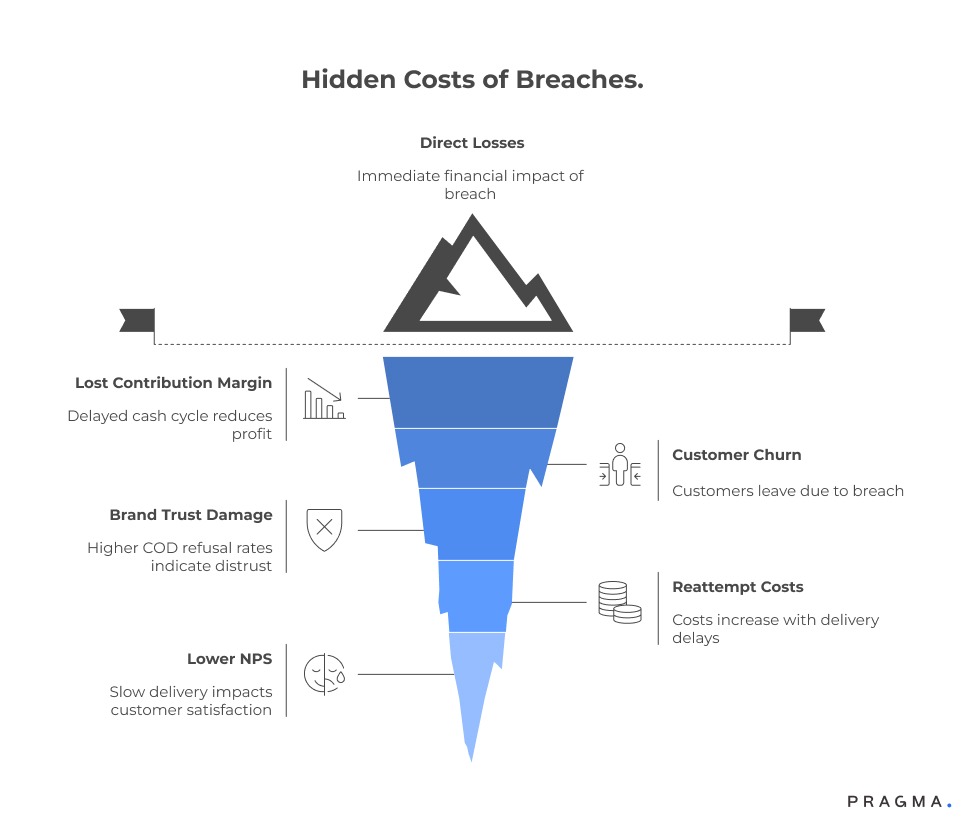
Indirect costs eclipse direct losses in most cases. A single breach may seem minor, yet patterns become expensive faster than teams expect.
Hidden impact areas include:
- Lost contribution margin due to delayed cash cycle
- Customer churn that compounds over six months
- Damage to brand trust, measured through higher COD refusal rates
- Reattempt costs that rise 2.5x with every day of delay
- Lower NPS because “slow delivery” sentiment spikes during festivals
When delivery timelines stretch, customers assume the brand has structural issues. They rarely blame carriers. Once that perception forms, recovery takes time, especially in categories like beauty, nutrition, and fashion, where switching costs are low.
How delay-driven RTO becomes the biggest cost sink
RTO triggered by SLA breaches drains profitability aggressively. During peak season, refusal rates climb because the customer expectation window shortens. A promised 2-day delivery that becomes 5 days feels unacceptable even if the actual delay is small.
Patterns show:
- COD orders delayed beyond 72 hours see a 19–24 percent refusal probability
- Prepaid orders delayed beyond 96 hours show a 6–8 percent cancellation rate
- Reattempt cycles increase cost per order by 31–46 percent
Example
Consider a brand shipping 25,000 orders during a Diwali week. A 16 percent SLA breach rate (common during peak) results in 4,000 delayed orders. If 21 percent of those convert to RTO, that is 840 lost orders.
If your average shipping cost is ₹75 and reverse cost is ₹65, the immediate loss is ₹1,17,600.
Add product damage, operational hours, and lost future revenue, and the real impact breaches ₹4–5 lakhs easily.
This demonstrates how apparently minor timeline slips snowball into significant financial strain.
How can brands reduce SLA breaches before they happen?
Proactive measures replace reactive firefighting when systems scale with intent.
SLA control requires a blend of forecasting, operational discipline, and routing intelligence. Peak season rewards teams that prepare weeks in advance rather than reacting to day-of chaos.
Forecasting tactics that reduce processing volatility
Predictive forecasting is the first defence against breach patterns. You need clarity on volume shape, SKU concentration, and regional skew.
Strong forecasting relies on:
- Clearing historical anomalies to understand true seasonal jumps
- Breaking down demand by region, not only SKU
- Simulating the next 30 days of volume based on campaign plans
- Capacity balancing between warehouses
Peaks become manageable when warehouses prepare for specific SKU surges rather than vague expectations.
Carrier management strategies that prioritise reliability
Carrier reliability varies sharply across lanes during peak seasons. You must select partners based on historic performance for specific regions and courier mix balance.
Useful practices include:
- Shifting a portion of your load to regionally strong carriers
- Avoiding over-dependence on a single aggregator
- Maintaining a dynamic routing table that adapts daily
- Monitoring mid-mile nodes known for congestion
This approach improves the probability that your shipments enter the right network at the right time.
Inventory allocation frameworks that reduce long-lane exposure
Inventory allocation becomes a strategic advantage when volumes spike. If you distribute stock intelligently, you shorten distance and reduce breach risk significantly.
Consider establishing:
- Multi-node fulfilment for your top 20 percent SKUs
- Seasonal rebalancing driven by predicted regional demand
- Safety stock buffers designed specifically for peak windows
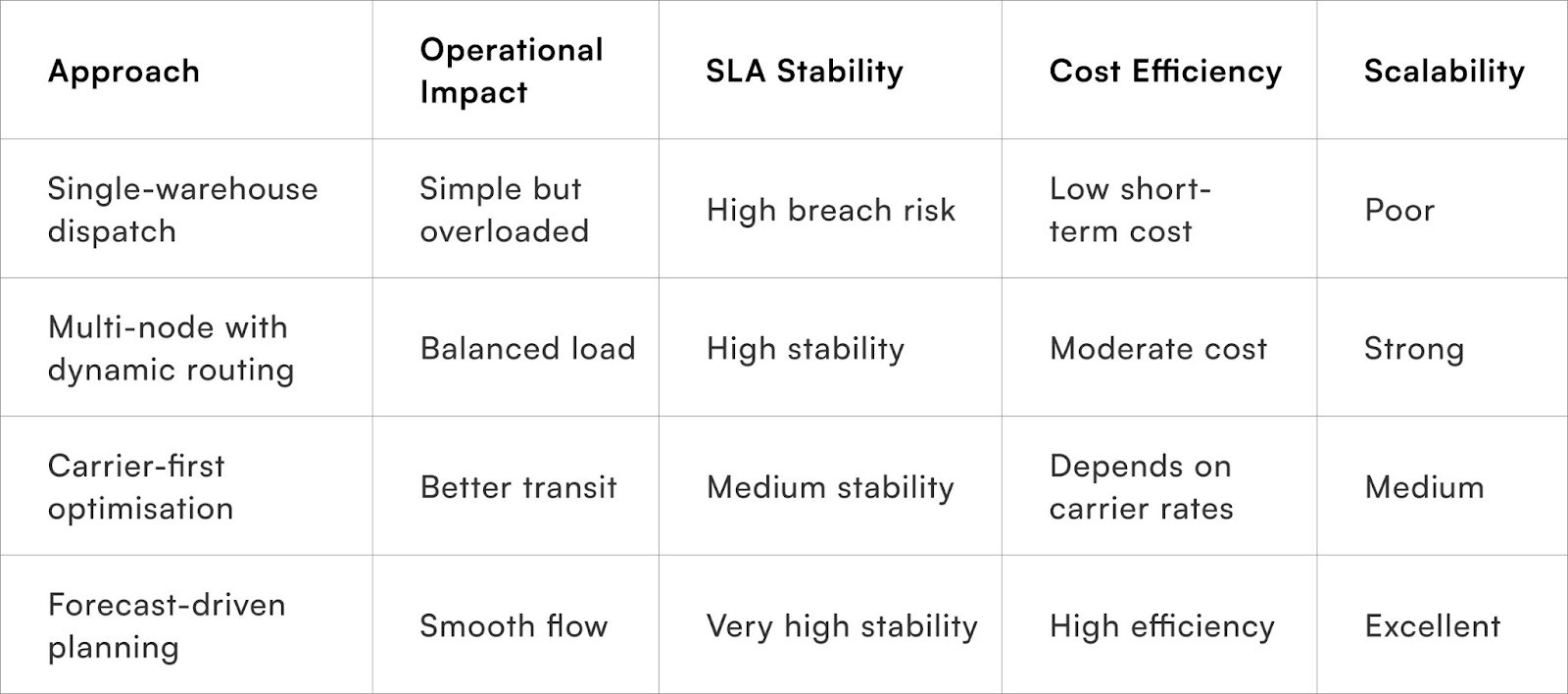
A quick comparison of strategies
Here’s a table showing how common approaches differ in outcome:
The Hidden Costs of SLA Breaches for D2C Brands
The cost of SLA breaches extends far beyond delayed delivery. Most of the impact is indirect and accumulates over time across multiple operational layers.
1. Direct operational costs
Each breach introduces immediate cost increases:
- Additional warehousing and handling
- Reattempt delivery charges
- Reverse logistics for RTO
- Customer compensation or refunds
These costs reduce contribution margin per order.
2. Increased RTO and cancellation rates
Delivery delays directly affect customer intent:
- COD orders are more likely to be refused
- Customers cancel orders if delivery exceeds expectations
- Reattempt cycles increase logistics cost significantly
Delay-driven RTO becomes one of the largest cost drivers during peak periods.
3. Higher customer support load
Delayed shipments trigger a spike in:
- “Where is my order?” queries
- Refund and cancellation requests
- Escalations and complaints
This increases support cost per order and operational workload.
4. Cash flow and working capital impact
When deliveries are delayed:
- Cash realisation (especially for COD) is delayed
- Refund cycles increase
- Inventory remains in transit longer
This slows down the overall cash conversion cycle.
5. Long-term customer and brand impact
The most significant costs are often not immediately visible:
- Loss of customer trust
- Lower repeat purchase rates
- Negative word-of-mouth and reviews
Customers attribute delivery delays to the brand, not the courier, which affects retention over time.
6. Reduced marketing efficiency
During peak seasons, brands invest heavily in acquisition. SLA breaches reduce the effectiveness of this spend because:
- Delayed deliveries weaken first-time customer experience
- Repeat purchase probability drops
- Customer lifetime value declines
How internal processes create or prevent breach scenarios
Every process during peak season becomes magnified, making discipline essential.
Whilst external systems carry some blame, a surprising proportion of SLA breaches originate from internal inconsistencies.
Cut-off discipline that defines dispatch predictability
Cut-off times are simple on paper yet difficult during peak cycles. A missed cut-off by even 45 minutes may push shipments to the next-day pickup, instantly creating SLA risk.
Useful methods include:
- Conducting pre-cut-off alignment huddles
- Reducing dependency on manual sorting
- Using staggered batch waves instead of single-batch rushes
Order prioritisation that keeps high-risk parcels under control
Not all orders carry equal risk. Identifying high-COD, high-ticket, or long-lane orders early helps teams prioritise them during crunch periods.
Frameworks that help:
- Risk scoring for delayed lanes
- Dynamic batching based on courier performance
- Micro-prioritisation for VIP or influencer-led campaigns
Packaging and handover processes that influence first-mile predictability
Peak seasons increase error probability at the packaging stage because teams rush. Missed labelling, mismatched SKUs, and inadequate sealing all create handover delays.
Precise processes reduce these errors:
- Parallel QA checks
- Pre-built packing kits for fast-moving SKUs
- Smaller batch sizes for fragile or premium categories
Why internal lapses matter more during peak
Customers become less patient when shopping during festive periods. They expect both speed and certainty because this is the most emotionally charged buying window of the year. Timely, predictable internal processes prevent small mistakes from turning into public dissatisfaction.
Quick Wins You Can Execute in the Next 30 Days
Focused actions that deliver immediate, measurable improvements.
- Introduce daily carrier performance checks for top 20 lanes.
- Rebalance stock for top SKUs towards key southern and western regions.
- Implement a strict warehouse cut-off protocol with buffer time.
- Pre-label 30–40 percent of fast-moving orders for faster dispatch.
- Build a rapid SLA tracker visible to both operations and customer support.
- Shift 10–15 percent of volume from your slowest carrier lanes to your fastest regional specialists.
To Wrap It Up
Peak season exposes inefficiencies that usually stay hidden during quieter months. SLA breaches multiply quickly because operational delays, carrier constraints, and routing issues stack on top of each other.
Focus on forecasting, carrier planning, and cut-off discipline this week to reduce breach patterns immediately.
The long-term approach involves multi-node fulfilment, dynamic routing, and stronger internal processes that scale with your order volume. Brands that treat SLA management as a continuous optimisation loop build long-term customer trust and better predictability.
For D2C brands seeking stronger delivery performance and predictable fulfilment outcomes, Pragma’s Fulfilment Optimisation platform provides forecasting tools, routing intelligence, and real-time operational visibility that help brands achieve higher on-time delivery rates and reduce breach-linked losses by measurable margins.

FAQs (Frequently Asked Questions On The Hidden Cost of SLA Breaches in Peak Season)
1. Why do SLAs fail even when my warehouse dispatches on time?
Delays often occur in the mid-mile because carriers redistribute loads during peak season. Your dispatch may be punctual, but network congestion increases transit variance.
2. Does diversifying carriers really reduce breach rates?
Yes. Relying on one aggregator raises risk because capacity shortages hit single-partner loads first. A balanced mix gives you routing flexibility.
3. How much does a single SLA breach cost on average?
Costs range from ₹40 to more than ₹180 depending on reattempts, RTO, packaging damage, and support hours.
4. Should I hold more inventory during peak season?
More inventory helps only when distributed correctly. Excess stock in the wrong warehouse slows delivery and increases breach probability.
5. Why do COD orders increase breach-related RTO?
Customers become less tolerant of delays with COD because commitment feels lower, so even small delays increase refusal likelihood.
Talk to our experts for a customised solution that can maximise your sales funnel
Book a demo.png)


.png)