

As messaging volume grows across channels, templates stop being simple content assets and start behaving like infrastructure. Every approval delay, mistranslation, or missing fallback creates real operational risk — from failed campaign launches to compliance exposure and broken customer journeys. At scale, template governance is no longer about control for its own sake; it is about ensuring velocity without sacrificing accuracy, consistency, or regulatory safety.
Template governance at scale: approvals, translations and fallback plans examines how high-growth organisations structure template workflows so that creation, review, localisation, and deployment happen predictably. The focus shifts from ad-hoc approvals and last-minute fixes to systems that define ownership, enforce version discipline, and anticipate failure modes before they reach production.
When approvals are auditable, translations are systematic, and fallback logic is designed upfront, templates become resilient building blocks rather than fragile dependencies. The result is a messaging layer that supports rapid experimentation while remaining stable under operational and regulatory pressure.
Why does template sprawl become an operational risk at scale?
Uncontrolled growth turns templates from assets into liabilities.
Template sprawl emerges when speed is prioritised without ownership, visibility, or lifecycle controls. Multiple teams create near-identical templates to avoid delays, introducing subtle variations in wording, variables, and compliance assumptions. Over time, it becomes impossible to identify which version is authoritative.
The risk compounds as scale increases. Approval histories fragment, translations drift from source content, and dependencies between templates weaken. What appears to be a content management issue is, in reality, a failure to govern shared infrastructure.
When no single source of truth exists, decision-making defaults to memory and convenience. Templates ship based on familiarity rather than validity, increasing the likelihood of non-compliant or broken messages entering production.
How should approval workflows be structured to balance speed and control?
Approvals must operate as deterministic systems, not human bottlenecks.
Approval workflows fail when they treat all templates as equal. Effective governance introduces risk-based approval tiers, where review depth corresponds to potential impact. Transactional and regulatory templates demand stricter scrutiny, while low-risk variants move through lighter paths.
What distinguishes scalable approval workflows?
Scalability depends on reducing ambiguity rather than reviewer load.
Well-designed workflows evaluate changes, not entire templates. Reviewers assess deltas with clear context: what changed, why it changed, and what downstream effects to expect. Once approved, templates are locked to prevent untracked edits.
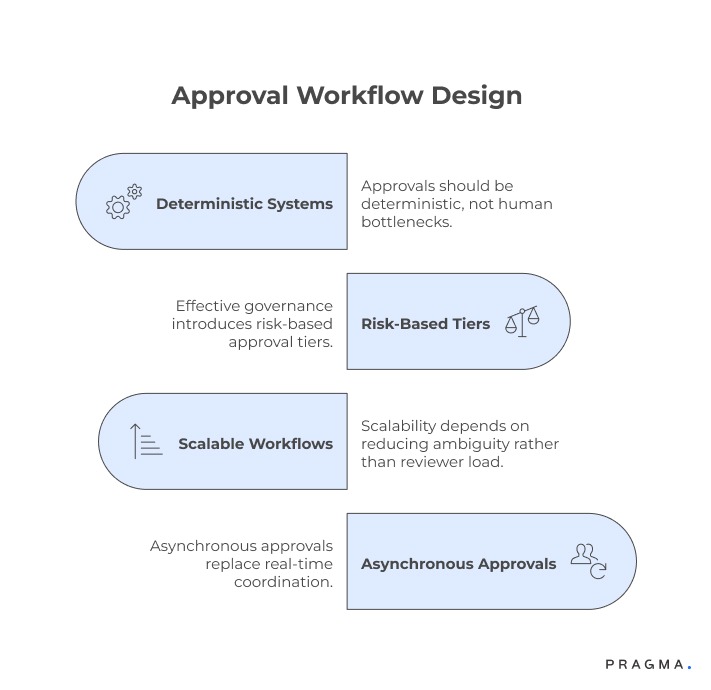
Asynchronous approvals replace real-time coordination. Defined SLAs, escalation paths, and immutable approval records remove the need for follow-ups and manual reminders, allowing speed and control to coexist.
What ownership model prevents approval bottlenecks and shadow edits?
Clear accountability eliminates friction more effectively than added tooling.
Governance breaks down when ownership is implied instead of explicit. Each template requires a single accountable owner responsible for accuracy, lifecycle decisions, and downstream consistency. This role exists to resolve ambiguity, not to author content.
Why does domain-based ownership outperform channel-based models?
Ownership aligned to business domains prevents divergence.
A payment or policy template should retain the same owner across email, SMS, and WhatsApp. Channel-based ownership encourages parallel edits and inconsistent approvals, while shared ownership diffuses responsibility and slows decisions.
Restrictive publishing permissions reinforce this model. Draft creation can remain flexible, but final deployment rights must be limited to owners or their delegates to prevent unauthorised changes reaching production.
How do versioning and change logs reduce approval fatigue?
Reducing review scope is the fastest path to faster approvals.
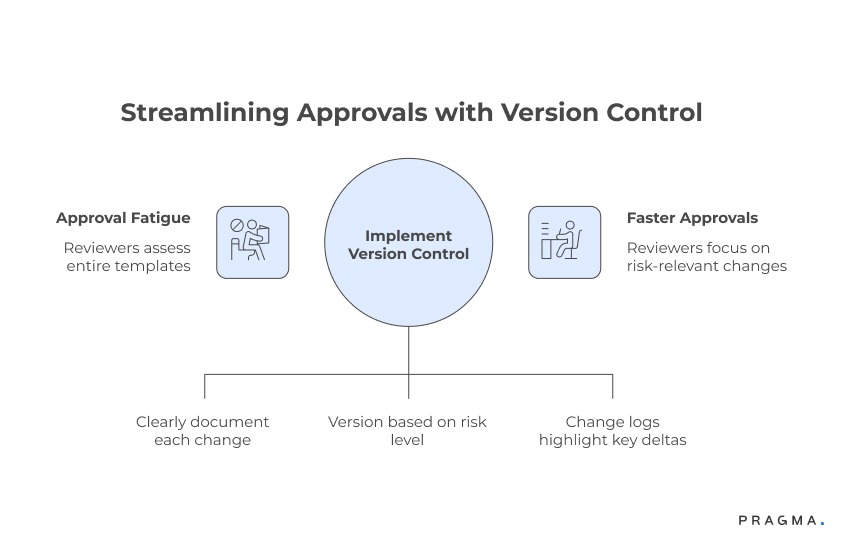
Approval fatigue arises when reviewers repeatedly assess entire templates for minor updates. Proper version control treats templates as evolving assets, with each change clearly scoped and documented.
What should a disciplined versioning system capture?
Versioning must reflect risk, not just chronology.
Minor copy edits increment patch versions, while structural or compliance-impacting changes trigger major version updates and stricter review paths.
Change logs summarise what changed and what remained untouched, allowing reviewers to focus only on risk-relevant deltas.
This discipline simplifies rollback and incident response. When failures occur, teams can identify the last known-good version instantly, turning version history into an operational asset rather than an archive.
Why do translations break down without central governance?
Localisation fails when it is treated as a downstream task instead of a governed system.
Translation quality degrades when source templates change faster than localisation workflows can absorb. Without governance, translators work on outdated versions, partial strings, or unapproved drafts. The result is linguistic drift, broken variables, and messages that are technically correct but contextually wrong.
At scale, translation failures surface unevenly. Some languages lag behind source updates, while others silently diverge.
Because approvals and versioning are often disconnected from localisation systems, teams lose visibility into which languages are production-safe at any given moment. What appears as a translation issue is usually a coordination failure between content, approvals, and deployment.
How should translation workflows be designed for scale and accuracy?
Translations must inherit the same governance guarantees as source templates.
Translation workflows scale only when they are tightly coupled to source template state. A template should become translatable only after source approval, and every source update should explicitly trigger downstream localisation actions. This prevents translators from working on unstable or unauthorised content.
What controls prevent translation drift?
Drift is prevented by enforcing structural and process constraints.
Effective systems lock variables, formatting tokens, and conditional logic before localisation begins. Translators operate on protected strings, reducing the risk of syntax errors or broken placeholders. Translation memory and glossary enforcement ensure consistent terminology across templates and time.
Approval parity is equally important. Localised versions must pass language-specific review before deployment, with approval status tracked per locale rather than inferred from the source template alone.
Why are fallback plans essential for resilient template systems?
Failures are inevitable; unplanned failures are not.
Fallbacks are often treated as edge cases, added reactively after incidents occur. At scale, this approach guarantees outages. Templates depend on approvals, translations, and delivery systems; when any link breaks, messages fail unless a predefined alternative exists.
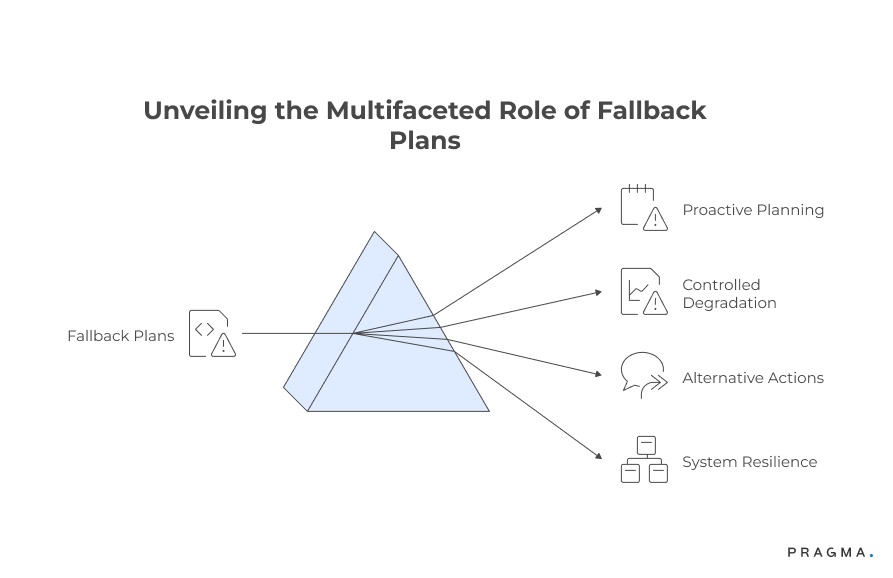
A fallback plan defines what happens when a template cannot be delivered as intended. This may include reverting to a previous approved version, switching to a default language, or suppressing non-critical messages altogether. The goal is not perfection, but controlled degradation.
How should fallback logic be structured across channels and languages?
Fallbacks must be deterministic, visible, and tested before deployment.
Fallback logic should be explicit rather than implicit. For each template, the system must define acceptable downgrade paths: which version to use, which language to default to, and under what conditions suppression is preferable to substitution.
What makes fallback plans operationally reliable?
Reliability comes from predictability and verification.
Fallbacks should follow a fixed resolution order and be logged whenever triggered. This creates auditability and surfaces systemic issues rather than masking them. Regular testing ensures that fallback paths remain valid as templates evolve, preventing surprises during high-volume sends.
By designing fallback behaviour alongside approvals and translations, template systems remain stable even when upstream processes fail.
How do approval, translation, and fallback systems fit together in practice?
Governance only works when interdependencies are designed, not assumed.
At scale, approvals, translations, and fallback plans cannot exist as separate workflows. Each relies on shared state: version status, ownership, and deployment readiness. When these systems are loosely coupled, failures cascade silently.
The most reliable implementations treat templates as stateful assets with explicit lifecycle stages. A template moves from draft to approved source, then to approved localisations, and finally to deployable artefacts with validated fallback paths. Each transition is gated, logged, and reversible.
What does a governed template lifecycle look like?
A clear lifecycle reduces ambiguity across teams.
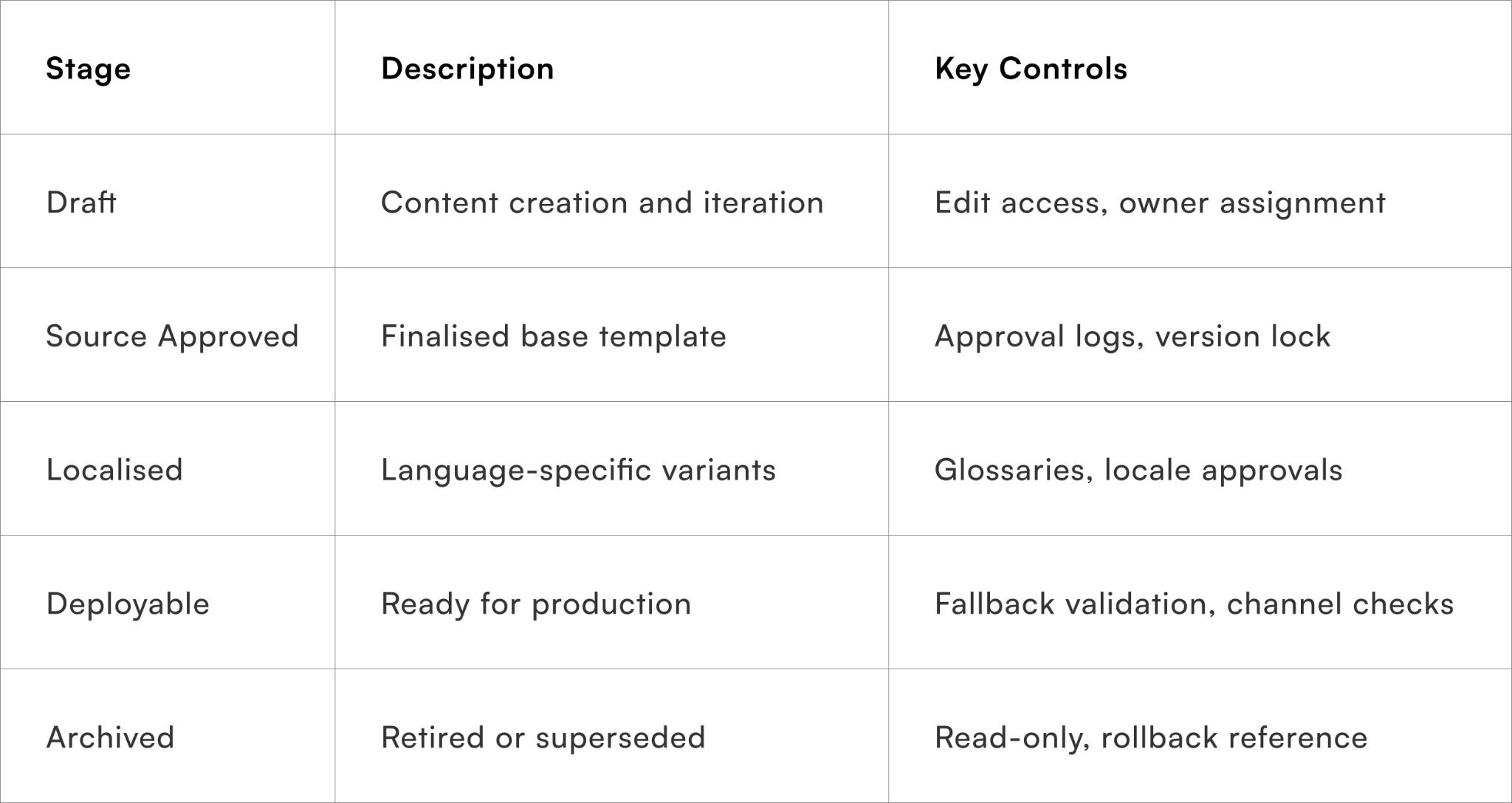
This structure ensures that no template reaches production without satisfying all governance conditions.
What operating models support template governance at scale?
Process consistency matters more than tooling sophistication.
Governance effectiveness depends on how responsibilities are distributed. High-performing teams separate decision-making from execution while maintaining clear escalation paths.
Which roles are non-negotiable?
Certain roles must exist, even if held part-time.
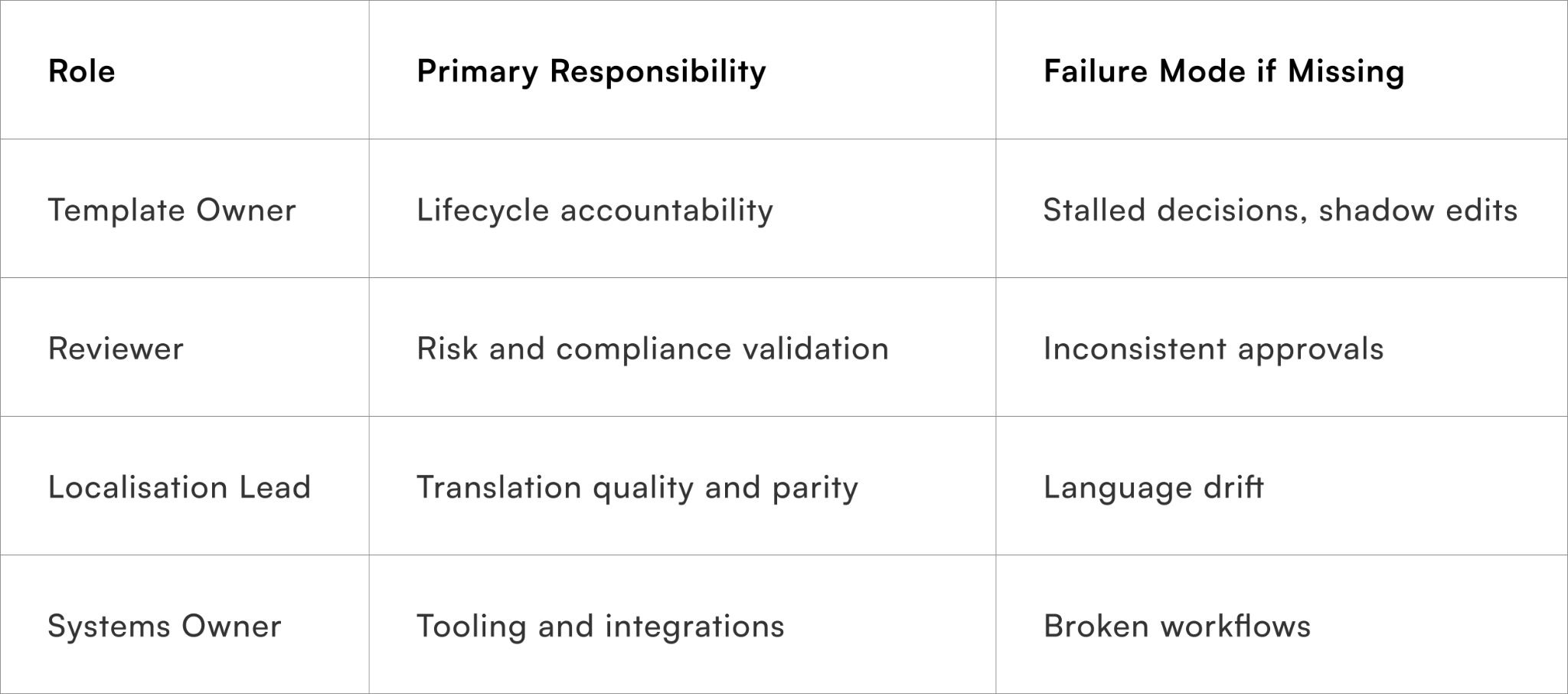
Clear role definition prevents governance from becoming personality-driven or tool-dependent.
What quick wins stabilise template governance in 30 days?
Small structural changes deliver outsized risk reduction.
Governance improvements do not require full replatforming. Early wins focus on visibility, ownership, and failure containment.
- Assign a single owner to every active template
- Introduce version naming conventions and mandatory change logs
- Separate approval paths for high-risk and low-risk templates
- Lock variables and formatting before translation begins
- Define a default fallback language and last-approved rollback version
- Log and review all fallback-triggered sends weekly
These steps reduce incident probability immediately, even before deeper system changes.
Which metrics indicate healthy template governance?
What is not measured eventually breaks.
Governance quality is visible in operational signals, not sentiment. Metrics should expose friction, drift, and failure recovery.
Core Metrics to Track
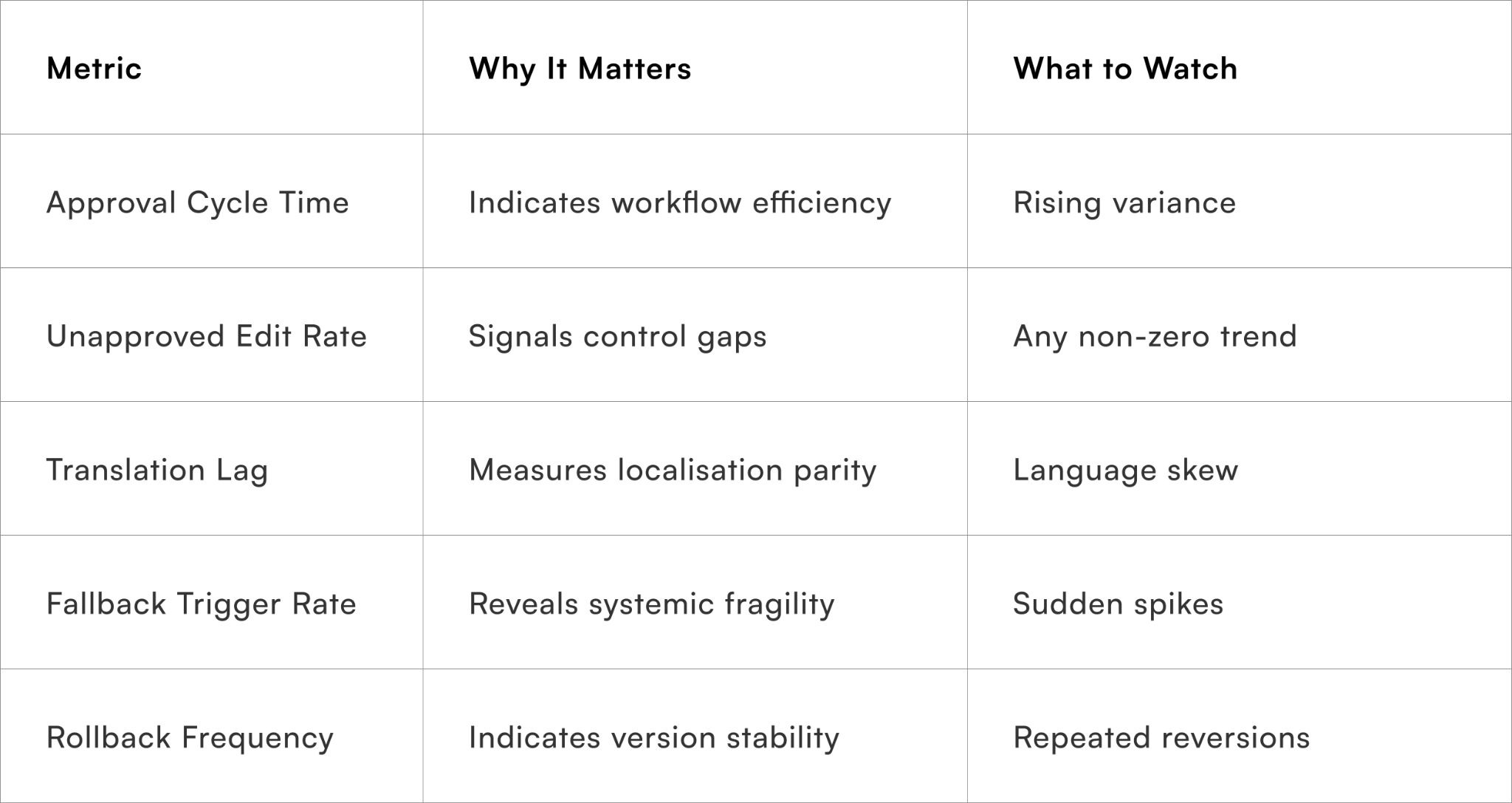
Metrics should drive corrective action, not reporting theatre.
To Wrap It Up
Template governance at scale is less about content control and more about operational reliability.When approvals, translations, and fallback plans are designed as connected systems, templates remain consistent, compliant, and deployable even as volume and complexity increase.
In the near term, stabilising governance starts with clarity: define ownership for every template, formalise approval tiers, and lock source versions before localisation begins. These steps surface hidden dependencies and prevent silent drift.
Over time, mature governance embeds fallback logic, version discipline, and auditability into the template lifecycle itself. This ensures that failures degrade predictably rather than disruptively, preserving execution velocity under pressure.
For organisations managing high-volume, multi-language messaging, Pragma provides the governance layer that connects approvals, localisation, and fallback logic into a resilient template infrastructure, enabling scale without fragmentation or operational risk.

FAQs (Frequently Asked Questions On Template governance at scale: approvals, translations and fallback plans)
1. Why can’t approvals be standardised across all templates?
Templates carry different levels of operational and regulatory risk, requiring differentiated review depth.
2. Should translations always mirror source templates exactly?
Structural parity is mandatory; linguistic flexibility is acceptable within approved constraints.
3. Are fallback plans only needed for transactional templates?
No. Any high-volume or time-sensitive message benefits from predefined fallback behaviour.
4. How often should fallback paths be tested?
Fallback logic should be tested on every major version change and periodically in production-like conditions.
Talk to our experts for a customised solution that can maximise your sales funnel
Book a demo.png)

.webp)
.png)