

Support teams across Indian D2C brands quietly carry the weight of returns. During high-volume weeks, return-related conversations account for 35–45% of inbound support tickets, even when the underlying logistics process functions normally. Internal benchmarking across mid-sized D2C brands shows that every manual return interaction costs ₹45–₹70 once agent time, system usage, and follow-ups are factored in. Yet most brands still rely on email threads or WhatsApp back-and-forth to handle predictable return requests.
This friction does not discourage returns. It simply shifts operational cost upstream into support. Customers who intend to return will proceed regardless, while unclear processes trigger anxiety-driven follow-ups. A 2023 LocalCircles survey found that 62% of Indian ecommerce shoppers contacted support at least once during a return, primarily to check status rather than resolve a dispute.
In this comprehensive guide on Self-service return flows that cut support load without increasing returns, we’re diving deep into how structured automation absorbs routine demand without encouraging abuse. Brands that implement well-designed self-service return journeys typically see 40–60% lower return-related tickets, 25–30% faster refund cycles, and stable return rates within the first 90 days.
Why do manual return processes overload support teams?
Understanding how routine intent turns into unnecessary human work
Manual return handling fails because it treats every request as an exception. In reality, most return requests follow predictable patterns. Customers want to initiate a return, confirm eligibility, schedule pickup, and track refunds. When each step requires human intervention, ticket volume grows faster than order volume.
The mismatch between intent and effort
Most return-related tickets are informational. Customers are not asking for policy changes. They are asking for confirmation, timelines, and reassurance. When these answers require an agent response, support queues inflate rapidly.
Common triggers include:
- Unclear eligibility windows after order delivery
- Delays between approval and pickup
- Silence between pickup and refund initiation
Each gap generates another ticket, even if the backend process continues correctly.
Why Indian D2C feels this more acutely
India’s ecommerce structure amplifies this problem. COD orders demand reassurance. Reverse logistics vary sharply by pin code. Refund timelines depend on payment mode. These variables increase customer uncertainty, which translates directly into support contact.
The critical insight here is that support teams absorb process ambiguity, not customer complexity.
How does lack of visibility amplify return-related anxiety?
The psychological cost of waiting without signals
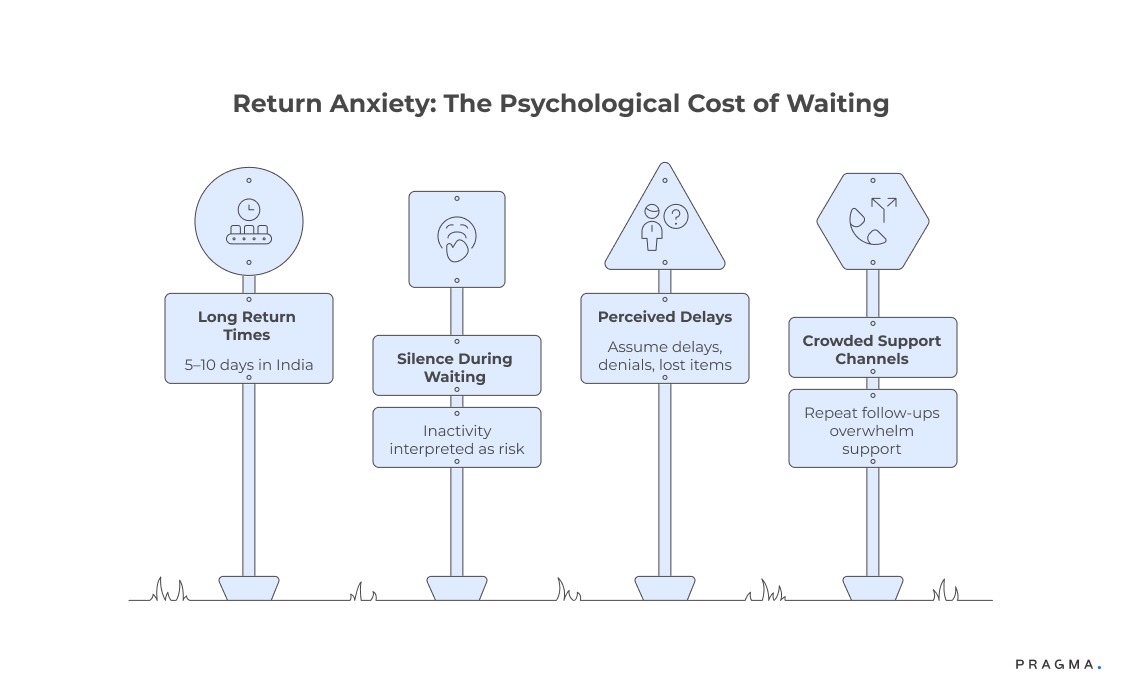
Reverse logistics in India often take 5–10 days, depending on region and carrier reliability. This duration is not the problem. Silence during this window is.
Customers interpret inactivity as risk. Without updates, they assume delays, denials, or lost shipments. This perception drives repeat follow-ups that crowd support channels.
Visibility reduces perceived risk, not actual timelines
When customers see progress markers, anxiety drops even if delivery speed remains unchanged. Simple milestones reassure buyers that the process remains under control.
Effective visibility typically includes:
- Return request received
- Pickup scheduled or pending
- Item received at warehouse
- Inspection completed
- Refund initiated
Each message reduces the likelihood of a follow-up.
Why “we’ll update you” doesn’t work
Generic promises create uncertainty. Customers want time-bound clarity. “Refund in 7–10 days” performs better than open-ended assurances, even if both lead to the same outcome.
Indian brands often delay communication until physical events occur. Global D2C models communicate intent early, then confirm execution later. This subtle difference significantly lowers ticket volume.
What role does self-service play in separating routine from risk?
Designing boundaries that protect support capacity
Self-service return flows succeed because they introduce structure. They define what customers can do independently and when human review is required. This separation prevents routine requests from overwhelming support.
Routine requests don’t need human judgement
Most returns fall into predictable buckets:
- Within policy window
- Eligible product categories
- Clear reason codes
- No prior abuse indicators
Automating these cases removes unnecessary decision-making from agents. Support teams then focus on exceptions rather than confirmations.
Why self-service doesn’t increase return rates
Indian brands often fear that easier returns encourage misuse. Data from global and Southeast Asian D2C brands shows the opposite. Clear rules reduce opportunistic behaviour because customers see firm boundaries upfront.
When eligibility is visible and enforced consistently, customers self-select out of invalid requests. Ambiguity, not convenience, fuels abuse.
Self-service reduces noise without weakening control when rules remain transparent.
How do global D2C brands design self-service return flows?
Process logic first, interface second
Global brands do not begin with UI. They begin with decision logic. The interface simply reflects backend rules that customers experience as predictable outcomes.
Decision logic over design
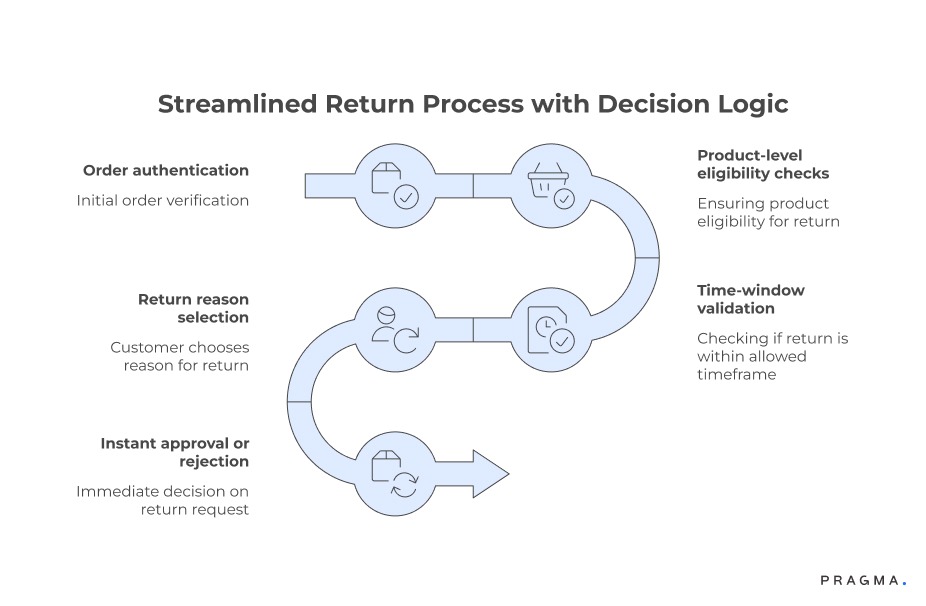
A typical flow includes:
- Order authentication
- Product-level eligibility checks
- Time-window validation
- Return reason selection
- Instant approval or rejection
Customers receive clarity within seconds, not days. There is no negotiation loop.
Why this matters for Indian brands
Indian D2C brands do not need sophisticated platforms to start. Even basic portals integrated with order databases and policy rules eliminate large volumes of manual work. The biggest gain comes from eliminating uncertainty, not from advanced tooling.
Where Indian brands struggle with self-service adoption
Automation without alignment creates false confidence
Some brands introduce self-service forms but retain manual approvals behind the scenes. Customers expect speed but experience delay. This mismatch increases frustration instead of reducing tickets.
Others fail to standardise return reasons. Free-text inputs create ambiguity, requiring follow-up clarification. Support teams re-enter the loop.
The three most common failure points
- Self-service initiation without automated approvals
- Poor return reason taxonomy
- No automated refund status communication
Each failure point reintroduces human dependency.
Automation only works when policy logic, communication, and logistics move together.
How can self-service reduce tickets without encouraging misuse?
Clarity beats convenience when boundaries are visible
Customers do not return more just because returns feel easier. They return more when policies feel unclear, inconsistent, or negotiable. Self-service works when it makes rules explicit at the moment of intent.
The psychology behind “visible rules”
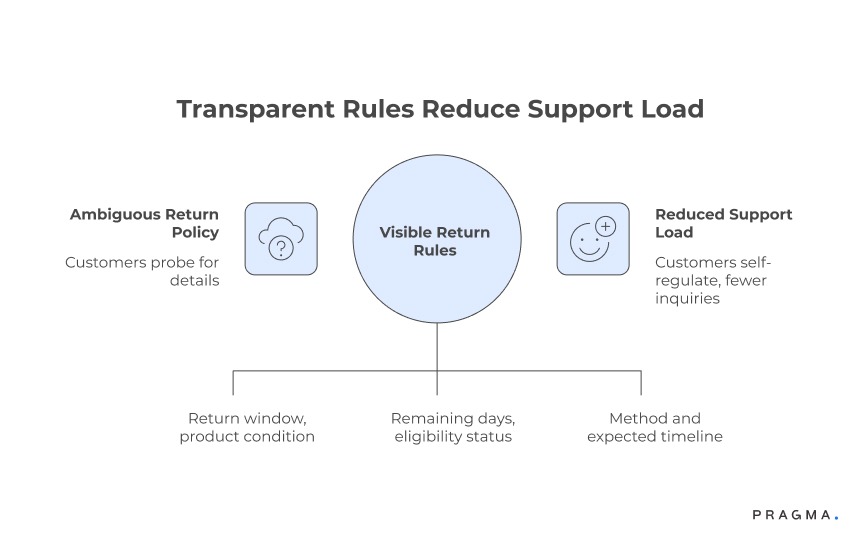
When customers see eligibility clearly stated—return window, product condition, refund mode—they self-regulate. Ambiguity invites probing. Clear outcomes discourage gaming.
Well-performing flows usually surface:
- Remaining days in return window
- Product eligibility status
- Refund method and expected timeline
This transparency reduces “trial” return attempts that clog support queues.
Why Indian customers respond strongly to structure
Indian shoppers often balance risk carefully, especially for prepaid orders. When rules appear firm and system-driven, customers trust outcomes even if they dislike them. Manual discretion, however, encourages follow-ups and negotiation.
The insight here is simple: systems feel fairer than humans when decisions are unfavourable.
What approval logic actually works in Indian conditions?
Simple rules first, intelligence later
You don’t need complex ML models to see impact. Most Indian D2C brands achieve large gains with rule-based logic tied to four signals.
The four-rule foundation
Effective self-service approval systems usually evaluate:
- Time since delivery
- Product category and value
- Customer order history
- Prior return frequency
When these rules align, instant approval works safely. Only when one signal breaks does manual review trigger.
Why blanket approvals fail
Approving everything instantly increases misuse. Delaying everything increases support load. The balance lies in conditional speed—fast for low-risk cases, deliberate for edge cases.
Brands that follow this model typically automate 65–80% of return approvals within weeks, without return-rate spikes.
How should return reasons be structured for action?
From noise to operational signals
Return reasons are not customer-facing labels. They are internal diagnostic tools. Global brands design them to drive decisions, not empathy.
Why free-text reasons hurt scale
Free-text inputs feel flexible but create analysis paralysis. Support teams waste time interpreting intent. Product and ops teams receive unusable data.
Structured reason codes enable:
- Faster approvals
- Cleaner analytics
- Direct feedback loops
What good reason taxonomy looks like
Effective setups balance simplicity and specificity. Instead of “Didn’t like product,” they surface:
- Fit too small / too large
- Colour mismatch
- Quality below expectation
- Delivery damage
- Changed mind
Each maps to a different operational response. Over time, this reduces avoidable returns rather than suppressing legitimate ones.
The key insight is that better reasons reduce future returns, not current ones.
How do timelines and refunds influence support volume?
Expectation management beats speed
Speed matters, but predictability matters more. Customers tolerate longer timelines when expectations are clear and consistently met.
Refund timing as a trust signal
Global D2C brands often initiate refunds at pickup scans for trusted customers. Indian brands can adopt this selectively. Even when refunds follow inspection, early communication stabilises expectations.
Clear timelines typically include:
- Pickup SLA by region
- Inspection window
- Refund initiation timeline by payment mode
Why COD needs different handling
COD returns demand extra reassurance. Customers want confirmation that the return won’t “disappear.” Automated messages confirming receipt and refund queue placement dramatically reduce follow-ups.
Brands that tailor refund communication by payment mode see 30–40% fewer status inquiries.
How should self-service integrate with support, not replace it?
Automation as a filter, not a wall
Self-service should reduce tickets, not block customers. The best systems offer a clear escalation path when automation stops.
When human intervention adds value
Support teams should step in when:
- Eligibility is borderline
- Product condition disputes arise
- High-value customers need reassurance
In these cases, context-rich tickets save time. The agent sees the entire return journey upfront, reducing resolution time.
Why escalation design matters
If customers feel trapped in automation, frustration rises. Clear escalation options preserve trust while keeping volume manageable.
Self-service succeeds when humans handle exceptions, not confirmations.
What Indian brands can realistically implement first
Practical adoption without heavy tooling
Most gains come from foundational changes, not platform overhauls. Brands often start with:
- Authenticated order-level return initiation
- Rule-based instant approvals
- Automated milestone communication
- Structured reason codes
These steps alone cut support load sharply while keeping return rates stable.
Quick Wins
Immediate operational steps to reduce support load without raising return rates
Week 1: Map Current Return Demand and Ticket Drivers
Audit the last 30 days of return-related tickets and classify them by intent. Most teams discover that status checks, eligibility questions, and refund timelines dominate volume. Document current return cycle times by region and payment mode. This baseline clarifies where automation will have the fastest impact.
Expected outcome: Clear visibility into which return interactions are informational versus exceptional, highlighting automation opportunities covering 60–70% of volume.
Week 2: Launch Authenticated Self-Service Return Initiation
Enable customers to initiate returns through login-based order access. Surface eligibility clearly using return window rules and product-level policies. Introduce structured return reasons aligned to operational outcomes rather than generic dissatisfaction labels.
Expected outcome: 50–65% of return requests move out of email or WhatsApp into self-service, reducing agent dependency immediately.
Week 3: Automate Approval Logic and Milestone Communication
Deploy rule-based approvals for low-risk cases using time window, category, and customer history. Trigger automated communication at key milestones: request received, pickup scheduled, item received, refund queued, refund initiated.
Expected outcome: Request-to-approval time drops from 24–48 hours to under 15 minutes for most returns, cutting follow-up tickets sharply.
Week 4: Align Refund Triggers and Escalation Paths
Integrate refund initiation with pickup or inspection milestones based on risk tier. Add clear escalation paths for edge cases so customers do not feel trapped in automation.
Expected outcome: Refund-related status inquiries reduce by 35–50%, whilst customer satisfaction scores stabilise or improve.
Which metrics actually indicate success?
Measuring support efficiency without masking return abuse
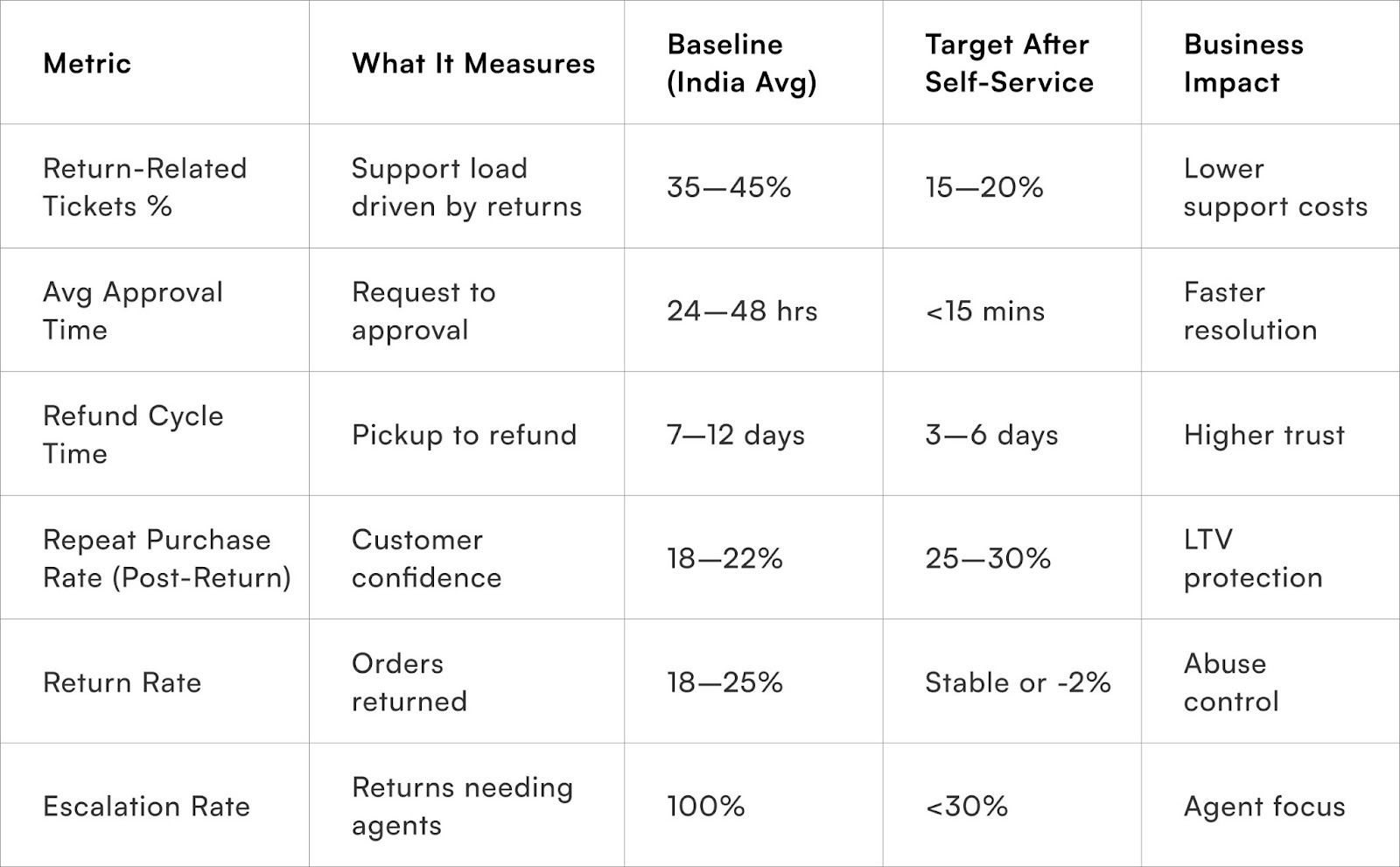
The insight here is that success lies in reducing effort per return, not eliminating returns themselves.
To Wrap It Up
Self-service return flows succeed when they absorb routine intent while preserving control over risk. They reduce support dependency, stabilise customer expectations, and protect operational bandwidth during peak periods. The goal is not fewer returns at any cost, but fewer unnecessary conversations.
This week, audit your top five return ticket triggers and identify which ones automation can resolve immediately.
Over the long term, brands that treat returns as a behavioural signal rather than an operational failure build stronger trust and healthier lifetime value. Continuous refinement of rules, communication, and segmentation ensures self-service evolves alongside customer expectations.
For D2C brands seeking to reduce support load without compromising control, Pragma’s returns automation platform provides rule-based approvals, milestone communication, and risk-aware refund workflows that help brands cut return-related tickets by up to 60% while maintaining stable return rates.

FAQs (Frequently Asked Questions On Self-service return flows that cut support load without increasing returns)
1. Will self-service returns increase misuse?
When policies are clear and enforced consistently, misuse typically declines. Ambiguity, not convenience, drives abuse.
2. Do COD orders need separate self-service logic?
Yes. COD returns benefit from additional confirmation messages and explicit refund timelines to reduce anxiety and follow-ups.
3. Is warehouse inspection mandatory before refunds?
Not always. Low-risk customers and categories often qualify for refund initiation at pickup scan without increasing fraud.
4. How much support load can self-service realistically remove?
Most Indian D2C brands remove 40–60% of return-related tickets within the first quarter of implementation.
4. Can small brands implement this without heavy platforms?
Yes. Even basic rule-based portals integrated with order data deliver meaningful results without enterprise tooling
Talk to our experts for a customised solution that can maximise your sales funnel
Book a demo
.png)
.png)