

Peak seasons have a way of exposing every weak link in a D2C operation. Volumes spike, delivery timelines compress, customer patience thins — and suddenly, Return to Origin (RTO) rates start creeping up just when margins matter most. Many brands respond by aggressively pushing RTO reduction levers, only to discover later that short-term fixes can quietly damage delivery performance, partner relationships, or customer trust.
This is where operational guardrails when scaling RTO reductions in peak seasons become critical. Reducing RTO is not just a logistics problem; it’s a cross-functional discipline that touches fulfilment, customer experience, fraud controls, carrier management, and finance. Without clear boundaries, teams often overcorrect — blocking risky orders too broadly, overloading support teams, or creating bottlenecks that surface only after the peak is over.
This blog breaks down how D2C teams can scale RTO reduction efforts responsibly during high-volume periods, while protecting throughput, customer experience, and long-term unit economics — not just surviving peak demand, but coming out stronger on the other side.
Why do RTO rates spike disproportionately during peak seasons?
Volume pressure exposes weak signals, rushed decisions, and fragile handoffs
Peak-season RTO spikes are rarely caused by a single failure. They emerge when normal operating assumptions break under load. Order volumes surge, fulfilment SLAs tighten, and teams lean on heuristics that worked at lower scale but fail in high-variance conditions.
Three patterns show up consistently:
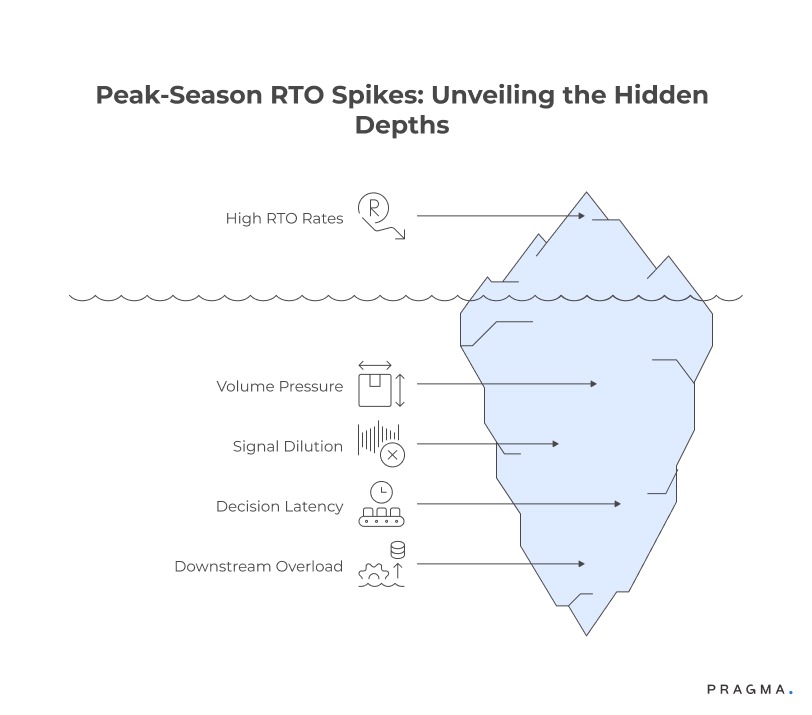
- Signal dilution: Risk markers like address quality, COD intent, or delivery zone reliability lose accuracy when order velocity spikes.
- Decision latency: Manual reviews and exception handling don’t scale linearly with volume.
- Downstream overload: Carriers, warehouses, and support teams absorb the shock — often invisibly at first.
Without guardrails, brands react by tightening controls everywhere, which suppresses RTO but also throttles growth or damages CX.
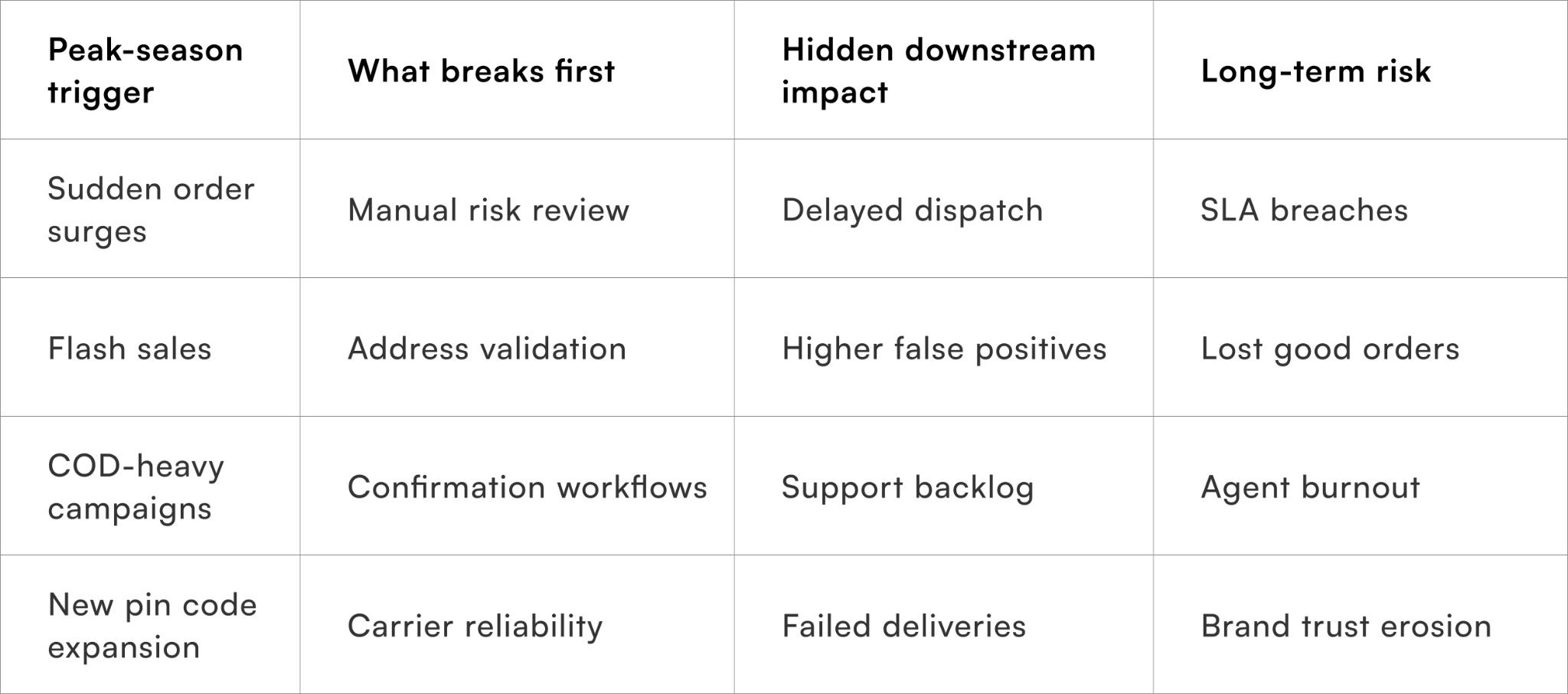
The goal isn’t to eliminate these pressures, but to contain their blast radius.
What guardrails should exist before scaling RTO controls?
Boundaries that prevent overcorrection and protect core throughput
Guardrails are not policies — they are limits on how aggressive your controls are allowed to be, even when pressure is high. Mature teams define these before peak hits.
Effective guardrails usually operate across four dimensions:
1. Order suppression limits
Never allow RTO rules to block more than a defined percentage of total demand, even if risk scores spike.
2. SLA protection thresholds
Any RTO intervention that increases fulfilment or confirmation time beyond a set window should auto-disable.
3. Customer cohort exclusions
High-LTV or repeat customers should be insulated from broad RTO controls unless fraud is explicitly detected.
4. Manual workload caps
If a control requires human review, cap daily volume and allow overflow to pass through.
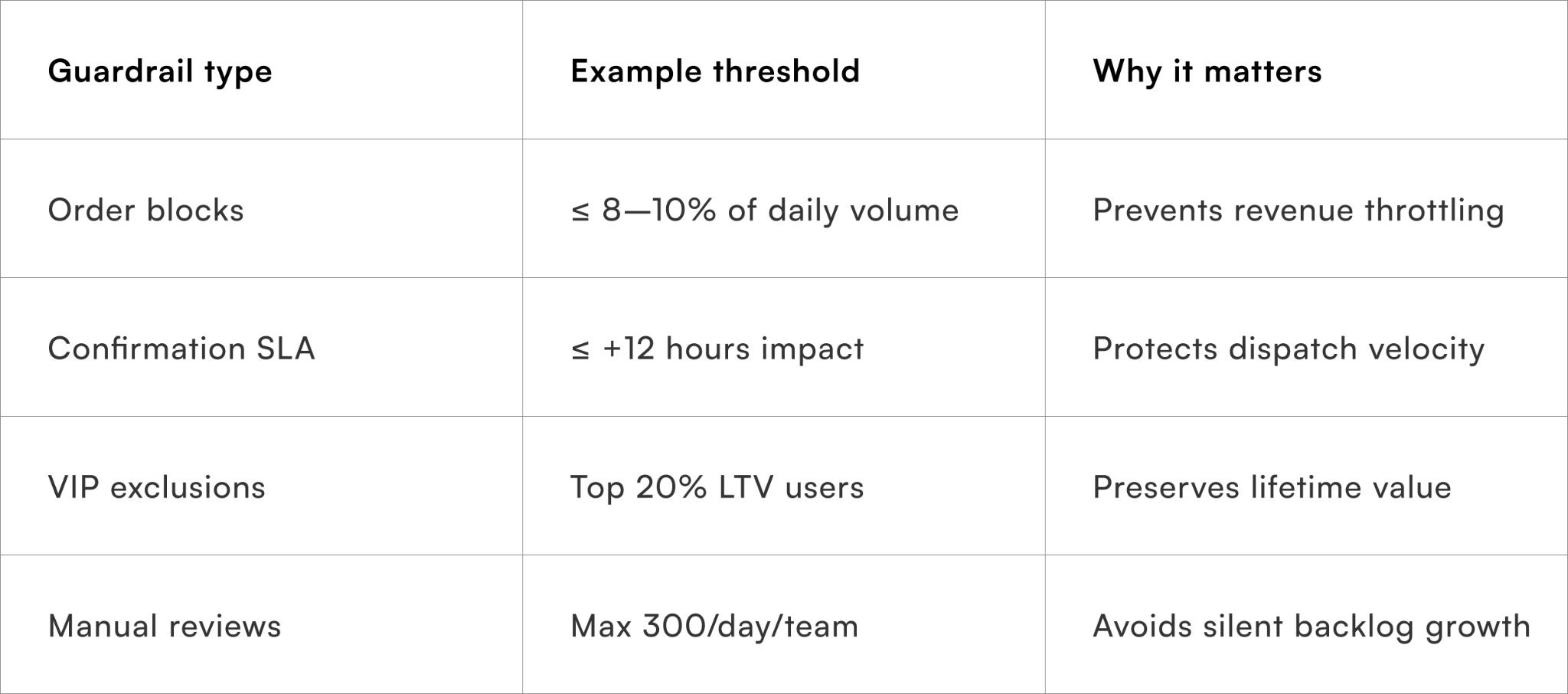
These guardrails convert RTO reduction from a reactive scramble into a bounded optimisation problem.
How can teams segment RTO strategies without slowing operations?
Precision beats blanket rules when volume is high
Peak season is the worst time to deploy broad, one-size-fits-all controls. The brands that scale cleanly segment aggressively — not just by customer, but by operational context.
High-performing teams typically segment along three axes:
Customer intent
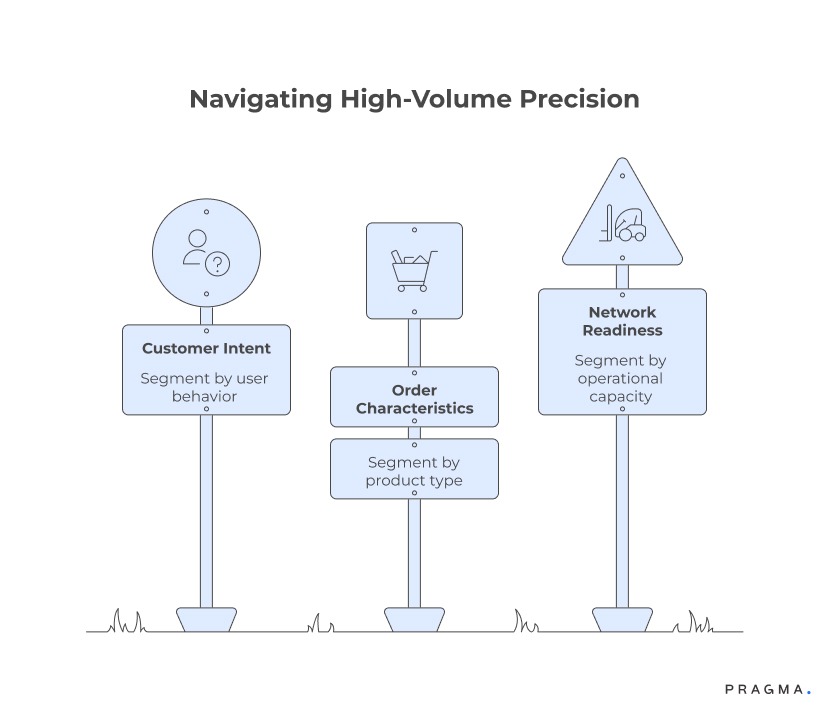
- New COD users vs repeat prepaid buyers
- Regions with historically high delivery success vs volatile zones
Order characteristics
- High-value, single-item orders vs multi-SKU baskets
- Promotional SKUs vs evergreen products
Network readiness
- Warehouses under load vs those with spare capacity
- Carriers operating within SLA vs degraded lanes
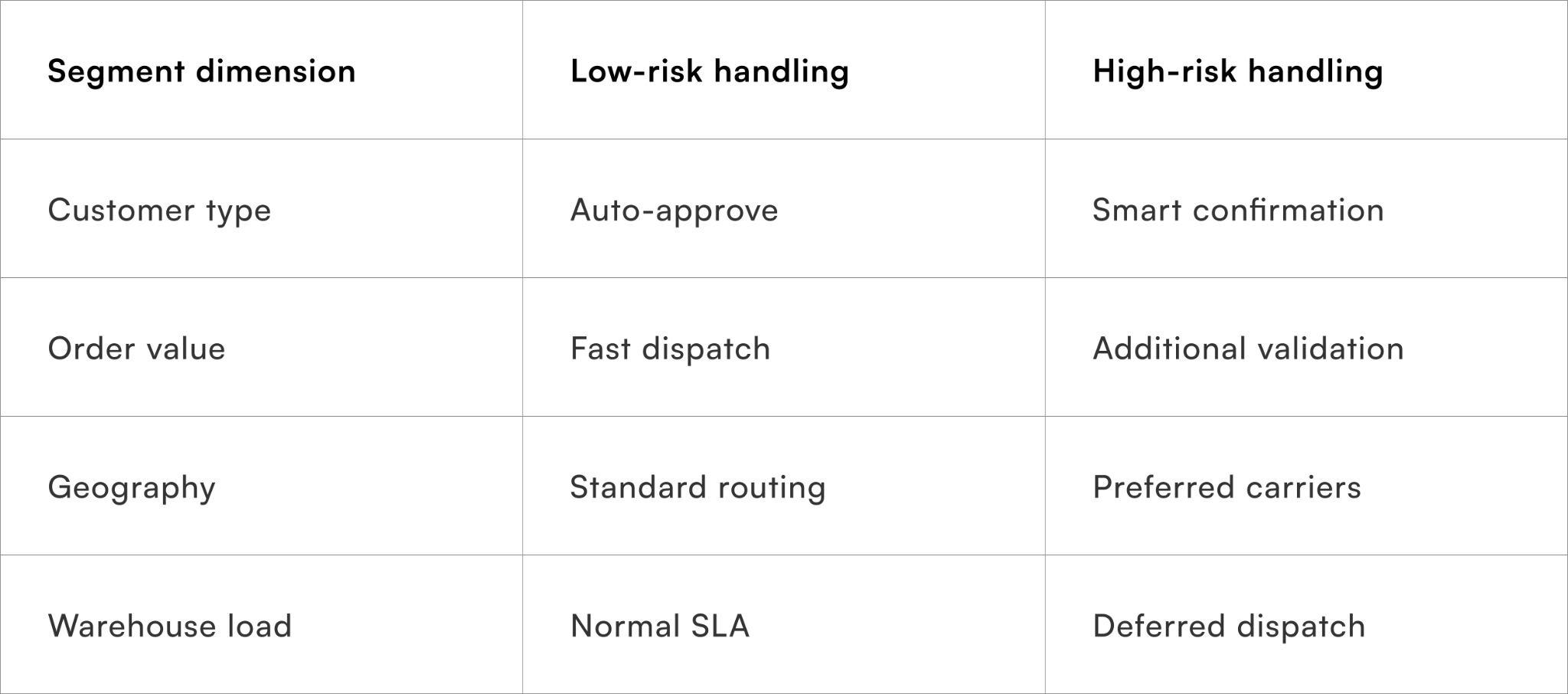
The key guardrail here: segmentation must not introduce friction that operations cannot absorb. Any segment-specific rule that adds steps must be measured against real processing capacity, not theoretical efficiency.
When segmentation is grounded in ops reality, RTO reduction scales without quietly breaking fulfilment.
How should carrier and lane-level controls be applied during peaks?
RTO risk lives in lanes, not logos
One of the most common peak-season mistakes is treating carrier performance as a binary choice — “good” or “bad”. In reality, RTO risk concentrates at the lane level, and peak volumes magnify these differences.
Smart guardrails focus on where and when to intervene:
Lane-specific routing
Instead of blacklisting entire carriers, restrict rerouting to:
- Pin codes with rising first-attempt failure
- COD-heavy lanes with repeat delivery refusals
- Congested metro hubs during sale days
Dynamic performance windows
Peak season requires shorter evaluation cycles. Weekly carrier scorecards are too slow when volumes double overnight.
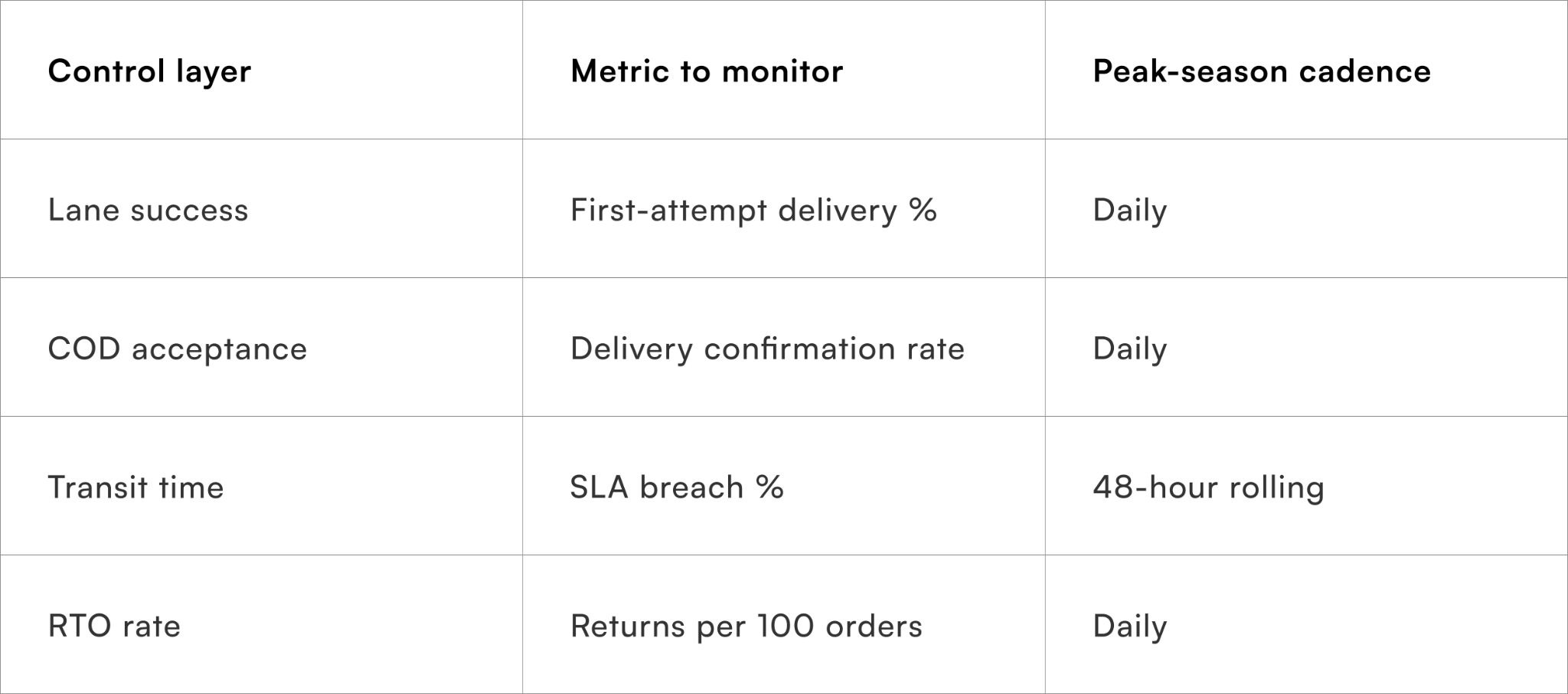
The guardrail: never reroute lanes without confirming downstream capacity. Shifting volume away from a weak carrier can overwhelm another if load planning isn’t synced.
How can customer communication reduce RTO without adding support load?
Clarity prevents refusals better than persuasion
During peaks, customers don’t refuse deliveries because they’re malicious — they refuse because they’re confused, unavailable, or misinformed. Over-communicating through manual calls often backfires by flooding support teams.
Effective guardrails here are about automation with restraint:
Pre-dispatch clarity
- Order summary with delivery date range, not exact promise
- Explicit COD amount and payment modes accepted
Smart nudges, not spam
- Trigger confirmations only for high-risk orders
- Use one primary channel per touchpoint
Exception-based outreach
Manual calls should be reserved for:
- High-value COD orders
- Addresses flagged as incomplete but fixable
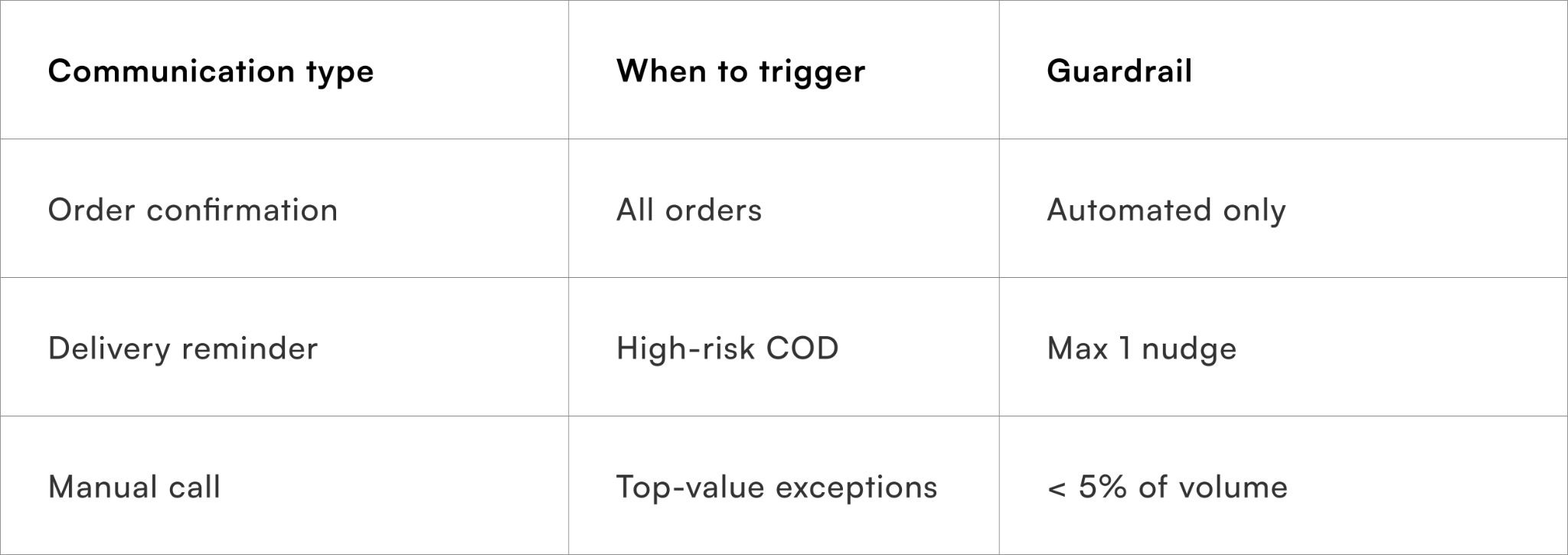
The objective is to reduce refusals without converting RTO prevention into a support bottleneck.
What financial and inventory risks emerge when RTO drops too fast?
Operational wins can mask balance-sheet stress
A sudden RTO reduction during peak season often looks like a clean win — until finance and ops start reconciling the after-effects. Without guardrails, teams optimise delivery success while creating silent cost leakage elsewhere.
Key risk areas include:
Inventory distortion
Aggressive dispatch of marginal orders increases:
- Slow-moving stock returning post-peak
- QC and restocking congestion
Cost misattribution
RTO costs shift from visible returns to:
- Higher forward shipping
- More reattempt fees
- Support overhead
Accounting lag
Delayed reconciliation of returned inventory can distort:
- Weekly gross margin
- SKU-level profitability
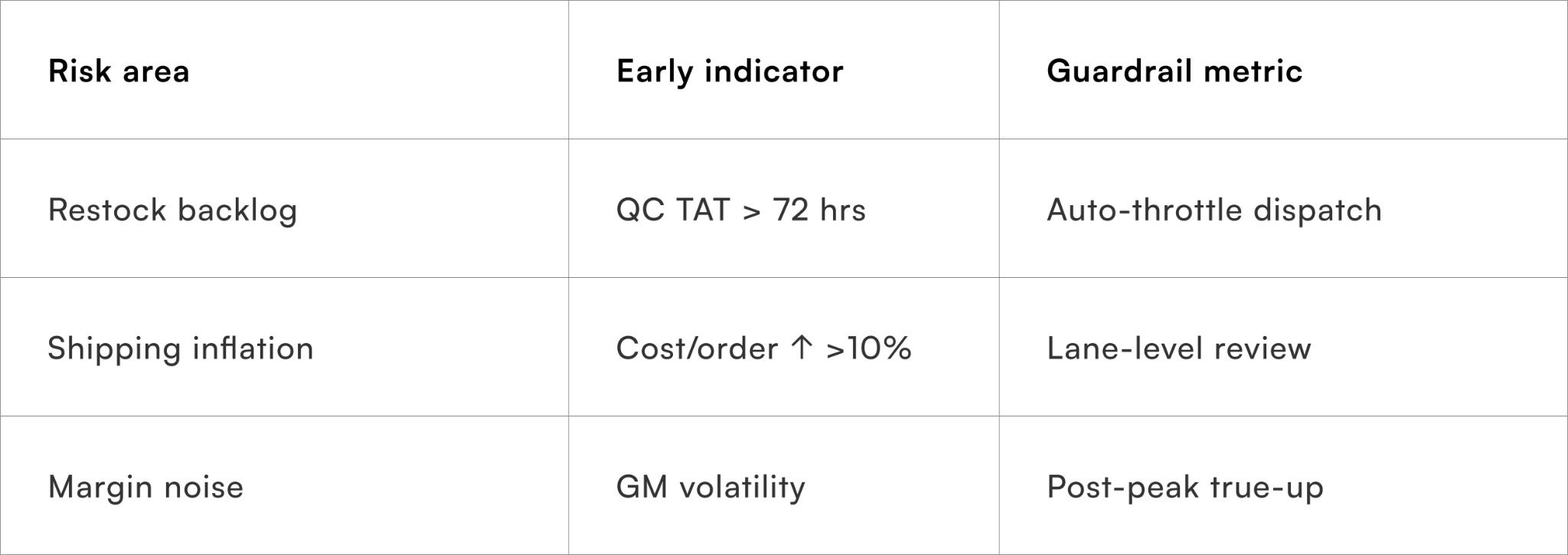
The guardrail mindset here is simple: if RTO falls faster than operational capacity adjusts, something else is absorbing the shock.
How do teams align cross-functionally without slowing decisions?
Pre-aligned rules beat real-time escalation
Peak seasons punish ad-hoc coordination. Waiting for approvals between ops, CX, and finance creates lag exactly when speed matters most.
High-performing teams pre-agree on:
- Acceptable RTO bands by campaign
- Maximum allowable order suppression
- Temporary overrides and expiry dates
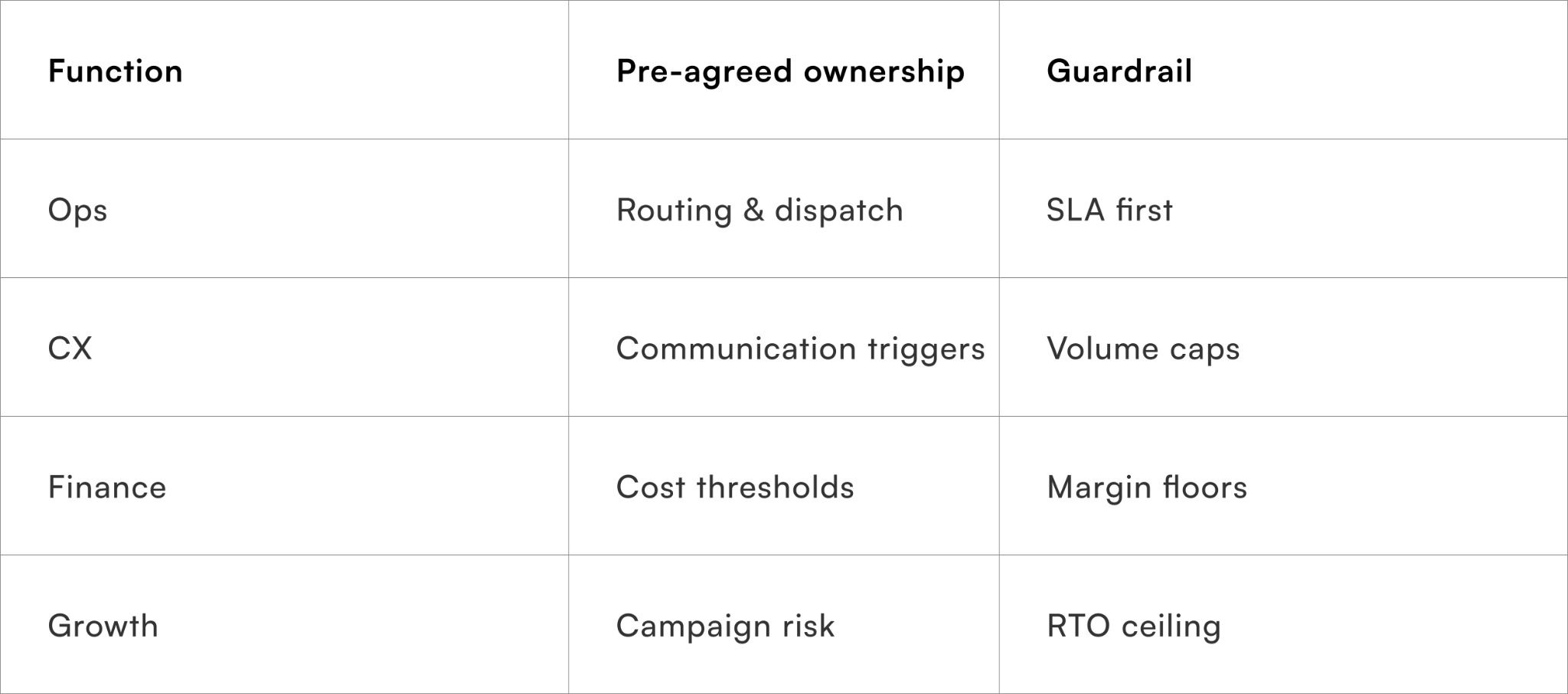
These agreements act as decision guardrails, allowing teams to move fast without escalating every exception.
Quick Wins
Practical guardrails you can deploy before the next spike
Peak seasons don’t leave room for long transformation cycles. These week-by-week actions help teams stabilise RTO reduction efforts quickly, without introducing new operational risk.
Week 1: Define non-negotiable limits
- Set maximum order suppression % by day and by campaign
- Lock fulfilment SLA impact thresholds for any RTO control
- Identify customer cohorts exempt from broad controls
Expected result: Teams stop overcorrecting under pressure.
Week 2: Activate lane-level visibility
- Track daily first-attempt delivery and COD acceptance by lane
- Flag top 10 deteriorating pin codes automatically
- Align carrier rerouting with warehouse capacity
Expected result: RTO risk becomes localised, not systemic.
Week 3: Rationalise customer communication
- Audit all delivery-related messages across channels
- Remove duplicate or low-impact nudges
- Restrict manual calls to defined high-value exceptions
Expected result: Lower refusals without spiking CX workload.
Week 4: Align finance and ops reporting
- Track shipping cost per order alongside RTO rate
- Monitor QC and restock turnaround times
- Run a weekly post-peak margin sanity check
Expected result: RTO improvements reflect real profitability, not optics.
Wrap It Up
Peak-season RTO reduction only works when it’s bounded by clear operational guardrails. The brands that win don’t chase the lowest possible RTO — they optimise for stable throughput, predictable costs, and recoverable operations once the surge ends.
This week, audit your current RTO controls and define hard limits on order suppression, SLA impact, and manual workload before the next spike hits.
Over the long term, sustainable RTO reduction comes from continuously refining segmentation, lane intelligence, and cross-functional alignment — not from reactive tightening during every sale cycle.
For D2C brands seeking tighter control over peak-season delivery risk, Pragma's logistics intelligence platform provides lane-level visibility, automated guardrails, and performance signals that help brands reduce RTO while protecting margins and fulfilment SLAs at scale.

FAQs (Frequently Asked Questions On Operational guardrails when scaling RTO reductions in peak seasons)
1. Should RTO reduction targets change during peak seasons?
Yes. Targets should be banded, not fixed. Accept slightly higher RTO if aggressive reduction risks fulfilment SLAs or margin stability.
2. Is it better to block risky orders upfront or manage them downstream?
Blocking works only within strict limits. Over-blocking hurts growth; downstream controls with lane and cohort segmentation scale better.
3. How much manual intervention is acceptable during peaks?
Very little. Manual processes should handle exceptions only, ideally under 5% of daily volume.
4. Can carrier switching alone solve peak-season RTO spikes?
No. RTO risk is lane-specific. Switching carriers without capacity checks often shifts, rather than solves, the problem.
5. When should teams roll back peak-season RTO controls?
Immediately after volume normalises. Temporary controls must have expiry dates to avoid becoming silent long-term friction
Talk to our experts for a customised solution that can maximise your sales funnel
Book a demo
.png)