

If you are a business owner running an e-commerce business, you must regularly encounter this situation in the day-to-day process.
You see that a customer had placed an order with you, you shipped the item to him, but for some reason, he did not like the product and decided to return it.
Now the product must have reached you through the process called reverse logistics. This is the process through which the products get back to the seller from the company it is sold. And this is one of the most important parts of the business and the supply chain management.
Because it is not just about returning products, it is about how efficiently the business handles the returns, including selling it, recycling or disposing of it. So, let us delve into what "Reverse Logistics in Supply Chain Management: Definition & Examples" is.
Why Reverse Logistics in Supply Chain Management Matters?
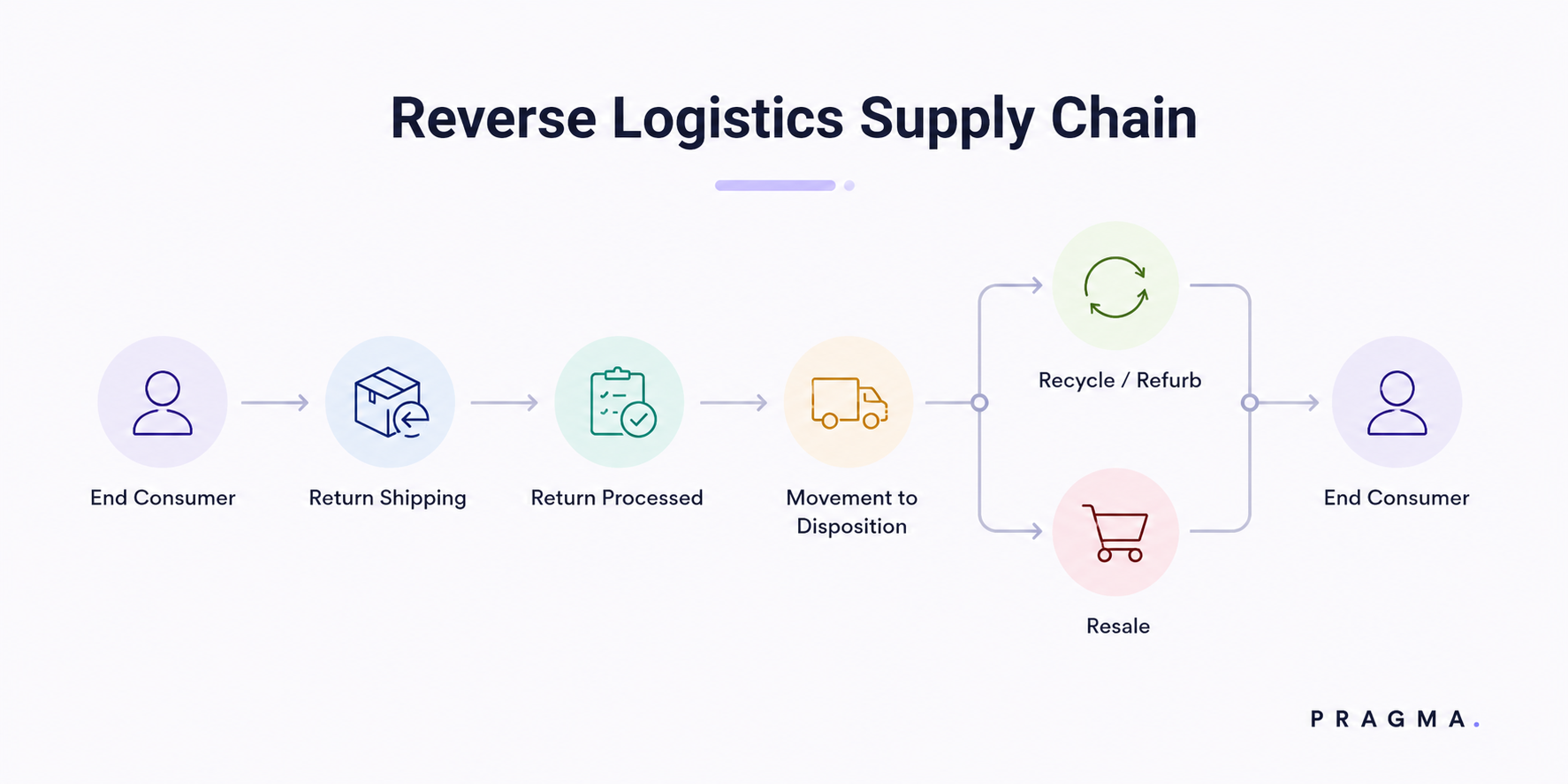
The Indian e-commerce market is rising at a very rapid rate! The India Brand Equity Foundation proposes that online shopping in India will grow to be a market of 200 billion dollars/ ₹18,12,000 crore by 2026.
The point is that when people shop online, they send back the products way more frequently than when shopping in physical stores. Why? Because they are not able to touch and try the products before they make purchases.
Let's look at some real numbers from a research:
- Clothes and shoes: 20-30% returns (the majority of the time due to incorrect size)
- Electronics: 10-15 per cent are returned (they fail to operate normally)
- Online shopping: It accounts for 15-20% of all.
This implies that when a company sells 100 products online, approximately 15-20 will be returned to it. With a business that is selling 10,000 products per month, it is 1,500-2,000 products of returns to manage!
That is why, with such a high number of returns, it is important to handle reverse logistics in an efficient manner so that the supply chain remains smooth. Here are some other reasons that states why reverse logistics in the supply chain is crucial:
- In order to carry out all the operations smoothly without any mess-ups or delays in processing returns, it is essential that the business focus on proper reverse logistics.
- Bad return handling can cost companies 20-30% more than regular shipping, according to the Council of Supply Chain Management Professionals. But with proper return management, brands can cover up to 60-80% of their product value.
- According to the Ellen MacArthur Foundation, the global benefits of reusing products (not disposing of them) would become 4.5 trillion by 2030.
- The National Retail Federation discovered that 92 per cent of customers will repurchase from a company when it is easy to send back goods. However, in cases where returns are hard to come by, the customer may never return.
What Is Reverse Logistics in Supply Chain Management?
Reverse logistics is the process of moving the products back from the customer to the business through the supply chain when the customer initiates the return for any reason. The following could be the reasons behind the reverse logistics:
- May the customer did not like the product
- The product does not fit well with the customer.
- Wrong or defective products have been delivered.
- The customer changes his mind and no longer needs the product, etc.
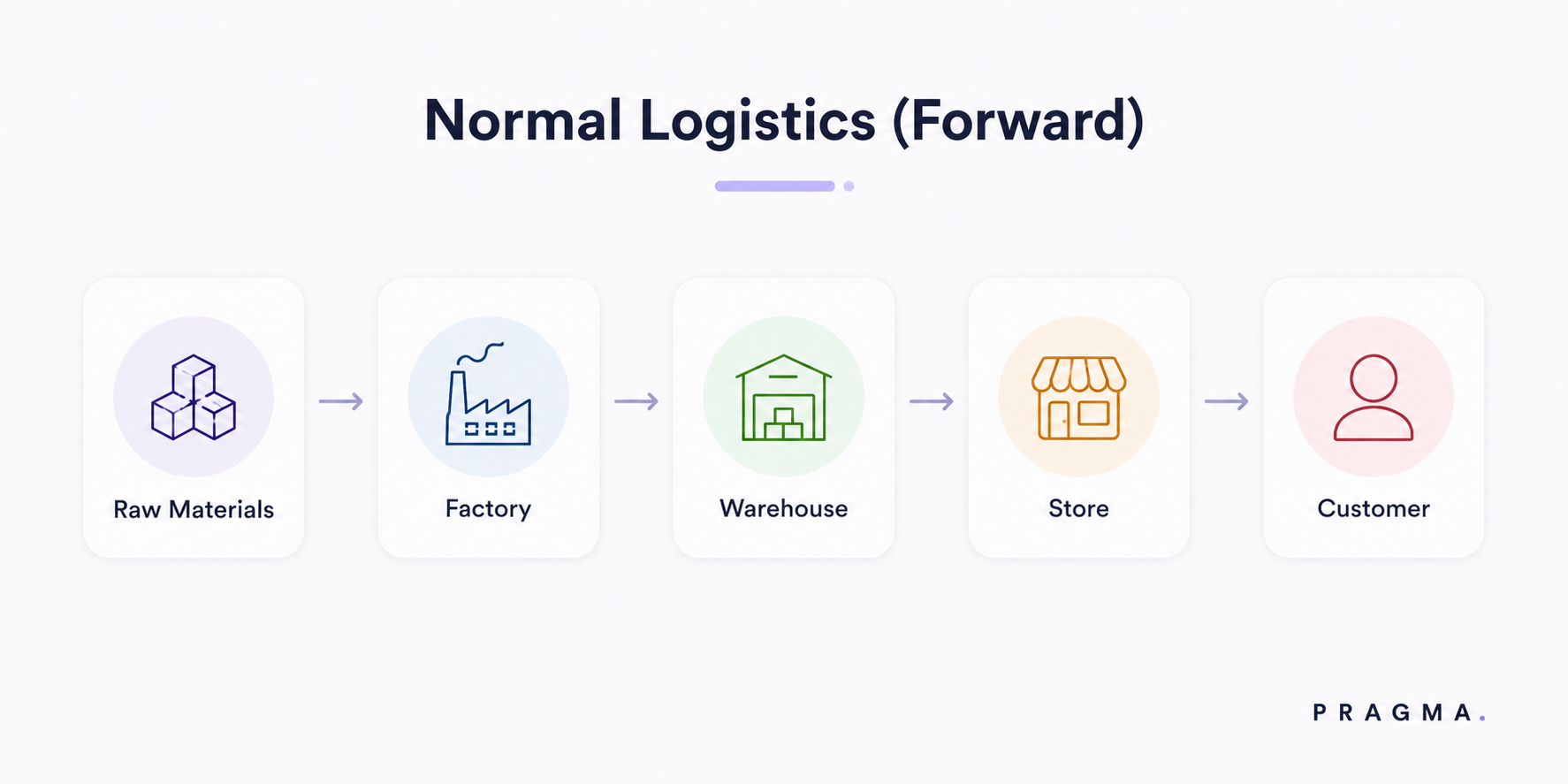
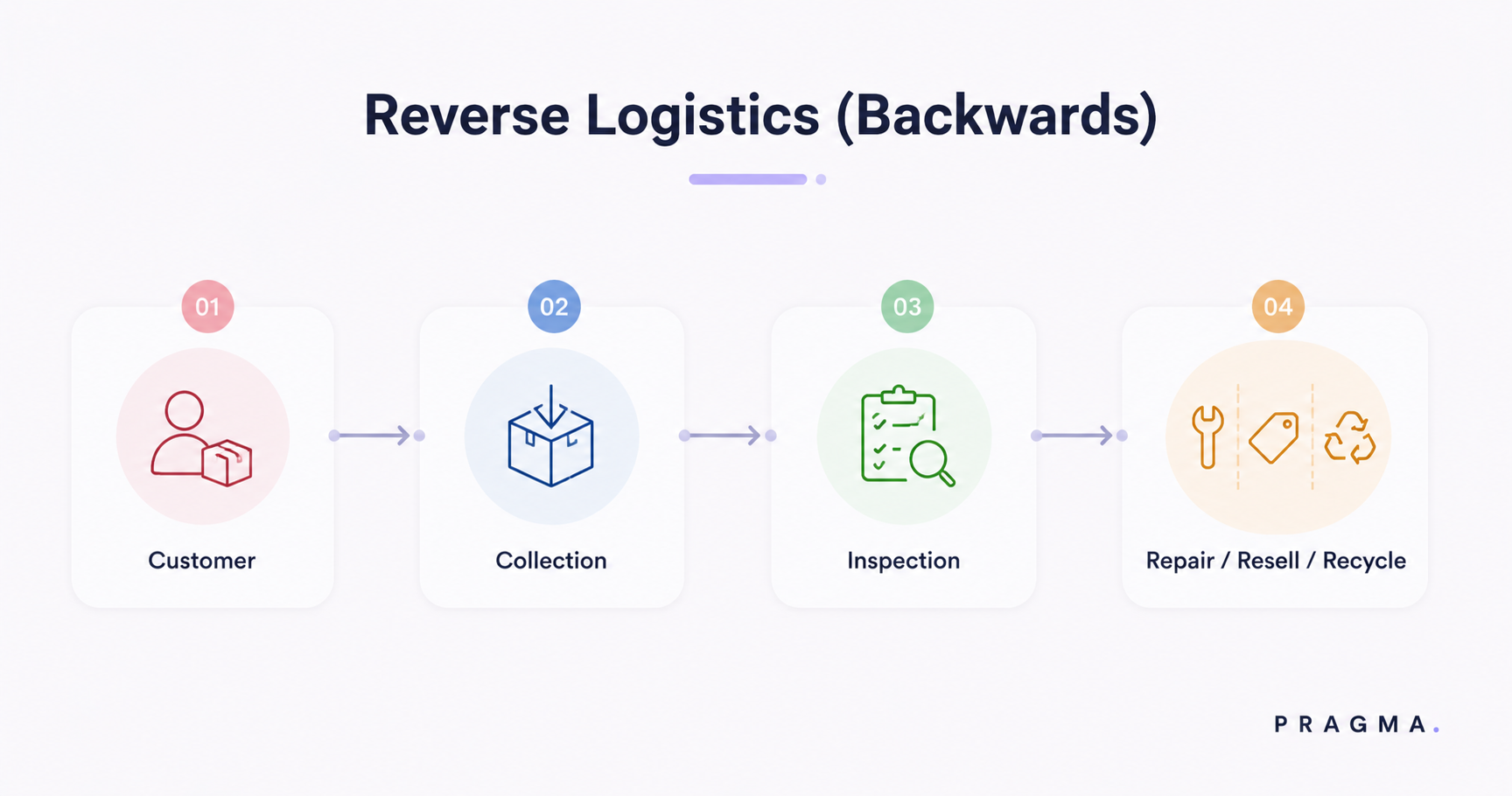
The reverse logistics is just the opposite of the forward logistics. In the forward logistics, the goods are transferred or shipped to the customer from the business, whereas in reverse logistics, it gets transferred back to the business.
From the following flow chart, you can easily grab the flow of both the logistics in the supply chain:
Normal Logistics (Forward):
Raw materials → Factory → Warehouse → Store → Customer
Reverse Logistics (Backwards):
Customer → Collection → Inspection → Repair/Resell/Recycle
And the big difference is that reverse logistics is much harder to predict. Companies never know exactly:
- When will products be returned?
- What condition will they be in?
- How many will come back?
- What needs to be done with each one?
That is why it has become one of the crucial aspects of supply chain management.
Key Activities of Reverse Logistics- What are The 5 R's of Reverse Logistics?
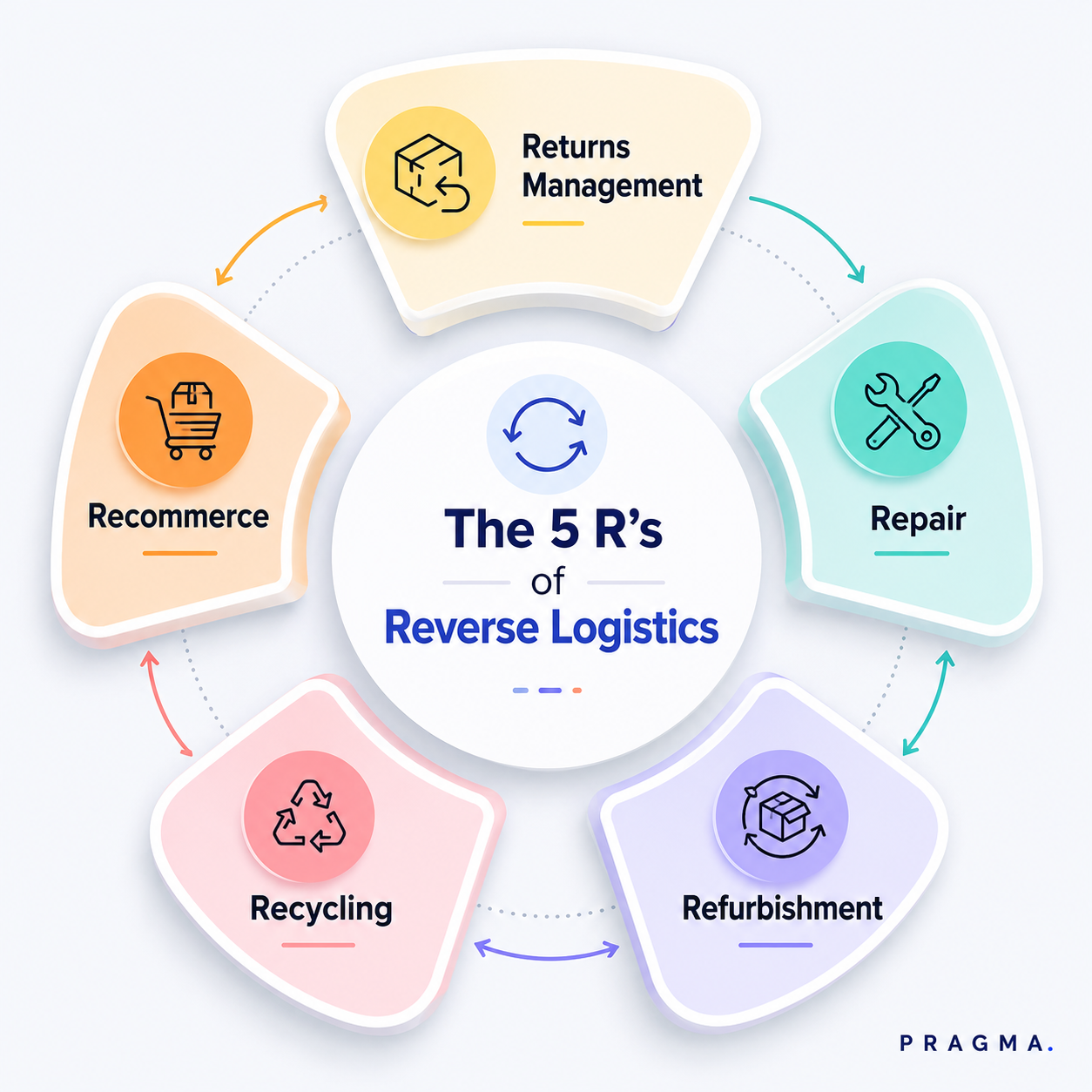
1. Returns
The first R of the reverse logistics is the return. This occurs when customers send products back because of the following reasons:
- The wrong size or a different coloured product was delivered.
- Defective products are delivered.
- Products got damaged during shipping.
- The customers simply changed their minds and don't want the product anymore.
2. Reselling
Now, when the customer initiates the return, and the goods come back to the business, the good-condition returned products can be sold again:
- As "open box" items at discounted prices
- Through outlet stores
- On secondary marketplaces
3. Repairs
Some returned products that are received may need some fixing to be sold again:
- Warranty repairs
- Refurbishment to like-new condition
- Component replacement
4. Repackaging
Sometimes it may happen that products are in good condition but with damaged packaging. Then those products can be repacked with:
- New packaging materials
- Quality checks
- Relabeling if needed
5. Recycling
When products can't be resold or repaired, they are sent for recycling purposes to:
- Extract valuable materials
- Taking apart products to separate different materials
- Proper disposal of hazardous components
What is the Importance of Reverse Logistics in E-commerce and Retail?
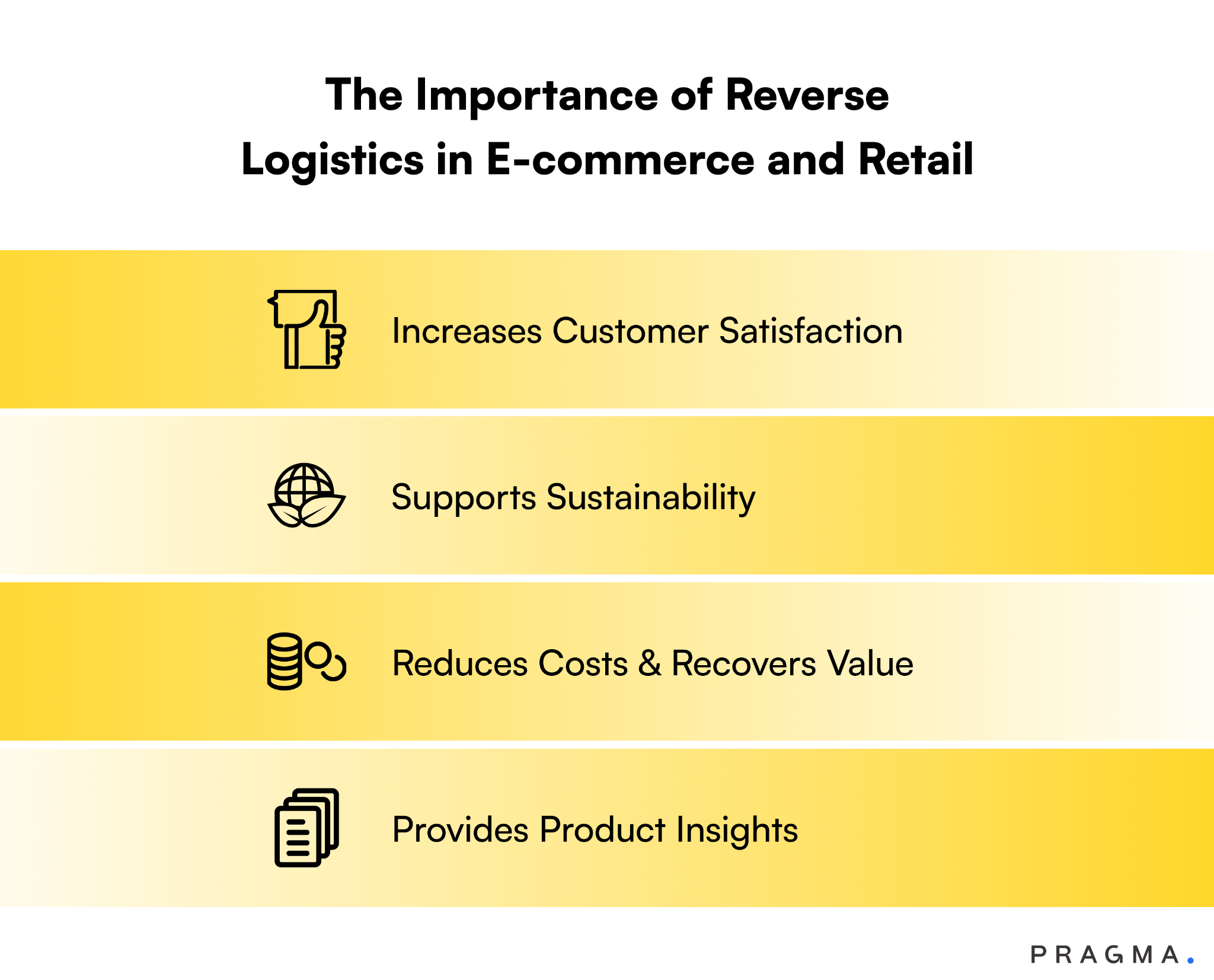
Increases Customer Satisfaction
Customers are comfortable making purchases online since they know that it is easy to make returns. The Baymard Institute states that 67% of individuals examine the return policy prior to purchasing something online.
Here's why easy returns are so important:
- Trust in purchasing: When customers understand that they can return things without any difficulties, people become more ready to get new products.
- Building trust: Good return experiences show that companies are concerned about their customers.
- Repeat business: Customers who are happy will repeat their purchases. This helps to increase sales and revenues.
Supports Sustainability
Reverse logistics contributes to preserving our environment in the following ways:
- Extends product life cycles: Companies do not have to dispose of products returned, but they can repair them and offer them once more. According to the Environmental Protection Agency, this could save the environment from damage by 70-80% of producing new products.
- Recovers useful stuff: E-waste has gold, silver, and other precious metals. These materials can be recycled to recover up to 95% rather than mining for other materials.
- Less wastage: The correct recycling removes products by placing them in landfills, where they may cause environmental damage.
- Meets customer expectations: Studies by Nielsen indicate that three out of five individuals across the globe are willing to spend extra money on buying the products of environmentally responsible organisations.
Reduces Costs & Recovers Value
Reverse logistics actually can be profitable to companies in the following ways:
- Smart reverse logistics can restore companies to 60-80% of the original value of a product.
- When all the processes are efficient, the time and money used in handling every item returned are minimised.
- It is possible to replace fixed products with the help of inventory.
Provides Product Insights
The returns provide companies with much information on their products and their customers:
- Product issues: When a large number of individuals take back the same product on account of a similar factor, then there may be a design or quality concern.
- Customer preferences: Return reasons give information on what customers actually desire and what they do not desire.
- Market trends: It can be determined that the shifting trend in customer preferences can be observed in the way they change their patterns.
The information is used to enable companies to design superior products and develop their services.
Reverse Logistics in Supply Chain Management Examples
Let us have a look at some of the reverse logistics in supply chain management examples in different industries!
Example 1: Fashion E-commerce Company
Let us consider that there is a clothing company that receives 25% returns due to size issues.
So, this is how the reverse logistics process follows there:
- Customer returns: A client has purchased a shirt via the internet, and it does not fit. They visit the site and press the button Return item.
- System gathers data: The site inquires about the reason as to why they are returning it (wrong size) and what its condition is (new with tags).
- Return authorisation: The system assigns them a return number and choices - they can choose to be picked up at home or drop off at a partner store.
- Inspection of products: Upon arrival at the warehouse, the shirt is inspected by trained staff.
- Decision making:
- In case of perfect, with tags - Returns to regular inventory
- In case of good and no tags - Visit the outlet section at a discount.
- In case of damage, submit to the repair section.
- Get to textile recycling - in case it can be repaired.
And in the above scenario mentioned, the Pragma's Return Management System can help the major D2C indian e-commerce brands in handling their returns efficiently. Here is what it can provide:
- It helps businesses create branded return pages for customers to initiate returns. They are built as per the brand's guidelines and custom domain names.
- It helps in the automatic AWB creation for reverse shipments, once the request is approved. But before approving, it checks the return eligibility properly. It interferes with, if the item is not eligible for return, by disabling the return eligibility based on SKUs.
- It enables/disables images & video upload based on the reasons for return.
Example 2: Electronics Retailer
Let us take another reverse logistics in supply chain management example of an electronic retailer. A smartphone is returned by a customer as a result of battery problems.
The reverse logistics process that occurs here is as follows:
- The customer brings the phone to the service centre.
- Battery defect is confirmed by technical diagnosis.
- The phone was sent to the repair facility.
- Replaced battery, phone tested.
- A second-hand phone is sold as a certified pre-owned one.
- A defective battery is sent to be recycled properly.
- Notice to the manufacturer on battery quality.
What are The Challenges of Reverse Logistics in India?
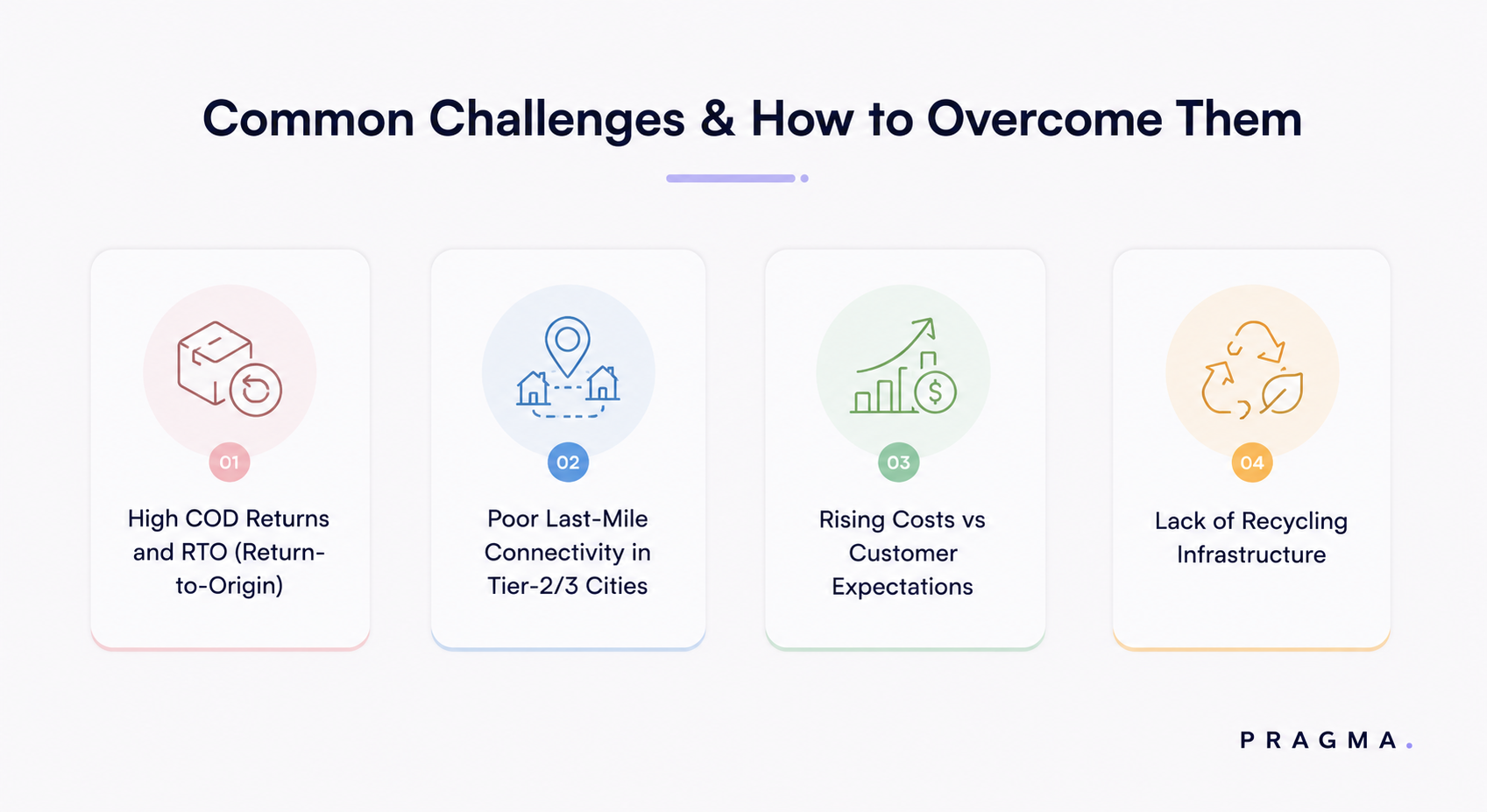
The Indian e-commerce market is prone to several different challenges that make it difficult for businesses to handle reverse logistics in supply chain management. Here are the following:
High COD Returns and RTO (Return-to-Origin)
The Cash on Delivery (COD) - paying on receiving the product at the door is still a favourite among many people in India. It is being reported that in India, 40-50% of online purchases are COD.
There are significantly high return rates in COD orders:
- COD orders: 25-30% return rate
- Prepaid orders: 10-15% return rate
When individuals have yet to make payments, they have it much easier to reject delivery or send items back within a short time. That is why this human behaviour becomes one of the problems in reverse logistics in the supply chain.
Poor Last-Mile Connectivity in Tier-2/3 Cities
Online shopping in India has extended to the small cities and villages, and the infrastructure has failed to keep pace. The report on the logistics infrastructure of KPMG demonstrates the following issues:
The smaller cities have a limited number of logistics companies, which results in:
- Less competition results in higher costs.
- Slower service
- Poor pick up and delivery.
Also, there are infrastructure problems prevailing mainly in India.
- Ineffective roads complicate and increase the cost of transport.
- Poor warehouse capacities.
- Customers are not easily found due to poor addressing systems.
Rising Costs vs Customer Expectations
Indian consumers insist on free and fast shipping back due to the availability of this feature by large corporations such as Amazon and Flipkart. However, the actual costs continue to rise because of:
- Fuel prices increasing
- Labor costs rising
- Infrastructure limitations
According to McKinsey's supply chain research, reverse logistics costs 20-30% more than forward logistics because:
- Each return needs individual handling.
- Timing is unpredictable
- Products go to different destinations.
- No economies of scale like regular shipping
Lack of Recycling Infrastructure
India lacks adequate recycling systems for all the returned products unable to be resold. According to the Central Pollution Control Board, the problem is as follows:
- The production of electronic waste in India is 3.2 million tons per year.
- Only 20-25% gets properly recycled.
- The remaining usually go into informal recycling, which can be harmful to the environment.
- The clothes that get returned are dumped into landfills.
- The majority of recycling centres are located in large industrial cities, and therefore, businesses are forced to transport waste over long distances, further increasing their expenses.
Strategies to Improve Reverse Logistics in Supply Chain Management
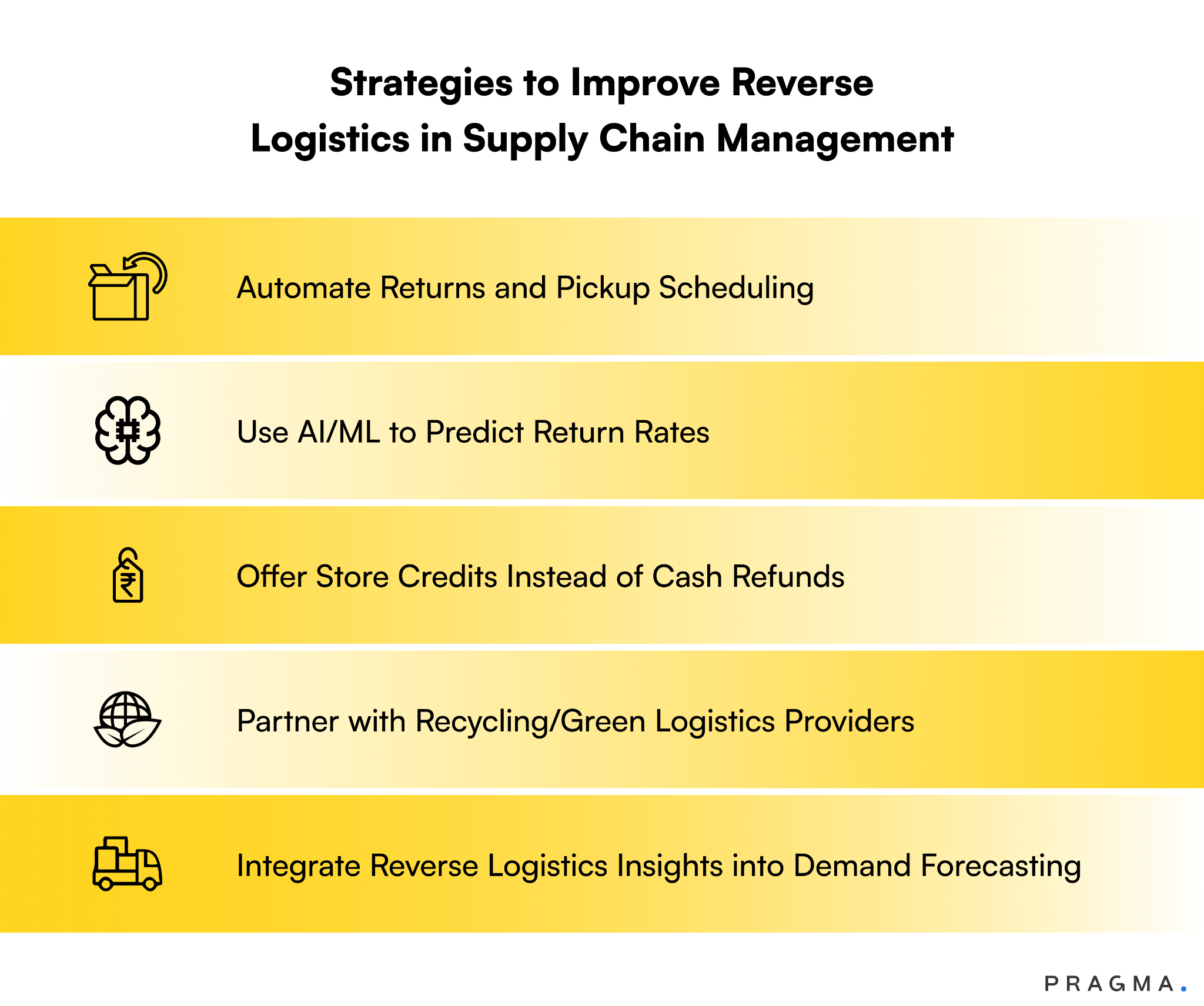
The following strategies can help in improving reverse logistics in supply chain management:
Automate Returns and Pickup Scheduling
Automation refers to the processing of returns that have been automated rather than being done manually by individuals. This will make the process quick, less expensive and more precise. Here is how brands can automate their work:
- They can use intelligent websites that guide customers through returns.
- They can use such systems that help in granting routine returns automatically.
- Make use of systems that help in providing real-time information about return status.
- They can provide several pickup and drop-off options, such as pickup and drop-off, etc.
See how Pragma can help you!
Pragma has a Return Management System (RMS) that can automate the whole returns process:
- Smart return authorisation: It can automate the routine returns and indicate any unusual cases to be reviewed by humans.
- Smart pickup scheduling: It can optimise the routes and merging of returns to reduce transportation costs.
- Fluent integration: It can integrate with the current warehouse systems to automatically direct products to the appropriate processing locations.
- Real-time monitoring: It gives the customer and internal teams visibility of their returns.
- Analytics and insights: It gives more specific information about the trends of returns, costs, and value recovery rates.
Use AI/ML to Predict Return Rates
Technologies like Artificial Intelligence (AI) and Machine Learning (ML) can be used to process massive amounts of data to forecast future events. In case of returns, it can help in getting the data related to the following:
- What products will be returned and why?
- Which customers can be predicted to have more likely chances of returning items?
- What regions will be performing better in returns?
- When the volumes of returns will be the highest.
Offer Store Credits Instead of Cash Refunds
To manage the cash flow in the organisation, businesses can provide customers with store credits or points instead of cash refunds to their customers. By doing this, they can get the following benefits:
- There will be no need to pay cash immediately.
- The customers who have given points will be likely to purchase again.
- Also, the customers can purchase more than the prior store points.
Partner with Recycling/Green Logistics Providers
Companies can collaborate with recycling companies and logistics partners that are friendly to the environment to dispose of used, broken, or unsold products in a responsible manner.
Rather than disposing of things, these partners assist in the recycling of resources, the reusing of useful constituents, and disposing of materials in an environmentally-friendly manner.
This not only minimises environmental degradation but also helps achieve sustainability objectives as well as increase the brand image of an environmentally friendly company.
Integrate Reverse Logistics Insights into Demand Forecasting
The returned products give a good insight into customer behaviour and product performance. With the help of that data, businesses can interpret the reasons behind the returns better, which could be due to defects, wrong sizing or low quality, which helps them understand what customers really require.
This information may be utilised to make more accurate predictions of future demand, better design of products, prevent excess stock ordering, and minimise future returns.
What is the Future of Reverse Logistics in India?
If we talk about the future of reverse logistics in India, we can see the following major things:
AI-Driven Smart Reverse Logistics Platforms
Artificial intelligence will enable the future of reverse logistics, where everything will be smarter and more automated:
- AI will develop optimal routes to pick up returns based on the current traffic, the weather and the customer preference.
- The computerised results can help to make decisions on whether to resell, repair, or recycle the returned items.
- It will act as an indicator of when products might fall out of order and avoid returns before they occur.
- Smart systems will automatically adjust the prices of refurbished products depending on the demand and market conditions.
Growth of Re-commerce (Second-hand/Resale Marketplaces)
Re-commerce refers to the sale and purchase of second-hand or refurbished goods. KPMG market analysis of re-commerce in India shows that this market will become $18 billion by 2025.
The following are the major players in this industry:
- Cashify
- 2GUD
- Flipkart Refurbished
To Wrap It Up
So, to conclude here, we want to say that reverse logistics is one of the crucial things in the supply chain of a business. Because it not only impacts the profitability of the business but is also linked to customer satisfaction.
And with proper strategies and systems, businesses can excel in reverse logistics management. And to support you in this journey, Pragma is here to help you with end-to-end solutions for all D2C e-commerce brands.

FAQs (Frequently Asked Questions On Reverse Logistics in Supply Chain Management: Definition & Examples)
1. What is reverse logistics in supply chain management?
Reverse logistics refers to the process of moving goods from the customer back to the seller or manufacturer for returns, repairs, refurbishment, recycling, or disposal.
2. How is reverse logistics different from forward logistics?
Forward logistics manages the movement of products from supplier to customer, while reverse logistics manages the return flow of products from customer back to the business.
3. Why is reverse logistics important in e-commerce?
Reverse logistics is critical in e-commerce due to higher return rates, especially in categories such as fashion and electronics. Efficient reverse processes reduce costs, protect margins, and improve customer satisfaction.
4. What are common examples of reverse logistics?
Examples include customer returns, Return to Origin (RTO), warranty replacements, product recalls, damaged goods recovery, recycling programmes, and refurbishment operations.
5. What are the main steps in the reverse logistics process?
Typical steps include return initiation, approval, pickup or drop-off, inspection and quality control, refund or replacement processing, restocking or disposal, and inventory update.
6. What challenges are associated with reverse logistics?
Common challenges include high transportation costs, delayed inspections, inventory mismanagement, refund delays, lack of visibility, and increased warehouse workload.
7. How does reverse logistics impact profitability?
Poor reverse logistics increases shipping costs, handling expenses, inventory ageing, and labour requirements, which directly affect contribution margins and cash flow.
8. How can technology improve reverse logistics?
Technology enables automated return authorisation, courier coordination, real-time tracking, refund triggers, data analytics, and inventory reconciliation, reducing manual intervention and errors.
9. What industries rely heavily on reverse logistics?
E-commerce, retail, electronics, automotive, pharmaceuticals, and consumer goods industries rely heavily on reverse logistics due to product returns, warranties, and regulatory requirements.
10. How can businesses optimise reverse logistics processes?
Businesses can optimise reverse logistics by implementing clear return policies, automating workflows, tracking return reasons, improving quality checks, and integrating reverse data into supply chain planning.
Talk to our experts for a customised solution that can maximise your sales funnel
Book a demo

.png)
.png)