

In Indian D2C, most failed deliveries do not collapse because customers lose intent. They collapse because brands respond too late. A delivery attempt fails, an NDR is marked, and hours pass before anyone reaches out. By then, urgency fades and friction hardens into disengagement.
This is where Golden-hour contact strategies to maximise order recovery become operationally critical. The golden hour order recovery window refers to the first 60–120 minutes after a delivery exception, when proactive customer contact can significantly increase recovery probability.
Instead of treating last mile exception management as a back-office workflow, brands that design structured order recovery strategies treat it as a time-sensitive conversion moment.
The real question is not what is golden hour in order recovery. It is whether your systems are fast enough to act within it.
Why do most D2C brands lose recoverable orders after dispatch?
Revenue leakage begins in operational blind spots
The majority of post-dispatch losses are not caused by customer intent to cancel. They are caused by delayed visibility and delayed response. A delivery attempt fails. A COD customer becomes unreachable. An address is incomplete. By the time the CX team intervenes, the parcel is already moving back to origin.
This is where most order recovery strategies break down. Teams treat recovery as a reactive process instead of a time-sensitive intervention.
Three common gaps drive avoidable losses:
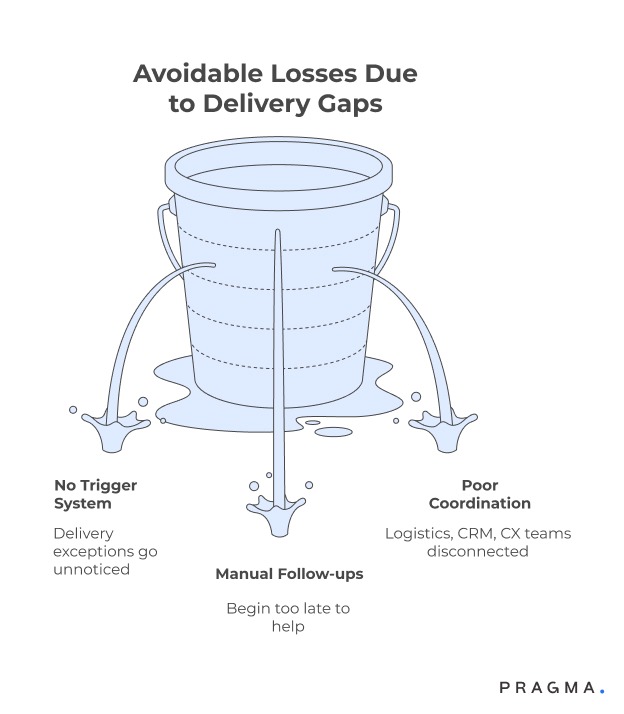
- No structured trigger system for delivery exceptions
- Manual follow-ups that begin too late
- Poor coordination between logistics, CRM, and CX teams
The cost is not just RTO freight. It is blocked inventory, delayed revenue recognition, and inflated CAC because replacement sales require fresh marketing spend.
Without disciplined last mile exception management, even strong acquisition funnels struggle to protect contribution margins.
What is golden hour in order recovery and why does timing matter?
The first intervention window defines recovery probability
So, what is golden hour in order recovery?
It is the first 30–120 minutes after a high-risk event — such as a failed delivery attempt, unreachable status, or payment hesitation — when the probability of customer response is highest.
Behaviourally, customers are still contextually engaged during this window. They remember the order. They are reachable. They have not mentally disengaged from the purchase.
Once 6–12 hours pass:
- Intent weakens
- Customers stop answering unknown numbers
- Parcels move further into the RTO pipeline
Here is how response probability typically behaves:
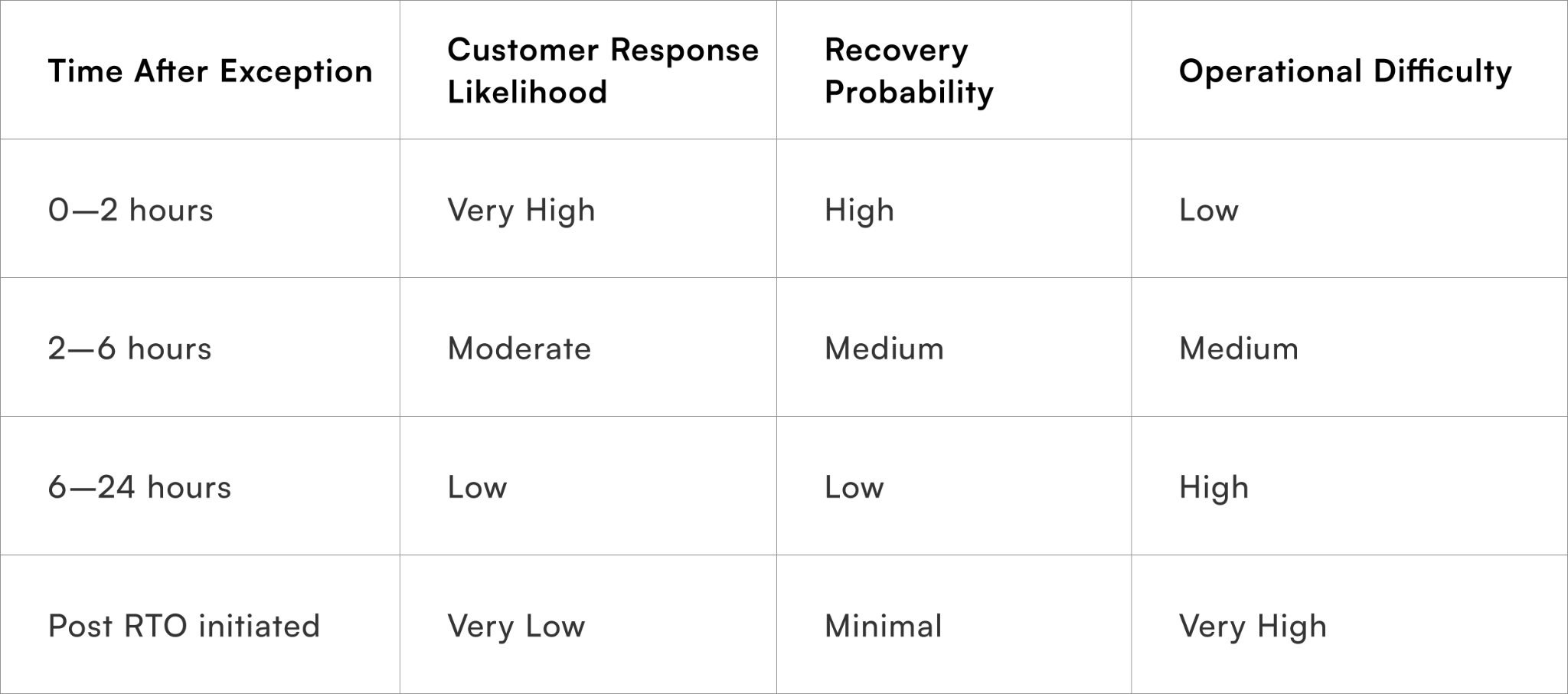
Golden hour order recovery is not about speed for optics. It is about intervening before intent decays.
Why does proactive customer contact outperform reactive follow-ups?
Structured outreach reduces friction and restores intent
Most brands wait for customers to call back. This is operationally convenient but commercially inefficient.
Proactive customer contact shifts the dynamic. Instead of waiting for confirmation, teams initiate structured outreach the moment a trigger is detected.
Effective outreach during the golden hour includes:
- Immediate automated WhatsApp/SMS confirmation
- Follow-up call attempt within 30–45 minutes
- Clear resolution options (address correction, delivery reschedule, payment confirmation)
Compare the two approaches:
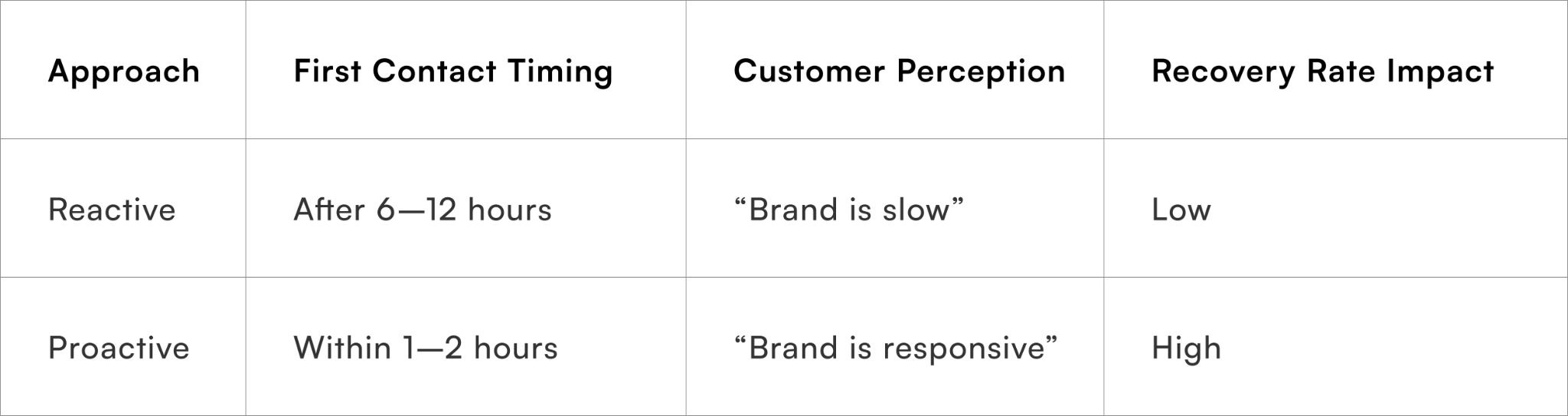
When outreach feels helpful rather than pushy, customers cooperate. Recovery improves without discounting or incentives.
Brands already optimising abandoned funnel stages through abandoned cart recovery frameworks often overlook that post-dispatch recovery can yield comparable incremental revenue.
The key difference? Timing is tighter and stakes are higher.
How does last mile exception management influence recovery outcomes?
Operational alignment determines intervention speed
Golden hour effectiveness depends on visibility. Without real-time exception feeds from logistics partners, CX teams operate blind.
Strong last mile exception management includes:
1. Exception Categorisation
Not all delivery failures are equal.
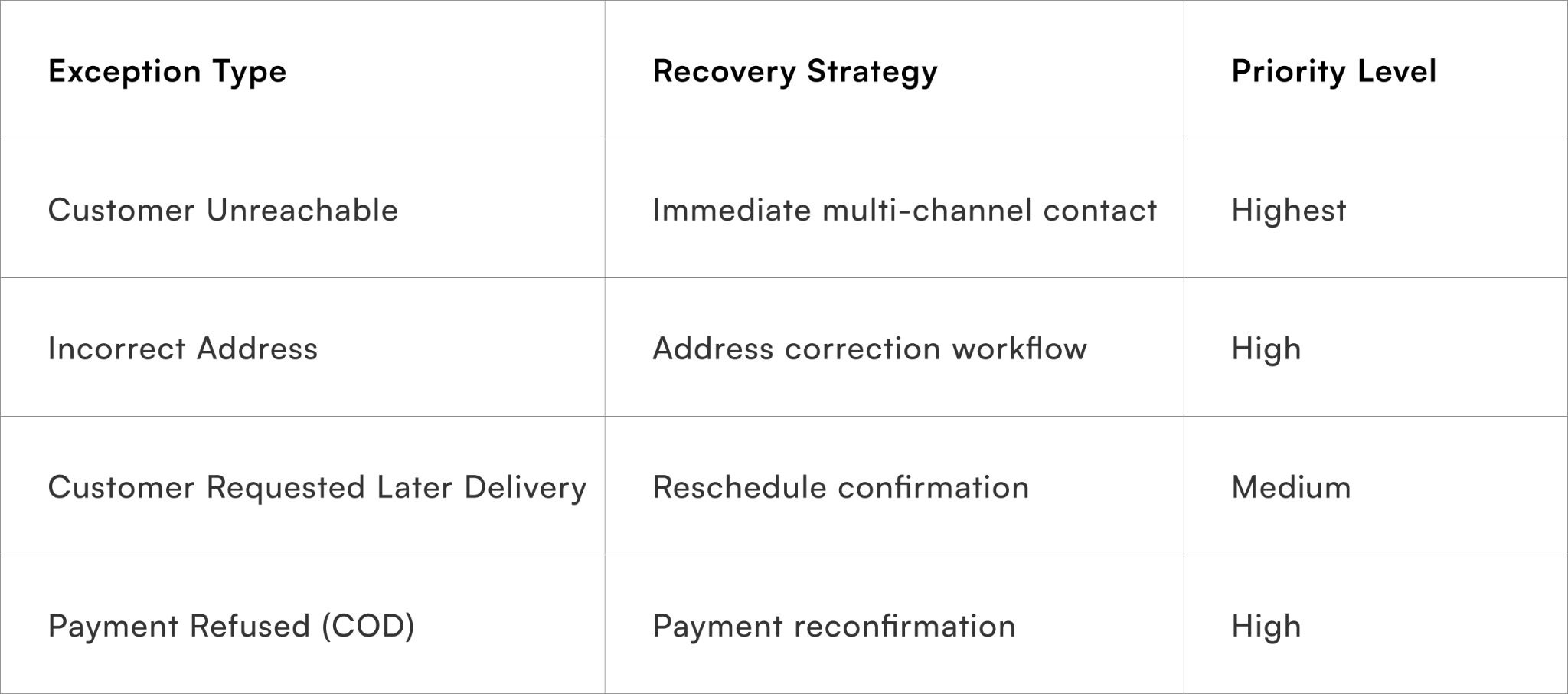
Structured tagging ensures teams don’t treat every case identically.
2. CRM + Logistics Integration
Recovery works best when:
- Delivery partner updates sync automatically into CRM
- Triggers create instant CX tasks
- Outreach history is logged in one system
Brands investing in omnichannel tracking frameworks often see measurable gains when exception data is layered into CRM logic, similar to how ROI is evaluated in [measuring the ROI of your omnichannel CRM investment].
The difference is immediacy. Golden hour workflows require automated triggers, not daily reports.
3. Ownership Clarity
Recovery stalls when:
- Logistics blames CX
- CX waits for warehouse confirmation
- Ops intervenes too late
Assigning a single recovery owner per order ensures speed and accountability.
Why do contribution margins improve when golden-hour workflows are enforced?
Recovery protects profit more efficiently than acquisition
Every recovered order saves:
- Forward freight
- Reverse freight
- Packaging cost
- Payment gateway reversals
- Replacement marketing spend
Consider this simplified comparison:
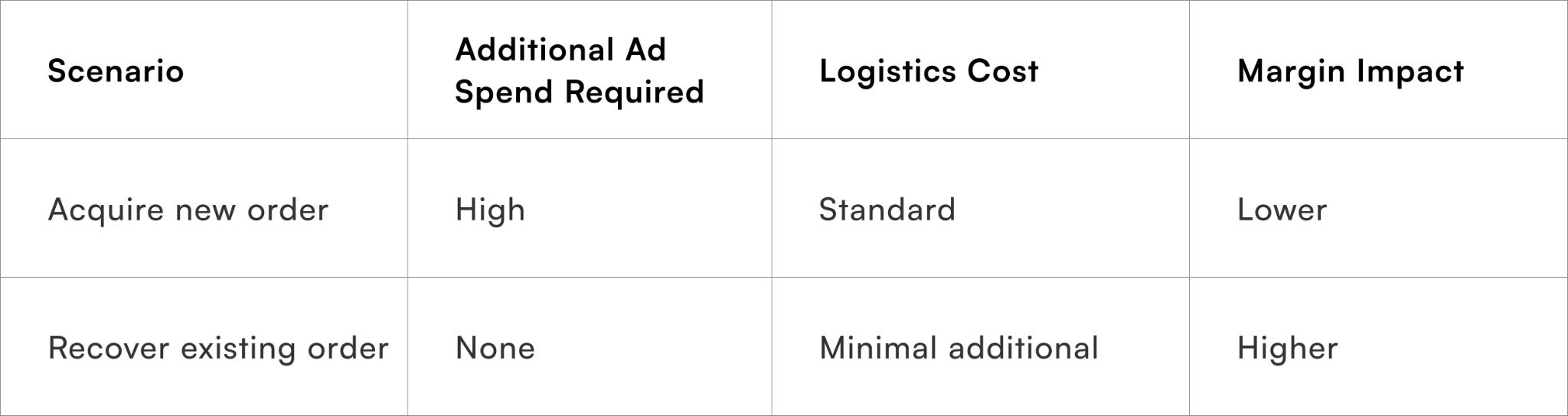
Recovering one high-AOV order during the golden hour often delivers better ROI than acquiring two new customers through paid media.
This is particularly critical for brands battling RTO pressure. Structured intervention during the golden hour reduces downstream losses often discussed in frameworks around reversing RTO losses ASAP.
Golden hour order recovery is not a CX tactic. It is a margin-protection strategy.
When should automation take over in golden hour order recovery?
Speed first, human judgement second
Golden hour order recovery depends on immediacy. Human teams alone cannot react within minutes at scale. Automation must trigger first contact; humans should intervene where nuance is required.
A simple rule works well:
- 0–15 minutes: Automated acknowledgement
- 15–60 minutes: Structured human follow-up
- Post 2 hours: Escalation or conditional closure
Automation should handle:
- Instant WhatsApp/SMS after failed delivery
- Payment reconfirmation links
- Address correction forms
- Reschedule options
Human intervention is critical when:
- High AOV orders are at rise
- Repeat customers show unusual behaviour
- Multiple failed contact attempts occur
Automation accelerates response. Humans protect brand tone. Together, they maximise recovery probability.
How can you design structured golden hour order recovery playbooks?
Standardised workflows remove ambiguity under pressure
Recovery collapses when CX teams improvise. A playbook removes decision fatigue and ensures consistency across agents.
A practical golden-hour playbook includes:
1. Trigger Matrix
Define what qualifies as “high risk”.
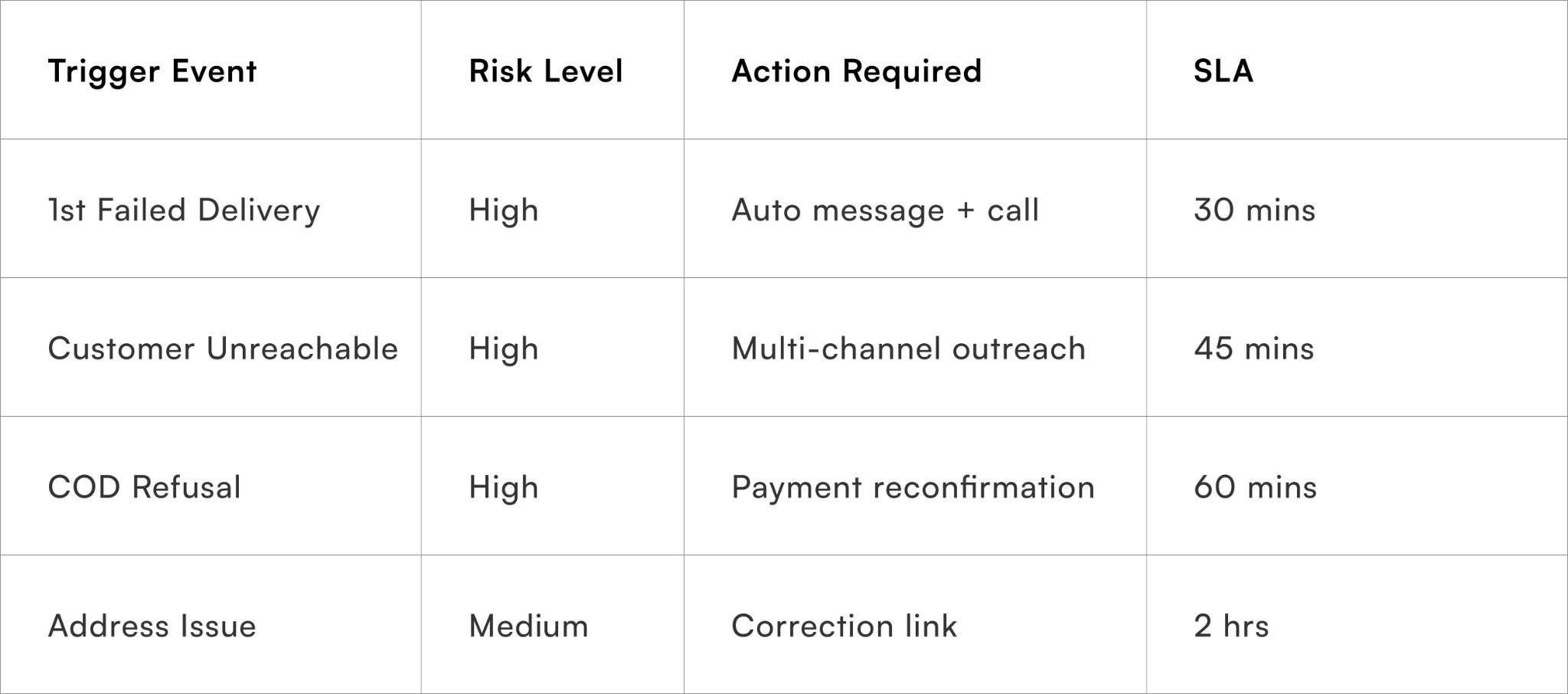
This matrix ensures that teams don’t treat exceptions casually.
2. Communication Templates
Templates should:
- Be solution-oriented, not accusatory
- Offer clear next steps
- Reduce effort for the customer
Example shift:
Instead of: “Your delivery failed.”
Use: “We noticed your delivery attempt didn’t go through. Would you like us to reschedule it for tomorrow?”
Tone influences cooperation.
3. Resolution Pathways
Every outreach should end with a clear action:
- Confirm delivery
- Update address
- Switch to prepaid
- Cancel intentionally
Ambiguity increases repeat follow-ups and operational load.
How does order type segmentation improve recovery performance?
Not all orders deserve identical urgency
Treating every exception equally wastes effort. Segmentation improves efficiency and margin protection.
Segment by:
- Order value (AOV tiers)
- First-time vs repeat buyer
- COD vs prepaid
- High-return SKU categories
Example framework:
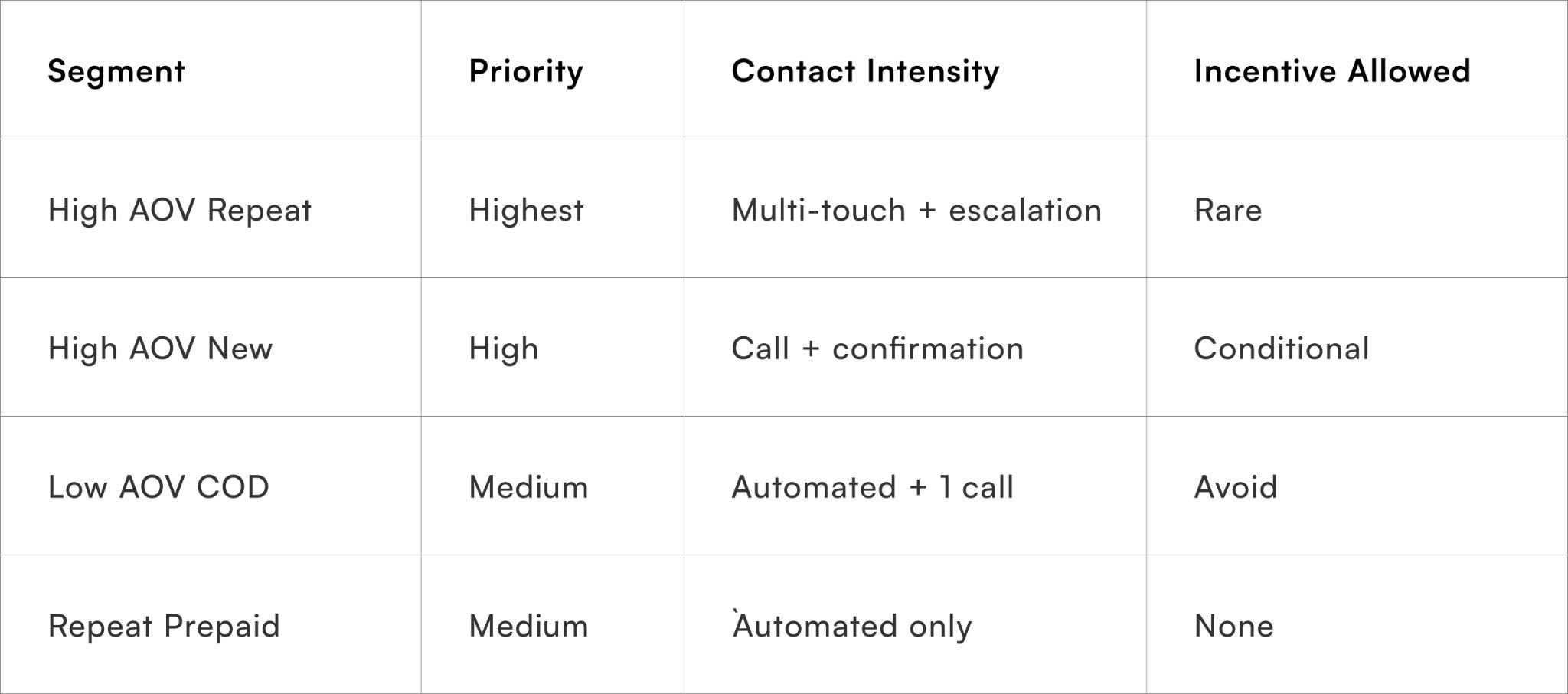
This approach prevents over-servicing low-risk orders and under-serving high-value ones.
Teams that already optimise funnel stages like abandoned cart recovery often discover that applying segmentation discipline post-dispatch yields similar incremental gains.
Recovery is not volume management. It is value prioritisation.
Why do incentives sometimes hurt golden hour order recovery?
Discounting can train undesirable behaviour
Offering instant discounts during recovery seems logical. In practice, it can distort customer behaviour.
Risks include:
- Encouraging intentional COD refusals
- Teaching customers to wait for recovery discounts
- Reducing margin unnecessarily
Incentives should only be considered when:
- High AOV orders are at stake
- Genuine logistics failure occurred
- Customer has strong historical value
Often, clarity and reassurance work better than discounting.
Golden hour order recovery succeeds primarily because of timing and structured communication not because of price correction.
When do golden hour systems fail despite good intent?
Operational friction undermines speed and consistency
Even well-designed workflows collapse under operational realities.
Common failure points:
1. Delayed Data Feeds
If delivery partner updates sync every few hours, golden hour becomes meaningless.
2. Overloaded CX Teams
If agents juggle inbound tickets and recovery calls without priority tagging, high-risk orders slip.
3. No Performance Tracking
Without metrics, recovery becomes anecdotal.
Brands that rigorously measure cross-channel engagement — similar to frameworks discussed in [measuring the ROI of your omnichannel CRM investment] — often achieve better consistency because visibility drives accountability.
Golden hour order recovery requires operational discipline, not just good scripts.
How to operationalise golden hour order recovery across teams?
Cross-functional ownership drives consistent execution
For recovery to become predictable rather than reactive, align three teams:
- Logistics
- CRM/Marketing automation
- CX
Execution checklist:
- Real-time exception tagging
- Automated trigger messaging
- Agent task creation within SLA
- Escalation matrix for high-value orders
- Weekly recovery performance review
Leadership should review:
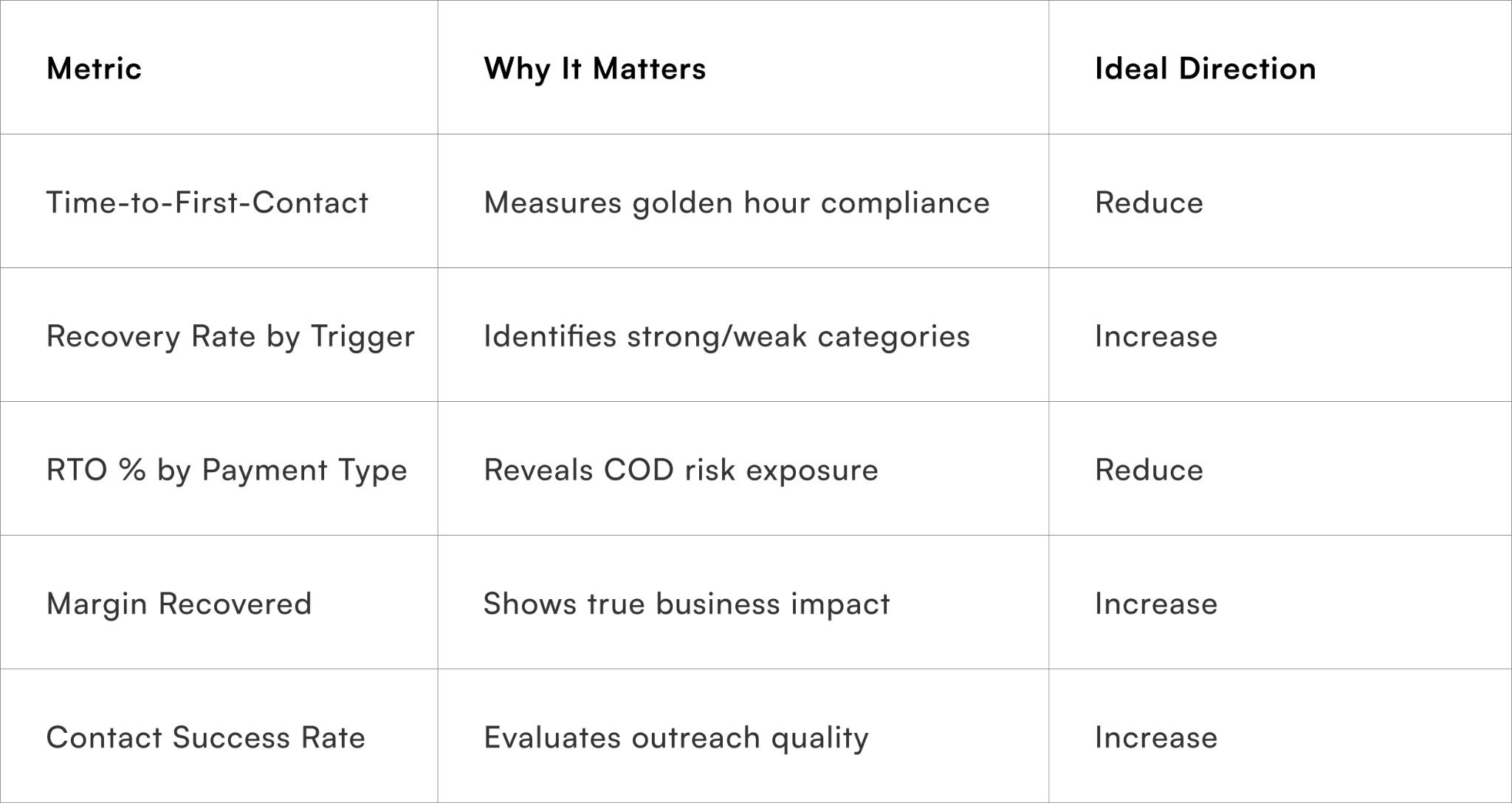
- Recovery rate by trigger type
- RTO reduction trend
- Time-to-first-contact
Golden hour workflows are sustainable only when embedded into dashboards and weekly ops reviews — not treated as ad-hoc firefighting.
How can you implement golden hour order recovery in the next 30 days?
Structured weekly execution roadmap for measurable impact
Golden hour order recovery becomes effective only when converted into disciplined execution. The following 30-day roadmap balances speed with operational control.
Week 1: Define trigger rules and visibility layers
Audit your last 30 days of delivery exceptions. Categorise them into:
- Customer unreachable
- Incorrect address
- COD refusal
- Customer requested reschedule
For each category, define:
- Recovery eligibility
- SLA for first contact
- Responsible team owner
Surface exception rules clearly inside your CRM so agents do not improvise under pressure.
Expected result: Faster, consistent intervention and fewer delayed follow-ups.
Week 2: Activate proactive customer contact workflows
Set up automated messages triggered within 5–10 minutes of an exception.
Include:
- WhatsApp/SMS acknowledgement
- Reschedule link
- Address correction form
- COD confirmation option
Follow this with a structured call attempt within 30–45 minutes for high-risk cases.
This is where proactive customer contact transforms recovery probability. Instead of waiting for inbound queries, you intervene while intent still exists.
Expected result: Higher response rate within the first 2 hours.
Week 3: Introduce segmentation and escalation logic
Segment orders by:
- AOV
- Customer lifetime value
- COD vs prepaid
- Repeat vs first-time buyer
Create an escalation rule for high-AOV orders that fail first contact.
Example:
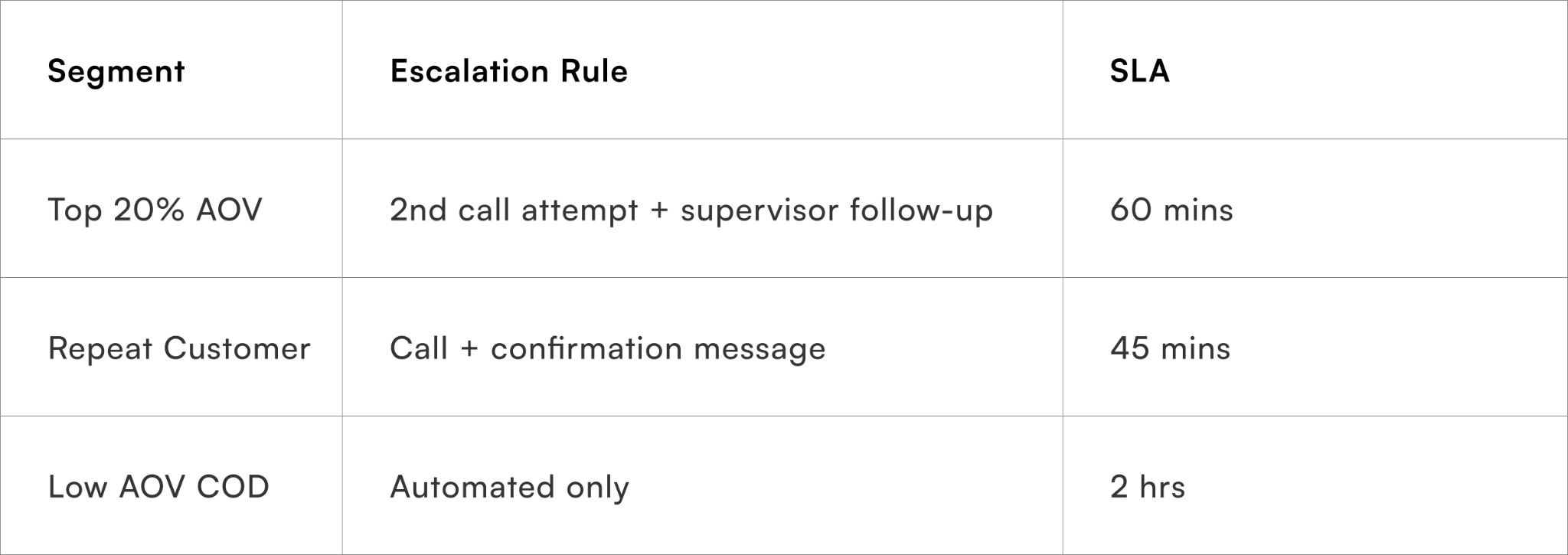
This prevents over-servicing low-risk cases while protecting high-value revenue.
Expected result: Better margin protection without increasing CX headcount.
Week 4: Review, measure, refine
Track:
- Time-to-first-contact
- Recovery rate by exception type
- RTO reduction percentage
- Margin recovered
Run a weekly 30-minute review with CX and ops.
Golden hour order recovery improves through iteration, not one-time setup.
Expected result: Clear visibility into recovery ROI and operational bottlenecks.
Which metrics truly define golden hour order recovery success?
Measure speed, effectiveness, and margin impact
Tracking only RTO percentage is insufficient. You need layered visibility.
Core Recovery Metrics
Advanced Insight Layer
Break recovery rate by:
- AOV tier
- City tier
- Logistics partner
- Customer type
This helps identify structural friction.
Teams already working on structured margin recovery frameworks, such as those discussed in reversing RTO losses ASAP, often see sharper gains when golden hour workflows are layered on top.
Recovery is not anecdotal. It is measurable.
To Wrap It Up
Golden hour order recovery is not a CX tactic — it is a margin-protection system. The brands that recover the most revenue are not louder or more aggressive; they are faster and more structured.
Audit your last 30 days of delivery exceptions this week and define a 60-minute SLA for first contact.
Long term, recovery success depends on automation, segmentation, and weekly performance reviews. As exception patterns evolve, your workflows must evolve with them. Continuous refinement compounds gains over time.
For D2C brands seeking structured recovery and last-mile visibility,Pragma's order intelligence platform provides real-time exception tracking, automated proactive customer contact workflows, and measurable recovery analytics that help brands reduce RTO losses and improve contribution margins.

FAQs (Frequently Asked Questions On Golden-hour contact strategies to maximise order recovery)
1. What is golden hour in order recovery?
Golden hour in order recovery refers to the critical time window immediately after a delivery failure or exception. Acting within this period increases the chances of successful resolution and recovery.
2. How do golden hour order recovery strategies work?
Golden hour order recovery strategies focus on rapid identification of failed deliveries and immediate action. This includes proactive customer contact and quick decision-making to prevent escalation.
3. Why is proactive customer contact important during the golden hour?
Proactive customer contact helps clarify issues like availability, address errors, or rescheduling needs. It reduces delays and improves the likelihood of successful delivery recovery.
4. What channels are effective for golden hour communication?
Channels such as calls, SMS, and messaging apps enable quick customer response. Choosing the right channel ensures faster engagement and resolution.
5. How does golden hour order recovery improve last mile exception management?
It enables teams to respond quickly to delivery failures and minimise repeat attempts. This improves efficiency and reduces operational costs in last mile exception management.
6. What triggers should activate golden hour recovery workflows?
Triggers include failed delivery attempts, NDR updates, or customer unavailability signals. These events should immediately initiate recovery actions.
7. Can automation support golden hour order recovery strategies?
Yes, automated workflows can trigger alerts, assign tasks, and initiate customer communication instantly. This ensures timely intervention without manual delays.
8. What are the benefits of implementing golden hour order recovery?
Benefits include higher recovery rates, improved customer satisfaction, and reduced return-to-origin cases. It also enhances operational efficiency and delivery success rates
Talk to our experts for a customised solution that can maximise your sales funnel
Book a demo.png)

.png)