

Failed delivery attempts are inevitable in D2C logistics. Customers are unavailable, addresses are unclear, cash is not ready, or riders run out of time. What is avoidable, however, is the way most brands respond to these failures. Too often, reattempts happen automatically without context, without scoring, and without a clear sense of when a retry is worth the cost.
Dynamic retry logic: operational rules for reattempts vs auto-RTO explores how D2C brands in India can move beyond static retry counts and build intelligent, data-led rules that decide when to retry a delivery and when to stop. The difference matters. Every unnecessary reattempt burns rider capacity, inflates last-mile costs, and delays refunds. Every premature RTO risks losing a genuine customer.
This blog lays out a practical framework for dynamic retry logic combining customer signals, payment method, locality behaviour and operational constraints. The goal is simple: maximise successful deliveries while minimising wasted effort. Done right, retry logic becomes an operational control lever, not an afterthought.
Why do delivery reattempts become inefficient at scale?
Static rules collide with real-world variability
Most brands start with a simple rule: attempt delivery two or three times before marking an order RTO. This works at low volumes, but breaks down as scale increases.
Not all failed attempts are equal
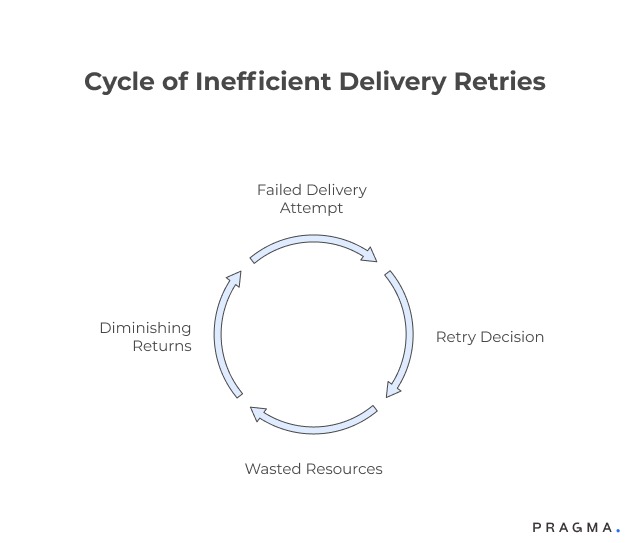
A failed attempt due to customer unavailability is very different from one caused by an incorrect address or COD refusal. Treating them the same leads to wasted retries.
Static retry counts ignore probability
A third attempt does not have the same success probability as the first. Each subsequent retry typically has diminishing returns.
Reattempts consume scarce rider capacity
Every retry displaces a fresh order. During peak periods, this trade-off becomes costly and invisible unless explicitly measured.
At scale, retry decisions must be probabilistic, not habitual.
What does “dynamic retry logic” actually mean?
Context-aware decisions instead of fixed attempt limits
Dynamic retry logic uses signals available at the time of failure to decide the next action.
Decisions are made per order, not per policy
Instead of “all orders get three attempts”, the question becomes: Is this specific order worth retrying again?
Signals evolve across attempts
Customer behaviour after the first failure — response to calls, messages, or verification prompts — materially changes the likelihood of success.
Outcomes are staged, not binary
The next step might be a reattempt, a scheduled retry, customer confirmation, or immediate RTO — depending on risk and value.
Dynamic logic replaces guesswork with structured judgement.
What signals should influence retry vs auto-RTO decisions?
Not more data — better data
Effective retry logic relies on a compact set of high-signal inputs.
Customer responsiveness signals
- Did the customer answer the rider’s call?
- Did they respond to WhatsApp or IVR messages?
- Have they previously rescheduled successfully?
Responsiveness is one of the strongest predictors of retry success.
Failure reason categorisation
Recoverable failures
- Customer unavailable
- Cash not ready
- Security or access issues
These often merit another attempt.
Structural failures
- Incorrect address
- Landmark mismatch
- Customer refusal
Repeated retries rarely fix these without intervention.
Order value and margin
Higher-value orders justify more retries. Low-margin orders often do not.
Payment method
COD orders show sharply declining success probabilities after the first refusal. Prepaid orders behave differently.
How should retry logic differ for COD and prepaid orders?
Payment method fundamentally alters incentives
COD and prepaid orders fail for different reasons and must be treated differently.
COD retry dynamics
COD failures are often intentional or situational.
- First failure due to cash unavailability may be recoverable
- Second refusal strongly predicts eventual RTO
- Reattempts after explicit refusal have very low ROI
COD retry logic should be conservative and confirmation-driven.
Prepaid retry dynamics
Prepaid orders usually fail due to logistics or timing issues.
- Address clarification and rescheduling improve success
- Customers are financially committed, increasing intent
Prepaid orders can sustain more retries — if customer responsiveness is high.
How should locality and pincode behaviour shape retry rules?
Retries cluster geographically
Retry success rates vary significantly by location.
High-density metros
- Traffic delays increase missed windows
- Same-day rescheduling works better than next-day retries
Tier-2 and Tier-3 cities
- Wider availability windows
- Higher effectiveness of voice calls
Pincode-level calibration
Historical retry success by pincode should directly influence:
- Maximum retries
- Time gaps between attempts
- Auto-RTO thresholds
Geography should inform probability, not bias decisions.
How many retries are actually optimal?
More is rarely better
Data from large D2C networks consistently shows diminishing returns.
Typical success curves
- Attempt 1: highest success probability
- Attempt 2: moderate uplift if customer is responsive
- Attempt 3+: sharply declining returns
Beyond a point, retries cost more than they recover.
Value-based caps
High-value electronics may justify 2–3 retries. Low-value apparel often does not.
Optimal retry counts vary — and should be configurable.
When should orders be auto-RTO’d immediately?
Stopping early is sometimes the best decision
Auto-RTO is not a failure — it is a cost-control decision.
Clear auto-RTO triggers
- Explicit customer refusal
- Repeated non-responsiveness across channels
- Address confirmed as invalid
- Fraud or abuse flags
Avoid emotional decision-making
Agents often hesitate to RTO due to CX concerns. Clear rules remove subjectivity.
Faster RTO improves downstream efficiency
Early RTOs free inventory sooner and accelerate refunds, improving customer trust.
How should retry logic integrate with customer communication?
Retries without communication are blind
Retries work best when paired with confirmation.
Pre-retry confirmation
Before reattempting, confirm:
- Availability window
- Address or landmark
- Payment readiness (for COD)
Channel sequencing
WhatsApp → IVR → SMS works better than repeated rider calls alone.
Clear customer expectations
Tell customers explicitly when the next attempt will happen — uncertainty increases failure.
How do retries impact rider productivity and morale?
Hidden costs teams often ignore
Retries are not free.
Time cost per failed stop
Each failed stop consumes travel time, call time and mental energy.
Rider behaviour adapts to policy
If retries are guaranteed, riders deprioritise “difficult” stops.
Clear rules improve execution
When riders know which orders are worth retrying, effort becomes more consistent.
Retry logic is a workforce design decision as much as a CX one.
How should brands implement dynamic retry logic incrementally?
Rules before automation
Phase 1 — Classify failures properly
Ensure failure reasons are accurate and standardised.
Phase 2 — Introduce decision rules
Define:
- Retry eligibility
- Max retries by segment
- Auto-RTO conditions
Phase 3 — Automate and optimise
Use systems to:
- Trigger confirmations
- Schedule retries
- Enforce RTO thresholds
Incremental rollout reduces operational risk.
What metrics indicate retry logic is working?
Measure opportunity cost, not just recovery
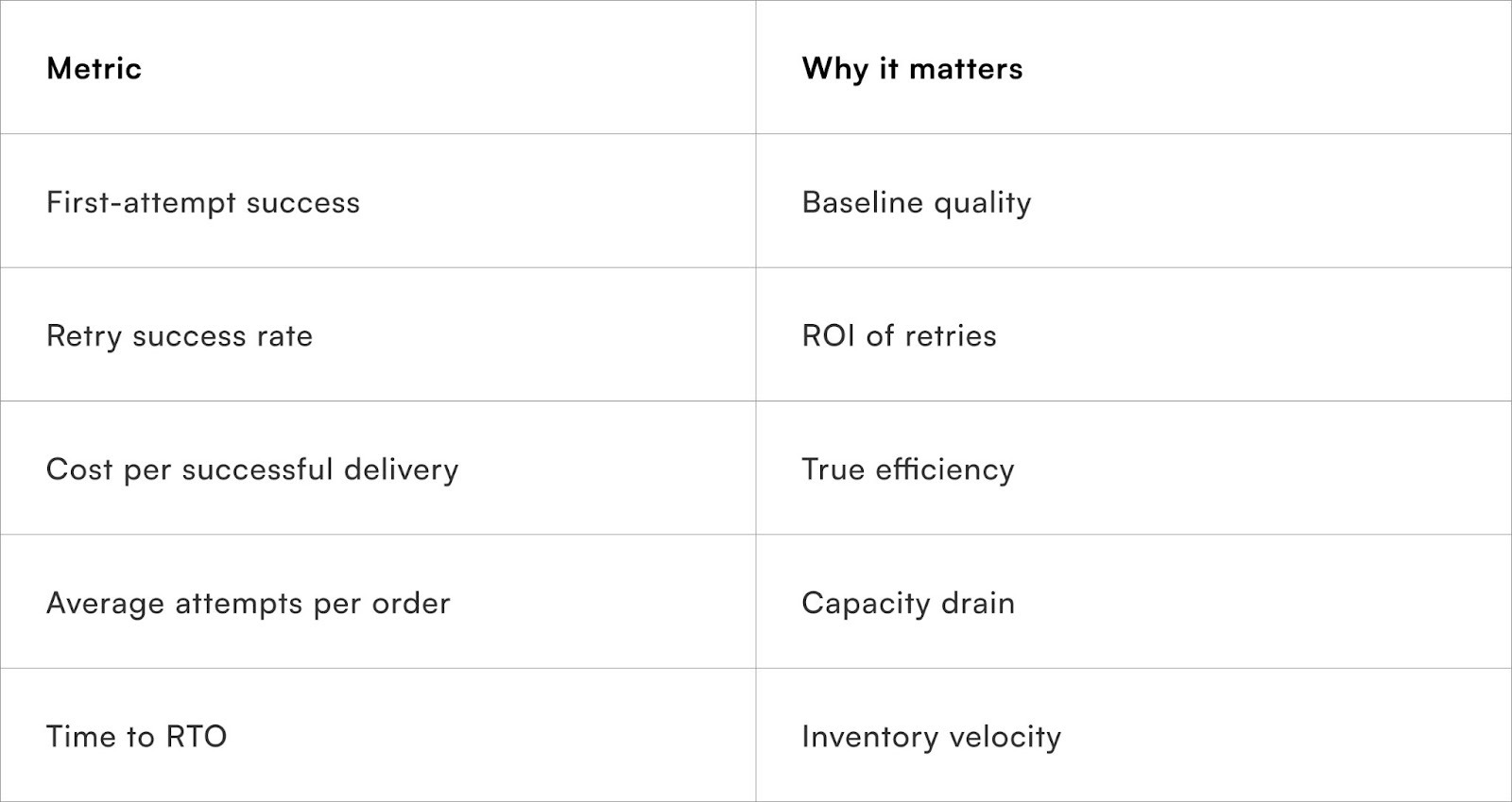
Track metrics by cohort, not just averages.
Quick Wins
A structured rollout that delivers visible impact without heavy tooling
Week 1: Build visibility into retry performance
Start by understanding how retries behave today, not how you assume they work.
- Pull last 30–60 days of failed delivery data
- Break it down by:
- Failure reason
- Attempt number
- COD vs prepaid
- City and pincode
- Calculate retry success rate for second and third attempts separately
Expected outcome:
Clear evidence of where retries stop paying off, and which failure reasons almost never recover.
Week 2: Define retry and auto-RTO rules
Translate insights into explicit operational rules.
- Categorise failure reasons into:
- Recoverable (retry eligible)
- Structural (auto-RTO after first failure)
- Set different retry caps for:
- COD vs prepaid
- High-value vs low-value orders
- Document auto-RTO triggers clearly for ops and CX teams
Expected outcome:
Reduced ambiguity in decision-making and fewer emotional or inconsistent retry calls.
Week 3: Add confirmation before retries
Ensure retries are informed, not blind.
- Introduce WhatsApp or IVR confirmation before second attempts
- Ask only what matters:
- Availability window
- Address or landmark confirmation
- Cash readiness for COD
- Block retries automatically if confirmation is not received
Expected outcome:
Higher second-attempt success rates and fewer wasted rider trips.
Week 4: Pilot, measure, and refine
Test rules in a controlled environment before scaling.
- Pilot dynamic retry logic in one city or courier lane
- Track:
- Retry success rate
- Average attempts per order
- Time to RTO
- Rider productivity
- Adjust thresholds based on early results
Expected outcome:
Measurable reduction in unnecessary retries, faster RTO resolution, and better utilisation of delivery capacity.
To Wrap It Up
Retries should be earned, not assumed. Dynamic retry logic helps brands invest effort where it pays off and stop early where it does not.
This week, audit retry outcomes by failure reason and payment method, and define clear auto-RTO triggers.
Over time, refine rules using data, integrate confirmation flows and continuously balance cost against customer trust. The best retry systems are invisible to customers — and invaluable to operations.
For D2C brands seeking intelligent retry orchestration, Pragma’s Logistics Intelligence platform enables dynamic retry rules, confirmation workflows and RTO optimisation that reduce last-mile waste and improve delivery efficiency.

FAQs (Frequently Asked Questions On Dynamic retry logic: operational rules for reattempts vs auto-RTO)
1. What is dynamic retry logic?
Dynamic retry logic is an approach where delivery reattempt decisions are made using real-time signals instead of fixed retry counts. It considers factors such as customer responsiveness, failure reasons, payment method and location-level behaviour. This ensures that only high-probability orders are retried, while low-intent orders are exited early to avoid unnecessary cost.
2. Why are static retry rules inefficient?
Static retry rules assume that every failed delivery has the same chance of success on the next attempt. In reality, customer intent varies widely based on behaviour, payment type and context. Applying the same retry logic to all orders leads to wasted rider trips, delayed RTO decisions and inflated last-mile costs without improving delivery success rates.
3. How does payment method affect retry decisions?
Payment method is a strong indicator of retry success. COD orders that face explicit refusal or non-responsiveness tend to show sharply declining success rates after the first failed attempt. Prepaid orders, on the other hand, respond better to rescheduling and confirmation flows, making them stronger candidates for controlled reattempts.
4. When should an order be automatically marked RTO?
An order should be auto-RTO’d when failure reasons are structural rather than situational. This includes explicit refusals, repeated non-responsiveness across channels, incorrect addresses, or delivery zones with historically low recovery rates. Early RTO decisions reduce cost leakage and free up capacity for deliverable orders.
5. Does dynamic retry logic improve rider productivity?
Yes. By filtering out low-probability reattempts, riders spend less time making futile stops and more time completing successful deliveries. This improves route efficiency, reduces frustration, and increases deliveries per rider shift without increasing workload.
6. Can dynamic retry logic be implemented without new tools?
Yes. Many brands see early gains by simply documenting retry rules clearly and enforcing them consistently through existing systems and SOPs. Even before automation, disciplined execution helps eliminate blind retries and builds the foundation for more advanced orchestration later.
7. Is dynamic retry logic only relevant for large D2C brands?
No. In fact, early-stage brands benefit significantly by adopting this approach before volumes scale. Implementing dynamic retry logic early prevents inefficiencies from becoming embedded in operations and avoids costly clean-up as order volumes grow.
Talk to our experts for a customised solution that can maximise your sales funnel
Book a demo


.png)