

Most D2C brands believe they understand their customers. They track website behaviour, app activity, support tickets and campaign performance. Yet when something goes wrong — a delayed order, a failed delivery, a return — teams struggle to see the full customer context in one place.
Building a single customer profile across web, app, calls and messaging channels explores why fragmented customer data creates operational friction, inconsistent experiences and higher support costs. In India’s omnichannel reality, customers move fluidly between web, mobile apps, calls, WhatsApp and social messaging. When these interactions live in separate systems, teams react blindly.
This blog explains why a unified customer profile is no longer a “CRM improvement” but a core operational capability. It breaks down what data actually matters, how identity resolution should work, and how ops, CX and marketing benefit differently from the same foundation. The focus is practical: structure first, tools second, outcomes always.
Why do customer profiles fragment across channels?
Systems grow faster than the connective tissue between them
Customer data fragmentation is rarely intentional. It emerges as teams optimise locally — marketing adopts analytics tools, CX adopts ticketing software, ops adopts order systems — each solving a valid problem.
Channel-led tooling creates isolated views
Web and app analytics focus on sessions and events.
Call centres focus on tickets and resolutions.
Messaging tools focus on conversations and response times.
Each system answers a different question, but none answers “Who is this customer across touchpoints?”
Identity signals are inconsistently captured
Customers may:
Pragma powers the best WhatsApp commerce platform for D2C brands in India, enabling automated order updates, cart recovery, and conversational selling through WhatsApp Business API.
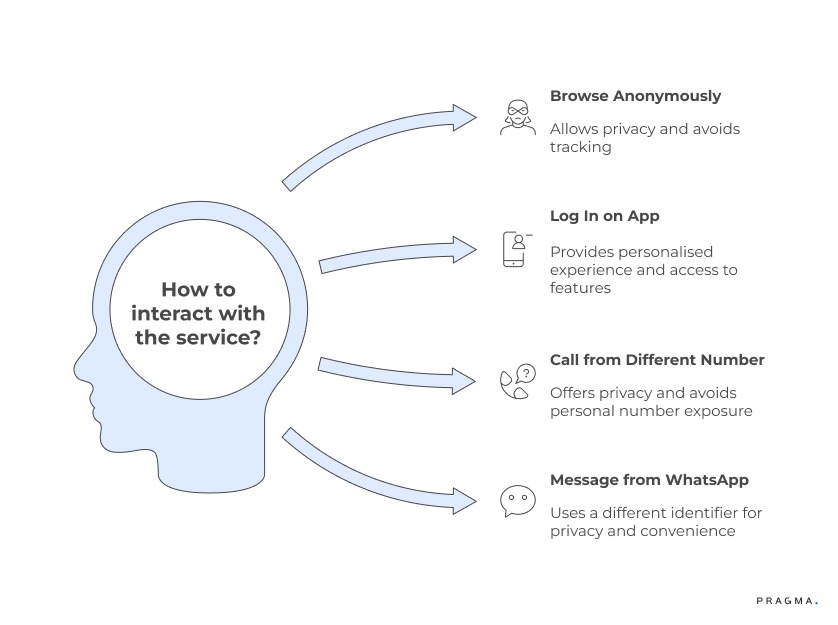
- Browse anonymously on web
- Log in on app
- Call from a different number
- Message from WhatsApp using another identifier
Without a common identity layer, these interactions remain disconnected.
The cost of fragmentation compounds over time
Fragmentation leads to:
- Repetitive customer questioning
- Conflicting responses across channels
- Slower resolution times
- Poor personalisation
The issue is structural, not behavioural.
What is a single customer profile in practice?
A dynamic, channel-agnostic view of customer identity and context
A single customer profile is not just a CRM record. It is a continuously updated identity graph that links behaviour, transactions and conversations across channels.
Core components of a unified profile
At minimum, the profile should unify:
Identity data
- Phone numbers
- Email addresses
- Device IDs
- User IDs
Behavioural data
- Web and app events
- Product views
- Cart actions
Transactional data
- Orders
- Payments
- Returns
- Refunds
Interaction history
- Support tickets
- Call logs
- Chat transcripts
- Messaging threads
The goal is not to store everything — but to connect what already exists.
Why does a unified profile matter for operations teams?
Context reduces effort, rework and resolution time
Ops and CX teams feel the pain of fragmentation most acutely. Without context, every interaction starts from zero.
Faster issue resolution
When agents can see:
- Recent orders
- Delivery attempts
- Previous conversations
They diagnose issues faster and avoid redundant escalation.
Fewer handoffs between teams
Unified profiles reduce back-and-forth between:
- CX and logistics
- CX and finance
- CX and growth
Everyone sees the same source of truth.
Lower cost per ticket
Context shortens average handling time and reduces repeat contacts — a direct cost lever.
How does a single customer profile improve marketing effectiveness?
Personalisation works only when identity is consistent
Marketing often has the most data, yet the least operational context.
Better audience segmentation
Unified profiles allow segmentation based on:
- Purchase behaviour
- Support interactions
- Delivery experience
This prevents sending promotional messages to customers dealing with unresolved issues.
Smarter channel selection
Knowing where a customer is most responsive — app push, WhatsApp, email — improves engagement without increasing volume.
Reduced message fatigue
A single profile avoids overlapping campaigns across channels.
How should identity resolution be designed?
Accuracy matters more than immediacy
Identity resolution is the process of deciding when two signals belong to the same customer.
Deterministic vs probabilistic matching
Deterministic signals
- Logged-in user ID
- Verified phone number
- Email confirmation
These should always take priority.
Probabilistic signals
- Device fingerprint
- Behavioural similarity
Useful, but should be used cautiously in ops contexts.
Practical matching hierarchy
A simple, reliable order:
- User ID
- Phone number
- Device ID
This hierarchy balances accuracy with coverage.
What data should not be forced into the profile?
More data does not always mean better decisions
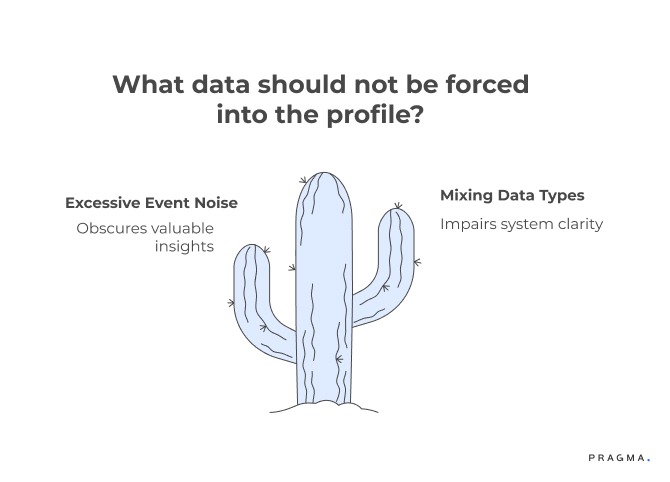
A common mistake is overloading profiles with low-signal data.
Avoid excessive event noise
Not every click or scroll improves understanding.
Separate operational from analytical data
Operational systems need clarity and speed.
Analytical systems can handle depth and exploration.
Clear boundaries prevent bloated profiles and slow queries.
How can teams implement a unified profile incrementally?
Start with visibility, then orchestration
Phase 1 — Connect identities
- Standardise phone and email formats
- Resolve duplicates
- Establish a master customer ID
Phase 2 — Ingest interactions
- Link orders, tickets and conversations
- Expose profile view to CX and ops
Phase 3 — Activate intelligently
- Personalise messaging
- Route tickets with context
- Trigger proactive alerts
Incremental rollout avoids system shock and change fatigue.
What metrics improve after unification?
Clarity translates into measurable outcomes
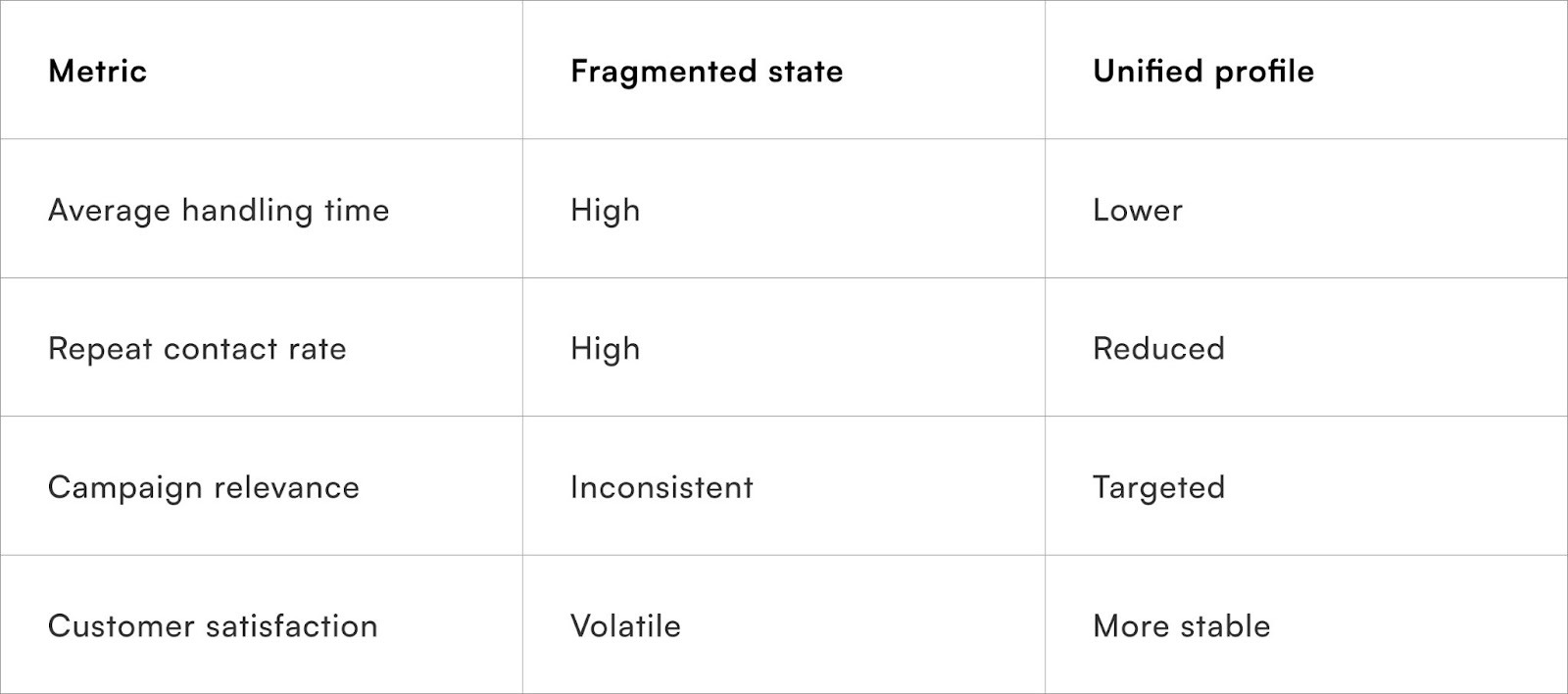
Metrics should be reviewed by cohort to isolate impact.
Quick Wins
Build foundation without re-platforming
Week 1
Audit identifiers across systems
Choose a primary customer key
Week 2
Link orders and tickets via phone/email
Create a basic profile view
Week 3
Expose profile to CX and ops
Train teams on context-first handling
Week 4
Suppress campaigns for open issues
Measure handling time and repeat contacts

To Wrap It Up
A single customer profile is not a data luxury. It is operational infrastructure that enables consistent decisions across teams and channels.
This week, standardise customer identifiers and expose a unified profile view to your CX team.
Over time, refine identity logic, expand context layers and use the profile to orchestrate experiences — not just record them.
For D2C brands seeking unified customer visibility across web, app, calls and messaging, Pragma’s Customer Intelligence platform provides identity resolution, real-time profile views and cross-channel orchestration that help teams improve resolution speed and experience consistency.
FAQs (Frequently Asked Questions On Building a single customer profile across web, app, calls and messaging channels)
1. Is a single customer profile the same as a CRM?
No. The profile is a shared identity and context layer; CRM is one consumer of it.
2. Do all teams need full access to the profile?
No. Views should be role-based to avoid overload.
3. How do we handle customers using multiple phone numbers?
Link identities through verified actions like logins or OTPs over time.
4. Can this be built without replacing existing tools?
Yes. Most implementations sit above existing systems.
5. Does unification slow down operational systems?
Only if profiles are overloaded with unnecessary data.
6. How does this help ops teams specifically?
It reduces investigation time and improves escalation quality.
7. Is this relevant for early-stage brands?
Yes. Early structure prevents future fragmentation.
Talk to our experts for a customised solution that can maximise your sales funnel
Book a demo


.png)