

Messaging channels like WhatsApp are highly effective for operational notifications, customer updates, and promotional communication. However, for D2C brands in India, the benefits can quickly erode if messages trigger carrier throttling or platform-level blocks. Bulk sending without careful scheduling not only reduces reach but also risks compliance issues and customer trust.
Broadcast scheduling and throttling to avoid carrier/WhatsApp blocks explores how to manage high-volume messaging campaigns intelligently. The focus is on understanding carrier and platform limits, segmenting audiences, pacing messages, and implementing throttling logic that preserves deliverability.
By combining operational discipline with data-driven scheduling, brands can ensure messages reach customers on time without compromising system reputation or operational efficiency. This approach allows teams to scale communication safely while avoiding unnecessary friction for customers and logistics teams.
Why improper scheduling triggers carrier and WhatsApp blocks
High-volume bursts can damage deliverability
Sending large volumes of messages in short windows can trigger spam filters, carrier throttling, and platform-level blocks. These limits exist to protect network integrity and customer experience, and ignoring them can result in delayed notifications, failed COD confirmations, or missed NDR updates. For D2C brands, even a small number of blocked messages during peak sales or festive periods can cascade into operational delays, frustrated customers, and increased RTO risk.
Operationally, bursts are risky because they create a mismatch between messaging volume and platform capacity. Many brands attempt to push hundreds of thousands of messages in a single batch, thinking automation alone ensures delivery.
In reality, carriers interpret sudden spikes as suspicious behaviour. By proactively pacing messages and aligning volumes with platform thresholds, brands can maintain consistent operational communication and avoid unexpected service disruptions.
Understanding platform-specific thresholds
Each channel has unique rules and rate limits
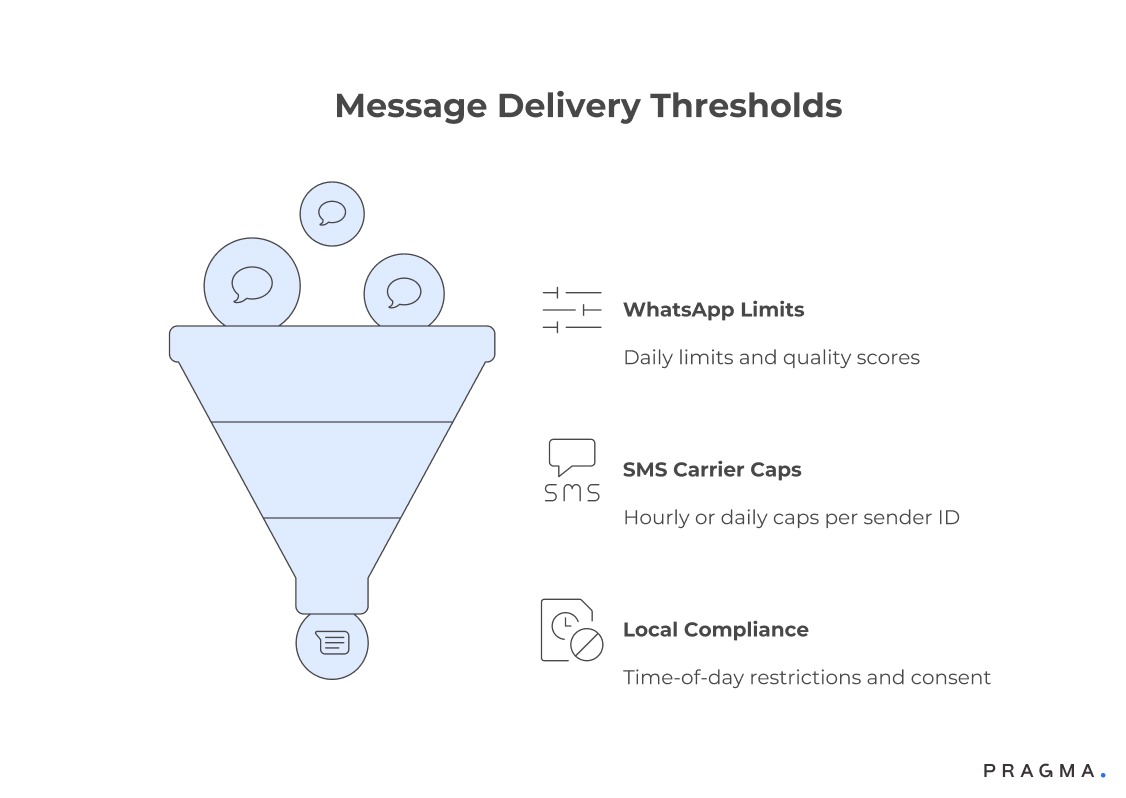
WhatsApp, SMS carriers, and local regulations impose different limitations:
- WhatsApp Business API: Daily limits per business account and per template type, along with quality score requirements that affect future delivery. Low-quality scores (due to high blocks or spam reports) can reduce allowed volumes.
- Carrier SMS: Hourly or daily caps per sender ID and combined network traffic rules. Overuse can lead to temporary suspension or delays in delivery.
- Local compliance: Some Indian states regulate commercial messaging, including time-of-day restrictions and consent requirements.
Why thresholds matter for operational messaging
Understanding these thresholds helps brands prioritise critical messages like COD confirmations or delivery alerts over low-priority campaigns. Exceeding limits can cause messages to bounce or be blocked entirely, affecting both revenue and customer trust. Monitoring platform communications, logs, and error codes is essential to detect when thresholds are being approached or exceeded.
Segmentation as a tool for controlled broadcasting
Smaller, targeted batches reduce risk and improve efficiency
Breaking large audiences into smaller, well-defined segments allows brands to stagger message delivery and observe early feedback before scaling. Segmentation can consider:
- Geography/pincode clusters: High-RTO areas or regions with lower engagement may need cautious pacing.
- Customer engagement history: Active buyers may respond better to early sequences, while less responsive buyers require staggered follow-ups.
- Message type: Transactional messages like order updates should take precedence over promotional campaigns to minimise delivery risk.
Segmenting also supports adaptive throttling. By distributing messages intelligently across segments, brands reduce the likelihood of bulk spikes that trigger platform blocks and can experiment with optimal timing for each cohort.
Implementing throttling logic
Pacing messages to optimise reach and compliance
Throttling ensures that messages are sent at a controlled pace, preventing platform overloads while maintaining operational efficiency. Effective throttling strategies include:
Static throttling rules
Set fixed limits per minute/hour for each channel based on historical delivery success and platform caps. For example, sending 500 messages per minute instead of 5,000 allows systems to remain compliant while delivering updates reliably.
Dynamic throttling
Adjust sending speed in real-time based on delivery success, bounce rates, and platform feedback. If error rates spike in a particular segment or pincode, the system can automatically slow the pace, preventing large-scale failures.
Prioritisation within throttling
Ensure that high-priority messages, like COD confirmations or NDR alerts, are sent first. Promotional or less time-sensitive campaigns can be queued to fill available capacity without risking blocks.
Timing broadcasts for maximum effectiveness
Delivery windows impact both reach and engagement
Timing plays a critical role in both deliverability and customer engagement. Sending messages during high network congestion can increase the risk of throttling, while sending during off-peak hours may improve reach.
Optimising windows by audience
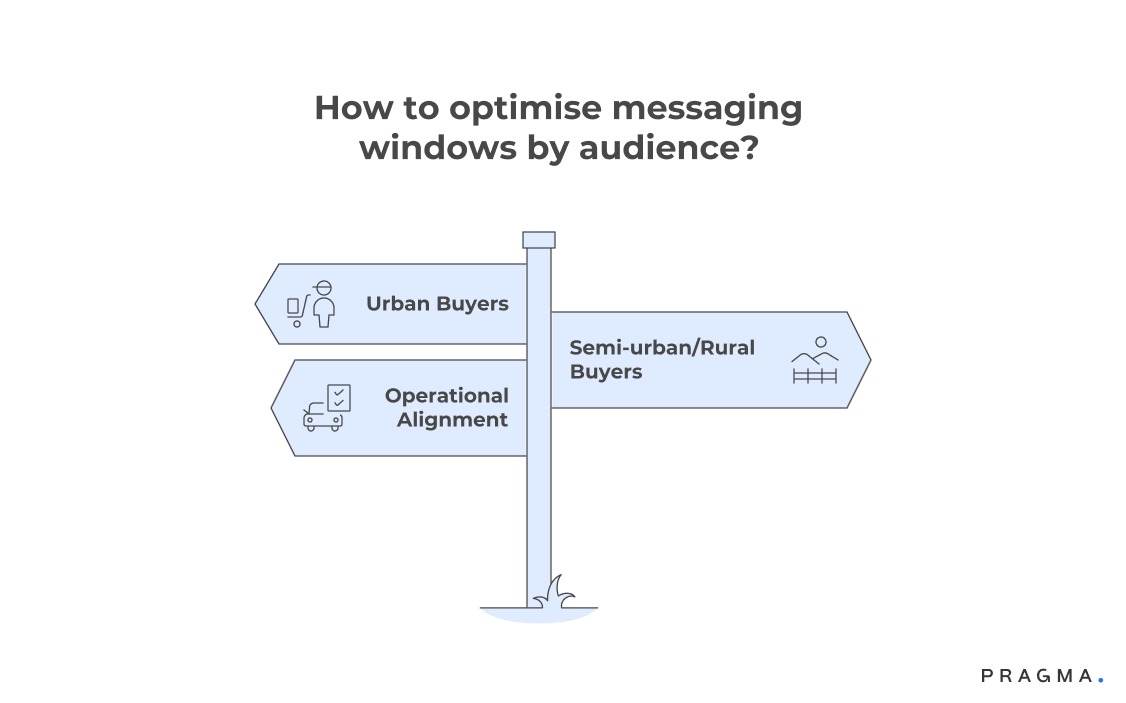
- Urban buyers: Early morning or evening may yield higher read rates due to routine usage patterns.
- Semi-urban/rural buyers: Afternoon slots may work better when network traffic is lighter.
- Operational alignment: Sync messages with delivery schedules, COD confirmations, or pickup updates to increase relevance and reduce unnecessary callbacks.
By analysing historical engagement and delivery success metrics, brands can identify optimal windows for each segment and message type.
Monitoring delivery and engagement metrics
Continuous feedback prevents operational issues
Metrics are crucial for measuring both reach and operational efficiency:
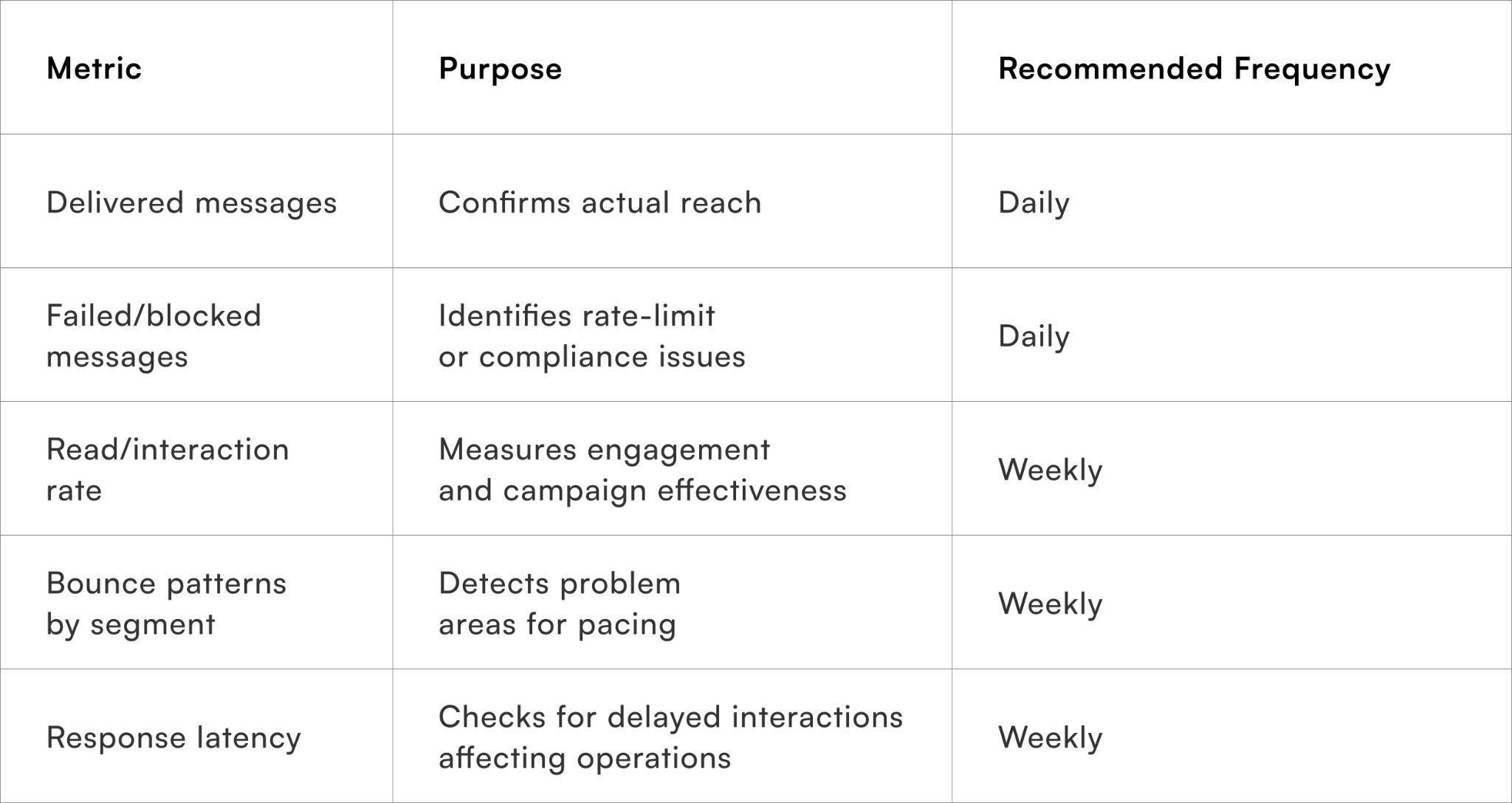
Monitoring these metrics allows teams to adjust throttling, refine timing, and optimise segmentation in near real-time, preventing large-scale messaging failures.
Automation and orchestration for large-scale campaigns
Scaling safely without manual intervention
For brands sending thousands of messages daily, automation is key. Orchestration platforms can dynamically schedule broadcasts, apply throttling rules, and monitor delivery performance.
Features to consider
- Priority queues: Ensure transactional messages are delivered first, with promotional campaigns queued intelligently.
- Real-time feedback loops: Systems detect spikes in bounce rates or blocks and adjust pacing automatically.
- Alerts and dashboards: Notify teams of unusual delivery patterns to prevent operational disruption.
Automation not only preserves compliance and deliverability but also reduces manual effort, allowing teams to focus on higher-level campaign optimisation rather than constant monitoring.
How content quality affects deliverability
Message relevance reduces spam flags and blocks
Not all messages are treated equally by carriers or WhatsApp. Repetitive, promotional-heavy, or irrelevant messages are more likely to be flagged as spam, increasing the risk of throttling or account-level blocks. Brands should prioritise transactional relevance, clear formatting, and compliance with WhatsApp template requirements.
Structuring messages for high deliverability
- Use concise language and clear call-to-actions.
- Avoid overusing promotional phrases that trigger spam algorithms.
- Maintain consistent branding to reinforce legitimacy.
High-quality content paired with proper scheduling ensures that critical operational messages reach the intended audience reliably.
Adaptive pacing based on real-time performance
Dynamic adjustments maintain safe broadcast levels
Static schedules are insufficient when audience size or engagement patterns fluctuate. Dynamic pacing adjusts message flow in real-time according to delivery success, read rates, and bounce trends. This prevents sudden spikes that trigger carrier blocks.
Monitoring triggers for pacing
- Rising failure or bounce rates in a segment
- Spike in customer complaints or opt-outs
- Unexpected platform delays or errors
By incorporating real-time feedback into scheduling, teams can maintain consistent message flow without compromising operational deadlines.
Coordinating multi-channel broadcasts
Synchronising SMS, WhatsApp, and email optimises outcomes
Brands often use multiple channels to reach customers. Uncoordinated messaging across channels can lead to over-contacting or inconsistent experience, increasing opt-outs or spam complaints. Coordinating broadcasts ensures messages are staggered, prioritised, and consistent in timing and content.
Practical approaches to multi-channel orchestration
- Assign channel priority based on message criticality
- Track customer engagement across all channels to avoid duplication
- Use centralised dashboards for visibility and adjustment
This approach maintains customer trust while maximising operational efficiency and deliverability.
Compliance and audit readiness
Proactive governance protects brand reputation
High-volume messaging campaigns require adherence to regulatory guidelines and platform rules. Non-compliance can lead to account suspension or legal penalties. Operational teams should maintain an audit trail of all broadcasts, segmentations, opt-outs, and template approvals.
Best practices for compliance
- Document message approvals and broadcast schedules
- Keep consent records for each customer segment
- Regularly review platform policies and local regulations
A proactive compliance framework not only protects brand reputation but also ensures uninterrupted communication during peak operational periods.
Quick Wins
Step-by-step approach to safe broadcast management
Even without a full-scale automation system, operational teams can start improving deliverability and avoiding blocks within 30 days:
Week 1: Audit current campaigns
- Review last 3–6 months of broadcast logs.
- Identify peak volume periods and messages that triggered errors or blocks.
- Segment audiences by engagement, geography, and message type to reduce bulk spikes.
Week 2: Implement basic throttling
- Set daily and hourly limits for each channel (WhatsApp, SMS, email).
- Prioritise transactional messages like COD confirmations and NDR alerts over promotions.
- Pilot small-scale batches to test thresholds and timing.
Week 3: Optimise message content and timing
- Refine copy for clarity, relevance, and compliance.
- Test different send times based on historical engagement data.
- Adjust pacing dynamically based on early performance signals.
Week 4: Monitor, scale, and automate
- Expand campaigns to larger segments while maintaining throttling limits.
- Track delivery, bounce, and engagement metrics closely.
- Begin automating sequencing and prioritisation for transactional vs promotional messages.
By the end of the month, teams should have safer broadcast processes, measurable engagement improvements, and operational confidence in scaling.
Key Metrics to Track
Focus on operational outcomes, not just message counts
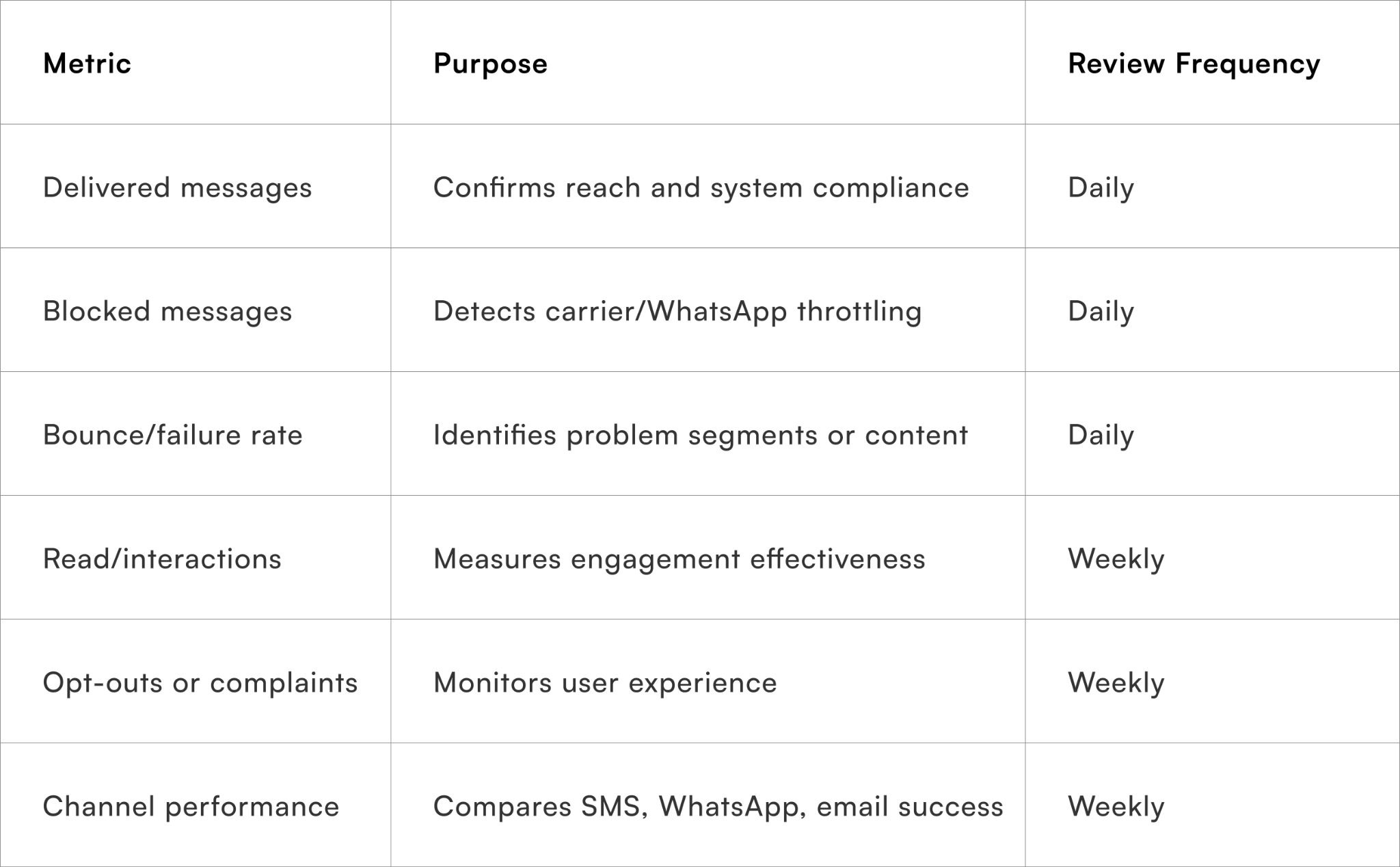
Tracking these metrics helps adjust segmentation, pacing, and content dynamically, reducing risk while maximising engagement.
Maintaining operational efficiency
Balancing high-volume communication with system stability
High-frequency messaging campaigns can strain operational workflows if not carefully monitored. Ensure that critical messages, like COD confirmations or NDR alerts, are prioritised over promotional broadcasts. Align broadcast scheduling with logistics events to minimise confusion and operational bottlenecks. Automated dashboards and alerts can notify teams of delivery failures, enabling proactive adjustments and maintaining a smooth flow of information.
To Wrap It Up
Broadcast scheduling and throttling are critical levers for D2C brands that rely on WhatsApp and SMS for operational communication. Proper segmentation, pacing, and compliance protect platform reputation, improve message reach, and prevent operational disruptions.
This week, review all active broadcast sequences and implement throttling rules for high-volume segments to reduce risk of carrier or WhatsApp blocks.
Long-term, continuously monitor performance metrics, adapt messaging cadence, and leverage automation for consistent, safe, and scalable communication across all channels.
For D2C brands seeking reliable broadcast management, Pragma’s messaging orchestration platform provides automated throttling, dynamic segmentation, and real-time delivery analytics to maximise engagement while safeguarding operational workflows.

FAQs (Frequently Asked Questions On Broadcast scheduling and throttling to avoid carrier/WhatsApp blocks)
1. Why do WhatsApp or carrier blocks occur?
High-volume bursts, repetitive content, and rapid message sequences can trigger platform spam filters or rate limits.
2. How can I safely scale high-volume broadcasts?
Segment audiences, stagger sends, implement throttling, and prioritise transactional messages over promotions.
3. Which metrics indicate broadcast issues?
Delivery rates, bounce/failure counts, read rates, opt-outs, and platform error codes are key indicators.
4. Does message content affect deliverability?
Yes. Repetitive, irrelevant, or promotional-heavy messages are more likely to be blocked. Transactional clarity improves success.
5. How often should throttling rules be reviewed?
Weekly monitoring is recommended; adjust limits dynamically based on platform performance and bounce rates.
6. Can multiple channels be used together safely?
Yes, if sequences are coordinated to prevent overlap, duplication, and customer fatigue.
7. Is automation necessary for large campaigns?
While small batches can be manually managed, automation ensures safe scaling, dynamic pacing, and real-time monitoring.
Talk to our experts for a customised solution that can maximise your sales funnel
Book a demo.webp)
.jpg)
.png)