

WhatsApp has become the default communication channel for Indian D2C brands, but most teams still use it like a loudspeaker. Broadcast-heavy messaging may drive reach, yet it often ignores buyer context, timing, and intent — leading to muted engagement and rising opt-outs. True value emerges when WhatsApp journeys adapt to who the buyer is, what they’ve done, and where they are in the lifecycle.
This blog, Beyond Broadcasts: How JMS Personalises WhatsApp Journeys for Every Buyer, explores how Journey Management Systems (JMS) enable brands to move from generic messaging to event-driven, buyer-specific communication.
Instead of one-size-fits-all campaigns, JMS allows ops and marketing teams to design responsive journeys that react to checkout behaviour, delivery events, returns, and repeat purchase signals.
Why broadcast-led WhatsApp strategies break down at scale
Broadcasts solve reach problems early, but create trust, control, and compliance issues as volume grows
Broadcasts optimise for distribution efficiency, not buyer context
Broadcast messaging is designed around a single question: “How fast can we reach everyone?”
This works in the early stages of a brand’s WhatsApp adoption, when message volumes are low and buyer states are relatively uniform. However, as order volumes, SKUs, and lifecycle touchpoints increase, this one-size-fits-all approach begins to fail.
In reality, buyers sit in very different states at any given moment — some are mid-checkout, others are waiting for delivery, some are stuck in return loops, and some are inactive repeat buyers. Broadcasts flatten all of this nuance into a single message stream.
The operational cost of ignoring context
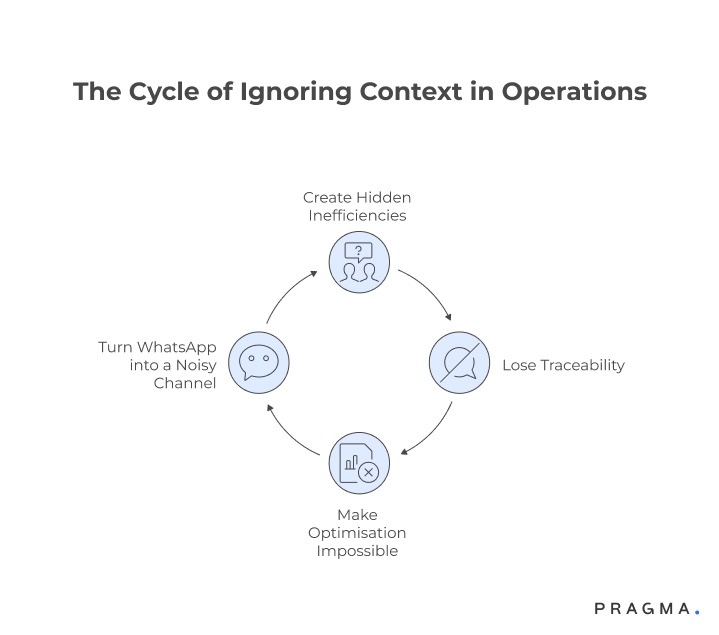
From an ops perspective, this creates hidden inefficiencies. Teams lose the ability to answer basic questions like:
- Why did this buyer receive this message?
- What else did they receive the same day?
- Was this message helpful or disruptive given their current order state?
Over time, this lack of traceability makes optimisation impossible and turns WhatsApp into a noisy, fragile channel rather than a reliable system of record.
Timing conflicts compound buyer frustration
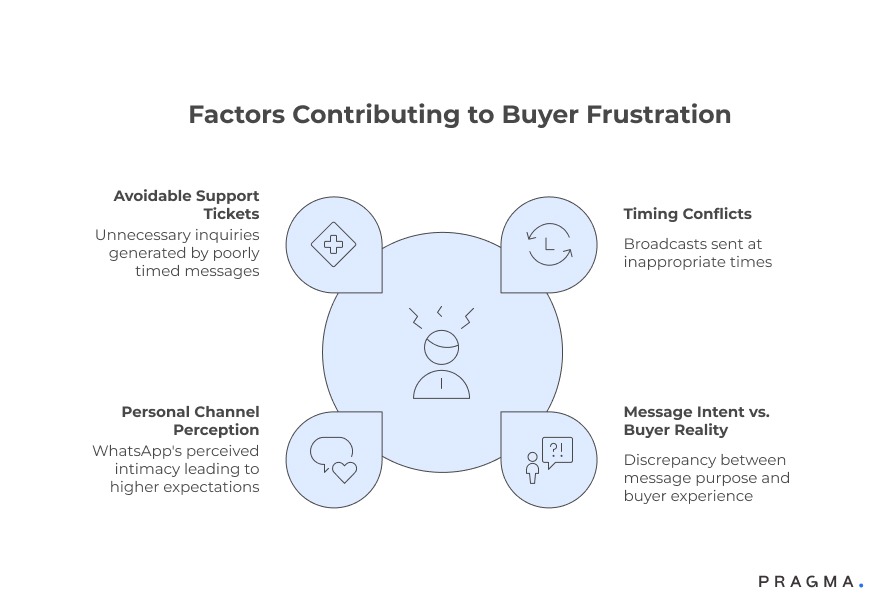
Broadcasts are blind to real-world events. Promotions go out during delivery delays, upsell nudges land while refunds are pending, and reminder messages arrive after an issue has already been resolved via support.
This mismatch between message intent and buyer reality erodes trust far faster on WhatsApp than on email or SMS, because WhatsApp is perceived as a more personal, high-signal channel.
Why this increases support load instead of reducing it
Instead of deflecting queries, poorly timed broadcasts often trigger inbound confusion:
- “Why am I getting this offer when my order hasn’t arrived?”
- “Why are you reminding me to pay when my payment already failed?”
- “Why am I seeing promotions while my return is pending?”
Each of these messages creates avoidable support tickets — a cost that is rarely attributed back to broadcast strategy but directly impacts ops teams.
Buyer fatigue and opt-out risk in the Indian WhatsApp context
India’s WhatsApp ecosystem magnifies the downside of over-messaging
WhatsApp is a utility channel, not just a marketing channel
In India, WhatsApp is used for bank alerts, delivery updates, OTPs, and service notifications. Buyers therefore have a much lower tolerance for irrelevant messages compared to other channels.
When brands overuse broadcasts, buyers don’t just ignore messages — they actively opt out to protect the signal quality of their inbox.
The irreversible nature of WhatsApp opt-outs
Unlike email, where re-subscription is relatively easy, WhatsApp opt-outs are hard to reverse. Once a buyer disengages, brands permanently lose a high-intent, high-open channel — often without realising it until campaign performance drops months later.
Frequency inflation without central control
As teams scale, multiple stakeholders begin using WhatsApp simultaneously — marketing for promotions, ops for delivery updates, support for issue resolution. Without a unified system, frequency limits are enforced per team, not per buyer.
The result is frequency inflation that no single team feels responsible for, but the buyer experiences all at once.
Why this becomes a governance problem
This is no longer a copy or campaign issue — it’s a governance failure. Without a central mechanism to prioritise, throttle, and suppress messages, even well-intentioned teams contribute to channel burnout.
What JMS fundamentally changes in WhatsApp journey design
Moving from calendar-driven sends to event-driven communication
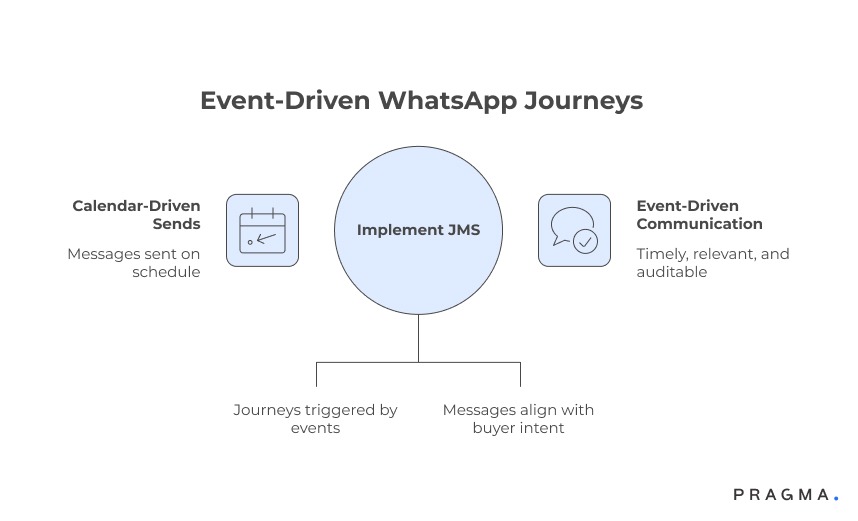
Journeys triggered by real buyer and system events
A Journey Management System replaces scheduled broadcasts with event-triggered journeys. Messages are sent because something meaningful happened — checkout completion, payment failure, delivery exception, or inactivity threshold crossed.
This shift aligns messaging with buyer intent instead of internal calendars.
Why this improves both UX and ops reliability
From the buyer’s perspective, messages feel timely and relevant.
From an ops perspective, every message has a clear cause-and-effect relationship, making audits, debugging, and optimisation far easier.
State-based progression instead of static lists
JMS maintains an evolving view of buyer state rather than static segments. As a buyer moves from “ordered” to “shipped” to “delayed” to “delivered”, their eligibility for different journeys automatically updates.
Preventing contradictory messaging
This state awareness prevents common failures such as:
- Promotional nudges sent during unresolved delivery issues
- Reorder prompts sent before returns are completed
- Feedback requests triggered before order confirmation
Each of these errors may seem minor in isolation but compound rapidly at scale.
The personalisation primitives that power JMS-led WhatsApp journeys
Personalisation that is operationally sustainable, not manually intensive
Event signals as the primary decision layer
Instead of relying solely on static attributes like city, cohort, or purchase history, JMS prioritises real-time event signals — payment status, shipment scans, support actions, and buyer inactivity windows.
This allows journeys to adapt dynamically as conditions change.
Why this matters during peak periods
During sales or logistics disruptions, static segmentation breaks quickly. Event-driven logic ensures that messages remain accurate even when thousands of buyers move between states within hours.
Centralised throttling, suppression, and priority rules
JMS acts as a traffic controller for WhatsApp. It enforces:
- Message frequency caps per buyer
- Priority ordering between transactional and promotional messages
- Suppression rules during sensitive states (refunds, escalations, delays)
The long-term channel health benefit
This is what allows WhatsApp to remain effective over months and years, not just campaigns. By protecting buyers from overload, JMS preserves trust, engagement, and compliance — outcomes that no single campaign optimisation can achieve.
Designing WhatsApp journeys around buyer moments, not campaigns
High-performing journeys mirror how buyers experience problems, not how teams plan calendars
Mapping journeys to moments of uncertainty
The most effective WhatsApp journeys are anchored around moments where buyers experience uncertainty — not moments where brands want attention. These include payment failures, delivery delays, failed attempts, refund initiation, and prolonged inactivity.
Unlike campaign-led messaging, these moments are finite, emotionally charged, and time-sensitive. Buyers actively look for clarity during these windows, which makes WhatsApp the right channel — but only if the message is precise and contextual.
Why “moment-first” design reduces message volume
When journeys are triggered only at genuine decision or anxiety points, overall message volume often drops, even as engagement improves. Instead of sending reminders “just in case,” teams intervene only when the system detects risk or confusion.
This is a critical shift: WhatsApp stops being a reminder channel and becomes a resolution channel.
Structuring journeys with entry, progression, and exit logic
A JMS-led journey is not a linear drip. It has three distinct layers:
- Entry conditions: what must be true for a buyer to enter
- Progression rules: what advances or pauses the journey
- Exit conditions: what immediately stops it
Without explicit exit logic, journeys overstay their relevance and become noise.
Preventing “zombie journeys” during ops recovery
Consider delivery-exception journeys. If exit conditions are not tied to successful delivery scans or support resolution events, buyers continue receiving delay-related messages even after receiving their order. This is one of the fastest ways to erode trust.
JMS enforces exit rules centrally, ensuring journeys terminate the moment the buyer’s reality changes.
Event-to-message alignment: what actually triggers WhatsApp sends
Precision beats creativity when messages are tied to operational systems
Operational events that reliably justify WhatsApp messaging
Not every event deserves a WhatsApp message. High-signal journeys typically rely on a minimal, high-confidence event set:
- Payment failures after retry exhaustion
- Shipment stuck beyond SLA threshold
- First failed delivery attempt
- Refund initiated or approved
- Buyer inactivity crossing a defined window
These events reflect genuine buyer-impacting states, not internal milestones.
Why fewer events improve journey quality
Teams often assume more events mean better personalisation. In practice, noisy or premature events create jittery journeys that start and stop unpredictably. JMS performs best when events are stable, delayed just enough to confirm reality, and tightly scoped.
Message intent must match event severity
A failed payment and a delayed delivery are not equal in emotional weight. JMS allows intent calibration — informational, corrective, or reassurance-driven — based on event severity.
Avoiding tone mismatches at scale
Tone mismatches (over-apologising for minor delays or being casual during refunds) usually stem from template reuse across journeys. JMS prevents this by binding templates to specific journey intents rather than reusing generic message libraries.
Cross-team ownership without channel conflict
WhatsApp journeys fail when teams optimise locally instead of systemically
Separating journey ownership from channel ownership
In mature setups, no single team “owns WhatsApp.” Instead:
- Ops owns delivery and exception journeys
- Finance owns payment and refund journeys
- Growth owns reorder and lifecycle journeys
- Support influences suppression and escalation rules
JMS coordinates these interests without letting any one team overwhelm the buyer.
Why this resolves internal blame loops
When journeys are event-bound and centrally governed, teams stop blaming each other for opt-outs or spikes in inbound queries. Every message has a clear owner, trigger, and justification.
Priority arbitration during peak periods
During sales or disruption windows, multiple journeys may compete for the same buyer. JMS introduces priority arbitration — ensuring that critical transactional messages suppress lower-priority nudges.
Protecting trust when everything is “urgent” internally
Peak periods create internal urgency everywhere. JMS is the mechanism that translates internal chaos into a calm, predictable buyer experience by enforcing objective priority rules.
Measuring journey quality beyond open rates
Success is defined by resolution speed, not message interaction
Resolution-aligned metrics for WhatsApp journeys
Traditional metrics like open rate or click-through rate are insufficient for operational journeys. JMS enables measurement aligned to outcomes:
- Time-to-resolution after first message
- Reduction in support tickets per journey
- Drop-off rate between journey steps
- Re-entry frequency into the same journey
These metrics reveal whether messaging is actually solving problems.
Why “silent success” matters
The best WhatsApp journeys often generate no replies. Buyers read, understand, and move on. JMS makes this silent success visible by linking message sends to downstream operational outcomes.
Long-term channel health indicators
Beyond individual journeys, JMS tracks:
- Opt-out trends by journey type
- Message density per buyer over time
- Suppression frequency during sensitive states
These indicators ensure WhatsApp remains sustainable as volumes grow.
Preventing gradual channel decay
Channel decay rarely happens overnight. It emerges when small, reasonable decisions accumulate. JMS provides the guardrails that surface risk early — before engagement collapses.
Quick wins on implementing JMS-driven WhatsApp personalisation (30 days)
What teams can realistically fix without replatforming everything
Week 1: Identify high-friction buyer moments
Focus on moments where buyers already generate support tickets or follow-ups. Typical candidates include payment failures, delivery delays beyond SLA, failed delivery attempts, and refund initiation.
The goal this week is not to design journeys, but to agree internally on which buyer moments genuinely justify WhatsApp communication. This alignment alone prevents over-messaging later.
Expected outcome:
A short, prioritised list of 4–5 buyer moments that deserve dedicated journeys.
Week 2: Define event triggers and exit conditions
For each selected moment, define:
- The exact system event that confirms the issue is real
- The event that should immediately stop messaging
This is where many teams struggle, but it is also where JMS creates the most value. Clear exit logic prevents stale or irrelevant messages from leaking into the buyer experience.
Expected outcome:
Event definitions that ops, engineering, and support all agree are reliable.
Week 3: Consolidate message ownership and throttling rules
Assign journey ownership by function, not by channel. Decide which journeys suppress others and set basic frequency caps to avoid buyer fatigue.
This step is critical in India-wide outreach, where overlapping operational and promotional needs frequently collide.
Expected outcome:
No conflicting messages during active delivery, payment, or return states.
Week 4: Launch, observe, and tune
Launch journeys quietly to a limited cohort. Observe support ticket volume, buyer replies, and suppression behaviour before scaling.
Avoid optimising copy too early. At this stage, correctness and timing matter far more than phrasing.
Expected outcome:
Fewer “where is my order?” tickets and clearer buyer expectations.
Metrics that actually reflect journey effectiveness
Shift measurement from engagement to resolution

These metrics ensure WhatsApp journeys are judged by problem solved, not message sent.
To wrap it up
Beyond Broadcasts: How JMS Personalises WhatsApp Journeys for Every Buyer shows that WhatsApp success is not about richer templates or higher send volume, but about aligning messages to real buyer moments with operational discipline.
This week, audit your WhatsApp sends and map each one to a buyer event — anything that cannot be justified should be paused.
Over time, brands that treat WhatsApp as a shared operational layer rather than a campaign channel build trust, reduce support load, and scale communication without burning the channel.
For D2C brands seeking controlled, event-driven WhatsApp journeys at scale, Pragma’s Journey Management platform provides centralised orchestration, suppression logic, and buyer-state awareness that help teams reduce operational noise and resolve buyer issues faster.

FAQs (Frequently Asked Questions On Beyond Broadcasts: How JMS Personalises WhatsApp Journeys for Every Buyer)
1. What is JMS in the context of WhatsApp journeys?
JMS (Journey Management System) orchestrates personalised customer interactions across WhatsApp.It moves beyond bulk messaging to behaviour-driven engagement.
2. How does JMS differ from traditional WhatsApp broadcasts?
Broadcasts send the same message to all users, while JMS tailors messages based on user data and actions.This leads to higher relevance and engagement.
3. How does JMS personalise WhatsApp journeys?
It uses customer data, behaviour, and journey stage to customise messaging.Each user receives context-aware and timely communication.
4. What data is used to personalise WhatsApp interactions?
Data includes purchase history, browsing behaviour, preferences, and past interactions.These inputs help create targeted and meaningful messages.
5. Can JMS trigger messages in real time?
Yes, JMS can send messages based on real-time events like order updates or user actions.This ensures timely and relevant communication.
6. How does personalisation improve customer engagement on WhatsApp?
Personalised messages feel more relevant and valuable to users.This increases response rates and overall engagement.
7. What role does automation play in JMS?
Automation enables scalable, rule-based messaging without manual intervention.It ensures consistency and efficiency across journeys.
8. Can JMS handle multi-step customer journeys?
Yes, it supports complex workflows with conditional branching and multiple touchpoints.This allows seamless end-to-end customer experiences.
9. How does JMS help improve conversion rates?
By delivering targeted messages at the right time, it nudges users towards action.This leads to higher conversions and sales.
10. Is JMS suitable for all types of businesses?
Yes, it can be adapted for eCommerce, fintech, logistics, and more.Any business with customer journeys can benefit from it.
11. How does JMS ensure compliance with WhatsApp policies?
It follows opt-in requirements and approved messaging templates.This ensures compliant and secure communication.
Talk to our experts for a customised solution that can maximise your sales funnel
Book a demo


.png)