

WhatsApp has quietly become the most trusted channel for delivery communication in India. Customers open it faster than SMS, understand it better than email, and often treat messages received there as the single source of truth for order status.
For many brands, this has shifted expectations — what is said on WhatsApp is now seen as the delivery promise, not just a notification.
This blog, Using WhatsApp as canonical delivery promise: UX and compliance considerations, explores what happens when WhatsApp moves from being a support channel to becoming the authoritative timeline customers rely on.
While the UX upside is clear, the operational and compliance implications are often underestimated.WhatsApp messaging can create mismatched expectations and regulatory exposure.
When designed deliberately, it becomes a powerful trust-building layer across the delivery lifecycle.
Why WhatsApp becomes the “truth layer” for delivery promises
When one channel feels more reliable than your checkout, tracking page, or email, customers anchor on it.
How customers interpret WhatsApp messages differently
WhatsApp messages are perceived as direct, human, and final. Unlike email (which feels archival) or SMS (which feels transactional), WhatsApp sits in the same mental space as personal conversations. When a delivery date or status is shared there, customers assume it reflects the latest internal reality, not a best-effort estimate.
This perception matters because customers rarely cross-check WhatsApp updates against tracking pages. If a conflict exists, WhatsApp almost always “wins”. That makes it a de-facto truth layer — whether teams intend it or not.
Why this shifts accountability inside the organisation
Once WhatsApp becomes canonical in the customer’s mind, responsibility quietly shifts:
- Product teams are now accountable for promise accuracy, not just message delivery.
- Ops teams are judged on message consistency, not internal SLA definitions.
- Support teams inherit escalations caused by message drift, not delivery failure.
Without recognising this shift, brands often optimise WhatsApp UX while leaving promise logic fragmented upstream.
Defining what “canonical delivery promise” actually means
Canonical does not mean frequent — it means authoritative.
Promise vs update vs reassurance
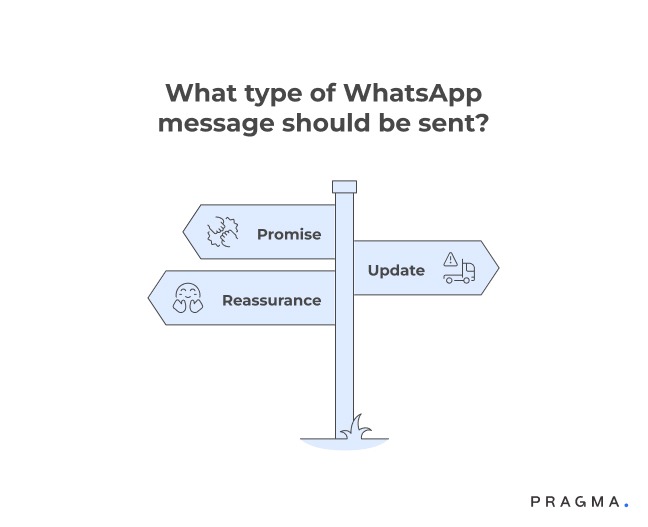
Not every WhatsApp message should be treated as a promise. Problems arise when teams blur three distinct message types:
- Promises: Explicit commitments (delivery date, slot, COD availability).
- Updates: State changes (shipped, out for delivery, delayed).
- Reassurance: Confidence-building messages without new information.
When all three are written in similar language, customers interpret everything as a promise. Canonical usage requires strict separation in tone, structure, and timing.
What must qualify as a promise-worthy message
A WhatsApp delivery promise should only be sent when:
- Inventory is allocated (not just reserved).
- Carrier handoff is confirmed.
- Exception probability is below an agreed threshold.
If these conditions are not met, the message should be framed as an update or expectation — never a commitment.
UX design principles when WhatsApp carries delivery commitments
Clarity beats optimism when the channel feels personal.
Language that reduces over-commitment risk
Over-friendly phrasing increases perceived certainty. Phrases like “We’ll deliver by tomorrow” create absolute expectations even when backend confidence is probabilistic.
Safer UX patterns include:
- Explicit time windows instead of dates.
- Conditional phrasing tied to operational checkpoints.
- Visible acknowledgement that plans can change.
This is not about sounding cautious — it’s about aligning perceived certainty with actual fulfilment confidence.
Message cadence and cognitive load
High-frequency WhatsApp updates increase anxiety rather than trust when nothing materially changes. Canonical channels should be quiet by default, speaking only when new, decision-relevant information exists.
Excessive nudges dilute the authority of the channel and make true promises harder to distinguish.
Aligning backend promise logic with WhatsApp delivery
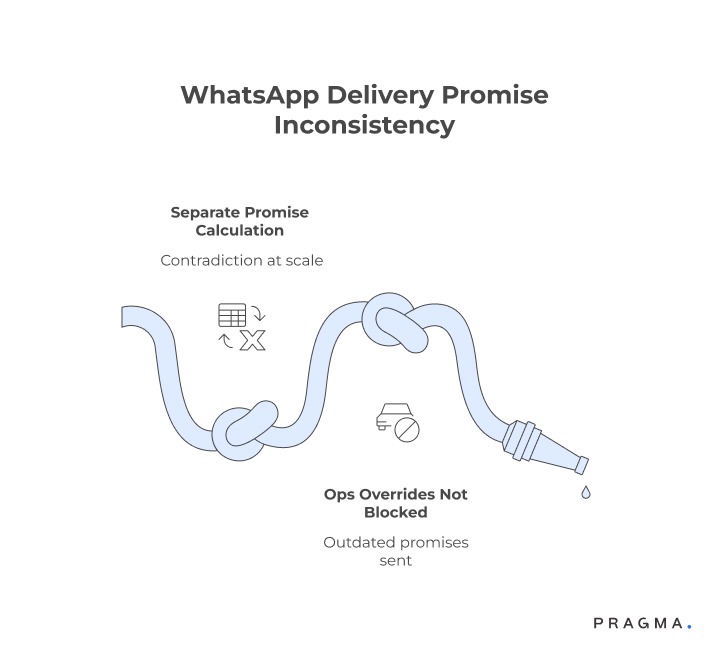
If your OMS and WhatsApp disagree, WhatsApp will lose you trust.
Single source of promise calculation
Many brands calculate delivery dates separately across checkout, tracking, and messaging tools. When WhatsApp is canonical, this becomes dangerous.
All promise-bearing messages must reference:
- The same SLA logic
- The same buffer rules
- The same exception overrides
Anything else guarantees contradiction at scale.
When ops overrides must block WhatsApp sends
Peak season reroutes, pin-code blocks, or carrier blackouts often update ops dashboards first. If WhatsApp automation is not gated on these signals, it continues sending outdated promises.
Canonical WhatsApp requires hard stops, not best-effort syncing.
Operational readiness before declaring WhatsApp canonical
You cannot message your way out of weak fulfilment controls.
Exception visibility before customer notification
If ops teams learn about delays after customers do, WhatsApp has already failed as a trust channel. Internal alerts must always precede external messages — even if that slows communication slightly.
Ownership and escalation clarity
Someone must own:
- Promise definition
- Message approval
- Delay re-messaging authority
When this ownership is fuzzy, WhatsApp becomes a blame amplifier during failures.
Compliance considerations specific to WhatsApp delivery promises
Friendly UX does not dilute regulatory responsibility.
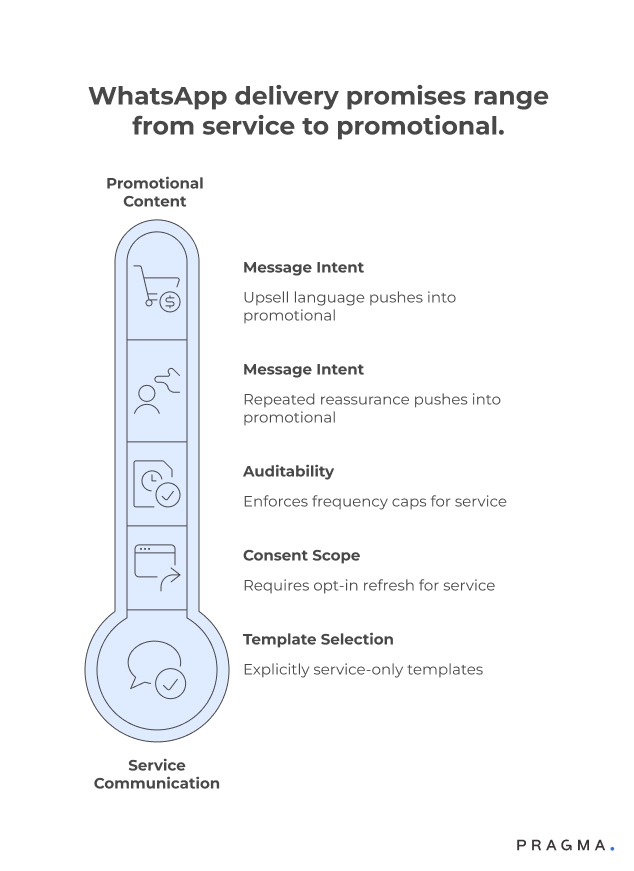
Consent scope and message intent
Delivery promises fall under service communication, but repeated reassurance or upsell language can push messages into promotional territory. This distinction matters under India’s consent and messaging regulations.
Teams must be explicit about:
- Which templates are service-only
- Which require opt-in refresh
- How frequency caps are enforced
Auditability and dispute defence
If a customer disputes a delivery commitment, WhatsApp screenshots are often treated as evidence. Canonical usage means every promise message must be:
- Logged
- Time-stamped
- Traceable to fulfilment logic used at send time
Without this, compliance and support teams are exposed.
Where most brands go wrong early
The failure is rarely WhatsApp — it’s premature authority.
Declaring canonical before systems are ready
Brands often crown WhatsApp as the “main channel” because open rates are high, not because promise accuracy is mature. This creates a trust debt that surfaces during the first large-scale disruption.
Optimising copy instead of governance
Polished templates cannot compensate for missing guardrails. Governance — not wording — determines whether WhatsApp builds or erodes trust.
Measuring whether WhatsApp is actually improving delivery trust
If WhatsApp is canonical, it must be measured like a promise system — not a messaging tool.
Metrics that reflect promise credibility
Open rates and read receipts are meaningless once WhatsApp carries commitments. What matters is whether customers experience fewer surprises after receiving a message.
High-signal metrics include:
- Promise-to-outcome deviation rate (message date vs actual delivery)
- Re-contact rate within 48 hours of a promise message
- Escalations triggered by “but WhatsApp said…” complaints
These metrics force teams to evaluate WhatsApp messages as operational liabilities or assets, not engagement wins.
Segmenting by confidence tier
Not all promises carry equal risk. Brands that mature fastest tag WhatsApp messages by confidence level (high, medium, conditional) and review outcomes separately. This reveals where over-optimism consistently creeps in.
Designing Quick Wins on implementing WhatsApp as a canonical delivery promise
The goal is controlled authority, not full replacement on day one.
Start with one promise class only
The safest entry point is post-handoff delivery date confirmation, not checkout promises or pre-shipment estimates. At this stage, inventory and carrier risk is already reduced.
Treat this as a controlled pilot:
- One geography or carrier
- One message template
- One clearly defined success metric
Introduce visible uncertainty instead of silence
When confidence drops, many teams stop messaging entirely. This creates anxiety and inbound load. A better pattern is explicit uncertainty: acknowledging risk without committing to a date.
Customers handle uncertainty better than broken certainty — especially on WhatsApp.
Handling delays and reversals on a canonical channel
The second message matters more than the first.
Why delay messages need stronger structure
A delay communicated on WhatsApp feels personal — almost apologetic. Poorly structured messages sound evasive or defensive.
Effective delay communication requires:
- Clear acknowledgement of the broken expectation
- A reason framed as operational, not vague
- A revised expectation with a confidence qualifier
This structure protects trust even when outcomes worsen.
Avoiding “promise stacking”
Sending a new promise before the previous one resolves compounds risk. Canonical channels should enforce a single active promise rule — no overlapping commitments.
Governance models that scale beyond early adoption
Canonical WhatsApp cannot be owned by one team alone.
Shared ownership without shared confusion
Best-in-class setups separate responsibilities:
- Ops owns promise inputs and exception flags
- Product owns message logic and sequencing
- Legal/compliance approves template intent and scope
WhatsApp works only when ownership is explicit, not collaborative by default.
Change management during peak seasons
Peak periods introduce last-minute rule changes. Any change to promise logic must automatically update WhatsApp eligibility rules — not rely on human intervention.
If this coupling does not exist, canonical status should be temporarily revoked during peaks.
When WhatsApp should stop being canonical
Authority is conditional, not permanent.
Signals that require downgrading authority
WhatsApp should revert to a supporting channel when:
- Exception rates spike beyond historical thresholds
- Ops visibility lags customer communication
- Carrier reliability becomes volatile
Continuing canonical messaging under these conditions accelerates trust loss.
Communicating the downgrade gracefully
Silence creates confusion. A brief framing message explaining reduced certainty preserves credibility and resets expectations without admitting failure.
How mature teams phase towards full canonical usage
The final state is earned, not declared.
Layering, not replacing, customer touchpoints
Even at maturity, WhatsApp should reference the tracking page, not replace it. Canonical does not mean exclusive — it means decisive when conflicts arise.
Institutionalising restraint
The hardest discipline is knowing when not to message. Mature teams reward accuracy over frequency and design incentives accordingly.
Operational metrics that keep WhatsApp promises honest
Canonical channels must be governed by outcome metrics, not engagement vanity.
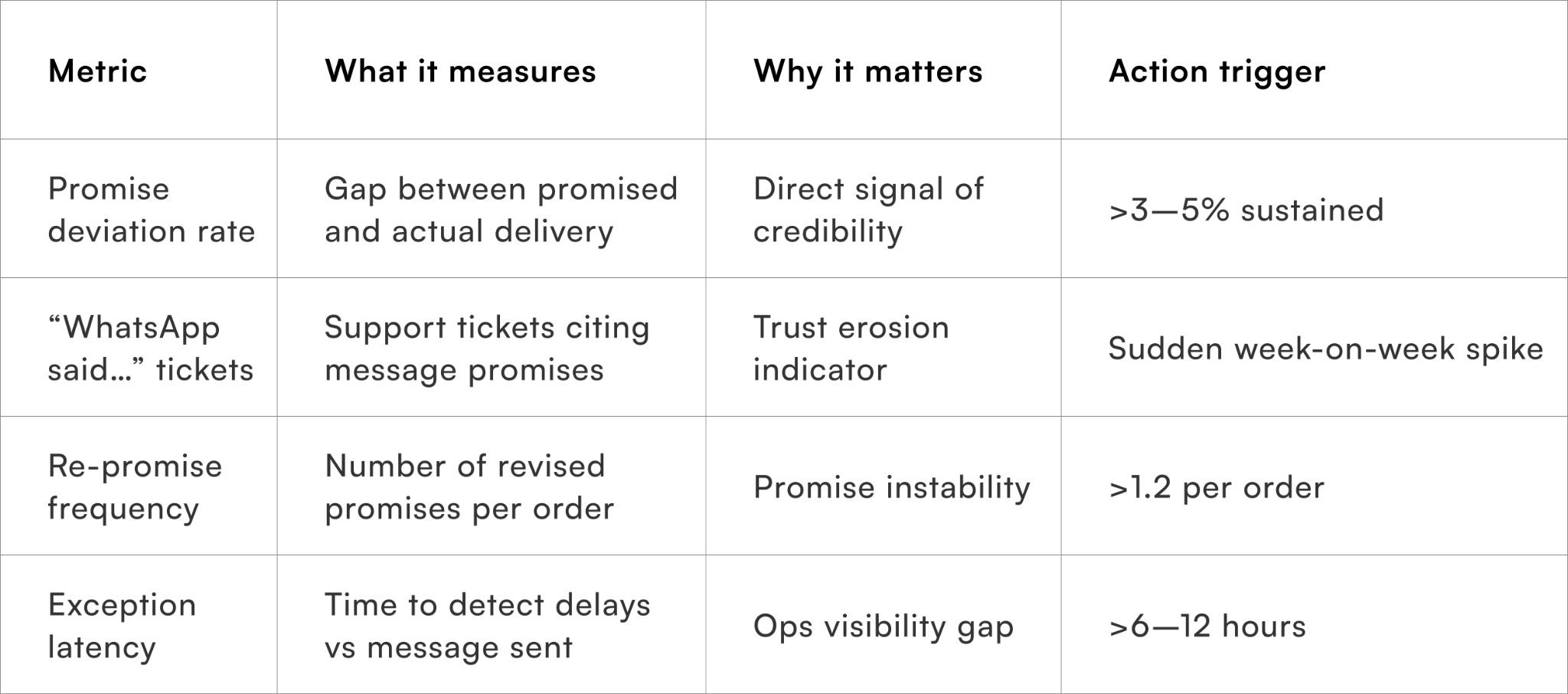
Core delivery-promise health metrics
These metrics should be reviewed weekly during normal periods and daily during peaks.
Supporting diagnostics
These don’t trigger rollbacks directly but explain why trust is breaking.
- Carrier volatility index by lane
- Inventory handoff variance
- Template override frequency by ops
To Wrap It Up
WhatsApp becomes powerful the moment customers treat it as the truth — and risky the moment brands forget that promises carry operational and legal weight. Making it canonical is less about channel choice and more about governance, restraint, and measurement.
Audit every WhatsApp delivery template this week and downgrade any promise your ops team cannot confidently uphold.
Over the long term, brands that win treat WhatsApp as a controlled promise layer, tightly coupled to real-time ops visibility and compliance review — not a faster SMS replacement.
For D2C brands seeking to operationalise trusted delivery communication, Pragma’s logistics intelligence platform provides event-level visibility, promise confidence controls, and exception-led messaging that help brands reduce delivery disputes and improve customer trust at scale.

FAQs (Frequently Asked Questions On Using WhatsApp as canonical delivery promise: UX and compliance considerations)
1. Should WhatsApp replace the tracking page entirely?
No. WhatsApp should resolve conflicts, not replace detailed tracking. The tracking page remains the system of record.
2. Is WhatsApp compliant for delivery promises in India?
Yes, if messages are transactional, consented, accurately worded, and auditable.
3. Can multiple teams send delivery messages on WhatsApp?
They can, but only through a single governed logic layer to avoid conflicting promises.
4. What happens during peak season volatility?
Canonical authority should be downgraded or scoped to high-confidence milestones only.
5. How do customers react to uncertainty messaging?
Clear uncertainty outperforms false certainty. Customers tolerate honesty better than reversals
Talk to our experts for a customised solution that can maximise your sales funnel
Book a demo

.png)